

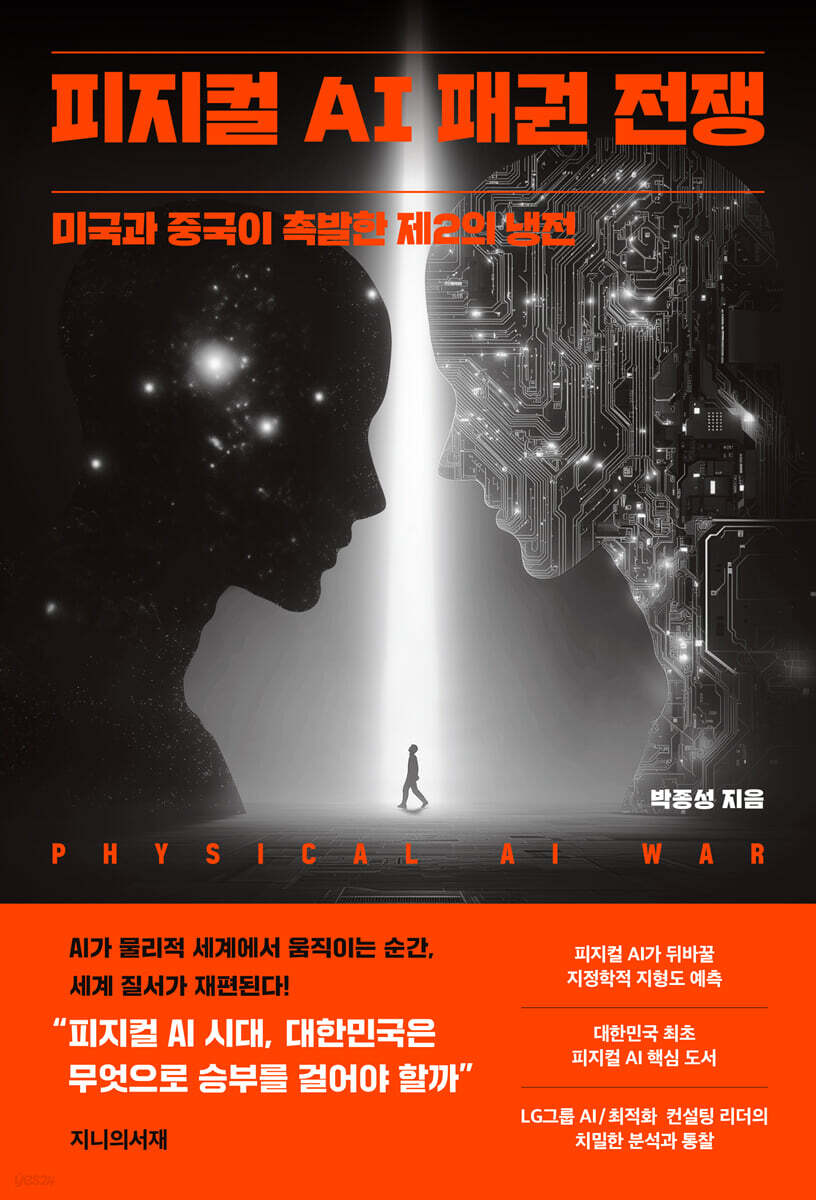
The Physical AI Hegemony War
 |
Description
Book Introduction
“Who will be the first to summon AI from the screen into reality?”
A new era of civilization warfare ushered in by physical AI.
A roadmap for national competitiveness and survival presented by field experts.
If you look at the AI-related shelves in bookstores these days, they are filled with stories about ChatGPT and Large Language Models (LLMs).
We are excited about artificial intelligence that speaks and thinks like humans, and we proclaim the arrival of a new era.
But in that very moment of admiration, the most dangerous delusion of our time begins.
In "Physical AI Hegemony War," written by Jongseong Park, a field expert who has led the AI field at LG CNS for over 15 years, he says that while we are fascinated by the "intelligence of AI" on the screen, a much larger and more strategic war is already taking place in the real world outside the screen to give AI a "body."
And he asserts that the winner of that war will determine the geopolitical and industrial hegemony of the 21st century.
This book dissects China's AI strategy with a massive three-act blueprint that leads to "building the body of AI," "designing the brain," and "integrating the soul and body (具身智能)."
The author shows that China is not simply a technological follower, but is pursuing a hegemonic project that will determine the fate of the nation through an innovation assembly line designed by a "national CEO."
China recognized early on that this 'physical AI' was the only and decisive battlefield of the future.
And by using the incident in 2017, when AlphaGo defeated 9-dan Ke Jie, as a “managed Sputnik moment,” they launched a meticulous strategy to transform the sense of crisis into a national agreement on AI investment.
The problem is the reality of South Korea facing that huge war.
While China is dominating the sky, the ground, and the factories, using DJI, Baidu, and Ubiquitous as the "dragon's claws" that execute its national strategy, Korea remains stuck in a fragmented strategy and an industrial imbalance centered on application software.
The moment China's strategy is finalized, South Korea's manufacturing competitiveness will be neutralized, and we risk being reduced to an "assembler" rather than a "designer" of the AI revolution.
This book forces us to face that very desperate crisis with a cool-headed gaze.
But the "Physical AI Hegemony War" doesn't end with just a warning.
The author asserts that blindly following the Chinese model is not the answer.
Instead, he proposes a strategy that could become a game changer by comparing China to a "giant with weak legs" and exploiting its structural vulnerabilities while maximizing Korea's strengths of agility and high-quality manufacturing capabilities.
The core of this is the 'K-Physical AI 2035 Grand Strategy'.
The suggestion is that the government, large corporations, and startups should work as a "one team" to break the chains of technological dependence and establish a national survival strategy.
This book is not a book of technological optimism or political slogans, but rather a realistic and urgent strategy for South Korea's survival and future, crafted through meticulous analysis and insight from a practitioner in the AI field.
The moment we open this book, we can see the real battlefield that we had been missing while being intoxicated by the magic of ChatGPT.
And in this deadly fight, you will find a way to survive 'like a tiger'.
A new era of civilization warfare ushered in by physical AI.
A roadmap for national competitiveness and survival presented by field experts.
If you look at the AI-related shelves in bookstores these days, they are filled with stories about ChatGPT and Large Language Models (LLMs).
We are excited about artificial intelligence that speaks and thinks like humans, and we proclaim the arrival of a new era.
But in that very moment of admiration, the most dangerous delusion of our time begins.
In "Physical AI Hegemony War," written by Jongseong Park, a field expert who has led the AI field at LG CNS for over 15 years, he says that while we are fascinated by the "intelligence of AI" on the screen, a much larger and more strategic war is already taking place in the real world outside the screen to give AI a "body."
And he asserts that the winner of that war will determine the geopolitical and industrial hegemony of the 21st century.
This book dissects China's AI strategy with a massive three-act blueprint that leads to "building the body of AI," "designing the brain," and "integrating the soul and body (具身智能)."
The author shows that China is not simply a technological follower, but is pursuing a hegemonic project that will determine the fate of the nation through an innovation assembly line designed by a "national CEO."
China recognized early on that this 'physical AI' was the only and decisive battlefield of the future.
And by using the incident in 2017, when AlphaGo defeated 9-dan Ke Jie, as a “managed Sputnik moment,” they launched a meticulous strategy to transform the sense of crisis into a national agreement on AI investment.
The problem is the reality of South Korea facing that huge war.
While China is dominating the sky, the ground, and the factories, using DJI, Baidu, and Ubiquitous as the "dragon's claws" that execute its national strategy, Korea remains stuck in a fragmented strategy and an industrial imbalance centered on application software.
The moment China's strategy is finalized, South Korea's manufacturing competitiveness will be neutralized, and we risk being reduced to an "assembler" rather than a "designer" of the AI revolution.
This book forces us to face that very desperate crisis with a cool-headed gaze.
But the "Physical AI Hegemony War" doesn't end with just a warning.
The author asserts that blindly following the Chinese model is not the answer.
Instead, he proposes a strategy that could become a game changer by comparing China to a "giant with weak legs" and exploiting its structural vulnerabilities while maximizing Korea's strengths of agility and high-quality manufacturing capabilities.
The core of this is the 'K-Physical AI 2035 Grand Strategy'.
The suggestion is that the government, large corporations, and startups should work as a "one team" to break the chains of technological dependence and establish a national survival strategy.
This book is not a book of technological optimism or political slogans, but rather a realistic and urgent strategy for South Korea's survival and future, crafted through meticulous analysis and insight from a practitioner in the AI field.
The moment we open this book, we can see the real battlefield that we had been missing while being intoxicated by the magic of ChatGPT.
And in this deadly fight, you will find a way to survive 'like a tiger'.
- You can preview some of the book's contents.
Preview
index
Prologue | The Real War Began Offscreen
Part 1.
A thoroughly prepared script
Chapter 1.
AI walks out of the screen
Chapter 2.
A meticulously designed Sputnik moment
Chapter 3.
A Grand Blueprint for Physical AI Hegemony
Part 2.
The Age of Physical AI: The Battle for Technological Hegemony
Chapter 4.
National representative companies that have become dragon's claws
Chapter 5.
Living Lab, Calculated Gambling
Chapter 6.
The perfect synergy created by a giant assembly line
Chapter 7.
A venture capitalist named Nation
Chapter 8.
The fateful paradox of semiconductor sanctions
Chapter 9.
A Hundred Schools of Thought Contend: Chaos Engineered by the State and an Unexpected Intruder
Part 3.
The Achilles' heel that can't be hidden
Chapter 10.
The Shaking Giant
Chapter 11.
A generation that embodies the will of the nation
Chapter 12.
The rules of the game have changed
Part 4.
The prelude to a new war for hegemony
Chapter 13.
Intelligent battlefield
Chapter 14.
A tiger standing in front of a giant dragon's mirror
Chapter 15.
The new board maker vs.
A sincere executor
Epilogue | Ladder Climbers, Ladder Makers
Part 1.
A thoroughly prepared script
Chapter 1.
AI walks out of the screen
Chapter 2.
A meticulously designed Sputnik moment
Chapter 3.
A Grand Blueprint for Physical AI Hegemony
Part 2.
The Age of Physical AI: The Battle for Technological Hegemony
Chapter 4.
National representative companies that have become dragon's claws
Chapter 5.
Living Lab, Calculated Gambling
Chapter 6.
The perfect synergy created by a giant assembly line
Chapter 7.
A venture capitalist named Nation
Chapter 8.
The fateful paradox of semiconductor sanctions
Chapter 9.
A Hundred Schools of Thought Contend: Chaos Engineered by the State and an Unexpected Intruder
Part 3.
The Achilles' heel that can't be hidden
Chapter 10.
The Shaking Giant
Chapter 11.
A generation that embodies the will of the nation
Chapter 12.
The rules of the game have changed
Part 4.
The prelude to a new war for hegemony
Chapter 13.
Intelligent battlefield
Chapter 14.
A tiger standing in front of a giant dragon's mirror
Chapter 15.
The new board maker vs.
A sincere executor
Epilogue | Ladder Climbers, Ladder Makers
Detailed image
Into the book
*** The scene was filled with hot heat.
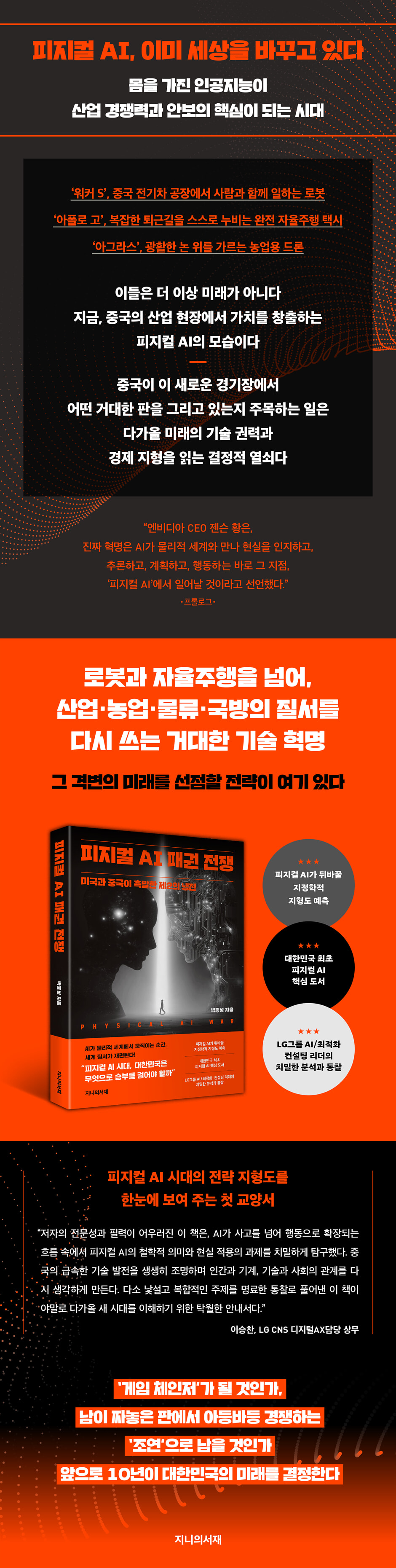
The venue was Las Vegas, at CES 2025 (Consumer Electronics Show 2005), the world's largest consumer technology show.
Amidst the suffocating tension, NVIDIA founder and CEO Jensen Huang took to the grand stage.
Dressed in a black leather jacket, he began to proclaim a new message about the future, like a rock star of the tech industry.
*** Finally, in 2024, the Chinese government officially included the term "Embodied Intelligence" in the government work report at the annual National People's Congress (NPC), its largest political event.
This was the signal that marked the beginning of Act 3.
It was a blatant declaration of war to finally merge the "body" and "brain" that had been painstakingly built over the past decade into one, and to move the center of the AI revolution from the server rooms of Silicon Valley to the factory in the Pearl River Delta.
*** DJI in the sky transforms the world's physical space into data and dominates the hegemony of 'embodied data', while Baidu on the ground monopolizes the world's most complex 'living laboratory' and completes the brain necessary for autonomous driving.
Ubiquitous in the factory is heralding the "end of labor" and fundamentally changing the manufacturing paradigm, while behind the scenes, Huawei is building a "technological Great Wall" of its own AI ecosystem to counter the US technological blockade.
*** This is not simply a story about the government throwing money away.
It's about a completely new investment philosophy that fundamentally reinterprets the nature of capital, the definition of risk, the concept of time, and the very meaning of the word "market."
I would like to call this 'state-directed patient capital.'
This model offers an alternative to the Silicon Valley model, and while it is powerful, it also has fatal weaknesses.
If Silicon Valley VCs are "surfers" riding the waves of the market, Beijing investors are closer to "engineers" building massive dams and canals to change the direction of the current itself.
*** The series of events surrounding DeepSec concisely illustrates the present and future of China's artificial intelligence strategy.
Amid the controlled chaos of the "Battle of the Hundred Mothers" and external pressure from US sanctions, China's tech ecosystem has developed a new AI doctrine that prioritizes "algorithmic efficiency" and "cost-effectiveness."
DeepSec, which demonstrated that even with inferior hardware, it is possible to reach world-class levels through software innovation alone, became the symbol of this new doctrine.
*** Now, the key question in international manufacturing competition is not 'Which country has cheaper labor?' but 'Which country's robots are more efficient?'
This is not simply an economic shift; it is closer to a geopolitical declaration of war.
China is redefining the game in areas where it already holds an overwhelming advantage, and is drawing the world into its fold.
*** The new technological hegemony competition is not simply a battle for market share of specific products.
The real battle will be over who will control the "technology standards" that all future robots and autonomous systems will have to follow.
Those who create the rules of the game and establish them as "de facto standards"—whether it's the operating system that powers robots, the 5G communication protocols that allow self-driving cars to communicate with each other, or the format of data flowing within smart factories—will dominate the future industries.
*** If a military conflict were to break out in a Chinese city in the future, the People's Liberation Army could deploy its autonomous military vehicles (Unmanned x Vehicles, UxVs) with a 3D operational map of the city, knowing every alley and structure like the back of its hand.
What's even scarier is that this map isn't a one-off creation.
As thousands of robotaxis patrol the city every day, collecting data, the map becomes a real-world “digital twin” that reflects new buildings and road changes in near real time.
*** South Korea's economy has relied heavily on product exports, and for decades it has desperately pursued factory automation to survive amid soaring labor costs and competition from low-wage countries.
As a result, we have the world's highest density of traditional industrial robots.
These are assets created out of past needs, not the result of a vision for the future.
Therefore, paradoxically, this overwhelming strength is also the target that highly intelligent physical AI seeks to destroy.
*** The path of the 'honest executor' seems familiar and safe.
This is the very method that has brought us dazzling success over the past several decades: using world-class manufacturing technology to bring in foreign platforms and components and create sophisticated finished products.
But now that physical AI is changing all the rules, the end of the familiar path is a future of subjugation.
South Korea's smart factories operate on the "brains" of the United States (Nvidia, Google), and are ultimately destined to be consumed by China's overwhelming "scale."
No matter how diligently you work, the core of added value will inevitably end up in the hands of others.
The venue was Las Vegas, at CES 2025 (Consumer Electronics Show 2005), the world's largest consumer technology show.
Amidst the suffocating tension, NVIDIA founder and CEO Jensen Huang took to the grand stage.
Dressed in a black leather jacket, he began to proclaim a new message about the future, like a rock star of the tech industry.
*** Finally, in 2024, the Chinese government officially included the term "Embodied Intelligence" in the government work report at the annual National People's Congress (NPC), its largest political event.
This was the signal that marked the beginning of Act 3.
It was a blatant declaration of war to finally merge the "body" and "brain" that had been painstakingly built over the past decade into one, and to move the center of the AI revolution from the server rooms of Silicon Valley to the factory in the Pearl River Delta.
*** DJI in the sky transforms the world's physical space into data and dominates the hegemony of 'embodied data', while Baidu on the ground monopolizes the world's most complex 'living laboratory' and completes the brain necessary for autonomous driving.
Ubiquitous in the factory is heralding the "end of labor" and fundamentally changing the manufacturing paradigm, while behind the scenes, Huawei is building a "technological Great Wall" of its own AI ecosystem to counter the US technological blockade.
*** This is not simply a story about the government throwing money away.
It's about a completely new investment philosophy that fundamentally reinterprets the nature of capital, the definition of risk, the concept of time, and the very meaning of the word "market."
I would like to call this 'state-directed patient capital.'
This model offers an alternative to the Silicon Valley model, and while it is powerful, it also has fatal weaknesses.
If Silicon Valley VCs are "surfers" riding the waves of the market, Beijing investors are closer to "engineers" building massive dams and canals to change the direction of the current itself.
*** The series of events surrounding DeepSec concisely illustrates the present and future of China's artificial intelligence strategy.
Amid the controlled chaos of the "Battle of the Hundred Mothers" and external pressure from US sanctions, China's tech ecosystem has developed a new AI doctrine that prioritizes "algorithmic efficiency" and "cost-effectiveness."
DeepSec, which demonstrated that even with inferior hardware, it is possible to reach world-class levels through software innovation alone, became the symbol of this new doctrine.
*** Now, the key question in international manufacturing competition is not 'Which country has cheaper labor?' but 'Which country's robots are more efficient?'
This is not simply an economic shift; it is closer to a geopolitical declaration of war.
China is redefining the game in areas where it already holds an overwhelming advantage, and is drawing the world into its fold.
*** The new technological hegemony competition is not simply a battle for market share of specific products.
The real battle will be over who will control the "technology standards" that all future robots and autonomous systems will have to follow.
Those who create the rules of the game and establish them as "de facto standards"—whether it's the operating system that powers robots, the 5G communication protocols that allow self-driving cars to communicate with each other, or the format of data flowing within smart factories—will dominate the future industries.
*** If a military conflict were to break out in a Chinese city in the future, the People's Liberation Army could deploy its autonomous military vehicles (Unmanned x Vehicles, UxVs) with a 3D operational map of the city, knowing every alley and structure like the back of its hand.
What's even scarier is that this map isn't a one-off creation.
As thousands of robotaxis patrol the city every day, collecting data, the map becomes a real-world “digital twin” that reflects new buildings and road changes in near real time.
*** South Korea's economy has relied heavily on product exports, and for decades it has desperately pursued factory automation to survive amid soaring labor costs and competition from low-wage countries.
As a result, we have the world's highest density of traditional industrial robots.
These are assets created out of past needs, not the result of a vision for the future.
Therefore, paradoxically, this overwhelming strength is also the target that highly intelligent physical AI seeks to destroy.
*** The path of the 'honest executor' seems familiar and safe.
This is the very method that has brought us dazzling success over the past several decades: using world-class manufacturing technology to bring in foreign platforms and components and create sophisticated finished products.
But now that physical AI is changing all the rules, the end of the familiar path is a future of subjugation.
South Korea's smart factories operate on the "brains" of the United States (Nvidia, Google), and are ultimately destined to be consumed by China's overwhelming "scale."
No matter how diligently you work, the core of added value will inevitably end up in the hands of others.
--- From the text
Publisher's Review
“The second round of the AI war,
The stage is now the physical world.”
In the face of this enormous change
Which path should we choose?
When Nvidia's Jensen Huang declared "physical AI" the true revolution of the future at the 2025 Consumer Electronics Show (CES), we should have realized that the weight of the AI race was already shifting from software to robots with physical bodies.
But the author of this book says that even that declaration was already a late warning.
That's because China, in the wake of AlphaGo's shocking 2017 defeat of Ke Jie, the world's strongest Go player, staged a "managed Sputnik moment" to block out nationwide chaos and precisely target the sense of crisis at a select group of tech elites, drawing out a three-act national blueprint for AI supremacy.
The first act of the 'Dragon Blueprint', meticulously planned over the past decade, was 'building the AI body.'
China has leveraged its overwhelming manufacturing base, dubbed the world's factory, to deploy AI-powered machines—robots and self-driving cars—early and on a large scale.
The second act begins with the design of the AI brain, but China's strategy goes beyond simple technological development.
As Chapters 6 and 7 reveal, the Chinese Communist Party, acting as the CEO and venture capitalist of the state, controls the flow of capital.
If Silicon Valley venture capitalists are "surfers" who ride the waves of the market, Chinese investors are "engineers" who change the current itself through a closed loop of "investment-construction-purchase."
By mobilizing an astronomical "Big Fund" to eliminate market risks and establishing an "innovation assembly line" where failure functions as part of the system, the survival and growth of AI companies were subordinated to national goals.
In short, China is like a giant assembly line, with the CEO of the "state" directing all resources toward the single goal of "securing physical AI leadership."
But China's design isn't perfect.
According to the analysis in Chapter 10, China's model still has a fundamental vulnerability: it relies on overseas suppliers for key components, such as high-performance semiconductors.
To overcome this weakness, China has put forward the 'B+ ecosystem strategy' of 'strategic performance = technical performance × supply chain stability' to counter US export controls.
At the expense of efficiency, the country is focusing its efforts on implementing 7nm through self-sufficient Ascend chips and DUV multi-patterning.
Regardless of technical success or failure, their brutal, 'bloody' frontal assault presents a threatening reality to us.
Ultimately, all these strategies converge on the 'intelligent battlefield'.
The embodied data and technology accumulated on the factory assembly line can be immediately converted into military power through 'military-civilian fusion,' and economic competition is inevitably leading to a new Cold War structure of 'technological fragmentation.'
The author, a field expert in the AI field, dissects the elaborate blueprint China has drawn to seize physical AI hegemony and vividly illustrates the battlefield of technological hegemony through the strategies and achievements of the country's leading companies: DJI, Baidu, Ubiquitous, and Huawei.
And it asks sharp questions.
Will South Korea become a leader in shaping the future of global AI technology, or will it remain a supporting actor, following a future created by others?
Beyond robots and autonomous driving, it will bring order to industry, agriculture, logistics, and national defense.
The beginning of a great revolution in rewriting
Here's the strategy to rule the future.
This book coldly reflects on the current state of South Korea through the 'mirror of the dragon' called China and poses questions.
"What does South Korea have, and what's holding it back?" The author warns that the collapse of industrial competitiveness has already begun, as a result of South Korea's complacency as a "follower" and its fragmented strategy and closed-offness centered on large corporations.
In 2023, China shook up the global AI market by releasing 'DeepSeek'.
The West dismissed it as a mere 'happening of a lucky continent,' but Deepseak's success was no accident.
It was the inevitable fruition of the massive strategic infrastructure that China had quietly but meticulously built over the past decade.
Deep Seek was just the tip of the iceberg.
From DJI, the drone empire that dominates the skies, to Baidu, the leader in autonomous driving that has turned cities into living laboratories, to Ubiquitous, the "hand of the factory" that has deployed humanoids in electric vehicle factories, China is already leading the world in all areas of "physical AI."
But this book doesn't stop at simply warning of signs of crisis.
The author asserts that blindly imitating the Chinese model is not the answer.
Instead, it proposes a "tiger-like" fighting style that exploits the Achilles' heel of China's industrial ecosystem and maximizes Korea's strengths of agility and high-quality manufacturing capabilities.
Centered around the national strategic vision of 'K-Physical AI 2035,' it presents a concrete roadmap, including the creation of a 10 trillion won 'Guardian Fund' for self-reliance in core components and the construction of a Korean-style 'Innovation Assembly Line' connecting Pangyo, Changwon, and Pyeongtaek.
This is a suggestion that clearly presents the direction that governments and businesses should take in the era of technological hegemony.
This book is the definitive account of the 21st-century physical AI war, woven with meticulous logic from the essence of technology to the ruthlessness of geopolitics to the strategies of national survival.
The moment you open the book, the real battlefield hidden behind the magic of ChatGPT unfolds.
Paying attention to the massive map China is drawing now will be a key to reading the future power and economic trends that lie ahead.
The stage is now the physical world.”
In the face of this enormous change
Which path should we choose?
When Nvidia's Jensen Huang declared "physical AI" the true revolution of the future at the 2025 Consumer Electronics Show (CES), we should have realized that the weight of the AI race was already shifting from software to robots with physical bodies.
But the author of this book says that even that declaration was already a late warning.
That's because China, in the wake of AlphaGo's shocking 2017 defeat of Ke Jie, the world's strongest Go player, staged a "managed Sputnik moment" to block out nationwide chaos and precisely target the sense of crisis at a select group of tech elites, drawing out a three-act national blueprint for AI supremacy.
The first act of the 'Dragon Blueprint', meticulously planned over the past decade, was 'building the AI body.'
China has leveraged its overwhelming manufacturing base, dubbed the world's factory, to deploy AI-powered machines—robots and self-driving cars—early and on a large scale.
The second act begins with the design of the AI brain, but China's strategy goes beyond simple technological development.
As Chapters 6 and 7 reveal, the Chinese Communist Party, acting as the CEO and venture capitalist of the state, controls the flow of capital.
If Silicon Valley venture capitalists are "surfers" who ride the waves of the market, Chinese investors are "engineers" who change the current itself through a closed loop of "investment-construction-purchase."
By mobilizing an astronomical "Big Fund" to eliminate market risks and establishing an "innovation assembly line" where failure functions as part of the system, the survival and growth of AI companies were subordinated to national goals.
In short, China is like a giant assembly line, with the CEO of the "state" directing all resources toward the single goal of "securing physical AI leadership."
But China's design isn't perfect.
According to the analysis in Chapter 10, China's model still has a fundamental vulnerability: it relies on overseas suppliers for key components, such as high-performance semiconductors.
To overcome this weakness, China has put forward the 'B+ ecosystem strategy' of 'strategic performance = technical performance × supply chain stability' to counter US export controls.
At the expense of efficiency, the country is focusing its efforts on implementing 7nm through self-sufficient Ascend chips and DUV multi-patterning.
Regardless of technical success or failure, their brutal, 'bloody' frontal assault presents a threatening reality to us.
Ultimately, all these strategies converge on the 'intelligent battlefield'.
The embodied data and technology accumulated on the factory assembly line can be immediately converted into military power through 'military-civilian fusion,' and economic competition is inevitably leading to a new Cold War structure of 'technological fragmentation.'
The author, a field expert in the AI field, dissects the elaborate blueprint China has drawn to seize physical AI hegemony and vividly illustrates the battlefield of technological hegemony through the strategies and achievements of the country's leading companies: DJI, Baidu, Ubiquitous, and Huawei.
And it asks sharp questions.
Will South Korea become a leader in shaping the future of global AI technology, or will it remain a supporting actor, following a future created by others?
Beyond robots and autonomous driving, it will bring order to industry, agriculture, logistics, and national defense.
The beginning of a great revolution in rewriting
Here's the strategy to rule the future.
This book coldly reflects on the current state of South Korea through the 'mirror of the dragon' called China and poses questions.
"What does South Korea have, and what's holding it back?" The author warns that the collapse of industrial competitiveness has already begun, as a result of South Korea's complacency as a "follower" and its fragmented strategy and closed-offness centered on large corporations.
In 2023, China shook up the global AI market by releasing 'DeepSeek'.
The West dismissed it as a mere 'happening of a lucky continent,' but Deepseak's success was no accident.
It was the inevitable fruition of the massive strategic infrastructure that China had quietly but meticulously built over the past decade.
Deep Seek was just the tip of the iceberg.
From DJI, the drone empire that dominates the skies, to Baidu, the leader in autonomous driving that has turned cities into living laboratories, to Ubiquitous, the "hand of the factory" that has deployed humanoids in electric vehicle factories, China is already leading the world in all areas of "physical AI."
But this book doesn't stop at simply warning of signs of crisis.
The author asserts that blindly imitating the Chinese model is not the answer.
Instead, it proposes a "tiger-like" fighting style that exploits the Achilles' heel of China's industrial ecosystem and maximizes Korea's strengths of agility and high-quality manufacturing capabilities.
Centered around the national strategic vision of 'K-Physical AI 2035,' it presents a concrete roadmap, including the creation of a 10 trillion won 'Guardian Fund' for self-reliance in core components and the construction of a Korean-style 'Innovation Assembly Line' connecting Pangyo, Changwon, and Pyeongtaek.
This is a suggestion that clearly presents the direction that governments and businesses should take in the era of technological hegemony.
This book is the definitive account of the 21st-century physical AI war, woven with meticulous logic from the essence of technology to the ruthlessness of geopolitics to the strategies of national survival.
The moment you open the book, the real battlefield hidden behind the magic of ChatGPT unfolds.
Paying attention to the massive map China is drawing now will be a key to reading the future power and economic trends that lie ahead.
GOODS SPECIFICS
- Date of issue: December 5, 2025
- Page count, weight, size: 272 pages | 153*225*20mm
- ISBN13: 9791194620211
- ISBN10: 1194620213
You may also like
카테고리
korean


korean

![GQ KOREA Mark (Monthly): December [2025]](http://librairie.coreenne.fr/cdn/shop/files/8ef265dbbfbf186523ed75ba7319009d.jpg?v=1765340328&width=3840)


