

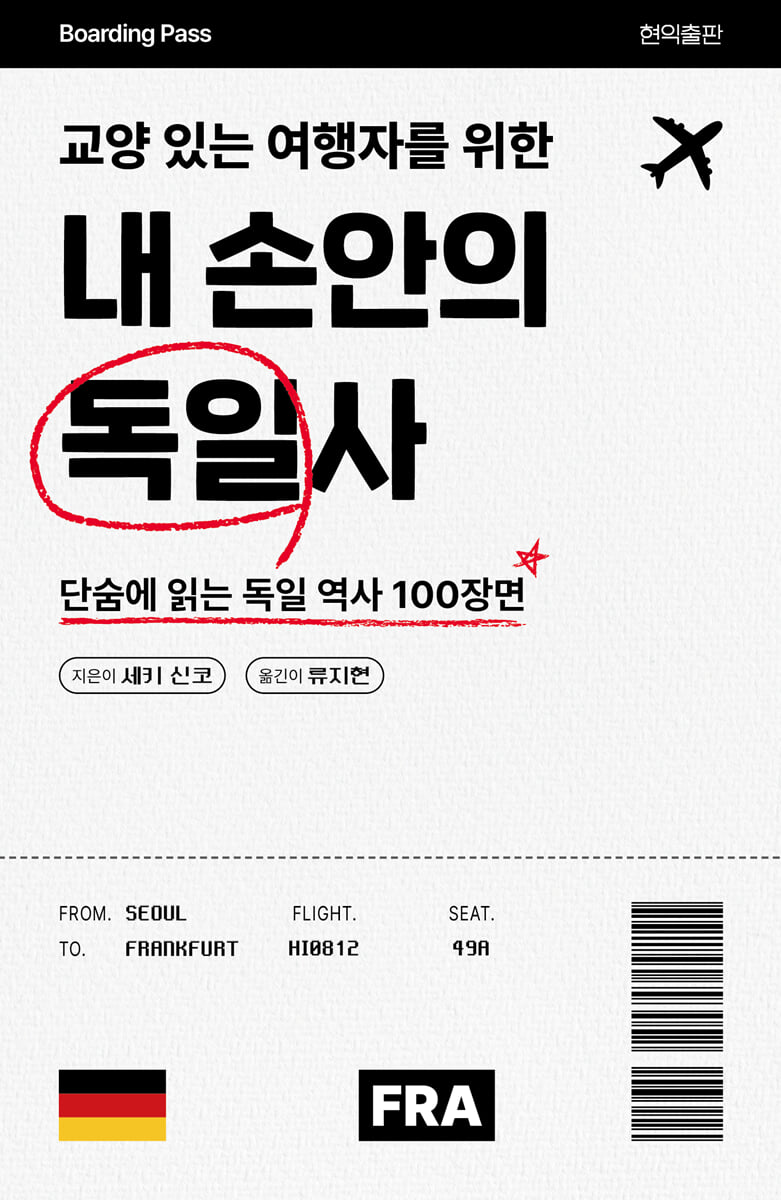
German History in the Palm of Your Hand for the Cultured Traveler
 |
Description
Book Introduction
Goodbye to heavy and boring history books!
The lightest and most comprehensive history textbook you can read, in one hand!
Enhance your travel experience with 100 key historical scenes!
When you travel to a foreign country and walk down an unfamiliar road, there are moments when questions like, “Why is this place like this?” or “Why do these people live this way?” come to mind.
But most people quickly put that curiosity aside and move on to the next tourist attraction.
Ultimately, our journey ends up following a map and we return without really understanding the country.
The series 'World History in the Palm of Your Hand for the Cultured Traveler' offers one suggestion to such travelers.
Before you leave, or during your trip, why not take a moment to look back at the path this country has taken?
A trip with an understanding of history will open up opportunities to delve deeper into a civilization and society, going beyond a simple tourist tour.
Knowing where the landscapes of an unfamiliar city come from and the historical moments that shaped the nation it is today transforms travel into a whole new experience.
This book is a historical textbook that kindly explains a story that may seem difficult.
It introduces the main flow of each country's history in 100 scenes, with a length and structure that is easy to unfold at the airport, on the plane, or on the train.
Additionally, the inclusion of pictures and maps helped to vividly portray the situation and changes at the time.
The chronology included at the end juxtaposes the 100 scenes introduced in this book with globally significant events, providing a broad overview of the flow of time.
As you follow this short but profound historical story, you will soon find yourself experiencing the saying, "You see as much as you know."
"German History in the Palm of Your Hand for the Cultured Traveler" explores the events that shaped present-day Germany, the moments of choice that changed the times, and Germany's role in European history, helping readers gain a three-dimensional view of present-day Germany, Europe, and the world.
A history of countless small nations intertwined and divided, two world wars, division and unification, and national growth through industrialization to become a European powerhouse.
By the time you finish the last chapter of this book, your perspective will have become deeper and richer, as you have become a "cultured traveler."
The lightest and most comprehensive history textbook you can read, in one hand!
Enhance your travel experience with 100 key historical scenes!
When you travel to a foreign country and walk down an unfamiliar road, there are moments when questions like, “Why is this place like this?” or “Why do these people live this way?” come to mind.
But most people quickly put that curiosity aside and move on to the next tourist attraction.
Ultimately, our journey ends up following a map and we return without really understanding the country.
The series 'World History in the Palm of Your Hand for the Cultured Traveler' offers one suggestion to such travelers.
Before you leave, or during your trip, why not take a moment to look back at the path this country has taken?
A trip with an understanding of history will open up opportunities to delve deeper into a civilization and society, going beyond a simple tourist tour.
Knowing where the landscapes of an unfamiliar city come from and the historical moments that shaped the nation it is today transforms travel into a whole new experience.
This book is a historical textbook that kindly explains a story that may seem difficult.
It introduces the main flow of each country's history in 100 scenes, with a length and structure that is easy to unfold at the airport, on the plane, or on the train.
Additionally, the inclusion of pictures and maps helped to vividly portray the situation and changes at the time.
The chronology included at the end juxtaposes the 100 scenes introduced in this book with globally significant events, providing a broad overview of the flow of time.
As you follow this short but profound historical story, you will soon find yourself experiencing the saying, "You see as much as you know."
"German History in the Palm of Your Hand for the Cultured Traveler" explores the events that shaped present-day Germany, the moments of choice that changed the times, and Germany's role in European history, helping readers gain a three-dimensional view of present-day Germany, Europe, and the world.
A history of countless small nations intertwined and divided, two world wars, division and unification, and national growth through industrialization to become a European powerhouse.
By the time you finish the last chapter of this book, your perspective will have become deeper and richer, as you have become a "cultured traveler."
- You can preview some of the book's contents.
Preview
index
Introduction | A Look at Germany
The more you know, the more surprising it becomes! 4 secrets of Germany
Cologne Cathedral, Birkenau Concentration Camp, and the Berlin Wall
Prologue | The People Across the River, the Land of the Germans
Chapter 1: The Beginning of the Frankish Kingdom
001 The Roots of Germany, the Frankish Kingdom
002 Europe Created by Charlemagne
003 East Francia, which became the Kingdom of Germany
004 The Beginning of the Holy Roman Empire
005 The 'Emperor-Chooser' Greater Than the Emperor
006 From the Agricultural Revolution to Urban Growth
007 East, East!
008 But what about Italy?
009 Renaissance and Reformation
010 The knights and peasants who rose up
011 Charles V's agony and Protestantism
Column: The Secrets of the German Flag, National Anthem, and Coat of Arms
The more you know about Germany's most interesting figure, ① Otto I
Chapter 2 Austria and Prussia
012 Austria, the center of the empire
013 The Habsburg family from Switzerland
014 The Divided Holy Roman Empire
015 From the Duchy of Prussia to the Kingdom
016 The first stage of the Thirty Years' War
017 The Second Stage of the Thirty Years' War
018 Another force, Sweden
019 300 Nations, Holy Roman Empire
020 Attack of the French Sun King
021 Is it possible for women to inherit the family line?
022 Lost Silesia
023 Silesia, which was never regained
024 Reforms of the Enlightened Absolutist Monarch
025 Genius artists appearing one after another
026 The Influence of the French Revolution
027 The Powerful Napoleon
028 The Holy Roman Empire finally fell
029 Prussia's national reforms
030 The Allied Forces that expelled Napoleon
031 Death Certificate of the Holy Roman Empire
Column Two German Families
The more you know about the German great figure, the more interesting it is ② Beethoven
Chapter 3 The Dizzying German Federation
032 The New Order in Europe, the Vienna Protocol
033 The newly born 'German Federation'
034 Students who advocated for liberalism
035 Why Potatoes Are Famous in Germany
036 Customs Union that established the economic foundation
037 Germany's first railway
038 The Shadow of the Industrial Revolution: The Gap Between Rich and Poor
039 What should we do with the country?
040 Failed Revolution
041 The Iron Chancellor who will lead German unification appears!
042 Prussia-centered unification plan
043 War between Prussia and France
044 But what about Austria?
The more you know about the German great figure, the more interesting it is ③ Goethe
Chapter 4 The Modern German Empire
045 Prussia-centered politics
046 Can we get along with Russia?
047 The Catholic Church and Socialists
048 Bismarck is dismissed
049 Was Wilhelm II a good monarch?
050 Expansion of naval power and overseas expansion
051 Britain and France are enemies after all!
052 The Collapse of the Triple Alliance
053 Europe's powder keg finally exploded
054 Germany engulfed in war atmosphere
055 Everyone around is an enemy!
056 America has appeared, what should we do?
057 Divided German Society
058 The collapse of the German Empire due to the German Revolution
059 Please, Evert!
060 Which socialist country should we aim for?
061 How to End the War
062 The Aftermath of the Treaty of Versailles After the War
Column: Germany's Armaments
The more you know about the German great figure, the more interesting it becomes. ④ Karl Marx
Chapter 5 From the Weimar Republic to Nazi Germany
063 There is no emperor, but there is a president.
064 The chaos of the Weimar Republic
065 Compensation Burden and Hyperinflation
066 Hitler's rise to power through the Munich Putsch
067 Conflict between the Left and the Right
068 The Great Depression: Nazi Power Grows
069 Why the word "socialist" is included in the party name
070 Hitler forming a ruling base
071 Nazis with many young people
072 Communism is the enemy!
073 Is it the military or the SA?
074 The unemployed are also Nazis
075 Secure food and resources!
076 Nazi Welfare, Propaganda, and Surveillance
077 The Nazis' thorough persecution of Jews
078 Overthrow the Versailles system!
079 Nazis Aiming for World Hegemony
080 World War II
081 Desert Fox, General Rommel
082 Germany in a corner
083 Germany's Defeat and Hitler's Death
Column: Sports in Germany
The more you learn about Germany's most interesting figure, Anne Frank.
Chapter 6 Federal Republic and Democratic Republic
084 The End of the Nazi Era
085 Germany divided into West and East Germany
086 Divided Berlin
087 West and East Germany, like oil and water
088 The pinnacle of social reconstruction, winning the World Cup!
089 East Germany cannot be rebuilt
090 The Berlin Wall, a symbol of East-West conflict
091 Cuba is in danger!
092 Reconciliation between Germany and France
093 Brandt's Foreign Policy
094 The rise of the new Green Party
095 The Berlin Wall finally collapses
096 Unification is not easy
097 Schindler's List, a True Story
098 Germany's Challenges and Changes After Reunification
099 Germany's first female chancellor
100 Two Thousand Years of German History and Future
The more you know about the interesting German figure, the more interesting it is: Richard Nikolaus von Cowdenhof-Kalergi
German History Chronology
The more you know, the more surprising it becomes! 4 secrets of Germany
Cologne Cathedral, Birkenau Concentration Camp, and the Berlin Wall
Prologue | The People Across the River, the Land of the Germans
Chapter 1: The Beginning of the Frankish Kingdom
001 The Roots of Germany, the Frankish Kingdom
002 Europe Created by Charlemagne
003 East Francia, which became the Kingdom of Germany
004 The Beginning of the Holy Roman Empire
005 The 'Emperor-Chooser' Greater Than the Emperor
006 From the Agricultural Revolution to Urban Growth
007 East, East!
008 But what about Italy?
009 Renaissance and Reformation
010 The knights and peasants who rose up
011 Charles V's agony and Protestantism
Column: The Secrets of the German Flag, National Anthem, and Coat of Arms
The more you know about Germany's most interesting figure, ① Otto I
Chapter 2 Austria and Prussia
012 Austria, the center of the empire
013 The Habsburg family from Switzerland
014 The Divided Holy Roman Empire
015 From the Duchy of Prussia to the Kingdom
016 The first stage of the Thirty Years' War
017 The Second Stage of the Thirty Years' War
018 Another force, Sweden
019 300 Nations, Holy Roman Empire
020 Attack of the French Sun King
021 Is it possible for women to inherit the family line?
022 Lost Silesia
023 Silesia, which was never regained
024 Reforms of the Enlightened Absolutist Monarch
025 Genius artists appearing one after another
026 The Influence of the French Revolution
027 The Powerful Napoleon
028 The Holy Roman Empire finally fell
029 Prussia's national reforms
030 The Allied Forces that expelled Napoleon
031 Death Certificate of the Holy Roman Empire
Column Two German Families
The more you know about the German great figure, the more interesting it is ② Beethoven
Chapter 3 The Dizzying German Federation
032 The New Order in Europe, the Vienna Protocol
033 The newly born 'German Federation'
034 Students who advocated for liberalism
035 Why Potatoes Are Famous in Germany
036 Customs Union that established the economic foundation
037 Germany's first railway
038 The Shadow of the Industrial Revolution: The Gap Between Rich and Poor
039 What should we do with the country?
040 Failed Revolution
041 The Iron Chancellor who will lead German unification appears!
042 Prussia-centered unification plan
043 War between Prussia and France
044 But what about Austria?
The more you know about the German great figure, the more interesting it is ③ Goethe
Chapter 4 The Modern German Empire
045 Prussia-centered politics
046 Can we get along with Russia?
047 The Catholic Church and Socialists
048 Bismarck is dismissed
049 Was Wilhelm II a good monarch?
050 Expansion of naval power and overseas expansion
051 Britain and France are enemies after all!
052 The Collapse of the Triple Alliance
053 Europe's powder keg finally exploded
054 Germany engulfed in war atmosphere
055 Everyone around is an enemy!
056 America has appeared, what should we do?
057 Divided German Society
058 The collapse of the German Empire due to the German Revolution
059 Please, Evert!
060 Which socialist country should we aim for?
061 How to End the War
062 The Aftermath of the Treaty of Versailles After the War
Column: Germany's Armaments
The more you know about the German great figure, the more interesting it becomes. ④ Karl Marx
Chapter 5 From the Weimar Republic to Nazi Germany
063 There is no emperor, but there is a president.
064 The chaos of the Weimar Republic
065 Compensation Burden and Hyperinflation
066 Hitler's rise to power through the Munich Putsch
067 Conflict between the Left and the Right
068 The Great Depression: Nazi Power Grows
069 Why the word "socialist" is included in the party name
070 Hitler forming a ruling base
071 Nazis with many young people
072 Communism is the enemy!
073 Is it the military or the SA?
074 The unemployed are also Nazis
075 Secure food and resources!
076 Nazi Welfare, Propaganda, and Surveillance
077 The Nazis' thorough persecution of Jews
078 Overthrow the Versailles system!
079 Nazis Aiming for World Hegemony
080 World War II
081 Desert Fox, General Rommel
082 Germany in a corner
083 Germany's Defeat and Hitler's Death
Column: Sports in Germany
The more you learn about Germany's most interesting figure, Anne Frank.
Chapter 6 Federal Republic and Democratic Republic
084 The End of the Nazi Era
085 Germany divided into West and East Germany
086 Divided Berlin
087 West and East Germany, like oil and water
088 The pinnacle of social reconstruction, winning the World Cup!
089 East Germany cannot be rebuilt
090 The Berlin Wall, a symbol of East-West conflict
091 Cuba is in danger!
092 Reconciliation between Germany and France
093 Brandt's Foreign Policy
094 The rise of the new Green Party
095 The Berlin Wall finally collapses
096 Unification is not easy
097 Schindler's List, a True Story
098 Germany's Challenges and Changes After Reunification
099 Germany's first female chancellor
100 Two Thousand Years of German History and Future
The more you know about the interesting German figure, the more interesting it is: Richard Nikolaus von Cowdenhof-Kalergi
German History Chronology
Detailed image

Into the book
Beethoven strongly sympathized with the French Revolution, which advocated freedom and equality, and expressed his ideas through music in a European society that was turbulently transitioning from feudal rule to a modern state.
Despite the deep-rooted rule of the aristocracy that obstructed the freedom of the people and the suffering caused by hearing problems that gradually worsened since his twenties, he approached music as a way to inspire himself.
---p.82 From "Beethoven, the Indomitable Musician Who Faced Fate"
As the population increases, the first problem that arises is securing food.
At that time, production of potatoes, which grow well even in poor soil, was increasing in Europe.
Potatoes were also produced in Germany and became a national food.
The next problem is job security.
City merchants and capitalists brought raw materials into the countryside and made peasants spin yarn, giving jobs to poor peasants.
---p.89 From “Why Potatoes Are Famous in Germany”
As large factories were built and heavy industry developed, railways became necessary.
In 1835, Germany's first railway opened between Nuremberg and Fürth in Bavaria.
By the mid-19th century, the total length of its railways was 4,300 km, making it the world's third-largest railway powerhouse after the United States and the United Kingdom.
---p.92 From "Germany's First Railway"
In 1915, Germany launched a submarine warfare campaign targeting civilian shipping in an attempt to break Britain's Atlantic blockade.
At this time, a German submarine sank the British passenger ship Lusitania, killing American passengers.
Germany suspends submarine operations over US protests.
However, by 1917, the war was in a stalemate, and Germany resumed its suspended operations as "unrestricted submarine warfare," which brought the United States into the war.
---p.124 From "America Appears, What Should We Do?"
But how did the Nazis emerge into German politics? The German Workers' Party, the predecessor to the Nazis, was formed in 1919, the year the Treaty of Versailles was signed.
In 1920, it became an official political party, the National Socialist German Workers' Party.
And the following year, Hitler emerged as the de facto leader of the party.
The Nazis are a right-wing political party that advocates nationalism, placing the state above everything else.
But the party name contains the word socialism.
Because we knew we needed to attract workers who wanted socialism.
Of course, it goes without saying that the actual form of this politics is anti-socialism.
Despite the deep-rooted rule of the aristocracy that obstructed the freedom of the people and the suffering caused by hearing problems that gradually worsened since his twenties, he approached music as a way to inspire himself.
---p.82 From "Beethoven, the Indomitable Musician Who Faced Fate"
As the population increases, the first problem that arises is securing food.
At that time, production of potatoes, which grow well even in poor soil, was increasing in Europe.
Potatoes were also produced in Germany and became a national food.
The next problem is job security.
City merchants and capitalists brought raw materials into the countryside and made peasants spin yarn, giving jobs to poor peasants.
---p.89 From “Why Potatoes Are Famous in Germany”
As large factories were built and heavy industry developed, railways became necessary.
In 1835, Germany's first railway opened between Nuremberg and Fürth in Bavaria.
By the mid-19th century, the total length of its railways was 4,300 km, making it the world's third-largest railway powerhouse after the United States and the United Kingdom.
---p.92 From "Germany's First Railway"
In 1915, Germany launched a submarine warfare campaign targeting civilian shipping in an attempt to break Britain's Atlantic blockade.
At this time, a German submarine sank the British passenger ship Lusitania, killing American passengers.
Germany suspends submarine operations over US protests.
However, by 1917, the war was in a stalemate, and Germany resumed its suspended operations as "unrestricted submarine warfare," which brought the United States into the war.
---p.124 From "America Appears, What Should We Do?"
But how did the Nazis emerge into German politics? The German Workers' Party, the predecessor to the Nazis, was formed in 1919, the year the Treaty of Versailles was signed.
In 1920, it became an official political party, the National Socialist German Workers' Party.
And the following year, Hitler emerged as the de facto leader of the party.
The Nazis are a right-wing political party that advocates nationalism, placing the state above everything else.
But the party name contains the word socialism.
Because we knew we needed to attract workers who wanted socialism.
Of course, it goes without saying that the actual form of this politics is anti-socialism.
---p.150 From “Why Socialism is in the Party Name”
Publisher's Review
Little habits of a cultured traveler!
A world history series that adds culture to the excitement of travel.
A journey you embark on with knowledge has a different depth.
When I travel to a foreign country, I often have thoughts like this.
“Why is this place like this?”, “Why do these people live this way?” But most of the time, we just brush those questions aside and head to our next destination.
In this way, the trip only leaves traces of moving along the map, and we return to our daily lives without having discovered the real story of the place.
The series 'World History in the Palm of Your Hand for the Cultured Traveler' speaks cautiously to such travelers.
Before you go on a trip, or during your trip, why not take a moment to look back on the path this country has taken?
Once you learn about the history of a land, you will see landscapes you had passed by without a second thought differently, and even a single scene you encounter in an unfamiliar alley will allow you to sense the long history embedded within it.
This series was written so that anyone can read it, breaking away from the difficult and heavy history books of the past.
Instead of extensive chronology or difficult theories, the history of each country is divided into 100 scenes, presented briefly and clearly.
It is organized so that you can follow along easily even if you open it at the airport, on the plane, or in a cafe, without reading it like a textbook.
However, it is by no means light.
Pictures and maps depicting the period add vividness to the story, and each scene accurately depicts the changes the country went through.
Additionally, a chronology is included at the end of the book, allowing readers to examine the position of each country's major events within the larger global context.
Just by comparing what was happening in other countries during the same period, readers will naturally experience the flow of civilization and the pace of development.
Traveling with knowledge gives travelers a deeper and richer story.
This book dreams of being a companion on just such a journey.
War, Division, Industrialization, and Growth
Germany's 2,000-year journey, drawing parallels with Korean history.
When you think of Germany, what comes to mind first? Beer, sausages, soccer, cars… Familiar and diverse images likely come to mind.
Moreover, the history of Germany today is surprisingly similar to that of Korea.
Both countries rose from the ashes of war, experienced division, and achieved remarkable growth on the world stage through industrialization.
Although Korea and Germany are located at the eastern and western ends of the Eurasian continent, they have drawn striking parallels in the flow of history.
It tells the story of those two thousand years.
This book explores how Germany was formed and changed, dividing the vast journey of German history into 100 scenes in an easy and entertaining way.
From the Frankish kingdom to the Holy Roman Empire that led medieval Europe, the conflict between Austria and Prussia, two world wars, the tragedy of Nazism, the division and unification of the Cold War, modern Germany that established itself as the center of Europe, and the history of European integration that continues to this day.
The more you learn about German people, places, flags, and sports, the more interesting they become. It is packed with hidden stories.
After reading this book, the German landscape you encounter will be different from before.
This is because old buildings, scenes from paintings, food and drink, and even people's lives are all products of the history that has accumulated on that land.
"German History in the Palm of Your Hand for the Cultured Traveler" explores the events that shaped present-day Germany, the moments of choice that changed the times, and Germany's role in European history, helping readers gain a three-dimensional view of present-day Germany, Europe, and the world.
By the time you finish the last chapter of this book, your perspective will have become deeper and richer, as you have become a "cultured traveler."
A world history series that adds culture to the excitement of travel.
A journey you embark on with knowledge has a different depth.
When I travel to a foreign country, I often have thoughts like this.
“Why is this place like this?”, “Why do these people live this way?” But most of the time, we just brush those questions aside and head to our next destination.
In this way, the trip only leaves traces of moving along the map, and we return to our daily lives without having discovered the real story of the place.
The series 'World History in the Palm of Your Hand for the Cultured Traveler' speaks cautiously to such travelers.
Before you go on a trip, or during your trip, why not take a moment to look back on the path this country has taken?
Once you learn about the history of a land, you will see landscapes you had passed by without a second thought differently, and even a single scene you encounter in an unfamiliar alley will allow you to sense the long history embedded within it.
This series was written so that anyone can read it, breaking away from the difficult and heavy history books of the past.
Instead of extensive chronology or difficult theories, the history of each country is divided into 100 scenes, presented briefly and clearly.
It is organized so that you can follow along easily even if you open it at the airport, on the plane, or in a cafe, without reading it like a textbook.
However, it is by no means light.
Pictures and maps depicting the period add vividness to the story, and each scene accurately depicts the changes the country went through.
Additionally, a chronology is included at the end of the book, allowing readers to examine the position of each country's major events within the larger global context.
Just by comparing what was happening in other countries during the same period, readers will naturally experience the flow of civilization and the pace of development.
Traveling with knowledge gives travelers a deeper and richer story.
This book dreams of being a companion on just such a journey.
War, Division, Industrialization, and Growth
Germany's 2,000-year journey, drawing parallels with Korean history.
When you think of Germany, what comes to mind first? Beer, sausages, soccer, cars… Familiar and diverse images likely come to mind.
Moreover, the history of Germany today is surprisingly similar to that of Korea.
Both countries rose from the ashes of war, experienced division, and achieved remarkable growth on the world stage through industrialization.
Although Korea and Germany are located at the eastern and western ends of the Eurasian continent, they have drawn striking parallels in the flow of history.
It tells the story of those two thousand years.
This book explores how Germany was formed and changed, dividing the vast journey of German history into 100 scenes in an easy and entertaining way.
From the Frankish kingdom to the Holy Roman Empire that led medieval Europe, the conflict between Austria and Prussia, two world wars, the tragedy of Nazism, the division and unification of the Cold War, modern Germany that established itself as the center of Europe, and the history of European integration that continues to this day.
The more you learn about German people, places, flags, and sports, the more interesting they become. It is packed with hidden stories.
After reading this book, the German landscape you encounter will be different from before.
This is because old buildings, scenes from paintings, food and drink, and even people's lives are all products of the history that has accumulated on that land.
"German History in the Palm of Your Hand for the Cultured Traveler" explores the events that shaped present-day Germany, the moments of choice that changed the times, and Germany's role in European history, helping readers gain a three-dimensional view of present-day Germany, Europe, and the world.
By the time you finish the last chapter of this book, your perspective will have become deeper and richer, as you have become a "cultured traveler."
GOODS SPECIFICS
- Date of issue: August 12, 2025
- Page count, weight, size: 220 pages | 129*198*20mm
- ISBN13: 9791194793052
- ISBN10: 1194793053
You may also like
카테고리
korean


korean

![GQ KOREA Mark (Monthly): December [2025]](http://librairie.coreenne.fr/cdn/shop/files/8ef265dbbfbf186523ed75ba7319009d.jpg?v=1765340328&width=3840)


