

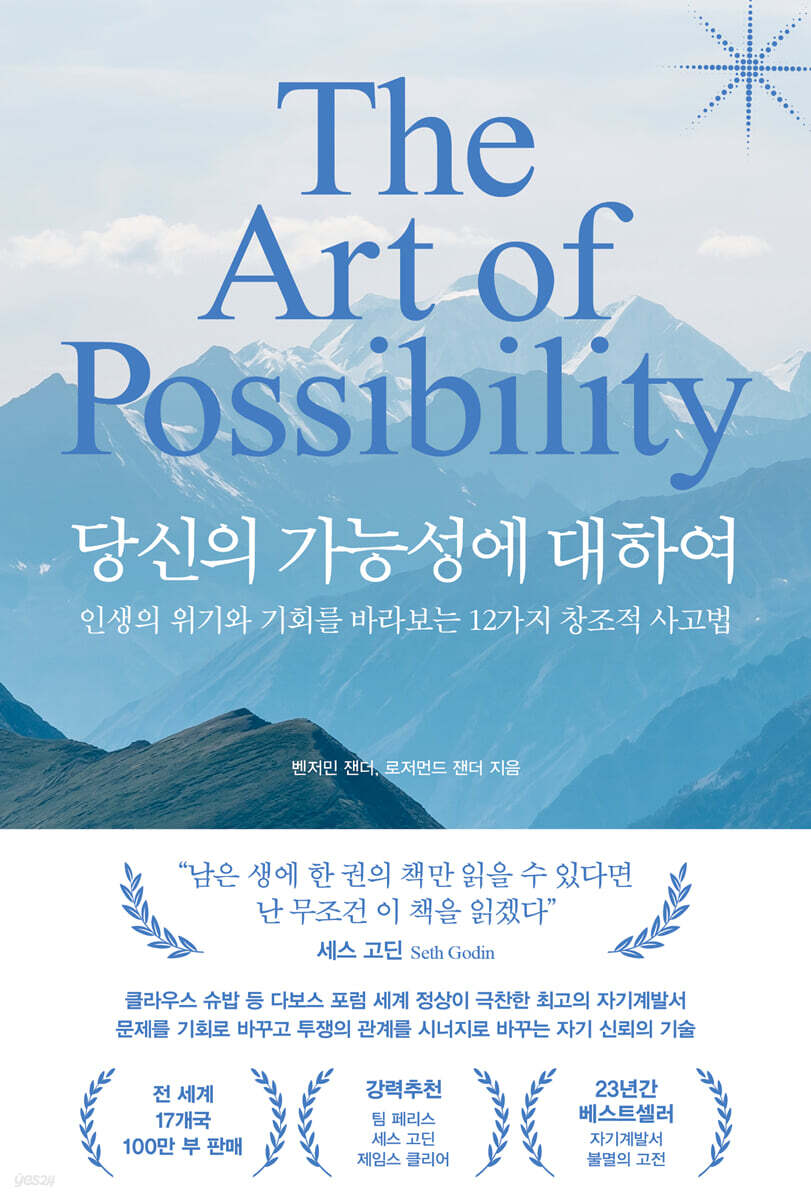
About your potential
 |
Description
Book Introduction
“If I could only read one book for the rest of my life,
“I will definitely read this book” _Seth Godin
One million copies sold in 17 countries! A bestseller for 23 years!
Immortal self-help books recommended by Tim Ferriss, Seth Godin, and James Clear
Tim Ferriss, Seth Godin, James Clear… …there are authors who are considered masters in the field of self-improvement.
There is a book that these masters unanimously recommend and read over and over again like a scripture.
It is Benjamin Zander and Rosamund Zander's "On Your Potential".
"On Your Potential" is a classic in the field of self-help that has remained a bestseller for 23 years since its first publication in the United States.
Co-authored by Boston Philharmonic Orchestra conductor Benjamin Zander and family therapist and achievement program instructor Rosamund Zander, the two suggest twelve creative thinking methods to solve problems in various fields such as business, education, arts, and family, and turn crises into opportunities.
This book, which spread creative thinking across various fields, was licensed for publication in 17 countries, sold over 1 million copies, and received rave reviews from global leaders, business leaders, and self-improvement writers, becoming an immortal classic.
Their praise for the book is as follows:
If I could only read one book for the rest of my life, I would definitely read this one.
Seth Godin, author of "Marketing"
A book you read over and over again.
Tim Ferriss, author of Tools of Titans
"Everything in my life is my own creation." This one sentence has become my absolute life motto, enabling me to focus on my potential in any situation.
_James Clear, author of The Power of Small Habits
The passionate energy contained in this book will serve as a powerful catalyst for fundamental change in the lives of all who read it.
Klaus Schwab, founder of the World Economic Forum
"About Your Potential" was published in Korea in 2013, but went out of print and was traded at a premium price on the used book market.
Republished after nearly 12 years, "On Your Potential" is a revised and expanded edition that adds contemporary commentary to the original work, satisfying the needs of the booming secondhand market and providing more readers with the opportunity to hone their creative thinking skills.
“I will definitely read this book” _Seth Godin
One million copies sold in 17 countries! A bestseller for 23 years!
Immortal self-help books recommended by Tim Ferriss, Seth Godin, and James Clear
Tim Ferriss, Seth Godin, James Clear… …there are authors who are considered masters in the field of self-improvement.
There is a book that these masters unanimously recommend and read over and over again like a scripture.
It is Benjamin Zander and Rosamund Zander's "On Your Potential".
"On Your Potential" is a classic in the field of self-help that has remained a bestseller for 23 years since its first publication in the United States.
Co-authored by Boston Philharmonic Orchestra conductor Benjamin Zander and family therapist and achievement program instructor Rosamund Zander, the two suggest twelve creative thinking methods to solve problems in various fields such as business, education, arts, and family, and turn crises into opportunities.
This book, which spread creative thinking across various fields, was licensed for publication in 17 countries, sold over 1 million copies, and received rave reviews from global leaders, business leaders, and self-improvement writers, becoming an immortal classic.
Their praise for the book is as follows:
If I could only read one book for the rest of my life, I would definitely read this one.
Seth Godin, author of "Marketing"
A book you read over and over again.
Tim Ferriss, author of Tools of Titans
"Everything in my life is my own creation." This one sentence has become my absolute life motto, enabling me to focus on my potential in any situation.
_James Clear, author of The Power of Small Habits
The passionate energy contained in this book will serve as a powerful catalyst for fundamental change in the lives of all who read it.
Klaus Schwab, founder of the World Economic Forum
"About Your Potential" was published in Korea in 2013, but went out of print and was traded at a premium price on the used book market.
Republished after nearly 12 years, "On Your Potential" is a revised and expanded edition that adds contemporary commentary to the original work, satisfying the needs of the booming secondhand market and providing more readers with the opportunity to hone their creative thinking skills.
- You can preview some of the book's contents.
Preview
index
Prologue 1: Invitation to Possibility
Prologue 2: Beginning the Journey
Chapter 1: Everything Was Made
Chapter 2: Taking a Step Into a Universe of Possibilities
Chapter 3: Grading A
Chapter 4: Becoming a Contributor
Chapter 5: Anyone Can Be a Leader
Chapter 6 Rule 6
Chapter 7: Being as You Are
Chapter 8: Surrendering to Passion
Chapter 9: Lighting a Fire
Chapter 10 Becoming a Game Board
Chapter 11: Building a Framework for Possibilities
Chapter 12: Telling the Story of "Us"
Epilogue From 'I' to 'We'
Acknowledgements
Prologue 2: Beginning the Journey
Chapter 1: Everything Was Made
Chapter 2: Taking a Step Into a Universe of Possibilities
Chapter 3: Grading A
Chapter 4: Becoming a Contributor
Chapter 5: Anyone Can Be a Leader
Chapter 6 Rule 6
Chapter 7: Being as You Are
Chapter 8: Surrendering to Passion
Chapter 9: Lighting a Fire
Chapter 10 Becoming a Game Board
Chapter 11: Building a Framework for Possibilities
Chapter 12: Telling the Story of "Us"
Epilogue From 'I' to 'We'
Acknowledgements
Detailed image

Into the book
Great musicians must take risks, but competition discourages them from taking such risks.
Music is communicated to others through the interpreter.
Performance technique varies greatly depending on expressiveness, and expressiveness comes from making mistakes.
In other words, only by making mistakes can you learn what to pay attention to and express.
So, when my students make a mistake, I actively train them to raise their arms, smile, and say, “Wow, that’s really cool!”
I recommend this method to everyone.
--- p.55, from “Chapter 3: Giving Grades A”
One evening, I sat down with Rosamund and talked about how we could help students overcome their fear of failure.
What if we started the semester by giving every student an A?
(……) The reason for giving an A grade is not to measure the student's performance without considering the standards.
The real reason for giving an A grade (even though the A grade does have some meaning of measurement) is to free us from the 'shackles of judgment' that have so strongly ingrained themselves in our consciousness since childhood.
Giving an A grade opens up possibilities for both mentor and student.
--- p.49-60, from “Chapter 3: Giving Grades A”
Take a closer look at the game box in front of you.
If the rules of the game don't light up your life, throw them away.
Then you can just get another box that looks better and give it your all in the new board.
Remember.
Everything was created.
--- p.101, from “Chapter 4: Becoming a Contributor”
Being a quiet conductor means recognizing the passion and dedication of the performers.
It's about seeing whether the performer's heart is in the orchestra, in the management team, or in their children.
So, what kind of person is a quiet conductor? A quiet conductor observes everything through the eyes of a performer.
So I ask myself this question:
“What am I doing that prevents them from shining?”
--- p.126, from “Chapter 5: Anyone Can Be a Leader”
The practice of being present is to check the imaginary facts that the calculating self has arbitrarily created.
It's similar to a situation where a police officer, tired of hearing someone else's words, says, "Just the truth, just the truth."
For possibilities to shine, we must begin by seeing them as they are.
And we need to focus on the open space, the path leading out.
Then you realize that obstacles are just a state of being.
These are nothing more or less than what happened in the past or is happening now.
--- p.182, from “Chapter 7: Existing as is”
To exist as we are, we must expand ourselves.
You have to start from where you are now, not where you 'should be'.
We must learn to soar, embracing even the opposing opinions, the painful feelings, the fears, and even the assumptions, without running away, without blaming, without trying to fix anything.
You must be able to soar high like an eagle and look down on the entire landscape.
--- p.186, from “Chapter 7: Existing as is”
I asked my father why he met the person in person instead of using the phone.
My father raised his eyebrows and his eyes sparkled, as if ready to impart a lesson.
My father raised his index finger and said:
“Some things in life are better done by yourself.”
--- p.208, from “Chapter 9: Lighting a Fire”
If something goes wrong and I blame the other person, I have to prove that I am the right person.
There is definitely a sweet satisfaction here.
But if you criticize someone because you don't like their vacation destination or because you feel a wall between you because you're not talking, you're losing that many opportunities.
Put the situation in another room
Because you miss out on the opportunity to drag them into a situation, learn a lesson from it, or develop a better relationship with them.
--- p.236, from “Chapter 10: Becoming a Game Board”
If you define yourself in game terms, that is, if you are trapped in a certain role, you cannot help but complain and resist when things do not go your way.
But if you define yourself by the game board itself, you can direct your attention in the direction you want.
There is no need to waste anything, including the energy needed to win, fight, or fix things.
(……) Just let all these events flow without any judgment.
Why? Because this is the reality as it is.
Music is communicated to others through the interpreter.
Performance technique varies greatly depending on expressiveness, and expressiveness comes from making mistakes.
In other words, only by making mistakes can you learn what to pay attention to and express.
So, when my students make a mistake, I actively train them to raise their arms, smile, and say, “Wow, that’s really cool!”
I recommend this method to everyone.
--- p.55, from “Chapter 3: Giving Grades A”
One evening, I sat down with Rosamund and talked about how we could help students overcome their fear of failure.
What if we started the semester by giving every student an A?
(……) The reason for giving an A grade is not to measure the student's performance without considering the standards.
The real reason for giving an A grade (even though the A grade does have some meaning of measurement) is to free us from the 'shackles of judgment' that have so strongly ingrained themselves in our consciousness since childhood.
Giving an A grade opens up possibilities for both mentor and student.
--- p.49-60, from “Chapter 3: Giving Grades A”
Take a closer look at the game box in front of you.
If the rules of the game don't light up your life, throw them away.
Then you can just get another box that looks better and give it your all in the new board.
Remember.
Everything was created.
--- p.101, from “Chapter 4: Becoming a Contributor”
Being a quiet conductor means recognizing the passion and dedication of the performers.
It's about seeing whether the performer's heart is in the orchestra, in the management team, or in their children.
So, what kind of person is a quiet conductor? A quiet conductor observes everything through the eyes of a performer.
So I ask myself this question:
“What am I doing that prevents them from shining?”
--- p.126, from “Chapter 5: Anyone Can Be a Leader”
The practice of being present is to check the imaginary facts that the calculating self has arbitrarily created.
It's similar to a situation where a police officer, tired of hearing someone else's words, says, "Just the truth, just the truth."
For possibilities to shine, we must begin by seeing them as they are.
And we need to focus on the open space, the path leading out.
Then you realize that obstacles are just a state of being.
These are nothing more or less than what happened in the past or is happening now.
--- p.182, from “Chapter 7: Existing as is”
To exist as we are, we must expand ourselves.
You have to start from where you are now, not where you 'should be'.
We must learn to soar, embracing even the opposing opinions, the painful feelings, the fears, and even the assumptions, without running away, without blaming, without trying to fix anything.
You must be able to soar high like an eagle and look down on the entire landscape.
--- p.186, from “Chapter 7: Existing as is”
I asked my father why he met the person in person instead of using the phone.
My father raised his eyebrows and his eyes sparkled, as if ready to impart a lesson.
My father raised his index finger and said:
“Some things in life are better done by yourself.”
--- p.208, from “Chapter 9: Lighting a Fire”
If something goes wrong and I blame the other person, I have to prove that I am the right person.
There is definitely a sweet satisfaction here.
But if you criticize someone because you don't like their vacation destination or because you feel a wall between you because you're not talking, you're losing that many opportunities.
Put the situation in another room
Because you miss out on the opportunity to drag them into a situation, learn a lesson from it, or develop a better relationship with them.
--- p.236, from “Chapter 10: Becoming a Game Board”
If you define yourself in game terms, that is, if you are trapped in a certain role, you cannot help but complain and resist when things do not go your way.
But if you define yourself by the game board itself, you can direct your attention in the direction you want.
There is no need to waste anything, including the energy needed to win, fight, or fix things.
(……) Just let all these events flow without any judgment.
Why? Because this is the reality as it is.
--- p.243, from “Chapter 10 Becoming a Game Board”
Publisher's Review
A world of creative thinking opened by an orchestra conductor and achievement program instructor.
Unlocking possibilities in business, education, the arts, and family life.
The authors of this book, Benjamin Zander, are conductor of the Boston Philharmonic Orchestra, and Rosamund Zander is a family therapist and achievement program instructor.
The two are a couple and a team, and they have a long-standing routine.
The two face various problems in their respective places, such as a company conference room, an orchestra practice room, a school, and a family counseling room.
And when he gets home, Benjamin shares with Rosamund the problems he couldn't solve during the day.
Rosamund offers a completely new perspective on Benjamin's problem, and Benjamin takes this approach to the stage and experiments with it.
In other words, we applied methods that were effective in company conference rooms, family therapy sessions, and achievement program meetings to orchestras and schools.
The two have been solving various problems in this way for decades, resulting in a vast amount of data that crosses various fields.
Harvard Business School Press asked the two authors to write a book that would appeal to both the general public and business professionals.
It was, and still is, extremely rare for an artist to receive such an offer.
Based on their experience, Rosamund and Benjamin have compiled twelve creative thinking methods that have proven most effective in this book.
In other words, the twelve creative thinking methods contained in this book are methods that have already been proven effective, regardless of the field in question.
A philosophical premise that shakes the very foundations of life
'Everything is made!'
"On Your Potential" offers twelve ways to think about turning problems into opportunities.
For example, 'giving an A' means starting a relationship by giving an A to whoever is first.
Once you give someone an A, the hostility towards them disappears, and they also try to become someone worthy of an A.
‘Becoming a game board’ means becoming a game board, not a game piece, and looking at and accepting everything that happens.
This way, you can maintain your sanity and attitude without wasting energy on fixing or fighting, and ultimately avoid a bigger conflict.
In this way, the two authors gain a more fundamental understanding of the world and its problems, and offer solutions that shake the very foundations.
And there is a premise that runs through all of these solutions.
'Everything was created.'
Grades like A and B and rankings like 68th place are man-made.
If I get a B on a math test, that's just a grade compared to other students; it doesn't show how well I've learned math formulas or anything like that.
As such, most of the things we are obsessed with are human-created.
But we forget this fact and become obsessed with, swayed by, and blocked by everything man-made.
This book offers ways to amplify your possibilities and mindset, but its fundamental goal is to help you see the world through new eyes and find harmony with it.
If we look at the world with the idea that 'everything is made up', all the problems we face are nothing.
With such a light body and a broadened field of vision, I go out into the world again.
This is how the harmony that Benjamin and Rosamund speak of begins.
Unlocking possibilities in business, education, the arts, and family life.
The authors of this book, Benjamin Zander, are conductor of the Boston Philharmonic Orchestra, and Rosamund Zander is a family therapist and achievement program instructor.
The two are a couple and a team, and they have a long-standing routine.
The two face various problems in their respective places, such as a company conference room, an orchestra practice room, a school, and a family counseling room.
And when he gets home, Benjamin shares with Rosamund the problems he couldn't solve during the day.
Rosamund offers a completely new perspective on Benjamin's problem, and Benjamin takes this approach to the stage and experiments with it.
In other words, we applied methods that were effective in company conference rooms, family therapy sessions, and achievement program meetings to orchestras and schools.
The two have been solving various problems in this way for decades, resulting in a vast amount of data that crosses various fields.
Harvard Business School Press asked the two authors to write a book that would appeal to both the general public and business professionals.
It was, and still is, extremely rare for an artist to receive such an offer.
Based on their experience, Rosamund and Benjamin have compiled twelve creative thinking methods that have proven most effective in this book.
In other words, the twelve creative thinking methods contained in this book are methods that have already been proven effective, regardless of the field in question.
A philosophical premise that shakes the very foundations of life
'Everything is made!'
"On Your Potential" offers twelve ways to think about turning problems into opportunities.
For example, 'giving an A' means starting a relationship by giving an A to whoever is first.
Once you give someone an A, the hostility towards them disappears, and they also try to become someone worthy of an A.
‘Becoming a game board’ means becoming a game board, not a game piece, and looking at and accepting everything that happens.
This way, you can maintain your sanity and attitude without wasting energy on fixing or fighting, and ultimately avoid a bigger conflict.
In this way, the two authors gain a more fundamental understanding of the world and its problems, and offer solutions that shake the very foundations.
And there is a premise that runs through all of these solutions.
'Everything was created.'
Grades like A and B and rankings like 68th place are man-made.
If I get a B on a math test, that's just a grade compared to other students; it doesn't show how well I've learned math formulas or anything like that.
As such, most of the things we are obsessed with are human-created.
But we forget this fact and become obsessed with, swayed by, and blocked by everything man-made.
This book offers ways to amplify your possibilities and mindset, but its fundamental goal is to help you see the world through new eyes and find harmony with it.
If we look at the world with the idea that 'everything is made up', all the problems we face are nothing.
With such a light body and a broadened field of vision, I go out into the world again.
This is how the harmony that Benjamin and Rosamund speak of begins.
GOODS SPECIFICS
- Date of issue: November 24, 2025
- Page count, weight, size: 332 pages | 502g | 142*210*19mm
- ISBN13: 9791169851633
- ISBN10: 1169851630
You may also like
카테고리
korean


korean

![ELLE 엘르 스페셜 에디션 A형 : 12월 [2025]](http://librairie.coreenne.fr/cdn/shop/files/b8e27a3de6c9538896439686c6b0e8fb.jpg?v=1766436872&width=3840)


