

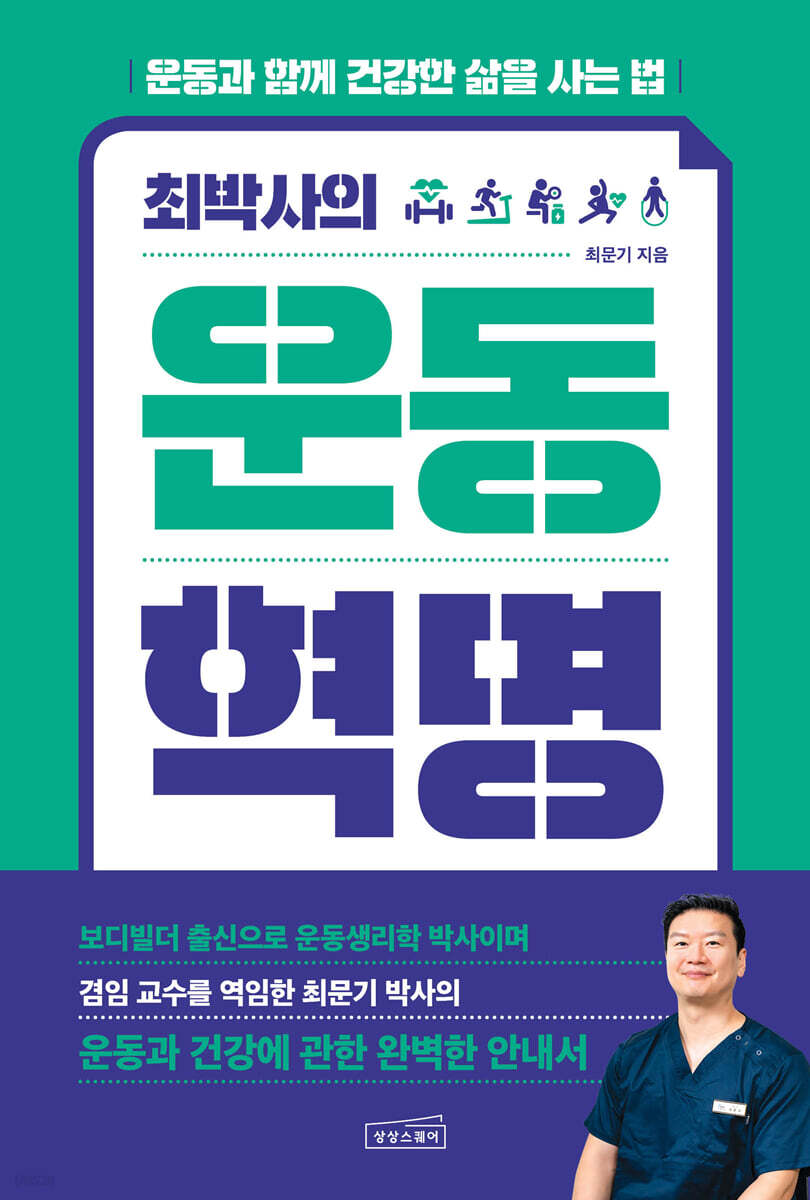
Dr. Choi's Exercise Revolution
 |
Description
Book Introduction
A former bodybuilder with a PhD in exercise physiology who served as an adjunct professor
Dr. Choi Moon-ki's Complete Guide to Exercise and Health
Dr. Choi's Exercise Revolution presents a new perspective that views exercise not simply as a physical activity, but as "the operating mechanism of a life system that fully reveals human potential."
Author Moon-ki Choi guides readers through an integrated recovery mechanism encompassing 'bones-muscles-cells-guts-brain-nerves' based on the latest research and experimental evidence across exercise physiology, behavioral science, neuroscience, and nutrition.
The author states that true health is a state in which the brain regains control within the harmony of the nervous and musculoskeletal systems.
Therefore, the process of securing flexibility and mobility of stiff muscles and joints, that is, stabilization of the body, must be achieved.
The author presents a scientific method for controlling the entire body, starting with breathing and walking, including the spine, shoulders, and core muscles, through 'stabilization exercises', and also introduces a special exercise method that can solve all of these processes at once.
If you've been avoiding exercise or ruining your health with the wrong kind of exercise, start a healthy life with exercise through "Dr. Choi's Exercise Revolution"!
Dr. Choi Moon-ki's Complete Guide to Exercise and Health
Dr. Choi's Exercise Revolution presents a new perspective that views exercise not simply as a physical activity, but as "the operating mechanism of a life system that fully reveals human potential."
Author Moon-ki Choi guides readers through an integrated recovery mechanism encompassing 'bones-muscles-cells-guts-brain-nerves' based on the latest research and experimental evidence across exercise physiology, behavioral science, neuroscience, and nutrition.
The author states that true health is a state in which the brain regains control within the harmony of the nervous and musculoskeletal systems.
Therefore, the process of securing flexibility and mobility of stiff muscles and joints, that is, stabilization of the body, must be achieved.
The author presents a scientific method for controlling the entire body, starting with breathing and walking, including the spine, shoulders, and core muscles, through 'stabilization exercises', and also introduces a special exercise method that can solve all of these processes at once.
If you've been avoiding exercise or ruining your health with the wrong kind of exercise, start a healthy life with exercise through "Dr. Choi's Exercise Revolution"!
- You can preview some of the book's contents.
Preview
index
PART 1.
Discover the secrets of exercise
Chapter 1.
People who exercise
- Exercise genes
- The process of finding the way
- Communication through the body
Chapter 2.
Exercise and Physical Development
- Stabilization of the body and efficient movement
- Guide to physical development
- Exercise and physical energy
- Exercise is the bridge that connects the body and brain.
Chapter 3.
Exercise and Disease Healing
- The essence of healing
- Exercise and pain reduction
- Let's go beyond drugs
Chapter 4.
Exercise and Aging
- Growing old as a complete me
- When strength leaves your body
- Young Seniors: Active Seniors
PART 2.
Exercise for my life
Chapter 5.
The importance of finding the right exercise for you
- Training method for me
- Have you ever learned how to run properly?
- The Science of Exercise Routines and Timing
Chapter 6.
Rest and Growth
- Recovery is also part of training
- Sleep is the most important thing?
- I'm getting enough rest, so why can't I recover?
Chapter 7.
Nutrition Secrets for Exercise and Recovery
- Healthy food for my body
- What on earth are gut microbes?
- Nutrition Guide for a Healthy Life
Chapter 8.
A happy life with exercise
- From knowledge to action
- The importance of positive words and altruistic actions
- The superpowers we have
Acknowledgements
References
Discover the secrets of exercise
Chapter 1.
People who exercise
- Exercise genes
- The process of finding the way
- Communication through the body
Chapter 2.
Exercise and Physical Development
- Stabilization of the body and efficient movement
- Guide to physical development
- Exercise and physical energy
- Exercise is the bridge that connects the body and brain.
Chapter 3.
Exercise and Disease Healing
- The essence of healing
- Exercise and pain reduction
- Let's go beyond drugs
Chapter 4.
Exercise and Aging
- Growing old as a complete me
- When strength leaves your body
- Young Seniors: Active Seniors
PART 2.
Exercise for my life
Chapter 5.
The importance of finding the right exercise for you
- Training method for me
- Have you ever learned how to run properly?
- The Science of Exercise Routines and Timing
Chapter 6.
Rest and Growth
- Recovery is also part of training
- Sleep is the most important thing?
- I'm getting enough rest, so why can't I recover?
Chapter 7.
Nutrition Secrets for Exercise and Recovery
- Healthy food for my body
- What on earth are gut microbes?
- Nutrition Guide for a Healthy Life
Chapter 8.
A happy life with exercise
- From knowledge to action
- The importance of positive words and altruistic actions
- The superpowers we have
Acknowledgements
References
Detailed image
.jpg)
Into the book
That is, our genes are not fixed.
It can be changed by environmental factors such as exercise.
Moreover, isn't it surprising that exercise even switches genes on and off through epigenetic mechanisms? We must keep in mind that exercise habits are not determined by genes.
--- p.24 「1.
Among the “People Who Exercise”
Habits are things we do unconsciously, routines are things we do consciously.
So I combine unconscious habits and conscious routines and call it the Daily Matrix.
Adding and implementing new processes to your daily matrix requires significant effort.
It takes a lot of thinking, executing, revising, and supplementing to figure out when and how it can be done before it finally becomes part of the Daily Matrix.
--- p.26 「1.
Among the “People Who Exercise”
Office workers who sit all day often experience back pain.
They have poor stability in their abdominal and back muscles, i.e. their core muscles.
So when you sit for a long time, your spine is not properly supported, which puts a lot of strain on your lower back and causes pain.
(...) Among those who have just started exercising, it is common to feel pain in the shoulder while doing weight training.
(...) All these problems arise because of the lack of stability exercises.
--- p.61 「2.
From “Exercise and Physical Development”
Continuing to exercise with insufficient stability can lead to injury.
Although the injury itself may occur suddenly, it is likely that there was a gradual build-up to the injury due to a lack of stability prior to the injury.
In other words, the real cause of the injury is a lack of stability in the muscles that support and move the joint.
Therefore, stability exercises should be performed to help restore natural movement and reduce the risk of injury.
--- p.64 「2.
From “Exercise and Physical Development”
So, can simply restricting calories activate AMPK and help you lose weight? (...) When we restrict calories, our bodies break down muscle protein to reduce energy expenditure, lowering our resting metabolic rate.
(...) This is why even if you try to stick to a long-term calorie restriction diet with mental fortitude, you will ultimately fail.
(...) In the end, we try to put into practice the proposition that “if you burn more calories than you consume, you will lose weight,” but the more we reduce our calorie intake, the less calories we burn, leading to the unfortunate situation where we have no effect.
--- p.125 「2.
From “Exercise and Physical Development”
In a new place I visited, I was suggested to try a medicinal herb called musk.
He said that if you take 100 doses of medicine worth 2 million won per 20 doses, you will be cured.
He felt something was off about the word ‘complete recovery’ and just left the clinic.
When he returned home, he was searching for papers related to musk on Google when he suddenly found himself clutching his head.
Why hadn't I thought to look up papers on "autonomic dysregulation" or "panic disorder"? It had been three years since I'd suffered from panic disorder.
From that day on, Mr. C began to search for and study materials related to panic disorder.
--- p.170 「3.
From “Exercise and Disease Healing”
It is clear that our innate genes have an influence on us.
However, as research results show, the environment has just as much influence as genes.
No, rather, in many cases the influence of the environment is even greater.
So rather than worrying about what we can't change, we need to focus on what we can change.
Exercise, sleep, and eating habits can all be changed with effort.
I hope that readers of this book will remember that cultivating these things healthily is the most powerful vaccine to prevent disease.
--- p.230 「4.
From “Exercise and Aging”
The recommended daily protein intake for a typical adult is 0.8 grams per kilogram of body weight per day.
Older people need even more protein.
(...) This is because as we age, our metabolic ability to absorb protein declines.
Therefore, muscle protein synthesis can be promoted only when a sufficient amount is continuously supplied.
(...) To maximize muscle protein synthesis, it is necessary to consume about 25 to 30 grams of high-quality protein per meal, and evenly distributing this amount over three or more meals is more effective in preventing sarcopenia.
--- p.242 「4.
From "Exercise and Aging" 242
Training is a systematic approach based on scientific principles.
You can achieve more effective results by clearly identifying your goals and choosing and implementing training methods that fit those goals.
Whether your goal is to increase strength, shape your body, improve your health, or enhance your athletic performance, understanding and applying appropriate training principles is key to successful exercise.
--- p.287 「5.
From “The Importance of Exercise That’s Right for Me”
Even minimal training can lead to positive changes in muscle activation and maintenance, and even body composition.
Therefore, minimal training can be a practical and realistic solution for those who want to maintain or improve strength and muscle health despite environmental constraints such as limited time.
It is also expected to have the effect of lowering the threshold for participation in exercise by making people reconsider the perception that exercise must be a long and arduous process.
--- p.325 「5.
From “The Importance of Exercise That’s Right for Me”
Although muscle soreness is often thought to be caused by lactic acid, there is no direct connection between DOMS and lactic acid.
Although lactic acid usually accumulates during exercise and acts as a fatigue substance that prevents you from continuing to exercise, it is difficult to see it as the cause of delayed-onset muscle soreness that causes pain over several days because it is recycled as an energy source in other tissues through several pathways within 1 to 2 hours after exercise.
In the past, lactic acid was thought to be the cause, but it is now accepted that delayed onset muscle soreness is caused by a complex interaction of muscle fiber microdamage, inflammatory response, pain signal transmission, and muscle regeneration processes.
--- p.329 「6.
From “Rest and Growth”
Lack of sleep also reduces exercise performance.
The sleep stage most closely related to strengthening motor skills is stage 2 non-REM sleep, particularly the last two hours of eight hours of sleep.
EEG analysis suggests that sleep spindles occurring in the motor cortex area during this time period play a key role in improving motor skills.
Experiments have shown that people who had more active sleep spindles while falling asleep after learning a new skill tended to perform that skill better when they woke up.
--- p.342 「6.
From “Rest and Growth”
Research shows that awareness of posture plays a vital role in improving body control.
There is a significant difference in the degree of neural plasticity activation between knowing and not knowing this information.
Conscious attention through awareness is an essential element in motor learning and body schema updating.
(...) When we become aware of this imbalance, our brain begins to consciously and unconsciously exchange proprioceptive information with our body to regulate its state for physical and emotional stability.
--- p.375 「6.
From “Rest and Growth”
Through food, we build healthy cells, regulate our gene expression, and design our future health.
This is not only a personal choice, but also an ethical and philosophical one that affects the ecosystem and the health of future generations.
It is a journey that expands from the question, “What do we eat?” to the question, “How do we eat?” and ultimately, “What do we want to become?”
--- p.386 「7.
From “The Secrets of Nutrition for Exercise and Recovery”
Reading and exercise are in themselves a philosophy of life and a practice that leads to the integrated functioning of the human mind and body.
When these two activities are interconnected and cyclical, we can achieve cognitive and physical progress that transcends individual limitations and deeply expand our humanity as social beings.
It can be changed by environmental factors such as exercise.
Moreover, isn't it surprising that exercise even switches genes on and off through epigenetic mechanisms? We must keep in mind that exercise habits are not determined by genes.
--- p.24 「1.
Among the “People Who Exercise”
Habits are things we do unconsciously, routines are things we do consciously.
So I combine unconscious habits and conscious routines and call it the Daily Matrix.
Adding and implementing new processes to your daily matrix requires significant effort.
It takes a lot of thinking, executing, revising, and supplementing to figure out when and how it can be done before it finally becomes part of the Daily Matrix.
--- p.26 「1.
Among the “People Who Exercise”
Office workers who sit all day often experience back pain.
They have poor stability in their abdominal and back muscles, i.e. their core muscles.
So when you sit for a long time, your spine is not properly supported, which puts a lot of strain on your lower back and causes pain.
(...) Among those who have just started exercising, it is common to feel pain in the shoulder while doing weight training.
(...) All these problems arise because of the lack of stability exercises.
--- p.61 「2.
From “Exercise and Physical Development”
Continuing to exercise with insufficient stability can lead to injury.
Although the injury itself may occur suddenly, it is likely that there was a gradual build-up to the injury due to a lack of stability prior to the injury.
In other words, the real cause of the injury is a lack of stability in the muscles that support and move the joint.
Therefore, stability exercises should be performed to help restore natural movement and reduce the risk of injury.
--- p.64 「2.
From “Exercise and Physical Development”
So, can simply restricting calories activate AMPK and help you lose weight? (...) When we restrict calories, our bodies break down muscle protein to reduce energy expenditure, lowering our resting metabolic rate.
(...) This is why even if you try to stick to a long-term calorie restriction diet with mental fortitude, you will ultimately fail.
(...) In the end, we try to put into practice the proposition that “if you burn more calories than you consume, you will lose weight,” but the more we reduce our calorie intake, the less calories we burn, leading to the unfortunate situation where we have no effect.
--- p.125 「2.
From “Exercise and Physical Development”
In a new place I visited, I was suggested to try a medicinal herb called musk.
He said that if you take 100 doses of medicine worth 2 million won per 20 doses, you will be cured.
He felt something was off about the word ‘complete recovery’ and just left the clinic.
When he returned home, he was searching for papers related to musk on Google when he suddenly found himself clutching his head.
Why hadn't I thought to look up papers on "autonomic dysregulation" or "panic disorder"? It had been three years since I'd suffered from panic disorder.
From that day on, Mr. C began to search for and study materials related to panic disorder.
--- p.170 「3.
From “Exercise and Disease Healing”
It is clear that our innate genes have an influence on us.
However, as research results show, the environment has just as much influence as genes.
No, rather, in many cases the influence of the environment is even greater.
So rather than worrying about what we can't change, we need to focus on what we can change.
Exercise, sleep, and eating habits can all be changed with effort.
I hope that readers of this book will remember that cultivating these things healthily is the most powerful vaccine to prevent disease.
--- p.230 「4.
From “Exercise and Aging”
The recommended daily protein intake for a typical adult is 0.8 grams per kilogram of body weight per day.
Older people need even more protein.
(...) This is because as we age, our metabolic ability to absorb protein declines.
Therefore, muscle protein synthesis can be promoted only when a sufficient amount is continuously supplied.
(...) To maximize muscle protein synthesis, it is necessary to consume about 25 to 30 grams of high-quality protein per meal, and evenly distributing this amount over three or more meals is more effective in preventing sarcopenia.
--- p.242 「4.
From "Exercise and Aging" 242
Training is a systematic approach based on scientific principles.
You can achieve more effective results by clearly identifying your goals and choosing and implementing training methods that fit those goals.
Whether your goal is to increase strength, shape your body, improve your health, or enhance your athletic performance, understanding and applying appropriate training principles is key to successful exercise.
--- p.287 「5.
From “The Importance of Exercise That’s Right for Me”
Even minimal training can lead to positive changes in muscle activation and maintenance, and even body composition.
Therefore, minimal training can be a practical and realistic solution for those who want to maintain or improve strength and muscle health despite environmental constraints such as limited time.
It is also expected to have the effect of lowering the threshold for participation in exercise by making people reconsider the perception that exercise must be a long and arduous process.
--- p.325 「5.
From “The Importance of Exercise That’s Right for Me”
Although muscle soreness is often thought to be caused by lactic acid, there is no direct connection between DOMS and lactic acid.
Although lactic acid usually accumulates during exercise and acts as a fatigue substance that prevents you from continuing to exercise, it is difficult to see it as the cause of delayed-onset muscle soreness that causes pain over several days because it is recycled as an energy source in other tissues through several pathways within 1 to 2 hours after exercise.
In the past, lactic acid was thought to be the cause, but it is now accepted that delayed onset muscle soreness is caused by a complex interaction of muscle fiber microdamage, inflammatory response, pain signal transmission, and muscle regeneration processes.
--- p.329 「6.
From “Rest and Growth”
Lack of sleep also reduces exercise performance.
The sleep stage most closely related to strengthening motor skills is stage 2 non-REM sleep, particularly the last two hours of eight hours of sleep.
EEG analysis suggests that sleep spindles occurring in the motor cortex area during this time period play a key role in improving motor skills.
Experiments have shown that people who had more active sleep spindles while falling asleep after learning a new skill tended to perform that skill better when they woke up.
--- p.342 「6.
From “Rest and Growth”
Research shows that awareness of posture plays a vital role in improving body control.
There is a significant difference in the degree of neural plasticity activation between knowing and not knowing this information.
Conscious attention through awareness is an essential element in motor learning and body schema updating.
(...) When we become aware of this imbalance, our brain begins to consciously and unconsciously exchange proprioceptive information with our body to regulate its state for physical and emotional stability.
--- p.375 「6.
From “Rest and Growth”
Through food, we build healthy cells, regulate our gene expression, and design our future health.
This is not only a personal choice, but also an ethical and philosophical one that affects the ecosystem and the health of future generations.
It is a journey that expands from the question, “What do we eat?” to the question, “How do we eat?” and ultimately, “What do we want to become?”
--- p.386 「7.
From “The Secrets of Nutrition for Exercise and Recovery”
Reading and exercise are in themselves a philosophy of life and a practice that leads to the integrated functioning of the human mind and body.
When these two activities are interconnected and cyclical, we can achieve cognitive and physical progress that transcends individual limitations and deeply expand our humanity as social beings.
--- p.498 「8.
From “A Happy Life with Exercise”
From “A Happy Life with Exercise”
Publisher's Review
What if I don't feel any change even after receiving expensive PT?
What if there is no pain in your shoulders, back, knees, etc. when you just exercise?
Start exercising to save your body, as Dr. Choi says!
Dr. Choi Moon-ki, author of “Dr. Choi’s Exercise Revolution,” is an expert with top-notch skills in both theory and practice.
In his youth, he won various competitions as a bodybuilder. He later earned a doctorate in exercise physiology and served as an adjunct professor at Yeungnam University, where he built a theoretical foundation in exercise and health.
Since then, he has run a fitness center and has solved various health problems on-site. He is currently the CEO of ‘Dr. Choi Healthcare’ and serves as a director of the Korea Sports Rehabilitation Welfare Association and Society.
What is particularly noteworthy is that Dr. Choi himself suffered from chronic pain resulting from panic disorder.
During my PhD, I was diagnosed with panic disorder due to overwork and stress, and although I visited several hospitals, my symptoms did not improve.
Then one day, he felt the need to educate himself about his illness, and after reading numerous books and papers, he developed an effective theory and philosophy about health.
Since then, with his strong theories and empathetic attitude, he has improved the health of countless people, and he wrote “Dr. Choi’s Exercise Revolution” to benefit the health of even more people.
Dr. Choi's Exercise Revolution particularly emphasizes the importance of body stabilization.
This is because many of the pain cases experienced by modern people are caused by a lack of physical stability.
For example, there was a man in his 50s who complained of discomfort in his right hip and knee.
I've been in and out of the hospital for years, but they always say there's nothing wrong.
The man complained, “I’m not feeling well, but the doctor said I’m fine. It’s driving me crazy.”
However, the diagnosis showed that the thickness of both legs was different, and when lying down, the height of the heels of both feet differed by more than 3 cm.
This happened because of a lack of stability in basic movements such as breathing and walking.
By simply massaging the stiff ligaments and correcting his walking posture, the man could immediately feel improvement in his symptoms.
People who exercise regularly are no different.
There was a fit young man in his early 30s who did CrossFit exercises regularly every day.
Although he appeared healthy on the outside, he was experiencing pain in his back, neck, and shoulders and was receiving treatment at the hospital.
Upon examination, it was discovered that the young man had breathing and alignment issues, which resulted in repeated high-intensity exercise with a twisted spine.
Even though I was receiving treatment at the hospital, I was creating pain through exercise.
In this case, you need to retrain yourself starting with breathing and core exercises.
As a result, the young man not only experienced pain relief, but also experienced improved athletic performance.
Through these diverse field experiences, Dr. Choi was able to grasp the essence of the health problems many people face today.
In addition, based on my own experience, I researched effective methods that people can easily access and developed the AMT exercise method.
The key is to provide complex stimulation so that you can feel the effects of various exercises through simple movements. Among them, 'Choice Good Morning Exercise' can stabilize various parts of the body with just simple movements, so it seems to be especially effective for busy modern people.
In today's information overload, the ability to discern correct information is becoming increasingly important.
The health sector in particular requires extra caution, as misinformation can be fatal.
"Dr. Choi's Exercise Revolution" presents an integrated recovery mechanism encompassing "bones, muscles, cells, gut, brain, and nerves" based on solid scientific evidence.
Rather than simply providing health advice, we guide you through the fundamental ways your body works, helping you create your own health routine.
The author states that “true health is a state in which the brain regains control within the harmony of the nervous and musculoskeletal systems.”
He also argues that “exercise is the least we can do for ourselves and those who care about us.”
If you've been avoiding exercise or haven't felt any improvement in your health even after exercising, start your journey toward true health right now with "Dr. Choi's Exercise Revolution."
You can achieve a healthy and happy life through exercise.
What if there is no pain in your shoulders, back, knees, etc. when you just exercise?
Start exercising to save your body, as Dr. Choi says!
Dr. Choi Moon-ki, author of “Dr. Choi’s Exercise Revolution,” is an expert with top-notch skills in both theory and practice.
In his youth, he won various competitions as a bodybuilder. He later earned a doctorate in exercise physiology and served as an adjunct professor at Yeungnam University, where he built a theoretical foundation in exercise and health.
Since then, he has run a fitness center and has solved various health problems on-site. He is currently the CEO of ‘Dr. Choi Healthcare’ and serves as a director of the Korea Sports Rehabilitation Welfare Association and Society.
What is particularly noteworthy is that Dr. Choi himself suffered from chronic pain resulting from panic disorder.
During my PhD, I was diagnosed with panic disorder due to overwork and stress, and although I visited several hospitals, my symptoms did not improve.
Then one day, he felt the need to educate himself about his illness, and after reading numerous books and papers, he developed an effective theory and philosophy about health.
Since then, with his strong theories and empathetic attitude, he has improved the health of countless people, and he wrote “Dr. Choi’s Exercise Revolution” to benefit the health of even more people.
Dr. Choi's Exercise Revolution particularly emphasizes the importance of body stabilization.
This is because many of the pain cases experienced by modern people are caused by a lack of physical stability.
For example, there was a man in his 50s who complained of discomfort in his right hip and knee.
I've been in and out of the hospital for years, but they always say there's nothing wrong.
The man complained, “I’m not feeling well, but the doctor said I’m fine. It’s driving me crazy.”
However, the diagnosis showed that the thickness of both legs was different, and when lying down, the height of the heels of both feet differed by more than 3 cm.
This happened because of a lack of stability in basic movements such as breathing and walking.
By simply massaging the stiff ligaments and correcting his walking posture, the man could immediately feel improvement in his symptoms.
People who exercise regularly are no different.
There was a fit young man in his early 30s who did CrossFit exercises regularly every day.
Although he appeared healthy on the outside, he was experiencing pain in his back, neck, and shoulders and was receiving treatment at the hospital.
Upon examination, it was discovered that the young man had breathing and alignment issues, which resulted in repeated high-intensity exercise with a twisted spine.
Even though I was receiving treatment at the hospital, I was creating pain through exercise.
In this case, you need to retrain yourself starting with breathing and core exercises.
As a result, the young man not only experienced pain relief, but also experienced improved athletic performance.
Through these diverse field experiences, Dr. Choi was able to grasp the essence of the health problems many people face today.
In addition, based on my own experience, I researched effective methods that people can easily access and developed the AMT exercise method.
The key is to provide complex stimulation so that you can feel the effects of various exercises through simple movements. Among them, 'Choice Good Morning Exercise' can stabilize various parts of the body with just simple movements, so it seems to be especially effective for busy modern people.
In today's information overload, the ability to discern correct information is becoming increasingly important.
The health sector in particular requires extra caution, as misinformation can be fatal.
"Dr. Choi's Exercise Revolution" presents an integrated recovery mechanism encompassing "bones, muscles, cells, gut, brain, and nerves" based on solid scientific evidence.
Rather than simply providing health advice, we guide you through the fundamental ways your body works, helping you create your own health routine.
The author states that “true health is a state in which the brain regains control within the harmony of the nervous and musculoskeletal systems.”
He also argues that “exercise is the least we can do for ourselves and those who care about us.”
If you've been avoiding exercise or haven't felt any improvement in your health even after exercising, start your journey toward true health right now with "Dr. Choi's Exercise Revolution."
You can achieve a healthy and happy life through exercise.
GOODS SPECIFICS
- Date of issue: December 3, 2025
- Page count, weight, size: 548 pages | 962g | 152*225*35mm
- ISBN13: 9791194368724
- ISBN10: 1194368727
You may also like
카테고리
korean


korean

![GQ KOREA Mark (Monthly): December [2025]](http://librairie.coreenne.fr/cdn/shop/files/8ef265dbbfbf186523ed75ba7319009d.jpg?v=1765340328&width=3840)


