

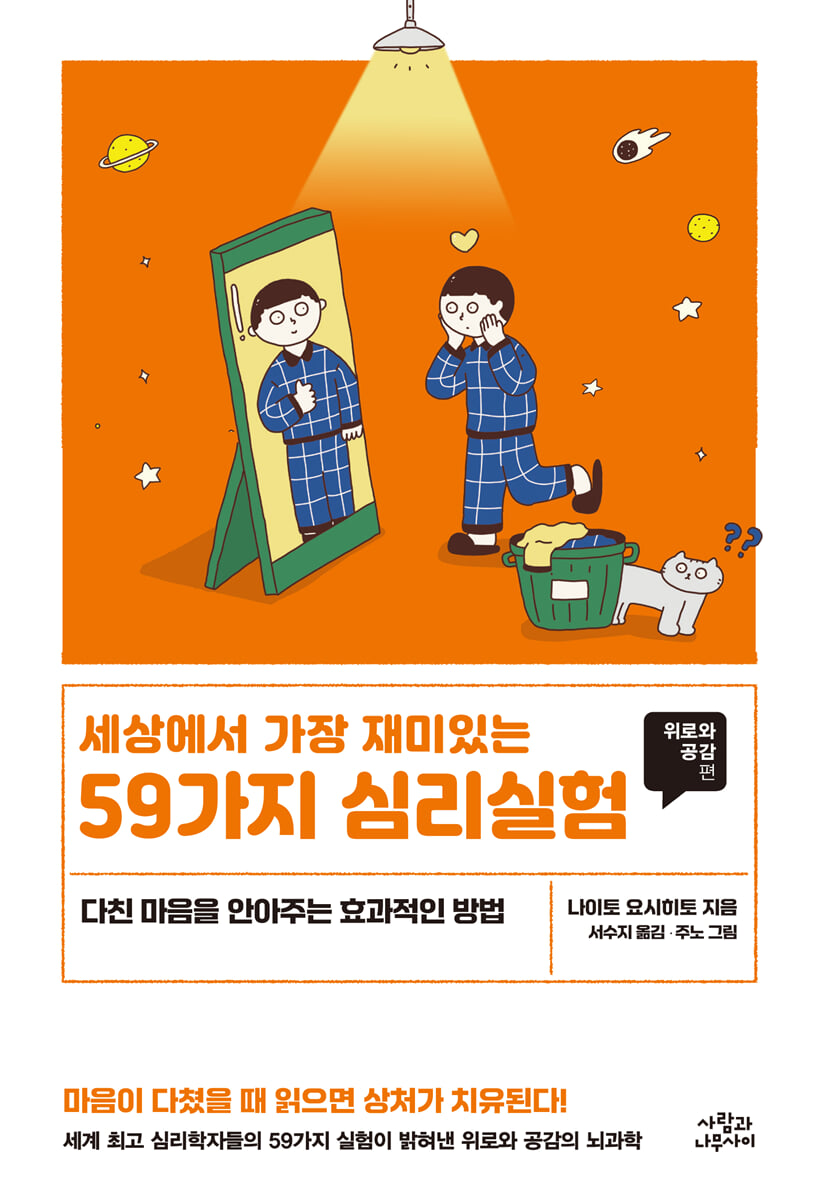
59 of the World's Funniest Psychological Experiments
 |
Description
Book Introduction
Animals comfort each other too?!
How do prairie voles care for their injured comrades?
The Secrets of Comfort and Empathy Revealed by Brain Science and 59 Psychological Experiments
The behavior of animals grooming each other is called 'grooming'.
This is an instinctive act that strengthens bonds and solidarity.
A research team at Emory University in the United States administered electric shocks to only one of the prairie voles paired together.
Then, the unshocked rats spent twice as much time grooming their companions.
On the other hand, there was no such reaction to unfamiliar objects.
Groomed rats showed reduced anxiety and increased courage.
Empathy is the beginning of comfort faster than words and is an instinct that helps us survive.
‘Empathy for myself’ has evolved into ‘empathy for others’ and into ‘comfort.’
Are you twice as likely to choose the option you can't eat in front of your best chimpanzee friend?!
― A study on the chimpanzee trust game by Dr. Engelmann's team at the Max Planck Institute
A research team at the Max Planck Institute in Germany conducted a trust game with 15 chimpanzees.
There are two options.
① Eat food that you have a low preference for, or ② Give food that you have a high preference for only your partner.
Surprisingly, the results of the experiment showed that the probability of choosing ② was twice as high when the other person was a close friend.
Chimpanzee experiments show that trust is the starting point of all social behavior.
What is the neuroscience secret behind why similar people are attracted to each other?
─ Dr. Richter's team at the Max Planck Institute for Biologically Inspired Experiments
A research team at the Max Planck Institute in Germany asked 96 5-year-old children to choose their favorite face from a series of unfamiliar faces.
One of them was a composite photo that reflected 50 percent of his face.
Children chose faces that resembled themselves 30 percent more often.
Birds of a feather flock together, not something learned, but a survival strategy built into the brain.
Can brain science alleviate human prejudice?!
─ Northwestern University Professor Faller's team's 'Sleep experiment to alleviate bias'
A research team at Northwestern University in the United States weakened prejudice against 'blacks' and 'women' through training in opposing combinations of likes and dislikes.
But the change did not last.
The research team replayed and strengthened the memory of 'weakened bias' during sleep.
The results were different.
The change continued.
Prejudice is a program engraved in the brain, but neuroscience has proven that it can be rewritten.
How do prairie voles care for their injured comrades?
The Secrets of Comfort and Empathy Revealed by Brain Science and 59 Psychological Experiments
The behavior of animals grooming each other is called 'grooming'.
This is an instinctive act that strengthens bonds and solidarity.
A research team at Emory University in the United States administered electric shocks to only one of the prairie voles paired together.
Then, the unshocked rats spent twice as much time grooming their companions.
On the other hand, there was no such reaction to unfamiliar objects.
Groomed rats showed reduced anxiety and increased courage.
Empathy is the beginning of comfort faster than words and is an instinct that helps us survive.
‘Empathy for myself’ has evolved into ‘empathy for others’ and into ‘comfort.’
Are you twice as likely to choose the option you can't eat in front of your best chimpanzee friend?!
― A study on the chimpanzee trust game by Dr. Engelmann's team at the Max Planck Institute
A research team at the Max Planck Institute in Germany conducted a trust game with 15 chimpanzees.
There are two options.
① Eat food that you have a low preference for, or ② Give food that you have a high preference for only your partner.
Surprisingly, the results of the experiment showed that the probability of choosing ② was twice as high when the other person was a close friend.
Chimpanzee experiments show that trust is the starting point of all social behavior.
What is the neuroscience secret behind why similar people are attracted to each other?
─ Dr. Richter's team at the Max Planck Institute for Biologically Inspired Experiments
A research team at the Max Planck Institute in Germany asked 96 5-year-old children to choose their favorite face from a series of unfamiliar faces.
One of them was a composite photo that reflected 50 percent of his face.
Children chose faces that resembled themselves 30 percent more often.
Birds of a feather flock together, not something learned, but a survival strategy built into the brain.
Can brain science alleviate human prejudice?!
─ Northwestern University Professor Faller's team's 'Sleep experiment to alleviate bias'
A research team at Northwestern University in the United States weakened prejudice against 'blacks' and 'women' through training in opposing combinations of likes and dislikes.
But the change did not last.
The research team replayed and strengthened the memory of 'weakened bias' during sleep.
The results were different.
The change continued.
Prejudice is a program engraved in the brain, but neuroscience has proven that it can be rewritten.
- You can preview some of the book's contents.
Preview
index
Author's Preface: Why I, a Neuroscience Researcher, Am a Happy Scientist
Chapter 1.
How does the brain generate empathy?
Psychological Experiment 01 What is the neuroscientific secret behind the attraction between similar people?
- The 'birds of a feather flock together' experiment by Dr. Richter's team at the Max Planck Institute
Psychological Experiment 02 How much do chimpanzees, who form groups with friendly individuals, trust their fellows?
- A study on the chimpanzee trust game by Dr. Engelmann's team at the Max Planck Institute
Psychological Experiment 03 Birds also have romantic feelings like humans?!
- A study on romantic emotions in birds by Dr. Ile's team at the Max Planck Institute
Psychological Experiment 04 Why does a baby try to piece together a broken plate to see its original shape?
- A study on the instinct for confirmation work by Professor Stahl's team at Johns Hopkins University
Psychological Experiment 05: Are 'average faces' and 'left-right symmetry' the universal standards of beauty?
- Professor Jones of the University of Glasgow's 'Study on Universal Beauty Standards'
Psychological Experiment 06 Why is the patience of human adults so surprisingly low compared to that of chimpanzees?
- 'Animal Endurance Limits Experiment' by Professor Rosati's team at the University of Michigan
Psychological Experiment 07 Forgetting works automatically in the brain, so it can't be stopped?
- Washington University Professor Roediger's team's study of natural forgetting
Psychological Experiment 08 Animals do not like delicious food, but rather find food that is beneficial to their body delicious?!
- A study on the phenomenon of preferring delicious food by Professor Rosati's team at the University of Michigan.
Psychological Experiment 09 Is it true that people get cancer because they are unlucky?
- Johns Hopkins University Professor Fogelstein's team's study on why people get cancer
Psychological Experiment 10: The more creative a job requires, the lower the morality?
- A study on the relationship between honesty and intelligence by a Harvard University professor and Duke University's Dr. Ariely team.
Psychological Experiment 11: When a person wears a fake product, does it actually turn them into something like the fake product?
- Harvard University Professor Gino's team's study on the psychology of purchasing counterfeit goods
Psychological Experiment 12 How does nature accurately select 2,998 out of 3,000 salmon eggs, or 99.9 percent?
- A study on human characteristics from a food chain perspective by Professor Dearymont's team at Victoria University.
Chapter 2.
What amazing things would happen if we combined brains?
Psychological Experiment 13: Can Brain Science Alleviate Human Prejudice?
- Northwestern University Professor Faller's team's 'Sleep Experiment to Alleviate Bias'
Psychological Experiment 14: The brain has developed a unique neural circuit to eliminate physical pain?!
- Tokyo University Professor Yuji's 'Research on the Brain's Pain Elimination Neural Circuit'
Psychological Experiment 15: Both rats and humans show that the more they fail initially, the higher their final success rate noticeably?!
- Tokyo University Professor Yuji's team's 'Experiment using rats to find the shortest distance in a maze'
Psychological Experiment 16 What is the neuroscientific basis for the tendency for attractiveness to increase when multiple photos are shown at once rather than when only one is shown?
- 'Cheerleader Effect Experiment' by Professor Pan Os's team at the University of California
Psychological Experiment 17 The brain has great potential and can be refined no matter how old you get?!
- A maze exploration experiment using blind rats by Professor Yuji Yu's team at the University of Tokyo.
Psychological Experiment 18: Do rat brains have the same outstanding 'parallel processing ability' as the human brain?
- Tokyo University Professor Yuji's 'Research on Brain Neurons'
Psychological Experiment 19: What is the neuroscientific basis for the inability to perceive 'time changes' when one loses all memory?
- Professor Yuji Yu of the University of Tokyo's 'Research on the Brain, Memory, and Time'
Psychological Experiment 20: Why is math so much more popular than other subjects in terms of neuroscience?
- Oxford University Professor Kadosh's team's 'dorsolateral prefrontal cortex stimulation activation experiment'
Psychological Experiment 21 What is the neuroscientific basis for why Westerners who never used chopsticks as children are just as good at it as Asians?
- Yale University Professor Finn's team's 'Habit Identification Experiment Through Brain Activity'
Psychological Experiment 22 What amazing things would happen if we combined brains?
- Duke University Professor Nicolelis's team's 'Brainnet Theory'
Psychological Experiment 23: Does the brain prefer something that costs money to something that comes without effort?
- Tokyo University Professor Yuji's 'Contra-Freeloading Effect Experiment'
Psychological Experiment 24 What is the reason that two elevators with very different departure times end up at almost the same floor at some point?
- Dr. Gallas's "Self-Organizing Emergence Phenomenon Experiment" at the Jülich Institute
Chapter 3.
Why "Praise Makes Even Whales Dance" Is Neuroscientifically Dangerous
Psychological Experiment 25: Stimulating the sweet brain region actually produces the same reaction as licking something 'sweet'?
- Two ways to evoke a virtual sense of taste, by Professor Rana Singer's team at the National University of Singapore and Professor Peng's team at Columbia University.
Psychological Experiment 26: What is the neuroscientific basis for why professional musicians have no difficulty conversing in noisy environments?
- Northwestern University Professor Kraus's team's 'Test of Sound Identification Ability Using Brain Wave Tracking'
Psychological Experiment 27: Many conservatives have a "fake smile" where the corners of their mouths go up when they smile, but their eyes don't. Why is that?
- A survey on happiness conducted by Professor Ditto's team at the University of California.
Psychological Experiment 28 Why is the claim that “praise makes even whales dance” creepy from a neuroscientific perspective?
- An experiment to change tastes by manipulating the brain by Dr. Benchenane's team at the French National Center for Scientific Research.
Psychological Experiment 29 How can thoughts in your head appear on the screen through the keyboard, from a neuroscientific perspective?
- Tokyo University Professor Yuji's "Study on the Identity of the Will to Write"
Psychological Experiment 30 The brain has a special ability to see 'ideal' images in memory by supplementing them with imagination?!
- 'Color perception experiment using banana images' by Professor Gegenfurtner's team at Justus Liebig University of Giessen
Psychological Experiment 31: Does reading a lot during childhood help develop the brain?
- A study on the effects of reading on the brain response by Dr. Pegado's team at the French National Institute of Health and Medical Research.
Psychological Experiment 32: What is the difference between 'reality', 'dreams', and 'hallucinations'?
- Professor Yukiyasu's team at Kyoto University conducted an experiment to predict dreams through brain activity during sleep.
Chapter 4.
The paradox of neuroscience: Children abused by their parents love them more.
Psychological Experiment 33 What is the surprising secret of oxytocin that makes even women who didn't like children love their children?
- A study on the relationship between parenting and oxytocin secretion by Professor Abraham's team at Bar-Ilan University.
Psychological Experiment 34 What is the neuroscientific basis for believing that moral children are born and raised by moral parents?
- 'Infant Moral Behavior Experiment' by Professor DeSeti's team at the University of Chicago
Psychological Experiment 35: 43% of the difference in motivation between individuals is due to genetics?!
- An experiment on the relationship between motivation and genetics by Professor Kobas's team at Tomsk State University.
Psychological Experiment 36: What is the terrifying brain science paradox that says children who are abused by their parents love them more?
- Professor Sullivan's team at New York University conducted a fear conditioning experiment using rats.
Psychological Experiment 37 Why are flirtatious male prairie voles at greater risk of losing their mates?
- Analysis of the philandering nature of male prairie voles by Professor Okobbat's team at the University of Texas.
Psychological Experiment 38 The secret to humanity's growing size and intelligence over generations is 'crossbreeding'?!
- 'Study on the Benefits of Crossbreeding' by Professor Joshi's team at the University of Edinburgh
Chapter 5.
Can the human brain survive the competition with artificial intelligence?
Psychological Experiment 39 How much of my current share should I leave to ensure a stable inheritance for future generations?
- Harvard University Professor Nowak's team's 'Future and Collaboration Experiment'
Psychological Experiment 40 Why are more and more people consulting artificial intelligence rather than humans about their intimate psychological issues?
- Harvard University Professor Bohannon's team's study on the frequency of patients choosing AI counseling
Psychological Experiment 41 From a genetic perspective, why are humans not superior to other organisms, even yeast?
- Professor Katsuru's team at Concordia University's 'Yeast Humanization Project'
Psychological Experiment 42 Is it true that lifespan varies depending on temperature?
- 'Developmental Promotion Experiment Using Lizards' by Dr. Bastion's team at the French National Center for Scientific Research
Psychological Experiment 43 How did computers surpass humans in tasks that require high-level abilities, such as intuition, that only humans possess?
"A Study on Artificial Intelligence That Surpasses Human Long-Term Skills" by Professor Yuji Yu of the University of Tokyo
Psychological Experiment 44: Can AI ultimately surpass human intelligence?
Google AI Development Team's 'Research on Deep Learning Applications of Reinforcement Learning'
Psychological Experiment 45: Can AI Create 'New Letters'?
- Professor Lake's team at New York University's 'Experiment on Classification and Creativity Through Text'
Psychological Experiment 46 They say they've successfully developed a robot that utilizes the water strider's amazing ability to move and jump freely on water?!
- 'Lightweight water jumping robot' by Professor Cho Kyu-jin's team at Seoul National University
Psychological Experiment 47: Most of the 'vanilla flavor' used in desserts is a synthetic artificial additive?
- Dr. Waltz of the Donald Danforth Center for Plant Sciences' 'Microbial Synthesis Research'
Chapter 6.
The Neuroscience Reason Why Humans Are Unusually Tolerant of Their Appearance
Psychological Experiment 48 Prairie rats that received electric shocks showed a marked decrease in anxiety after being groomed by a friend?
- Professor Burkitt's team at Emory University's 'Experiment on Comfort through Prairie Rat Grooming'
Psychological Experiment 9: Does the pigeon with the best flying ability become the leader, rather than the pigeon with the best commanding ability?
- Oxford University Professor Biro's team's study of the pigeon leader selection process
Psychological Experiment 50: Is it true that poker can fundamentally change human society?
Professor Bolling's team at the University of Alberta discovered the optimal chess solution.
Psychological Experiment 51: What is the neuroscientific reason why our self-evaluation of our appearance is on average 34 percent higher than others' evaluation of our appearance?
- Self-Assessment Preference Experiment by Dr. Nestor's team at the Florida Clinical and Aesthetic Research Center
Psychological Experiment 52: Are Jokes Effective as a 'Strategy to Gain Advantage Over the Other Person'?
Professor Cantor of the University of Wisconsin's "Joke Effect Study"
Psychological Experiment 53: How is it possible to have a winning strategy in rock-paper-scissors that never gives up, no matter what the situation?
Professor Watanabe's team at the University of Tokyo developed a robot that can play rock-paper-scissors with a 100 percent chance of winning.
Psychological Experiment 54: Is blood type the most important factor in suicide, regardless of nationality or race?
- Study on the relationship between malaria and blood type by Dr. Valgren's team at the Karolinska Institutet
Psychological Experiment 55 Why did humans develop a strange joint that allows them to apply force with their thumb pointing in the opposite direction, unlike other animals?
- Kent University Professor Skinner's team's study proving human ignorance
Psychological Experiment 56 The number of trees on Earth is 10 times more than the number of stars in our galaxy?
- Professor Crowther's team at the University of Illinois' 'Global Tree Counting Project'
Psychological Experiment 57 Why is it interesting that 90% of people's palanquins 'turn to the left'?
- Professor Yuji Yu of the University of Tokyo's "Considerations on Why Kilns Are Not Bilaterally Symmetrical"
Psychological Experiment 58: Does the average person walk three and a half times around the Earth in their lifetime?
- Professor Collins' team at Carnegie Mellon University's study, "Identifying Human Weaknesses Through Skeletal and Muscle Movement During Walking."
Psychological Experiment 59 Only 14% of people feel and like the unique stimulating scent of a master?!
- Tokyo University Professor Yuji's "Analysis of the Genetic Code of the Master and a Study of Flavor"
References
Chapter 1.
How does the brain generate empathy?
Psychological Experiment 01 What is the neuroscientific secret behind the attraction between similar people?
- The 'birds of a feather flock together' experiment by Dr. Richter's team at the Max Planck Institute
Psychological Experiment 02 How much do chimpanzees, who form groups with friendly individuals, trust their fellows?
- A study on the chimpanzee trust game by Dr. Engelmann's team at the Max Planck Institute
Psychological Experiment 03 Birds also have romantic feelings like humans?!
- A study on romantic emotions in birds by Dr. Ile's team at the Max Planck Institute
Psychological Experiment 04 Why does a baby try to piece together a broken plate to see its original shape?
- A study on the instinct for confirmation work by Professor Stahl's team at Johns Hopkins University
Psychological Experiment 05: Are 'average faces' and 'left-right symmetry' the universal standards of beauty?
- Professor Jones of the University of Glasgow's 'Study on Universal Beauty Standards'
Psychological Experiment 06 Why is the patience of human adults so surprisingly low compared to that of chimpanzees?
- 'Animal Endurance Limits Experiment' by Professor Rosati's team at the University of Michigan
Psychological Experiment 07 Forgetting works automatically in the brain, so it can't be stopped?
- Washington University Professor Roediger's team's study of natural forgetting
Psychological Experiment 08 Animals do not like delicious food, but rather find food that is beneficial to their body delicious?!
- A study on the phenomenon of preferring delicious food by Professor Rosati's team at the University of Michigan.
Psychological Experiment 09 Is it true that people get cancer because they are unlucky?
- Johns Hopkins University Professor Fogelstein's team's study on why people get cancer
Psychological Experiment 10: The more creative a job requires, the lower the morality?
- A study on the relationship between honesty and intelligence by a Harvard University professor and Duke University's Dr. Ariely team.
Psychological Experiment 11: When a person wears a fake product, does it actually turn them into something like the fake product?
- Harvard University Professor Gino's team's study on the psychology of purchasing counterfeit goods
Psychological Experiment 12 How does nature accurately select 2,998 out of 3,000 salmon eggs, or 99.9 percent?
- A study on human characteristics from a food chain perspective by Professor Dearymont's team at Victoria University.
Chapter 2.
What amazing things would happen if we combined brains?
Psychological Experiment 13: Can Brain Science Alleviate Human Prejudice?
- Northwestern University Professor Faller's team's 'Sleep Experiment to Alleviate Bias'
Psychological Experiment 14: The brain has developed a unique neural circuit to eliminate physical pain?!
- Tokyo University Professor Yuji's 'Research on the Brain's Pain Elimination Neural Circuit'
Psychological Experiment 15: Both rats and humans show that the more they fail initially, the higher their final success rate noticeably?!
- Tokyo University Professor Yuji's team's 'Experiment using rats to find the shortest distance in a maze'
Psychological Experiment 16 What is the neuroscientific basis for the tendency for attractiveness to increase when multiple photos are shown at once rather than when only one is shown?
- 'Cheerleader Effect Experiment' by Professor Pan Os's team at the University of California
Psychological Experiment 17 The brain has great potential and can be refined no matter how old you get?!
- A maze exploration experiment using blind rats by Professor Yuji Yu's team at the University of Tokyo.
Psychological Experiment 18: Do rat brains have the same outstanding 'parallel processing ability' as the human brain?
- Tokyo University Professor Yuji's 'Research on Brain Neurons'
Psychological Experiment 19: What is the neuroscientific basis for the inability to perceive 'time changes' when one loses all memory?
- Professor Yuji Yu of the University of Tokyo's 'Research on the Brain, Memory, and Time'
Psychological Experiment 20: Why is math so much more popular than other subjects in terms of neuroscience?
- Oxford University Professor Kadosh's team's 'dorsolateral prefrontal cortex stimulation activation experiment'
Psychological Experiment 21 What is the neuroscientific basis for why Westerners who never used chopsticks as children are just as good at it as Asians?
- Yale University Professor Finn's team's 'Habit Identification Experiment Through Brain Activity'
Psychological Experiment 22 What amazing things would happen if we combined brains?
- Duke University Professor Nicolelis's team's 'Brainnet Theory'
Psychological Experiment 23: Does the brain prefer something that costs money to something that comes without effort?
- Tokyo University Professor Yuji's 'Contra-Freeloading Effect Experiment'
Psychological Experiment 24 What is the reason that two elevators with very different departure times end up at almost the same floor at some point?
- Dr. Gallas's "Self-Organizing Emergence Phenomenon Experiment" at the Jülich Institute
Chapter 3.
Why "Praise Makes Even Whales Dance" Is Neuroscientifically Dangerous
Psychological Experiment 25: Stimulating the sweet brain region actually produces the same reaction as licking something 'sweet'?
- Two ways to evoke a virtual sense of taste, by Professor Rana Singer's team at the National University of Singapore and Professor Peng's team at Columbia University.
Psychological Experiment 26: What is the neuroscientific basis for why professional musicians have no difficulty conversing in noisy environments?
- Northwestern University Professor Kraus's team's 'Test of Sound Identification Ability Using Brain Wave Tracking'
Psychological Experiment 27: Many conservatives have a "fake smile" where the corners of their mouths go up when they smile, but their eyes don't. Why is that?
- A survey on happiness conducted by Professor Ditto's team at the University of California.
Psychological Experiment 28 Why is the claim that “praise makes even whales dance” creepy from a neuroscientific perspective?
- An experiment to change tastes by manipulating the brain by Dr. Benchenane's team at the French National Center for Scientific Research.
Psychological Experiment 29 How can thoughts in your head appear on the screen through the keyboard, from a neuroscientific perspective?
- Tokyo University Professor Yuji's "Study on the Identity of the Will to Write"
Psychological Experiment 30 The brain has a special ability to see 'ideal' images in memory by supplementing them with imagination?!
- 'Color perception experiment using banana images' by Professor Gegenfurtner's team at Justus Liebig University of Giessen
Psychological Experiment 31: Does reading a lot during childhood help develop the brain?
- A study on the effects of reading on the brain response by Dr. Pegado's team at the French National Institute of Health and Medical Research.
Psychological Experiment 32: What is the difference between 'reality', 'dreams', and 'hallucinations'?
- Professor Yukiyasu's team at Kyoto University conducted an experiment to predict dreams through brain activity during sleep.
Chapter 4.
The paradox of neuroscience: Children abused by their parents love them more.
Psychological Experiment 33 What is the surprising secret of oxytocin that makes even women who didn't like children love their children?
- A study on the relationship between parenting and oxytocin secretion by Professor Abraham's team at Bar-Ilan University.
Psychological Experiment 34 What is the neuroscientific basis for believing that moral children are born and raised by moral parents?
- 'Infant Moral Behavior Experiment' by Professor DeSeti's team at the University of Chicago
Psychological Experiment 35: 43% of the difference in motivation between individuals is due to genetics?!
- An experiment on the relationship between motivation and genetics by Professor Kobas's team at Tomsk State University.
Psychological Experiment 36: What is the terrifying brain science paradox that says children who are abused by their parents love them more?
- Professor Sullivan's team at New York University conducted a fear conditioning experiment using rats.
Psychological Experiment 37 Why are flirtatious male prairie voles at greater risk of losing their mates?
- Analysis of the philandering nature of male prairie voles by Professor Okobbat's team at the University of Texas.
Psychological Experiment 38 The secret to humanity's growing size and intelligence over generations is 'crossbreeding'?!
- 'Study on the Benefits of Crossbreeding' by Professor Joshi's team at the University of Edinburgh
Chapter 5.
Can the human brain survive the competition with artificial intelligence?
Psychological Experiment 39 How much of my current share should I leave to ensure a stable inheritance for future generations?
- Harvard University Professor Nowak's team's 'Future and Collaboration Experiment'
Psychological Experiment 40 Why are more and more people consulting artificial intelligence rather than humans about their intimate psychological issues?
- Harvard University Professor Bohannon's team's study on the frequency of patients choosing AI counseling
Psychological Experiment 41 From a genetic perspective, why are humans not superior to other organisms, even yeast?
- Professor Katsuru's team at Concordia University's 'Yeast Humanization Project'
Psychological Experiment 42 Is it true that lifespan varies depending on temperature?
- 'Developmental Promotion Experiment Using Lizards' by Dr. Bastion's team at the French National Center for Scientific Research
Psychological Experiment 43 How did computers surpass humans in tasks that require high-level abilities, such as intuition, that only humans possess?
"A Study on Artificial Intelligence That Surpasses Human Long-Term Skills" by Professor Yuji Yu of the University of Tokyo
Psychological Experiment 44: Can AI ultimately surpass human intelligence?
Google AI Development Team's 'Research on Deep Learning Applications of Reinforcement Learning'
Psychological Experiment 45: Can AI Create 'New Letters'?
- Professor Lake's team at New York University's 'Experiment on Classification and Creativity Through Text'
Psychological Experiment 46 They say they've successfully developed a robot that utilizes the water strider's amazing ability to move and jump freely on water?!
- 'Lightweight water jumping robot' by Professor Cho Kyu-jin's team at Seoul National University
Psychological Experiment 47: Most of the 'vanilla flavor' used in desserts is a synthetic artificial additive?
- Dr. Waltz of the Donald Danforth Center for Plant Sciences' 'Microbial Synthesis Research'
Chapter 6.
The Neuroscience Reason Why Humans Are Unusually Tolerant of Their Appearance
Psychological Experiment 48 Prairie rats that received electric shocks showed a marked decrease in anxiety after being groomed by a friend?
- Professor Burkitt's team at Emory University's 'Experiment on Comfort through Prairie Rat Grooming'
Psychological Experiment 9: Does the pigeon with the best flying ability become the leader, rather than the pigeon with the best commanding ability?
- Oxford University Professor Biro's team's study of the pigeon leader selection process
Psychological Experiment 50: Is it true that poker can fundamentally change human society?
Professor Bolling's team at the University of Alberta discovered the optimal chess solution.
Psychological Experiment 51: What is the neuroscientific reason why our self-evaluation of our appearance is on average 34 percent higher than others' evaluation of our appearance?
- Self-Assessment Preference Experiment by Dr. Nestor's team at the Florida Clinical and Aesthetic Research Center
Psychological Experiment 52: Are Jokes Effective as a 'Strategy to Gain Advantage Over the Other Person'?
Professor Cantor of the University of Wisconsin's "Joke Effect Study"
Psychological Experiment 53: How is it possible to have a winning strategy in rock-paper-scissors that never gives up, no matter what the situation?
Professor Watanabe's team at the University of Tokyo developed a robot that can play rock-paper-scissors with a 100 percent chance of winning.
Psychological Experiment 54: Is blood type the most important factor in suicide, regardless of nationality or race?
- Study on the relationship between malaria and blood type by Dr. Valgren's team at the Karolinska Institutet
Psychological Experiment 55 Why did humans develop a strange joint that allows them to apply force with their thumb pointing in the opposite direction, unlike other animals?
- Kent University Professor Skinner's team's study proving human ignorance
Psychological Experiment 56 The number of trees on Earth is 10 times more than the number of stars in our galaxy?
- Professor Crowther's team at the University of Illinois' 'Global Tree Counting Project'
Psychological Experiment 57 Why is it interesting that 90% of people's palanquins 'turn to the left'?
- Professor Yuji Yu of the University of Tokyo's "Considerations on Why Kilns Are Not Bilaterally Symmetrical"
Psychological Experiment 58: Does the average person walk three and a half times around the Earth in their lifetime?
- Professor Collins' team at Carnegie Mellon University's study, "Identifying Human Weaknesses Through Skeletal and Muscle Movement During Walking."
Psychological Experiment 59 Only 14% of people feel and like the unique stimulating scent of a master?!
- Tokyo University Professor Yuji's "Analysis of the Genetic Code of the Master and a Study of Flavor"
References
Detailed image

Into the book
A research team led by Dr. Nadja Richter at the Max Planck Institute for Physics in Germany conducted research from this perspective.
The research team showed 96 five-year-old children photographs and asked them to choose their favorite face.
All the photos were of strangers, and one of them had 50 percent of his facial features altered using synthetic techniques.
In other words, it was a face that 'slightly resembled' me.
The percentage of children who participated in the experiment who chose photos that resembled themselves was 30 percent higher than those who chose other photos.
Children are not specially trained to choose people who look like them.
That is, driven by instinct, they naturally chose someone similar to themselves.
The brain reacts sensitively to ‘unknown danger’.
If you don't fully understand the situation, you worry that danger is lurking somewhere, so you become cautious and cautious.
For example, in a dark and secluded alley, you feel uneasy and your steps become faster.
I often walk to a bright and safe place with a little bit of open view.
The 'invisible' situation is terrifying.
Similarly, when surrounded by strangers, we look around to find someone with even a slight resemblance to a familiar face (like our own), and this psychological drive is a desire to avoid potential danger.
In other words, the 'birds of a feather flock together' strategy of long evolutionary survival, and can be said to be a basic program naturally embedded in the brain.
--- From "What is the neuroscientific secret behind the attraction between similar people?"
Jan M. Engelmann of the Max Planck Institute
Dr. Engelmann's research team observed a group of 15 chimpanzees for five months, assessing their 'friendliness' and randomly pairing them up to play a trust game repeatedly, in a paper published in the scientific journal Current Biology.
The research team gave one of the paired chimpanzees two choices.
If you select ①, a food with low preference will be given, and if you select ②, a food with very high preference will be given to the 'partner' chimpanzee (the selected chimpanzee cannot eat anything).
If you cannot trust the other person, it is safer to choose ①, and if you can expect the other person to reciprocate, it is wiser to choose ②.
This is because there is a possibility that the other person will also choose ② in the next experiment.
In this situation, when the chimpanzee's partner was a close friend, the probability of choosing ② was about twice as high as when the chimpanzee was not a close friend.
That is, friendly relations and trust are closely related.
Trust is an act of testing 'courage'.
But trust is also the starting point for social behaviors such as grooming, sharing food, and working together.
Since the time when humans were still monkeys, they have always possessed the 'courage' to trust others.
I am encouraged by the heartwarming results of this experiment.
--- From "How much do chimpanzees, who form groups of friendly individuals, trust their fellows?"
Unconscious bias can be measured with the 'latent association test'.
For example, if you associate bright words like 'smile' and 'sunshine' with dark words like 'bomb' and 'disaster' with 'white' and 'black', there will be a subtle difference in judgment speed depending on the combination, and this difference is measured.
Then, even if you consciously try to treat others equally, the prejudices that you have kept hidden deep inside your heart will be revealed.
If you apply this experiment to a variety of people, you'll find that there's a near-universal psychological tendency to consider "black" and "women" as one level lower.
Unfortunately, this is the truth.
But there is hope.
This tendency can be corrected by training to combine likes and dislikes in the opposite way.
As a result of the training, it was revealed that unconscious discrimination was weakened and people changed to judge equally.
However, this change does not last long and usually returns to normal after a few hours.
So how can we maintain this effect over the long term? The research team came up with the idea of utilizing sleep.
For human behavior to change, ‘plasticity’, or ‘memory’, is required.
Memories are recalled and strengthened during sleep.
To permanently fix the memory of 'weakened bias' in the brain, it is effective to play it back during sleep.
--- From "Can Brain Science Alleviate Human Prejudice?"
However, a research team led by Dr. Yvette van Osch of the University of California, USA, is negative about this claim.
Because the cheerleader effect occurs even in photos.
The appeal is enhanced when you look at several ID photos lined up rather than just one.
According to a 2015 study published in Psychological Science, presenting just four ID photos is enough to achieve the cheerleading effect.
The 'viewing time' hypothesis can also be considered.
Naturally, if there are a lot of people, the time for each person to savor the food becomes shorter.
It is generally known that if the time for presenting an ID photo is shorter than 0.5 seconds, there is no time to examine every nook and cranny and find faults, which results in a more favorable evaluation of the person.
So, Dr. Oss' research team conducted an experiment by adjusting the environment so that the average gaze time was equal, but the cheerleader effect did not disappear.
'Concealment' is also a factor known to increase a person's attractiveness.
For example, there is a saying that the conditions for a woman to look beautiful are 'night, distance, and umbrella.'
It is said that it is most beautiful when viewed from a dark and distant place with an umbrella.
Night, distance, and umbrellas have one thing in common: they are 'hard to see'.
The brain imagines the hidden parts as ideals.
So the research team experimented with out-of-focus photos.
Just by blurring the focus, the attractiveness score of the face increased by a deviation of 10 points.
However, when they were in groups, the evaluation scores went up even more, and the cheerleader effect also worked as a way to distract from the focus.
--- From "What is the neuroscientific basis for the tendency for attractiveness to increase when multiple photos are shown at once rather than when only one is shown?"
Let's look at two more BrainNet achievements announced by Arjun Ramakrishnan's research team in July 2015.
First, three monkeys were asked to work together to move a ball in a virtual space on a computer screen to a destination.
Virtual space is three-dimensional, consisting of the X, Y, and Z axes.
Each monkey must move the axis assigned to them and work together to move the ball.
Three breaths are needed because if even one of them makes a mistake, the ball will go off course.
In this experiment, the monkeys did not operate the lever with their hands.
A device was set up to directly connect the brains of three monkeys to a computer, allowing the neural activity of the monkeys to be synchronized through the computer.
The monkeys found that after about a month of training in this strange situation, they could skillfully move the ball in coordination.
In experiments using rats, the brains of four rats were successfully linked.
We considered each mouse as a computing element and set up an artificial circuit consisting of four computing elements and assigned it various tasks.
Artificial intelligence also requires four components.
Compared to the latest artificial intelligence, the circuit is much smaller in scale, but it was able to perform simple image recognition and other tasks.
During this task, the rats were completely focused on their 'little' role.
Each rat simply changed its brain activity in response to signals sent from the upstream circuit.
Then, a device mounted on the head silently performed a series of tasks by reading the brain activity and transmitting it to the lower brain.
--- From "What Amazing Things Will Happen When Brains Combine?"
When did this aversion begin? Regina M. Sullivan of New York University, USA.
Professor Sullivan's research team conducted a fear conditioning experiment on infant rats and published the results in the Journal of the National Academy of Sciences in January 2015.
The research team exposed the baby rats to the scent of peppermint for two weeks after birth.
Peppermint is a neutral scent for rats, meaning they neither like it nor dislike it.
However, when baby rats were exposed to the smell of peppermint and then given an electric shock, the results were shocking.
The adult rat never approached the peppermint again, but the pups did.
At the same time, the tendency to act spoiled by the mother rat also increased.
Although this may seem like an unexpected result, there is actually a profound truth hidden in this phenomenon.
Baby rats grow up in a safe environment in the arms of their mother rats, so they do not know hardship or pain.
If you have a bitter experience, it is obviously the pain your mother gave you.
It constitutes abuse.
The research team's experimental results proved the chilling fact that abused children actually come to like their caregivers.
This phenomenon is an automatic program installed across mammals, including humans, and is called 'trauma bonding'.
For example, preschool children have absolute trust in their caregivers.
Be unconditionally kind to your parents.
Even if they are abused, they don't hate their parents to any great extent.
It is not uncommon for children to show affection even to abusive parents.
This effect is so strong that abused children develop an affinity for their abuser's characteristics (such as body odor) even as adults.
Why does this phenomenon occur? Is it because we long for the parental love we didn't experience in childhood? There's a complex psychology at play here.
It is not a mentality of longing for what one does not have and trying to fill in what is lacking.
This kind of psychology is an instinct that developed during the evolution of animals.
--- From "What is the terrifying paradox of brain science that says 'children who are abused by their parents love their parents more'?"
The simple contact phenomenon can be observed in various situations in our daily lives.
For example, we feel closer to family and acquaintances than to strangers.
Also, as the saying goes, "If you live there and get attached to it, it becomes your hometown," even if you live in a place you have no connection to, you gradually become attached to it.
But the object most familiar to me is my own face.
You can see it in the bathroom mirror every morning.
If you meet someone this often, it's not surprising that they give you high marks for your appearance just from simple contact.
However, some might counter by saying, “There are many people who are not satisfied with their own faces.”
But the key here is whether there is a difference between the 'subjective evaluation' I give my face and the 'objective evaluation' others give my face.
Dr. Nestor's research team at the Florida Clinical and Cosmetic Research Center in the United States studied this.
The research team showed 67 participants a series of photographs of faces and asked them to rate them.
The photo also included the participant's own face.
The results were as expected.
Self-evaluations were on average 34 percent higher than those given by others.
It has been proven that people tend to evaluate their appearance higher than reality.
The research team showed 96 five-year-old children photographs and asked them to choose their favorite face.
All the photos were of strangers, and one of them had 50 percent of his facial features altered using synthetic techniques.
In other words, it was a face that 'slightly resembled' me.
The percentage of children who participated in the experiment who chose photos that resembled themselves was 30 percent higher than those who chose other photos.
Children are not specially trained to choose people who look like them.
That is, driven by instinct, they naturally chose someone similar to themselves.
The brain reacts sensitively to ‘unknown danger’.
If you don't fully understand the situation, you worry that danger is lurking somewhere, so you become cautious and cautious.
For example, in a dark and secluded alley, you feel uneasy and your steps become faster.
I often walk to a bright and safe place with a little bit of open view.
The 'invisible' situation is terrifying.
Similarly, when surrounded by strangers, we look around to find someone with even a slight resemblance to a familiar face (like our own), and this psychological drive is a desire to avoid potential danger.
In other words, the 'birds of a feather flock together' strategy of long evolutionary survival, and can be said to be a basic program naturally embedded in the brain.
--- From "What is the neuroscientific secret behind the attraction between similar people?"
Jan M. Engelmann of the Max Planck Institute
Dr. Engelmann's research team observed a group of 15 chimpanzees for five months, assessing their 'friendliness' and randomly pairing them up to play a trust game repeatedly, in a paper published in the scientific journal Current Biology.
The research team gave one of the paired chimpanzees two choices.
If you select ①, a food with low preference will be given, and if you select ②, a food with very high preference will be given to the 'partner' chimpanzee (the selected chimpanzee cannot eat anything).
If you cannot trust the other person, it is safer to choose ①, and if you can expect the other person to reciprocate, it is wiser to choose ②.
This is because there is a possibility that the other person will also choose ② in the next experiment.
In this situation, when the chimpanzee's partner was a close friend, the probability of choosing ② was about twice as high as when the chimpanzee was not a close friend.
That is, friendly relations and trust are closely related.
Trust is an act of testing 'courage'.
But trust is also the starting point for social behaviors such as grooming, sharing food, and working together.
Since the time when humans were still monkeys, they have always possessed the 'courage' to trust others.
I am encouraged by the heartwarming results of this experiment.
--- From "How much do chimpanzees, who form groups of friendly individuals, trust their fellows?"
Unconscious bias can be measured with the 'latent association test'.
For example, if you associate bright words like 'smile' and 'sunshine' with dark words like 'bomb' and 'disaster' with 'white' and 'black', there will be a subtle difference in judgment speed depending on the combination, and this difference is measured.
Then, even if you consciously try to treat others equally, the prejudices that you have kept hidden deep inside your heart will be revealed.
If you apply this experiment to a variety of people, you'll find that there's a near-universal psychological tendency to consider "black" and "women" as one level lower.
Unfortunately, this is the truth.
But there is hope.
This tendency can be corrected by training to combine likes and dislikes in the opposite way.
As a result of the training, it was revealed that unconscious discrimination was weakened and people changed to judge equally.
However, this change does not last long and usually returns to normal after a few hours.
So how can we maintain this effect over the long term? The research team came up with the idea of utilizing sleep.
For human behavior to change, ‘plasticity’, or ‘memory’, is required.
Memories are recalled and strengthened during sleep.
To permanently fix the memory of 'weakened bias' in the brain, it is effective to play it back during sleep.
--- From "Can Brain Science Alleviate Human Prejudice?"
However, a research team led by Dr. Yvette van Osch of the University of California, USA, is negative about this claim.
Because the cheerleader effect occurs even in photos.
The appeal is enhanced when you look at several ID photos lined up rather than just one.
According to a 2015 study published in Psychological Science, presenting just four ID photos is enough to achieve the cheerleading effect.
The 'viewing time' hypothesis can also be considered.
Naturally, if there are a lot of people, the time for each person to savor the food becomes shorter.
It is generally known that if the time for presenting an ID photo is shorter than 0.5 seconds, there is no time to examine every nook and cranny and find faults, which results in a more favorable evaluation of the person.
So, Dr. Oss' research team conducted an experiment by adjusting the environment so that the average gaze time was equal, but the cheerleader effect did not disappear.
'Concealment' is also a factor known to increase a person's attractiveness.
For example, there is a saying that the conditions for a woman to look beautiful are 'night, distance, and umbrella.'
It is said that it is most beautiful when viewed from a dark and distant place with an umbrella.
Night, distance, and umbrellas have one thing in common: they are 'hard to see'.
The brain imagines the hidden parts as ideals.
So the research team experimented with out-of-focus photos.
Just by blurring the focus, the attractiveness score of the face increased by a deviation of 10 points.
However, when they were in groups, the evaluation scores went up even more, and the cheerleader effect also worked as a way to distract from the focus.
--- From "What is the neuroscientific basis for the tendency for attractiveness to increase when multiple photos are shown at once rather than when only one is shown?"
Let's look at two more BrainNet achievements announced by Arjun Ramakrishnan's research team in July 2015.
First, three monkeys were asked to work together to move a ball in a virtual space on a computer screen to a destination.
Virtual space is three-dimensional, consisting of the X, Y, and Z axes.
Each monkey must move the axis assigned to them and work together to move the ball.
Three breaths are needed because if even one of them makes a mistake, the ball will go off course.
In this experiment, the monkeys did not operate the lever with their hands.
A device was set up to directly connect the brains of three monkeys to a computer, allowing the neural activity of the monkeys to be synchronized through the computer.
The monkeys found that after about a month of training in this strange situation, they could skillfully move the ball in coordination.
In experiments using rats, the brains of four rats were successfully linked.
We considered each mouse as a computing element and set up an artificial circuit consisting of four computing elements and assigned it various tasks.
Artificial intelligence also requires four components.
Compared to the latest artificial intelligence, the circuit is much smaller in scale, but it was able to perform simple image recognition and other tasks.
During this task, the rats were completely focused on their 'little' role.
Each rat simply changed its brain activity in response to signals sent from the upstream circuit.
Then, a device mounted on the head silently performed a series of tasks by reading the brain activity and transmitting it to the lower brain.
--- From "What Amazing Things Will Happen When Brains Combine?"
When did this aversion begin? Regina M. Sullivan of New York University, USA.
Professor Sullivan's research team conducted a fear conditioning experiment on infant rats and published the results in the Journal of the National Academy of Sciences in January 2015.
The research team exposed the baby rats to the scent of peppermint for two weeks after birth.
Peppermint is a neutral scent for rats, meaning they neither like it nor dislike it.
However, when baby rats were exposed to the smell of peppermint and then given an electric shock, the results were shocking.
The adult rat never approached the peppermint again, but the pups did.
At the same time, the tendency to act spoiled by the mother rat also increased.
Although this may seem like an unexpected result, there is actually a profound truth hidden in this phenomenon.
Baby rats grow up in a safe environment in the arms of their mother rats, so they do not know hardship or pain.
If you have a bitter experience, it is obviously the pain your mother gave you.
It constitutes abuse.
The research team's experimental results proved the chilling fact that abused children actually come to like their caregivers.
This phenomenon is an automatic program installed across mammals, including humans, and is called 'trauma bonding'.
For example, preschool children have absolute trust in their caregivers.
Be unconditionally kind to your parents.
Even if they are abused, they don't hate their parents to any great extent.
It is not uncommon for children to show affection even to abusive parents.
This effect is so strong that abused children develop an affinity for their abuser's characteristics (such as body odor) even as adults.
Why does this phenomenon occur? Is it because we long for the parental love we didn't experience in childhood? There's a complex psychology at play here.
It is not a mentality of longing for what one does not have and trying to fill in what is lacking.
This kind of psychology is an instinct that developed during the evolution of animals.
--- From "What is the terrifying paradox of brain science that says 'children who are abused by their parents love their parents more'?"
The simple contact phenomenon can be observed in various situations in our daily lives.
For example, we feel closer to family and acquaintances than to strangers.
Also, as the saying goes, "If you live there and get attached to it, it becomes your hometown," even if you live in a place you have no connection to, you gradually become attached to it.
But the object most familiar to me is my own face.
You can see it in the bathroom mirror every morning.
If you meet someone this often, it's not surprising that they give you high marks for your appearance just from simple contact.
However, some might counter by saying, “There are many people who are not satisfied with their own faces.”
But the key here is whether there is a difference between the 'subjective evaluation' I give my face and the 'objective evaluation' others give my face.
Dr. Nestor's research team at the Florida Clinical and Cosmetic Research Center in the United States studied this.
The research team showed 67 participants a series of photographs of faces and asked them to rate them.
The photo also included the participant's own face.
The results were as expected.
Self-evaluations were on average 34 percent higher than those given by others.
It has been proven that people tend to evaluate their appearance higher than reality.
--- From "The Neuroscientific Reason Why Our Appearance Evaluations Are 34 Percent Higher on Average Than Others' Appearance Evaluations"
Publisher's Review
When you're hurt, read this and your wounds will heal!
The ultimate tranquilizer specially formulated using 'brain science' by world-renowned neuroscientist Professor Yuji Ikegaya!
Wounds on the body are easily visible, but wounds on the mind are not easily visible.
Wounds on the body can be healed with proper treatment, such as disinfection, medicine, and surgery, but wounds on the heart cannot be healed with disinfectants, medicine, or surgery.
We live in a time when more people are hurt than ever before.
They do not bleed like people who are wounded in the body, but they secretly shed tears and grieve and suffer.
We live in an age when we need ‘comfort’ and ‘empathy’ more than ever.
In these times, Saramwanamusae has published a book that can embrace, heal, and comfort people's wounded hearts with 'brain science' instead of using disinfectants, medicine, or surgical knives.
The book is "59 Most Interesting Psychological Experiments in the World - Comfort and Empathy," written by Professor Yuji Ikegaya of the University of Tokyo, a world-renowned neuroscientist and bestselling author.
『59 Most Interesting Psychological Experiments in the World - Comfort and Empathy』 is the sixth book in the 'Most Interesting Psychological Experiments in the World' series, which is loved by many readers and continues with 『63 Most Interesting Psychological Experiments in the World - Brain Science』, 『61 Most Interesting Psychological Experiments in the World - Human Relationships』, 『88 Most Interesting Psychological Experiments in the World - Self-Development』, 『62 Most Interesting Psychological Experiments in the World - Desire and Economy』, and 『81 Most Interesting Psychological Experiments in the World - Work and Rest』.
This book, like the previous works in the series, is written by a renowned neuroscientist who, through 59 fascinating and bizarre psychological experiments conducted by the world's most authoritative scholars in various fields such as neuroscience, psychiatry, social psychology, and behavioral economics, keenly examines how neuroscience and psychology move people's minds and lead to actions in everyday life, and how they comfort wounded hearts and build empathy.
Following the first book in the series, “63 Most Interesting Psychological Experiments in the World - Brain Science” and the second book, “61 Most Interesting Psychological Experiments in the World - Human Relationships,” this book was also organized and written by Yuji Ikegaya, a neuroscientist recognized not only in Japan but also around the world, and the author of best-selling and steady-selling books, “Read Brain Science When Life Feels Shaky,” “The Simple Brain, Complex Me,” and “Reading the Brain as Culture,” who is also a professor at the University of Tokyo.
This book contains 10 chapters, nearly 20 percent of the total, that contain the results of experiments or research conducted directly by Professor Ikegaya and his research team.
Most of the 59 psychological experiments introduced in this book are based on 'brain science', in keeping with the author's identity as a neuroscientist, and many chapters and chapters are related to the subtitle 'Comfort and Empathy'.
As readers read through the fascinating stories of brain science and psychological experiments, they will gain insight into the diverse desires and needs hidden within themselves, others, and individuals and groups.
Furthermore, readers will learn how brain science can comfort the wounded, connect hearts, inspire empathy, and foster a broader consensus. They will also gain insight into how brain science-based psychology can move and orchestrate human society.
Animals comfort each other too?!
How do prairie voles care for their injured comrades?
The Secrets of Comfort and Empathy Revealed by Brain Science and 59 Psychological Experiments
The behavior of animals grooming each other is called 'grooming'.
This is an instinctive act that strengthens bonds and solidarity.
A research team at Emory University in the United States administered electric shocks to only one of the prairie voles paired together.
Then, the unshocked rats spent twice as much time grooming their companions.
On the other hand, there was no such reaction to unfamiliar objects.
Groomed rats showed reduced anxiety and increased courage.
Empathy is the beginning of comfort faster than words and is an instinct that helps us survive.
‘Empathy for myself’ has evolved into ‘empathy for others’ and into ‘comfort.’
What is the neuroscience secret behind why similar people are attracted to each other?
― Dr. Richter's team at the Max Planck Institute for Biologically Inspired Experiments
There are those who have conducted psychological experiments to determine what the 'birds of a feather flock together' principle is and when and how this psychology emerged.
They are the research team led by Dr. Nadja Richter of the Max Planck Institute for Physics in Germany.
The research team showed 96 five-year-old children photographs and asked them to choose their favorite face.
All the faces in the photos were strangers, and one of them had 50 percent of his features altered using synthetic technology.
In other words, that one photo was of a face that 'looked a little like' himself.
What were the results of the experiment? Surprisingly, the children who participated in the experiment were 30 percent more likely to choose photos that resembled themselves than photos that didn't.
Children are driven by instinct to choose people who resemble them, even though they are not specially trained to do so.
The brain reacts sensitively to ‘unknown danger’.
If you don't fully understand the situation, you worry that danger is lurking somewhere, so you become cautious and cautious.
For example, in a dark and secluded alley, you feel uneasy and your steps become faster.
I often walk to a bright and safe place with a little bit of open view.
The 'invisible' situation is terrifying in itself.
Similarly, when surrounded by strangers, we look around to find someone with even a slight resemblance to a familiar face (like our own), a psychological drive to avoid potential danger.
In other words, the 'birds of a feather flock together' strategy of long evolutionary survival, and can be said to be a basic program naturally embedded in the brain.
How much do chimpanzees, who form groups of friendly individuals, trust other chimpanzees?
― A study on the chimpanzee trust game by Dr. Engelmann's team at the Max Planck Institute
How can we mitigate the risk of harm from betrayal? A useful approach is to cultivate a close relationship with a specific business partner and maintain a positive long-term relationship.
In this context, the concept of friendship was created, and the proposition that “friendship is a great defense against betrayal” was born.
To verify the scientific validity of this proposition, some scientists have analyzed whether trust and friendliness are two sides of the same coin in animals other than humans.
That is, they scientifically verified through experiments with chimpanzees how much these animals trust their fellows.
The scientists who conducted this experiment were Jan M. Engelmann of the Max Planck Institute for
This is the research team of Dr. Engelmann.
They published a paper in the scientific journal Current Biology in which they observed a group of 15 chimpanzees over a five-month period, assessing their "friendliness" and then randomly pairing them up to play a trust game repeatedly.
The research team gave one of the paired chimpanzees two choices.
If you choose ①, a food with low preference will be provided to the 'partner' chimpanzee, and if you choose ②, a food with very high preference will be provided to the 'partner' chimpanzee (the selected chimpanzee cannot eat anything).
If you cannot trust the other person, it is safer to choose ①, and if you can expect the other person to reciprocate, it is wiser to choose ②.
This is because there is a possibility that the other person will also choose ② in the next experiment.
In this situation, when the chimpanzee's partner was a close friend, the probability of choosing ② increased by about twice compared to chimpanzees who were not close friends.
That is, friendly relations and trust are closely related.
Trust is an act of testing 'courage'.
But for chimpanzees, trust is also the starting point for social behaviors such as grooming, sharing food, and working together.
Through the above experiment, we can infer that humans have always possessed the 'courage' to trust others since the time when we were still monkeys.
What amazing things would happen if we combined brains?
― Duke University Professor Nicolelis's team's 'Brainnet Theory'
What happens when you combine two brains? A research team led by Professor Miguel Nicolelis at Duke University in the United States has successfully created a circuit network by connecting two brains.
The research team combined the words 'brain' and 'network' and named it 'BrainNet'.
In this book, the author states that when human brain activity is measured during simple conversations or collaborative tasks, the better the breathing, the more similarly the brain functions.
In other words, by utilizing the 'brainnet' discovered through brain science experiments by Professor Nicolelis' research team, humans can actively connect their brains with those of others and live in cooperation with each other in daily life without the need to physically connect their brains.
The concept becomes clearer when we look at the BrainNet results announced by Arjun Ramakrishnan's research team in July 2015.
The research team first had three monkeys work together to move a ball in a virtual space on a computer screen to a destination.
Virtual space is three-dimensional, consisting of the X, Y, and Z axes.
Each monkey must move the axis assigned to them and work together to move the ball.
The three monkeys must work together well because if even one makes a mistake, the ball will go off course.
In this experiment, the monkeys did not operate the lever with their hands.
Ramakrishnan's research team set up a device that directly connected the brains of three monkeys to a computer, so that the monkeys' neural activity was synchronized through the computer.
The research team discovered that in such a strange situation, monkeys could skillfully move the ball in conjunction with each other after about a month of training.
In an experiment using mice, the research team succeeded in connecting the brains of four mice.
They treated each rat as a single computing element, set up an artificial circuit consisting of four computing elements, and assigned it various tasks.
Artificial intelligence also requires four components.
The artificial intelligence of the time was much smaller in scale than the latest artificial intelligence, but it was capable of simple image recognition and other tasks.
During this task, the rats were completely focused on their 'little' role.
Each rat simply changed its brain activity in response to signals sent from the upstream circuit.
Then, a device mounted on the head would silently perform a series of tasks by reading the brain activity and transmitting it to the lower brain.
This work revealed that the artificial circuitry as a whole can perform the advanced task of 'image recognition'.
For reference, BrainNet's work efficiency is almost equivalent to that of an animal.
Even if you put in three or four, you won't get any higher performance.
In the current situation, it is similar to a two-person triangle race where it is still faster to do it alone, and only a few horses need to come together to do 'one horse's share'.
Simply put, connecting multiple brains actually reduces overall efficiency.
If humans could scientifically solve these limitations and problems, wouldn't the human "collective brain" be able to demonstrate capabilities that are difficult to imagine?
The ultimate tranquilizer specially formulated using 'brain science' by world-renowned neuroscientist Professor Yuji Ikegaya!
Wounds on the body are easily visible, but wounds on the mind are not easily visible.
Wounds on the body can be healed with proper treatment, such as disinfection, medicine, and surgery, but wounds on the heart cannot be healed with disinfectants, medicine, or surgery.
We live in a time when more people are hurt than ever before.
They do not bleed like people who are wounded in the body, but they secretly shed tears and grieve and suffer.
We live in an age when we need ‘comfort’ and ‘empathy’ more than ever.
In these times, Saramwanamusae has published a book that can embrace, heal, and comfort people's wounded hearts with 'brain science' instead of using disinfectants, medicine, or surgical knives.
The book is "59 Most Interesting Psychological Experiments in the World - Comfort and Empathy," written by Professor Yuji Ikegaya of the University of Tokyo, a world-renowned neuroscientist and bestselling author.
『59 Most Interesting Psychological Experiments in the World - Comfort and Empathy』 is the sixth book in the 'Most Interesting Psychological Experiments in the World' series, which is loved by many readers and continues with 『63 Most Interesting Psychological Experiments in the World - Brain Science』, 『61 Most Interesting Psychological Experiments in the World - Human Relationships』, 『88 Most Interesting Psychological Experiments in the World - Self-Development』, 『62 Most Interesting Psychological Experiments in the World - Desire and Economy』, and 『81 Most Interesting Psychological Experiments in the World - Work and Rest』.
This book, like the previous works in the series, is written by a renowned neuroscientist who, through 59 fascinating and bizarre psychological experiments conducted by the world's most authoritative scholars in various fields such as neuroscience, psychiatry, social psychology, and behavioral economics, keenly examines how neuroscience and psychology move people's minds and lead to actions in everyday life, and how they comfort wounded hearts and build empathy.
Following the first book in the series, “63 Most Interesting Psychological Experiments in the World - Brain Science” and the second book, “61 Most Interesting Psychological Experiments in the World - Human Relationships,” this book was also organized and written by Yuji Ikegaya, a neuroscientist recognized not only in Japan but also around the world, and the author of best-selling and steady-selling books, “Read Brain Science When Life Feels Shaky,” “The Simple Brain, Complex Me,” and “Reading the Brain as Culture,” who is also a professor at the University of Tokyo.
This book contains 10 chapters, nearly 20 percent of the total, that contain the results of experiments or research conducted directly by Professor Ikegaya and his research team.
Most of the 59 psychological experiments introduced in this book are based on 'brain science', in keeping with the author's identity as a neuroscientist, and many chapters and chapters are related to the subtitle 'Comfort and Empathy'.
As readers read through the fascinating stories of brain science and psychological experiments, they will gain insight into the diverse desires and needs hidden within themselves, others, and individuals and groups.
Furthermore, readers will learn how brain science can comfort the wounded, connect hearts, inspire empathy, and foster a broader consensus. They will also gain insight into how brain science-based psychology can move and orchestrate human society.
Animals comfort each other too?!
How do prairie voles care for their injured comrades?
The Secrets of Comfort and Empathy Revealed by Brain Science and 59 Psychological Experiments
The behavior of animals grooming each other is called 'grooming'.
This is an instinctive act that strengthens bonds and solidarity.
A research team at Emory University in the United States administered electric shocks to only one of the prairie voles paired together.
Then, the unshocked rats spent twice as much time grooming their companions.
On the other hand, there was no such reaction to unfamiliar objects.
Groomed rats showed reduced anxiety and increased courage.
Empathy is the beginning of comfort faster than words and is an instinct that helps us survive.
‘Empathy for myself’ has evolved into ‘empathy for others’ and into ‘comfort.’
What is the neuroscience secret behind why similar people are attracted to each other?
― Dr. Richter's team at the Max Planck Institute for Biologically Inspired Experiments
There are those who have conducted psychological experiments to determine what the 'birds of a feather flock together' principle is and when and how this psychology emerged.
They are the research team led by Dr. Nadja Richter of the Max Planck Institute for Physics in Germany.
The research team showed 96 five-year-old children photographs and asked them to choose their favorite face.
All the faces in the photos were strangers, and one of them had 50 percent of his features altered using synthetic technology.
In other words, that one photo was of a face that 'looked a little like' himself.
What were the results of the experiment? Surprisingly, the children who participated in the experiment were 30 percent more likely to choose photos that resembled themselves than photos that didn't.
Children are driven by instinct to choose people who resemble them, even though they are not specially trained to do so.
The brain reacts sensitively to ‘unknown danger’.
If you don't fully understand the situation, you worry that danger is lurking somewhere, so you become cautious and cautious.
For example, in a dark and secluded alley, you feel uneasy and your steps become faster.
I often walk to a bright and safe place with a little bit of open view.
The 'invisible' situation is terrifying in itself.
Similarly, when surrounded by strangers, we look around to find someone with even a slight resemblance to a familiar face (like our own), a psychological drive to avoid potential danger.
In other words, the 'birds of a feather flock together' strategy of long evolutionary survival, and can be said to be a basic program naturally embedded in the brain.
How much do chimpanzees, who form groups of friendly individuals, trust other chimpanzees?
― A study on the chimpanzee trust game by Dr. Engelmann's team at the Max Planck Institute
How can we mitigate the risk of harm from betrayal? A useful approach is to cultivate a close relationship with a specific business partner and maintain a positive long-term relationship.
In this context, the concept of friendship was created, and the proposition that “friendship is a great defense against betrayal” was born.
To verify the scientific validity of this proposition, some scientists have analyzed whether trust and friendliness are two sides of the same coin in animals other than humans.
That is, they scientifically verified through experiments with chimpanzees how much these animals trust their fellows.
The scientists who conducted this experiment were Jan M. Engelmann of the Max Planck Institute for
This is the research team of Dr. Engelmann.
They published a paper in the scientific journal Current Biology in which they observed a group of 15 chimpanzees over a five-month period, assessing their "friendliness" and then randomly pairing them up to play a trust game repeatedly.
The research team gave one of the paired chimpanzees two choices.
If you choose ①, a food with low preference will be provided to the 'partner' chimpanzee, and if you choose ②, a food with very high preference will be provided to the 'partner' chimpanzee (the selected chimpanzee cannot eat anything).
If you cannot trust the other person, it is safer to choose ①, and if you can expect the other person to reciprocate, it is wiser to choose ②.
This is because there is a possibility that the other person will also choose ② in the next experiment.
In this situation, when the chimpanzee's partner was a close friend, the probability of choosing ② increased by about twice compared to chimpanzees who were not close friends.
That is, friendly relations and trust are closely related.
Trust is an act of testing 'courage'.
But for chimpanzees, trust is also the starting point for social behaviors such as grooming, sharing food, and working together.
Through the above experiment, we can infer that humans have always possessed the 'courage' to trust others since the time when we were still monkeys.
What amazing things would happen if we combined brains?
― Duke University Professor Nicolelis's team's 'Brainnet Theory'
What happens when you combine two brains? A research team led by Professor Miguel Nicolelis at Duke University in the United States has successfully created a circuit network by connecting two brains.
The research team combined the words 'brain' and 'network' and named it 'BrainNet'.
In this book, the author states that when human brain activity is measured during simple conversations or collaborative tasks, the better the breathing, the more similarly the brain functions.
In other words, by utilizing the 'brainnet' discovered through brain science experiments by Professor Nicolelis' research team, humans can actively connect their brains with those of others and live in cooperation with each other in daily life without the need to physically connect their brains.
The concept becomes clearer when we look at the BrainNet results announced by Arjun Ramakrishnan's research team in July 2015.
The research team first had three monkeys work together to move a ball in a virtual space on a computer screen to a destination.
Virtual space is three-dimensional, consisting of the X, Y, and Z axes.
Each monkey must move the axis assigned to them and work together to move the ball.
The three monkeys must work together well because if even one makes a mistake, the ball will go off course.
In this experiment, the monkeys did not operate the lever with their hands.
Ramakrishnan's research team set up a device that directly connected the brains of three monkeys to a computer, so that the monkeys' neural activity was synchronized through the computer.
The research team discovered that in such a strange situation, monkeys could skillfully move the ball in conjunction with each other after about a month of training.
In an experiment using mice, the research team succeeded in connecting the brains of four mice.
They treated each rat as a single computing element, set up an artificial circuit consisting of four computing elements, and assigned it various tasks.
Artificial intelligence also requires four components.
The artificial intelligence of the time was much smaller in scale than the latest artificial intelligence, but it was capable of simple image recognition and other tasks.
During this task, the rats were completely focused on their 'little' role.
Each rat simply changed its brain activity in response to signals sent from the upstream circuit.
Then, a device mounted on the head would silently perform a series of tasks by reading the brain activity and transmitting it to the lower brain.
This work revealed that the artificial circuitry as a whole can perform the advanced task of 'image recognition'.
For reference, BrainNet's work efficiency is almost equivalent to that of an animal.
Even if you put in three or four, you won't get any higher performance.
In the current situation, it is similar to a two-person triangle race where it is still faster to do it alone, and only a few horses need to come together to do 'one horse's share'.
Simply put, connecting multiple brains actually reduces overall efficiency.
If humans could scientifically solve these limitations and problems, wouldn't the human "collective brain" be able to demonstrate capabilities that are difficult to imagine?
GOODS SPECIFICS
- Date of issue: November 28, 2025
- Page count, weight, size: 326 pages | 478g | 140*205*20mm
- ISBN13: 9791194096351
- ISBN10: 1194096352
You may also like
카테고리
korean


korean

![GQ KOREA Mark (Monthly): December [2025]](http://librairie.coreenne.fr/cdn/shop/files/8ef265dbbfbf186523ed75ba7319009d.jpg?v=1765340328&width=3840)


