

Where do I start when starting a food brand?
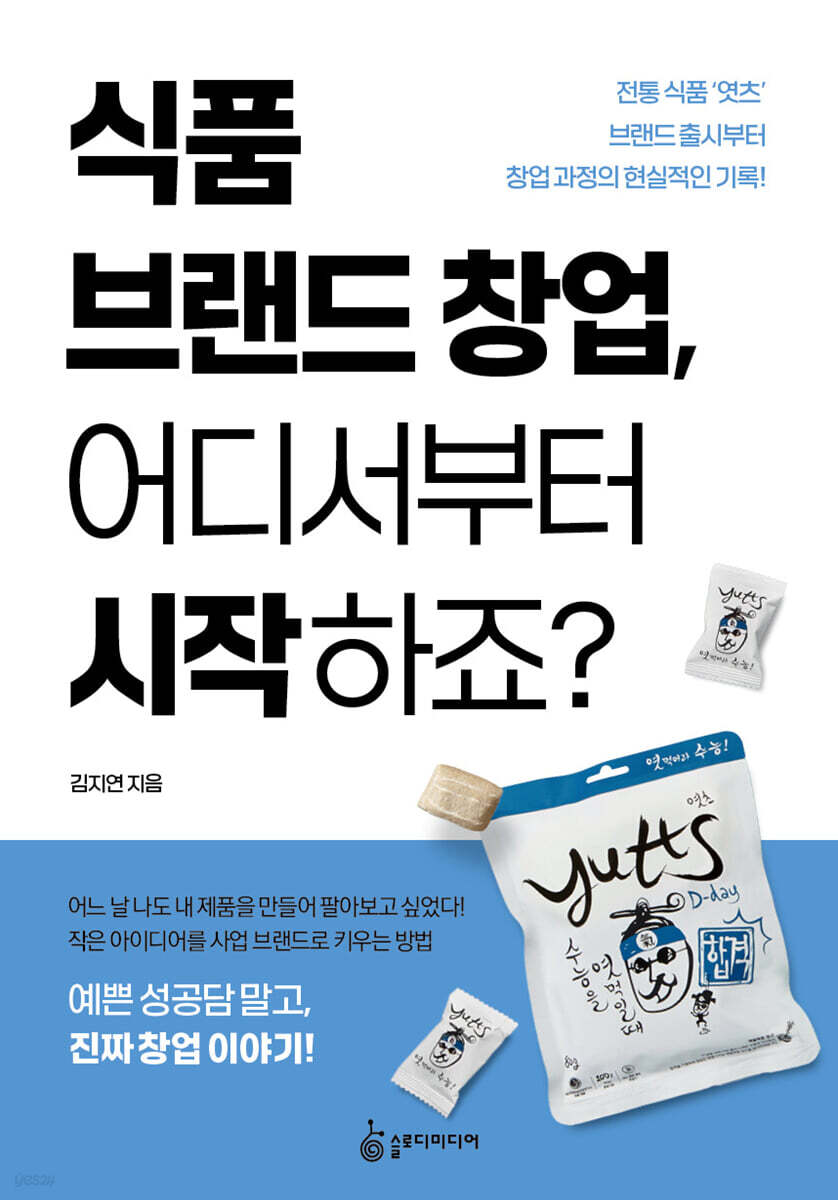 |
Description
Book Introduction
One day, I wanted to try making and selling my own product!
Yeots - From EXO collaboration to department store entry and export to the US,
Not a pretty success story from an ordinary office worker, but a real story about starting a business!
“I want to make something like this, but I don’t know where to start.” This is a question I get asked a lot by people around me who know what I do.
I too felt the same sense of helplessness when I first started my brand.
Answering these questions made the story go on too long and led to more questions.
This book is a record of the 'initial confusion' organized around actual experiences and the process of implementation.
While most branding books focus on “How do you get the word out?”, this book first asks, “How was the brand created?”
This book contains the entire process of creating the traditional taffy brand 'Yutts', which started with the joke, "Why is taffy used as a curse word?", and solving practical problems that could not be found through searches, such as OEM factory recruitment and contracts, licensing, MOQ minimum order quantity, distribution, packaging, trademark registration, and packaging material production.
I made a lot of mistakes while making 'Yeotz'.
By honestly talking about where we faltered and how we found our way back, I wanted to show that mistakes are ultimately part of a brand.
It's okay if you're not perfect, and you can build a brand even if you're not an expert.
I believe that beginner's perspective can be a necessary starting point for some people.
Yeots - From EXO collaboration to department store entry and export to the US,
Not a pretty success story from an ordinary office worker, but a real story about starting a business!
“I want to make something like this, but I don’t know where to start.” This is a question I get asked a lot by people around me who know what I do.
I too felt the same sense of helplessness when I first started my brand.
Answering these questions made the story go on too long and led to more questions.
This book is a record of the 'initial confusion' organized around actual experiences and the process of implementation.
While most branding books focus on “How do you get the word out?”, this book first asks, “How was the brand created?”
This book contains the entire process of creating the traditional taffy brand 'Yutts', which started with the joke, "Why is taffy used as a curse word?", and solving practical problems that could not be found through searches, such as OEM factory recruitment and contracts, licensing, MOQ minimum order quantity, distribution, packaging, trademark registration, and packaging material production.
I made a lot of mistakes while making 'Yeotz'.
By honestly talking about where we faltered and how we found our way back, I wanted to show that mistakes are ultimately part of a brand.
It's okay if you're not perfect, and you can build a brand even if you're not an expert.
I believe that beginner's perspective can be a necessary starting point for some people.
- You can preview some of the book's contents.
Preview
index
Recommendation · 4
Prologue: An Ordinary Office Worker Dreams of a Brand · 6
Chapter 1: Organizing Ideas: "Is this good?" The moment an idea becomes a brand
From finding what you like, what you can make, and what you need.
01 Can I really create a brand with my ideas? 14
02 How to Choose the Right Item for You 18
03 Avoid these items 26
04 A Mental Guide Before Starting a Brand 32
Chapter 2 Market Research: Do Small Brands Need Market Research?
Reading the market smartly without spending a lot of money
01 Market Research = The First Conversation Connecting Me and My Customers 36
02 Why should small brand market research be different? 39
03 4 Small Market Research Methods 41
04 Four Weapons Only Small Brands Have 54
05 What's More Important Than Perfect Analysis 58
Chapter 3 Building Brand Identity: Brand Essence: Why Does Everyone Say It's Important?
Finding Your Own Brand DNA
01 Brand Essence: Is It Really Necessary? 64
02 Why Brand Essence Matters for Smaller Brands 69
03 How did you find your brand essence? 73
04 Commonalities of Good Brand Essences 82
05 Amazing Changes Made by One Brand Essence 86
06 How to Create a Mission and Vision Without Being Grandiose 89
07 It's not too late to start branding your essence now. 92
Chapter 4 Product Development and Trial and Error: The Hardening Process
The Real Laws of Branding Learned Through Failure
01 The Moment When Ideas Become Responsibilities 96
02 I never knew finding a good factory would be this difficult. 101
03 A promise without a contract will eventually turn into poison 111
04 That first product that seemed perfect? It was just the beginning. 116
05 100-Day Launch: How Was It Possible? 121
06 What Missed Opportunities Taught Us 128
07 Growth accumulates and becomes a system 132
Chapter 5 Branding and Packaging: First Impressions Are Everything!
The power of design to capture consumers' hearts
01 The Amazing Power of Packaging Design on Your Brand 140
02 Design ideas come from unexpected places 148
03 Briefing Techniques for Communicating with Designers 155
04 Things You Should Never Miss When Creating a Package 162
05 Finding a Package Development Partner: From the Defense Market to Online 174
Chapter 6 Brand Protection: Legal Shields to Protect Your Brand
Legal shields, from trademarks to intellectual property rights, that protect your brand.
01 Protecting the Brand 188
02 Trademarks are essential, patent attorneys are strategic 190
03 Packaging is an Asset, Too: The Power of Design Protection 193
04 How far should we go in responding to imitation? 197
05 Government Support Systems: A Strong Umbrella for Small Brands 201
06 How Small Brands Can Become Confident 205
Chapter 7 Business Plan: The Blueprint for Turning Dreams into Reality
Writing a Business Plan That Persuasively Convinces Me
01 The first document to convince myself 210
02 Brand Blueprint in My Language 212
03 Financial Planning for Reality 216
04 From Diary to Communication Tool 218
05 Step-by-step growth plan without overdoing it 220
06 Finding a Strategy for Small Brands 222
07 A business plan is a living document 225
08 Business Plan to Start Today 227
Chapter 8 Distribution and Marketing: Now it's time to get it out there!
How small brands survive in big markets
01 After the first sale, the real story begins. 232
02 How to Design Your First Distribution Channel? 235
03 Marketing: Start with small steps, not big money. 240
04 Pricing Strategy, Cost + Appraisal + Strategy 244
05 The Art of Giving Up, the Power of Concentration 247
06 Why It's Okay to Be Imperfect, Small, and Slow 252
Epilogue: One Small Question Is Enough · 255
Appendix 257
Prologue: An Ordinary Office Worker Dreams of a Brand · 6
Chapter 1: Organizing Ideas: "Is this good?" The moment an idea becomes a brand
From finding what you like, what you can make, and what you need.
01 Can I really create a brand with my ideas? 14
02 How to Choose the Right Item for You 18
03 Avoid these items 26
04 A Mental Guide Before Starting a Brand 32
Chapter 2 Market Research: Do Small Brands Need Market Research?
Reading the market smartly without spending a lot of money
01 Market Research = The First Conversation Connecting Me and My Customers 36
02 Why should small brand market research be different? 39
03 4 Small Market Research Methods 41
04 Four Weapons Only Small Brands Have 54
05 What's More Important Than Perfect Analysis 58
Chapter 3 Building Brand Identity: Brand Essence: Why Does Everyone Say It's Important?
Finding Your Own Brand DNA
01 Brand Essence: Is It Really Necessary? 64
02 Why Brand Essence Matters for Smaller Brands 69
03 How did you find your brand essence? 73
04 Commonalities of Good Brand Essences 82
05 Amazing Changes Made by One Brand Essence 86
06 How to Create a Mission and Vision Without Being Grandiose 89
07 It's not too late to start branding your essence now. 92
Chapter 4 Product Development and Trial and Error: The Hardening Process
The Real Laws of Branding Learned Through Failure
01 The Moment When Ideas Become Responsibilities 96
02 I never knew finding a good factory would be this difficult. 101
03 A promise without a contract will eventually turn into poison 111
04 That first product that seemed perfect? It was just the beginning. 116
05 100-Day Launch: How Was It Possible? 121
06 What Missed Opportunities Taught Us 128
07 Growth accumulates and becomes a system 132
Chapter 5 Branding and Packaging: First Impressions Are Everything!
The power of design to capture consumers' hearts
01 The Amazing Power of Packaging Design on Your Brand 140
02 Design ideas come from unexpected places 148
03 Briefing Techniques for Communicating with Designers 155
04 Things You Should Never Miss When Creating a Package 162
05 Finding a Package Development Partner: From the Defense Market to Online 174
Chapter 6 Brand Protection: Legal Shields to Protect Your Brand
Legal shields, from trademarks to intellectual property rights, that protect your brand.
01 Protecting the Brand 188
02 Trademarks are essential, patent attorneys are strategic 190
03 Packaging is an Asset, Too: The Power of Design Protection 193
04 How far should we go in responding to imitation? 197
05 Government Support Systems: A Strong Umbrella for Small Brands 201
06 How Small Brands Can Become Confident 205
Chapter 7 Business Plan: The Blueprint for Turning Dreams into Reality
Writing a Business Plan That Persuasively Convinces Me
01 The first document to convince myself 210
02 Brand Blueprint in My Language 212
03 Financial Planning for Reality 216
04 From Diary to Communication Tool 218
05 Step-by-step growth plan without overdoing it 220
06 Finding a Strategy for Small Brands 222
07 A business plan is a living document 225
08 Business Plan to Start Today 227
Chapter 8 Distribution and Marketing: Now it's time to get it out there!
How small brands survive in big markets
01 After the first sale, the real story begins. 232
02 How to Design Your First Distribution Channel? 235
03 Marketing: Start with small steps, not big money. 240
04 Pricing Strategy, Cost + Appraisal + Strategy 244
05 The Art of Giving Up, the Power of Concentration 247
06 Why It's Okay to Be Imperfect, Small, and Slow 252
Epilogue: One Small Question Is Enough · 255
Appendix 257
Detailed image

Into the book
"What if we reinterpreted taffy in a modern way? Couldn't taffy become truly new by giving it a story?" That's when it all began.
The moment I started looking at taffy in a new way, the possibility of expanding from a story to a brand opened up.
We prepared our first experiment.
The name was decided naturally.
Add S to Yut to make Yutts.
I wanted to include not only taffy, but also a variety of 'sweet things'.
That's how it started, a new challenge that added a story to old things, and a brand that gathered sweet things.
While some brands, like Yeots, started from chance conversations, the motivations for starting them are truly diverse.
Some brands start from very personal inconveniences.
Sarah Blakely, the founder of Spanx, cut off the ankles of her pantyhose because she didn't want her underwear lines to show when she wore white pants.
What started out as a small inconvenience has now led to a multi-billion dollar brand.
Beginnings are often hidden in seemingly coincidental, small moments.
--- p.16
It takes longer than you think for a product to become a brand.
It should not simply be an 'item worth selling', but something that is 'mine' and that I can hold onto for a long time.
To do that, you have to be able to really like it.
No, more precisely, there has to be a reason to like it.
When I started writing Yeots, it started with a small question: “Why is Yeot used as a curse word?”
Most beginnings are light like this.
But sincerity grows slowly from small curiosity.
Some items may seem simple on the surface, but if you look closely, you'll find a story alive within them.
The moment you learn about the history, culture, technology, or social significance of an item, interest turns to affection.
But love alone is not enough.
A brand is not a thing, it is a reason.
Anyone can sell anything, but few brands can explain why they sell it.
'Why?' is the essence of a brand.
It means that there must be a message you want to convey.
Yeots wanted to convey 'positive energy'.
I hope it's not just a sweet candy, but a gift that can cheer someone up or comfort them.
So, we gave each candy a name, wrote a short sentence on the packaging, and included a warm story in the marketing.
--- p.18~19
A common mistake people make when starting a brand is that if they like it, people will like it too.
Unfortunately, this is often not the case.
An idea that is valuable to someone may mean nothing in the marketplace.
I also had a hard time accepting this fact at first.
The belief that a good product will do well easily convinces us.
But ultimately, a brand has to be something that someone needs.
So before we begin, I always ask this question:
“Do I really need this, or do I just like it?” It’s a simple question, but it can change the fate of an item.
This is where the decision is made whether the item I create will end up as my personal taste or become established as a brand.
--- p.21
Many novice entrepreneurs overlook this point.
With the complacent thought that “if I order from an OEM (original equipment manufacturer) factory, the product will come out,” they focus on making the packaging and naming look good.
But that doesn't last long.
Anything that can be called differentiation must ultimately be created from within.
Although Yeotsdo started out as an OEM, it was not left to the factory.
Through trial and error, testing dozens of prototypes, adjusting ingredient ratios, and changing packaging methods, we established our own standards one by one.
If there had been no process, there would be no Yeotseu today.
Ultimately, differentiation begins not with packaging or words, but with the ‘experience’ created by technology.
And at some point, we need to have a system that goes beyond the limitations of manual work.
That's how you survive as a real brand.
--- p.25
After all, no matter how good an item is, it is difficult to sustain if there is no money left.
Even if it is emotionally satisfying, it becomes a situation that is realistically unbearable.
So when choosing an item, you need to calculate in advance how much you can sell it for and how much you will have left.
Brands start with emotions, but survive with numbers.
If this calculation is wrong, no matter how beautiful the philosophy is, it will not last long.
Ultimately, a brand's fate begins with the choices it makes.
Items to avoid are those that are difficult for me to handle at the moment.
It's too complicated, too unfamiliar, or too inconceivable to handle.
--- p.31
A brand begins in the heart.
But enduring brands add realism and execution to the feeling of love.
More important than perfect preparation are the small actions you can take today.
The stronger the heart, the longer the brand will last.
And the moment that mind connects with the market, the idea becomes a brand.
--- p.33
Market research isn't about numbers on paper, it's about going out and finding things.
This is the first conversation that bridges the gap between what I want to sell and what people want.
Therefore, more important than a perfect analytical framework is the courage to start the conversation.
Conversations don't start with the perfect question.
A simple greeting like “Hello” is enough.
The same goes for market research.
You can start with a simple question: “How do you like this product?”
What's important is what comes next.
The first step in market research is to listen carefully to the other person's answers and find the real meaning in them.
--- p.38
Above all, there is no need to expect a perfect response.
There is no product that is loved by everyone.
What matters is how strongly the people I'm targeting react.
If 10 out of 100 people respond enthusiastically, you can find more people who are similar to those 10. The most important thing when conducting small tests is your mindset.
There is no need to wait until you are completely sure.
Rather, small failures prevent big failures.
It's better to fall for a small amount early than to lose a lot later.
Another is the voice of the customer.
No matter how good I think it is, it's meaningless if the customer doesn't want it.
The strength that small brands have comes from humbly listening, quickly adjusting, and trying again. The purpose of market research isn't to provide a perfect analysis, but to gather a starting point.
By running around, asking questions, observing, and doing small experiments, the evidence gradually accumulates.
And there will come a moment where you think, “Is this worth a try?”
--- p.52~53
The most important thing is to be prepared for failure.
No matter how well you conduct market research, the results may be different from what you expected.
Customers may react differently than I expected, or market conditions may change suddenly.
In such cases, there is no need to blame yourself for doing market research incorrectly.
It's natural.
The important thing is to quickly admit that you are wrong and correct it.
If the market is different from my expectations, I have to adjust to the market.
The advantage of a small brand is that it responds flexibly rather than being stubborn.
Looking back, Yeotsoo changed a lot from the original plan.
Originally, I was going to focus only on the CSAT season, but now I've expanded it to include messages of support for various situations.
What used to be considered only traditional taffy is now being developed in modern flavors and forms.
Some of the hypotheses developed through market research were correct, and some were wrong.
But all that process made the brand stronger.
--- p.60
I had a similar experience when preparing for the yuts.
One day, a client asked quietly:
“But why do you do this, this brand?” I gasped.
I could tell you what I was selling and how I was making it, but I couldn't explain why I started it.
At that moment, I realized how unprepared I was.
Actually, the answer was within me.
But I couldn't come up with the answer in one sentence.
From then on, we began to refine the brand essence more clearly.
At the heart of all this confusion lies the question: “What feeling do you want to give your customers?”
The answer was simple.
It was positive energy, a feeling of good cheer.
When the positive energy we wanted to convey reached our customers, they felt a pleasant sense of support.
--- p.67
The competitive edge of small brands isn't speed or price, but feeling and reason.
The reason for its existence must be clear, and the power to make customers feel that reason first is brand essence.
Clear brand essences, such as Fritz Coffee's "Good coffee is made by good people," 29CM's "Introducing your taste," and Toss's "Convenience," sharpen the weapons of small brands.
In the case of Toss, "convenience" was not an official slogan, but a core value that was imprinted on the market from the beginning. However, this one line became a weapon that overturned the inconvenience of existing finance.
If you have essence, you can fight big companies in a different way.
Starbucks, Apple, and Nike all started from small beginnings.
What made them grow was not their size, but the unwavering brand essence they maintained from the beginning.
It was the same with Yeotsoo.
We were small, but with one line of essence, we defeated the sweet offers of large distributors, won the hearts of customers, and maintained team pride.
It's not about size.
I'm serious.
And that sincerity is the brand essence.
--- p.72
Once you have a standard, your brand changes completely.
Even though the same people are working in the same office and doing the same job, everything changes.
When choosing a product, creating a package, writing a description, or even holding a team meeting, one question sets the direction: “Is this our brand?”
From that moment on, choices become faster and trial and error decreases.
The first thing that changes is the speed of decision-making.
When there are no standards, meetings lasting over three hours will not lead to a conclusion.
Since everyone has different standards, opinions are endlessly divided.
The debate just gets longer and the conclusion is postponed.
But if your brand identity is clear, you can come to a conclusion in 10 minutes, whether it's design or marketing.
It's not a debate, it's a confirmation process.
Customer reactions also change.
When identity is unclear, all you get is function-focused feedback like “That’s nice” or “That’s neat.”
But products with a clear identity move emotions.
Customers interpret the brand's intentions themselves, saying things like, "I'm glad I can convey this feeling," or "I think the recipient will like it."
It's a moment that goes beyond function.
--- p.86
When touring a factory, preparations were also important.
I brought a sincere introduction, a product concept summarized on about one sheet of A4 paper, and a small gift.
The sincerity and heartfelt expression was effective in breaking the awkwardness of a first meeting and opening up a conversation.
In my experience over the years, small local OEM factories have responded best when I bring them a box of coffee mix.
While Seoul's trendy desserts and snacks from famous bakeries are great, the reality is that they can be a hassle to prepare.
If you want to go to the countryside, you have to leave early in the morning, and since factories are often open in the morning, it is not easy to buy something before leaving.
So, the most realistic option was a coffee mix that required less preparation and was welcomed on site.
These small considerations can make a relationship last.
Ultimately, we are borrowing their time.
It's a blessing that people who are busy working in the field take the time to meet with me, so I thought this was the least I could do to repay their kindness.
This is something I learned while touring factories: even if a brand has its own manufacturing facility, I recommend visiting other production facilities if you have the opportunity.
--- p.105
I came across the current factory.
On my first visit, I bought some famous bread and drinks from Seoul, and the owner spoke quietly.
“We don’t eat that kind of thing very often.
It's full of bad things.
“Don’t eat too much of that.” My heart stopped at those words.
The space had a much more honest philosophy than we had imagined.
In one corner of the workshop, there was a cup of herbal tea for the workers, and in another corner, a young grandson was playing with a piece of taffy.
I felt relieved when I saw that he was allowed to eat as much taffy as he wanted while not allowing him to eat candy.
The tone of voice, the expression, and even the air flowing through the space made us feel confident.
There were many challenges and adjustments after that, and whenever things got difficult, I thought about other options.
But in the end, I came back with the thought, “I want to create with these people.”
Choosing a partner is ultimately a process of finding someone who can grow together beyond just skills.
And the beginning wasn't about trying to look like a perfect expert, but about showing a genuine desire to learn as an imperfect beginner.
Finding a good manufacturing partner isn't about matching criteria, it's about finding someone who's looking in the same direction.
And that encounter creates the brand's identity.
--- p.109~110
After that incident, I always make sure to write a contract.
We now know that a brand that works without a contract is not a brand, but a risk.
Many companies are reluctant to sign contracts.
Even the friendly atmosphere suddenly becomes awkward when the clause review begins.
However, avoiding documentation can ultimately signal a reluctance to take full responsibility.
Contracts are not simply legal safeguards.
A contract is not evidence of mistrust, but rather a minimum promise that clarifies each party's responsibilities.
The better the partner, the more they welcome the contract.
Because we know that each and every clause in the contract is not an inconvenient shackle, but a safety net that protects each other.
A contract alone doesn't solve everything.
But without a contract, nothing can be resolved.
While records like emails and meeting minutes can reduce disputes, without a basic framework like a contract, all evidence quickly loses its force.
So, if a company is reluctant to sign a contract, we don't consider them as partners in the first place.
Because contracts are the starting point for reducing misunderstandings, clarifying responsibilities, and enabling long-term collaboration.
--- p.113
Consumer feedback was a gift, not a criticism.
Each and every comment was a valuable clue to improving the product.
We switched from aluminum foil to translucent packaging.
The results were surprising.
The product's features were better displayed, the bond odor problem was naturally eliminated, and costs were reduced, resulting in a triple benefit.
Going through all this process changed my perspective on brands.
At first, I believed that only a perfect product, a perfect package, and a perfect system were the answer, and that failure was a flaw that had to be hidden.
But there is no perfect brand.
A true brand is one that acknowledges failure and uses it as a stepping stone for growth.
Yeotsut was a series of trial and error.
--- p.119
We put more effort into ensuring production stability.
We diversified our collaborative structure to spread risk and established processes to prepare for increased volume.
We also began regularly reviewing our current maximum supply, how we would respond to sudden increases in orders, and whether additional suppliers were available. PPL was a missed opportunity, but the lessons it taught us solidified Yeots' growth.
Not all opportunities are good.
You need to select opportunities that fit your brand's capabilities.
Unprepared rapid growth can be toxic and can be fatal to your credibility.
A brand is about direction, not speed.
Growth must be pursued in stages based on stability.
Sometimes I wonder what it would have been like if Yeotsoo had appeared in the drama back then.
But what matters is not the opportunity itself, but the preparation to take on that opportunity.
So when the next opportunity comes, I won't give up using lack of preparation as an excuse.
Sometimes when I meet people who used to work at my company, I regret that I should have pushed myself harder back then.
Looking back, it is regrettable, but at the same time, it also becomes a pledge to prepare for the next opportunity.
Opportunity comes again.
Let's not regret it then.
--- p.131
When you walk around a store, you shouldn't just glance around.
I took careful notes of the package's appearance.
Look at what colors catch your eye first, what sizes and shapes stand out on the shelf, how the text and images are arranged in proportion, and even how the back information is organized.
We also found out which OEM factories they use through manufacturer information.
The display environment is also important.
Consider whether they are stacked vertically or horizontally, how they look when placed next to other products, and which materials look most attractive under different lighting conditions.
We also analyzed strategies by price range.
How do low-priced products appeal, what elements make high-priced products feel premium, how do they differentiate themselves from similar price ranges, etc.
Actually, I was surprised when I looked at the imported products corner at SSG Cheongdam.
They are the same product, but some cost 30,000 won and some cost 150,000 won.
I saw what was different, the packaging was completely different.
I realized once again that packaging is an important means of expressing a brand's identity.
--- p.149
Good design is often decided from a brief.
Even the most skilled designer won't be able to produce good results if the brief is sloppy.
A brand asked the designer to design a cookie and asked, “It’s a cookie, but please give it a youthful feel.”
“Please, please, please,” he asked.
However, when he received the result, he said that the colors were awkward, the font was awkward, and overall, something felt strange.
Because you didn't say specifically what you wanted.
For the second attempt, I asked the same designer again, but this time I clearly targeted the target audience: office workers in their 20s and 30s, and gifts for families.
It was organized into keywords that are warm yet sophisticated, and reinterpret traditional sensibilities with a modern perspective.
--- p.156
Even though we've taken care of the convenience and safety of opening it, something unexpected happens when you actually go to the store.
There was a time when something was pretty when I designed it, but it didn't stand out in the store.
When I was designing it, I definitely thought it was cool and came out well.
It was neat and luxurious, and the brand sensibility was alive and well.
But when I actually went to the store, the products didn't stand out and didn't even stand properly on the shelves.
One of the most common problems is a structure that doesn't take display into account.
Depending on whether the product will be hung, displayed standing up, or stacked, the shape, balance, and packaging method should be different, but if we focus only on design, the actual display environment is overlooked.
So the product keeps falling over, can't be hung on a hook, or wobbles unsteadily on the shelf.
Store employees are uncomfortable, customers have a hard time holding it, and ultimately, it affects sales.
The size and specifications of display cases are often ignored.
Display space is limited, and each shelf has different heights and widths.
However, packages that are made without reflecting that reality may not fit on shelves, may end up lying around, or may even obscure other products.
This could have been avoided if the standard specifications had been checked in advance.
--- p.168
Initial quantity literally means 'first order quantity'.
The first production run of any product is usually pilot in nature.
This is to identify areas for improvement through actual sales testing and then move on to full-scale production. MOQ refers to the minimum order quantity set by the supplier.
For example, if a packaging company's MOQ is 500 units, it is impossible to produce less than that.
Therefore, when planning the initial quantity, you must check the MOQ of the company.
Here, the concept of EOQ (Economic Order Quantity) needs to be considered. EOQ is a quantity determined by a comprehensive assessment of financial status, sales volume, storage costs, and the possibility of packaging modifications.
For example, let's assume the MOQ is 100 pieces and the unit price is 1,000 won.
When ordering 1,000 units, the unit price may be reduced to 700 won, and when ordering 5,000 units, the unit price may be reduced to 500 won.
However, if problems arise immediately after launch, there is a risk of having to scrap the mass-produced quantity.
Therefore, initially, small-scale production to meet MOQ can be EOQ, and then it is reasonable to expand to 1,000 or 5,000 units depending on sales situation.
--- p.179
There is another important consideration that has come up recently.
It is eco-friendly.
As social awareness of environmental protection has increased, eco-friendly packaging is no longer an option but a necessity.
Reflecting this trend, the number of companies providing a variety of sustainable materials to the defense industry is increasing.
Biodegradable plastics, recyclable paper, and plant-based inks help maintain quality and functionality while minimizing environmental impact.
When visiting the defense industry market, it is a good idea to seek out and consult with companies that provide these eco-friendly materials.
You can obtain specific information about a product's production process, recyclability, and decomposition time, and incorporating this data into your brand story can have a positive impact on your brand value.
--- p.181
Lastly, the patent office provides discounts on fees such as application fees, examination fees, and registration fees.
Small and medium-sized enterprises and small business owners can receive a discount of up to 70%, and young people under 29 years of age or seniors over 65 years of age can receive a discount of up to 85%.
These systems are helpful in the early stages of a startup.
At first, I didn't even know there was such a thing.
It was difficult to search for, and no one could tell me.
But it was so helpful that I wondered why I didn't know about it sooner.
However, there are some things to be careful about.
Just because a patent attorney is connected to you by a support organization doesn't mean you can unconditionally trust them.
In fact, there was a case where I could have easily resolved the situation with a certified letter, but I recommended starting a lawsuit that was expected to have an unfavorable outcome.
On the other hand, other attorneys suggested a step-by-step approach, and the cost difference was more than ten times.
Ultimately, it requires the ability to listen to multiple opinions and carefully compare strategies and costs.
The way you utilize support also changes at each stage of brand growth.
If you are just starting out, there is no need to overthink it.
The first thing to do is to register your core brand name trademark.
Because budgets are tight, it is important to make the most of government support to protect essential rights.
--- p.202
A brand is ultimately a memory.
Only those who truly preserve the name, form, and message that people will remember can maintain a brand for a long time.
And that power comes from attitude rather than huge capital or organization.
The smaller the brand, the more meticulous and strategic the approach must be.
Because I don't have a legal team or an unlimited budget, I have to take care of everything myself.
However, it is not necessarily the case that small brands are at a disadvantage.
In recent years, there has been a growing number of protections and support systems for small business owners and startups.
Government support programs that reduce trademark application costs, organizations offering free consultations on design rights and intellectual property rights, and even patent attorney matching programs for young entrepreneurs.
Legal barriers that were once only available to large corporations are now open to small brands as well.
--- p.206
‘Where’ was a choice that determined the brand’s personality.
Where to sell was a question beyond the sales channel, but rather what image to project.
I wanted to start online and gradually expand to select shops and department stores.
I realized that each channel required a different look for the brand.
The 'why' was the heart of the business plan.
If the answer to this question is unclear, all other plans are shaken.
“If only I could think of taffy when I need encouragement.” That one reason has become the compass that guides every decision we make for our brand.
'How' was the specific method of turning the ideal into reality.
It was a way to make it in a traditional way, package it in a modern way, and incorporate the story I wanted to tell into the brand.
Here, I realized that before asking "How can I sell it?", I needed to consider "How can I present it?" As I answered these questions one by one, the scattered ideas in my head began to coalesce into a single picture.
--- p.214
Ultimately, a business plan builds trust.
It's not because the format is perfect, but because it's based on the clarity of direction contained within it and my attitude that I'm prepared.
The moment they sense sincerity, sustainability, and the possibility of cooperation, they become on my side.
But soon a new problem arose.
I couldn't handle all situations with just a basic business plan written in my own language.
When submitting to government grants, proposing collaborations, or meeting with distributors, a different language was needed.
No matter how sincere the sentence, “If you can think of taffy when you need cheering,” was, there were times when it wasn’t the answer they were looking for.
At that time, keywords such as market size, competitive analysis, financial planning, and growth strategy were required.
In this case, you don't need to change the core, just adjust the expression to suit the situation.
--- p.219
In Kakao Gifting, ‘value as a gift’ was the most important thing.
The sophistication of the packaging, the sentiment of the message card, and even the feeling you get when you receive it.
Here, we weren't selling products, we were selling experiences.
I had to constantly prepare by imagining, “How would I feel if I received this?”
There is a trap that beginner brands often fall into.
This is simply increasing the number of channels with the thought that “the more exposure, the better.”
Of course, there are definitely advantages to having more exposure.
But for smaller brands, a different question comes first.
Can you afford it? Can you afford to operate it? Does the channel's identity align with our brand? And do our target customers truly exist there? If these conditions aren't met, exposure becomes a risk, not an opportunity. After the success of Yeotseudo Ten by Ten, I briefly became greedy.
“Let’s try other places while we’re at it.” But we soon realized that exposure on the wrong stage was not building our brand image, but rather damaging it.
In fact, while the offer to open a store on a discount platform was initially welcome, its customers were focused only on price and not on the brand story.
Eventually, we acknowledged that it did not align with our values and quickly withdrew.
In the end, what matters is not how much you see, but where, to whom, and in what way you see it.
--- p.238
There is no right answer in advertising, public relations, or marketing.
Just because I follow other people's success stories doesn't mean it will work for me.
For brands that aren't prepared, social media, which requires daily content creation, can be a torture.
There is a different way to do it for my product.
Since the best-selling channels vary depending on the characteristics of the product and category, you need to find the answer through direct observation and experimentation.
Even if you borrow external resources, it is much wiser to experiment with various methods on a small scale and focus on what works rather than investing a large amount of money from the beginning.
Marketing for small brands starts with small actions, not big money.
And when those small actions accumulate, the brand's unique style is finally completed.
--- p.243
At first, every opportunity seems precious.
I feel bad about turning it down, and I'm worried that I might miss something.
But over time, small brands realize that growth starts with focus, not expansion.
It's a truth you only realize after experiencing moments where you try to do everything but end up failing to do the important things properly.
The real power of small brands lies in not doing everything.
With limited resources, deciding where to focus and where to give up is a survival strategy.
As channels increase, management points such as inventory, personnel, costs, and communication increase exponentially.
At first, seizing opportunities may seem like growth, but at some point, you start to become more driven by operations than by the essence of your brand.
So what's important is selection and focus.
I must boldly reduce the areas I cannot directly control and move as efficiently as possible within the scope of my power.
That way you won't get tired.
--- p.247
Yeotsut focused on one identity: 'a traditional snack brand that conveys a spirit of support.'
I boldly gave up everything else.
Thanks to this, customers remember us clearly and naturally seek us out when they need us.
As a small brand, selection and focus are not optional, they are essential.
Because we don't have the resources to do everything like a big company.
But that can be a strength rather than a weakness.
Because you can focus, you can do it more deeply and with more authenticity.
The important thing is to be clear about what you are giving up as well as what you are choosing.
The criteria should be the brand's identity and long-term goals.
Rather than focusing on immediate sales or opportunities, we should focus on what we really want to do, what we are good at, and what we find meaningful.
If you keep making choices and focusing like that, at some point your brand's unique color will emerge.
And that color is the real competitive edge that will allow you to survive in the market.
The moment I started looking at taffy in a new way, the possibility of expanding from a story to a brand opened up.
We prepared our first experiment.
The name was decided naturally.
Add S to Yut to make Yutts.
I wanted to include not only taffy, but also a variety of 'sweet things'.
That's how it started, a new challenge that added a story to old things, and a brand that gathered sweet things.
While some brands, like Yeots, started from chance conversations, the motivations for starting them are truly diverse.
Some brands start from very personal inconveniences.
Sarah Blakely, the founder of Spanx, cut off the ankles of her pantyhose because she didn't want her underwear lines to show when she wore white pants.
What started out as a small inconvenience has now led to a multi-billion dollar brand.
Beginnings are often hidden in seemingly coincidental, small moments.
--- p.16
It takes longer than you think for a product to become a brand.
It should not simply be an 'item worth selling', but something that is 'mine' and that I can hold onto for a long time.
To do that, you have to be able to really like it.
No, more precisely, there has to be a reason to like it.
When I started writing Yeots, it started with a small question: “Why is Yeot used as a curse word?”
Most beginnings are light like this.
But sincerity grows slowly from small curiosity.
Some items may seem simple on the surface, but if you look closely, you'll find a story alive within them.
The moment you learn about the history, culture, technology, or social significance of an item, interest turns to affection.
But love alone is not enough.
A brand is not a thing, it is a reason.
Anyone can sell anything, but few brands can explain why they sell it.
'Why?' is the essence of a brand.
It means that there must be a message you want to convey.
Yeots wanted to convey 'positive energy'.
I hope it's not just a sweet candy, but a gift that can cheer someone up or comfort them.
So, we gave each candy a name, wrote a short sentence on the packaging, and included a warm story in the marketing.
--- p.18~19
A common mistake people make when starting a brand is that if they like it, people will like it too.
Unfortunately, this is often not the case.
An idea that is valuable to someone may mean nothing in the marketplace.
I also had a hard time accepting this fact at first.
The belief that a good product will do well easily convinces us.
But ultimately, a brand has to be something that someone needs.
So before we begin, I always ask this question:
“Do I really need this, or do I just like it?” It’s a simple question, but it can change the fate of an item.
This is where the decision is made whether the item I create will end up as my personal taste or become established as a brand.
--- p.21
Many novice entrepreneurs overlook this point.
With the complacent thought that “if I order from an OEM (original equipment manufacturer) factory, the product will come out,” they focus on making the packaging and naming look good.
But that doesn't last long.
Anything that can be called differentiation must ultimately be created from within.
Although Yeotsdo started out as an OEM, it was not left to the factory.
Through trial and error, testing dozens of prototypes, adjusting ingredient ratios, and changing packaging methods, we established our own standards one by one.
If there had been no process, there would be no Yeotseu today.
Ultimately, differentiation begins not with packaging or words, but with the ‘experience’ created by technology.
And at some point, we need to have a system that goes beyond the limitations of manual work.
That's how you survive as a real brand.
--- p.25
After all, no matter how good an item is, it is difficult to sustain if there is no money left.
Even if it is emotionally satisfying, it becomes a situation that is realistically unbearable.
So when choosing an item, you need to calculate in advance how much you can sell it for and how much you will have left.
Brands start with emotions, but survive with numbers.
If this calculation is wrong, no matter how beautiful the philosophy is, it will not last long.
Ultimately, a brand's fate begins with the choices it makes.
Items to avoid are those that are difficult for me to handle at the moment.
It's too complicated, too unfamiliar, or too inconceivable to handle.
--- p.31
A brand begins in the heart.
But enduring brands add realism and execution to the feeling of love.
More important than perfect preparation are the small actions you can take today.
The stronger the heart, the longer the brand will last.
And the moment that mind connects with the market, the idea becomes a brand.
--- p.33
Market research isn't about numbers on paper, it's about going out and finding things.
This is the first conversation that bridges the gap between what I want to sell and what people want.
Therefore, more important than a perfect analytical framework is the courage to start the conversation.
Conversations don't start with the perfect question.
A simple greeting like “Hello” is enough.
The same goes for market research.
You can start with a simple question: “How do you like this product?”
What's important is what comes next.
The first step in market research is to listen carefully to the other person's answers and find the real meaning in them.
--- p.38
Above all, there is no need to expect a perfect response.
There is no product that is loved by everyone.
What matters is how strongly the people I'm targeting react.
If 10 out of 100 people respond enthusiastically, you can find more people who are similar to those 10. The most important thing when conducting small tests is your mindset.
There is no need to wait until you are completely sure.
Rather, small failures prevent big failures.
It's better to fall for a small amount early than to lose a lot later.
Another is the voice of the customer.
No matter how good I think it is, it's meaningless if the customer doesn't want it.
The strength that small brands have comes from humbly listening, quickly adjusting, and trying again. The purpose of market research isn't to provide a perfect analysis, but to gather a starting point.
By running around, asking questions, observing, and doing small experiments, the evidence gradually accumulates.
And there will come a moment where you think, “Is this worth a try?”
--- p.52~53
The most important thing is to be prepared for failure.
No matter how well you conduct market research, the results may be different from what you expected.
Customers may react differently than I expected, or market conditions may change suddenly.
In such cases, there is no need to blame yourself for doing market research incorrectly.
It's natural.
The important thing is to quickly admit that you are wrong and correct it.
If the market is different from my expectations, I have to adjust to the market.
The advantage of a small brand is that it responds flexibly rather than being stubborn.
Looking back, Yeotsoo changed a lot from the original plan.
Originally, I was going to focus only on the CSAT season, but now I've expanded it to include messages of support for various situations.
What used to be considered only traditional taffy is now being developed in modern flavors and forms.
Some of the hypotheses developed through market research were correct, and some were wrong.
But all that process made the brand stronger.
--- p.60
I had a similar experience when preparing for the yuts.
One day, a client asked quietly:
“But why do you do this, this brand?” I gasped.
I could tell you what I was selling and how I was making it, but I couldn't explain why I started it.
At that moment, I realized how unprepared I was.
Actually, the answer was within me.
But I couldn't come up with the answer in one sentence.
From then on, we began to refine the brand essence more clearly.
At the heart of all this confusion lies the question: “What feeling do you want to give your customers?”
The answer was simple.
It was positive energy, a feeling of good cheer.
When the positive energy we wanted to convey reached our customers, they felt a pleasant sense of support.
--- p.67
The competitive edge of small brands isn't speed or price, but feeling and reason.
The reason for its existence must be clear, and the power to make customers feel that reason first is brand essence.
Clear brand essences, such as Fritz Coffee's "Good coffee is made by good people," 29CM's "Introducing your taste," and Toss's "Convenience," sharpen the weapons of small brands.
In the case of Toss, "convenience" was not an official slogan, but a core value that was imprinted on the market from the beginning. However, this one line became a weapon that overturned the inconvenience of existing finance.
If you have essence, you can fight big companies in a different way.
Starbucks, Apple, and Nike all started from small beginnings.
What made them grow was not their size, but the unwavering brand essence they maintained from the beginning.
It was the same with Yeotsoo.
We were small, but with one line of essence, we defeated the sweet offers of large distributors, won the hearts of customers, and maintained team pride.
It's not about size.
I'm serious.
And that sincerity is the brand essence.
--- p.72
Once you have a standard, your brand changes completely.
Even though the same people are working in the same office and doing the same job, everything changes.
When choosing a product, creating a package, writing a description, or even holding a team meeting, one question sets the direction: “Is this our brand?”
From that moment on, choices become faster and trial and error decreases.
The first thing that changes is the speed of decision-making.
When there are no standards, meetings lasting over three hours will not lead to a conclusion.
Since everyone has different standards, opinions are endlessly divided.
The debate just gets longer and the conclusion is postponed.
But if your brand identity is clear, you can come to a conclusion in 10 minutes, whether it's design or marketing.
It's not a debate, it's a confirmation process.
Customer reactions also change.
When identity is unclear, all you get is function-focused feedback like “That’s nice” or “That’s neat.”
But products with a clear identity move emotions.
Customers interpret the brand's intentions themselves, saying things like, "I'm glad I can convey this feeling," or "I think the recipient will like it."
It's a moment that goes beyond function.
--- p.86
When touring a factory, preparations were also important.
I brought a sincere introduction, a product concept summarized on about one sheet of A4 paper, and a small gift.
The sincerity and heartfelt expression was effective in breaking the awkwardness of a first meeting and opening up a conversation.
In my experience over the years, small local OEM factories have responded best when I bring them a box of coffee mix.
While Seoul's trendy desserts and snacks from famous bakeries are great, the reality is that they can be a hassle to prepare.
If you want to go to the countryside, you have to leave early in the morning, and since factories are often open in the morning, it is not easy to buy something before leaving.
So, the most realistic option was a coffee mix that required less preparation and was welcomed on site.
These small considerations can make a relationship last.
Ultimately, we are borrowing their time.
It's a blessing that people who are busy working in the field take the time to meet with me, so I thought this was the least I could do to repay their kindness.
This is something I learned while touring factories: even if a brand has its own manufacturing facility, I recommend visiting other production facilities if you have the opportunity.
--- p.105
I came across the current factory.
On my first visit, I bought some famous bread and drinks from Seoul, and the owner spoke quietly.
“We don’t eat that kind of thing very often.
It's full of bad things.
“Don’t eat too much of that.” My heart stopped at those words.
The space had a much more honest philosophy than we had imagined.
In one corner of the workshop, there was a cup of herbal tea for the workers, and in another corner, a young grandson was playing with a piece of taffy.
I felt relieved when I saw that he was allowed to eat as much taffy as he wanted while not allowing him to eat candy.
The tone of voice, the expression, and even the air flowing through the space made us feel confident.
There were many challenges and adjustments after that, and whenever things got difficult, I thought about other options.
But in the end, I came back with the thought, “I want to create with these people.”
Choosing a partner is ultimately a process of finding someone who can grow together beyond just skills.
And the beginning wasn't about trying to look like a perfect expert, but about showing a genuine desire to learn as an imperfect beginner.
Finding a good manufacturing partner isn't about matching criteria, it's about finding someone who's looking in the same direction.
And that encounter creates the brand's identity.
--- p.109~110
After that incident, I always make sure to write a contract.
We now know that a brand that works without a contract is not a brand, but a risk.
Many companies are reluctant to sign contracts.
Even the friendly atmosphere suddenly becomes awkward when the clause review begins.
However, avoiding documentation can ultimately signal a reluctance to take full responsibility.
Contracts are not simply legal safeguards.
A contract is not evidence of mistrust, but rather a minimum promise that clarifies each party's responsibilities.
The better the partner, the more they welcome the contract.
Because we know that each and every clause in the contract is not an inconvenient shackle, but a safety net that protects each other.
A contract alone doesn't solve everything.
But without a contract, nothing can be resolved.
While records like emails and meeting minutes can reduce disputes, without a basic framework like a contract, all evidence quickly loses its force.
So, if a company is reluctant to sign a contract, we don't consider them as partners in the first place.
Because contracts are the starting point for reducing misunderstandings, clarifying responsibilities, and enabling long-term collaboration.
--- p.113
Consumer feedback was a gift, not a criticism.
Each and every comment was a valuable clue to improving the product.
We switched from aluminum foil to translucent packaging.
The results were surprising.
The product's features were better displayed, the bond odor problem was naturally eliminated, and costs were reduced, resulting in a triple benefit.
Going through all this process changed my perspective on brands.
At first, I believed that only a perfect product, a perfect package, and a perfect system were the answer, and that failure was a flaw that had to be hidden.
But there is no perfect brand.
A true brand is one that acknowledges failure and uses it as a stepping stone for growth.
Yeotsut was a series of trial and error.
--- p.119
We put more effort into ensuring production stability.
We diversified our collaborative structure to spread risk and established processes to prepare for increased volume.
We also began regularly reviewing our current maximum supply, how we would respond to sudden increases in orders, and whether additional suppliers were available. PPL was a missed opportunity, but the lessons it taught us solidified Yeots' growth.
Not all opportunities are good.
You need to select opportunities that fit your brand's capabilities.
Unprepared rapid growth can be toxic and can be fatal to your credibility.
A brand is about direction, not speed.
Growth must be pursued in stages based on stability.
Sometimes I wonder what it would have been like if Yeotsoo had appeared in the drama back then.
But what matters is not the opportunity itself, but the preparation to take on that opportunity.
So when the next opportunity comes, I won't give up using lack of preparation as an excuse.
Sometimes when I meet people who used to work at my company, I regret that I should have pushed myself harder back then.
Looking back, it is regrettable, but at the same time, it also becomes a pledge to prepare for the next opportunity.
Opportunity comes again.
Let's not regret it then.
--- p.131
When you walk around a store, you shouldn't just glance around.
I took careful notes of the package's appearance.
Look at what colors catch your eye first, what sizes and shapes stand out on the shelf, how the text and images are arranged in proportion, and even how the back information is organized.
We also found out which OEM factories they use through manufacturer information.
The display environment is also important.
Consider whether they are stacked vertically or horizontally, how they look when placed next to other products, and which materials look most attractive under different lighting conditions.
We also analyzed strategies by price range.
How do low-priced products appeal, what elements make high-priced products feel premium, how do they differentiate themselves from similar price ranges, etc.
Actually, I was surprised when I looked at the imported products corner at SSG Cheongdam.
They are the same product, but some cost 30,000 won and some cost 150,000 won.
I saw what was different, the packaging was completely different.
I realized once again that packaging is an important means of expressing a brand's identity.
--- p.149
Good design is often decided from a brief.
Even the most skilled designer won't be able to produce good results if the brief is sloppy.
A brand asked the designer to design a cookie and asked, “It’s a cookie, but please give it a youthful feel.”
“Please, please, please,” he asked.
However, when he received the result, he said that the colors were awkward, the font was awkward, and overall, something felt strange.
Because you didn't say specifically what you wanted.
For the second attempt, I asked the same designer again, but this time I clearly targeted the target audience: office workers in their 20s and 30s, and gifts for families.
It was organized into keywords that are warm yet sophisticated, and reinterpret traditional sensibilities with a modern perspective.
--- p.156
Even though we've taken care of the convenience and safety of opening it, something unexpected happens when you actually go to the store.
There was a time when something was pretty when I designed it, but it didn't stand out in the store.
When I was designing it, I definitely thought it was cool and came out well.
It was neat and luxurious, and the brand sensibility was alive and well.
But when I actually went to the store, the products didn't stand out and didn't even stand properly on the shelves.
One of the most common problems is a structure that doesn't take display into account.
Depending on whether the product will be hung, displayed standing up, or stacked, the shape, balance, and packaging method should be different, but if we focus only on design, the actual display environment is overlooked.
So the product keeps falling over, can't be hung on a hook, or wobbles unsteadily on the shelf.
Store employees are uncomfortable, customers have a hard time holding it, and ultimately, it affects sales.
The size and specifications of display cases are often ignored.
Display space is limited, and each shelf has different heights and widths.
However, packages that are made without reflecting that reality may not fit on shelves, may end up lying around, or may even obscure other products.
This could have been avoided if the standard specifications had been checked in advance.
--- p.168
Initial quantity literally means 'first order quantity'.
The first production run of any product is usually pilot in nature.
This is to identify areas for improvement through actual sales testing and then move on to full-scale production. MOQ refers to the minimum order quantity set by the supplier.
For example, if a packaging company's MOQ is 500 units, it is impossible to produce less than that.
Therefore, when planning the initial quantity, you must check the MOQ of the company.
Here, the concept of EOQ (Economic Order Quantity) needs to be considered. EOQ is a quantity determined by a comprehensive assessment of financial status, sales volume, storage costs, and the possibility of packaging modifications.
For example, let's assume the MOQ is 100 pieces and the unit price is 1,000 won.
When ordering 1,000 units, the unit price may be reduced to 700 won, and when ordering 5,000 units, the unit price may be reduced to 500 won.
However, if problems arise immediately after launch, there is a risk of having to scrap the mass-produced quantity.
Therefore, initially, small-scale production to meet MOQ can be EOQ, and then it is reasonable to expand to 1,000 or 5,000 units depending on sales situation.
--- p.179
There is another important consideration that has come up recently.
It is eco-friendly.
As social awareness of environmental protection has increased, eco-friendly packaging is no longer an option but a necessity.
Reflecting this trend, the number of companies providing a variety of sustainable materials to the defense industry is increasing.
Biodegradable plastics, recyclable paper, and plant-based inks help maintain quality and functionality while minimizing environmental impact.
When visiting the defense industry market, it is a good idea to seek out and consult with companies that provide these eco-friendly materials.
You can obtain specific information about a product's production process, recyclability, and decomposition time, and incorporating this data into your brand story can have a positive impact on your brand value.
--- p.181
Lastly, the patent office provides discounts on fees such as application fees, examination fees, and registration fees.
Small and medium-sized enterprises and small business owners can receive a discount of up to 70%, and young people under 29 years of age or seniors over 65 years of age can receive a discount of up to 85%.
These systems are helpful in the early stages of a startup.
At first, I didn't even know there was such a thing.
It was difficult to search for, and no one could tell me.
But it was so helpful that I wondered why I didn't know about it sooner.
However, there are some things to be careful about.
Just because a patent attorney is connected to you by a support organization doesn't mean you can unconditionally trust them.
In fact, there was a case where I could have easily resolved the situation with a certified letter, but I recommended starting a lawsuit that was expected to have an unfavorable outcome.
On the other hand, other attorneys suggested a step-by-step approach, and the cost difference was more than ten times.
Ultimately, it requires the ability to listen to multiple opinions and carefully compare strategies and costs.
The way you utilize support also changes at each stage of brand growth.
If you are just starting out, there is no need to overthink it.
The first thing to do is to register your core brand name trademark.
Because budgets are tight, it is important to make the most of government support to protect essential rights.
--- p.202
A brand is ultimately a memory.
Only those who truly preserve the name, form, and message that people will remember can maintain a brand for a long time.
And that power comes from attitude rather than huge capital or organization.
The smaller the brand, the more meticulous and strategic the approach must be.
Because I don't have a legal team or an unlimited budget, I have to take care of everything myself.
However, it is not necessarily the case that small brands are at a disadvantage.
In recent years, there has been a growing number of protections and support systems for small business owners and startups.
Government support programs that reduce trademark application costs, organizations offering free consultations on design rights and intellectual property rights, and even patent attorney matching programs for young entrepreneurs.
Legal barriers that were once only available to large corporations are now open to small brands as well.
--- p.206
‘Where’ was a choice that determined the brand’s personality.
Where to sell was a question beyond the sales channel, but rather what image to project.
I wanted to start online and gradually expand to select shops and department stores.
I realized that each channel required a different look for the brand.
The 'why' was the heart of the business plan.
If the answer to this question is unclear, all other plans are shaken.
“If only I could think of taffy when I need encouragement.” That one reason has become the compass that guides every decision we make for our brand.
'How' was the specific method of turning the ideal into reality.
It was a way to make it in a traditional way, package it in a modern way, and incorporate the story I wanted to tell into the brand.
Here, I realized that before asking "How can I sell it?", I needed to consider "How can I present it?" As I answered these questions one by one, the scattered ideas in my head began to coalesce into a single picture.
--- p.214
Ultimately, a business plan builds trust.
It's not because the format is perfect, but because it's based on the clarity of direction contained within it and my attitude that I'm prepared.
The moment they sense sincerity, sustainability, and the possibility of cooperation, they become on my side.
But soon a new problem arose.
I couldn't handle all situations with just a basic business plan written in my own language.
When submitting to government grants, proposing collaborations, or meeting with distributors, a different language was needed.
No matter how sincere the sentence, “If you can think of taffy when you need cheering,” was, there were times when it wasn’t the answer they were looking for.
At that time, keywords such as market size, competitive analysis, financial planning, and growth strategy were required.
In this case, you don't need to change the core, just adjust the expression to suit the situation.
--- p.219
In Kakao Gifting, ‘value as a gift’ was the most important thing.
The sophistication of the packaging, the sentiment of the message card, and even the feeling you get when you receive it.
Here, we weren't selling products, we were selling experiences.
I had to constantly prepare by imagining, “How would I feel if I received this?”
There is a trap that beginner brands often fall into.
This is simply increasing the number of channels with the thought that “the more exposure, the better.”
Of course, there are definitely advantages to having more exposure.
But for smaller brands, a different question comes first.
Can you afford it? Can you afford to operate it? Does the channel's identity align with our brand? And do our target customers truly exist there? If these conditions aren't met, exposure becomes a risk, not an opportunity. After the success of Yeotseudo Ten by Ten, I briefly became greedy.
“Let’s try other places while we’re at it.” But we soon realized that exposure on the wrong stage was not building our brand image, but rather damaging it.
In fact, while the offer to open a store on a discount platform was initially welcome, its customers were focused only on price and not on the brand story.
Eventually, we acknowledged that it did not align with our values and quickly withdrew.
In the end, what matters is not how much you see, but where, to whom, and in what way you see it.
--- p.238
There is no right answer in advertising, public relations, or marketing.
Just because I follow other people's success stories doesn't mean it will work for me.
For brands that aren't prepared, social media, which requires daily content creation, can be a torture.
There is a different way to do it for my product.
Since the best-selling channels vary depending on the characteristics of the product and category, you need to find the answer through direct observation and experimentation.
Even if you borrow external resources, it is much wiser to experiment with various methods on a small scale and focus on what works rather than investing a large amount of money from the beginning.
Marketing for small brands starts with small actions, not big money.
And when those small actions accumulate, the brand's unique style is finally completed.
--- p.243
At first, every opportunity seems precious.
I feel bad about turning it down, and I'm worried that I might miss something.
But over time, small brands realize that growth starts with focus, not expansion.
It's a truth you only realize after experiencing moments where you try to do everything but end up failing to do the important things properly.
The real power of small brands lies in not doing everything.
With limited resources, deciding where to focus and where to give up is a survival strategy.
As channels increase, management points such as inventory, personnel, costs, and communication increase exponentially.
At first, seizing opportunities may seem like growth, but at some point, you start to become more driven by operations than by the essence of your brand.
So what's important is selection and focus.
I must boldly reduce the areas I cannot directly control and move as efficiently as possible within the scope of my power.
That way you won't get tired.
--- p.247
Yeotsut focused on one identity: 'a traditional snack brand that conveys a spirit of support.'
I boldly gave up everything else.
Thanks to this, customers remember us clearly and naturally seek us out when they need us.
As a small brand, selection and focus are not optional, they are essential.
Because we don't have the resources to do everything like a big company.
But that can be a strength rather than a weakness.
Because you can focus, you can do it more deeply and with more authenticity.
The important thing is to be clear about what you are giving up as well as what you are choosing.
The criteria should be the brand's identity and long-term goals.
Rather than focusing on immediate sales or opportunities, we should focus on what we really want to do, what we are good at, and what we find meaningful.
If you keep making choices and focusing like that, at some point your brand's unique color will emerge.
And that color is the real competitive edge that will allow you to survive in the market.
--- p.251
Publisher's Review
If you want to know the brand,
Stop studying and start reading this book.
A book for beginners like me, not for the great!
This book may be more comforting as a record of small failures than a perfect success story, and a sincere confession may help someone get started.
A brand may not start with a grand plan, but with a small question.
The brand began with a love for it and a simple desire to try it.
And it was a joy to the customers.
The reviews sent by customers were a warm encouragement to me.
Thanks to Yeots, I learned that taffy can make people happy.
As I created the brand, I realized that it ultimately contained my heart.
Someone reading this might have something on their mind right now.
Whether it's a small idea, a vague dream, or something you'd like to do someday.
In fact, it had already begun at that moment.
Even the smallest question, the smallest wish, the fleeting thought—they are all seeds of a brand.
It's natural to be shaken.
The important thing is to cherish that seed.
It's okay to be imperfect, it's okay to be small.
Today, someone might change the world with one small question.
I hope the end of this book will be your beginning.
I hope this book will be especially helpful to the following people:
· Aspiring brand founders preparing to start a one-person business
· Office workers who dream of creating a brand through a side job or side project
· Early-stage entrepreneurs in desperate need of action-oriented, practical guidance
Marketers and planners who want to systematically learn brand practices
Especially those who have this kind of mindset will sympathize even more.
“I want to create a brand, but where do I start?”
“I have an idea, but can it really become a brand?”
“I searched, but the reality was so different.”
“I keep putting it off because I’m not fully prepared.”
To those who, like me, had a difficult time getting started,
Small courage and reality Small courage and reality
I hope this will be a guide for you.
Stop studying and start reading this book.
A book for beginners like me, not for the great!
This book may be more comforting as a record of small failures than a perfect success story, and a sincere confession may help someone get started.
A brand may not start with a grand plan, but with a small question.
The brand began with a love for it and a simple desire to try it.
And it was a joy to the customers.
The reviews sent by customers were a warm encouragement to me.
Thanks to Yeots, I learned that taffy can make people happy.
As I created the brand, I realized that it ultimately contained my heart.
Someone reading this might have something on their mind right now.
Whether it's a small idea, a vague dream, or something you'd like to do someday.
In fact, it had already begun at that moment.
Even the smallest question, the smallest wish, the fleeting thought—they are all seeds of a brand.
It's natural to be shaken.
The important thing is to cherish that seed.
It's okay to be imperfect, it's okay to be small.
Today, someone might change the world with one small question.
I hope the end of this book will be your beginning.
I hope this book will be especially helpful to the following people:
· Aspiring brand founders preparing to start a one-person business
· Office workers who dream of creating a brand through a side job or side project
· Early-stage entrepreneurs in desperate need of action-oriented, practical guidance
Marketers and planners who want to systematically learn brand practices
Especially those who have this kind of mindset will sympathize even more.
“I want to create a brand, but where do I start?”
“I have an idea, but can it really become a brand?”
“I searched, but the reality was so different.”
“I keep putting it off because I’m not fully prepared.”
To those who, like me, had a difficult time getting started,
Small courage and reality Small courage and reality
I hope this will be a guide for you.
GOODS SPECIFICS
- Date of issue: December 10, 2025
- Page count, weight, size: 264 pages | 146*209*20mm
- ISBN13: 9791167852908
- ISBN10: 1167852907
You may also like
카테고리
korean


korean

![ELLE 엘르 스페셜 에디션 A형 : 12월 [2025]](http://librairie.coreenne.fr/cdn/shop/files/b8e27a3de6c9538896439686c6b0e8fb.jpg?v=1766436872&width=3840)


