

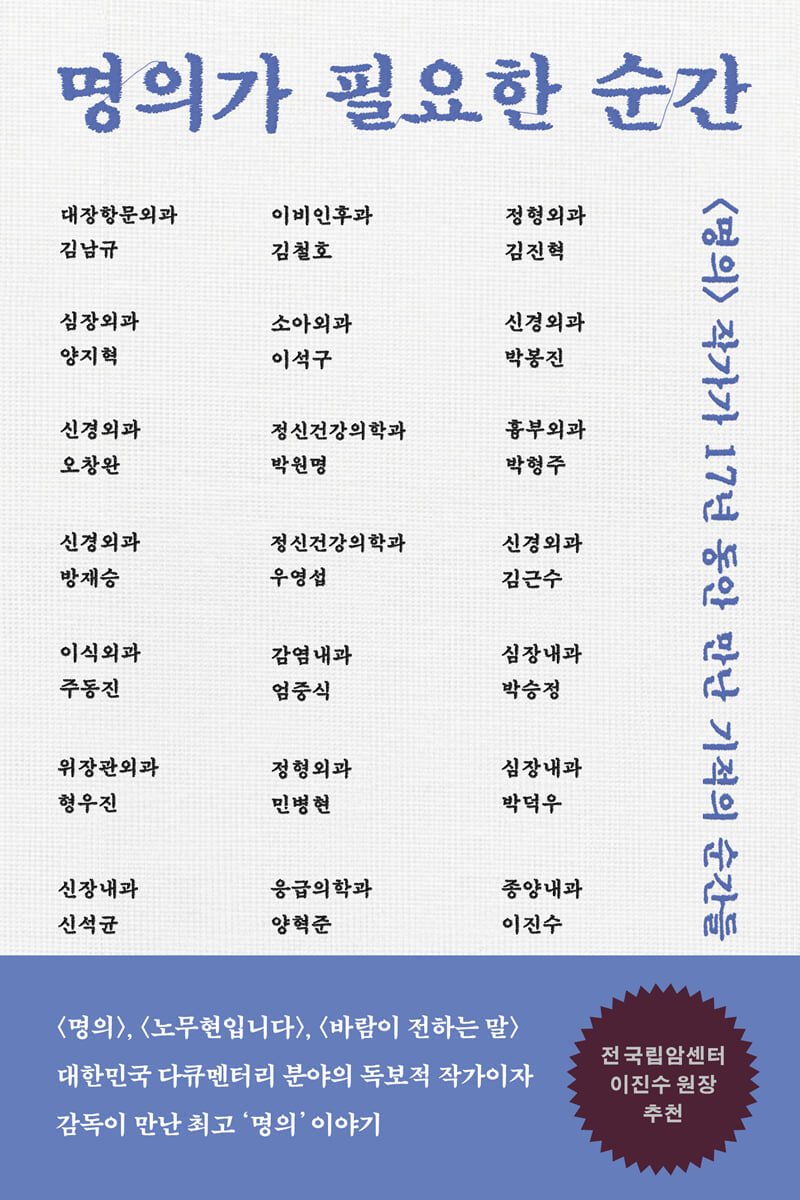
The moment when a name is needed
 |
Description
Book Introduction
〈Name〉, 〈This is Roh Moo-hyun〉, 〈Words Carried by the Wind〉…
A unique writer and director in the Korean documentary field
The story of the best 'name'
"Questioning the Reason for the Existence of Real Doctors"
Stories from Korea's best medical staff
It is a medical guide containing disease information.
Medical records that patients and their families must know
It's hard enough when someone you love is sick to the point of death, but there's nothing more difficult and lonely than not knowing anyone at the hospital and not having anyone to consult about treatment options.
So, in writing this book, I put ‘patients and their families’ as my top priority.
I hope this helps even a little.
- In the text
I highly recommend this book to patients and their families who are struggling with a serious illness and are at a crossroads in deciding what treatment to receive.
I also recommend this book to medical professionals and young medical students who dream of becoming doctors.
Lee Jin-soo (former director of the National Cancer Center)
A unique writer and director in the Korean documentary field
The story of the best 'name'
"Questioning the Reason for the Existence of Real Doctors"
Stories from Korea's best medical staff
It is a medical guide containing disease information.
Medical records that patients and their families must know
It's hard enough when someone you love is sick to the point of death, but there's nothing more difficult and lonely than not knowing anyone at the hospital and not having anyone to consult about treatment options.
So, in writing this book, I put ‘patients and their families’ as my top priority.
I hope this helps even a little.
- In the text
I highly recommend this book to patients and their families who are struggling with a serious illness and are at a crossroads in deciding what treatment to receive.
I also recommend this book to medical professionals and young medical students who dream of becoming doctors.
Lee Jin-soo (former director of the National Cancer Center)
- You can preview some of the book's contents.
Preview
index
Recommendation 9
Introduction 12
Part 1.
Where Everyday Miracles Happen 19
Kim Nam-gyu, a Patient-Oral Surgeon, 21
Miracles in the Hands of Man Yang Ji-hyuk | Cardiac Surgery 27
When Unexpected Misfortune Happens: Oh Chang-wan & Bang Jae-seung | Neurosurgery 35
Author's Note: A warm word from a doctor is the beginning of healing. 45
Part 2.
Person holding patient's hand 53
I hope you live a long life. Joo Dong-jin | Transplant Surgery 55
The Secret Behind the World's Best Robotic Surgery: Hyung Woo-jin | Gastrointestinal Surgery 61
Dialysis: Not the End, But the Beginning Shin Seok-gyun | Nephrology '67
Author's Note│You See It When You Stop 73
Part 3.
Healing Beyond Treatment 79
Head and Neck Cancer: Treating the Worst Cancers Kim Cheol-ho | Otolaryngology 81
Remembering the Patient Who Couldn't Come Lee Seok-gu | Pediatric Surgery 89
A doctor who heals the heart with all his heart
Park Won-myeong & Woo Young-seop | Department of Psychiatry '97
Author's Note│A Doctor's Mind 104
Part 4.
Earnestly, gathering wisdom 109
The Endemic Is Not Over! Eom Jung-sik | Infectious Diseases 111
Min Byeong-hyeon, Orthopedic Surgery 119 | How to Get Your Sore Knees Back on Track
No matter where you are or how sick you are, I will save you and treat you.
Yang Hyuk-jun | Emergency Medicine 127
Author's Note: A Wise Approach to Illness 134
Part 5.
A Truly Great Job 141
Kim Jin-hyeok's 5-Hour Surgery to Straighten Your Spine | Orthopedic Surgery 143
Trigeminal Neuralgia: Solving the Most Excruciating Pain by Park Bong-jin | Neurosurgery 153
Dr. Park Hyung-joo, the man who sets the standard for chest wall deformity surgery | Thoracic Surgery 159
Author's Note│What Should I Eat to Be Healthy? 166
Part 6.
I want to meet a doctor like this 173
The doctor we want to meet is… Kim Geun-soo | Neurosurgery 175
Park Seung-jeong & Park Deok-woo: Guarding the Crossroads of Life and Death | Cardiology 183
We're not living to cure cancer. Lee Jin-su | Oncology 191
Author's Note│Preparing for the End 198
Epilogue 204
Introduction 12
Part 1.
Where Everyday Miracles Happen 19
Kim Nam-gyu, a Patient-Oral Surgeon, 21
Miracles in the Hands of Man Yang Ji-hyuk | Cardiac Surgery 27
When Unexpected Misfortune Happens: Oh Chang-wan & Bang Jae-seung | Neurosurgery 35
Author's Note: A warm word from a doctor is the beginning of healing. 45
Part 2.
Person holding patient's hand 53
I hope you live a long life. Joo Dong-jin | Transplant Surgery 55
The Secret Behind the World's Best Robotic Surgery: Hyung Woo-jin | Gastrointestinal Surgery 61
Dialysis: Not the End, But the Beginning Shin Seok-gyun | Nephrology '67
Author's Note│You See It When You Stop 73
Part 3.
Healing Beyond Treatment 79
Head and Neck Cancer: Treating the Worst Cancers Kim Cheol-ho | Otolaryngology 81
Remembering the Patient Who Couldn't Come Lee Seok-gu | Pediatric Surgery 89
A doctor who heals the heart with all his heart
Park Won-myeong & Woo Young-seop | Department of Psychiatry '97
Author's Note│A Doctor's Mind 104
Part 4.
Earnestly, gathering wisdom 109
The Endemic Is Not Over! Eom Jung-sik | Infectious Diseases 111
Min Byeong-hyeon, Orthopedic Surgery 119 | How to Get Your Sore Knees Back on Track
No matter where you are or how sick you are, I will save you and treat you.
Yang Hyuk-jun | Emergency Medicine 127
Author's Note: A Wise Approach to Illness 134
Part 5.
A Truly Great Job 141
Kim Jin-hyeok's 5-Hour Surgery to Straighten Your Spine | Orthopedic Surgery 143
Trigeminal Neuralgia: Solving the Most Excruciating Pain by Park Bong-jin | Neurosurgery 153
Dr. Park Hyung-joo, the man who sets the standard for chest wall deformity surgery | Thoracic Surgery 159
Author's Note│What Should I Eat to Be Healthy? 166
Part 6.
I want to meet a doctor like this 173
The doctor we want to meet is… Kim Geun-soo | Neurosurgery 175
Park Seung-jeong & Park Deok-woo: Guarding the Crossroads of Life and Death | Cardiology 183
We're not living to cure cancer. Lee Jin-su | Oncology 191
Author's Note│Preparing for the End 198
Epilogue 204
Detailed image

Into the book
As the author of "Myung-ui," the question I've been asked most often is, "Who is Myung-ui?"
He asks me directly whether this person can cure my illness.
But if no famous doctor in the world can cure my illness, he cannot be considered a doctor.
It's not like you won't lose patients just because you're famous.
So, what I realized while producing over 800 episodes of “The Name” is not “Who is the name?”
The question is, 'What kind of person is a real doctor?'
I learned the criteria for what a true doctor should have.
That person understands my pain.
A doctor who knows my pain and offers to save me from it, who offers to heal me by borrowing the hand of God, is a good doctor.
--- p.14 From the "Preface"
As of 2023, colon cancer is the second most common cancer among Koreans.
In 2007, when Professor Kim Nam-gyu first appeared on “Myung-ui,” the five-year survival rate for colon cancer was 54% for stage 3 and 11.9% for stage 4.
However, according to the National Cancer Registry Statistics published in 2023, the survival rate for colon cancer is 82.1% for stage 3 and 20.6% for stage 4.
Anyone with cancer knows.
What does this change in numbers mean?
This is the number of hope created by a true doctor who never gave up on any patient and existed only for the patient, a doctor who devoted his entire life to being a doctor.
--- p.25 From “People Who Exist for Patients”
Someone asked me.
Do you believe in miracles?
I believe in miracles.
No, I saw a miracle.
The miracle was nothing else.
To always stay awake and silently study to continue someone's life, to pray earnestly for the one you love—that was a miracle.
So, can't we all be someone's miracle?
Watching the cerebrovascular surgery, I wanted to believe in miracles more than ever.
If I could, I would want to be someone's miracle too.
--- p.44 From “When Encountering Unexpected Misfortune”
Unfortunately, not everyone is eligible for transplantation.
As of 2023, there are approximately 6,300 patients in need of liver transplantation, of which approximately 1,500 are eligible for transplantation.
What these statistics tell us is that only about 25% of patients receive a transplant, or in other words, the remaining 75% are unfortunately not saved.
--- p.57 From "I hope you live long"
“When patients with chronic kidney disease reach the terminal stage, they think that their lives have also reached the terminal stage.” He said that this is the most difficult thing when treating patients as a doctor.
When patients start dialysis, they feel despair as if all the knowledge, financial resources, and education they have accumulated throughout their lives have all been lost.
right.
'Terminal' only describes the state of the disease, and does not mean that our life is over.
--- p.72 From “Stone throwing is not the end, but the beginning”
I wondered if seeing sick babies every day might be more difficult than seeing adult patients, so I asked, “When are you the happiest as a pediatrician?”
“The best part is when children who have had surgery stop coming for regular checkups.
Get healthy.
“I hope my children grow up healthy and well, even if they forget me.”
--- p.92 From “Remembering the Patients Who Couldn’t Come”
What Professor Woo Young-seop also emphasizes is early detection and drug treatment of depression.
This is because depression is not a disease that suddenly occurs one day due to a single stressful event.
It is a disease that occurs when stress builds up over a long period of time and the brain eventually cannot withstand the stress.
It takes a long time for the brain to recover.
The treatment to reduce stress on the brain during that time is drug therapy.
So, while continuing drug treatment, if the surrounding environment or relationships improve, the depressive symptoms will improve, and when the condition continues stably, the drug treatment will be stopped and ended.
--- p.103 From “A Doctor Who Treats the Heart with All His Heart”
The 'cure-all' recommended by Professor Min Byeong-hyeon is actually not surgery, but exercise.
So he was once a 'bicycle evangelist'.
He used to spread the gospel whenever he had the chance, saying that there was no better exercise than cycling to strengthen the quadriceps without putting a strain on the knee cartilage.
When I worked at a university hospital, I used to commute by bicycle, and a few years ago, I even cycled along the east coast, enjoying cycling for the health of my knees.
Of course, I still give a thumbs up to bicycles.
--- p.124 From “Raising Sore Knees”
The profession of orthopedic surgeon, which helped him stand again, seemed truly great.
I remembered the back of Professor Kim Jin-hyeok, who had been performing surgery while standing for over five hours, bending and stretching his legs alternately.
Even though I am not the patient's mother, I wanted to bow and say thank you again and again.
And he prayed and prayed that the life of the patient he helped stand again would shine brightly for a long time.
--- p.151 From “5-hour surgery to straighten your spine”
The doctor a patient needs is not an authoritarian doctor.
He is an authoritative doctor.
Sometimes, when my acquaintances ask me to recommend a doctor for cervical or spinal problems, I recommend him.
And he always adds this:
“If Professor Kim Geun-soo wants to perform the surgery, then do it!” This is because a doctor’s authority lies in his/her skills and personality.
--- p.181 From “The doctor we want to meet is… … ”
“We are talking.
We are receiving treatment to live meaningfully, not to cure cancer.
“Don’t live like that, obsessed with cancer treatment and unable to travel with your family, attend your child’s graduation, or meet your friends.” When asked what he really wants to say to his patients, Dr. Jin-soo Lee answered like this.
right.
You shouldn't live like that.
Sometimes we live missing the essence.
I can't even tell whether I'm treating to live or living to be treated.
He asks me directly whether this person can cure my illness.
But if no famous doctor in the world can cure my illness, he cannot be considered a doctor.
It's not like you won't lose patients just because you're famous.
So, what I realized while producing over 800 episodes of “The Name” is not “Who is the name?”
The question is, 'What kind of person is a real doctor?'
I learned the criteria for what a true doctor should have.
That person understands my pain.
A doctor who knows my pain and offers to save me from it, who offers to heal me by borrowing the hand of God, is a good doctor.
--- p.14 From the "Preface"
As of 2023, colon cancer is the second most common cancer among Koreans.
In 2007, when Professor Kim Nam-gyu first appeared on “Myung-ui,” the five-year survival rate for colon cancer was 54% for stage 3 and 11.9% for stage 4.
However, according to the National Cancer Registry Statistics published in 2023, the survival rate for colon cancer is 82.1% for stage 3 and 20.6% for stage 4.
Anyone with cancer knows.
What does this change in numbers mean?
This is the number of hope created by a true doctor who never gave up on any patient and existed only for the patient, a doctor who devoted his entire life to being a doctor.
--- p.25 From “People Who Exist for Patients”
Someone asked me.
Do you believe in miracles?
I believe in miracles.
No, I saw a miracle.
The miracle was nothing else.
To always stay awake and silently study to continue someone's life, to pray earnestly for the one you love—that was a miracle.
So, can't we all be someone's miracle?
Watching the cerebrovascular surgery, I wanted to believe in miracles more than ever.
If I could, I would want to be someone's miracle too.
--- p.44 From “When Encountering Unexpected Misfortune”
Unfortunately, not everyone is eligible for transplantation.
As of 2023, there are approximately 6,300 patients in need of liver transplantation, of which approximately 1,500 are eligible for transplantation.
What these statistics tell us is that only about 25% of patients receive a transplant, or in other words, the remaining 75% are unfortunately not saved.
--- p.57 From "I hope you live long"
“When patients with chronic kidney disease reach the terminal stage, they think that their lives have also reached the terminal stage.” He said that this is the most difficult thing when treating patients as a doctor.
When patients start dialysis, they feel despair as if all the knowledge, financial resources, and education they have accumulated throughout their lives have all been lost.
right.
'Terminal' only describes the state of the disease, and does not mean that our life is over.
--- p.72 From “Stone throwing is not the end, but the beginning”
I wondered if seeing sick babies every day might be more difficult than seeing adult patients, so I asked, “When are you the happiest as a pediatrician?”
“The best part is when children who have had surgery stop coming for regular checkups.
Get healthy.
“I hope my children grow up healthy and well, even if they forget me.”
--- p.92 From “Remembering the Patients Who Couldn’t Come”
What Professor Woo Young-seop also emphasizes is early detection and drug treatment of depression.
This is because depression is not a disease that suddenly occurs one day due to a single stressful event.
It is a disease that occurs when stress builds up over a long period of time and the brain eventually cannot withstand the stress.
It takes a long time for the brain to recover.
The treatment to reduce stress on the brain during that time is drug therapy.
So, while continuing drug treatment, if the surrounding environment or relationships improve, the depressive symptoms will improve, and when the condition continues stably, the drug treatment will be stopped and ended.
--- p.103 From “A Doctor Who Treats the Heart with All His Heart”
The 'cure-all' recommended by Professor Min Byeong-hyeon is actually not surgery, but exercise.
So he was once a 'bicycle evangelist'.
He used to spread the gospel whenever he had the chance, saying that there was no better exercise than cycling to strengthen the quadriceps without putting a strain on the knee cartilage.
When I worked at a university hospital, I used to commute by bicycle, and a few years ago, I even cycled along the east coast, enjoying cycling for the health of my knees.
Of course, I still give a thumbs up to bicycles.
--- p.124 From “Raising Sore Knees”
The profession of orthopedic surgeon, which helped him stand again, seemed truly great.
I remembered the back of Professor Kim Jin-hyeok, who had been performing surgery while standing for over five hours, bending and stretching his legs alternately.
Even though I am not the patient's mother, I wanted to bow and say thank you again and again.
And he prayed and prayed that the life of the patient he helped stand again would shine brightly for a long time.
--- p.151 From “5-hour surgery to straighten your spine”
The doctor a patient needs is not an authoritarian doctor.
He is an authoritative doctor.
Sometimes, when my acquaintances ask me to recommend a doctor for cervical or spinal problems, I recommend him.
And he always adds this:
“If Professor Kim Geun-soo wants to perform the surgery, then do it!” This is because a doctor’s authority lies in his/her skills and personality.
--- p.181 From “The doctor we want to meet is… … ”
“We are talking.
We are receiving treatment to live meaningfully, not to cure cancer.
“Don’t live like that, obsessed with cancer treatment and unable to travel with your family, attend your child’s graduation, or meet your friends.” When asked what he really wants to say to his patients, Dr. Jin-soo Lee answered like this.
right.
You shouldn't live like that.
Sometimes we live missing the essence.
I can't even tell whether I'm treating to live or living to be treated.
--- p.195 From “We don’t live to fight cancer”
Publisher's Review
Medical Guide for Patients and Their Families
The author's record of 17 years of writing for Korea's representative medical documentary EBS's "Myeongui" has been reborn as a book.
"When You Need a Doctor" contains real stories of doctors in Korea and actual treatment sites for major diseases.
The author completed a vivid medical documentary that simultaneously recorded the lives of patients and doctors, going back and forth between the operating room and the examination room.
The book introduces diseases most closely related to modern life, such as colon cancer, stomach cancer, heart disease, cerebrovascular disease, liver transplant, mental health, and infectious diseases, and allows patients and their families to view the medical field with trust rather than fear.
The first chapter of the book begins with the words of Professor Nam-gyu Kim, a colorectal cancer specialist, who said, “Doctors are people who exist for their patients.”
Professor Yang Ji-hyeok's belief that "miracles are always achieved by human hands" in the field of heart transplantation demonstrates the essence of medicine that saves lives.
The stories of Professors Oh Chang-wan and Bang Jae-seung, who performed cerebrovascular surgeries, reveal the reality of treating rare diseases such as Moyamoya disease and cerebral aneurysms, and show how advances in treatment technology can change patients' lives.
The author hopes that this book will serve as a medical guide for patients and their families who are at a loss in the face of serious illness.
This is also a wish that comes from the author's own experience 30 years ago, when he was at a loss as to which hospital to go to or which doctor to see when faced with the diagnosis given to his father.
“There is nothing more lonely than when someone you love is sick and you don’t know anyone in the hospital,” the author says.
This book, filled with the author's sincerity and extensive experience, is a reliable guide to medical information and a source of warm comfort to patients and their families.
A true doctor is someone who understands the patient's pain.
The resonance of this book lies in its new questioning of the 'definition of name.'
The author realized this while writing over 800 EBS "Name" episodes over 17 years.
A doctor is not someone who simply cures illness, but someone who understands the patient's pain.
“If even the most famous doctor in the world cannot cure my illness, he is not a good doctor.” This sentence penetrates the essence of medicine.
A doctor who can wipe away a patient's tears and empathize with their feelings is a 'true doctor'.
The author says, “A good doctor is someone who knows my pain and offers to save me from that suffering.”
The hospital is a place where birth, aging, illness, and death intersect, and is the place where humans become most vulnerable.
This book conveys the 'essence of human art' discovered there in a warm and solid manner.
After reading this book, we will realize not only the technology to cure diseases, but also the great power of the mind to save people.
Sincerity towards patients is not grandiose.
“A doctor who calls patients like their own children, stays at the hospital even at dawn, and runs to an emergency call without hesitation” is a true doctor.
This book proves that such doctors still exist.
Life philosophy discovered in daily life at the hospital
The book also contains a journey of learning the 'philosophy of life' in the tragic space of a hospital.
A hospital is a place where anyone can shed tears, and it is there that the finiteness of humanity is most clearly revealed.
“It’s not strange to sit in a crowded waiting room and shed tears. If you sit there and cry together, you will naturally grow up,” the author confesses.
The filming location of “Name” was itself a microcosm of life.
In the chaos of the emergency room, the tension of the operating room, and the silence of the waiting room, humans are fragile yet resilient.
People who collapse due to illness, people who stay by their side, and people who get back up again.
The author quietly reflects on the truth he realized through them.
“Throughout life, all we have to share and cherish is compassion and love.”
“Prayer is not something grandiose. Even just closing your eyes is prayer,” the author says, quoting a poem by Lee Moon-jae.
The essence of a documentary is to look at someone and listen to them.
There is true healing in that 'quiet gaze'.
Curing illness is medicine, but relieving wounds is humanity.
This book contains the warm faces of people encountered at that border.
As you read, you will find yourself walking together on a 'healing journey' where doctors, patients, production staff, viewers, and all of us learn little by little about each other's pain.
17 Years of Records: Human Dignity Captured by Camera
From 2007 to 2024, the author met hundreds of doctors and thousands of patients through “Myeongui.”
Although he is neither a medical professional nor a patient, he is someone who has observed the 'scene of life' more deeply than anyone else.
Beyond his sense of mission as a broadcast writer, he was an 'observer' who recorded human dignity.
Over the course of 17 years, he has endured countless crises, including infectious diseases, medical strikes, and changes in hospitals. His manuscripts feature doctors who stay up all night fighting for their lives, patients who never give up hope, and production staff who cry alongside them.
“Even when filming stopped, even when broadcasting became difficult, their stories could not be stopped.” “Moments in Need of a Name” is an “archive of life” that records all of those moments, and a narrative of awe and respect for humanity.
It is a portrait of doctors who treat people with their hearts, not their skills, and a 'chronicle of hope' that makes people believe in each other.
The author's record of 17 years of writing for Korea's representative medical documentary EBS's "Myeongui" has been reborn as a book.
"When You Need a Doctor" contains real stories of doctors in Korea and actual treatment sites for major diseases.
The author completed a vivid medical documentary that simultaneously recorded the lives of patients and doctors, going back and forth between the operating room and the examination room.
The book introduces diseases most closely related to modern life, such as colon cancer, stomach cancer, heart disease, cerebrovascular disease, liver transplant, mental health, and infectious diseases, and allows patients and their families to view the medical field with trust rather than fear.
The first chapter of the book begins with the words of Professor Nam-gyu Kim, a colorectal cancer specialist, who said, “Doctors are people who exist for their patients.”
Professor Yang Ji-hyeok's belief that "miracles are always achieved by human hands" in the field of heart transplantation demonstrates the essence of medicine that saves lives.
The stories of Professors Oh Chang-wan and Bang Jae-seung, who performed cerebrovascular surgeries, reveal the reality of treating rare diseases such as Moyamoya disease and cerebral aneurysms, and show how advances in treatment technology can change patients' lives.
The author hopes that this book will serve as a medical guide for patients and their families who are at a loss in the face of serious illness.
This is also a wish that comes from the author's own experience 30 years ago, when he was at a loss as to which hospital to go to or which doctor to see when faced with the diagnosis given to his father.
“There is nothing more lonely than when someone you love is sick and you don’t know anyone in the hospital,” the author says.
This book, filled with the author's sincerity and extensive experience, is a reliable guide to medical information and a source of warm comfort to patients and their families.
A true doctor is someone who understands the patient's pain.
The resonance of this book lies in its new questioning of the 'definition of name.'
The author realized this while writing over 800 EBS "Name" episodes over 17 years.
A doctor is not someone who simply cures illness, but someone who understands the patient's pain.
“If even the most famous doctor in the world cannot cure my illness, he is not a good doctor.” This sentence penetrates the essence of medicine.
A doctor who can wipe away a patient's tears and empathize with their feelings is a 'true doctor'.
The author says, “A good doctor is someone who knows my pain and offers to save me from that suffering.”
The hospital is a place where birth, aging, illness, and death intersect, and is the place where humans become most vulnerable.
This book conveys the 'essence of human art' discovered there in a warm and solid manner.
After reading this book, we will realize not only the technology to cure diseases, but also the great power of the mind to save people.
Sincerity towards patients is not grandiose.
“A doctor who calls patients like their own children, stays at the hospital even at dawn, and runs to an emergency call without hesitation” is a true doctor.
This book proves that such doctors still exist.
Life philosophy discovered in daily life at the hospital
The book also contains a journey of learning the 'philosophy of life' in the tragic space of a hospital.
A hospital is a place where anyone can shed tears, and it is there that the finiteness of humanity is most clearly revealed.
“It’s not strange to sit in a crowded waiting room and shed tears. If you sit there and cry together, you will naturally grow up,” the author confesses.
The filming location of “Name” was itself a microcosm of life.
In the chaos of the emergency room, the tension of the operating room, and the silence of the waiting room, humans are fragile yet resilient.
People who collapse due to illness, people who stay by their side, and people who get back up again.
The author quietly reflects on the truth he realized through them.
“Throughout life, all we have to share and cherish is compassion and love.”
“Prayer is not something grandiose. Even just closing your eyes is prayer,” the author says, quoting a poem by Lee Moon-jae.
The essence of a documentary is to look at someone and listen to them.
There is true healing in that 'quiet gaze'.
Curing illness is medicine, but relieving wounds is humanity.
This book contains the warm faces of people encountered at that border.
As you read, you will find yourself walking together on a 'healing journey' where doctors, patients, production staff, viewers, and all of us learn little by little about each other's pain.
17 Years of Records: Human Dignity Captured by Camera
From 2007 to 2024, the author met hundreds of doctors and thousands of patients through “Myeongui.”
Although he is neither a medical professional nor a patient, he is someone who has observed the 'scene of life' more deeply than anyone else.
Beyond his sense of mission as a broadcast writer, he was an 'observer' who recorded human dignity.
Over the course of 17 years, he has endured countless crises, including infectious diseases, medical strikes, and changes in hospitals. His manuscripts feature doctors who stay up all night fighting for their lives, patients who never give up hope, and production staff who cry alongside them.
“Even when filming stopped, even when broadcasting became difficult, their stories could not be stopped.” “Moments in Need of a Name” is an “archive of life” that records all of those moments, and a narrative of awe and respect for humanity.
It is a portrait of doctors who treat people with their hearts, not their skills, and a 'chronicle of hope' that makes people believe in each other.
GOODS SPECIFICS
- Date of issue: November 7, 2025
- Page count, weight, size: 208 pages | 280g | 140*210*12mm
- ISBN13: 9791199539204
- ISBN10: 1199539201
You may also like
카테고리
korean


korean

![GQ KOREA Mark (Monthly): December [2025]](http://librairie.coreenne.fr/cdn/shop/files/8ef265dbbfbf186523ed75ba7319009d.jpg?v=1765340328&width=3840)


