

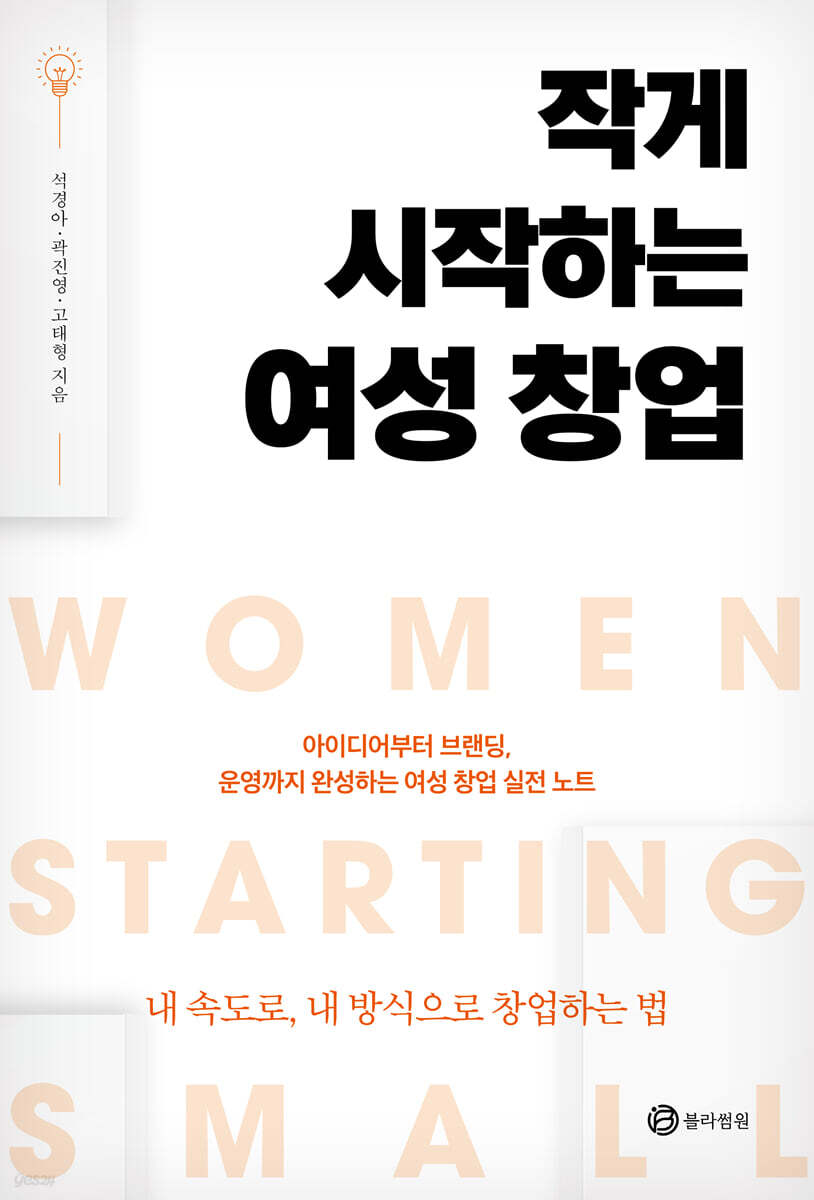
Women Starting Small
 |
Description
Book Introduction
“It’s okay to start small.”
The most realistic guide for women entrepreneurs!
A practical entrepreneurship book written by two female entrepreneurs and a professor specializing in entrepreneurship.
The two female founders are real entrepreneurs who chose to start a business between childcare, work, and life.
Another is a professor at Kangnam University's Entrepreneurship Support Center, a mentor to hundreds of entrepreneurs.
This book is a combination of “experienced reality” and “proven advice from experts.”
This is a practical guide to entrepreneurship tailored to women, something the market needs right now.
Starting a business is more difficult for women.
So we need more 'realistic' guidance.
Childcare gaps, lack of capital, information gaps, and limitations in marketing capabilities.
Female entrepreneurs face numerous hurdles from the start.
But the authors say:
“Even if it’s not perfect, anyone can do it if they start small.” The vivid experiences of female entrepreneurs and the professional startup strategies of a startup mentor professor are added.
We provide a step-by-step guide to practical methods for 'starting small as a female entrepreneur.'
The core message from these three authors is that entrepreneurship doesn't begin with grand goals, but with the smallest actions possible now.
· Motivation to move beyond fear and take action
· Government-supported project selection process and success strategy
· Core branding and marketing strategies
· Creating a sustainable startup management system
How to turn failure into opportunity
From fear to action, from despair to growth. Through this book, the authors honestly convey the 'real reality' of entrepreneurship, not the superficial aspects.
From the moment you first come up with an idea to standing in front of a customer, and even the trials and errors of government-supported projects and branding.
The experiences contained in the process will also give readers realistic courage and new possibilities.
"Women's Startups: Starting Small" shows that starting a business is not a grand challenge, but begins with the smallest action possible now.
If you believe in yourself and are ready to take the next step, it's time to launch "Women's Startups: Starting Small"!
The most realistic guide for women entrepreneurs!
A practical entrepreneurship book written by two female entrepreneurs and a professor specializing in entrepreneurship.
The two female founders are real entrepreneurs who chose to start a business between childcare, work, and life.
Another is a professor at Kangnam University's Entrepreneurship Support Center, a mentor to hundreds of entrepreneurs.
This book is a combination of “experienced reality” and “proven advice from experts.”
This is a practical guide to entrepreneurship tailored to women, something the market needs right now.
Starting a business is more difficult for women.
So we need more 'realistic' guidance.
Childcare gaps, lack of capital, information gaps, and limitations in marketing capabilities.
Female entrepreneurs face numerous hurdles from the start.
But the authors say:
“Even if it’s not perfect, anyone can do it if they start small.” The vivid experiences of female entrepreneurs and the professional startup strategies of a startup mentor professor are added.
We provide a step-by-step guide to practical methods for 'starting small as a female entrepreneur.'
The core message from these three authors is that entrepreneurship doesn't begin with grand goals, but with the smallest actions possible now.
· Motivation to move beyond fear and take action
· Government-supported project selection process and success strategy
· Core branding and marketing strategies
· Creating a sustainable startup management system
How to turn failure into opportunity
From fear to action, from despair to growth. Through this book, the authors honestly convey the 'real reality' of entrepreneurship, not the superficial aspects.
From the moment you first come up with an idea to standing in front of a customer, and even the trials and errors of government-supported projects and branding.
The experiences contained in the process will also give readers realistic courage and new possibilities.
"Women's Startups: Starting Small" shows that starting a business is not a grand challenge, but begins with the smallest action possible now.
If you believe in yourself and are ready to take the next step, it's time to launch "Women's Startups: Starting Small"!
index
Prologue: Even though our beginnings may be different, we can all start a business.
Chapter 1.
Why do I want to start a business?
1.
When you can't go back to work
2.
What do I want, money or freedom?
3.
If only I could earn 500,000 won.
Entrepreneurship that starts from a realistic need
4.
How to Overcome Fear: Why It's More Effective Than You Think
5.
There is a world that only those who have begun know.
* Mentor's Note: Can an ordinary person like me start a business?
Chapter 2.
What startup idea is right for me?
1.
How to Use Me as Material: Turning Experiences, Skills, and Narratives into Startup Ideas
2.
Where do good items come from?
3.
Exploring no-capital, low-capital startup models
4.
Online vs. Offline vs. Hybrid Startups
5.
Should I sell value or technology?
* Mentor's Note: I don't have a specific item.
So does that mean I shouldn't start a business?
Chapter 3.
Translating your ideas into business plans
1.
Who are your customers? Creating personas
2.
What problem is that customer having?
3.
What solutions can I offer?
4.
Competitor Analysis and Differentiation Strategy
5.
Market research, how should I do it?
6. What is MVP?
7.
Organizing Your Ideas into a One-Page Business Plan
* Mentor's Note: I have a vague idea, but can I write a business plan?
Chapter 4.
Support systems for entrepreneurs and how to use them
1.
A guide to government-supported programs available for startups
2.
Small but substantial local government small business
3.
Practical In-Kind Support: How to Use Space, Training, and Mentoring
4.
For-Profit vs. Non-Profit Business Startup Structure
5.
The Difference Between Elimination and Selection: It All Comes Down to Documents
6.
Interviews and pitching: How much should I prepare?
7.
Benefits of Women-Owned Enterprises and Show Venture Certification
* Mentor's Note: Government-funded projects, should I try them too? They seem too difficult.
Chapter 5.
Creating your own brand and marketing execution skills
1.
The Essence of Branding: Defining Yourself
2.
Create your own brand name and slogan
3.
Customer Branding Strategies: Emotional vs. Informational vs. Practical
4. Content Strategy by Social Media Channel: Where Are Customers Waiting?
5.
Marketing Blueprint: Awareness -> Trust -> Purchase Flow
6.
The moment customers trust your content: Authenticity and Continuity
7.
Building Brand Fans: From Regulars to Advocates
* Mentor's Note: I think you're too small a business to build a brand.
Do you still need it?
Chapter 6.
How does it work?
1.
Structures, not ideas, sell.
2.
My Business Model Summary: Revenue and Costs
3.
How to calculate sales, fixed costs, and variable costs
4.
Price psychology and packaging strategies that drive customers to open their wallets.
5.
Operational Strategies by Customer Type: B2B, B2C, B2G
6.
Creating an operating system that can be run alone
7.
Expansion Strategies for Solo Businesses: Outsourcing vs. Collaboration vs. Fixed Staffing
* Mentor's Note: Is running a business alone really possible? It seems too complicated.
Chapter 7.
There's no such thing as a failure-free startup, but preparation is possible.
1.
Why do most startups fail within three years?
2.
Realistic funding and start-up cost strategies
3.
When to Pivot: Hold vs. Change Direction
4.
How to Recover from Emotional Exhaustion and Burnout
5.
The Key to Sustainable Entrepreneurship: Team
* Mentor's words: I'm so scared of failure.
I don't have the courage to start.
Chapter 1.
Why do I want to start a business?
1.
When you can't go back to work
2.
What do I want, money or freedom?
3.
If only I could earn 500,000 won.
Entrepreneurship that starts from a realistic need
4.
How to Overcome Fear: Why It's More Effective Than You Think
5.
There is a world that only those who have begun know.
* Mentor's Note: Can an ordinary person like me start a business?
Chapter 2.
What startup idea is right for me?
1.
How to Use Me as Material: Turning Experiences, Skills, and Narratives into Startup Ideas
2.
Where do good items come from?
3.
Exploring no-capital, low-capital startup models
4.
Online vs. Offline vs. Hybrid Startups
5.
Should I sell value or technology?
* Mentor's Note: I don't have a specific item.
So does that mean I shouldn't start a business?
Chapter 3.
Translating your ideas into business plans
1.
Who are your customers? Creating personas
2.
What problem is that customer having?
3.
What solutions can I offer?
4.
Competitor Analysis and Differentiation Strategy
5.
Market research, how should I do it?
6. What is MVP?
7.
Organizing Your Ideas into a One-Page Business Plan
* Mentor's Note: I have a vague idea, but can I write a business plan?
Chapter 4.
Support systems for entrepreneurs and how to use them
1.
A guide to government-supported programs available for startups
2.
Small but substantial local government small business
3.
Practical In-Kind Support: How to Use Space, Training, and Mentoring
4.
For-Profit vs. Non-Profit Business Startup Structure
5.
The Difference Between Elimination and Selection: It All Comes Down to Documents
6.
Interviews and pitching: How much should I prepare?
7.
Benefits of Women-Owned Enterprises and Show Venture Certification
* Mentor's Note: Government-funded projects, should I try them too? They seem too difficult.
Chapter 5.
Creating your own brand and marketing execution skills
1.
The Essence of Branding: Defining Yourself
2.
Create your own brand name and slogan
3.
Customer Branding Strategies: Emotional vs. Informational vs. Practical
4. Content Strategy by Social Media Channel: Where Are Customers Waiting?
5.
Marketing Blueprint: Awareness -> Trust -> Purchase Flow
6.
The moment customers trust your content: Authenticity and Continuity
7.
Building Brand Fans: From Regulars to Advocates
* Mentor's Note: I think you're too small a business to build a brand.
Do you still need it?
Chapter 6.
How does it work?
1.
Structures, not ideas, sell.
2.
My Business Model Summary: Revenue and Costs
3.
How to calculate sales, fixed costs, and variable costs
4.
Price psychology and packaging strategies that drive customers to open their wallets.
5.
Operational Strategies by Customer Type: B2B, B2C, B2G
6.
Creating an operating system that can be run alone
7.
Expansion Strategies for Solo Businesses: Outsourcing vs. Collaboration vs. Fixed Staffing
* Mentor's Note: Is running a business alone really possible? It seems too complicated.
Chapter 7.
There's no such thing as a failure-free startup, but preparation is possible.
1.
Why do most startups fail within three years?
2.
Realistic funding and start-up cost strategies
3.
When to Pivot: Hold vs. Change Direction
4.
How to Recover from Emotional Exhaustion and Burnout
5.
The Key to Sustainable Entrepreneurship: Team
* Mentor's words: I'm so scared of failure.
I don't have the courage to start.
Into the book
Some say they don't have ideas, some say they don't have capital, and some say they don't have courage.
But starting a business isn't a grand declaration. It starts the moment you step into the world with something you can do.
This book started with the belief that it's okay for women entrepreneurs to start small.
The book contains the long-term conversations and experiences of three authors who met as mentors and mentees, as well as practical notes verified in the field.
At the end of each chapter, we include a 'Mentor's Notes' appendix, providing practical advice that will be helpful when you're just getting started.
Entrepreneurship is not an endless competition, but a process of creating your own sustainable work.
This book will serve as a solid guide to help you take that first step.
But starting a business isn't a grand declaration. It starts the moment you step into the world with something you can do.
This book started with the belief that it's okay for women entrepreneurs to start small.
The book contains the long-term conversations and experiences of three authors who met as mentors and mentees, as well as practical notes verified in the field.
At the end of each chapter, we include a 'Mentor's Notes' appendix, providing practical advice that will be helpful when you're just getting started.
Entrepreneurship is not an endless competition, but a process of creating your own sustainable work.
This book will serve as a solid guide to help you take that first step.
--- From the prologue
Publisher's Review
While the number of female entrepreneurs is rapidly increasing, few are actually remaining in the market and creating sustainable models.
Especially for women who have to balance childcare and work, starting a business is a task that is always put off until “later.”
"Women's Startups: Starting Small" starts from that very point.
Two female entrepreneurs and a startup mentor share their honest account of how to take the first step within the constraints of time, capital, and experience, and how small beginnings can grow into a full-fledged business.
This book is not a grand success story, but a practical entrepreneurship notebook from people who have overcome reality.
Solid insights that give you the confidence to start small
The authors threw themselves fiercely from the very first moment of their startup.
"Why do I want to do this?", "Where are my current choices leading?" To answer these questions, two female entrepreneurs overcame the barriers of reality every day, and one startup mentor discovered the essence through the trial and error of countless entrepreneurs.
The message they convey is simple yet profound.
“Entrepreneurship doesn’t start with a grand leap, but with the smallest action possible today.”
Even for shaky beginner entrepreneurs,
Anyone who hesitates in front of a new path
You will find scenes in this book that resemble yourself.
And finally you will ask yourself:
“Why am I starting this? And where do I want to go?”
This book is the most realistic and solid mentoring for women entrepreneurs, giving them the courage and direction to answer that question.
Especially for women who have to balance childcare and work, starting a business is a task that is always put off until “later.”
"Women's Startups: Starting Small" starts from that very point.
Two female entrepreneurs and a startup mentor share their honest account of how to take the first step within the constraints of time, capital, and experience, and how small beginnings can grow into a full-fledged business.
This book is not a grand success story, but a practical entrepreneurship notebook from people who have overcome reality.
Solid insights that give you the confidence to start small
The authors threw themselves fiercely from the very first moment of their startup.
"Why do I want to do this?", "Where are my current choices leading?" To answer these questions, two female entrepreneurs overcame the barriers of reality every day, and one startup mentor discovered the essence through the trial and error of countless entrepreneurs.
The message they convey is simple yet profound.
“Entrepreneurship doesn’t start with a grand leap, but with the smallest action possible today.”
Even for shaky beginner entrepreneurs,
Anyone who hesitates in front of a new path
You will find scenes in this book that resemble yourself.
And finally you will ask yourself:
“Why am I starting this? And where do I want to go?”
This book is the most realistic and solid mentoring for women entrepreneurs, giving them the courage and direction to answer that question.
GOODS SPECIFICS
- Date of issue: November 17, 2025
- Page count, weight, size: 208 pages | 152*224*20mm
- ISBN13: 9791199018532
- ISBN10: 1199018538
You may also like
카테고리
korean


korean

![GQ KOREA Mark (Monthly): December [2025]](http://librairie.coreenne.fr/cdn/shop/files/8ef265dbbfbf186523ed75ba7319009d.jpg?v=1765340328&width=3840)


