

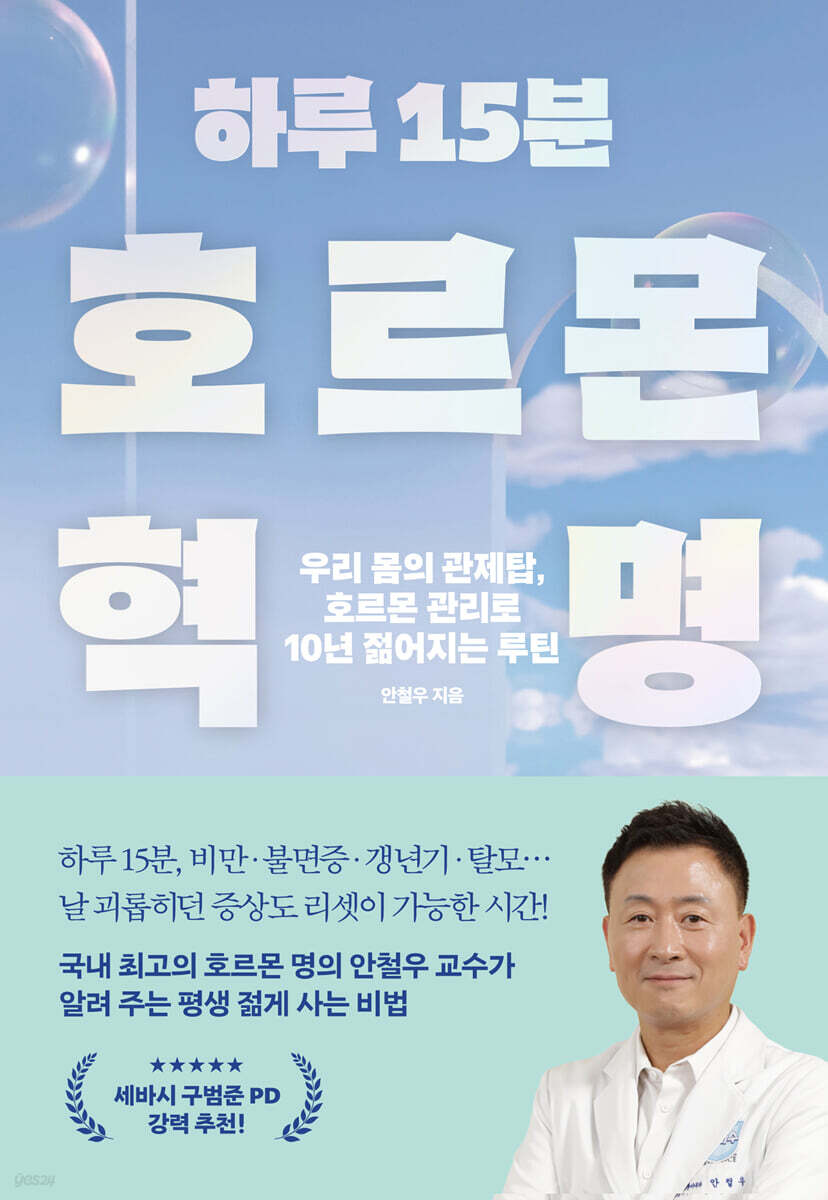
15 Minutes a Day Hormone Revolution
 |
Description
Book Introduction
Sebashi YouTube cumulative views 1.28 million, Professor Ahn Cheol-woo's new work
Experience slow aging with a 15-minute daily hormone reset habit!
The secret to living younger and healthier than your age lies in hormonal balance!
Professor Ahn Cheol-woo, Korea's leading hormone authority, has released a new book, "15-Minute Hormone Revolution," which overturns the stereotype that "aging is unavoidable."
Rather, based on scientific evidence that suggests that we can become healthier as we age, we present specific practices that can help us regain vitality in our lives with a 15-minute daily routine.
The author, an endocrinologist, finds the cause of 'accelerated aging' in hormonal imbalance.
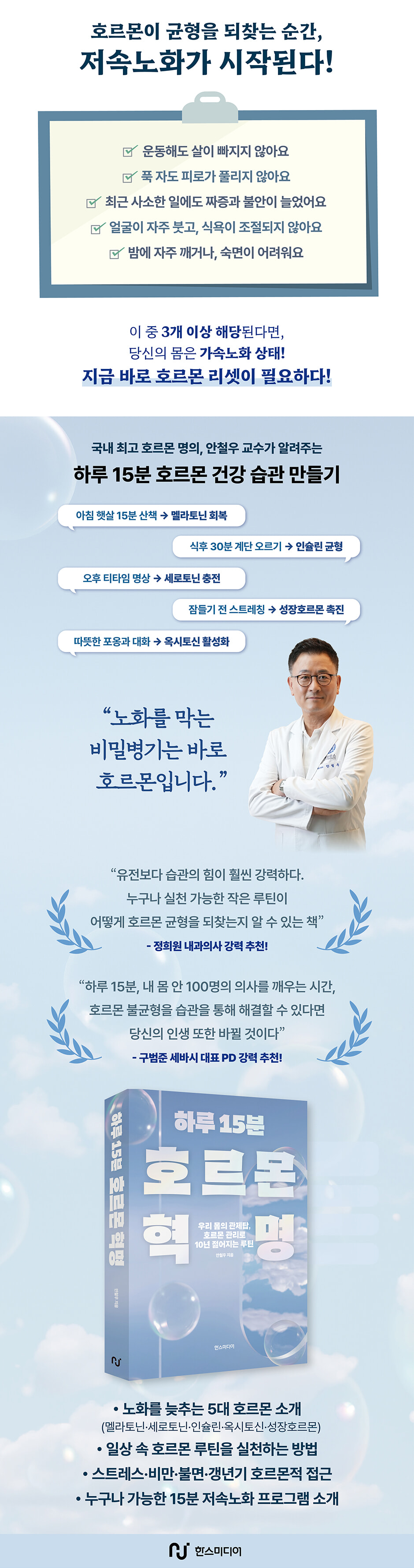
It analyzes the causes of aging and adult diseases from the perspective of hormonal changes and explains that the balance of five key hormones, including melatonin, growth hormone, serotonin, oxytocin, and insulin, is the main factor determining the fate of health.
This book explains complex medical knowledge in easy-to-understand everyday language, and introduces 31 "15-minute daily hormone prescriptions" that anyone can follow, helping them put them into practice right away.
It helps you achieve a healthy life even in your busy daily life through sustainable routines such as a 15-minute morning walk, tea time meditation, climbing stairs, listening to music, and upside-down eating.
Good habits are more powerful than medicine or treatment.
"The 15-Minute Hormone Revolution" will be a new health book that teaches "how to manage life with hormones" not only to middle-aged people who want to delay aging, but also to everyone who wants to plan a healthy life from a young age.
Experience slow aging with a 15-minute daily hormone reset habit!
The secret to living younger and healthier than your age lies in hormonal balance!
Professor Ahn Cheol-woo, Korea's leading hormone authority, has released a new book, "15-Minute Hormone Revolution," which overturns the stereotype that "aging is unavoidable."
Rather, based on scientific evidence that suggests that we can become healthier as we age, we present specific practices that can help us regain vitality in our lives with a 15-minute daily routine.
The author, an endocrinologist, finds the cause of 'accelerated aging' in hormonal imbalance.
It analyzes the causes of aging and adult diseases from the perspective of hormonal changes and explains that the balance of five key hormones, including melatonin, growth hormone, serotonin, oxytocin, and insulin, is the main factor determining the fate of health.
This book explains complex medical knowledge in easy-to-understand everyday language, and introduces 31 "15-minute daily hormone prescriptions" that anyone can follow, helping them put them into practice right away.
It helps you achieve a healthy life even in your busy daily life through sustainable routines such as a 15-minute morning walk, tea time meditation, climbing stairs, listening to music, and upside-down eating.
Good habits are more powerful than medicine or treatment.
"The 15-Minute Hormone Revolution" will be a new health book that teaches "how to manage life with hormones" not only to middle-aged people who want to delay aging, but also to everyone who wants to plan a healthy life from a young age.
- You can preview some of the book's contents.
Preview
index
Introduction: 15 Minutes a Day: A Miracle Time to Slow Down Aging
Chapter 1: Slow and Accelerated Aging Are Determined by Hormones
Why Aging Progresses in Steps
Slow aging vs. accelerated aging
Micro-diseases that promote accelerated aging
Anti-aging is more important than wrinkles, as it prevents vascular aging.
The three major diseases that cause accelerated aging
Hormone management methods that promote slow aging
Vitamins are taken in, and hormones are treated through habits.
Hormone management that makes you 10 years younger in 15 minutes a day
Chapter 2: Hormonal Recipes to Stay Youthful and Fight Aging
Aging occurs when hormones no longer protect us.
When melatonin declines, accelerated aging begins.
The happiness hormone that even regulates the speed of aging
Protect yourself with powerful antioxidants that prevent skin aging.
Women need testosterone too
Hormonal management should also vary depending on the type of hair loss.
Growth hormone that makes even the elderly look younger?
Why You Should Never Give Up on Sexual Satisfaction Until the End
【15-Minute Hormone Prescription a Day】
Chapter 3: From mood regulation to dementia prevention, finding answers in hormones.
Understanding the stress that attacks my body, cortisol, reveals the solution.
Can melatonin diagnose Alzheimer's?
When the gut is depressed, the brain is depressed too.
Estrogen decline causes dementia
Thyroid hormones that regulate the temperature of the mind
Dementia that leads to type 3 diabetes
Dopamine deficiency causes degenerative diseases
How to Use Your Smartphone Properly: It Can Be Both Poison and Medicine
【15-Minute Hormone Prescription a Day】
Chapter 4: Balance Your Hormones for Weight and Health
Metabolic syndrome that starts with weight gain
The obesity switch that turns on and off with hormones
To manage your appetite, start with dopamine.
Diabetes, which eats away at your lifespan, should be addressed starting with these four key indicators.
If you gain weight despite exercising, check your insulin resistance.
The key to muscle hormones is exercise.
Hormone Prescriptions for Gut Microbiota
Treating obesity with hormones
【15-Minute Hormone Prescription a Day】
Chapter 5: Hormonal Management for Slow and Wise Aging
Menopause, when rapid aging begins
Menopausal women experience pain from head to toe.
Don't make fun of male menopause.
Aerobic exercise is the basic, and strength training is increasingly important.
Stress that turns menopause into a serious illness
Another option: hormone therapy
Hormone therapy is also available for men.
Menopause wisely, the second act of life energetically
【15-Minute Hormone Prescription a Day】
Chapter 1: Slow and Accelerated Aging Are Determined by Hormones
Why Aging Progresses in Steps
Slow aging vs. accelerated aging
Micro-diseases that promote accelerated aging
Anti-aging is more important than wrinkles, as it prevents vascular aging.
The three major diseases that cause accelerated aging
Hormone management methods that promote slow aging
Vitamins are taken in, and hormones are treated through habits.
Hormone management that makes you 10 years younger in 15 minutes a day
Chapter 2: Hormonal Recipes to Stay Youthful and Fight Aging
Aging occurs when hormones no longer protect us.
When melatonin declines, accelerated aging begins.
The happiness hormone that even regulates the speed of aging
Protect yourself with powerful antioxidants that prevent skin aging.
Women need testosterone too
Hormonal management should also vary depending on the type of hair loss.
Growth hormone that makes even the elderly look younger?
Why You Should Never Give Up on Sexual Satisfaction Until the End
【15-Minute Hormone Prescription a Day】
Chapter 3: From mood regulation to dementia prevention, finding answers in hormones.
Understanding the stress that attacks my body, cortisol, reveals the solution.
Can melatonin diagnose Alzheimer's?
When the gut is depressed, the brain is depressed too.
Estrogen decline causes dementia
Thyroid hormones that regulate the temperature of the mind
Dementia that leads to type 3 diabetes
Dopamine deficiency causes degenerative diseases
How to Use Your Smartphone Properly: It Can Be Both Poison and Medicine
【15-Minute Hormone Prescription a Day】
Chapter 4: Balance Your Hormones for Weight and Health
Metabolic syndrome that starts with weight gain
The obesity switch that turns on and off with hormones
To manage your appetite, start with dopamine.
Diabetes, which eats away at your lifespan, should be addressed starting with these four key indicators.
If you gain weight despite exercising, check your insulin resistance.
The key to muscle hormones is exercise.
Hormone Prescriptions for Gut Microbiota
Treating obesity with hormones
【15-Minute Hormone Prescription a Day】
Chapter 5: Hormonal Management for Slow and Wise Aging
Menopause, when rapid aging begins
Menopausal women experience pain from head to toe.
Don't make fun of male menopause.
Aerobic exercise is the basic, and strength training is increasingly important.
Stress that turns menopause into a serious illness
Another option: hormone therapy
Hormone therapy is also available for men.
Menopause wisely, the second act of life energetically
【15-Minute Hormone Prescription a Day】
Detailed image
Into the book
Hormonal imbalance causes skin diseases
So why are so many people suffering from premature aging? Hormonal imbalance is a common cause of premature aging.
Type 2 diabetes, also known as acquired diabetes, occurs when the body's sensitivity to insulin, which regulates blood sugar levels, decreases.
If there is an abnormality in the secretion of cortisol, thyroid hormones, etc. along with insulin, hyperlipidemia may also occur.
This is also why the number of patients with diabetes and hyperlipidemia increases in middle age and older age when hormone secretion becomes difficult.
If hormonal imbalance is disrupted during accelerated aging, it will inevitably progress from minor illness to disease.
To prevent a minor illness from progressing into a disease, you must first recognize the abnormal signals your body is sending you.
If you feel tired easily, have trouble sleeping, experience mood swings, or your hair is thinning or your skin is saggy, making you look older, you should check to see if these are warning signals from your body.
--- p.35 From “Misfortunes that Promote Accelerated Aging”
Why the Dopamine You Need in Your 20s Is Still Necessary in Your 80s
As we age, our muscle strength, balance, nervous system, and reflexes decline.
To compensate for this, dopamine is absolutely necessary.
Dopamine is often known as the hormone of youth.
The dopamine-driven 'reward system' is involved in love, self-actualization, achievement, and sacrifice.
But dopamine really starts to shine much later.
Dopamine is involved in human movement and conscious movements of the limbs.
However, as we age, dopaminergic neurons are destroyed and signal transmission is interrupted, causing muscles to become stiff and limb movements to become slow.
If you do it wrong, your whole body could become paralyzed.
Parkinson's disease is a representative disease caused by dopamine deficiency.
It is the second most common degenerative disease after dementia.
--- p.167 From “Dopamine Deficiency Causes Degenerative Diseases”
Why does serotonin like to chat?
The chatter is powerful.
This applies to men as well as women.
Sharing your feelings and worries through small talk relieves stress and puts you at ease.
This emotional stability creates a positive feedback loop with the release of serotonin.
In fact, many studies have confirmed that anxiety and stress lower serotonin levels.
On the other hand, a sense of stability and peace of mind increase serotonin levels.
Chatting strengthens relationships with others, giving us a sense of belonging and connection, a sense of being socially connected.
These positive emotions are also associated with feelings of stability and happiness.
The joy felt during chatting is often expressed through laughter, which itself increases heart rate and lung capacity, producing effects similar to exercise.
These physical changes further activate serotonin secretion.
--- pp.176-177 From "Chatter? Chatter! Chatter that Creates Serotonin"
When estrogen disappears, cognitive abilities also decline.
It has long been known that estrogen affects cognitive abilities.
In 1988, a research team at McGill University in Canada conducted an experiment in which women whose estrogen levels had plummeted due to ovarian removal were divided into two groups and estrogen was injected periodically into only one side.
After three months, the cognitive abilities of the group that received estrogen injections and the group that did not were checked, and the group that received estrogen injections received significantly better scores in memory, cognitive speed, and reasoning ability.
A follow-up study conducted several years later found that the group that received estrogen injections showed little change in cognitive ability, while the group that did not showed a significant decline in cognitive ability.
In fact, estrogen increases cerebral blood flow, mediates hormones, promotes the formation of synapses in the brain, which are called 'information substations', and prevents brain cell death.
Therefore, menopause is not simply the cessation of menstruation, but an important time to look after a woman's physical and mental health.
--- pp.151-152 From “Estrogen Decreased Causes Dementia”
Even though I exercise, I still gain weight?
The principle of dieting is simple.
You just need to have more calories going out than coming in.
Exercise is the best way to increase your calorie expenditure.
However, many patients who visit the clinic complain, “I gain weight even though I exercise.”
In fact, it is common to gain weight in the early stages of exercise.
There are three main reasons.
First, when muscle mass increases.
There is a difference between the density of muscle (about 1.1 g/cm³) and the density of fat (about 0.9 g/cm³).
Muscles are smaller in volume than fat but weigh more, so if you gain more muscle through exercise, you will gain weight.
But as time goes by, the weight gradually decreases.
Second, when the amount of water in the body increases.
When you exercise, your muscles store the energy they need as glycogen, but glycogen has the property of attracting water.
Water builds up in the muscles, causing temporary weight gain.
The last one is when you really gain weight.
If you have insulin resistance, exercising doesn't burn calories efficiently.
Additionally, if you have insulin resistance, your appetite may increase after exercise, leading to increased food intake.
In this case, insulin resistance must be corrected first.
So why are so many people suffering from premature aging? Hormonal imbalance is a common cause of premature aging.
Type 2 diabetes, also known as acquired diabetes, occurs when the body's sensitivity to insulin, which regulates blood sugar levels, decreases.
If there is an abnormality in the secretion of cortisol, thyroid hormones, etc. along with insulin, hyperlipidemia may also occur.
This is also why the number of patients with diabetes and hyperlipidemia increases in middle age and older age when hormone secretion becomes difficult.
If hormonal imbalance is disrupted during accelerated aging, it will inevitably progress from minor illness to disease.
To prevent a minor illness from progressing into a disease, you must first recognize the abnormal signals your body is sending you.
If you feel tired easily, have trouble sleeping, experience mood swings, or your hair is thinning or your skin is saggy, making you look older, you should check to see if these are warning signals from your body.
--- p.35 From “Misfortunes that Promote Accelerated Aging”
Why the Dopamine You Need in Your 20s Is Still Necessary in Your 80s
As we age, our muscle strength, balance, nervous system, and reflexes decline.
To compensate for this, dopamine is absolutely necessary.
Dopamine is often known as the hormone of youth.
The dopamine-driven 'reward system' is involved in love, self-actualization, achievement, and sacrifice.
But dopamine really starts to shine much later.
Dopamine is involved in human movement and conscious movements of the limbs.
However, as we age, dopaminergic neurons are destroyed and signal transmission is interrupted, causing muscles to become stiff and limb movements to become slow.
If you do it wrong, your whole body could become paralyzed.
Parkinson's disease is a representative disease caused by dopamine deficiency.
It is the second most common degenerative disease after dementia.
--- p.167 From “Dopamine Deficiency Causes Degenerative Diseases”
Why does serotonin like to chat?
The chatter is powerful.
This applies to men as well as women.
Sharing your feelings and worries through small talk relieves stress and puts you at ease.
This emotional stability creates a positive feedback loop with the release of serotonin.
In fact, many studies have confirmed that anxiety and stress lower serotonin levels.
On the other hand, a sense of stability and peace of mind increase serotonin levels.
Chatting strengthens relationships with others, giving us a sense of belonging and connection, a sense of being socially connected.
These positive emotions are also associated with feelings of stability and happiness.
The joy felt during chatting is often expressed through laughter, which itself increases heart rate and lung capacity, producing effects similar to exercise.
These physical changes further activate serotonin secretion.
--- pp.176-177 From "Chatter? Chatter! Chatter that Creates Serotonin"
When estrogen disappears, cognitive abilities also decline.
It has long been known that estrogen affects cognitive abilities.
In 1988, a research team at McGill University in Canada conducted an experiment in which women whose estrogen levels had plummeted due to ovarian removal were divided into two groups and estrogen was injected periodically into only one side.
After three months, the cognitive abilities of the group that received estrogen injections and the group that did not were checked, and the group that received estrogen injections received significantly better scores in memory, cognitive speed, and reasoning ability.
A follow-up study conducted several years later found that the group that received estrogen injections showed little change in cognitive ability, while the group that did not showed a significant decline in cognitive ability.
In fact, estrogen increases cerebral blood flow, mediates hormones, promotes the formation of synapses in the brain, which are called 'information substations', and prevents brain cell death.
Therefore, menopause is not simply the cessation of menstruation, but an important time to look after a woman's physical and mental health.
--- pp.151-152 From “Estrogen Decreased Causes Dementia”
Even though I exercise, I still gain weight?
The principle of dieting is simple.
You just need to have more calories going out than coming in.
Exercise is the best way to increase your calorie expenditure.
However, many patients who visit the clinic complain, “I gain weight even though I exercise.”
In fact, it is common to gain weight in the early stages of exercise.
There are three main reasons.
First, when muscle mass increases.
There is a difference between the density of muscle (about 1.1 g/cm³) and the density of fat (about 0.9 g/cm³).
Muscles are smaller in volume than fat but weigh more, so if you gain more muscle through exercise, you will gain weight.
But as time goes by, the weight gradually decreases.
Second, when the amount of water in the body increases.
When you exercise, your muscles store the energy they need as glycogen, but glycogen has the property of attracting water.
Water builds up in the muscles, causing temporary weight gain.
The last one is when you really gain weight.
If you have insulin resistance, exercising doesn't burn calories efficiently.
Additionally, if you have insulin resistance, your appetite may increase after exercise, leading to increased food intake.
In this case, insulin resistance must be corrected first.
--- pp.227-228 From “If you gain weight even when exercising, check your insulin resistance”
Publisher's Review
Can 15 minutes of daily care make you 10 years younger?
Professor Ahn Cheol-woo suggests creating habits that balance hormones.
Professor Ahn Cheol-woo, author of “15 Minutes a Day Hormone Revolution,” does not view aging as simply a decline in biological functions.
He defines the essence of aging as a process of hormonal changes, and emphasizes that it is not genetics but hormones that determine the timing and speed of aging, based on the latest medical data including the Stanford University School of Medicine's 'Stairway Aging Study'.
In particular, the rapid decline in sex hormones, growth hormones, and sleep hormones after the age of 40 presses the switch to accelerate aging.
This book guides you through specific examples and methods to show how good habits can turn the accelerator switch back into a slow switch.
The author focuses on the 'hormonal imbalance' that comes before illness.
Symptoms such as chronic fatigue, insomnia, weight gain, and mood swings are not simply stress, but the “language of hormones.”
He emphasizes that we should not ignore the signals our body sends us, but rather read the hormonal imbalance at its root.
You can check your hormonal status through the true/false quiz and self-diagnosis table presented in the introduction of the book and design a customized routine tailored to your hormone deficiencies.
Diagnose your hormone deficiencies and restore hormonal balance with the power of habit, a more powerful tool than genetics.
31 Hormone Prescriptions You Can Apply Immediately in Your Life
《15 Minutes a Day Hormone Revolution》 is not just a health information book.
It contains Professor Ahn Cheol-woo's vivid clinical experience, warm advice, and practical tips from his experience meeting numerous patients in his clinic.
The stories of an insomnia patient regaining deep sleep through morning sunlight meditation, and of a patient suffering from menopausal depression regaining their daily lives through music listening and hugs, go beyond simple medical prescriptions and convey the comfort of life and the courage to put it into practice.
Aging is no longer an inevitable fate, but rather a choice that individuals can control.
The author presents a detailed explanation of how a small 15-minute routine out of 24 hours a day can change physical strength, emotions, memory, and even immunity, and awakens us to the essence of health through the message, “Vitamins are obtained through eating, but hormones must be cultivated through habits.”
The beginning of the book contains questions that help you diagnose which hormones you may be lacking.
By checking this item, you can check for deficiencies in the five hormones that play a major role in slow aging: melatonin, growth hormone, serotonin, oxytocin, and insulin.
And the book begins by presenting a methodology for filling this hormone deficiency with hormone recipes that can be put into practice in real life.
Chapter 1, “Slow and accelerated aging are determined by hormones,” introduces the micro-diseases that promote accelerated aging and reveals the three major diseases that are the main culprits of accelerated aging.
And it explains what hormone management methods are available to practice slow aging.
Chapter 2, 'Hormon Recipe to Stay Youthful and Prevent Aging', explains that the main cause of accelerated aging is the decline of melatonin, and introduces the happiness hormone that even controls the speed of aging.
It also explains why women need testosterone and explains how hormone management should be tailored to each type of hair loss.
And it explains growth hormones that make even the elderly look younger, and introduces 9 hormone recipes that prevent aging.
Chapter 3, “Finding Answers in Hormones, from Mood Control to Dementia Prevention,” introduces an approach to understanding and resolving the stress that attacks our bodies, cortisol, and shows that Alzheimer’s can be diagnosed with melatonin.
And it points out that dementia is caused by a decrease in estrogen and that it is thyroid hormones that regulate the temperature of the mind.
And it points out that degenerative diseases are caused by dopamine deficiency.
Chapter 4, “Hormonal Balance: Controlling Weight and Health,” explains that obesity can be solved by balancing hormones, and explains how to properly manage dopamine, insulin, and muscle hormones.
We also suggest simple diets, such as black food meals that lower diabetes, meals that lower cholesterol, and protein meals that build muscle.
Chapter 5, “Hormonal Management for Slow and Wise Aging,” focuses on female and male menopause and presents a methodology through hormone prescriptions on how to live through the menopausal period in an energetic manner through a hormonal approach.
We will show you how to activate melatonin through short outings, and how to improve circulation and relieve menopausal pain through pelvic exercises and meridian massage.
"The 15-Minute Hormone Revolution" is a hormone user manual and self-healing technique book for modern people that suggests how to live younger than your age and with a vibrant mind.
Professor Ahn Cheol-woo's 15-minute daily hormone recipe will serve as a milestone in slowing down the aging process and restoring health.
Professor Ahn Cheol-woo suggests creating habits that balance hormones.
Professor Ahn Cheol-woo, author of “15 Minutes a Day Hormone Revolution,” does not view aging as simply a decline in biological functions.
He defines the essence of aging as a process of hormonal changes, and emphasizes that it is not genetics but hormones that determine the timing and speed of aging, based on the latest medical data including the Stanford University School of Medicine's 'Stairway Aging Study'.
In particular, the rapid decline in sex hormones, growth hormones, and sleep hormones after the age of 40 presses the switch to accelerate aging.
This book guides you through specific examples and methods to show how good habits can turn the accelerator switch back into a slow switch.
The author focuses on the 'hormonal imbalance' that comes before illness.
Symptoms such as chronic fatigue, insomnia, weight gain, and mood swings are not simply stress, but the “language of hormones.”
He emphasizes that we should not ignore the signals our body sends us, but rather read the hormonal imbalance at its root.
You can check your hormonal status through the true/false quiz and self-diagnosis table presented in the introduction of the book and design a customized routine tailored to your hormone deficiencies.
Diagnose your hormone deficiencies and restore hormonal balance with the power of habit, a more powerful tool than genetics.
31 Hormone Prescriptions You Can Apply Immediately in Your Life
《15 Minutes a Day Hormone Revolution》 is not just a health information book.
It contains Professor Ahn Cheol-woo's vivid clinical experience, warm advice, and practical tips from his experience meeting numerous patients in his clinic.
The stories of an insomnia patient regaining deep sleep through morning sunlight meditation, and of a patient suffering from menopausal depression regaining their daily lives through music listening and hugs, go beyond simple medical prescriptions and convey the comfort of life and the courage to put it into practice.
Aging is no longer an inevitable fate, but rather a choice that individuals can control.
The author presents a detailed explanation of how a small 15-minute routine out of 24 hours a day can change physical strength, emotions, memory, and even immunity, and awakens us to the essence of health through the message, “Vitamins are obtained through eating, but hormones must be cultivated through habits.”
The beginning of the book contains questions that help you diagnose which hormones you may be lacking.
By checking this item, you can check for deficiencies in the five hormones that play a major role in slow aging: melatonin, growth hormone, serotonin, oxytocin, and insulin.
And the book begins by presenting a methodology for filling this hormone deficiency with hormone recipes that can be put into practice in real life.
Chapter 1, “Slow and accelerated aging are determined by hormones,” introduces the micro-diseases that promote accelerated aging and reveals the three major diseases that are the main culprits of accelerated aging.
And it explains what hormone management methods are available to practice slow aging.
Chapter 2, 'Hormon Recipe to Stay Youthful and Prevent Aging', explains that the main cause of accelerated aging is the decline of melatonin, and introduces the happiness hormone that even controls the speed of aging.
It also explains why women need testosterone and explains how hormone management should be tailored to each type of hair loss.
And it explains growth hormones that make even the elderly look younger, and introduces 9 hormone recipes that prevent aging.
Chapter 3, “Finding Answers in Hormones, from Mood Control to Dementia Prevention,” introduces an approach to understanding and resolving the stress that attacks our bodies, cortisol, and shows that Alzheimer’s can be diagnosed with melatonin.
And it points out that dementia is caused by a decrease in estrogen and that it is thyroid hormones that regulate the temperature of the mind.
And it points out that degenerative diseases are caused by dopamine deficiency.
Chapter 4, “Hormonal Balance: Controlling Weight and Health,” explains that obesity can be solved by balancing hormones, and explains how to properly manage dopamine, insulin, and muscle hormones.
We also suggest simple diets, such as black food meals that lower diabetes, meals that lower cholesterol, and protein meals that build muscle.
Chapter 5, “Hormonal Management for Slow and Wise Aging,” focuses on female and male menopause and presents a methodology through hormone prescriptions on how to live through the menopausal period in an energetic manner through a hormonal approach.
We will show you how to activate melatonin through short outings, and how to improve circulation and relieve menopausal pain through pelvic exercises and meridian massage.
"The 15-Minute Hormone Revolution" is a hormone user manual and self-healing technique book for modern people that suggests how to live younger than your age and with a vibrant mind.
Professor Ahn Cheol-woo's 15-minute daily hormone recipe will serve as a milestone in slowing down the aging process and restoring health.
GOODS SPECIFICS
- Date of issue: November 25, 2025
- Page count, weight, size: 352 pages | 632g | 145*210*21mm
- ISBN13: 9791194777755
You may also like
카테고리
korean


korean

![GQ KOREA Mark (Monthly): December [2025]](http://librairie.coreenne.fr/cdn/shop/files/8ef265dbbfbf186523ed75ba7319009d.jpg?v=1765340328&width=3840)


