

Dasan's last question
 |
Description
Book Introduction
The final installment in the best-selling 'Dasan's Last' series by author Jo Yoon-je.
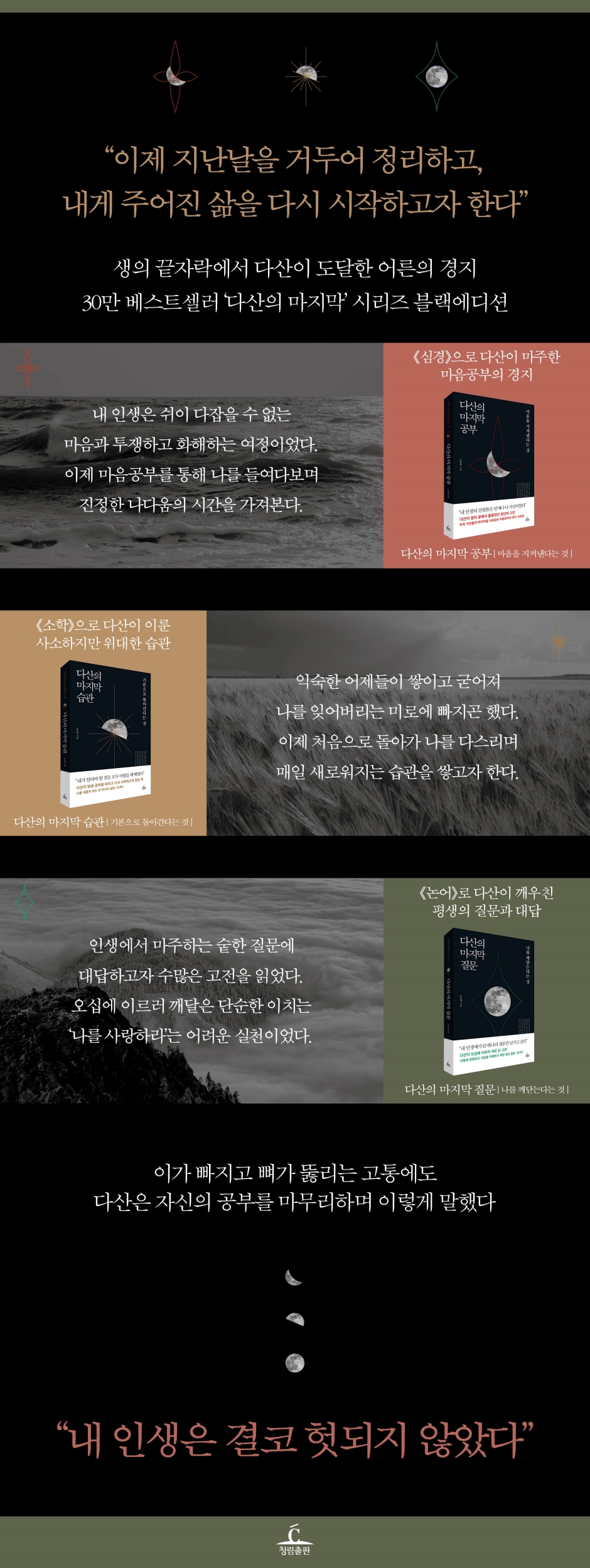
Following the two books that Dasan read side by side at the end of his life, the most profound of the Confucian classics, 『Simgyeong』 (『Dasan's Last Study』), and the easiest 『Sohak』 (『Dasan's Last Habit』, 『Analects of Confucius Gogeumju』, which Dasan compiled during the most difficult time in his life, has been explained in an easy-to-understand manner to suit today's sensibilities.
Following the two books that Dasan read side by side at the end of his life, the most profound of the Confucian classics, 『Simgyeong』 (『Dasan's Last Study』), and the easiest 『Sohak』 (『Dasan's Last Habit』, 『Analects of Confucius Gogeumju』, which Dasan compiled during the most difficult time in his life, has been explained in an easy-to-understand manner to suit today's sensibilities.
- You can preview some of the book's contents.
Preview
index
Introduction: Dasan wanted to live like the Analects.
Chapter 1: The Unknown Heaven's Destiny: Grow without stopping until the very last moment.
Study to know why you are studying
Only I know my depth.
Words are vessels that contain everything about a person.
Greatness is achieved slowly and incrementally.
Studying is refining the scenery you see every day.
We read poetry to become like poetry.
Maturity is being willing to grow older.
Hyoran is trying to resemble the heart she received when she was first born.
A teacher is someone who realizes new things through his students.
Reading is like reading ten thousand books, engraving one book.
Studying to become a person who can give to others
Knowledge advances without rest, so you can never stop studying.
I can't change the path, but I can decide my steps.
To write like a human being, you must earn like a human being.
All great teachings are summed up in one word: love.
The classics tell us not to be trapped by authority.
The brush is mightier than the sword, so the karma created with the brush is also heavier than the sword.
Studying is the process of finding the lost self.
Don't rob your child of the opportunity to experience trial and error.
Just as the mind is revealed in the posture, the posture also permeates the mind.
To enjoy is to go forward in spite of it all.
Humanity began with the thought that you are like me.
Chapter 2: If you want to dye, dye first.
If you want to worry about the world, first look at your own shortcomings.
Today is better than yesterday, and tomorrow will be better than today.
Learning also requires qualifications
Courage is the wisdom to fear what is fearful.
Money should be spent, not spent on money.
Everything in my daily life is my teacher.
The burden I carry and the path I have taken prove who I am.
Those who lack confidence in themselves distinguish between noble and base.
If you know what you want to do and what you have to do, there is nothing to fear.
Too much depth can lead to isolation, too much breadth can lead to distraction.
A teacher must pass on the old and receive the new.
Look to those who look upon me with righteousness rather than those who look upon me with high regard.
This soil is the last handful that will complete the mountain.
Wisdom and courage are needed because we cannot dare to hope for perfection.
If you act appropriately to the time and situation, you can be called an adult.
If you're an adult, worry about what you should worry about.
Why didn't Confucius ask about the death of the horse?
Manners are knowing when to approach and when to retreat.
A talent that cannot look after people is like a discarded sword.
Don't ask for the answer, seek the answer.
Living like Dasan, even if just for one day
When the wind blows, the grass will surely bend.
Loving someone is also loving yourself
Chapter 3: Add one every day and take one away every day.
Studying is something you can learn and apply to your daily life.
Don't just give them fish; let them dream of the distant sea.
If you call someone a flower, they will turn into a flower.
If you walk too fast, looking only at the ground, you will lose your way.
I'd rather go crazy, or I'd rather stop
If I get dyed, I lose myself, and if I get dyed, I lose others.
Live a life heavier than Mount Tai
There are two paths before a person: up and down.
Learn history today to escape the past.
The world comes from me, and I come from study.
If we go together, we can go further.
Even a flight that crosses a thousand miles begins at the tip of your toes.
How can you judge a person without giving them a chance to learn?
There is nothing in the world easier to lose than oneself.
It's not temperament that makes a man, it's attitude.
Every little choice I make every day becomes my history.
The biggest mistake is not admitting your mistakes.
Learning is not conveyed through words, but through life.
At the end of his studies, Dasan swept the yard every morning.
Live your own life
Chapter 1: The Unknown Heaven's Destiny: Grow without stopping until the very last moment.
Study to know why you are studying
Only I know my depth.
Words are vessels that contain everything about a person.
Greatness is achieved slowly and incrementally.
Studying is refining the scenery you see every day.
We read poetry to become like poetry.
Maturity is being willing to grow older.
Hyoran is trying to resemble the heart she received when she was first born.
A teacher is someone who realizes new things through his students.
Reading is like reading ten thousand books, engraving one book.
Studying to become a person who can give to others
Knowledge advances without rest, so you can never stop studying.
I can't change the path, but I can decide my steps.
To write like a human being, you must earn like a human being.
All great teachings are summed up in one word: love.
The classics tell us not to be trapped by authority.
The brush is mightier than the sword, so the karma created with the brush is also heavier than the sword.
Studying is the process of finding the lost self.
Don't rob your child of the opportunity to experience trial and error.
Just as the mind is revealed in the posture, the posture also permeates the mind.
To enjoy is to go forward in spite of it all.
Humanity began with the thought that you are like me.
Chapter 2: If you want to dye, dye first.
If you want to worry about the world, first look at your own shortcomings.
Today is better than yesterday, and tomorrow will be better than today.
Learning also requires qualifications
Courage is the wisdom to fear what is fearful.
Money should be spent, not spent on money.
Everything in my daily life is my teacher.
The burden I carry and the path I have taken prove who I am.
Those who lack confidence in themselves distinguish between noble and base.
If you know what you want to do and what you have to do, there is nothing to fear.
Too much depth can lead to isolation, too much breadth can lead to distraction.
A teacher must pass on the old and receive the new.
Look to those who look upon me with righteousness rather than those who look upon me with high regard.
This soil is the last handful that will complete the mountain.
Wisdom and courage are needed because we cannot dare to hope for perfection.
If you act appropriately to the time and situation, you can be called an adult.
If you're an adult, worry about what you should worry about.
Why didn't Confucius ask about the death of the horse?
Manners are knowing when to approach and when to retreat.
A talent that cannot look after people is like a discarded sword.
Don't ask for the answer, seek the answer.
Living like Dasan, even if just for one day
When the wind blows, the grass will surely bend.
Loving someone is also loving yourself
Chapter 3: Add one every day and take one away every day.
Studying is something you can learn and apply to your daily life.
Don't just give them fish; let them dream of the distant sea.
If you call someone a flower, they will turn into a flower.
If you walk too fast, looking only at the ground, you will lose your way.
I'd rather go crazy, or I'd rather stop
If I get dyed, I lose myself, and if I get dyed, I lose others.
Live a life heavier than Mount Tai
There are two paths before a person: up and down.
Learn history today to escape the past.
The world comes from me, and I come from study.
If we go together, we can go further.
Even a flight that crosses a thousand miles begins at the tip of your toes.
How can you judge a person without giving them a chance to learn?
There is nothing in the world easier to lose than oneself.
It's not temperament that makes a man, it's attitude.
Every little choice I make every day becomes my history.
The biggest mistake is not admitting your mistakes.
Learning is not conveyed through words, but through life.
At the end of his studies, Dasan swept the yard every morning.
Live your own life
Detailed image
Into the book
The three provinces of Japan, the people, the people, the people, the friends, the people, the friends, the people, the people, the friends, the people, the people, the people, the people, the people, the people, the people, etc.
Oil Samsung Osin Wiinmoi Bulchungho Yeobungwoogyoibulshinho Jeonbulseupho
Zhu Xi criticized Zengzi for reflecting on three things, saying:
“Reflecting on three things is not something an adult should do.
“In his later years, Zengzi was unable to remove even the slightest flaw in his studies of virtue.”
They say it was because there was a lack of steam, but Dasan counters by saying this.
"Even though King Tang reproached himself for the six evil practices, how could he have failed to eliminate all the dregs that were flaws? Even sages constantly reflect on themselves and introspect."
An adult is not someone who lives without flaws, but someone who is wary of himself and willing to admit his shortcomings.
Therefore, Dasan interpreted that Zengzi also reflected on himself every day with a cautious and fearful mind, and that it was by no means because of a flaw in his later years.
---From "Greatness is achieved little by little and slowly"
吾十有五而志于學 31 十而立 4 10 而不惑 5 10 而知天命 6 10 而耳順 7 10 而從心所欲Not knowing
Fifty-two, five, two, three, four, five, six, six, seven, seventy, seventy, seventy, eighty, eighty, ninety ...
Dasan said this about the state of enlightenment he attained at the age of fifty.
“Knowing the mandate of heaven is the state of being well-versed in the virtues of heaven, and Yi Sun is at a level even higher than that, so how can one speak of it easily? … However, everyone only admires the sage, but they only look down on his achievements and cannot approach them.
Adults are inherently higher beings, so I give up, saying that I can never become one.
This is why there are no adults today.”
Respect for great people comes from the self-esteem that if they can achieve it, so can I.
And it starts with the courage to boldly challenge.
There is no way to rise higher without knowing how to elevate yourself.
---From "Adulthood is being willing to grow older"
The story of the child, the father, the mother, the family, the family, and the sorrow
The saying, "Meng Wu Baek Mun Hyo Ja-Wol" means "the abandonment of parents is the quality of life"
Dasan believed that the most important thing in filial piety was sincerity and devotion.
This can be clearly seen in the writings of the two sons who were taught.
“When serving your mother, you must pay attention to even the smallest details to attain the shortcut to filial piety.
There are many small articles about food in the “Internal Rules” section of the “Book of Rites.”
The ancient sages did not begin their teachings from a distant place.
When you greet them at dawn and take care of their beds in the evening, do not ask servants to do it for you. Instead, bring wood and light a fire yourself to keep them warm.
“It may be just a momentary smoke, but your mother’s joy will be like drinking a delicious wine.”
The first emotion that humans encounter when they are born is love.
Hyoran is the sincerity that seeks to touch that heart even a little.
---From "Hyo-ran's efforts to resemble the heart she received when she was first born"
Three people's actions, I am a good person, I am a good person, I am a good person, I am a good person, I am a good person.
Saminhaeng Pilyuasaeon Taekgi Seonja Ijongji Gibul Seonja Igaeji
Good and evil coexist in the human heart.
If we look at ourselves, we see that we go back and forth between good and evil several times a day.
In this way, what we, ordinary people who are sometimes good and sometimes evil, must do is to examine whether our hearts, not yours, are inclined toward good or evil.
If you look at it this way, the surroundings are full of things worth learning.
It is not a lie that studying is something you do throughout your life.
Such study begins right in our daily lives.
Everything we encounter and everything we meet in our daily lives are objects of learning.
The three of us always walk together.
One of those three is 'me'.
Just as I am dyed by those I am with, I am also dyed by those I am with.
Just as everyone in the world is my teacher, I too am a teacher to someone.
---From “Everything in daily life is my teacher”
If you want to get rich, if you want to do something, if you want to do something, if you don't want to do it, don't do it.
Buyagaguya Collection Letters, Oyeokwiji, Yeobulgagu, Jongo Soho
Dasan said this about wealth:
“When I looked closely at the ways of the world, I realized there was no need to move around in a hurry and be anxious.
It is the law of heaven that when silkworms hatch from their eggs, mulberry leaves sprout first, and when swallows emerge from their eggs, the fields are full of flies.
But why be so caught up in deep worry and excessive anxiety, running around frantically, afraid that you might miss the opportunities that everyone else is taking?
So don't say anything.
I'm already planning for next year, but who knows if I'll live until then?
“They caress their young children and plan for the future of their great-grandchildren, but how can they be thoughtless fools who will live through the future?”
---From "Money should be spent, not spent on money"
People who love to study, people who love people, people who know, people who know, people who know how to travel Seeing a child's summer report, reading a book about a young child, studying with a young child, reading a book, reading a book, reading a book about a child's summer, reading a book about a child's summer Under heaven, on the way to the next 不仁者遠尹 不仁者遠矣 不仁者遠矣
The person who wrote the book, the lover, the person who wrote the book ...
Dasan quoted the Huainanzi to directly refute their claims.
“In means loving people, and Ji means knowing people.
…therefore, there is nothing greater than loving people, and there is nothing greater than knowing people.
If these two things are not established, even if you have bright wisdom and nimble skills, and even if you put in all your diligence and effort, you will not be able to avoid trouble.”
Loving someone means beautifying my life.
Trying to understand someone and, furthermore, to get to know them is what preserves the dignity of my life.
A beautiful and dignified life, the power that makes it possible is the humanities, the study of humanity.
Humanities is ultimately an effort to love myself.
---From “To love someone is also to love yourself”
The story of the child, the death of the deceased, the death of the deceased, the death of the deceased, the death of the deceased, the death of the deceased, the death of the deceased, the death of the deceased, the death of the deceased, the death of the deceased, the death of the deceased, the death of the deceased管仲之力也 如其仁 如其仁
Jarowal, Hwan-gong-sal-gong-ja-gyu, So-hol-sa-ji, Guan-gwan-bul-sa, Wal-mi-in-ho, Ja-wal, Hwan-gong-gu-hap-je-hu, fire-chariot, Guan-gwan-ji-rye-ya, here, here
Instead of dying with honor, Guan Zhong lived a life as heavy as Mount Tai and made his country a wealthy and powerful nation.
The reason why Dasan never gave up even in the face of extreme hardship was because he had a calling he wanted to fulfill.
He never put down his brush under any circumstances in order to perfect his studies and pass them on to future generations.
Dasan said this in a letter to his disciple Jeong Su-chil.
“If we eat our fill, are warmly clothed, and live our lives without worry, and then on the day of death, our bones and souls rot together, and not a single box of words remains to be written, then life is as if it were nothing.
If such a life is called life, then that life is no different from that of a beast.”
Every death has weight.
But no death is heavier than living.
Oil Samsung Osin Wiinmoi Bulchungho Yeobungwoogyoibulshinho Jeonbulseupho
Zhu Xi criticized Zengzi for reflecting on three things, saying:
“Reflecting on three things is not something an adult should do.
“In his later years, Zengzi was unable to remove even the slightest flaw in his studies of virtue.”
They say it was because there was a lack of steam, but Dasan counters by saying this.
"Even though King Tang reproached himself for the six evil practices, how could he have failed to eliminate all the dregs that were flaws? Even sages constantly reflect on themselves and introspect."
An adult is not someone who lives without flaws, but someone who is wary of himself and willing to admit his shortcomings.
Therefore, Dasan interpreted that Zengzi also reflected on himself every day with a cautious and fearful mind, and that it was by no means because of a flaw in his later years.
---From "Greatness is achieved little by little and slowly"
吾十有五而志于學 31 十而立 4 10 而不惑 5 10 而知天命 6 10 而耳順 7 10 而從心所欲Not knowing
Fifty-two, five, two, three, four, five, six, six, seven, seventy, seventy, seventy, eighty, eighty, ninety ...
Dasan said this about the state of enlightenment he attained at the age of fifty.
“Knowing the mandate of heaven is the state of being well-versed in the virtues of heaven, and Yi Sun is at a level even higher than that, so how can one speak of it easily? … However, everyone only admires the sage, but they only look down on his achievements and cannot approach them.
Adults are inherently higher beings, so I give up, saying that I can never become one.
This is why there are no adults today.”
Respect for great people comes from the self-esteem that if they can achieve it, so can I.
And it starts with the courage to boldly challenge.
There is no way to rise higher without knowing how to elevate yourself.
---From "Adulthood is being willing to grow older"
The story of the child, the father, the mother, the family, the family, and the sorrow
The saying, "Meng Wu Baek Mun Hyo Ja-Wol" means "the abandonment of parents is the quality of life"
Dasan believed that the most important thing in filial piety was sincerity and devotion.
This can be clearly seen in the writings of the two sons who were taught.
“When serving your mother, you must pay attention to even the smallest details to attain the shortcut to filial piety.
There are many small articles about food in the “Internal Rules” section of the “Book of Rites.”
The ancient sages did not begin their teachings from a distant place.
When you greet them at dawn and take care of their beds in the evening, do not ask servants to do it for you. Instead, bring wood and light a fire yourself to keep them warm.
“It may be just a momentary smoke, but your mother’s joy will be like drinking a delicious wine.”
The first emotion that humans encounter when they are born is love.
Hyoran is the sincerity that seeks to touch that heart even a little.
---From "Hyo-ran's efforts to resemble the heart she received when she was first born"
Three people's actions, I am a good person, I am a good person, I am a good person, I am a good person, I am a good person.
Saminhaeng Pilyuasaeon Taekgi Seonja Ijongji Gibul Seonja Igaeji
Good and evil coexist in the human heart.
If we look at ourselves, we see that we go back and forth between good and evil several times a day.
In this way, what we, ordinary people who are sometimes good and sometimes evil, must do is to examine whether our hearts, not yours, are inclined toward good or evil.
If you look at it this way, the surroundings are full of things worth learning.
It is not a lie that studying is something you do throughout your life.
Such study begins right in our daily lives.
Everything we encounter and everything we meet in our daily lives are objects of learning.
The three of us always walk together.
One of those three is 'me'.
Just as I am dyed by those I am with, I am also dyed by those I am with.
Just as everyone in the world is my teacher, I too am a teacher to someone.
---From “Everything in daily life is my teacher”
If you want to get rich, if you want to do something, if you want to do something, if you don't want to do it, don't do it.
Buyagaguya Collection Letters, Oyeokwiji, Yeobulgagu, Jongo Soho
Dasan said this about wealth:
“When I looked closely at the ways of the world, I realized there was no need to move around in a hurry and be anxious.
It is the law of heaven that when silkworms hatch from their eggs, mulberry leaves sprout first, and when swallows emerge from their eggs, the fields are full of flies.
But why be so caught up in deep worry and excessive anxiety, running around frantically, afraid that you might miss the opportunities that everyone else is taking?
So don't say anything.
I'm already planning for next year, but who knows if I'll live until then?
“They caress their young children and plan for the future of their great-grandchildren, but how can they be thoughtless fools who will live through the future?”
---From "Money should be spent, not spent on money"
People who love to study, people who love people, people who know, people who know, people who know how to travel Seeing a child's summer report, reading a book about a young child, studying with a young child, reading a book, reading a book, reading a book about a child's summer, reading a book about a child's summer Under heaven, on the way to the next 不仁者遠尹 不仁者遠矣 不仁者遠矣
The person who wrote the book, the lover, the person who wrote the book ...
Dasan quoted the Huainanzi to directly refute their claims.
“In means loving people, and Ji means knowing people.
…therefore, there is nothing greater than loving people, and there is nothing greater than knowing people.
If these two things are not established, even if you have bright wisdom and nimble skills, and even if you put in all your diligence and effort, you will not be able to avoid trouble.”
Loving someone means beautifying my life.
Trying to understand someone and, furthermore, to get to know them is what preserves the dignity of my life.
A beautiful and dignified life, the power that makes it possible is the humanities, the study of humanity.
Humanities is ultimately an effort to love myself.
---From “To love someone is also to love yourself”
The story of the child, the death of the deceased, the death of the deceased, the death of the deceased, the death of the deceased, the death of the deceased, the death of the deceased, the death of the deceased, the death of the deceased, the death of the deceased, the death of the deceased, the death of the deceased管仲之力也 如其仁 如其仁
Jarowal, Hwan-gong-sal-gong-ja-gyu, So-hol-sa-ji, Guan-gwan-bul-sa, Wal-mi-in-ho, Ja-wal, Hwan-gong-gu-hap-je-hu, fire-chariot, Guan-gwan-ji-rye-ya, here, here
Instead of dying with honor, Guan Zhong lived a life as heavy as Mount Tai and made his country a wealthy and powerful nation.
The reason why Dasan never gave up even in the face of extreme hardship was because he had a calling he wanted to fulfill.
He never put down his brush under any circumstances in order to perfect his studies and pass them on to future generations.
Dasan said this in a letter to his disciple Jeong Su-chil.
“If we eat our fill, are warmly clothed, and live our lives without worry, and then on the day of death, our bones and souls rot together, and not a single box of words remains to be written, then life is as if it were nothing.
If such a life is called life, then that life is no different from that of a beast.”
Every death has weight.
But no death is heavier than living.
---From "Live a Life Heavier Than Mount Tai"
Publisher's Review
“I want to leave only one question in my life.”
Why did Dasan take out the Analects again at the age of fifty?
How did Dasan reinterpret the Analects?
“All learning begins with asking yourself questions.
And all learning ends in loving oneself.”
Old wisdom rewritten by Dasan when he reached the age of fifty.
Deep questions to understand myself and listen to others: The Analects
The Analects of Confucius, the most beloved classic among Koreans
The Analects is a classic composed of questions and answers between Confucius and his disciples. Since it does not unfold in a continuous flow, it is difficult to examine the context, making it impossible to fully interpret it by looking at the text itself.
Because it is composed of everyday conversations, there are many interesting stories and you can easily find familiar phrases such as “learning from the past to know the new” and “too much is as bad as not enough.”
The reason why the Analects of Confucius are so beloved among Koreans among Eastern classics is because of its characteristics of being the easiest yet the most difficult.
This is because the person guiding the scriptures has more room to intervene between the lines while providing context.
Because of these characteristics, the Analects have become a book that is kept by people of all ages and references, from young adults just becoming adults to elderly people who are putting their lives in order.
This is why readers familiar with Eastern classics repeatedly read the Analects of Confucius at every turning point in their lives, from their twenties to their thirties, forties, and fifties, and find something new each time.
Dasan read the Analects differently.
Among the many commentaries on the Analects, the one that had the greatest influence on Koreans was the Analects Collection Commentary compiled by Zhu Xi.
The 『Analects and Commentaries』 is still accepted as the standard for reading the 『Analects』 today, and many of the 『Analects』-related books currently available in bookstores are also based on Zhu Xi's commentary.
However, when Dasan Jeong Yak-yong reached the age of fifty, he began to question the authority of the Analects of Confucius.
He reread the Analects and included all the theories of the time, including the exegetical commentaries of the Goju and the Neo-Confucian commentaries of the Shinju, as well as the opinions of Japanese Confucian scholars such as Ito Jinsai.
And while writing the Analects of Confucius, he boldly expressed an opinion that differed from Zhu Xi's theory of human nature.
In the most famous idiom in the Analects, “Three Friends”, Zhu Xi interpreted it as “If three people walk along a road, they learn goodness from one person, see evil from another, and examine themselves. Each person can become their teacher.”
This is a commentary that is familiar to us even today.
However, Dasan said, “People only worry about getting themselves stained, not about the fact that they can also stain others.
He went one step further from Zhu Xi's interpretation, which emphasizes self-reflection, by asserting, "Just as everyone who is with me becomes my teacher, I also become someone's teacher."
"Dasan's Last Question" is the result of Dasan's unique interpretation being organized in a friendly manner to suit today's sensibilities.
This is also the final installment of the best-selling 'Dasan's Last' series, which introduces classics newly interpreted by Dasan, following 'Simgyeong' (Dasan's last study) and 'Sohak' (Dasan's last habit).
Specifically, the Analects of Confucius, the most beloved oriental text among Koreans, was rearranged around Dasan's Analects of Confucius Ancient and Modern Commentary, and 65 passages that modern people can relate to were selected and introduced.
The question Dasan faced when he reached the age of fifty was, “How will you love me?”
Before writing the Analects of Confucius, Dasan was going through the most dramatic moment in his life.
The reason Dasan reinterpreted the Analects of Confucius even while suffering the pain of losing three teeth and having holes in his bones was because he could not promise tomorrow.
For him, the Analects of Confucius were a consolation for himself, having reached the top only to lose everything, fall, and be locked in a closet. They were also proof that his life was not a failure, and they were an expression of his will to endure everything, survive, and start anew tomorrow.
This book uses the Analects of Confucius and the various writings he left behind as its basis, and traces the process of Dasan finding answers to the questions of his life as he reached his fifties.
If we were to briefly summarize the restored Dasan's thoughts, we could say that they are an emphasis on practice and a love (forgiveness) that listens to oneself and others.
So, Dasan's 'last question' summarized in 'Dasan's Last Question' is as follows.
“How can you love me?” If you want to know the words of heaven, you must first know people, and to know people, you must love people, and to love people, you must first love yourself.
Living like the Analects
The Analects of Confucius begins with, "Isn't it a joy to learn and practice from time to time?" and ends with, "If you don't know the mandate of heaven, you cannot become a gentleman."
In other words, the context of the Analects can be said to be a process of starting from the small, everyday points and reaching a higher level of reason.
Here, the small daily routines are the days when you sweep the yard every morning, cherish those close to you, and don't lie to yourself.
It is a teaching that would be criticized as boring even in a moral textbook, but it is also a life attitude that is difficult to keep up with even after dedicating one's entire life.
Dasan, who emphasized the greatness contained in everyday life, kept the Analects of Confucius by his side throughout his life and used it as a guide for his life.
This is also why, in his later years, he read the first Confucian classic, 『Sohak』, and the last classic, 『Heart Sutra』, side by side and said that we should love others as we love ourselves, and to do so, we should love ourselves first.
He tried to apply the Analects' slogan of forgiveness, "Others are no different from me," to his own life.
In a rude world where we cannot ask ourselves questions and do not know how to love ourselves, the 'last question' that Dasan held onto until the very end, the teaching of the Analects of Confucius, which says to love others as much as you love yourself and not to give up on yourself as much as you do not give up on others, can resonate deeply.
Why did Dasan take out the Analects again at the age of fifty?
How did Dasan reinterpret the Analects?
“All learning begins with asking yourself questions.
And all learning ends in loving oneself.”
Old wisdom rewritten by Dasan when he reached the age of fifty.
Deep questions to understand myself and listen to others: The Analects
The Analects of Confucius, the most beloved classic among Koreans
The Analects is a classic composed of questions and answers between Confucius and his disciples. Since it does not unfold in a continuous flow, it is difficult to examine the context, making it impossible to fully interpret it by looking at the text itself.
Because it is composed of everyday conversations, there are many interesting stories and you can easily find familiar phrases such as “learning from the past to know the new” and “too much is as bad as not enough.”
The reason why the Analects of Confucius are so beloved among Koreans among Eastern classics is because of its characteristics of being the easiest yet the most difficult.
This is because the person guiding the scriptures has more room to intervene between the lines while providing context.
Because of these characteristics, the Analects have become a book that is kept by people of all ages and references, from young adults just becoming adults to elderly people who are putting their lives in order.
This is why readers familiar with Eastern classics repeatedly read the Analects of Confucius at every turning point in their lives, from their twenties to their thirties, forties, and fifties, and find something new each time.
Dasan read the Analects differently.
Among the many commentaries on the Analects, the one that had the greatest influence on Koreans was the Analects Collection Commentary compiled by Zhu Xi.
The 『Analects and Commentaries』 is still accepted as the standard for reading the 『Analects』 today, and many of the 『Analects』-related books currently available in bookstores are also based on Zhu Xi's commentary.
However, when Dasan Jeong Yak-yong reached the age of fifty, he began to question the authority of the Analects of Confucius.
He reread the Analects and included all the theories of the time, including the exegetical commentaries of the Goju and the Neo-Confucian commentaries of the Shinju, as well as the opinions of Japanese Confucian scholars such as Ito Jinsai.
And while writing the Analects of Confucius, he boldly expressed an opinion that differed from Zhu Xi's theory of human nature.
In the most famous idiom in the Analects, “Three Friends”, Zhu Xi interpreted it as “If three people walk along a road, they learn goodness from one person, see evil from another, and examine themselves. Each person can become their teacher.”
This is a commentary that is familiar to us even today.
However, Dasan said, “People only worry about getting themselves stained, not about the fact that they can also stain others.
He went one step further from Zhu Xi's interpretation, which emphasizes self-reflection, by asserting, "Just as everyone who is with me becomes my teacher, I also become someone's teacher."
"Dasan's Last Question" is the result of Dasan's unique interpretation being organized in a friendly manner to suit today's sensibilities.
This is also the final installment of the best-selling 'Dasan's Last' series, which introduces classics newly interpreted by Dasan, following 'Simgyeong' (Dasan's last study) and 'Sohak' (Dasan's last habit).
Specifically, the Analects of Confucius, the most beloved oriental text among Koreans, was rearranged around Dasan's Analects of Confucius Ancient and Modern Commentary, and 65 passages that modern people can relate to were selected and introduced.
The question Dasan faced when he reached the age of fifty was, “How will you love me?”
Before writing the Analects of Confucius, Dasan was going through the most dramatic moment in his life.
The reason Dasan reinterpreted the Analects of Confucius even while suffering the pain of losing three teeth and having holes in his bones was because he could not promise tomorrow.
For him, the Analects of Confucius were a consolation for himself, having reached the top only to lose everything, fall, and be locked in a closet. They were also proof that his life was not a failure, and they were an expression of his will to endure everything, survive, and start anew tomorrow.
This book uses the Analects of Confucius and the various writings he left behind as its basis, and traces the process of Dasan finding answers to the questions of his life as he reached his fifties.
If we were to briefly summarize the restored Dasan's thoughts, we could say that they are an emphasis on practice and a love (forgiveness) that listens to oneself and others.
So, Dasan's 'last question' summarized in 'Dasan's Last Question' is as follows.
“How can you love me?” If you want to know the words of heaven, you must first know people, and to know people, you must love people, and to love people, you must first love yourself.
Living like the Analects
The Analects of Confucius begins with, "Isn't it a joy to learn and practice from time to time?" and ends with, "If you don't know the mandate of heaven, you cannot become a gentleman."
In other words, the context of the Analects can be said to be a process of starting from the small, everyday points and reaching a higher level of reason.
Here, the small daily routines are the days when you sweep the yard every morning, cherish those close to you, and don't lie to yourself.
It is a teaching that would be criticized as boring even in a moral textbook, but it is also a life attitude that is difficult to keep up with even after dedicating one's entire life.
Dasan, who emphasized the greatness contained in everyday life, kept the Analects of Confucius by his side throughout his life and used it as a guide for his life.
This is also why, in his later years, he read the first Confucian classic, 『Sohak』, and the last classic, 『Heart Sutra』, side by side and said that we should love others as we love ourselves, and to do so, we should love ourselves first.
He tried to apply the Analects' slogan of forgiveness, "Others are no different from me," to his own life.
In a rude world where we cannot ask ourselves questions and do not know how to love ourselves, the 'last question' that Dasan held onto until the very end, the teaching of the Analects of Confucius, which says to love others as much as you love yourself and not to give up on yourself as much as you do not give up on others, can resonate deeply.
GOODS SPECIFICS
- Publication date: November 29, 2023
- Page count, weight, size: 352 pages | 153*224*30mm
- ISBN13: 9788935214440
- ISBN10: 8935214442
You may also like
카테고리
korean


korean

![ELLE 엘르 스페셜 에디션 A형 : 12월 [2025]](http://librairie.coreenne.fr/cdn/shop/files/b8e27a3de6c9538896439686c6b0e8fb.jpg?v=1766436872&width=3840)


