![Magazine G: Issue 2 [2021]](http://librairie.coreenne.fr/cdn/shop/files/746f1464fd02d3a9151411fc061874b7.jpg?v=1765417429&width=3840)

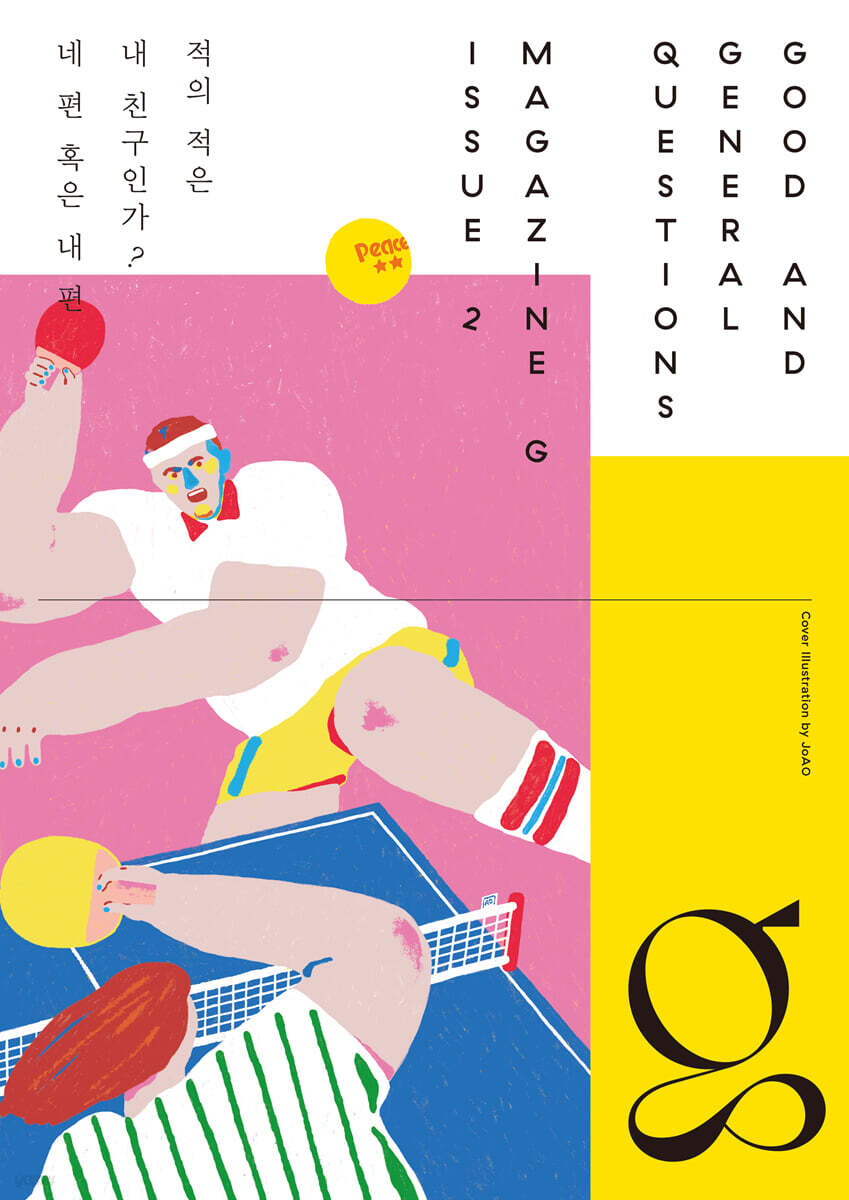
Magazine G: Issue 2 [2021]
 |
Description
Book Introduction
The intellectual habit of facing inevitable questions
Magazine G's second question: "Is the enemy of my enemy my friend?"
The world has become smaller and we have become closer.
Thanks to social media.
However, prejudice is more prevalent than understanding, and miscommunication is more prevalent than communication.
The words of hatred, discrimination, and exclusion are used as tools of political strife.
The mindset that if you're not on my side, you're no better than me is prevalent everywhere.
The second question of 『Magazine G』, which started by asking about ‘me’, is “Is the enemy of my enemy my friend?”
What is the difference between an enemy and a friend?
What brings me closer to you, and what, on the contrary, drives me further away?
Why and how are sides divided?
Is it impossible for your side and mine to coexist?
The problem of teaching only emotionally is explored in twenty different ways.
From historical events to clinical psychology cases, from the survival of the fittest in plant ecosystems to the latest AI technologies, from the most intimate relationships—family—to the social distancing required between coworkers.
You will break away from the conventional wisdom about friend and foe, and the division of factions, and look at the boundaries between 'your side and my side' with new eyes.
Magazine G's second question: "Is the enemy of my enemy my friend?"
The world has become smaller and we have become closer.
Thanks to social media.
However, prejudice is more prevalent than understanding, and miscommunication is more prevalent than communication.
The words of hatred, discrimination, and exclusion are used as tools of political strife.
The mindset that if you're not on my side, you're no better than me is prevalent everywhere.
The second question of 『Magazine G』, which started by asking about ‘me’, is “Is the enemy of my enemy my friend?”
What is the difference between an enemy and a friend?
What brings me closer to you, and what, on the contrary, drives me further away?
Why and how are sides divided?
Is it impossible for your side and mine to coexist?
The problem of teaching only emotionally is explored in twenty different ways.
From historical events to clinical psychology cases, from the survival of the fittest in plant ecosystems to the latest AI technologies, from the most intimate relationships—family—to the social distancing required between coworkers.
You will break away from the conventional wisdom about friend and foe, and the division of factions, and look at the boundaries between 'your side and my side' with new eyes.
- You can preview some of the book's contents.
Preview
index
prolog
The Difference Between Friends and Enemies_Kim Dae-sik
TENDENCY
An eternal alliance? There's no way such a thing exists... _Joo Kyung-chul
The Psychology of Partisanship_Heo Ji-won
Four Parts of the Plant World: My Part_Song Eun-young
Everything is connected like knitting_Moon Bo-young
SURROUNDINGS
No enemies, no comrades either_Han Seong-woo
Deepfake Journalism: The Technologist of Discrimination and Hate_Jeong Jun-hee
“The enemy of my enemy is my friend”_Richard Dawkins
KEEP!_Yoon Pa-rang
But what about the hedgehog?_Kang Bo-won
INSPIRING
Brain-Made Enemies, Brain-Made Friends_Kim Dae-sik
The Villains of the Anthropocene Who Turned Everyone into Enemies_Kim Han-min
We, for us, hate_Hwang Ye-ji
Horse_Kim Eom-ji
MECHANISM
Strangers on the Highway: Can You Become Friends with Complete Strangers?_Kim Kwang-gi
Building a Struggling Relationship with Technology_Shin Yu-jeong
With the Enemy_Lee Jae-gap
Words That Make Enemies, Words That Make Friends_Park So-yeon
Not too far, not too close: When you need cost-effectiveness in a relationship_Mikang X Editorial Department
INNER SIDE
The Soul's Guilt: The Karma of Friends and Enemies_Park Jin-yeo
How to Coexist with My Inner Self and Ego_Jeongmin
Epilogue
Contributor
Appendix [These days, food, clothing, shelter, and pleasure]_Kim Nam-hee, Kim Hye-won, Mi-kang, Lee Kyung-hee, Cha Woo-jin, Han Seung-hye
The Difference Between Friends and Enemies_Kim Dae-sik
TENDENCY
An eternal alliance? There's no way such a thing exists... _Joo Kyung-chul
The Psychology of Partisanship_Heo Ji-won
Four Parts of the Plant World: My Part_Song Eun-young
Everything is connected like knitting_Moon Bo-young
SURROUNDINGS
No enemies, no comrades either_Han Seong-woo
Deepfake Journalism: The Technologist of Discrimination and Hate_Jeong Jun-hee
“The enemy of my enemy is my friend”_Richard Dawkins
KEEP!_Yoon Pa-rang
But what about the hedgehog?_Kang Bo-won
INSPIRING
Brain-Made Enemies, Brain-Made Friends_Kim Dae-sik
The Villains of the Anthropocene Who Turned Everyone into Enemies_Kim Han-min
We, for us, hate_Hwang Ye-ji
Horse_Kim Eom-ji
MECHANISM
Strangers on the Highway: Can You Become Friends with Complete Strangers?_Kim Kwang-gi
Building a Struggling Relationship with Technology_Shin Yu-jeong
With the Enemy_Lee Jae-gap
Words That Make Enemies, Words That Make Friends_Park So-yeon
Not too far, not too close: When you need cost-effectiveness in a relationship_Mikang X Editorial Department
INNER SIDE
The Soul's Guilt: The Karma of Friends and Enemies_Park Jin-yeo
How to Coexist with My Inner Self and Ego_Jeongmin
Epilogue
Contributor
Appendix [These days, food, clothing, shelter, and pleasure]_Kim Nam-hee, Kim Hye-won, Mi-kang, Lee Kyung-hee, Cha Woo-jin, Han Seung-hye
Detailed image

Into the book
From France's perspective, England is a country without esprit or culture, a country that only cares about money, and above all, a pitiful country that is so bad at cooking that it is 'a country that betrays as easily as eating rice', as Jacques-Beigne Bossuet put it.
So, is France, conversely, a country we can trust? If we listen to the opinions of neighboring countries like the UK, Germany, the Netherlands, and Spain, they'll undoubtedly say the same harsh things.
Modern nations basically live like that.
--- p.
19
There are numbers written on the back of the paper where you wrote the sentences you prepared.
And then they drew numbers.
I listed the sentences in the order they were selected.
But strangely enough, it makes sense.
Next, I read the poem backwards, starting from the last sentence.
It was even better! The funny thing is, the poem written by the lottery was even better.
“The air wrote poetry, you guys!” I said.
The essence of co-creation may be 'chance' or 'air'.
Maybe it's not all that good that's better than me or you or us.
I mean, trusting the air that flows between us.
--- p.
35
Even though they are the same fiction, the faction division established by the 007 series and Western films is potentially more dangerous because it reflects and reinforces the imbalance of power in reality.
Even so, they are still less dangerous than the partisanship practiced by science and journalism, which are seduced by narratives.
Nazi eugenics, and the extremist right-wing journalism that (perhaps still) espouses it, have divided humanity in the name of science and engineering, disguised hostility as utility and efficiency, and ultimately gone so far as to justify the mass murder of "others" like the Jews.
--- p.
56
Doesn't the inability to give up taking sides ultimately mean we can't resolve all the conflicts and confrontations it brings? Perhaps so.
But the point is that there is no magical way to resolve all conflicts and confrontations.
While it would be wonderful if a harmonious (and sometimes necessary) approach where we acknowledge each other's differences and respect each other's opinions were always possible, the reality is that we have to live with those for whom such dialogue is impossible, and who we can never acknowledge or understand—the so-called evildoers.
--- p.
70
The object of eating and the purpose of revenge
Unlike the cannibals who are transparently aware of it…
War to war
Revenge for revenge
Neither recognizing nor acknowledging the enemy as an enemy
A civilized person is
Everyone else is an enemy
Everyday life becomes a slaughterhouse of revenge
The Earth is a ruin of war
I succeeded in making it.
In the most barbaric way
As the most barbaric result.
--- p.
92
Just as a car on the road never reveals its interior, humans are complete strangers to one another, briefly interacting and then parting ways.
Just as we cannot know the identity of the driver in a car, we cannot know exactly what is in the minds of others.
That is, we are strangers to each other.
But on the other hand, just as vehicles try to avoid colliding with each other and respond sensitively to the signals and speed increases and decreases sent by other vehicles to reach their respective destinations, we adjust our actions in response to the signals sent by others.
Act in response to other people's facial expressions, gestures, gaze, gestures, silence, and speech.
At that moment, the encounter continues without being broken, and in this way, the appearance of society is briefly revealed.
--- p.
129
Is artificial intelligence our enemy or our friend? Every time a cutting-edge technology emerges, we apply this dichotomous yardstick and ask, "What is it?"
Because the uncertainty of cutting-edge technology creates fear in some and anticipation in others.
But what's needed to understand cutting-edge technology is neither fear nor anticipation, but a thoroughly comprehensive sense of reality.
This is why we must seek a third way, beyond the endless affirmation or negation of advanced technology.
--- p.
131
"Even if we can't make everyone our friend, let's not make everyone our enemy." We live in a world where we have no choice but to survive with viruses.
We may regard the virus as an enemy and try to eradicate it to the end.
But viruses have been with us all along, and they will continue to come to us in one form or another.
Since we can neither befriend nor completely defeat them, we have no choice but to coexist to the extent that we can minimize the damage.
--- p.
149
As more and more people take care of their own minds, it's becoming more common to talk about the ego.
More and more people are learning and analyzing, in their own ways, what the ego is and how it has influenced their lives.
There are many ways to do this, such as meditation, studying Buddhism, or studying psychology.
But the most common thing that happens in this process is that we completely separate the 'ego' and the 'me' and try to discern what is better and what is worse.
In an attempt to eliminate discrimination, we end up creating a new type of discrimination.
So, is France, conversely, a country we can trust? If we listen to the opinions of neighboring countries like the UK, Germany, the Netherlands, and Spain, they'll undoubtedly say the same harsh things.
Modern nations basically live like that.
--- p.
19
There are numbers written on the back of the paper where you wrote the sentences you prepared.
And then they drew numbers.
I listed the sentences in the order they were selected.
But strangely enough, it makes sense.
Next, I read the poem backwards, starting from the last sentence.
It was even better! The funny thing is, the poem written by the lottery was even better.
“The air wrote poetry, you guys!” I said.
The essence of co-creation may be 'chance' or 'air'.
Maybe it's not all that good that's better than me or you or us.
I mean, trusting the air that flows between us.
--- p.
35
Even though they are the same fiction, the faction division established by the 007 series and Western films is potentially more dangerous because it reflects and reinforces the imbalance of power in reality.
Even so, they are still less dangerous than the partisanship practiced by science and journalism, which are seduced by narratives.
Nazi eugenics, and the extremist right-wing journalism that (perhaps still) espouses it, have divided humanity in the name of science and engineering, disguised hostility as utility and efficiency, and ultimately gone so far as to justify the mass murder of "others" like the Jews.
--- p.
56
Doesn't the inability to give up taking sides ultimately mean we can't resolve all the conflicts and confrontations it brings? Perhaps so.
But the point is that there is no magical way to resolve all conflicts and confrontations.
While it would be wonderful if a harmonious (and sometimes necessary) approach where we acknowledge each other's differences and respect each other's opinions were always possible, the reality is that we have to live with those for whom such dialogue is impossible, and who we can never acknowledge or understand—the so-called evildoers.
--- p.
70
The object of eating and the purpose of revenge
Unlike the cannibals who are transparently aware of it…
War to war
Revenge for revenge
Neither recognizing nor acknowledging the enemy as an enemy
A civilized person is
Everyone else is an enemy
Everyday life becomes a slaughterhouse of revenge
The Earth is a ruin of war
I succeeded in making it.
In the most barbaric way
As the most barbaric result.
--- p.
92
Just as a car on the road never reveals its interior, humans are complete strangers to one another, briefly interacting and then parting ways.
Just as we cannot know the identity of the driver in a car, we cannot know exactly what is in the minds of others.
That is, we are strangers to each other.
But on the other hand, just as vehicles try to avoid colliding with each other and respond sensitively to the signals and speed increases and decreases sent by other vehicles to reach their respective destinations, we adjust our actions in response to the signals sent by others.
Act in response to other people's facial expressions, gestures, gaze, gestures, silence, and speech.
At that moment, the encounter continues without being broken, and in this way, the appearance of society is briefly revealed.
--- p.
129
Is artificial intelligence our enemy or our friend? Every time a cutting-edge technology emerges, we apply this dichotomous yardstick and ask, "What is it?"
Because the uncertainty of cutting-edge technology creates fear in some and anticipation in others.
But what's needed to understand cutting-edge technology is neither fear nor anticipation, but a thoroughly comprehensive sense of reality.
This is why we must seek a third way, beyond the endless affirmation or negation of advanced technology.
--- p.
131
"Even if we can't make everyone our friend, let's not make everyone our enemy." We live in a world where we have no choice but to survive with viruses.
We may regard the virus as an enemy and try to eradicate it to the end.
But viruses have been with us all along, and they will continue to come to us in one form or another.
Since we can neither befriend nor completely defeat them, we have no choice but to coexist to the extent that we can minimize the damage.
--- p.
149
As more and more people take care of their own minds, it's becoming more common to talk about the ego.
More and more people are learning and analyzing, in their own ways, what the ego is and how it has influenced their lives.
There are many ways to do this, such as meditation, studying Buddhism, or studying psychology.
But the most common thing that happens in this process is that we completely separate the 'ego' and the 'me' and try to discern what is better and what is worse.
In an attempt to eliminate discrimination, we end up creating a new type of discrimination.
--- p.
173
173
Publisher's Review
“Okay, so whose side are you on?”
An era of extreme confrontation where it's either my side or yours
Good and General Questions: Breaking Down the Walls of Imperfection and Prejudice
The world has become smaller and we have become closer.
My thoughts, your daily life, our or their actions are exchanged in real time and spread on a global scale.
This is thanks to communication technologies such as social media.
The possibilities for communication between me, you, and us have expanded to this extent unprecedented.
Have we really come to understand each other better?
Unfortunately, the situation is not good.
Prejudice is more prevalent than understanding, and lack of communication is more prevalent than understanding.
Expanded communication possibilities often work as poison.
The words of hatred, discrimination, and exclusion directed at each other are disguised as content and used as tools for political strife.
Conflicts in the real world can spread to the online world, further escalating the conflict, or online conflicts can lead to further conflicts in the real world.
The mindset that if someone is not on my side, they are no better than you is prevalent throughout society.
Now, at a time when we are closest yet farthest from each other, 『Magazine G』 No. 2 focuses on the most universal and necessary questions.
These are 'enemy', 'friend', and 'taking sides'.
What is the difference between an enemy and a friend?
What brings me closer to you, and what, on the contrary, drives me further away?
Why and how are sides divided?
Is it impossible for your side and mine to coexist?
We question the boundaries of our four sides, which are fixed and taken for granted, from various perspectives and gauge the path to understanding and communication.
History and psychology, civilization and nature, technology and life, science and spirituality
Twenty Brilliant Insights That Transcend Reality and Fiction
At first glance, it seems like taking sides is the fate of humans and the law of the world.
After examining the history of temporary alliances and long-standing conflicts between France and Britain, historian Joo Kyung-chul says:
“From France’s perspective, Britain is a country that ‘betrays people as easily as eating rice.’
So, is France, conversely, a country we can trust? Surrounding countries like Britain, Germany, the Netherlands, and Spain are sure to make equally harsh remarks.
“Modern nations basically live like that.” (p. 19) We all repeat the cycle of coming together and dispersing according to our own needs.
This fact becomes even more vivid when you look at the paintings of botanical artist Song Eun-young.
When Western sea buckthorn of the same parent line is planted in the same place, they find a way to coexist by limiting the expansion of each other's leaves, but when Western sea buckthorn of different parent lines is planted together, they spread their roots sideways and increase the size of their leaves, hindering each other's growth (p. 29).
Of course, there are also cases to the contrary.
According to linguist Han Seong-woo, “Even if there is an ‘I’ as a being, if there is no you or I, there is no need for the person ‘I’ or the word to express it.
Because there is me, you, and that, we exist.
“Me, you, we are originally words of taking sides, but they are words that are only possible in coexistence.” (p. 47) Linguistically speaking, coexistence takes precedence over taking sides.
Poet Moon Bo-young also emphasizes the wonder and joy of “collective creation,” emphasizing that we are not divided but “all connected like knitting,” and that we are “beings created by many people coming together” (p. 37).
On the other hand, it may be absurd to try to define or define the problem of 'partisanship' in reality in one word.
Yet, we easily conclude the 'your side, my side' issue and act hastily.
As a result, the situation gets worse.
Richard Dawkins (p. 58), who criticizes the complacency of the attitude that “the enemy of my enemy is my friend” can be easily persuaded, and literary critic Kang Bo-won (p. 68), who points out that superficial understanding and tolerance can further solidify the boundaries between our side and your side, are pointing out this very problem.
The cynicism that says, "Taking sides is a necessary evil and is unavoidable," and the optimism that says, "With effort, harmony and coexistence between your side and my side are possible," are both attitudes we should keep our distance from.
By looking beyond the superficial results to the deeper causes and diverse contexts, we can arrive at richer lessons and solutions for ourselves, you, and our relationships.
There are no eternal enemies or eternal friends.
Clinical psychologist Heo Ji-won says:
“Our lives and relationships are neither black and white nor within castle walls, but on a continuous road” (p. 27).
If I hastily conclude about the relationship between me and others, it will not benefit me even in the short term.
Yet, we are fixated on immediately and dichotomously dividing ourselves into your side and my side.
Media scholar Jeong Jun-hee's diagnosis that "deepfake journalism," which "fills fragments of facts into a sinister, biased narrative" (p. 57) will become more rampant in the future, is based on this social situation.
In the digital age, where information is updated and distributed in real time, it is essential to take the time to exchange and reflect on diverse ideas and positions.
Keeping a distance from the world of high-speed, fast-paced teaching
The depth and sensibility of an analog knowledge and culture magazine
In this way, 『Magazine G』 No. 2 explores the problem of partisanship, which is swayed solely by emotions, from twenty different perspectives.
From historical events to clinical psychology cases, from the survival of the fittest in plant ecosystems to the latest AI technologies, from the most intimate relationships—family—to the social distancing required between coworkers.
Breaking free from conventional wisdom about friend and foe, and the division between your side and mine, we look at the boundaries between your side and mine with new eyes.
In terms of composition and design, we actively distanced ourselves from dichotomous attitudes.
Rather than presenting a single, coherent voice on a single topic, it offers a mosaic of thoughts from writers with diverse fields and specialties, including historians, clinical psychologists, linguists, media scholars, evolutionary biologists, neuroscientists, sociologists, science and technology policy scholars, and infectious disease specialists.
Here are essays that vary the theme in a variety of ways, botanical illustrations, graphic novels, photo essays, postcard novels, and even a separate booklet titled [Cooking, Clothing, Shelter, and Entertainment for Today's People].
Thoughts and perspectives that would not have been easy to gather in one place in any other space sometimes come together like friends and sometimes stand in opposition like enemies, forming a three-dimensional magazine.
If you follow the analog rhythm of holding a book in your hand and taking your time turning each page, you will soon find yourself keeping a critical distance from the world of high-speed storytelling.
An era of extreme confrontation where it's either my side or yours
Good and General Questions: Breaking Down the Walls of Imperfection and Prejudice
The world has become smaller and we have become closer.
My thoughts, your daily life, our or their actions are exchanged in real time and spread on a global scale.
This is thanks to communication technologies such as social media.
The possibilities for communication between me, you, and us have expanded to this extent unprecedented.
Have we really come to understand each other better?
Unfortunately, the situation is not good.
Prejudice is more prevalent than understanding, and lack of communication is more prevalent than understanding.
Expanded communication possibilities often work as poison.
The words of hatred, discrimination, and exclusion directed at each other are disguised as content and used as tools for political strife.
Conflicts in the real world can spread to the online world, further escalating the conflict, or online conflicts can lead to further conflicts in the real world.
The mindset that if someone is not on my side, they are no better than you is prevalent throughout society.
Now, at a time when we are closest yet farthest from each other, 『Magazine G』 No. 2 focuses on the most universal and necessary questions.
These are 'enemy', 'friend', and 'taking sides'.
What is the difference between an enemy and a friend?
What brings me closer to you, and what, on the contrary, drives me further away?
Why and how are sides divided?
Is it impossible for your side and mine to coexist?
We question the boundaries of our four sides, which are fixed and taken for granted, from various perspectives and gauge the path to understanding and communication.
History and psychology, civilization and nature, technology and life, science and spirituality
Twenty Brilliant Insights That Transcend Reality and Fiction
At first glance, it seems like taking sides is the fate of humans and the law of the world.
After examining the history of temporary alliances and long-standing conflicts between France and Britain, historian Joo Kyung-chul says:
“From France’s perspective, Britain is a country that ‘betrays people as easily as eating rice.’
So, is France, conversely, a country we can trust? Surrounding countries like Britain, Germany, the Netherlands, and Spain are sure to make equally harsh remarks.
“Modern nations basically live like that.” (p. 19) We all repeat the cycle of coming together and dispersing according to our own needs.
This fact becomes even more vivid when you look at the paintings of botanical artist Song Eun-young.
When Western sea buckthorn of the same parent line is planted in the same place, they find a way to coexist by limiting the expansion of each other's leaves, but when Western sea buckthorn of different parent lines is planted together, they spread their roots sideways and increase the size of their leaves, hindering each other's growth (p. 29).
Of course, there are also cases to the contrary.
According to linguist Han Seong-woo, “Even if there is an ‘I’ as a being, if there is no you or I, there is no need for the person ‘I’ or the word to express it.
Because there is me, you, and that, we exist.
“Me, you, we are originally words of taking sides, but they are words that are only possible in coexistence.” (p. 47) Linguistically speaking, coexistence takes precedence over taking sides.
Poet Moon Bo-young also emphasizes the wonder and joy of “collective creation,” emphasizing that we are not divided but “all connected like knitting,” and that we are “beings created by many people coming together” (p. 37).
On the other hand, it may be absurd to try to define or define the problem of 'partisanship' in reality in one word.
Yet, we easily conclude the 'your side, my side' issue and act hastily.
As a result, the situation gets worse.
Richard Dawkins (p. 58), who criticizes the complacency of the attitude that “the enemy of my enemy is my friend” can be easily persuaded, and literary critic Kang Bo-won (p. 68), who points out that superficial understanding and tolerance can further solidify the boundaries between our side and your side, are pointing out this very problem.
The cynicism that says, "Taking sides is a necessary evil and is unavoidable," and the optimism that says, "With effort, harmony and coexistence between your side and my side are possible," are both attitudes we should keep our distance from.
By looking beyond the superficial results to the deeper causes and diverse contexts, we can arrive at richer lessons and solutions for ourselves, you, and our relationships.
There are no eternal enemies or eternal friends.
Clinical psychologist Heo Ji-won says:
“Our lives and relationships are neither black and white nor within castle walls, but on a continuous road” (p. 27).
If I hastily conclude about the relationship between me and others, it will not benefit me even in the short term.
Yet, we are fixated on immediately and dichotomously dividing ourselves into your side and my side.
Media scholar Jeong Jun-hee's diagnosis that "deepfake journalism," which "fills fragments of facts into a sinister, biased narrative" (p. 57) will become more rampant in the future, is based on this social situation.
In the digital age, where information is updated and distributed in real time, it is essential to take the time to exchange and reflect on diverse ideas and positions.
Keeping a distance from the world of high-speed, fast-paced teaching
The depth and sensibility of an analog knowledge and culture magazine
In this way, 『Magazine G』 No. 2 explores the problem of partisanship, which is swayed solely by emotions, from twenty different perspectives.
From historical events to clinical psychology cases, from the survival of the fittest in plant ecosystems to the latest AI technologies, from the most intimate relationships—family—to the social distancing required between coworkers.
Breaking free from conventional wisdom about friend and foe, and the division between your side and mine, we look at the boundaries between your side and mine with new eyes.
In terms of composition and design, we actively distanced ourselves from dichotomous attitudes.
Rather than presenting a single, coherent voice on a single topic, it offers a mosaic of thoughts from writers with diverse fields and specialties, including historians, clinical psychologists, linguists, media scholars, evolutionary biologists, neuroscientists, sociologists, science and technology policy scholars, and infectious disease specialists.
Here are essays that vary the theme in a variety of ways, botanical illustrations, graphic novels, photo essays, postcard novels, and even a separate booklet titled [Cooking, Clothing, Shelter, and Entertainment for Today's People].
Thoughts and perspectives that would not have been easy to gather in one place in any other space sometimes come together like friends and sometimes stand in opposition like enemies, forming a three-dimensional magazine.
If you follow the analog rhythm of holding a book in your hand and taking your time turning each page, you will soon find yourself keeping a critical distance from the world of high-speed storytelling.
GOODS SPECIFICS
- Date of issue: May 31, 2021
- Page count, weight, size: 192 pages | 476g | 170*240*20mm
- ISBN13: 9788934988991
- ISBN10: 8934988991
You may also like
카테고리
korean


korean

![GQ KOREA Mark (Monthly): December [2025]](http://librairie.coreenne.fr/cdn/shop/files/8ef265dbbfbf186523ed75ba7319009d.jpg?v=1765340328&width=3840)


