

Core Mind
 |
Description
Book Introduction
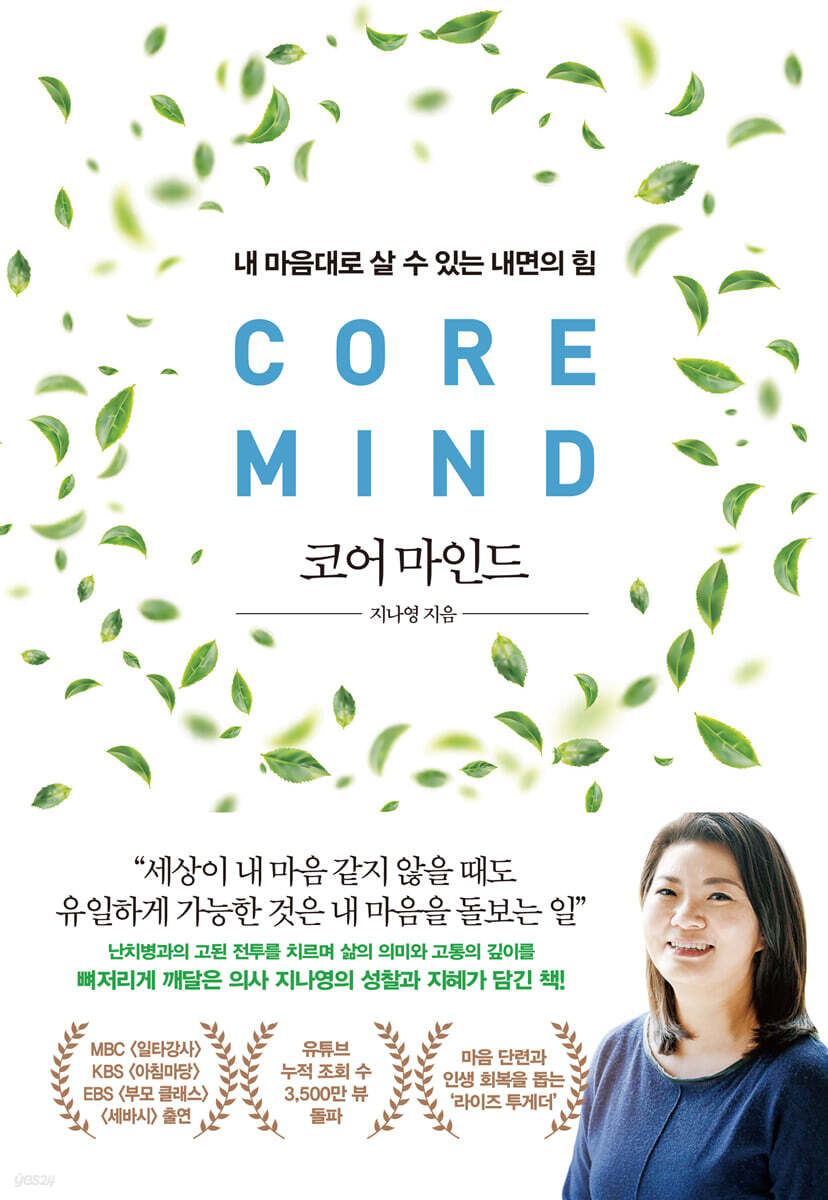
“Even when the world doesn’t suit me, the only thing I can do is take care of my heart.”
Fighting an arduous battle with an incurable disease, he explored the meaning of life and the depth of suffering.
A book filled with the insight and wisdom of Dr. Jinah Young, a doctor who has come to a painful realization!
Professor Jinah Young, who was on the rise as a psychiatrist and professor in the United States, suffered a great setback when she suddenly became ill with an incurable disease, which seemed to bring her life to a halt.
Even in the midst of extreme pain and anxiety, she did not accept setbacks as failures.
Because life can change depending on how you think about crises and adversity, I started to find things that were precious to me one by one.
As a result, Professor Jinah Young, who is now living a more active and fulfilling life than ever before, answers without a moment's hesitation when asked if she would go back in time to before she got sick.
For her, who lived her life swept away by the whirlwind of things that others had decided for her and things she had to do, adversity and crisis became a valuable opportunity to realize the essence of life.
What is the inner strength of Professor Jinah Young, who even overcame an incurable disease like ADHD? This book is like a textbook, systematically organizing the secrets of her mindset and the mental training methods that shaped her into the person she is today.
This book can bring about change in our lives, which are constantly faced with unexpected hardships and difficulties and are inevitably swayed by negative emotions.
Fighting an arduous battle with an incurable disease, he explored the meaning of life and the depth of suffering.
A book filled with the insight and wisdom of Dr. Jinah Young, a doctor who has come to a painful realization!
Professor Jinah Young, who was on the rise as a psychiatrist and professor in the United States, suffered a great setback when she suddenly became ill with an incurable disease, which seemed to bring her life to a halt.
Even in the midst of extreme pain and anxiety, she did not accept setbacks as failures.
Because life can change depending on how you think about crises and adversity, I started to find things that were precious to me one by one.
As a result, Professor Jinah Young, who is now living a more active and fulfilling life than ever before, answers without a moment's hesitation when asked if she would go back in time to before she got sick.
For her, who lived her life swept away by the whirlwind of things that others had decided for her and things she had to do, adversity and crisis became a valuable opportunity to realize the essence of life.
What is the inner strength of Professor Jinah Young, who even overcame an incurable disease like ADHD? This book is like a textbook, systematically organizing the secrets of her mindset and the mental training methods that shaped her into the person she is today.
This book can bring about change in our lives, which are constantly faced with unexpected hardships and difficulties and are inevitably swayed by negative emotions.
- You can preview some of the book's contents.
Preview
index
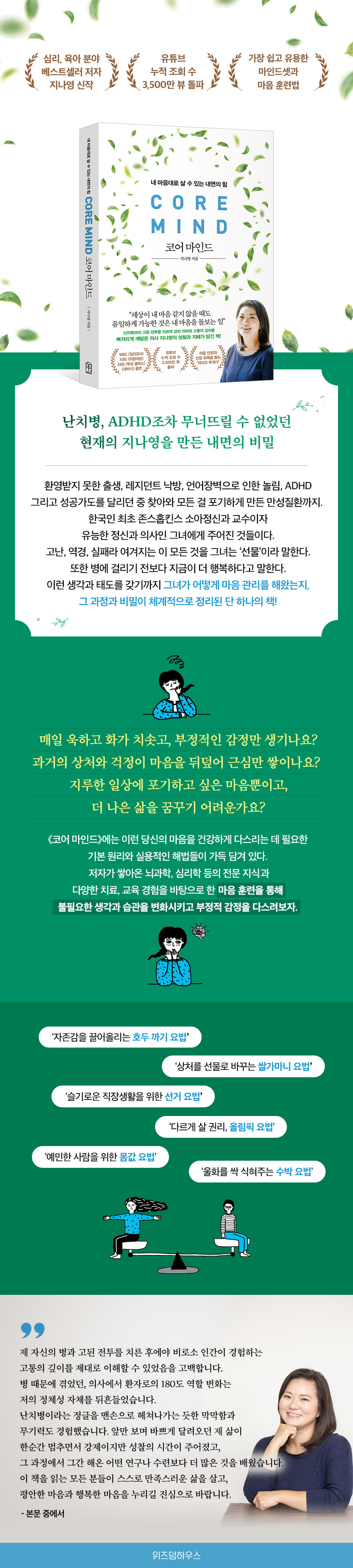
Prologue: What I need to live my life is a strong inner strength.
Part 1.
Design your life as your heart flows.
- Where does human suffering come from? The stress response that arises for survival.
The World Is Made in My Mind: The Psychiatrist's Trade Secret, Cognitive Behavioral Therapy
- If you are crouching, consumed by apathy: Why a low wall appears to be an insurmountable wall
- If you live as if you are being dragged by what you have to do: It is choices, not coincidences, that determine your life. I choose to~
- For those of you who don't want to go to work every morning: The magic words that make even the things you don't want to do enjoyable, I get to~
Why Even Small Decisions Are So Difficult: Two Crucial Reasons You Can't Make Decisions
From 'Fear of Missing Out' to 'Joy of Missing Out': Essentialism in Life and JOMO
- Invincible stress management method that can be used for a lifetime: The highly effective breathing technique that even Navy SEALs learn.
- Let's breathe deeply and live: Abdominal breathing method to return to the original body
Part 2.
I am a valuable and beautiful person just the way I am.
- My beauty is in my eyes: the colored glasses that exist in my brain
Strength Comes from Difference: The Right to Live Differently, Olympic Therapy
- To Lay Bricks or to Build a Temple: The Driving Force of My Life, Inner Motivation vs.
extrinsic motivation
- If you want to be free from wounds: How to turn wounds into gifts, rice bag therapy
- The power to face moments you want to avoid with ease: the master's ability to deal with discomfort, the hot potato therapy
- When you easily get tired of looking out for other people's feelings: A prescription for the mind for sensitive people, a body price therapy
My achievements are not my worth: A genuine life filled with authenticity
- Changing the frame reveals a completely different self: The surprising duality of ADHD
Part 3.
I am the one who tells others how to treat me.
- The minimum safety measure to protect myself from rude people: Drawing a line + keeping distance = election therapy
- You Can't Bully Me, Because I Won't Allow It: Election Therapy for a Smart Work Life
- I am the brightest star in my universe: The Nutcracker Method to boost self-esteem
- Finding the key to opening each other's hearts: This alone is half the battle in communication, the first word resonance therapy.
- If you want to find true love: Another name for love, respect
- If you feel angry and irritable without warning: Watermelon therapy to cool down your anger
- Things that can only be obtained through waiting and patience: the aesthetics of endurance that indicates emotional maturity.
Part 4.
Even if you fall, get back up and move forward one step at a time.
Failure is not a defeat or loss, but an opportunity: The real reason why you must fail.
What to Do and What Not to Do When You Fall: How to Build Resilience Through Failure
- For those who can't tolerate failure: Mistake play therapy for perfectionists
How to Manage Anxiety Without Becoming Its Prisoner: The Die Is Cast, Taxi Therapy
How to Live Well with Panic Disorder: This Too Shall Pass, Wind Therapy
- Is your sleep okay?: Sleep Conqueror Jamsuni Therapy
- Unlocking ADHD Potential: Kimbap Therapy and Each Room Therapy
It's Okay to Be Kind to Yourself: 3 Steps to Forgiving Yourself
- I'm grateful, you're grateful too: Gratitude therapy to cultivate the power of positivity
Epilogue: Rise Together, a wave of change creating a healthy and happy society.
Part 1.
Design your life as your heart flows.
- Where does human suffering come from? The stress response that arises for survival.
The World Is Made in My Mind: The Psychiatrist's Trade Secret, Cognitive Behavioral Therapy
- If you are crouching, consumed by apathy: Why a low wall appears to be an insurmountable wall
- If you live as if you are being dragged by what you have to do: It is choices, not coincidences, that determine your life. I choose to~
- For those of you who don't want to go to work every morning: The magic words that make even the things you don't want to do enjoyable, I get to~
Why Even Small Decisions Are So Difficult: Two Crucial Reasons You Can't Make Decisions
From 'Fear of Missing Out' to 'Joy of Missing Out': Essentialism in Life and JOMO
- Invincible stress management method that can be used for a lifetime: The highly effective breathing technique that even Navy SEALs learn.
- Let's breathe deeply and live: Abdominal breathing method to return to the original body
Part 2.
I am a valuable and beautiful person just the way I am.
- My beauty is in my eyes: the colored glasses that exist in my brain
Strength Comes from Difference: The Right to Live Differently, Olympic Therapy
- To Lay Bricks or to Build a Temple: The Driving Force of My Life, Inner Motivation vs.
extrinsic motivation
- If you want to be free from wounds: How to turn wounds into gifts, rice bag therapy
- The power to face moments you want to avoid with ease: the master's ability to deal with discomfort, the hot potato therapy
- When you easily get tired of looking out for other people's feelings: A prescription for the mind for sensitive people, a body price therapy
My achievements are not my worth: A genuine life filled with authenticity
- Changing the frame reveals a completely different self: The surprising duality of ADHD
Part 3.
I am the one who tells others how to treat me.
- The minimum safety measure to protect myself from rude people: Drawing a line + keeping distance = election therapy
- You Can't Bully Me, Because I Won't Allow It: Election Therapy for a Smart Work Life
- I am the brightest star in my universe: The Nutcracker Method to boost self-esteem
- Finding the key to opening each other's hearts: This alone is half the battle in communication, the first word resonance therapy.
- If you want to find true love: Another name for love, respect
- If you feel angry and irritable without warning: Watermelon therapy to cool down your anger
- Things that can only be obtained through waiting and patience: the aesthetics of endurance that indicates emotional maturity.
Part 4.
Even if you fall, get back up and move forward one step at a time.
Failure is not a defeat or loss, but an opportunity: The real reason why you must fail.
What to Do and What Not to Do When You Fall: How to Build Resilience Through Failure
- For those who can't tolerate failure: Mistake play therapy for perfectionists
How to Manage Anxiety Without Becoming Its Prisoner: The Die Is Cast, Taxi Therapy
How to Live Well with Panic Disorder: This Too Shall Pass, Wind Therapy
- Is your sleep okay?: Sleep Conqueror Jamsuni Therapy
- Unlocking ADHD Potential: Kimbap Therapy and Each Room Therapy
It's Okay to Be Kind to Yourself: 3 Steps to Forgiving Yourself
- I'm grateful, you're grateful too: Gratitude therapy to cultivate the power of positivity
Epilogue: Rise Together, a wave of change creating a healthy and happy society.
Detailed image
Into the book
Another interesting thing is that it is not only the emotions of 'fear' and 'anxiety', such as worrying about being eaten by a wild beast, that cause a stress response.
Emotions such as anger, conflict, and psychological stress also trigger the stress response, or fight-or-flight response.
In some ways, in prehistoric times, conflicts between neighbors could have led to bloody fights.
Or, if you fail to fulfill the role assigned to you, you may find yourself in a precarious situation where you are ignored or abandoned.
Since many negative emotions are directly linked to threats to survival, I think that when such emotions arise, a fight-ready response automatically occurs to protect oneself.
---From "Where does human suffering come from: the stress response that emerged for survival"
If you feel like you're in a thick fog and can't see ahead of you, try to muster up a little strength and walk.
If what you want seems too far away to reach, start with a small task within your reach.
Take the first step: do the dishes that have piled up, fold the blanket, take a 10-minute walk, or read a page of a book.
Then you will see the next stepping stone, and if you put in more effort, you will see the stepping stone after that.
---From "If you are consumed by apathy and just crouch down: Why a low wall looks like an insurmountable wall"
No one can see into the future to know which choice will be better.
Since there are no wrong answers in life, if I live the way I want to live, that is 'my right answer'.
So, just be quiet and listen to the voice that comes from your heart.
If you decide to follow your heart's lead as long as it doesn't harm others, then that is a good choice.
---From "Why are even small decisions so difficult? Two crucial reasons why you can't make decisions"
Think of filling a cup with tap water.
If you open the faucet too quickly and wide, the cup will quickly fill up and overflow, right? The breathing we're trying to do is like slowly opening the faucet.
Breathe in slowly, like filling a cup with water little by little.
When you exhale, think of pouring water out of the cup.
Instead of pouring it all out at once, exhale slowly little by little as if pouring it out.
---From "Let's breathe deeply and live: Abdominal breathing method to return to the original body"
There are probably more people who were born in a better environment than me.
Most of them would have been welcomed from birth and would have been quickly added to the family register.
Are there people who feel they've been given only "bad things" and have nothing to contribute? "What's been given to you" here doesn't just mean "good things."
What I've been given includes an unwelcome birth, a failed residency, ADHD, infertility, and chronic illness.
These are things that most people would classify as 'bad things'.
But I think all of this is what you've been given, a gift.
And actually, these things have helped me grow and become more empathetic towards others.
---“Should I Lay Bricks or Build a Temple: The Driving Force of My Life, Inner Motivation vs.
Among “external motivation”
During your long voyage, will you continue to leave a sack of rotten rice on your ship, chewing it and throwing it to someone else? Or will you haul it up on deck and let it drift away to sea? The choice is yours.
So, take courage and give it a try.
Close your eyes and open the deep storehouse within your belly.
Now is the time to choose to lift that stinking bag of rice, throw it into the sea, and be free.
Then stand in the captain's seat and take control of the ship's rudder again.
I sail the sea in a lightened boat and look towards the place I want to go.
---From "If you want to be free from wounds: How to turn wounds into gifts, rice bag therapy"
Being so forgetful that you lose things often doesn't seem like it would be a good thing, right? Surprisingly, there are advantages.
A child who is always losing things and getting lost naturally learns as he grows up how to do things without those things.
Should I say that problem-solving and resourcefulness are important? If I don't have a textbook, I study with a friend, and if I don't have a pencil, I can't take notes, so I listen more intently.
I don't have much trouble because I know from experience that I can get by with just socks if I don't have slippers.
You will develop the ability to respond quickly to unexpected situations and solve problems creatively.
---From "Change the Frame and You'll See a Completely Different Me: The Surprising Duality of ADHD"
The 'nutcracker therapy' is about confidently speaking out about what might be considered shortcomings, with the attitude of 'I am a good person inside the shell', just like cracking a walnut.
We all have things we want to hide or not make public for fear that they will be criticized if shown to others.
Rather than hiding those things, we just peel them all away like cracking open a walnut shell.
Ironically, cracking a nut properly can actually boost your self-esteem.
---From "I am the brightest star in my universe: The Nutcracker Method to boost self-esteem"
Have you ever heard stories of people who grew and became stronger after experiencing a major accident or failure? This is called post-traumatic growth.
In my case, I became more mature and grew after going through the hardships of having my daily life completely ruined by illness.
Those who can see the positive aspects hidden in the process of failure can go beyond recovery and grow even further.
This requires a shift in thinking, reframing failure as an “opportunity” rather than a “loss,” “defeat,” or “falling behind.”
---From "Failure is not a defeat or loss, but an opportunity: The real reason why you must fail"
Sleep also plays an important role in our physical health.
It relaxes muscles and the nervous system that have been tense during the day, balances hormones, and restores immune function, protecting our bodies from various diseases.
Lack of sleep can lead to obesity and accelerate skin aging.
There is a reason why the saying, “Beauty is sleepyhead” came about.
Not only that, but research has shown that people who sleep well live on average five years longer than those who don't (for men).
Emotions such as anger, conflict, and psychological stress also trigger the stress response, or fight-or-flight response.
In some ways, in prehistoric times, conflicts between neighbors could have led to bloody fights.
Or, if you fail to fulfill the role assigned to you, you may find yourself in a precarious situation where you are ignored or abandoned.
Since many negative emotions are directly linked to threats to survival, I think that when such emotions arise, a fight-ready response automatically occurs to protect oneself.
---From "Where does human suffering come from: the stress response that emerged for survival"
If you feel like you're in a thick fog and can't see ahead of you, try to muster up a little strength and walk.
If what you want seems too far away to reach, start with a small task within your reach.
Take the first step: do the dishes that have piled up, fold the blanket, take a 10-minute walk, or read a page of a book.
Then you will see the next stepping stone, and if you put in more effort, you will see the stepping stone after that.
---From "If you are consumed by apathy and just crouch down: Why a low wall looks like an insurmountable wall"
No one can see into the future to know which choice will be better.
Since there are no wrong answers in life, if I live the way I want to live, that is 'my right answer'.
So, just be quiet and listen to the voice that comes from your heart.
If you decide to follow your heart's lead as long as it doesn't harm others, then that is a good choice.
---From "Why are even small decisions so difficult? Two crucial reasons why you can't make decisions"
Think of filling a cup with tap water.
If you open the faucet too quickly and wide, the cup will quickly fill up and overflow, right? The breathing we're trying to do is like slowly opening the faucet.
Breathe in slowly, like filling a cup with water little by little.
When you exhale, think of pouring water out of the cup.
Instead of pouring it all out at once, exhale slowly little by little as if pouring it out.
---From "Let's breathe deeply and live: Abdominal breathing method to return to the original body"
There are probably more people who were born in a better environment than me.
Most of them would have been welcomed from birth and would have been quickly added to the family register.
Are there people who feel they've been given only "bad things" and have nothing to contribute? "What's been given to you" here doesn't just mean "good things."
What I've been given includes an unwelcome birth, a failed residency, ADHD, infertility, and chronic illness.
These are things that most people would classify as 'bad things'.
But I think all of this is what you've been given, a gift.
And actually, these things have helped me grow and become more empathetic towards others.
---“Should I Lay Bricks or Build a Temple: The Driving Force of My Life, Inner Motivation vs.
Among “external motivation”
During your long voyage, will you continue to leave a sack of rotten rice on your ship, chewing it and throwing it to someone else? Or will you haul it up on deck and let it drift away to sea? The choice is yours.
So, take courage and give it a try.
Close your eyes and open the deep storehouse within your belly.
Now is the time to choose to lift that stinking bag of rice, throw it into the sea, and be free.
Then stand in the captain's seat and take control of the ship's rudder again.
I sail the sea in a lightened boat and look towards the place I want to go.
---From "If you want to be free from wounds: How to turn wounds into gifts, rice bag therapy"
Being so forgetful that you lose things often doesn't seem like it would be a good thing, right? Surprisingly, there are advantages.
A child who is always losing things and getting lost naturally learns as he grows up how to do things without those things.
Should I say that problem-solving and resourcefulness are important? If I don't have a textbook, I study with a friend, and if I don't have a pencil, I can't take notes, so I listen more intently.
I don't have much trouble because I know from experience that I can get by with just socks if I don't have slippers.
You will develop the ability to respond quickly to unexpected situations and solve problems creatively.
---From "Change the Frame and You'll See a Completely Different Me: The Surprising Duality of ADHD"
The 'nutcracker therapy' is about confidently speaking out about what might be considered shortcomings, with the attitude of 'I am a good person inside the shell', just like cracking a walnut.
We all have things we want to hide or not make public for fear that they will be criticized if shown to others.
Rather than hiding those things, we just peel them all away like cracking open a walnut shell.
Ironically, cracking a nut properly can actually boost your self-esteem.
---From "I am the brightest star in my universe: The Nutcracker Method to boost self-esteem"
Have you ever heard stories of people who grew and became stronger after experiencing a major accident or failure? This is called post-traumatic growth.
In my case, I became more mature and grew after going through the hardships of having my daily life completely ruined by illness.
Those who can see the positive aspects hidden in the process of failure can go beyond recovery and grow even further.
This requires a shift in thinking, reframing failure as an “opportunity” rather than a “loss,” “defeat,” or “falling behind.”
---From "Failure is not a defeat or loss, but an opportunity: The real reason why you must fail"
Sleep also plays an important role in our physical health.
It relaxes muscles and the nervous system that have been tense during the day, balances hormones, and restores immune function, protecting our bodies from various diseases.
Lack of sleep can lead to obesity and accelerate skin aging.
There is a reason why the saying, “Beauty is sleepyhead” came about.
Not only that, but research has shown that people who sleep well live on average five years longer than those who don't (for men).
---From "Is Your Sleep Okay?: Sleep Conqueror's Sleep Therapy"
Publisher's Review
“Cope calmly with crisis situations and overcome sadness and loss
What is the secret of people who endure well?”
The answer is not to be swayed by negative emotions.
It's all about having a strong 'core mind' to protect yourself!
According to a 2021 International Monetary Fund survey, South Korea's gross domestic product (GDP) ranks 10th in the world.
In terms of economic indicators, it falls into the category of a fairly well-off country.
However, the results are completely different in terms of happiness in life and mental health indicators.
According to a Gallup International survey conducted in early 2023, more than 40 percent of college graduates and higher responded that they would “like to live in a country other than Korea if given the opportunity.”
And that's not all.
Korea consistently ranks first in suicide rates among OECD member countries and is the only country with a total fertility rate below 1.
Regarding this, Christine Lagarde, Managing Director of the International Monetary Fund, expressed concern over the severity of the situation, calling Korea a “mass suicide society.”
Both objective figures and perceived emotions show that the situation is serious.
Korea is a fairly well-off country that has joined the ranks of advanced countries.
Yet, there are still many people who live each day with a difficult heart.
There are many factors at play, including the rapid growth and development achieved under growth-centered policies, the gap between outward and emotional growth, and the resulting competitive or comparative culture.
Reflection and problem-solving in social structures and systems are obviously necessary.
However, we cannot just wait for policy and external solutions.
So, how can we avoid being stranded or shipwrecked when the waves of life crash down upon us, shaking and exhausting us? Professor Jina Young, author of "Core Mind," says that to protect ourselves, we must first strengthen our inner selves.
So how can we cultivate our inner self? The author explains that we must strengthen our core mind, the center of our heart.
If we trace the root of much of the mental suffering we experience, we often find it rooted in a negative view of ourselves, others, and the world.
Dark beliefs like, 'I'm a loser,' 'Others are just competitors to beat,' and 'The world is a bloody battlefield.'
In psychology, these deep-rooted beliefs within us are called core beliefs.
So, if we can improve these core beliefs in a healthy way, we can save ourselves a lot of mental anguish.
In other words, when my 'center of mind' becomes healthy, I can overcome psychological difficulties more easily.
Let's call this center of the mind the 'core mind.'
Just as you need to have a strong 'core body', such as your waist, abdomen, and back muscles, to build a strong body, you need to have a strong 'core mind' at the center of your mind to overcome the difficulties and ups and downs of life and live well.
_From the prologue
The author is a psychiatrist and clinician-educator, but also a patient who has fought a difficult battle with a sudden, incurable disease.
Because of this, he desperately sought a way to escape the pain and mental anguish of life more than anyone else, and he proposed the core mind as the answer, which helps people live with a flexible attitude while strengthening their inner self.
The author has lectured on various methods necessary for training the core mind, and this book is a systematic compilation of these methods.
"Core Mind" is filled with the knowledge I've gained as a psychiatrist and educator, my experience treating a wide range of patients, and the life insights I've gained from living with a terminal illness.
Professor Jinah Young's heartfelt advice and wisdom of self-reflection will provide small but powerful comfort to all of us navigating the rough seas of life.
“Have the flexibility to surrender to the waves of life.
“It protects me with a firmness that does not allow me to be swept away by the waves!”
The art of mindfulness to draw on inner strength to protect yourself from hardship and adversity.
“It seems like everyone in the world is happy except me.”
“The world is a bloody battlefield, and others are just competitors.”
“What if I make a mistake and fail at the presentation tomorrow?”
“I get angry over little things and everything annoys me.”
“I couldn’t even say a word to that person who ignored me.”
Many people struggle to maintain a positive attitude and composure, but it's not easy.
When I get angry and upset, I tend to forget all the promises I made, and when things don't go as planned, I feel anxious.
Sometimes, because we want to do it perfectly or because we are afraid of failure, we hesitate and end up failing to do anything. Sometimes, because we are too concerned about others, we ignore our own feelings.
As all kinds of worries and concerns cover the mind, anxiety builds up.
How can we manage negative emotions like anger, anxiety, worry, concern, discontent, irritation, and helplessness to lessen our mental suffering? How can we adapt flexibly to the changing world and its turbulent currents while protecting ourselves? The author suggests that understanding the fundamental principles of human psychology can bring us closer to finding solutions.
Professor Jinah Young uses her expertise as a psychiatrist to examine the connections between the negative emotions that sometimes plague us, the unnecessary thoughts that keep lingering, and the behaviors and habits that are difficult to change, using brain science and psychology.
And by understanding the underlying issues, it helps you accept your feelings, change your thoughts, and change your habits.
But it doesn't end here.
Each chapter presents a familiar and diverse case study that everyone has likely experienced at least once in their lives, and practical solutions that can be easily implemented every day in order to overcome them are presented along with fun therapy names.
What's most attractive is that these aren't some grandiose methods, but rather very simple and easy methods that anyone can follow right away.
For example, it is like thinking of the burden of the mind, such as the memories of wounds and pain received in life, as a sack of rice.
When sailing the sea of life, the rice sacks piled up inside the boat are a hindrance.
This is especially true in situations where the ship is shaken by wind and waves.
The wounds received in life, that is, the sack of rice, must be thrown into the sea so that the ship can sail safely.
This is called the 'rice bag therapy'.
There is also 'Olympic Therapy'.
There is no Olympics that consists of only one sport.
It is obvious that if Kim Yeon-kyung were to pursue figure skating, it would be difficult for her to achieve good results.
When uniform standards like these are applied, superiority and inferiority are created and the diverse potential of individuals is ignored.
Just as the countless stars in the night sky are each different, we are all the brightest stars in our own universe.
In other words, they are just athletes competing in their respective Olympic events.
In addition to this, it suggests various therapies such as ‘election therapy’, ‘nutcracker therapy’, and ‘watermelon therapy’.
There are quite a few books published to help with the health of the mind and brain.
However, when you read a book, it seems like you know everything and can put it into practice right away, but once you close the book, it often doesn't stick in your memory and is difficult to put into practice.
To address this, this book is written so that what you learn can be immediately recalled when faced with real-world situations, not just after reading it, and includes many examples.
We also differentiated the therapy by giving it an easy-to-remember name.
This book is divided into four main parts, so you can keep it with you and refer to the relevant section whenever necessary to help you train your core mind.
▶ Design your life as your heart flows.
Everything in the world is actually created within us.
If your mind is strong and healthy, you can overcome many psychological difficulties more easily.
Just as core muscles help center the body, 'core mind' helps center the mind.
▶ I am a valuable and beautiful person just the way I am.
I am not a being who has to do something to be meaningful, but I am already valuable simply by existing.
It suggests how to live not as 'others' but 'your own way', not as a 'good person' but 'just as yourself'.
What I need most now is to understand and love myself.
▶ I am the one who tells others how to treat me.
Others treat me the way I treat myself.
It suggests ways to protect yourself while maintaining a safe distance from others in the midst of the chaos of emotions and thoughts between you and others.
When my inner self is healthy, my life and my relationships with others are also healthy.
▶ Even if you fall, get back up and move forward one step at a time.
Sometimes life is about growing through crisis and being filled through loss.
If you strengthen your inner self and learn a flexible attitude toward life, even when emotional pain strikes and knocks you down, you can shake it off, get back up, and move forward.
“A wave of change that creates a healthy and happy society!”
A small ripple can later create a big wave.
Dreaming of 'Rise Together' that changes individuals and society
Professor Jinah Young, author of 'Core Mind', has worked as a psychiatrist for a long time, caring for the mind and spirit.
Using this experience, he appeared on MBC's "Daily Instructor," KBS's "Morning Yard," EBS's "Parents' Class," and "Sebashi" to give various lectures.
Additionally, he runs the Naver Cafe “Captains of Essential Parenting” and the community open chat room “Core Mind,” and helps people live as masters of their own lives through the YouTube channel “Doctor Jihago,” which has over 300,000 subscribers.
Recently, we started the 'Rise Together' movement, which encourages everyone to rise up and take action together to create a society with healthy inner selves.
What motivates her to engage in such diverse activities? Professor Jinah Young confesses that she was diagnosed with autonomic nervous system disorder and chronic fatigue syndrome in her forties, and only after navigating the jungle of incurable diseases with her own bare hands did she truly understand the suffering of her patients.
Her suffering doesn't end here.
She experienced an unwelcome birth, was teased for her language barrier in the US, failed her residency, and has ADHD.
It's not a smooth life, no matter who looks at it.
Yet, we ask ourselves whether the problems we face, the things that are often categorized as 'bad things', are really that bad.
Perhaps this could be a gift.
In fact, these things have helped her grow further, become more empathetic towards others, and have become a catalyst for her to be more active than before in helping those who are struggling.
And there was another factor that drove her.
She stayed at her parents' house for a while to receive treatment for an illness, which gave her the opportunity to look at her homeland, which she had been away from for 17 years, from the inside, rather than the outside.
“Unfortunately, Korean society is plagued by a number of challenges, including depression, anxiety, suicide, self-harm, low self-esteem, and relationship problems.
I have come to realize that these dark thoughts have permeated everyone, from preschool children to teenagers, young adults, middle-aged adults, adults, and the elderly.” I have personally experienced the reality that in the 21st century, with its dazzling advancements in medicine and science, mental pain seems to have grown even more than in previous centuries.
She says we cannot afford to leave the state of mental health in our society as it is, with anxiety, depression, unhappiness and despair becoming the main topics.
She argues that efforts are needed to create a society where individuals pursue happiness, where each person's diversity is respected, and where hope never fades.
This must have been an even more urgent calling for her, as she was a psychiatrist and also a patient who suffered from pain.
For that reason, 『Core Mind』 was written from a slightly different perspective from books based on neuroscience or psychological theories and knowledge, or books that introduce patient cases from my experience as a therapist.
This book not only makes you reflect on your mind and heart, and the problems that lie at their root, but also leads you to accept and love yourself as you are.
Furthermore, when you are struggling with negative emotions or are struggling with relationship problems, it presents very easy solutions to strengthen your inner self and overcome those situations.
However, it is difficult to spread or sustain change if only I change.
Therefore, I propose that everyone join the 'Rise Together' movement so that we can all change together, not just change by myself.
Of course, it won't be easy.
However, the author says that if we muster up the courage to join the new wave of change rather than cowering and blaming reality, the day will surely come when I, you, and we will all become a little healthier.
What is the secret of people who endure well?”
The answer is not to be swayed by negative emotions.
It's all about having a strong 'core mind' to protect yourself!
According to a 2021 International Monetary Fund survey, South Korea's gross domestic product (GDP) ranks 10th in the world.
In terms of economic indicators, it falls into the category of a fairly well-off country.
However, the results are completely different in terms of happiness in life and mental health indicators.
According to a Gallup International survey conducted in early 2023, more than 40 percent of college graduates and higher responded that they would “like to live in a country other than Korea if given the opportunity.”
And that's not all.
Korea consistently ranks first in suicide rates among OECD member countries and is the only country with a total fertility rate below 1.
Regarding this, Christine Lagarde, Managing Director of the International Monetary Fund, expressed concern over the severity of the situation, calling Korea a “mass suicide society.”
Both objective figures and perceived emotions show that the situation is serious.
Korea is a fairly well-off country that has joined the ranks of advanced countries.
Yet, there are still many people who live each day with a difficult heart.
There are many factors at play, including the rapid growth and development achieved under growth-centered policies, the gap between outward and emotional growth, and the resulting competitive or comparative culture.
Reflection and problem-solving in social structures and systems are obviously necessary.
However, we cannot just wait for policy and external solutions.
So, how can we avoid being stranded or shipwrecked when the waves of life crash down upon us, shaking and exhausting us? Professor Jina Young, author of "Core Mind," says that to protect ourselves, we must first strengthen our inner selves.
So how can we cultivate our inner self? The author explains that we must strengthen our core mind, the center of our heart.
If we trace the root of much of the mental suffering we experience, we often find it rooted in a negative view of ourselves, others, and the world.
Dark beliefs like, 'I'm a loser,' 'Others are just competitors to beat,' and 'The world is a bloody battlefield.'
In psychology, these deep-rooted beliefs within us are called core beliefs.
So, if we can improve these core beliefs in a healthy way, we can save ourselves a lot of mental anguish.
In other words, when my 'center of mind' becomes healthy, I can overcome psychological difficulties more easily.
Let's call this center of the mind the 'core mind.'
Just as you need to have a strong 'core body', such as your waist, abdomen, and back muscles, to build a strong body, you need to have a strong 'core mind' at the center of your mind to overcome the difficulties and ups and downs of life and live well.
_From the prologue
The author is a psychiatrist and clinician-educator, but also a patient who has fought a difficult battle with a sudden, incurable disease.
Because of this, he desperately sought a way to escape the pain and mental anguish of life more than anyone else, and he proposed the core mind as the answer, which helps people live with a flexible attitude while strengthening their inner self.
The author has lectured on various methods necessary for training the core mind, and this book is a systematic compilation of these methods.
"Core Mind" is filled with the knowledge I've gained as a psychiatrist and educator, my experience treating a wide range of patients, and the life insights I've gained from living with a terminal illness.
Professor Jinah Young's heartfelt advice and wisdom of self-reflection will provide small but powerful comfort to all of us navigating the rough seas of life.
“Have the flexibility to surrender to the waves of life.
“It protects me with a firmness that does not allow me to be swept away by the waves!”
The art of mindfulness to draw on inner strength to protect yourself from hardship and adversity.
“It seems like everyone in the world is happy except me.”
“The world is a bloody battlefield, and others are just competitors.”
“What if I make a mistake and fail at the presentation tomorrow?”
“I get angry over little things and everything annoys me.”
“I couldn’t even say a word to that person who ignored me.”
Many people struggle to maintain a positive attitude and composure, but it's not easy.
When I get angry and upset, I tend to forget all the promises I made, and when things don't go as planned, I feel anxious.
Sometimes, because we want to do it perfectly or because we are afraid of failure, we hesitate and end up failing to do anything. Sometimes, because we are too concerned about others, we ignore our own feelings.
As all kinds of worries and concerns cover the mind, anxiety builds up.
How can we manage negative emotions like anger, anxiety, worry, concern, discontent, irritation, and helplessness to lessen our mental suffering? How can we adapt flexibly to the changing world and its turbulent currents while protecting ourselves? The author suggests that understanding the fundamental principles of human psychology can bring us closer to finding solutions.
Professor Jinah Young uses her expertise as a psychiatrist to examine the connections between the negative emotions that sometimes plague us, the unnecessary thoughts that keep lingering, and the behaviors and habits that are difficult to change, using brain science and psychology.
And by understanding the underlying issues, it helps you accept your feelings, change your thoughts, and change your habits.
But it doesn't end here.
Each chapter presents a familiar and diverse case study that everyone has likely experienced at least once in their lives, and practical solutions that can be easily implemented every day in order to overcome them are presented along with fun therapy names.
What's most attractive is that these aren't some grandiose methods, but rather very simple and easy methods that anyone can follow right away.
For example, it is like thinking of the burden of the mind, such as the memories of wounds and pain received in life, as a sack of rice.
When sailing the sea of life, the rice sacks piled up inside the boat are a hindrance.
This is especially true in situations where the ship is shaken by wind and waves.
The wounds received in life, that is, the sack of rice, must be thrown into the sea so that the ship can sail safely.
This is called the 'rice bag therapy'.
There is also 'Olympic Therapy'.
There is no Olympics that consists of only one sport.
It is obvious that if Kim Yeon-kyung were to pursue figure skating, it would be difficult for her to achieve good results.
When uniform standards like these are applied, superiority and inferiority are created and the diverse potential of individuals is ignored.
Just as the countless stars in the night sky are each different, we are all the brightest stars in our own universe.
In other words, they are just athletes competing in their respective Olympic events.
In addition to this, it suggests various therapies such as ‘election therapy’, ‘nutcracker therapy’, and ‘watermelon therapy’.
There are quite a few books published to help with the health of the mind and brain.
However, when you read a book, it seems like you know everything and can put it into practice right away, but once you close the book, it often doesn't stick in your memory and is difficult to put into practice.
To address this, this book is written so that what you learn can be immediately recalled when faced with real-world situations, not just after reading it, and includes many examples.
We also differentiated the therapy by giving it an easy-to-remember name.
This book is divided into four main parts, so you can keep it with you and refer to the relevant section whenever necessary to help you train your core mind.
▶ Design your life as your heart flows.
Everything in the world is actually created within us.
If your mind is strong and healthy, you can overcome many psychological difficulties more easily.
Just as core muscles help center the body, 'core mind' helps center the mind.
▶ I am a valuable and beautiful person just the way I am.
I am not a being who has to do something to be meaningful, but I am already valuable simply by existing.
It suggests how to live not as 'others' but 'your own way', not as a 'good person' but 'just as yourself'.
What I need most now is to understand and love myself.
▶ I am the one who tells others how to treat me.
Others treat me the way I treat myself.
It suggests ways to protect yourself while maintaining a safe distance from others in the midst of the chaos of emotions and thoughts between you and others.
When my inner self is healthy, my life and my relationships with others are also healthy.
▶ Even if you fall, get back up and move forward one step at a time.
Sometimes life is about growing through crisis and being filled through loss.
If you strengthen your inner self and learn a flexible attitude toward life, even when emotional pain strikes and knocks you down, you can shake it off, get back up, and move forward.
“A wave of change that creates a healthy and happy society!”
A small ripple can later create a big wave.
Dreaming of 'Rise Together' that changes individuals and society
Professor Jinah Young, author of 'Core Mind', has worked as a psychiatrist for a long time, caring for the mind and spirit.
Using this experience, he appeared on MBC's "Daily Instructor," KBS's "Morning Yard," EBS's "Parents' Class," and "Sebashi" to give various lectures.
Additionally, he runs the Naver Cafe “Captains of Essential Parenting” and the community open chat room “Core Mind,” and helps people live as masters of their own lives through the YouTube channel “Doctor Jihago,” which has over 300,000 subscribers.
Recently, we started the 'Rise Together' movement, which encourages everyone to rise up and take action together to create a society with healthy inner selves.
What motivates her to engage in such diverse activities? Professor Jinah Young confesses that she was diagnosed with autonomic nervous system disorder and chronic fatigue syndrome in her forties, and only after navigating the jungle of incurable diseases with her own bare hands did she truly understand the suffering of her patients.
Her suffering doesn't end here.
She experienced an unwelcome birth, was teased for her language barrier in the US, failed her residency, and has ADHD.
It's not a smooth life, no matter who looks at it.
Yet, we ask ourselves whether the problems we face, the things that are often categorized as 'bad things', are really that bad.
Perhaps this could be a gift.
In fact, these things have helped her grow further, become more empathetic towards others, and have become a catalyst for her to be more active than before in helping those who are struggling.
And there was another factor that drove her.
She stayed at her parents' house for a while to receive treatment for an illness, which gave her the opportunity to look at her homeland, which she had been away from for 17 years, from the inside, rather than the outside.
“Unfortunately, Korean society is plagued by a number of challenges, including depression, anxiety, suicide, self-harm, low self-esteem, and relationship problems.
I have come to realize that these dark thoughts have permeated everyone, from preschool children to teenagers, young adults, middle-aged adults, adults, and the elderly.” I have personally experienced the reality that in the 21st century, with its dazzling advancements in medicine and science, mental pain seems to have grown even more than in previous centuries.
She says we cannot afford to leave the state of mental health in our society as it is, with anxiety, depression, unhappiness and despair becoming the main topics.
She argues that efforts are needed to create a society where individuals pursue happiness, where each person's diversity is respected, and where hope never fades.
This must have been an even more urgent calling for her, as she was a psychiatrist and also a patient who suffered from pain.
For that reason, 『Core Mind』 was written from a slightly different perspective from books based on neuroscience or psychological theories and knowledge, or books that introduce patient cases from my experience as a therapist.
This book not only makes you reflect on your mind and heart, and the problems that lie at their root, but also leads you to accept and love yourself as you are.
Furthermore, when you are struggling with negative emotions or are struggling with relationship problems, it presents very easy solutions to strengthen your inner self and overcome those situations.
However, it is difficult to spread or sustain change if only I change.
Therefore, I propose that everyone join the 'Rise Together' movement so that we can all change together, not just change by myself.
Of course, it won't be easy.
However, the author says that if we muster up the courage to join the new wave of change rather than cowering and blaming reality, the day will surely come when I, you, and we will all become a little healthier.
GOODS SPECIFICS
- Date of issue: August 15, 2023
- Page count, weight, size: 320 pages | 518g | 145*210*19mm
- ISBN13: 9791168126909
- ISBN10: 1168126908
You may also like
카테고리
korean


korean

![ELLE 엘르 스페셜 에디션 A형 : 12월 [2025]](http://librairie.coreenne.fr/cdn/shop/files/b8e27a3de6c9538896439686c6b0e8fb.jpg?v=1766436872&width=3840)


