

Future Intelligence
 |
Description
Book Introduction
People with listening skills are also better at predicting the future.
Future practice is a practice that seeks to overcome the limits of my cognitive intelligence.
Training to bring anxiety to a manageable level in the age of artificial intelligence
★Winner of the Outstanding Young Futurist Award
★Highly recommended by futurists Jim Data, Sohail Inayatullah, and Lee Kwang-hyung
★Future Practice Workbook
Intelligence is the ability to achieve goals in an uncertain environment.
The reason Homo sapiens survived for over 200,000 years is because of our intelligence.
Scientists and psychologists believe that the core of intelligence is 'future vision' and 'future prediction'.
This book structures future intelligence and shows methods and practices for enhancing its cognitive abilities.
Futurists, including the author, say that the more you practice, the better your forecasting skills become.
If we simply follow the futures created by others or constantly ask artificial intelligence for its predictions about our own future, our own predictive abilities will inevitably deteriorate.
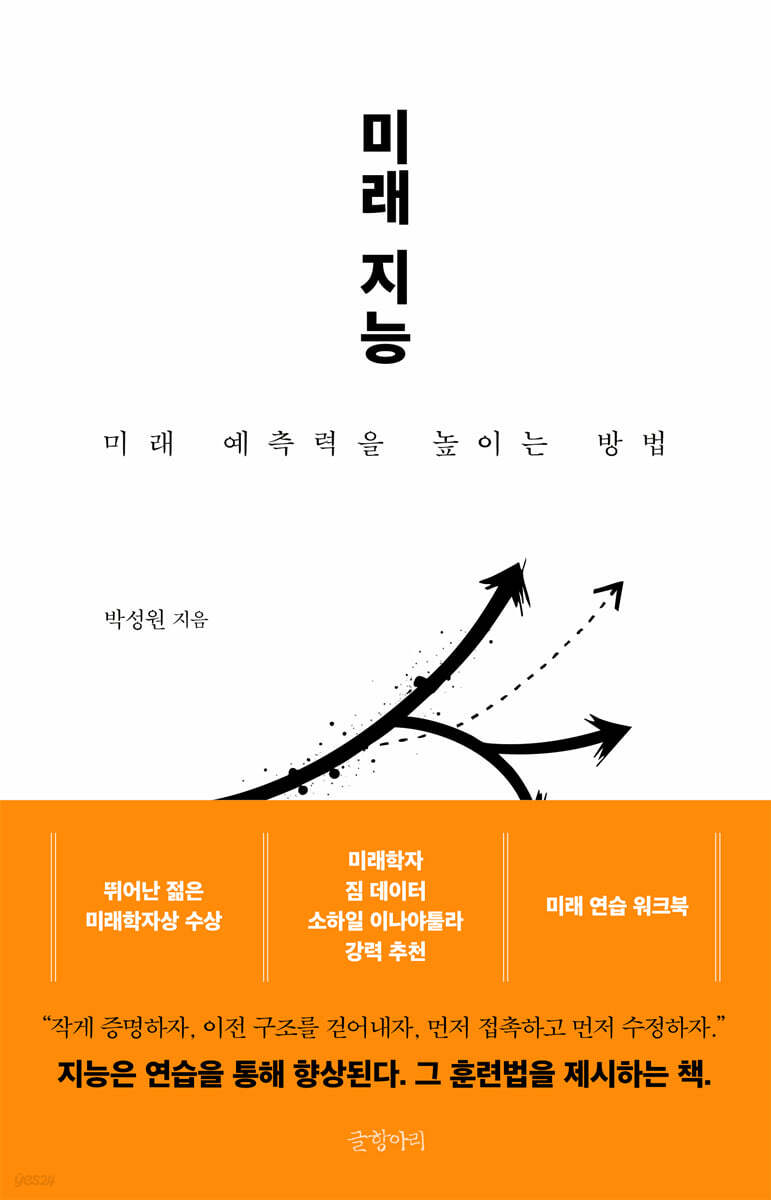
The future is not a linear path.
It curves in many directions, sometimes retreating, and sometimes the line suddenly breaks.
In other words, it is normal for the future to be uncertain and unstable.
If you feel helpless, it's because you believe you can't change the future.
This book argues that those with the ability to listen are excellent at predicting the future, and that even if the future is pessimistic, there is no reason to be depressed as long as you believe that it can be changed.
The author received the Best Paper Award from the Association of Future Professionals, the Paper of the Year Award from the Journal of Future Studies, and the Outstanding Young Futurist Award from the World Federation of Future Studies. He also founded the Asia Pacific Future Network, a network of Asian futurists.
The ability to predict the future consists of strategic forecasting, the ability to identify changes in real time, and critical thinking.
Especially the young and middle-aged must develop the ability to predict the future as a survival weapon.
Whatever you do, you can do it better if you look to the medium- to long-term future.
If you are a leader or manager, you must have the ability to 'change and manage change' along with continuous learning.
The author suggests ways to increase future intelligence through practice.
The goal of this exercise is to understand and overcome your limitations, not to reach some level where you can stop practicing.
In this respect, practice is closer to performance.
This is a practice that aims to overcome the limitations of my cognitive intelligence in understanding the space-time of the future.
Future practice is a practice that seeks to overcome the limits of my cognitive intelligence.
Training to bring anxiety to a manageable level in the age of artificial intelligence
★Winner of the Outstanding Young Futurist Award
★Highly recommended by futurists Jim Data, Sohail Inayatullah, and Lee Kwang-hyung
★Future Practice Workbook
Intelligence is the ability to achieve goals in an uncertain environment.
The reason Homo sapiens survived for over 200,000 years is because of our intelligence.
Scientists and psychologists believe that the core of intelligence is 'future vision' and 'future prediction'.
This book structures future intelligence and shows methods and practices for enhancing its cognitive abilities.
Futurists, including the author, say that the more you practice, the better your forecasting skills become.
If we simply follow the futures created by others or constantly ask artificial intelligence for its predictions about our own future, our own predictive abilities will inevitably deteriorate.
The future is not a linear path.
It curves in many directions, sometimes retreating, and sometimes the line suddenly breaks.
In other words, it is normal for the future to be uncertain and unstable.
If you feel helpless, it's because you believe you can't change the future.
This book argues that those with the ability to listen are excellent at predicting the future, and that even if the future is pessimistic, there is no reason to be depressed as long as you believe that it can be changed.
The author received the Best Paper Award from the Association of Future Professionals, the Paper of the Year Award from the Journal of Future Studies, and the Outstanding Young Futurist Award from the World Federation of Future Studies. He also founded the Asia Pacific Future Network, a network of Asian futurists.
The ability to predict the future consists of strategic forecasting, the ability to identify changes in real time, and critical thinking.
Especially the young and middle-aged must develop the ability to predict the future as a survival weapon.
Whatever you do, you can do it better if you look to the medium- to long-term future.
If you are a leader or manager, you must have the ability to 'change and manage change' along with continuous learning.
The author suggests ways to increase future intelligence through practice.
The goal of this exercise is to understand and overcome your limitations, not to reach some level where you can stop practicing.
In this respect, practice is closer to performance.
This is a practice that aims to overcome the limitations of my cognitive intelligence in understanding the space-time of the future.
- You can preview some of the book's contents.
Preview
index
prolog
An Incident at the Graduate School of Future Studies | The Core of Intelligence: Future Prospects | A Completely Underrated Ability
Chapter 1: Why is the future always uncertain?
The mind that seeks to avoid anxiety | Looking back on the past is the first step to predicting | How to move from anxiety to a sense of future change through practice
Chapter 2: We're busy enough living now, so when will we ever think about the future?
I don't want to mortgage the present to the future | The logic of survival that overwhelms the future | What you're doing now will soon disappear | The rise of the deserted office | How to compress the time of future practice experiences
Chapter 3: The future is not certain, right?
Fukuyama's Reflections After "The End of History" | Tatsuru Uchida's "Productive Uncertainty" | Future Practice: Transforming Uncertainty into Curiosity and Vibrant Energy
Chapter 4 Can You Accurately Predict the Future?
The Pandemics Predicted in 2019 | The Future Runs Counter to Expectations | The Problem of Forecasting Bias | Three Villains That Hinder Forecasting | Social Interaction and Forecasting Modification | Future Practice: Predicting While Enduring Social Discomfort
Chapter 5: Will the future turn out as planned?
Harvard University's Defense Mechanism Study | What the World's First Pilots and War Heroes Have in Common | The Difference Between a "Negative Outlook" and a "False Outlook" | Improving Your Ability to Anticipate Future Exercises
Chapter 6 Can you predict unexpected situations?
The plan for the day was perfect... | The sudden collapse | The silently approaching explosion | Future practice: Dealing with sudden situations and emerging issues
Chapter 7 So, what changes with future predictions?
The Future Encountered in Honolulu | Predicting the Future 7,000 Years Ago: The Bangudae Petroglyphs in Ulsan | How to Read the Minds of Future Generations | Predicting the Future That Will Change the World | Future Practice: What Will the Future Outlook of 2035 Change?
Chapter 8 Are there any methods and examples that even beginners can use to make predictions without difficulty?
The Birth of a Forecaster | Training to Believe in the Impossible | Creator of the Quantum World and Time | Reborn as a Future-Practicing Forecaster
Chapter 9: I have the society I want, but how can I change it on my own?
Someone Steps Up for Change | Future Realization | The Emergence of a Morphogenic Future | Future Practice: Changing the Future with a Small Voice
Chapter 10: How do you finance your long-term plans?
Advice from Lama and Dalio: "Start Small" | Autopsy of Failure | Dreams, But Money Matters | Adaptation and Foresight from Companies that See the Future | Future Practice: Long-Term Financial Planning Workshop
Chapter 11 I'm still afraid of failing.
I just want to follow others
The Story of Yiying Lu, the Creator of the Whale of Failure | The Future Uncovered by Maladaptive Intelligence | Resisting Fate is the Essence of Predicting the Future | Practicing the Future: Using Maladaptive Intelligence
Epilogue
An Incident at the Graduate School of Future Studies | The Core of Intelligence: Future Prospects | A Completely Underrated Ability
Chapter 1: Why is the future always uncertain?
The mind that seeks to avoid anxiety | Looking back on the past is the first step to predicting | How to move from anxiety to a sense of future change through practice
Chapter 2: We're busy enough living now, so when will we ever think about the future?
I don't want to mortgage the present to the future | The logic of survival that overwhelms the future | What you're doing now will soon disappear | The rise of the deserted office | How to compress the time of future practice experiences
Chapter 3: The future is not certain, right?
Fukuyama's Reflections After "The End of History" | Tatsuru Uchida's "Productive Uncertainty" | Future Practice: Transforming Uncertainty into Curiosity and Vibrant Energy
Chapter 4 Can You Accurately Predict the Future?
The Pandemics Predicted in 2019 | The Future Runs Counter to Expectations | The Problem of Forecasting Bias | Three Villains That Hinder Forecasting | Social Interaction and Forecasting Modification | Future Practice: Predicting While Enduring Social Discomfort
Chapter 5: Will the future turn out as planned?
Harvard University's Defense Mechanism Study | What the World's First Pilots and War Heroes Have in Common | The Difference Between a "Negative Outlook" and a "False Outlook" | Improving Your Ability to Anticipate Future Exercises
Chapter 6 Can you predict unexpected situations?
The plan for the day was perfect... | The sudden collapse | The silently approaching explosion | Future practice: Dealing with sudden situations and emerging issues
Chapter 7 So, what changes with future predictions?
The Future Encountered in Honolulu | Predicting the Future 7,000 Years Ago: The Bangudae Petroglyphs in Ulsan | How to Read the Minds of Future Generations | Predicting the Future That Will Change the World | Future Practice: What Will the Future Outlook of 2035 Change?
Chapter 8 Are there any methods and examples that even beginners can use to make predictions without difficulty?
The Birth of a Forecaster | Training to Believe in the Impossible | Creator of the Quantum World and Time | Reborn as a Future-Practicing Forecaster
Chapter 9: I have the society I want, but how can I change it on my own?
Someone Steps Up for Change | Future Realization | The Emergence of a Morphogenic Future | Future Practice: Changing the Future with a Small Voice
Chapter 10: How do you finance your long-term plans?
Advice from Lama and Dalio: "Start Small" | Autopsy of Failure | Dreams, But Money Matters | Adaptation and Foresight from Companies that See the Future | Future Practice: Long-Term Financial Planning Workshop
Chapter 11 I'm still afraid of failing.
I just want to follow others
The Story of Yiying Lu, the Creator of the Whale of Failure | The Future Uncovered by Maladaptive Intelligence | Resisting Fate is the Essence of Predicting the Future | Practicing the Future: Using Maladaptive Intelligence
Epilogue
Detailed image

Into the book
While humans are losing their predictive abilities, artificial intelligence is racing to catch up with them.
--- p.14
Especially young people who need to decide on a career path or middle-aged people who are trying to change jobs need to develop the ability to predict the future as a survival weapon.
No matter what you do, if you look to the mid- to long-term future, you can do it better.
Karim Lakhani, a professor at Harvard Business School, argues that “most executives, managers, and leaders have two imperatives: one is continuous learning, and the second, which is completely underrated, is change and change management.”
--- p.18
It's normal to feel anxious about the future, but there are times when your own future feels even more anxious.
These feelings should not be missed and should be looked into slowly and deeply.
--- p.29
When we look ahead to the many futures that lie ahead of us, the first thing we must do is identify the reasons for our anxiety about the future.
Reflection on the past begins with anxiety about the future.
I call this process reflective future forecasting.
It can be defined as the process of looking back on my life, reexamining my past, re-examining my goals, rediscovering my former colleagues, and through this gaining the strength to move forward into the future while perceiving an uncertain future.
--- p.31
Is it safe to stay in the present just because we can't plan for the future?
Many young people choose the psychological stability of holding on to the present, believing that change is impossible in the current state of apathy.
However, the structure of current society does not even allow us to ‘stay in the present.’
--- p.53
The era of artificial intelligence is one in which intelligent beings with intelligence superior to humans emerge.
Let's assume that every human being utilizes at least one of these intelligent beings.
The world population will not be 8 billion, but 16 billion, and this number will grow exponentially.
The increase in the number of beings engaged in intellectual activities suggests that social change is accelerating.
No matter what you imagine in the future, society will change at a faster pace and with more content than you can imagine.
--- p.62
Any certainty about the future should be seen as a warning sign, not as an insight into the times.
The appropriate attitude in predicting or designing the future is to accept uncertainty as its essence and to be open to the possibility that even the beliefs we hold now may one day be revised.
Let me emphasize once again that an open attitude is most important.
To better predict the future, we must stop seeking to know the 'certain future'.
--- p.80
In this way, amidst the uncertainty and fear of the future, there comes a moment when you feel a small, but subtle, tremor.
That thrill comes when I decide to jump in and make a change.
The moment you decide to crack the great dominant ideology, the future turns from fear to trembling.
Many social visionaries also looked to the future with anxiety and fear, but they were people who, by looking at the various possibilities of the future with an open mind, sensed a small thrill in their hearts through this and resolved to bring about change.
--- p.86~87
The true value of predicting the future is revealed when it presents a perspective that differs from the current consensus.
In other words, it is preparing for a different time and space than the present.
--- p.110
Safe predictions can be rather useless.
--- p.111
Rather, predictions reveal their value when they cause social discomfort or anxiety.
The comfort of data, the allure of trends, the stability of averages—these three things soothe us, but they also blind us.
To get better at predicting, we need to confront this.
We need to be skeptical of areas where the data doesn't speak, look for inflection points that defy trends, and look for small risks lurking in the tails outside the average.
--- p.14
Especially young people who need to decide on a career path or middle-aged people who are trying to change jobs need to develop the ability to predict the future as a survival weapon.
No matter what you do, if you look to the mid- to long-term future, you can do it better.
Karim Lakhani, a professor at Harvard Business School, argues that “most executives, managers, and leaders have two imperatives: one is continuous learning, and the second, which is completely underrated, is change and change management.”
--- p.18
It's normal to feel anxious about the future, but there are times when your own future feels even more anxious.
These feelings should not be missed and should be looked into slowly and deeply.
--- p.29
When we look ahead to the many futures that lie ahead of us, the first thing we must do is identify the reasons for our anxiety about the future.
Reflection on the past begins with anxiety about the future.
I call this process reflective future forecasting.
It can be defined as the process of looking back on my life, reexamining my past, re-examining my goals, rediscovering my former colleagues, and through this gaining the strength to move forward into the future while perceiving an uncertain future.
--- p.31
Is it safe to stay in the present just because we can't plan for the future?
Many young people choose the psychological stability of holding on to the present, believing that change is impossible in the current state of apathy.
However, the structure of current society does not even allow us to ‘stay in the present.’
--- p.53
The era of artificial intelligence is one in which intelligent beings with intelligence superior to humans emerge.
Let's assume that every human being utilizes at least one of these intelligent beings.
The world population will not be 8 billion, but 16 billion, and this number will grow exponentially.
The increase in the number of beings engaged in intellectual activities suggests that social change is accelerating.
No matter what you imagine in the future, society will change at a faster pace and with more content than you can imagine.
--- p.62
Any certainty about the future should be seen as a warning sign, not as an insight into the times.
The appropriate attitude in predicting or designing the future is to accept uncertainty as its essence and to be open to the possibility that even the beliefs we hold now may one day be revised.
Let me emphasize once again that an open attitude is most important.
To better predict the future, we must stop seeking to know the 'certain future'.
--- p.80
In this way, amidst the uncertainty and fear of the future, there comes a moment when you feel a small, but subtle, tremor.
That thrill comes when I decide to jump in and make a change.
The moment you decide to crack the great dominant ideology, the future turns from fear to trembling.
Many social visionaries also looked to the future with anxiety and fear, but they were people who, by looking at the various possibilities of the future with an open mind, sensed a small thrill in their hearts through this and resolved to bring about change.
--- p.86~87
The true value of predicting the future is revealed when it presents a perspective that differs from the current consensus.
In other words, it is preparing for a different time and space than the present.
--- p.110
Safe predictions can be rather useless.
--- p.111
Rather, predictions reveal their value when they cause social discomfort or anxiety.
The comfort of data, the allure of trends, the stability of averages—these three things soothe us, but they also blind us.
To get better at predicting, we need to confront this.
We need to be skeptical of areas where the data doesn't speak, look for inflection points that defy trends, and look for small risks lurking in the tails outside the average.
--- p.112~113
Publisher's Review
People who are good at reflecting are also good at preparing for the future.
People have a psychological barrier to thinking about the future.
I don't know how to control it even now, but I'm overwhelmed by the thought of whether I can handle the space and time of the future.
This is the psychological pressure that comes from individuals having to shoulder social structural problems.
Accordingly, the author does not simply present self-development survival skills, but also encompasses the ability to leap beyond the system or imagine the outside.
Because the prospects and practices of the future without social participation are ultimately reduced to a narrative of individualized self-regulation.
The text consists of 11 chapters, each titled with a question that people who hesitate to take a step into the future often ask, and the author, as a futures researcher, provides multi-layered answers.
It incorporates the findings of large-scale surveys, qualitative research, social science methodologies, and futures workshops.
At the end of each chapter, a workbook called 'Future Practice' is included to enhance practicality.
For example, it suggests ways to convert anxiety into energy for those who have it.
The author also suggests ways to correct forecast bias and revise forecasts, enabling readers to spot hidden problems in their own forecasts.
Furthermore, it presents a method for distinguishing between a 'negative outlook' and a 'false outlook' and a practice method for improving 'anticipatory capacity'.
The future feeds on the past.
If you are walking towards the future and feel unsure about the path, you should look back to the past.
There must have been a reason for choosing this path in the past, but as time passes, circumstances and conditions change, people's thoughts and actions change, and society changes.
'Reflective future forecasting' begins with looking back at yourself for missing or ignoring the signs of change.
This can lead to significant changes.
You may decide to distance yourself from a close colleague or venture into an unfamiliar place to experience something you've never tried before.
You may also have to quit your current job, and at that time, you need to carefully plan your mid- to long-term finances.
This decision might make you feel more anxious right now, but you'll likely find yourself satisfied with your decision in the long run, wondering, "Why didn't I make this choice sooner?"
People who are good at reflecting also prepare well for the future.
Future intelligence will be driven by the transformation of sensory data.
Bringing about structural changes in emotions
The author encourages practice in bringing about real change by looking into the details of how to welcome or anticipate the future.
The important thing here is to start from the basics.
For example, let's define anxiety about the future not as the pain of ignorance that comes from not understanding the future, but as a state of waiting for a 'sense of change that has not yet been verbalized.'
By training this sense, individuals can grasp the essence of an 'uncertain future' and develop the ability to respond to it.
First, let's express the vague anxiety in words and convert it into 'sensory data'.
For example, try answering the question, “What news has made you most anxious recently?”
By using this method, detailed in the text, and gathering small clues, vague feelings are transformed into signals of structural change, and your sense of the future is gradually sharpened through training.
If so, anxiety can be a starting point for sensory training to read the changes to come, rather than an emotion that discourages me.
People facing the future have two choices.
One is to adapt to the system, and the other is to develop an alternative humanity with new ethics and technologies.
The key here is to view certainty as a red flag and embrace uncertainty as its essence by improving your ability to adjust.
To better predict the future, we must stop seeking to know the 'certain future'.
This desire goes hand in hand with an attitude of relying on experts, and the author believes that “the more expert a person is in a field, the less able they are to cope with change.”
Ultimately, prediction is not a simple calculation; it is a discipline to recognize and avoid psychological traps.
Predictions reveal their value when they make society uncomfortable.
We need to be skeptical of what the data doesn't say, look for inflection points that defy trends, and look for risks lurking in the outer tails of the average.
In particular, anticipating a negative future through prediction is a productive activity.
The author worked as a journalist for a media company for 10 years before quitting and going to study abroad in the United States, where he received a doctorate in future studies.
He later became a researcher at a government-funded organization, but he shares his experience of starting a new company 10 years later.
This decision was made after I took a different path to find a new career beyond being a journalist, but with the advent of the AI era, it became difficult to foresee the future while working as a researcher who wrote one or two papers a year.
Looking into the future as a futurist, a stable position as a researcher is guaranteed, but a negative future is depicted from the perspective of self-efficacy.
Therefore, the author analyzes himself and places his 20-year trajectory on the coordinates, showing an example of the past and future.
Successful people often use mature mechanisms such as anticipation, humor, artistic sublimation, and restraint.
The author emphasizes that among these, ‘anticipation’ should be actively utilized.
Let's try to predict the future of artificial intelligence, for example, in the current situation.
Many people will picture the future negatively, but this book says that we must persist even if a negative future is predicted through predictions.
This is because, if you do so, you will be able to see breakthroughs that you had not thought of before, and you will be able to improve your mental strength to endure an uncertain future.
Predicting the future needs to become a constant and routine activity.
The future does not come in an orderly manner according to the accumulation of time.
However, if you consistently train yourself to read the signals and face their meaning, unexpected situations will change from unpredictable events to predictable uncertainties.
There are always warning signs in emergencies.
Whether we face it or ignore it will determine our future.
There are also emerging issues that are somewhat different from sudden variables.
If a sudden outbreak is something that strikes suddenly, an emerging issue is a 'slow-moving crack'.
The author redefines emerging issues as ruptures that reveal the structural problems of contemporary society, and encourages us to read the face of the future from them.
Emerging issues can cause rifts and suddenly push society to a turning point, so we must address both unexpected variables and emerging issues in our future exercises.
Only people and societies that listen to the sound of the explosion can avoid future collapse and turn the crisis into an opportunity for innovation.
People have a psychological barrier to thinking about the future.
I don't know how to control it even now, but I'm overwhelmed by the thought of whether I can handle the space and time of the future.
This is the psychological pressure that comes from individuals having to shoulder social structural problems.
Accordingly, the author does not simply present self-development survival skills, but also encompasses the ability to leap beyond the system or imagine the outside.
Because the prospects and practices of the future without social participation are ultimately reduced to a narrative of individualized self-regulation.
The text consists of 11 chapters, each titled with a question that people who hesitate to take a step into the future often ask, and the author, as a futures researcher, provides multi-layered answers.
It incorporates the findings of large-scale surveys, qualitative research, social science methodologies, and futures workshops.
At the end of each chapter, a workbook called 'Future Practice' is included to enhance practicality.
For example, it suggests ways to convert anxiety into energy for those who have it.
The author also suggests ways to correct forecast bias and revise forecasts, enabling readers to spot hidden problems in their own forecasts.
Furthermore, it presents a method for distinguishing between a 'negative outlook' and a 'false outlook' and a practice method for improving 'anticipatory capacity'.
The future feeds on the past.
If you are walking towards the future and feel unsure about the path, you should look back to the past.
There must have been a reason for choosing this path in the past, but as time passes, circumstances and conditions change, people's thoughts and actions change, and society changes.
'Reflective future forecasting' begins with looking back at yourself for missing or ignoring the signs of change.
This can lead to significant changes.
You may decide to distance yourself from a close colleague or venture into an unfamiliar place to experience something you've never tried before.
You may also have to quit your current job, and at that time, you need to carefully plan your mid- to long-term finances.
This decision might make you feel more anxious right now, but you'll likely find yourself satisfied with your decision in the long run, wondering, "Why didn't I make this choice sooner?"
People who are good at reflecting also prepare well for the future.
Future intelligence will be driven by the transformation of sensory data.
Bringing about structural changes in emotions
The author encourages practice in bringing about real change by looking into the details of how to welcome or anticipate the future.
The important thing here is to start from the basics.
For example, let's define anxiety about the future not as the pain of ignorance that comes from not understanding the future, but as a state of waiting for a 'sense of change that has not yet been verbalized.'
By training this sense, individuals can grasp the essence of an 'uncertain future' and develop the ability to respond to it.
First, let's express the vague anxiety in words and convert it into 'sensory data'.
For example, try answering the question, “What news has made you most anxious recently?”
By using this method, detailed in the text, and gathering small clues, vague feelings are transformed into signals of structural change, and your sense of the future is gradually sharpened through training.
If so, anxiety can be a starting point for sensory training to read the changes to come, rather than an emotion that discourages me.
People facing the future have two choices.
One is to adapt to the system, and the other is to develop an alternative humanity with new ethics and technologies.
The key here is to view certainty as a red flag and embrace uncertainty as its essence by improving your ability to adjust.
To better predict the future, we must stop seeking to know the 'certain future'.
This desire goes hand in hand with an attitude of relying on experts, and the author believes that “the more expert a person is in a field, the less able they are to cope with change.”
Ultimately, prediction is not a simple calculation; it is a discipline to recognize and avoid psychological traps.
Predictions reveal their value when they make society uncomfortable.
We need to be skeptical of what the data doesn't say, look for inflection points that defy trends, and look for risks lurking in the outer tails of the average.
In particular, anticipating a negative future through prediction is a productive activity.
The author worked as a journalist for a media company for 10 years before quitting and going to study abroad in the United States, where he received a doctorate in future studies.
He later became a researcher at a government-funded organization, but he shares his experience of starting a new company 10 years later.
This decision was made after I took a different path to find a new career beyond being a journalist, but with the advent of the AI era, it became difficult to foresee the future while working as a researcher who wrote one or two papers a year.
Looking into the future as a futurist, a stable position as a researcher is guaranteed, but a negative future is depicted from the perspective of self-efficacy.
Therefore, the author analyzes himself and places his 20-year trajectory on the coordinates, showing an example of the past and future.
Successful people often use mature mechanisms such as anticipation, humor, artistic sublimation, and restraint.
The author emphasizes that among these, ‘anticipation’ should be actively utilized.
Let's try to predict the future of artificial intelligence, for example, in the current situation.
Many people will picture the future negatively, but this book says that we must persist even if a negative future is predicted through predictions.
This is because, if you do so, you will be able to see breakthroughs that you had not thought of before, and you will be able to improve your mental strength to endure an uncertain future.
Predicting the future needs to become a constant and routine activity.
The future does not come in an orderly manner according to the accumulation of time.
However, if you consistently train yourself to read the signals and face their meaning, unexpected situations will change from unpredictable events to predictable uncertainties.
There are always warning signs in emergencies.
Whether we face it or ignore it will determine our future.
There are also emerging issues that are somewhat different from sudden variables.
If a sudden outbreak is something that strikes suddenly, an emerging issue is a 'slow-moving crack'.
The author redefines emerging issues as ruptures that reveal the structural problems of contemporary society, and encourages us to read the face of the future from them.
Emerging issues can cause rifts and suddenly push society to a turning point, so we must address both unexpected variables and emerging issues in our future exercises.
Only people and societies that listen to the sound of the explosion can avoid future collapse and turn the crisis into an opportunity for innovation.
GOODS SPECIFICS
- Date of issue: November 7, 2025
- Page count, weight, size: 304 pages | 448g | 135*210*20mm
- ISBN13: 9791169094481
You may also like
카테고리
korean


korean

![GQ KOREA Mark (Monthly): December [2025]](http://librairie.coreenne.fr/cdn/shop/files/8ef265dbbfbf186523ed75ba7319009d.jpg?v=1765340328&width=3840)


