

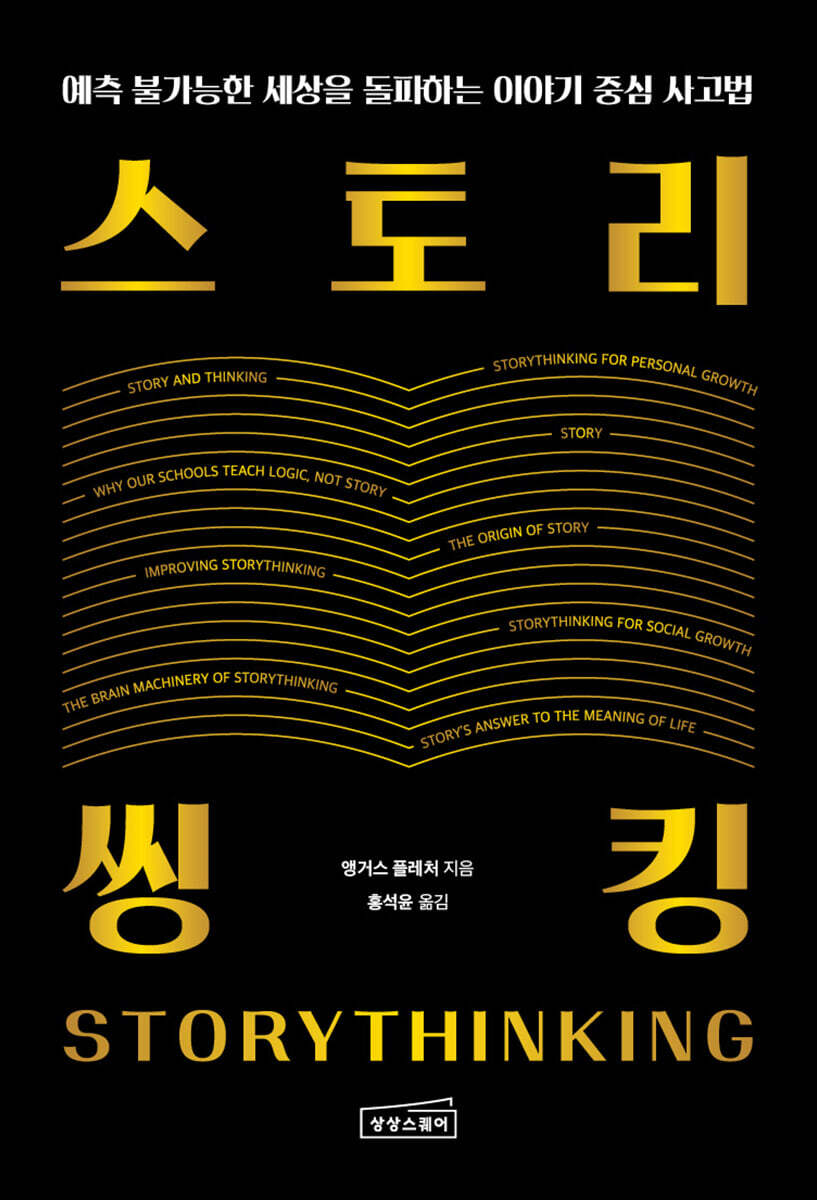
Story Thinking
 |
Description
Book Introduction
If you change the way you think, your life will change like a story!
Awakening the Story Thinker Within Us
"Story Thinking" is a guidebook that teaches the essential mindset for survival in an age of uncertainty and fluidity.
Angus Fletcher, a neuroscientist and literary scholar, has been studying the remarkable power of stories.
In this book, he strongly argues that we must develop story thinking skills, a narrative-centered thinking method.
He describes story thinking as a narrative-centered way of thinking that creates and experiments with worlds of possibility and predicts what will happen in the future.
Behind every great innovation, there has always been a ‘story.’
Copernicus destroyed the existing narrative of geocentrism and wrote a new narrative of heliocentrism.
For a new story like this to be written, it was necessary to imagine possibilities and take action.
The author explains, based on scientific evidence, that such remarkable achievements were possible thanks to human storytelling.
In the coming era, we will need to create and act more stories to survive.
That's why we need to learn to think in stories again.
This book helps us rediscover this unique human ability to think and navigate an uncertain world.
The moment you read this book, your way of thinking will evolve to the next level.
Awakening the Story Thinker Within Us
"Story Thinking" is a guidebook that teaches the essential mindset for survival in an age of uncertainty and fluidity.
Angus Fletcher, a neuroscientist and literary scholar, has been studying the remarkable power of stories.
In this book, he strongly argues that we must develop story thinking skills, a narrative-centered thinking method.
He describes story thinking as a narrative-centered way of thinking that creates and experiments with worlds of possibility and predicts what will happen in the future.
Behind every great innovation, there has always been a ‘story.’
Copernicus destroyed the existing narrative of geocentrism and wrote a new narrative of heliocentrism.
For a new story like this to be written, it was necessary to imagine possibilities and take action.
The author explains, based on scientific evidence, that such remarkable achievements were possible thanks to human storytelling.
In the coming era, we will need to create and act more stories to survive.
That's why we need to learn to think in stories again.
This book helps us rediscover this unique human ability to think and navigate an uncertain world.
The moment you read this book, your way of thinking will evolve to the next level.
- You can preview some of the book's contents.
Preview
index
Chapter 1 Story
Story Thinking
The logic of philosophers
What teachers missed
To get better at thinking in stories
Developing Story Thinking Abilities Through Art and Science
Chapter 2: Stories and Thoughts
The Origins of Philosophy
The rise of academic philosophy
More metaphysics, more arguments
The mind of Socrates
Thinking in different ways
Chapter 3: The Origin of the Story
Investigation Takes Over the World
The deeper origins of the story
neural network
Chapter 4: Why do schools teach logic instead of stories?
How did the learning assessment criteria delete the story?
Problems that narrative cannot address
What Semiotics Misses
Chapter 5: The Limits of Logic - Why Story Thinking Is Still Necessary
A young doctor's awakening
The owner of the most unusual thoughts
rational thinking machine
failed experiment
Chapter 6: The Brain Machine That Thinks Story
First and second characters: Eccles and the soup group
The third character: Karl Popper, a logician who suffered from extreme pain.
The fourth figure: Francis Bacon, the founder of modern science.
Fifth Figure: John Herschel and the Modern Scientific Method
From Herschel back to Popper
A brain machine that performs scientific guessing
The structure of the brain that engages in story thinking
Chapter 7: Develop Your Story Thinking Skills
The Wizard's Mistake
Become a story wizard
Maximize Creativity
Sharpen your tool of choice
Separate creation and selection
If you improve your story thinking skills,
Chapter 8: Story Thinking for Personal Growth
The Roots of John Dewey's Thought
Two new forms of logic
John Dewey Beyond Dialectics
From Hegel's 'Growth' to Dewey's 'Growth'
Three Types of Personal Growth
Chapter 9: Story Thinking for Social Growth
shabby inn
Blueprint for a Free Society
Continue the story
How does narrative address social conflict?
The ending of this book
Chapter 10: The Answers Stories Give About the Meaning of Life
Two ills: logic and narrative
Why the story and logic are inconsistent
Beyond happiness
A conversation with the author, Story Thinker Jongjang
annotation
Story Thinking
The logic of philosophers
What teachers missed
To get better at thinking in stories
Developing Story Thinking Abilities Through Art and Science
Chapter 2: Stories and Thoughts
The Origins of Philosophy
The rise of academic philosophy
More metaphysics, more arguments
The mind of Socrates
Thinking in different ways
Chapter 3: The Origin of the Story
Investigation Takes Over the World
The deeper origins of the story
neural network
Chapter 4: Why do schools teach logic instead of stories?
How did the learning assessment criteria delete the story?
Problems that narrative cannot address
What Semiotics Misses
Chapter 5: The Limits of Logic - Why Story Thinking Is Still Necessary
A young doctor's awakening
The owner of the most unusual thoughts
rational thinking machine
failed experiment
Chapter 6: The Brain Machine That Thinks Story
First and second characters: Eccles and the soup group
The third character: Karl Popper, a logician who suffered from extreme pain.
The fourth figure: Francis Bacon, the founder of modern science.
Fifth Figure: John Herschel and the Modern Scientific Method
From Herschel back to Popper
A brain machine that performs scientific guessing
The structure of the brain that engages in story thinking
Chapter 7: Develop Your Story Thinking Skills
The Wizard's Mistake
Become a story wizard
Maximize Creativity
Sharpen your tool of choice
Separate creation and selection
If you improve your story thinking skills,
Chapter 8: Story Thinking for Personal Growth
The Roots of John Dewey's Thought
Two new forms of logic
John Dewey Beyond Dialectics
From Hegel's 'Growth' to Dewey's 'Growth'
Three Types of Personal Growth
Chapter 9: Story Thinking for Social Growth
shabby inn
Blueprint for a Free Society
Continue the story
How does narrative address social conflict?
The ending of this book
Chapter 10: The Answers Stories Give About the Meaning of Life
Two ills: logic and narrative
Why the story and logic are inconsistent
Beyond happiness
A conversation with the author, Story Thinker Jongjang
annotation
Into the book
"Story thinking began before writers, humans, and even language.
Perhaps we have to go back hundreds of millions of years to when animal brains first emerged.”
--- p.16, from “Chapter 1 Story”
"Stories were not just a tool for speaking, as they say.
It's much more fundamental than that.
Stories are for thought.
"
--- p.16, from “Chapter 1 Story”
"Story thinking is thinking about 'why' and 'what if?'
"It is to guess the whole from cause to effect, and to imagine the consequences of various rules for action."
--- p.18, from “Chapter 1 Story”
"Cicero observed that Naratio, when he was in his thirties and a judge, had tremendous powers of persuasion.
"Simple facts alone were not enough to convince the jury, but if you tied the same facts to a story, they immediately found it believable."
--- p.80, from “Chapter 3: The Origin of the Story”
"Story thinking is the superpower that has enabled us, as a species, to achieve amazing, life-enhancing inventions like culture, science, business, and technology, enabling us to adapt better than other animals."
--- p.91, from “Chapter 3: The Origin of the Story”
"Replacing narrative with semiotics may have made literature classes more logical, but it didn't make the American school system any less obviously better."
--- p.112, from “Chapter 4: Why Do Schools Teach Logic Instead of Stories?”
"If Richard and the ancient philosophers were right in thinking that data-driven logic was the only mental tool we needed for a wise and prosperous life, then their actions would be unconditionally beneficial.
But in reality, that's not the case."
--- p.117, from “Chapter 4: Why Do Schools Teach Logic Instead of Stories?”
“Growth is the driving force of life.
Growth is about facing problems head-on and moving toward opportunities.
Growth is organic, creative, and non-teleological."
--- p.207, from “Chapter 8 Story Thinking for Personal Growth”
"Machiavelli did not reach a final conclusion about politics in this book.
He subtly suggests that we continue the story as we did when we read Livy's "History of Rome."
"Thanks to the help and comfort of those who helped me carry this burden, I believe I have become a path that will help future generations carry it to its destination."
--- p.244, from “Chapter 9: Story Thing for Social Growth”
"Story thinking can be synonymous with narrative cognition or the idea of action.
Story thinking is neither semantic nor computational.
Story thinking is not just used to understand a situation, but to create new paths of action and execution, including planning, plotting, and strategizing.
Perhaps we have to go back hundreds of millions of years to when animal brains first emerged.”
--- p.16, from “Chapter 1 Story”
"Stories were not just a tool for speaking, as they say.
It's much more fundamental than that.
Stories are for thought.
"
--- p.16, from “Chapter 1 Story”
"Story thinking is thinking about 'why' and 'what if?'
"It is to guess the whole from cause to effect, and to imagine the consequences of various rules for action."
--- p.18, from “Chapter 1 Story”
"Cicero observed that Naratio, when he was in his thirties and a judge, had tremendous powers of persuasion.
"Simple facts alone were not enough to convince the jury, but if you tied the same facts to a story, they immediately found it believable."
--- p.80, from “Chapter 3: The Origin of the Story”
"Story thinking is the superpower that has enabled us, as a species, to achieve amazing, life-enhancing inventions like culture, science, business, and technology, enabling us to adapt better than other animals."
--- p.91, from “Chapter 3: The Origin of the Story”
"Replacing narrative with semiotics may have made literature classes more logical, but it didn't make the American school system any less obviously better."
--- p.112, from “Chapter 4: Why Do Schools Teach Logic Instead of Stories?”
"If Richard and the ancient philosophers were right in thinking that data-driven logic was the only mental tool we needed for a wise and prosperous life, then their actions would be unconditionally beneficial.
But in reality, that's not the case."
--- p.117, from “Chapter 4: Why Do Schools Teach Logic Instead of Stories?”
“Growth is the driving force of life.
Growth is about facing problems head-on and moving toward opportunities.
Growth is organic, creative, and non-teleological."
--- p.207, from “Chapter 8 Story Thinking for Personal Growth”
"Machiavelli did not reach a final conclusion about politics in this book.
He subtly suggests that we continue the story as we did when we read Livy's "History of Rome."
"Thanks to the help and comfort of those who helped me carry this burden, I believe I have become a path that will help future generations carry it to its destination."
--- p.244, from “Chapter 9: Story Thing for Social Growth”
"Story thinking can be synonymous with narrative cognition or the idea of action.
Story thinking is neither semantic nor computational.
Story thinking is not just used to understand a situation, but to create new paths of action and execution, including planning, plotting, and strategizing.
--- p.295, from “Conversation with the final story thinker (author)”
Publisher's Review
Our lives begin with stories.
Although logic and data are becoming the standards for all judgments, the world is becoming increasingly unpredictable through logic.
There are times when we feel helpless when faced with complex problems that cannot be solved with conventional logic.
"Story Thinking" teaches us how to think our way through this uncertain world.
Drawing on original research that bridges literature and neuroscience, the author demonstrates that "storytelling" is not simply a skill in writing or speaking, but rather a uniquely human cognitive mechanism.
He argues forcefully that stories were the way we understood the world and gave meaning to it before logic or language.
This book shows, through various examples, how story thinking actually works in our lives.
When scientist Herschel deduced the location of the center of the galaxy, he started with narrative imagination rather than logical calculation.
Political theorist Machiavelli rejected existing philosophical logic and designed a new leadership model through the narrative diagnosis that "humans are selfish."
We think through stories when we learn something, when we adapt to new circumstances, and when we plan for an uncertain future.
So the author calls our brain a "story-thinking brain machine," and backs up with neuroscientific examples that more creative and innovative decisions emerge from stories than from logic or data.
The author emphasizes that story thinking is not a special ability reserved for geniuses, but a universal way of thinking that we all have potential for.
Story thinking is not difficult.
Not just acting, but thinking and imagining the situation as a story.
That's story thinking.
For example, a child who ponders, "Why should I solve this problem?" or "What will it mean to me if I solve this problem?" is engaging in deeper story thinking than a child who solves a given math problem.
This difference in thinking becomes even more evident when faced with problems for which there is no right answer.
Story thinking is the best way to find direction in uncertain situations and see problems in a completely different way.
Throughout history, story thinking has driven innovation around the world.
Copernicus overturned the existing narrative of the Earth being the center of the universe and imagined a new story of the sun being the center of the universe.
In other words, if we change the story, the world changes.
The discovery of brain neurotransmission is also an example of innovation brought about by story thinking.
A new story was born when John Eccles, who had been advocating for electrical transmission, declared that his claims were wrong through experimental results.
In these examples, we can see that even scientific thinking is born from narrative structure, not logic.
Story thinking is a way to change the world by mixing stories and creating new stories or destroying existing stories.
We live in an age where answers are disappearing and predictions are crumbling.
In this day and age, we can no longer plan for the future based solely on past logic or simple information.
It requires the ability to ask new questions, imagine possibilities, and create your own stories.
This book will serve as a guide to developing that ability.
"Story Thinking" is not simply a book about how to create good stories; it provides the thinking tools we need to interpret the world, reconstruct problems, and design meaningful lives.
We are all potential story thinkers.
Now, all you have to do is consciously bring out your story thinking skills and use them.
This book will help you take that first step.
Although logic and data are becoming the standards for all judgments, the world is becoming increasingly unpredictable through logic.
There are times when we feel helpless when faced with complex problems that cannot be solved with conventional logic.
"Story Thinking" teaches us how to think our way through this uncertain world.
Drawing on original research that bridges literature and neuroscience, the author demonstrates that "storytelling" is not simply a skill in writing or speaking, but rather a uniquely human cognitive mechanism.
He argues forcefully that stories were the way we understood the world and gave meaning to it before logic or language.
This book shows, through various examples, how story thinking actually works in our lives.
When scientist Herschel deduced the location of the center of the galaxy, he started with narrative imagination rather than logical calculation.
Political theorist Machiavelli rejected existing philosophical logic and designed a new leadership model through the narrative diagnosis that "humans are selfish."
We think through stories when we learn something, when we adapt to new circumstances, and when we plan for an uncertain future.
So the author calls our brain a "story-thinking brain machine," and backs up with neuroscientific examples that more creative and innovative decisions emerge from stories than from logic or data.
The author emphasizes that story thinking is not a special ability reserved for geniuses, but a universal way of thinking that we all have potential for.
Story thinking is not difficult.
Not just acting, but thinking and imagining the situation as a story.
That's story thinking.
For example, a child who ponders, "Why should I solve this problem?" or "What will it mean to me if I solve this problem?" is engaging in deeper story thinking than a child who solves a given math problem.
This difference in thinking becomes even more evident when faced with problems for which there is no right answer.
Story thinking is the best way to find direction in uncertain situations and see problems in a completely different way.
Throughout history, story thinking has driven innovation around the world.
Copernicus overturned the existing narrative of the Earth being the center of the universe and imagined a new story of the sun being the center of the universe.
In other words, if we change the story, the world changes.
The discovery of brain neurotransmission is also an example of innovation brought about by story thinking.
A new story was born when John Eccles, who had been advocating for electrical transmission, declared that his claims were wrong through experimental results.
In these examples, we can see that even scientific thinking is born from narrative structure, not logic.
Story thinking is a way to change the world by mixing stories and creating new stories or destroying existing stories.
We live in an age where answers are disappearing and predictions are crumbling.
In this day and age, we can no longer plan for the future based solely on past logic or simple information.
It requires the ability to ask new questions, imagine possibilities, and create your own stories.
This book will serve as a guide to developing that ability.
"Story Thinking" is not simply a book about how to create good stories; it provides the thinking tools we need to interpret the world, reconstruct problems, and design meaningful lives.
We are all potential story thinkers.
Now, all you have to do is consciously bring out your story thinking skills and use them.
This book will help you take that first step.
GOODS SPECIFICS
- Date of issue: April 30, 2025
- Page count, weight, size: 328 pages | 336g | 128*188*18mm
- ISBN13: 9791194368229
- ISBN10: 1194368220
You may also like
카테고리
korean


korean

![ELLE 엘르 스페셜 에디션 A형 : 12월 [2025]](http://librairie.coreenne.fr/cdn/shop/files/b8e27a3de6c9538896439686c6b0e8fb.jpg?v=1766436872&width=3840)


