

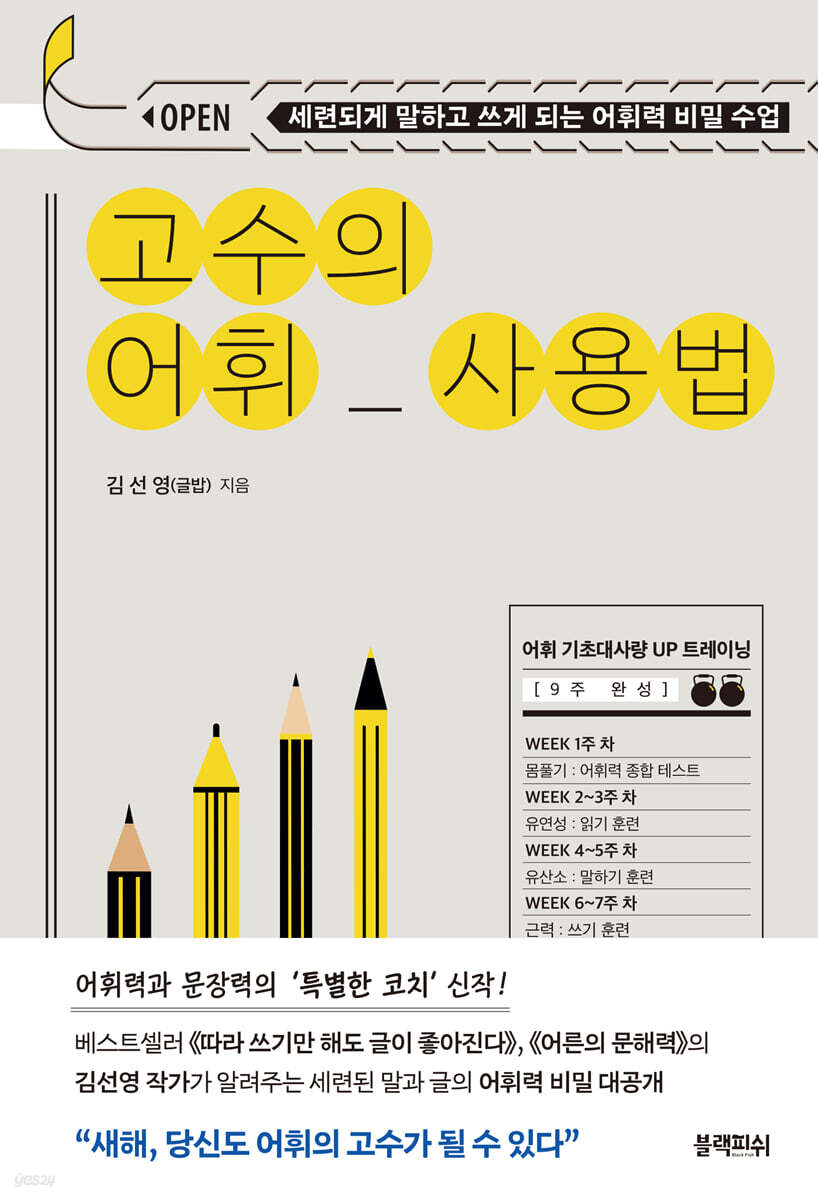
How to Use Vocabulary as a Master
 |
Description
Book Introduction
“When your vocabulary changes, the quality of your speech increases and your image changes!”
Bestseller 『Adult Literacy』 New book from Coach 'Geulbap'!
Use the words you know correctly and change the words you don't know into words you know.
30 Advanced Vocabulary Training Methods
How many words do I use? Think about when you're talking to people.
Since the vocabulary used in daily life is limited, most people use common words.
Still, some people say they have a great vocabulary, while others worry that their vocabulary is poor.
What is the one-point difference that determines vocabulary?
And what specifically are the benefits of having a high vocabulary?
Vocabulary has the power to shape a person's image! Even just one well-chosen word can make you appear sophisticated and intelligent, conveying a sense of respect and likability.
Being able to express your thoughts accurately builds confidence and increases efficiency.
In other words, vocabulary is not limited to reading or writing skills, but it also affects relationships, work, self-esteem, and even life as a whole.
Vocabulary is so important, yet I find myself using only the most common words.
People tell us to read a lot of books to build our vocabulary, but it's not easy, and it doesn't seem like it will make a huge difference.
It's a problem that it's a word that you clearly know, but can't express it well in speech or writing.
It is important to increase the amount of vocabulary (input), but only after I go through the process of checking the vocabulary I know in text, writing it down, and recalling its meaning (output) can it truly become mine.
In other words, vocabulary can be effectively developed only through systematic training, like receiving PT.
Kim Seon-young, the 'writing coach' who laid the foundation for writing in 'If I Could Write One Sentence Well, I Would Have Nothing to Wish For' and taught us how to properly read and understand long texts in 'Adult Literacy', has now prepared an advanced vocabulary PT.
After reading "Vocabulary Usage Guide for Experts," which contains thirty training methods to upgrade your vocabulary, you will break free from the dry language life of expressing all emotions with "daebak" and "wow" and become a communication expert who accurately expresses emotions and thoughts with just the right vocabulary.
Bestseller 『Adult Literacy』 New book from Coach 'Geulbap'!
Use the words you know correctly and change the words you don't know into words you know.
30 Advanced Vocabulary Training Methods
How many words do I use? Think about when you're talking to people.
Since the vocabulary used in daily life is limited, most people use common words.
Still, some people say they have a great vocabulary, while others worry that their vocabulary is poor.
What is the one-point difference that determines vocabulary?
And what specifically are the benefits of having a high vocabulary?
Vocabulary has the power to shape a person's image! Even just one well-chosen word can make you appear sophisticated and intelligent, conveying a sense of respect and likability.
Being able to express your thoughts accurately builds confidence and increases efficiency.
In other words, vocabulary is not limited to reading or writing skills, but it also affects relationships, work, self-esteem, and even life as a whole.
Vocabulary is so important, yet I find myself using only the most common words.
People tell us to read a lot of books to build our vocabulary, but it's not easy, and it doesn't seem like it will make a huge difference.
It's a problem that it's a word that you clearly know, but can't express it well in speech or writing.
It is important to increase the amount of vocabulary (input), but only after I go through the process of checking the vocabulary I know in text, writing it down, and recalling its meaning (output) can it truly become mine.
In other words, vocabulary can be effectively developed only through systematic training, like receiving PT.
Kim Seon-young, the 'writing coach' who laid the foundation for writing in 'If I Could Write One Sentence Well, I Would Have Nothing to Wish For' and taught us how to properly read and understand long texts in 'Adult Literacy', has now prepared an advanced vocabulary PT.
After reading "Vocabulary Usage Guide for Experts," which contains thirty training methods to upgrade your vocabulary, you will break free from the dry language life of expressing all emotions with "daebak" and "wow" and become a communication expert who accurately expresses emotions and thoughts with just the right vocabulary.
- You can preview some of the book's contents.
Preview
index
Prologue: What if your vocabulary remains stagnant even after reading books? When to start "Vocabulary PT"
Chapter 1.
Warm-up Week 1 | Before Vocabulary PT
PT 1st session
Are You Speaking with Dignity? - Comprehensive Vocabulary Test
Why Does It Look Like It's Not There When I Talk? - OT 1st Period
How diverse is your vocabulary? - OT 2nd period
What's the Benefit of a Great Vocabulary? - OT 3rd Period
Three Habits for Advanced Vocabulary - OT 4th Period
#Supplement_ How to avoid spelling mistakes
Chapter 2.
Flexibility Weeks 2-3 | Reading Practice: Reading with Vocabulary Sensitivity
PT 2nd Classification of Unfamiliar Words into 3 Levels
PT 3: Exploring the Differences Like "Spot the Difference"
PT 4: Replace unfamiliar words with known words
PT 5: Inferring Unfamiliar Words (Advanced)
PT 6th session: Minimum number of Chinese characters required for stable vocabulary
PT 7: Collecting Unique Dialects
PT 8th Storytelling Vocabulary Learning Method
#Supplement_ A habit of building vocabulary without the yo-yo effect
Chapter 3.
Aerobic Week 4-5 | Speaking Training: Start by learning how to speak properly.
PT 9: Do it alone! Develop your conversational skills.
PT 10th episode, let's speak accurately
PT 11 Let's speak properly and smartly
PT 12: Use small words instead of big words
PT 13: Practice to Eliminate Preconceptions
PT 14: Replacing Old Discriminatory Words with New Words
PT Session 15: Positive Speaking: Changing Your Words to Gentle and Active
PT 16: Proverbs and Idioms to Make Social Life Easier
#Supplement_ The idea that using a foreign language is sophisticated is rather old-fashioned.
Chapter 4.
Strength Weeks 6-7 | Writing Training: Elevating the Level of Speaking and Writing
PT 17: Utilizing Digital Notes to Manage Vocabulary 200%
PT 18th Vocabulary Twenty Questions (Advanced)
Mind Map Vocabulary Training While Drawing PT 19
PT 20: Minimum spacing that must not be wrong
PT 21st Word Treasure Hunt: How to Retrieve Forgotten Words
PT 22nd Episode: Investigation into Creating Subtlety
PT 23: Write a diary by specifying banned words
PT 24: Don't Order Tea and Don't Get Taken: Little Things But Not Little
#Supplement_ Confusing foreign word spelling “Is it a donut or a doughnut?”
Chapter 5.
Endurance Weeks 8-9 | Reflection Training
PT 25th Article: Improving Vocabulary Sensitivity by Reading - Reading Practice ①
PT 26: How to Acquire Language in Unfamiliar Fields - Reading Training ②
PT 27 Reading the Book and Creating Questions - Speaking Training ①
PT 28: Using Analogies - Speaking Practice ②
PT 29: Creating Your Own Korean Dictionary - Writing Practice ①
PT 30: Filling in Synonyms and Antonyms with the "Vocabulary Mandala" (Advanced) - Writing Practice ②
Epilogue_ Let's put on our 'Vocabulary' sneakers and go for a run!
Appendix_ Vocabulary Mandala Form
Chapter 1.
Warm-up Week 1 | Before Vocabulary PT
PT 1st session
Are You Speaking with Dignity? - Comprehensive Vocabulary Test
Why Does It Look Like It's Not There When I Talk? - OT 1st Period
How diverse is your vocabulary? - OT 2nd period
What's the Benefit of a Great Vocabulary? - OT 3rd Period
Three Habits for Advanced Vocabulary - OT 4th Period
#Supplement_ How to avoid spelling mistakes
Chapter 2.
Flexibility Weeks 2-3 | Reading Practice: Reading with Vocabulary Sensitivity
PT 2nd Classification of Unfamiliar Words into 3 Levels
PT 3: Exploring the Differences Like "Spot the Difference"
PT 4: Replace unfamiliar words with known words
PT 5: Inferring Unfamiliar Words (Advanced)
PT 6th session: Minimum number of Chinese characters required for stable vocabulary
PT 7: Collecting Unique Dialects
PT 8th Storytelling Vocabulary Learning Method
#Supplement_ A habit of building vocabulary without the yo-yo effect
Chapter 3.
Aerobic Week 4-5 | Speaking Training: Start by learning how to speak properly.
PT 9: Do it alone! Develop your conversational skills.
PT 10th episode, let's speak accurately
PT 11 Let's speak properly and smartly
PT 12: Use small words instead of big words
PT 13: Practice to Eliminate Preconceptions
PT 14: Replacing Old Discriminatory Words with New Words
PT Session 15: Positive Speaking: Changing Your Words to Gentle and Active
PT 16: Proverbs and Idioms to Make Social Life Easier
#Supplement_ The idea that using a foreign language is sophisticated is rather old-fashioned.
Chapter 4.
Strength Weeks 6-7 | Writing Training: Elevating the Level of Speaking and Writing
PT 17: Utilizing Digital Notes to Manage Vocabulary 200%
PT 18th Vocabulary Twenty Questions (Advanced)
Mind Map Vocabulary Training While Drawing PT 19
PT 20: Minimum spacing that must not be wrong
PT 21st Word Treasure Hunt: How to Retrieve Forgotten Words
PT 22nd Episode: Investigation into Creating Subtlety
PT 23: Write a diary by specifying banned words
PT 24: Don't Order Tea and Don't Get Taken: Little Things But Not Little
#Supplement_ Confusing foreign word spelling “Is it a donut or a doughnut?”
Chapter 5.
Endurance Weeks 8-9 | Reflection Training
PT 25th Article: Improving Vocabulary Sensitivity by Reading - Reading Practice ①
PT 26: How to Acquire Language in Unfamiliar Fields - Reading Training ②
PT 27 Reading the Book and Creating Questions - Speaking Training ①
PT 28: Using Analogies - Speaking Practice ②
PT 29: Creating Your Own Korean Dictionary - Writing Practice ①
PT 30: Filling in Synonyms and Antonyms with the "Vocabulary Mandala" (Advanced) - Writing Practice ②
Epilogue_ Let's put on our 'Vocabulary' sneakers and go for a run!
Appendix_ Vocabulary Mandala Form
Detailed image

Into the book
As time goes by and we spend expressing a wide range of emotions, it's not just our vocabulary that deteriorates.
My ability to recognize my emotions is becoming dull.
Because we think in language.
The moment you hit the jackpot with 'ecstasy' and 'thrill', the two emotions collapse into one.
You lose the joy of experiencing a variety of emotions.
Also, every buzzword has an expiration date.
Even daebak or hull will one day disappear like 'bangga bangga' or 'heogyeok'.
What words should I use to express my feelings at that time?
--- From "How diverse are your vocabulary?"
Did you know that the expression "desert heat" is incorrect? Even when describing the peak of summer, "the heat has begun" is often used.
It may be because the feeling of heat is stronger than just heat, but heat does not mean 'very hot'.
It is a compound word of ‘water’ and ‘heat’, and refers to ‘sweltering heat due to high humidity.’
So, it is not appropriate to express the scorching heat that is like a desert.
In such cases, the word 'scorching heat' is appropriate.
After completing the Advanced Vocabulary PT, you'll suddenly find yourself curious about words, like "What's the difference between hot and humid?"
--- From "Exploring Differences Like 'Spot the Difference'"
The word 'crown' doesn't fit the round of 16.
This is because it is an expression used when someone has reached the highest position in a certain field, such as ‘became a champion’ or ‘reached the top of an international competition.’
The word 'mastermind' also needs to be reexamined.
It is often used indiscriminately to refer to someone who played a decisive role in something, but it is awkward.
It's a word that's appropriate when referring to someone who has done something negative, such as 'That person is the one who ruined things.'
The situation that led to victory in the round of 16 was positive, so wouldn't it be more natural to change it to 'The main character that led to victory is~'?
--- From "Let's talk accurately"
The absence of initiative means that it reveals a passive nuance of 'I didn't want it, I had no choice.'
For example, “I’m tired because I have to walk the dog every day” or “I have to go work at my uncle’s store again today.”
Of course, even if it wasn't something I truly wanted, if I ultimately chose it, wouldn't it be better to actively express it? I'm the master of my own life, and feeling dragged along by something isn't very pleasant, right?
Active expression gives a positive and subjective feeling.
I believe that each of these words and actions adds up to change the direction of your life.
--- From "Positive Speaking: Changing to Generous and Active Words"
The sentence 'watermelon is sweet' generally means that the fruit called watermelon is sweet, and the sentence 'watermelon is sweet' adds the meaning of emphasizing a specific watermelon (e.g., the one you are eating right now).
'Eun/neun' is mainly used when giving general explanations, while 'i/ga' is more appropriate when showing a current state or action.
The phrase 'coffee is delicious' usually shows a preference, but the phrase 'coffee is delicious' feels more real, as if it refers to a specific coffee (e.g. the one in front of me).
In general, 'eun/neun' is logical and 'i/ga' is sensory.
Therefore, when explaining or expressing an opinion, it is better to use the former, and when describing a situation you are experiencing, it is better to use the latter to convey the desired nuance.
Of course, this is not an absolute rule.
We need to consider the context.
My ability to recognize my emotions is becoming dull.
Because we think in language.
The moment you hit the jackpot with 'ecstasy' and 'thrill', the two emotions collapse into one.
You lose the joy of experiencing a variety of emotions.
Also, every buzzword has an expiration date.
Even daebak or hull will one day disappear like 'bangga bangga' or 'heogyeok'.
What words should I use to express my feelings at that time?
--- From "How diverse are your vocabulary?"
Did you know that the expression "desert heat" is incorrect? Even when describing the peak of summer, "the heat has begun" is often used.
It may be because the feeling of heat is stronger than just heat, but heat does not mean 'very hot'.
It is a compound word of ‘water’ and ‘heat’, and refers to ‘sweltering heat due to high humidity.’
So, it is not appropriate to express the scorching heat that is like a desert.
In such cases, the word 'scorching heat' is appropriate.
After completing the Advanced Vocabulary PT, you'll suddenly find yourself curious about words, like "What's the difference between hot and humid?"
--- From "Exploring Differences Like 'Spot the Difference'"
The word 'crown' doesn't fit the round of 16.
This is because it is an expression used when someone has reached the highest position in a certain field, such as ‘became a champion’ or ‘reached the top of an international competition.’
The word 'mastermind' also needs to be reexamined.
It is often used indiscriminately to refer to someone who played a decisive role in something, but it is awkward.
It's a word that's appropriate when referring to someone who has done something negative, such as 'That person is the one who ruined things.'
The situation that led to victory in the round of 16 was positive, so wouldn't it be more natural to change it to 'The main character that led to victory is~'?
--- From "Let's talk accurately"
The absence of initiative means that it reveals a passive nuance of 'I didn't want it, I had no choice.'
For example, “I’m tired because I have to walk the dog every day” or “I have to go work at my uncle’s store again today.”
Of course, even if it wasn't something I truly wanted, if I ultimately chose it, wouldn't it be better to actively express it? I'm the master of my own life, and feeling dragged along by something isn't very pleasant, right?
Active expression gives a positive and subjective feeling.
I believe that each of these words and actions adds up to change the direction of your life.
--- From "Positive Speaking: Changing to Generous and Active Words"
The sentence 'watermelon is sweet' generally means that the fruit called watermelon is sweet, and the sentence 'watermelon is sweet' adds the meaning of emphasizing a specific watermelon (e.g., the one you are eating right now).
'Eun/neun' is mainly used when giving general explanations, while 'i/ga' is more appropriate when showing a current state or action.
The phrase 'coffee is delicious' usually shows a preference, but the phrase 'coffee is delicious' feels more real, as if it refers to a specific coffee (e.g. the one in front of me).
In general, 'eun/neun' is logical and 'i/ga' is sensory.
Therefore, when explaining or expressing an opinion, it is better to use the former, and when describing a situation you are experiencing, it is better to use the latter to convey the desired nuance.
Of course, this is not an absolute rule.
We need to consider the context.
--- From "Investigations that Create Subtlety"
Publisher's Review
"If you change the words you use, your image will change and life will become easier."
A practical vocabulary book by a 'writing coach' that increases expressiveness, confidence, and likability.
How many words do I use when speaking and writing? According to research by Luan Brizendine, we speak an average of 7,000 to 20,000 words per day.
Am I really writing 7,000 to 20,000 words a day? Think back to when you interact with people at home, school, or work.
In fact, you probably use similar words every day.
Still, some people say they have a great vocabulary, while others worry that their vocabulary is lacking.
What's the difference? The vocabulary we need for survival is relatively limited, so why do we feel a vocabulary craving?
Because vocabulary greatly influences a person's image.
The secret of this person, who somehow feels cultured and dignified, is hidden in the words he usually uses, that is, in his vocabulary.
At this time, vocabulary is not simply the ability to memorize a lot of difficult words.
A person who uses the right vocabulary in the right place, a person who expresses his or her feelings in a detailed and diverse vocabulary, a person who reads books (collecting new vocabulary) like eating every day, a person who does not stop at knowing words but writes them down and internalizes them.
People who have this ability to use vocabulary well are more efficient at work and are liked in interpersonal relationships because they write and speak with sophistication.
Having a rich vocabulary makes life easier.
Isn't this enough reason to focus on vocabulary? Writing coach Kim Seon-young, author of "Geulbap," shares practical training methods for improving this crucial vocabulary in her book, "Vocabulary Usage Guide for Experts."
The author, who laid the foundation for writing in his previous work, "If I Could Write One Sentence Well, I Would Have Nothing to Wish For," and taught how to read properly by reading just one book in "Adult Literacy," shares thirty secrets for upgrading your vocabulary skills through this book.
“Use the words you know correctly, and use the words you know for the things you don’t know!”
Advanced Vocabulary Training Starting with Everyday Vocabulary
The issue of declining vocabulary and literacy skills resurfaces as a hot potato whenever we forget about it.
There was even a case where today was mistaken for Friday and the phrase "Lunch provided" in the household newsletter was mistaken for "Chinese food provided", which became a hot topic.
A problem that has worsened amidst the social atmosphere of preferring short videos like shorts and avoiding long texts or books.
Accordingly, there is an increasing number of people who feel the seriousness of the issue and read related books and copy good sentences to broaden the scope and depth of their speech and writing.
『Vocabulary Usage Guide for Experts』 is a book for those who want to speak and write with more dignity.
But why is it called "expert" vocabulary? It's because it contains a vocabulary training method with a challenging level of difficulty for the avid reader who wants to know more than the basics.
Rather than a dictionary-style structure that teaches you how to use specific words, it is full of fun missions that contain the author's know-how, such as 'replacing unfamiliar words with familiar words', 'speaking by replacing old discriminatory words with new words', and 'writing a diary by designating banned words'.
If you invest 9 weeks in an advanced vocabulary PT that sequentially develops reading, speaking, and writing skills, your vocabulary base will definitely increase.
After reading this book, you will break free from the life of expressing all your emotions with "daebak" and "wow" and habitually shouting "no," "stop," and "honestly," and become a master of deeper communication.
"Vocabulary Mastery" will be a powerful vocabulary supplement for anyone who has ever felt frustrated because their feelings or thoughts were not properly conveyed, anyone who wants to use more professional and sophisticated vocabulary in business communication, anyone who wants to strengthen their communication skills for better interpersonal relationships, anyone who wants to write clearly and accurately, and anyone who wants to read difficult books fluently.
A practical vocabulary book by a 'writing coach' that increases expressiveness, confidence, and likability.
How many words do I use when speaking and writing? According to research by Luan Brizendine, we speak an average of 7,000 to 20,000 words per day.
Am I really writing 7,000 to 20,000 words a day? Think back to when you interact with people at home, school, or work.
In fact, you probably use similar words every day.
Still, some people say they have a great vocabulary, while others worry that their vocabulary is lacking.
What's the difference? The vocabulary we need for survival is relatively limited, so why do we feel a vocabulary craving?
Because vocabulary greatly influences a person's image.
The secret of this person, who somehow feels cultured and dignified, is hidden in the words he usually uses, that is, in his vocabulary.
At this time, vocabulary is not simply the ability to memorize a lot of difficult words.
A person who uses the right vocabulary in the right place, a person who expresses his or her feelings in a detailed and diverse vocabulary, a person who reads books (collecting new vocabulary) like eating every day, a person who does not stop at knowing words but writes them down and internalizes them.
People who have this ability to use vocabulary well are more efficient at work and are liked in interpersonal relationships because they write and speak with sophistication.
Having a rich vocabulary makes life easier.
Isn't this enough reason to focus on vocabulary? Writing coach Kim Seon-young, author of "Geulbap," shares practical training methods for improving this crucial vocabulary in her book, "Vocabulary Usage Guide for Experts."
The author, who laid the foundation for writing in his previous work, "If I Could Write One Sentence Well, I Would Have Nothing to Wish For," and taught how to read properly by reading just one book in "Adult Literacy," shares thirty secrets for upgrading your vocabulary skills through this book.
“Use the words you know correctly, and use the words you know for the things you don’t know!”
Advanced Vocabulary Training Starting with Everyday Vocabulary
The issue of declining vocabulary and literacy skills resurfaces as a hot potato whenever we forget about it.
There was even a case where today was mistaken for Friday and the phrase "Lunch provided" in the household newsletter was mistaken for "Chinese food provided", which became a hot topic.
A problem that has worsened amidst the social atmosphere of preferring short videos like shorts and avoiding long texts or books.
Accordingly, there is an increasing number of people who feel the seriousness of the issue and read related books and copy good sentences to broaden the scope and depth of their speech and writing.
『Vocabulary Usage Guide for Experts』 is a book for those who want to speak and write with more dignity.
But why is it called "expert" vocabulary? It's because it contains a vocabulary training method with a challenging level of difficulty for the avid reader who wants to know more than the basics.
Rather than a dictionary-style structure that teaches you how to use specific words, it is full of fun missions that contain the author's know-how, such as 'replacing unfamiliar words with familiar words', 'speaking by replacing old discriminatory words with new words', and 'writing a diary by designating banned words'.
If you invest 9 weeks in an advanced vocabulary PT that sequentially develops reading, speaking, and writing skills, your vocabulary base will definitely increase.
After reading this book, you will break free from the life of expressing all your emotions with "daebak" and "wow" and habitually shouting "no," "stop," and "honestly," and become a master of deeper communication.
"Vocabulary Mastery" will be a powerful vocabulary supplement for anyone who has ever felt frustrated because their feelings or thoughts were not properly conveyed, anyone who wants to use more professional and sophisticated vocabulary in business communication, anyone who wants to strengthen their communication skills for better interpersonal relationships, anyone who wants to write clearly and accurately, and anyone who wants to read difficult books fluently.
GOODS SPECIFICS
- Date of issue: October 29, 2024
- Page count, weight, size: 248 pages | 390g | 140*205*15mm
- ISBN13: 9788968334818
- ISBN10: 8968334811
You may also like
카테고리
korean


korean

![GQ KOREA Mark (Monthly): December [2025]](http://librairie.coreenne.fr/cdn/shop/files/8ef265dbbfbf186523ed75ba7319009d.jpg?v=1765340328&width=3840)


