

Soccer: The Absolute Skill of Receiving and Moving Forward
 |
Description
Book Introduction
Dominating time, not space
The best soccer theory on the 'receiving' technique!
Soccer technology evangelist 'Yahiro Kazama'
A thorough analysis of the technique to reach the goal in the shortest possible time!
Includes a special interview with Japan's national team coach Hajime Moriyasu.
“No matter how skilled the player receiving the ball is,
If the player who is supposed to pass the ball fails to stop and kick the ball properly
It is difficult to find the 'timing' to pass.
Likewise, even if there are players who know how to stop the ball accurately and kick it,
If you don't receive the ball properly, you won't find a free player.
Rather than thinking of the six elements of soccer skills separately,
It must be understood and executed as a single action.
Only then can it be completed with true skill.”
_From the preface
The best soccer theory on the 'receiving' technique!
Soccer technology evangelist 'Yahiro Kazama'
A thorough analysis of the technique to reach the goal in the shortest possible time!
Includes a special interview with Japan's national team coach Hajime Moriyasu.
“No matter how skilled the player receiving the ball is,
If the player who is supposed to pass the ball fails to stop and kick the ball properly
It is difficult to find the 'timing' to pass.
Likewise, even if there are players who know how to stop the ball accurately and kick it,
If you don't receive the ball properly, you won't find a free player.
Rather than thinking of the six elements of soccer skills separately,
It must be understood and executed as a single action.
Only then can it be completed with true skill.”
_From the preface
- You can preview some of the book's contents.
Preview
index
preface
Reviewer's Note
CHAPTER 1.
Six soccer skills
LESSON 1.
What does 'receive' mean?
LESSON 2.
All six soccer skills are connected
CHAPTER 2.
What is 'stop'?
LESSON 3.
Stop the ball
LESSON 4.
'Stop' towards the goal
CHAPTER 3.
What is 'next'?
LESSON 5.
Fill from point to point
LESSON 6.
Kick the 'living ball', the 'ball with intention'
CHAPTER 4.
What does 'carry' mean?
LESSON 7.
The shortest and fastest way to get to where you want to go
CHAPTER 5.
What does 'receive' mean?
LESSON 8.
Set the standard
LESSON 9.
What is a free state?
LESSON 10.
How to train 'receiving'
CHAPTER 6.
What is 'tear-off'?
LESSON 11.
The opposing team's player is in the location
LESSON 12.
Make it move and make it move in the opposite direction
LESSON 13.
Make it stop and distance / Make it move and stop
LESSON 14.
The destructive power of 'receiving'
CHAPTER 7.
What does 'See? Don't See' mean?
LESSON 15.
When will we see each other?
LESSON 16.
See from the farthest point / See from the fastest point
CHAPTER 8.
Six First-Class Technology Practices
LESSON 17.
First-class 'stop'
LESSON 18.
First-class 'next'
LESSON 19.
First-class 'transportation'
LESSON 20.
First-class 'receiving'
LESSON 21.
First-class 'tear-off'
LESSON 22.
First-class 'See? Don't See'
CHAPTER 9.
Special Interview - Hajime Moriyasu × Yahiro Kazama
The skills and strategies needed to conquer the world
Reviews
Reviewer's Note
CHAPTER 1.
Six soccer skills
LESSON 1.
What does 'receive' mean?
LESSON 2.
All six soccer skills are connected
CHAPTER 2.
What is 'stop'?
LESSON 3.
Stop the ball
LESSON 4.
'Stop' towards the goal
CHAPTER 3.
What is 'next'?
LESSON 5.
Fill from point to point
LESSON 6.
Kick the 'living ball', the 'ball with intention'
CHAPTER 4.
What does 'carry' mean?
LESSON 7.
The shortest and fastest way to get to where you want to go
CHAPTER 5.
What does 'receive' mean?
LESSON 8.
Set the standard
LESSON 9.
What is a free state?
LESSON 10.
How to train 'receiving'
CHAPTER 6.
What is 'tear-off'?
LESSON 11.
The opposing team's player is in the location
LESSON 12.
Make it move and make it move in the opposite direction
LESSON 13.
Make it stop and distance / Make it move and stop
LESSON 14.
The destructive power of 'receiving'
CHAPTER 7.
What does 'See? Don't See' mean?
LESSON 15.
When will we see each other?
LESSON 16.
See from the farthest point / See from the fastest point
CHAPTER 8.
Six First-Class Technology Practices
LESSON 17.
First-class 'stop'
LESSON 18.
First-class 'next'
LESSON 19.
First-class 'transportation'
LESSON 20.
First-class 'receiving'
LESSON 21.
First-class 'tear-off'
LESSON 22.
First-class 'See? Don't See'
CHAPTER 9.
Special Interview - Hajime Moriyasu × Yahiro Kazama
The skills and strategies needed to conquer the world
Reviews
Detailed image

Into the book
The six techniques of 'stopping', 'kick', 'carrying', 'receiving', 'taking off', and 'seeing? not seeing' are not separate movements, but are closely related.
To answer your question about the timing of the 'receive', if there is no 'stop', the player receiving the ball will not know when to connect the line.
However, if the 'stop' is done properly, the ball is stationary, so the player sending the pass does not need to keep watching the ball.
So you'll be able to see the player who's going to receive the ball, and you'll be able to see the opposing team's players even better.
This means that you can pass while observing the situation of the player receiving the pass and the opposing defender.
--- p.13 「LESSON 2.
“All six soccer skills are connected”
I always tell my players to “kick with ease.”
Anything goes well if you let go of the pressure.
If you say, “Kick fast, kick hard,” you will use force and move your body inefficiently.
The structure of the human body is designed to allow efficient movement and proper use of force.
So, if you teach them to “kick with ease” and “kick slowly,” they will be able to kick the ball faster.
--- p.38 「LESSON 6.
From "Kick the 'Living Ball', the 'Ball with Intention'"
In order to establish a standard for when to 'receive' the ball, the players' perspectives must be aligned and defined.
One way to set a standard is, for example, one player passes with his own timing, and the other player also passes with his own timing.
If you connect the pass three times like that, 'connecting the ball with yourself', you can quickly tell who is right.
Without a standard, everyone gets confused when a pass play doesn't go well, but with a clear standard, you can quickly realize your mistakes.
--- pp.48-49 「LESSON 8.
From “Setting the Standard”
Before you 'receive' the ball, the person you need to look at is the opponent.
If you move against your opponent, you can receive the pass without having to get too far away from him.
Basically, you don't need a lot of space.
Of course, this assumes that the teammate in possession of the ball can definitely stop the ball and share the timing.
But since both the sender and receiver of the pass are looking at the same target, the timing can be adjusted.
--- p.74 「LESSON 15.
From "When will we see each other?"
As two opposing players move towards Dani Alves, he passes to Messi.
Messi dribbles quickly and carries the ball to the penalty area.
Meanwhile, Dani Alves also runs and enters the penalty box.
At the end, Messi broke through with a one-two pass with Dani Alves and scored a goal.
Messi and Dani Alves constantly created passing lanes by moving around each other, and this passing work between the two players resulted in goals.
--- p.81 「LESSON 20.
Among the first-class 'receiving'
We have moved from the era of puzzles to the era of ground-sized games.
What I mean is, it's a difference in speed.
How fast you can play soccer determines whether you win or lose.
If you spread the ball laterally, you will have space, but it will be very slow.
So, it is difficult to move forward.
You need a ground size that allows you to outsmart your opponents and avoid wasting time as much as possible.
To do this, it is important to be able to use the correct technique continuously.
Because that determines the speed of play.
If that's possible, I think the national team can win.
To answer your question about the timing of the 'receive', if there is no 'stop', the player receiving the ball will not know when to connect the line.
However, if the 'stop' is done properly, the ball is stationary, so the player sending the pass does not need to keep watching the ball.
So you'll be able to see the player who's going to receive the ball, and you'll be able to see the opposing team's players even better.
This means that you can pass while observing the situation of the player receiving the pass and the opposing defender.
--- p.13 「LESSON 2.
“All six soccer skills are connected”
I always tell my players to “kick with ease.”
Anything goes well if you let go of the pressure.
If you say, “Kick fast, kick hard,” you will use force and move your body inefficiently.
The structure of the human body is designed to allow efficient movement and proper use of force.
So, if you teach them to “kick with ease” and “kick slowly,” they will be able to kick the ball faster.
--- p.38 「LESSON 6.
From "Kick the 'Living Ball', the 'Ball with Intention'"
In order to establish a standard for when to 'receive' the ball, the players' perspectives must be aligned and defined.
One way to set a standard is, for example, one player passes with his own timing, and the other player also passes with his own timing.
If you connect the pass three times like that, 'connecting the ball with yourself', you can quickly tell who is right.
Without a standard, everyone gets confused when a pass play doesn't go well, but with a clear standard, you can quickly realize your mistakes.
--- pp.48-49 「LESSON 8.
From “Setting the Standard”
Before you 'receive' the ball, the person you need to look at is the opponent.
If you move against your opponent, you can receive the pass without having to get too far away from him.
Basically, you don't need a lot of space.
Of course, this assumes that the teammate in possession of the ball can definitely stop the ball and share the timing.
But since both the sender and receiver of the pass are looking at the same target, the timing can be adjusted.
--- p.74 「LESSON 15.
From "When will we see each other?"
As two opposing players move towards Dani Alves, he passes to Messi.
Messi dribbles quickly and carries the ball to the penalty area.
Meanwhile, Dani Alves also runs and enters the penalty box.
At the end, Messi broke through with a one-two pass with Dani Alves and scored a goal.
Messi and Dani Alves constantly created passing lanes by moving around each other, and this passing work between the two players resulted in goals.
--- p.81 「LESSON 20.
Among the first-class 'receiving'
We have moved from the era of puzzles to the era of ground-sized games.
What I mean is, it's a difference in speed.
How fast you can play soccer determines whether you win or lose.
If you spread the ball laterally, you will have space, but it will be very slow.
So, it is difficult to move forward.
You need a ground size that allows you to outsmart your opponents and avoid wasting time as much as possible.
To do this, it is important to be able to use the correct technique continuously.
Because that determines the speed of play.
If that's possible, I think the national team can win.
--- p.92 「CHAPER 9.
From “The skills and strategies needed to conquer the world”
From “The skills and strategies needed to conquer the world”
Publisher's Review
Soccer technology evangelist 'Yahiro Kazama'
A thorough analysis of the technique to reach the goal in the shortest possible time!
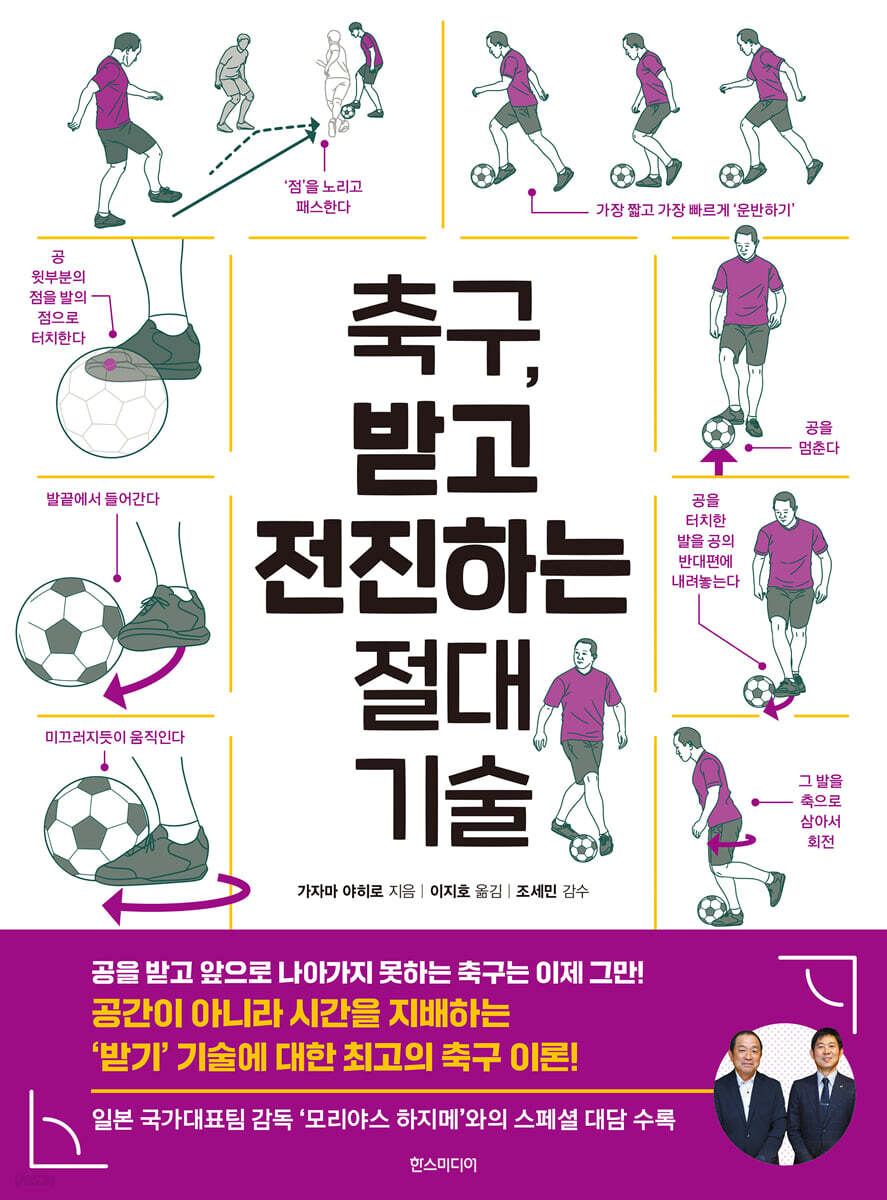
"Soccer, the Absolute Skill of Receiving and Moving Forward" is a book written by the author, a former Japanese national team player and active soccer theorist, focusing on the "receiving" skill to help students develop an eye for the game and clarify the purpose of training by learning the six basic skills that serve as the standard for soccer skills.
The author examines the criteria for six soccer skills: 'stopping', 'kicking', 'receiving', 'carrying', 'taking off', and 'seeing? not seeing'. He emphasizes that only by being able to perform 'receiving' consistently and accurately can you organically and perfectly connect other soccer skills to reach the goal.
Redefining the six fundamental skills of soccer
Updated with the latest theories!
The author argues that the six fundamental soccer skills cannot be considered separately, but only when understood and executed as a single movement can they truly be perfected.
In soccer, it is important to execute all plays sequentially, not only from the sender to the receiver and back, but also to figure out the next necessary action while 'not seeing' the ball, to decide in advance what to do next, and to always handle the ball accurately.
He says that the best way to master this is to practice repeatedly while being conscious of all the techniques, so you should focus on increasing the amount of practice and improving the quality of your skills.
Key points to help you hone your skills,
Includes real-life examples of world-class soccer players.
This book explains six closely interconnected technologies in detail, with easy-to-understand illustrations and key points.
In particular, the author's soccer philosophy and quotes are included to help you arm yourself with the mental strength needed to consistently hone the six skills.
Additionally, we have introduced various examples of world-class soccer players such as Lionel Messi and Kevin De Bruyne perfectly executing the six techniques in actual matches and scoring goals.
Includes a special interview with Japan national soccer team coach Hajime Moriyasu.
: The skills and strategies needed to conquer the world
This book features a conversation between the author, Kenji Nishibe, the moderator, and current Japan national soccer team coach Hajime Moriyasu, examining what it takes to win the World Cup, using the team's recent matches as examples.
The author and coach Hajime Moriyasu argue that for a national team that has been leveled at a high level to take a leap forward to world-class level, “how consistently they can use accurate techniques is important.”
In particular, he emphasizes that learning the six techniques properly and playing accurately and at a fast pace is important for conquering the world, as the ability to dominate the game while playing quickly determines whether one wins or loses.
An interview with coach Hajime Moriyasu, who has currently led Japanese soccer to the top of Asia, provides many insights into the coach's attitude, vision, and concept regarding the management of the national team.
This book, which explains the author's technical methodology, emphasizing the accuracy and speed of fundamental soccer skills from a detailed perspective, will be of great help to anyone who wants to improve their soccer skills and develop better soccer strategies.
A thorough analysis of the technique to reach the goal in the shortest possible time!
"Soccer, the Absolute Skill of Receiving and Moving Forward" is a book written by the author, a former Japanese national team player and active soccer theorist, focusing on the "receiving" skill to help students develop an eye for the game and clarify the purpose of training by learning the six basic skills that serve as the standard for soccer skills.
The author examines the criteria for six soccer skills: 'stopping', 'kicking', 'receiving', 'carrying', 'taking off', and 'seeing? not seeing'. He emphasizes that only by being able to perform 'receiving' consistently and accurately can you organically and perfectly connect other soccer skills to reach the goal.
Redefining the six fundamental skills of soccer
Updated with the latest theories!
The author argues that the six fundamental soccer skills cannot be considered separately, but only when understood and executed as a single movement can they truly be perfected.
In soccer, it is important to execute all plays sequentially, not only from the sender to the receiver and back, but also to figure out the next necessary action while 'not seeing' the ball, to decide in advance what to do next, and to always handle the ball accurately.
He says that the best way to master this is to practice repeatedly while being conscious of all the techniques, so you should focus on increasing the amount of practice and improving the quality of your skills.
Key points to help you hone your skills,
Includes real-life examples of world-class soccer players.
This book explains six closely interconnected technologies in detail, with easy-to-understand illustrations and key points.
In particular, the author's soccer philosophy and quotes are included to help you arm yourself with the mental strength needed to consistently hone the six skills.
Additionally, we have introduced various examples of world-class soccer players such as Lionel Messi and Kevin De Bruyne perfectly executing the six techniques in actual matches and scoring goals.
Includes a special interview with Japan national soccer team coach Hajime Moriyasu.
: The skills and strategies needed to conquer the world
This book features a conversation between the author, Kenji Nishibe, the moderator, and current Japan national soccer team coach Hajime Moriyasu, examining what it takes to win the World Cup, using the team's recent matches as examples.
The author and coach Hajime Moriyasu argue that for a national team that has been leveled at a high level to take a leap forward to world-class level, “how consistently they can use accurate techniques is important.”
In particular, he emphasizes that learning the six techniques properly and playing accurately and at a fast pace is important for conquering the world, as the ability to dominate the game while playing quickly determines whether one wins or loses.
An interview with coach Hajime Moriyasu, who has currently led Japanese soccer to the top of Asia, provides many insights into the coach's attitude, vision, and concept regarding the management of the national team.
This book, which explains the author's technical methodology, emphasizing the accuracy and speed of fundamental soccer skills from a detailed perspective, will be of great help to anyone who wants to improve their soccer skills and develop better soccer strategies.
GOODS SPECIFICS
- Date of issue: April 29, 2025
- Page count, weight, size: 104 pages | 292g | 170*230*8mm
- ISBN13: 9791194777045
- ISBN10: 119477704X
You may also like
카테고리
korean


korean

![GQ KOREA Mark (Monthly): December [2025]](http://librairie.coreenne.fr/cdn/shop/files/8ef265dbbfbf186523ed75ba7319009d.jpg?v=1765340328&width=3840)


