

Things I Wish I Knew When I Was Twenty
 |
Description
Book Introduction
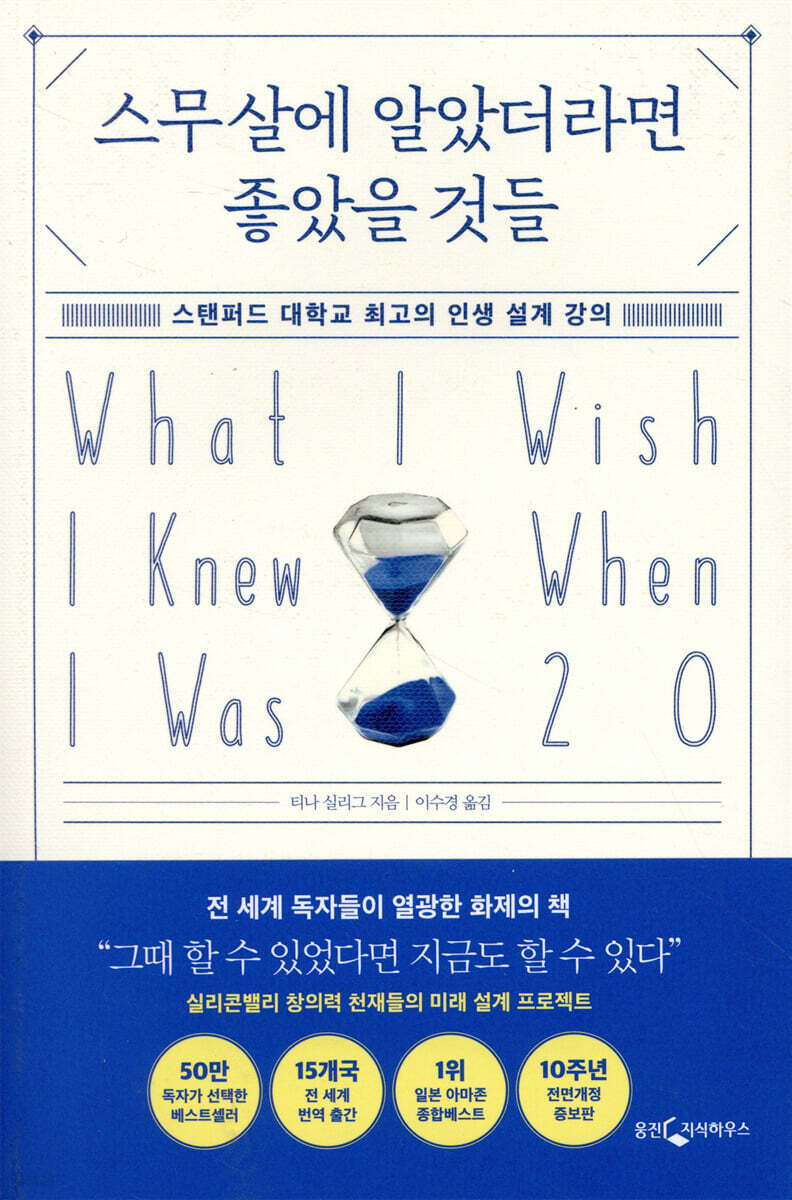
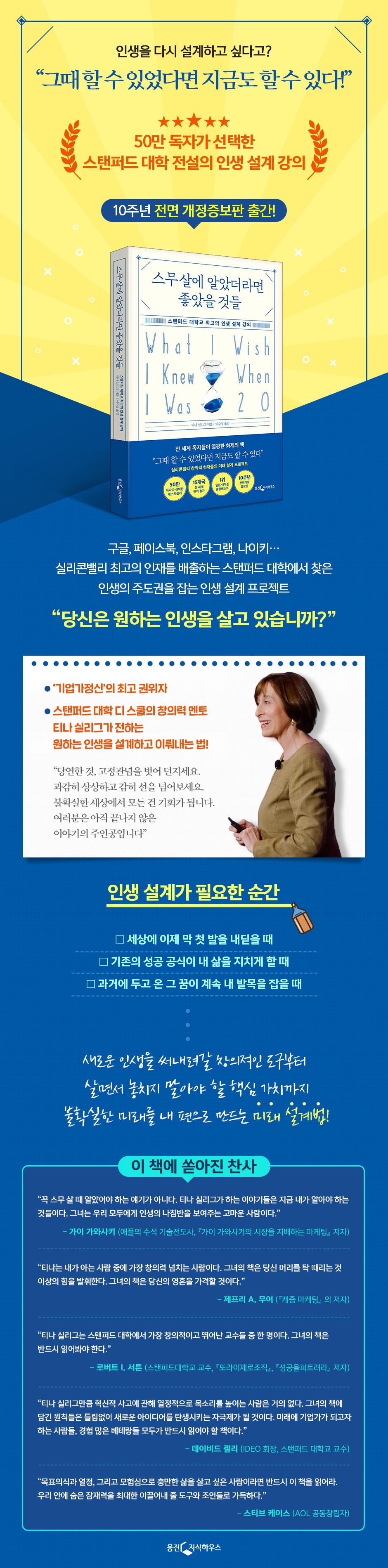
Translated into 15 languages worldwide and chosen by 500,000 readers in Korea alone, the bestseller "Things I Wish I Knew When I Was Twenty" has returned in a fully revised and expanded edition to celebrate its 10th anniversary.
This book is based on the renowned lecture "Entrepreneurship and Innovation" from Stanford University, which is famous for discovering creative talents. At the time of its publication, it rekindled the passion and spirit of challenge among readers in Korea and around the world, sparking a craze for "getting back your lost twenties."
It is still greatly loved as a book that provides hope and inspiration to readers in their 20s who are taking the first step in life, and to those in their 30s and 40s who want to redesign their lives.
This revised and expanded edition captures her 10 years of teaching global talent at Stanford University's "d.school," renowned for its world-class, innovative and creative curriculum.
Based on the lecture 'Entrepreneurship and Innovation' that has been a famous lecture at Stanford for 10 years, it not only contains unique ideas encountered in the Stanford classroom, but also adds life design tips and new ideas that were not found in the first edition, using insights gained from world-class innovators such as Elon Musk, Steve Jobs, and Larry Page as examples.
If you haven't found what you want to do yet, if you don't want to live like this anymore, if you're still wondering what you need to achieve your life goals, then you definitely need to read this book.
Her lectures, which shatter rigid ideas with unheard-of tasks, are filled with key words that can help you take control of your life.
Her solid lectures will rekindle your stagnant spirit of challenge.
This book is based on the renowned lecture "Entrepreneurship and Innovation" from Stanford University, which is famous for discovering creative talents. At the time of its publication, it rekindled the passion and spirit of challenge among readers in Korea and around the world, sparking a craze for "getting back your lost twenties."
It is still greatly loved as a book that provides hope and inspiration to readers in their 20s who are taking the first step in life, and to those in their 30s and 40s who want to redesign their lives.
This revised and expanded edition captures her 10 years of teaching global talent at Stanford University's "d.school," renowned for its world-class, innovative and creative curriculum.
Based on the lecture 'Entrepreneurship and Innovation' that has been a famous lecture at Stanford for 10 years, it not only contains unique ideas encountered in the Stanford classroom, but also adds life design tips and new ideas that were not found in the first edition, using insights gained from world-class innovators such as Elon Musk, Steve Jobs, and Larry Page as examples.
If you haven't found what you want to do yet, if you don't want to live like this anymore, if you're still wondering what you need to achieve your life goals, then you definitely need to read this book.
Her lectures, which shatter rigid ideas with unheard-of tasks, are filled with key words that can help you take control of your life.
Her solid lectures will rekindle your stagnant spirit of challenge.
- You can preview some of the book's contents.
Preview
index
Publishing the 10th Anniversary Revised and Expanded Edition of Prologue 6
Lecture 1: Stanford University's $5 Project
The Value of Five Dollars 13 | The Value of a Red Paperclip 18 | The Bigger the Problem, the Bigger the Opportunity 21 | How to Succeed in the World Beyond School 25
Have you ever turned a circus upside down?
A CEO Who Longs for His School Days 33 | Things Solved When You Look at Them Differently 36 | Gems Hidden in the Little Things 39 | The DNA of Creativity and Innovation 41 | The Answer Lies in Stereotypes 46 | If You Turn Your Life Upside Down 51 | There's a Solution to Any Problem 54
Give me a bikini or give me death
What Do Rules Mean to You? 61 | The Impossible Challenge 66 | The Ingenious "Worst" Idea 69 | A Letter of Recommendation from a Prison Fellow 72 | "It's Okay to Be Odd" 75 | Dare to Break the Rules 78 | Let Go of Expectations 82
4. Are you satisfied with your wallet?
Why Put My Life in Someone Else's Hands? 87 | Wait for Permission or Make Your Own Decisions 89 | There Are Infinite Gaps in the World 93 | No One Is 100 Percent Satisfied with Their Wallet 95 | To Win the Lottery, First Buy a Ticket 98 | Run in the Direction of Your Dreams: "Ready, Start!" 103
The Secret of Silicon Valley: Supporting Failure
Failure Resume 109 | Fail as Much as You Can, as Fast as You Can 113 | Invest in Failure and Experience Valuable Giving Up 117 | Failure is the Foundation for Success 120
Lesson 6: When Life Meets Turbulence
Traces of a Person Remain Until the End 127 | The Spirit of Challenge That Runs Away from Failure 130 | The Life of a Successful Person Always Has Ups and Downs 133 | A Smart Failure is Better Than a Meaningless Success 138 | My Own Risk Profile 140
Lesson 7: What do you really want?
3 Essentials for a Great Job 151 | The Trap of the "What Do You Want to Be When You Grow Up?" Question 156 | What I Want vs.
What People Around Me Want From Me 160 | Should I Really Dig Just One Well? 162 | Things I Wish I Knew Before Choosing a Career 167
The Lucky Physics of Turning a Lemon into a Helicopter
Luck favors only those who work hard 173 | The behavioral science of making luck work for you 177 | The secrets of physics that make luck work 184 | Always look around like a traveler 187 | Rich experiences will eventually shine 192 | A surprising way of thinking that attracts luck 195 | Go boldly for luck 199
Lesson 9: Is it the right thing to do or the smart thing to do?
The Power of Small but Great Gratitude 205 | The Pond of Human Relationships 208 | How to Turn Crisis into Opportunity 211 | Life is a Continuous Negotiation 215 | 'Right' and 'Smart' Actions 2 18 | The Rule of Three 21
Lesson 10: Draw the target after shooting the arrow.
Life is a Continuous Negotiation 229 | Change Your Perspective on Negotiation 231 | Expand Your Negotiation Options 235 | Life is Negotiation 237
Lesson 11: Will that be on the test?
Don't Miss the Opportunity to Create an Amazing Life 245 | There's No Rehearsal in Life 247 | The Only Thing Standing in the Way of Achieving Your Goals Is You 252 | Don't Get Caught Up in a Zero-Sum Game 257 | New Opportunities Come in Different Forms 261
Lesson 12: A Happy Invitation to an Uncertain World
Beware of the Advice of Those Around You 267 | Problems Without Set Answers 269 | What Perspective Should You Take? 272 | You Can't Predict Your Destination by Just Looking at Your Starting Point 277 | Looking Back on Your Life 281 | The Treasure in My Bag 284
Epilogue Lecture 288
Acknowledgments 292
Reference 297
Lecture 1: Stanford University's $5 Project
The Value of Five Dollars 13 | The Value of a Red Paperclip 18 | The Bigger the Problem, the Bigger the Opportunity 21 | How to Succeed in the World Beyond School 25
Have you ever turned a circus upside down?
A CEO Who Longs for His School Days 33 | Things Solved When You Look at Them Differently 36 | Gems Hidden in the Little Things 39 | The DNA of Creativity and Innovation 41 | The Answer Lies in Stereotypes 46 | If You Turn Your Life Upside Down 51 | There's a Solution to Any Problem 54
Give me a bikini or give me death
What Do Rules Mean to You? 61 | The Impossible Challenge 66 | The Ingenious "Worst" Idea 69 | A Letter of Recommendation from a Prison Fellow 72 | "It's Okay to Be Odd" 75 | Dare to Break the Rules 78 | Let Go of Expectations 82
4. Are you satisfied with your wallet?
Why Put My Life in Someone Else's Hands? 87 | Wait for Permission or Make Your Own Decisions 89 | There Are Infinite Gaps in the World 93 | No One Is 100 Percent Satisfied with Their Wallet 95 | To Win the Lottery, First Buy a Ticket 98 | Run in the Direction of Your Dreams: "Ready, Start!" 103
The Secret of Silicon Valley: Supporting Failure
Failure Resume 109 | Fail as Much as You Can, as Fast as You Can 113 | Invest in Failure and Experience Valuable Giving Up 117 | Failure is the Foundation for Success 120
Lesson 6: When Life Meets Turbulence
Traces of a Person Remain Until the End 127 | The Spirit of Challenge That Runs Away from Failure 130 | The Life of a Successful Person Always Has Ups and Downs 133 | A Smart Failure is Better Than a Meaningless Success 138 | My Own Risk Profile 140
Lesson 7: What do you really want?
3 Essentials for a Great Job 151 | The Trap of the "What Do You Want to Be When You Grow Up?" Question 156 | What I Want vs.
What People Around Me Want From Me 160 | Should I Really Dig Just One Well? 162 | Things I Wish I Knew Before Choosing a Career 167
The Lucky Physics of Turning a Lemon into a Helicopter
Luck favors only those who work hard 173 | The behavioral science of making luck work for you 177 | The secrets of physics that make luck work 184 | Always look around like a traveler 187 | Rich experiences will eventually shine 192 | A surprising way of thinking that attracts luck 195 | Go boldly for luck 199
Lesson 9: Is it the right thing to do or the smart thing to do?
The Power of Small but Great Gratitude 205 | The Pond of Human Relationships 208 | How to Turn Crisis into Opportunity 211 | Life is a Continuous Negotiation 215 | 'Right' and 'Smart' Actions 2 18 | The Rule of Three 21
Lesson 10: Draw the target after shooting the arrow.
Life is a Continuous Negotiation 229 | Change Your Perspective on Negotiation 231 | Expand Your Negotiation Options 235 | Life is Negotiation 237
Lesson 11: Will that be on the test?
Don't Miss the Opportunity to Create an Amazing Life 245 | There's No Rehearsal in Life 247 | The Only Thing Standing in the Way of Achieving Your Goals Is You 252 | Don't Get Caught Up in a Zero-Sum Game 257 | New Opportunities Come in Different Forms 261
Lesson 12: A Happy Invitation to an Uncertain World
Beware of the Advice of Those Around You 267 | Problems Without Set Answers 269 | What Perspective Should You Take? 272 | You Can't Predict Your Destination by Just Looking at Your Starting Point 277 | Looking Back on Your Life 281 | The Treasure in My Bag 284
Epilogue Lecture 288
Acknowledgments 292
Reference 297
Detailed image
Into the book
We often look at problems through too fixed and narrow a lens.
When given a simple challenge (like generating income in two hours), most people quickly resort to the common, clichéd solutions that come to mind.
They don't know how to take a step back and look at the problem from a broader perspective.
But when we remove the blinders from our eyes, countless possibilities and opportunities appear.
The students who participated in my project took this lesson to heart.
Now that they are penniless, they think it makes no sense to make excuses.
Because there are always problems around us waiting to be solved.
--- p.22, from “Stanford University’s Five Dollar Project”
Let's make this assumption.
What would your life look like if you turned it upside down? Try challenging your stereotypes with these exercises:
First, create a 'before change' list.
Write down all the stereotypes about your daily life, that is, your daily life.
For example, write down what time you wake up in the morning, how many days and hours you work per week, how far you commute, what kind of work you do, who you work with, how often you exercise, who you spend your free time with, what you usually eat for dinner, what you do in the evenings and on weekends, where you go on vacation, how much of your paycheck you save, how you feel at the end of the day, and what time you go to bed.
The longer the list, the better.
It's about getting rid of as many stereotypes you have about your own life as possible.
--- p.52, from “Have you ever turned the circus upside down?”
We don't expect our children to do everything perfectly from the beginning.
Likewise, adults faced with complex tasks should not be expected to do it perfectly from the start.
It's nearly impossible to learn something without trying it yourself, without constantly going through trial and error and recovering from failure.
You can't learn soccer just by reading the rules, and you can't learn piano just by reading sheet music.
--- p.115, from “The Secret of Silicon Valley, Which Supports Failure”
Most people aren't born with a passion for something; they discover what they like through experience.
Most of the time, you don't know much about something until you start liking it.
You never know if you really love cooking and have a knack for it until you try it.
The same goes for software coding, golf, and novel writing.
The reason it's important to keep trying new experiences is because it opens the door to developing different types of passions.
--- p.154, from “What Do You Really Want?”
Remember that anything someone does for you always comes with an opportunity cost.
In other words, if someone gives some time out of their day for you, they are giving up doing something for themselves or someone else and making time for you.
You may think that your request is trivial and small.
But if the other person is busy, it is by no means a trivial request.
--- p.206, from “Is it the right thing to do or the smart thing to do?”
I have students do this exercise in the classroom.
On the surface, it is an exercise in simple negotiation between job seekers and employers.
In this negotiation, eight conditions including salary, vacation, and job description must be agreed upon, and the participants (both job seekers and employers) aim to increase their point values for each condition to the maximum they want.
Then, usually, the job seeker and the employer negotiate by reviewing the conditions one by one in order.
But you soon realize that this isn't a very effective method.
--- p.231, from “Draw the target after shooting the arrow”
To complete your own story in life, you must be aware of your current appearance and position.
You also need to know how you got here, what your strengths and weaknesses are, where you want to go next, what obstacles are holding you back, what drives you forward, and what you need to prepare for the journey ahead in life.
And you have to understand what people mean by the stories they tell you about your past and the stories you tell yourself about your future.
When given a simple challenge (like generating income in two hours), most people quickly resort to the common, clichéd solutions that come to mind.
They don't know how to take a step back and look at the problem from a broader perspective.
But when we remove the blinders from our eyes, countless possibilities and opportunities appear.
The students who participated in my project took this lesson to heart.
Now that they are penniless, they think it makes no sense to make excuses.
Because there are always problems around us waiting to be solved.
--- p.22, from “Stanford University’s Five Dollar Project”
Let's make this assumption.
What would your life look like if you turned it upside down? Try challenging your stereotypes with these exercises:
First, create a 'before change' list.
Write down all the stereotypes about your daily life, that is, your daily life.
For example, write down what time you wake up in the morning, how many days and hours you work per week, how far you commute, what kind of work you do, who you work with, how often you exercise, who you spend your free time with, what you usually eat for dinner, what you do in the evenings and on weekends, where you go on vacation, how much of your paycheck you save, how you feel at the end of the day, and what time you go to bed.
The longer the list, the better.
It's about getting rid of as many stereotypes you have about your own life as possible.
--- p.52, from “Have you ever turned the circus upside down?”
We don't expect our children to do everything perfectly from the beginning.
Likewise, adults faced with complex tasks should not be expected to do it perfectly from the start.
It's nearly impossible to learn something without trying it yourself, without constantly going through trial and error and recovering from failure.
You can't learn soccer just by reading the rules, and you can't learn piano just by reading sheet music.
--- p.115, from “The Secret of Silicon Valley, Which Supports Failure”
Most people aren't born with a passion for something; they discover what they like through experience.
Most of the time, you don't know much about something until you start liking it.
You never know if you really love cooking and have a knack for it until you try it.
The same goes for software coding, golf, and novel writing.
The reason it's important to keep trying new experiences is because it opens the door to developing different types of passions.
--- p.154, from “What Do You Really Want?”
Remember that anything someone does for you always comes with an opportunity cost.
In other words, if someone gives some time out of their day for you, they are giving up doing something for themselves or someone else and making time for you.
You may think that your request is trivial and small.
But if the other person is busy, it is by no means a trivial request.
--- p.206, from “Is it the right thing to do or the smart thing to do?”
I have students do this exercise in the classroom.
On the surface, it is an exercise in simple negotiation between job seekers and employers.
In this negotiation, eight conditions including salary, vacation, and job description must be agreed upon, and the participants (both job seekers and employers) aim to increase their point values for each condition to the maximum they want.
Then, usually, the job seeker and the employer negotiate by reviewing the conditions one by one in order.
But you soon realize that this isn't a very effective method.
--- p.231, from “Draw the target after shooting the arrow”
To complete your own story in life, you must be aware of your current appearance and position.
You also need to know how you got here, what your strengths and weaknesses are, where you want to go next, what obstacles are holding you back, what drives you forward, and what you need to prepare for the journey ahead in life.
And you have to understand what people mean by the stories they tell you about your past and the stories you tell yourself about your future.
--- p.276, from “A Happy Invitation to an Uncertain World”
Publisher's Review
★★ Bestseller chosen by 500,000 readers
★★ Published in 15 countries worldwide
★★ Completely revised and expanded edition to commemorate the 10th anniversary of publication
★★ The best lectures chosen by Stanford University students
How Stanford students, a Silicon Valley favorite, prepare for life.
Stanford University's Creative Life Design Method in One Book
“The only thing holding you back is your imagination!”
Translated into 15 languages worldwide and chosen by 500,000 readers in Korea alone, life mentor Tina Seelig's "Things I Wish I Knew When I Was Twenty" has returned in a fully revised and expanded edition to celebrate its 10th anniversary.
This revised and expanded edition contains not only the unique ideas she encountered in Stanford's classrooms, but also the 10 years she spent teaching global talent at Stanford University's "d.school," which is recognized as one of the world's most innovative and creative educational programs.
Her lectures begin with developing the most creative attitude necessary for designing one's life.
First, from Lessons 1 to 5, we introduce creative challenges that can break the stereotypes that have taken root within us.
She shares her friendly, out-of-the-box methodology to help you find fun solutions, using examples from her classroom projects like the $5 Project and the Upside-Down Circus Project.
Now that you're ready to break free from the mold, Lessons 6 through 10 will dive deep into the essentials of setting long-term goals that are crucial to your life.
It starts with reflecting on whether you are aiming for what you truly want, and explains the interpersonal relationships you need to maintain, misunderstandings about negotiation, and more, with examples.
In the remaining 11th and 12th episodes, she offers readers her own warm advice to help them remain steadfast and become victors in the face of the new life that is just beginning.
The lecture concludes by conveying that following the old formula for success isn't the only answer, and that an uncertain future isn't a bad thing, but an opportunity.
“Escape from the prison of your thoughts right now.”
The key to life planning is to boldly imagine and freely cross the line!
What would you do if someone gave you $5 and two hours of your time and told you to make money? Students on this daunting task, known as the "Stanford Five Dollar Project," achieve an average return of 4,000 percent.
Instead of relying on luck, like making and selling lemonade or buying lottery tickets, Stanford students discovered the potential for success in everyday life.
In restaurants with long lines, we saw customers' desire to eat right away, and some people solved their homework in a completely new way, saying that the key to the answer was 'the time for the homework presentation.'
This is an advertisement that promotes companies that want to hire Stanford students who are about to start their careers.
In this way, her classroom is filled with outrageous challenges that cannot be found in Korea, and it has become a classroom that produces students who creatively solve these problems.
It's clear why she poses such a unique challenge to her students.
This is because looking at problems in a new way and breaking stereotypes cannot be achieved through desk-bound theories alone.
Instead of explaining, she poses a challenge for them to figure out on their own.
For example, it suggests a new way to brainstorm from the worst ideas to come up with successful business items.
These assignments force students to break out of their own prisons and come up with ingenious solutions.
As this training continues, students develop their own competitive edge.
"In an uncertain world, every problem becomes an opportunity."
A Life Manual for Turning Stereotypes and Failure into Opportunities
Famous global companies like Google, Netflix, Nike, and Instagram have one thing in common.
The fact is that it was an 'out-of-school startup' centered around Stanford University.
Those who have found the 'creative breakthrough' that leads to success boldly go beyond the safe confines of school.
In Korean society, young venture companies like Tada, Market Kurly, and Laundrygo are emerging one after another, creating cracks in the existing market. What we need now is the 'entrepreneurial spirit', the method to create that small difference.
Seek out new things, take risks when necessary, collaborate flexibly with experts from other fields, be willing to fail in the process of taking on challenges, and gain as much experience as possible.
She offers several ways to cultivate an "entrepreneurial spirit" through real-life examples she finds both inside and outside the classroom.
It helps us understand how to break stereotypes and why we should pursue certain failure rather than ambiguous success through the examples of our seniors.
What Tina Seelig says in class boils down to: “Allow yourself to be.”
When we give ourselves permission to try something beyond our abilities without believing in our limitations, we truly take control of our lives.
If you still need someone's permission in your life, I encourage you to read this book.
In this uncertain world with no right answers, if you follow in the footsteps of those who have achieved success in unique and original ways, you will surely find clues to redesign your life.
★★ Published in 15 countries worldwide
★★ Completely revised and expanded edition to commemorate the 10th anniversary of publication
★★ The best lectures chosen by Stanford University students
How Stanford students, a Silicon Valley favorite, prepare for life.
Stanford University's Creative Life Design Method in One Book
“The only thing holding you back is your imagination!”
Translated into 15 languages worldwide and chosen by 500,000 readers in Korea alone, life mentor Tina Seelig's "Things I Wish I Knew When I Was Twenty" has returned in a fully revised and expanded edition to celebrate its 10th anniversary.
This revised and expanded edition contains not only the unique ideas she encountered in Stanford's classrooms, but also the 10 years she spent teaching global talent at Stanford University's "d.school," which is recognized as one of the world's most innovative and creative educational programs.
Her lectures begin with developing the most creative attitude necessary for designing one's life.
First, from Lessons 1 to 5, we introduce creative challenges that can break the stereotypes that have taken root within us.
She shares her friendly, out-of-the-box methodology to help you find fun solutions, using examples from her classroom projects like the $5 Project and the Upside-Down Circus Project.
Now that you're ready to break free from the mold, Lessons 6 through 10 will dive deep into the essentials of setting long-term goals that are crucial to your life.
It starts with reflecting on whether you are aiming for what you truly want, and explains the interpersonal relationships you need to maintain, misunderstandings about negotiation, and more, with examples.
In the remaining 11th and 12th episodes, she offers readers her own warm advice to help them remain steadfast and become victors in the face of the new life that is just beginning.
The lecture concludes by conveying that following the old formula for success isn't the only answer, and that an uncertain future isn't a bad thing, but an opportunity.
“Escape from the prison of your thoughts right now.”
The key to life planning is to boldly imagine and freely cross the line!
What would you do if someone gave you $5 and two hours of your time and told you to make money? Students on this daunting task, known as the "Stanford Five Dollar Project," achieve an average return of 4,000 percent.
Instead of relying on luck, like making and selling lemonade or buying lottery tickets, Stanford students discovered the potential for success in everyday life.
In restaurants with long lines, we saw customers' desire to eat right away, and some people solved their homework in a completely new way, saying that the key to the answer was 'the time for the homework presentation.'
This is an advertisement that promotes companies that want to hire Stanford students who are about to start their careers.
In this way, her classroom is filled with outrageous challenges that cannot be found in Korea, and it has become a classroom that produces students who creatively solve these problems.
It's clear why she poses such a unique challenge to her students.
This is because looking at problems in a new way and breaking stereotypes cannot be achieved through desk-bound theories alone.
Instead of explaining, she poses a challenge for them to figure out on their own.
For example, it suggests a new way to brainstorm from the worst ideas to come up with successful business items.
These assignments force students to break out of their own prisons and come up with ingenious solutions.
As this training continues, students develop their own competitive edge.
"In an uncertain world, every problem becomes an opportunity."
A Life Manual for Turning Stereotypes and Failure into Opportunities
Famous global companies like Google, Netflix, Nike, and Instagram have one thing in common.
The fact is that it was an 'out-of-school startup' centered around Stanford University.
Those who have found the 'creative breakthrough' that leads to success boldly go beyond the safe confines of school.
In Korean society, young venture companies like Tada, Market Kurly, and Laundrygo are emerging one after another, creating cracks in the existing market. What we need now is the 'entrepreneurial spirit', the method to create that small difference.
Seek out new things, take risks when necessary, collaborate flexibly with experts from other fields, be willing to fail in the process of taking on challenges, and gain as much experience as possible.
She offers several ways to cultivate an "entrepreneurial spirit" through real-life examples she finds both inside and outside the classroom.
It helps us understand how to break stereotypes and why we should pursue certain failure rather than ambiguous success through the examples of our seniors.
What Tina Seelig says in class boils down to: “Allow yourself to be.”
When we give ourselves permission to try something beyond our abilities without believing in our limitations, we truly take control of our lives.
If you still need someone's permission in your life, I encourage you to read this book.
In this uncertain world with no right answers, if you follow in the footsteps of those who have achieved success in unique and original ways, you will surely find clues to redesign your life.
GOODS SPECIFICS
- Date of publication: February 28, 2020
- Page count, weight, size: 304 pages | 394g | 140*210*18mm
- ISBN13: 9788901239859
- ISBN10: 890123985X
You may also like
카테고리
korean


korean

![GQ KOREA Mark (Monthly): December [2025]](http://librairie.coreenne.fr/cdn/shop/files/8ef265dbbfbf186523ed75ba7319009d.jpg?v=1765340328&width=3840)


