

Good Life
 |
Description
Book Introduction
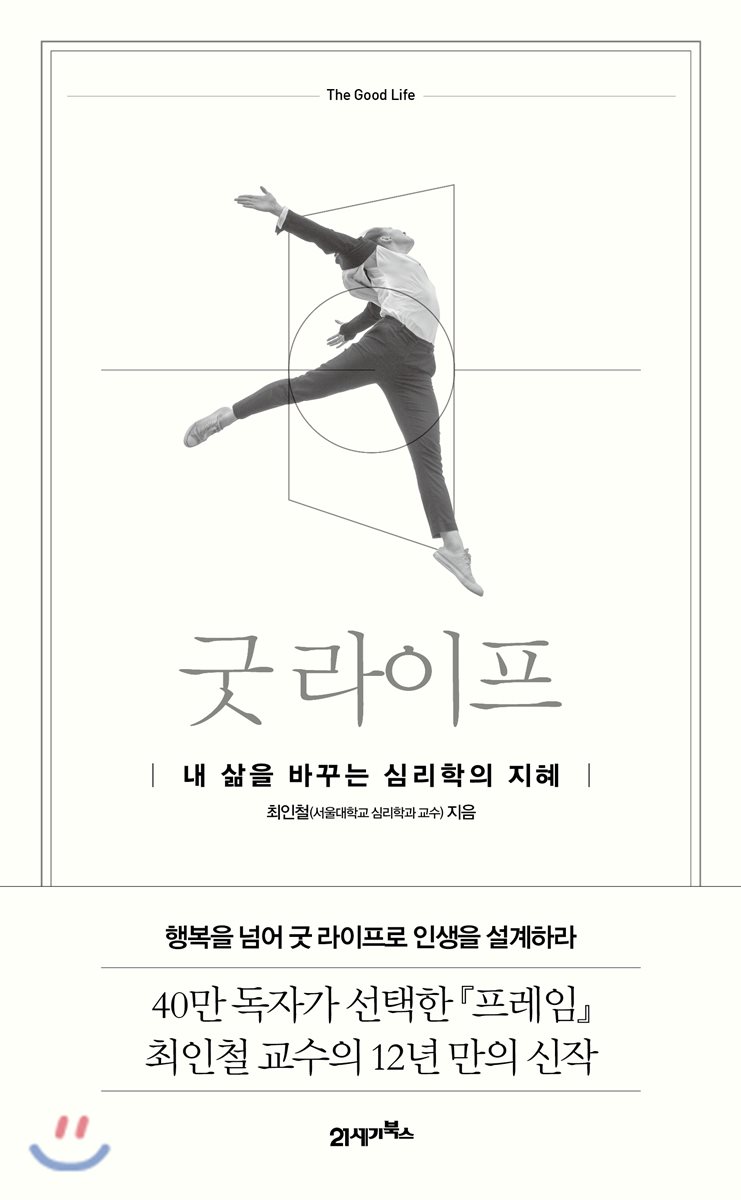
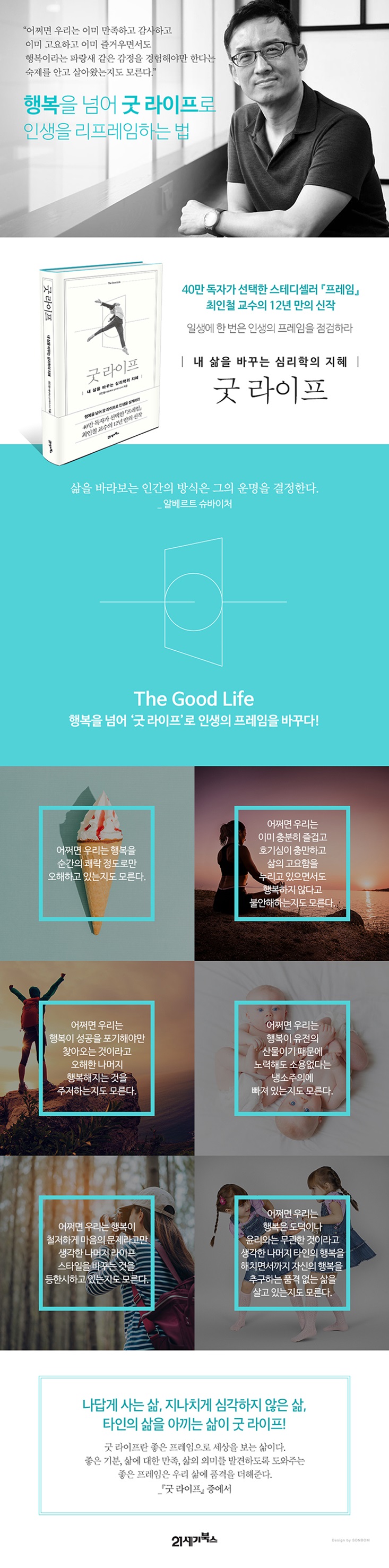
Professor Choi In-cheol's new book, "Frame," chosen by 400,000 readers, after 12 years ·Change the frame of your life beyond happiness to a 'good life' A good life is a life lived true to yourself, a life that isn't overly serious, and a life that values the lives of others! Professor Choi In-cheol of the Department of Psychology at Seoul National University, author of "Frame," which has been loved by 400,000 readers since its publication in 2007 and has established itself as the bible of psychology, has published a book on life that synthesizes his research on happiness and human psychology over the past 10 years. In his previous work, 『Frame』, he presented the concept of a ‘frame’ as a window of the mind through which he views the world, while in his new work, 『Good Life』, he deals with the happiness and value of life that come when he views the world through a good frame. The Good Life literally means 'a good life'. A good life is one that seeks a balance between fun and meaning, success and happiness, present and future, and one's own happiness and the happiness of others. Drawing on the diverse research findings of his research team, the author redefines the seemingly vacant concept of happiness. He presents a concrete methodology for a "good life" that encompasses not only happiness but also meaning and dignity, along with the profound insights gained through a good life, in vivid and realistic language. This book highlights the author's powerful writing style, which has made this psychology textbook a bestseller, and the appeal of psychology as a practical discipline that transcends the fields of humanities, society, and self-development. |
- You can preview some of the book's contents.
Preview
index
Preface
Prologue | Beyond Happiness, to a Good Life
Part 01 | A Happy Life
Chapter 01 | The Meaning of Happiness
The problem is the name "happiness"
Happiness isn't just about happiness
The misconception that happiness is something light
The misconception that happiness is the absence of pain
Allow for the randomness of happiness
Chapter 02 | The Right Thoughts on Happiness and Genetics
Is happiness a destiny created by genetics?
Happiness is easier than growing taller.
Misconceptions about variability and heritability
If you go to a happy country, you will be happy.
The backlash against the belief that happiness is destiny
Does happiness always return to its original place?
The misconception that happiness depends on one's mindset
Chapter 03 | The Life Skills of Happy People
1.
Do what you like rather than what you are good at.
2.
I see myself as I want to be rather than as I should be.
3.
Don't compare
4.
I believe in the power of relationships more than the power of money.
5.
Buy experiences rather than possessions
6.
Buying stories with money
7.
Buy time with money
8.
Walk, meditate, and travel
9.
I often find small pleasures
10.
Fill with emptiness
Part 02 | A Meaningful Life
Chapter 04 | The Meaning of Meaning
Heavy and light meanings
The human will toward meaning
Source of meaning, self
Semantic Nation: Lessons from the UK
Chapter 05 | The Difference Between Meaning and Pleasure
Pleasure vs. Youth
What does it mean to get older?
Fragile pleasure vs.
Strong meaning
Pleasure together vs.
Meaning of being alone
Now it's pleasure vs.
later meaning
One life to live is a matter of pleasure vs.
Life is meaningless once you die
Chapter 06 | Calling and Fulfillment
A life led by calling
A life that values achievement
A life with purpose
A life of self-control
The Four Meanings of Life: Work, Love, Soul, and Transcendence
Part 03 | A Life of Dignity
1.
A life of striving to overcome self-centeredness
2.
A life that knows the value of travel
3.
A life that knows both the headwinds and tailwinds of life
4.
A life without cynicism
5.
A life without jealousy
6.
A life of consistent effort
7.
A Life of Overcoming the Temptation to Say "I Knew It"
8.
A beautiful life of assumptions
9.
Living a life aware of death
10.
A life that isn't too serious
Epilogue | The 10 Commandments of a Good Life
source
References
Prologue | Beyond Happiness, to a Good Life
Part 01 | A Happy Life
Chapter 01 | The Meaning of Happiness
The problem is the name "happiness"
Happiness isn't just about happiness
The misconception that happiness is something light
The misconception that happiness is the absence of pain
Allow for the randomness of happiness
Chapter 02 | The Right Thoughts on Happiness and Genetics
Is happiness a destiny created by genetics?
Happiness is easier than growing taller.
Misconceptions about variability and heritability
If you go to a happy country, you will be happy.
The backlash against the belief that happiness is destiny
Does happiness always return to its original place?
The misconception that happiness depends on one's mindset
Chapter 03 | The Life Skills of Happy People
1.
Do what you like rather than what you are good at.
2.
I see myself as I want to be rather than as I should be.
3.
Don't compare
4.
I believe in the power of relationships more than the power of money.
5.
Buy experiences rather than possessions
6.
Buying stories with money
7.
Buy time with money
8.
Walk, meditate, and travel
9.
I often find small pleasures
10.
Fill with emptiness
Part 02 | A Meaningful Life
Chapter 04 | The Meaning of Meaning
Heavy and light meanings
The human will toward meaning
Source of meaning, self
Semantic Nation: Lessons from the UK
Chapter 05 | The Difference Between Meaning and Pleasure
Pleasure vs. Youth
What does it mean to get older?
Fragile pleasure vs.
Strong meaning
Pleasure together vs.
Meaning of being alone
Now it's pleasure vs.
later meaning
One life to live is a matter of pleasure vs.
Life is meaningless once you die
Chapter 06 | Calling and Fulfillment
A life led by calling
A life that values achievement
A life with purpose
A life of self-control
The Four Meanings of Life: Work, Love, Soul, and Transcendence
Part 03 | A Life of Dignity
1.
A life of striving to overcome self-centeredness
2.
A life that knows the value of travel
3.
A life that knows both the headwinds and tailwinds of life
4.
A life without cynicism
5.
A life without jealousy
6.
A life of consistent effort
7.
A Life of Overcoming the Temptation to Say "I Knew It"
8.
A beautiful life of assumptions
9.
Living a life aware of death
10.
A life that isn't too serious
Epilogue | The 10 Commandments of a Good Life
source
References
Detailed image
Into the book
The reason I titled this book “Good Life” despite it being about happiness is to correct the tendency to understand happiness as just a “momentary feeling.”
Happiness is a momentary feeling, but at the same time it is the happiness of ‘life’.
Just as good food is more than just good taste, happiness in life is more than just momentary happiness.
Although happiness has both the meaning of a good feeling and a good life, modern people tend to pursue happiness only as a good feeling.
So, I intentionally titled the book 'Good Life' to emphasize the need to consider happiness as a balanced aspect of a 'good life'.
--- From the "Prologue"
Part 01 | The Happy Life
Happiness isn't just about happiness.
Just knowing this fact puts my mind at ease.
The reason we are wary of happiness as something light is because we understand happiness not as a state of inspiration or interest, but as the pleasure of eating ice cream.
The reason why fatigue about happiness has increased is because we think that happiness is a 'blessing' that can only be experienced by breaking away from everyday life.
Happiness is much deeper than we think, yet at the same time, it is extremely ordinary.
--- p.
43
The idea that there is no need to make an effort because we will eventually return to our original emotional state, whether in terms of happiness or suffering, is overly cynical.
Considering the limitations of human existence, where death may come at any moment, every moment of our lives is precious.
It is not a wise attitude toward life to ignore the happiness of the present moment because you think it will eventually return to where it was.
Because the most certain life for us is always in this moment.
--- pp.
84 - 86
It is clear that genetics plays a role in human happiness.
However, this is not so surprising given the first law of behavioral genetics, which states that heredity is involved in almost all human traits.
The important point is that while genetics contribute to happiness, they never determine one's destiny.
Genetic determinism, especially strong genetic determinism, is not only wrong, but it also risks weakening our will to be happy and leading us to be overly cynical about our individual and societal efforts to become happy.
--- p.
88
While it's important to learn the "mental skills" of happy people, it's equally important to learn how happy people structure their daily lives.
A happy person and an unhappy person may live the same daily life with different mindsets, but it is highly likely that they lived different daily lives from the beginning.
Perhaps, rather than trying to analyze the minds of happy people, we should prioritize analyzing their daily lives.
It is important to eat any food with gratitude and joy, but it is also important to eat delicious and healthy food from the beginning.
It's important to try to meet everyone with a happy heart, but it's also important to hang out with good people from the beginning. It's also important to discover the secret to making boring things fun, but it's more important to do things that are fun from the beginning.
--- pp.
94~95
We need to pay much more attention to doing what we love than we do now.
When you hear the "adult" advice that you can't make a living doing only what you love, you should always remember the mantra that you can't make a living doing only what you're good at.
Because that's the secret to how happy people live.
--- p.
99
A happy person is one who lives for experiences rather than possessions.
Even if you buy something, you are a person who tries to gain the experience that the thing provides.
Conversely, unhappy people are those who buy possessions rather than experiences.
Even while experiencing something, he is a person who owns or thingifies that experience.
As what you buy changes, what you live changes as well.
The reason happy people live differently is because they buy differently.
--- p.
117
Part 02 | The Meaningful Life
Humans are beings who constantly reflect on their lives and give stories to their lives.
It is human nature to recall the past and plan for the future, creating meaning by connecting the past, present, and future, a process called 'connecting the dots.'
This work is not about the individual moments of life, but about life as a whole.
Life is a series of interpretations and reinterpretations.
It is human to regret past pleasures that seem foolish in retrospect, and to be thankful for past pains that seem blessings in retrospect.
As Charlie Chaplin said, “Life is a tragedy when seen in close-up, but a comedy in long-shot,” moments of experience do not end in that moment, but are constantly reinterpreted and reevaluated over time.
Therefore, we cannot understand a good life based on moments or feelings alone.
--- pp.
142~143
Meaning does not only have heavy and big meanings, but also small and light meanings.
Small meaning refers to the extremely personal meaning experienced in everyday life.
It is the meaning experienced through everyday tasks such as preparing breakfast for children every morning, calling elderly parents to check in, completing assigned tasks on time, teaching a child the multiplication table, saying a mealtime prayer, successfully dieting, watering plants, and being punctual for appointments.
It doesn't mean that you have to sacrifice yourself to get something.
It's not something that can be achieved by giving up pleasure.
Just as there is small but certain happiness, there is also small but certain meaning, there is also small but certain meaning.
--- p.
150
Humans experience meaning when they feel that what they are doing reveals who they are.
When things go well, it feels good, but when things are personal, it feels meaningful.
If we become obsessed with achieving things like success, accomplishment, utility, and efficiency, we may enjoy momentary feelings of happiness, but the possibility of experiencing a meaningful life decreases.
A meaningful life is a life of self.
--- p.
159
A goal is a condition of happiness that can never be given up.
You must discover your own goals, not someone else's.
Above all, we must restore the everydayness of our goals.
If you think that only special and grand things are goals, and so neglect small and precious goals in the name of caution against goal-oriented thinking, you are filling up your own reservoir of happiness.
The goal is like a runway.
Without it, life is just a series of conflicts.
--- p.
206
Part 03 | The Classy Life
When we ask ourselves whether happiness is the highest value that transcends all other values, we become more aware of the need for a virtuous life.
Is it ever justifiable to pursue one's own happiness at the expense of others? Unless you're an extreme happiness-first enthusiast, few would answer yes.
The happiness we pursue should not only not infringe upon the happiness of others, but should also be a happiness that helps others become happy.
The argument is that rather than forcing a life of self-sacrifice for others, it is necessary to pursue one's own happiness while truly respecting and cherishing the lives of others.
If we consider that one of the highest human virtues is respect for the happiness of others, it becomes clearer that we must embrace a virtuous life as a core element of the good life.
--- p.
225
A person of character is one who is honestly surprised by the unexpected.
When everyone is rushing to come up with quick diagnoses and solutions, there are people who think about the problem persistently and intently for years, and learn what they should learn from it.
The reason we're wary of people who always seem to have the answer to every question, whether it's their area of expertise or not, is because we sense they don't acknowledge their own intellectual limitations.
--- p.
254
Personality can be said to be the family status that a person has.
Character is not a matter of degree of moral perfection, but of the accuracy and quality of the assumptions an individual holds about the world.
Therefore, character development means the process of examining one's own assumptions and changing bad assumptions into good assumptions and baseless assumptions into accurate assumptions.
Happiness is a momentary feeling, but at the same time it is the happiness of ‘life’.
Just as good food is more than just good taste, happiness in life is more than just momentary happiness.
Although happiness has both the meaning of a good feeling and a good life, modern people tend to pursue happiness only as a good feeling.
So, I intentionally titled the book 'Good Life' to emphasize the need to consider happiness as a balanced aspect of a 'good life'.
--- From the "Prologue"
Part 01 | The Happy Life
Happiness isn't just about happiness.
Just knowing this fact puts my mind at ease.
The reason we are wary of happiness as something light is because we understand happiness not as a state of inspiration or interest, but as the pleasure of eating ice cream.
The reason why fatigue about happiness has increased is because we think that happiness is a 'blessing' that can only be experienced by breaking away from everyday life.
Happiness is much deeper than we think, yet at the same time, it is extremely ordinary.
--- p.
43
The idea that there is no need to make an effort because we will eventually return to our original emotional state, whether in terms of happiness or suffering, is overly cynical.
Considering the limitations of human existence, where death may come at any moment, every moment of our lives is precious.
It is not a wise attitude toward life to ignore the happiness of the present moment because you think it will eventually return to where it was.
Because the most certain life for us is always in this moment.
--- pp.
84 - 86
It is clear that genetics plays a role in human happiness.
However, this is not so surprising given the first law of behavioral genetics, which states that heredity is involved in almost all human traits.
The important point is that while genetics contribute to happiness, they never determine one's destiny.
Genetic determinism, especially strong genetic determinism, is not only wrong, but it also risks weakening our will to be happy and leading us to be overly cynical about our individual and societal efforts to become happy.
--- p.
88
While it's important to learn the "mental skills" of happy people, it's equally important to learn how happy people structure their daily lives.
A happy person and an unhappy person may live the same daily life with different mindsets, but it is highly likely that they lived different daily lives from the beginning.
Perhaps, rather than trying to analyze the minds of happy people, we should prioritize analyzing their daily lives.
It is important to eat any food with gratitude and joy, but it is also important to eat delicious and healthy food from the beginning.
It's important to try to meet everyone with a happy heart, but it's also important to hang out with good people from the beginning. It's also important to discover the secret to making boring things fun, but it's more important to do things that are fun from the beginning.
--- pp.
94~95
We need to pay much more attention to doing what we love than we do now.
When you hear the "adult" advice that you can't make a living doing only what you love, you should always remember the mantra that you can't make a living doing only what you're good at.
Because that's the secret to how happy people live.
--- p.
99
A happy person is one who lives for experiences rather than possessions.
Even if you buy something, you are a person who tries to gain the experience that the thing provides.
Conversely, unhappy people are those who buy possessions rather than experiences.
Even while experiencing something, he is a person who owns or thingifies that experience.
As what you buy changes, what you live changes as well.
The reason happy people live differently is because they buy differently.
--- p.
117
Part 02 | The Meaningful Life
Humans are beings who constantly reflect on their lives and give stories to their lives.
It is human nature to recall the past and plan for the future, creating meaning by connecting the past, present, and future, a process called 'connecting the dots.'
This work is not about the individual moments of life, but about life as a whole.
Life is a series of interpretations and reinterpretations.
It is human to regret past pleasures that seem foolish in retrospect, and to be thankful for past pains that seem blessings in retrospect.
As Charlie Chaplin said, “Life is a tragedy when seen in close-up, but a comedy in long-shot,” moments of experience do not end in that moment, but are constantly reinterpreted and reevaluated over time.
Therefore, we cannot understand a good life based on moments or feelings alone.
--- pp.
142~143
Meaning does not only have heavy and big meanings, but also small and light meanings.
Small meaning refers to the extremely personal meaning experienced in everyday life.
It is the meaning experienced through everyday tasks such as preparing breakfast for children every morning, calling elderly parents to check in, completing assigned tasks on time, teaching a child the multiplication table, saying a mealtime prayer, successfully dieting, watering plants, and being punctual for appointments.
It doesn't mean that you have to sacrifice yourself to get something.
It's not something that can be achieved by giving up pleasure.
Just as there is small but certain happiness, there is also small but certain meaning, there is also small but certain meaning.
--- p.
150
Humans experience meaning when they feel that what they are doing reveals who they are.
When things go well, it feels good, but when things are personal, it feels meaningful.
If we become obsessed with achieving things like success, accomplishment, utility, and efficiency, we may enjoy momentary feelings of happiness, but the possibility of experiencing a meaningful life decreases.
A meaningful life is a life of self.
--- p.
159
A goal is a condition of happiness that can never be given up.
You must discover your own goals, not someone else's.
Above all, we must restore the everydayness of our goals.
If you think that only special and grand things are goals, and so neglect small and precious goals in the name of caution against goal-oriented thinking, you are filling up your own reservoir of happiness.
The goal is like a runway.
Without it, life is just a series of conflicts.
--- p.
206
Part 03 | The Classy Life
When we ask ourselves whether happiness is the highest value that transcends all other values, we become more aware of the need for a virtuous life.
Is it ever justifiable to pursue one's own happiness at the expense of others? Unless you're an extreme happiness-first enthusiast, few would answer yes.
The happiness we pursue should not only not infringe upon the happiness of others, but should also be a happiness that helps others become happy.
The argument is that rather than forcing a life of self-sacrifice for others, it is necessary to pursue one's own happiness while truly respecting and cherishing the lives of others.
If we consider that one of the highest human virtues is respect for the happiness of others, it becomes clearer that we must embrace a virtuous life as a core element of the good life.
--- p.
225
A person of character is one who is honestly surprised by the unexpected.
When everyone is rushing to come up with quick diagnoses and solutions, there are people who think about the problem persistently and intently for years, and learn what they should learn from it.
The reason we're wary of people who always seem to have the answer to every question, whether it's their area of expertise or not, is because we sense they don't acknowledge their own intellectual limitations.
--- p.
254
Personality can be said to be the family status that a person has.
Character is not a matter of degree of moral perfection, but of the accuracy and quality of the assumptions an individual holds about the world.
Therefore, character development means the process of examining one's own assumptions and changing bad assumptions into good assumptions and baseless assumptions into accurate assumptions.
--- p.
255
255
Publisher's Review
· Overcoming misunderstandings and prejudices about happiness, one step closer to happiness
· Happiness psychology that leads to a happy life beyond happy moments
“Happiness is a good thing.
However, our frame of looking at happiness
“It was just too narrow to capture the good things about happiness.”
- From "Chapter 01 | The Meaning of Happiness"
"Good Life" is a book about happiness, but at the same time, it is a book that seeks to consider a new framework for life that goes beyond happiness.
Let's think about happiness.
What happiness comes to mind? It could be the pleasure of enjoying a sweet, cold ice cream, a romantic dinner with a loved one listening to sweet music, or the thrill of finishing a project you've been working on for months.
These are generally 'good feelings' that you feel in the moment.
Professor Choi In-cheol, the author, points out that although individuals' thoughts on happiness are diverse, there is a bias toward understanding happiness only as a 'momentary feeling', and says that happiness is a 'moment', but it must be considered, planned, and implemented in the dimension of 'life'.
These are not the only biased ideas about happiness.
The world is full of misunderstandings and concerns about happiness, such as the tendency to think that happiness is only possible if you feel a special emotion called "happiness" even though you are experiencing happy emotions such as tranquility, immersion, and competence; the tendency to think that your unhappiness is due to your genetic makeup; the tendency to look down on happiness as something infinitely light; and the tendency to think that you shouldn't strive for happiness because it will return to you anyway.
The author corrects these misconceptions about happiness and points out, one by one, the reasons why we worry or fear becoming happy.
In this way, readers will be able to look into their own happiness frames, and furthermore, they will be able to examine the life frames they each have for their own lives.
· Add meaning through calling and achievement, and dignity through consideration and respect.
· Life psychology that goes beyond a happy life to a good life
“A good life is a life full of meaning.
Meaning is in our lives
“It not only gives us order, but also clarifies our own identity.”
- From "Chapter 04 | The Meaning of Meaning"
This book presents insights about happiness and life in three frameworks.
Part 1, "The Happy Life," aims to redefine the ambiguous concept of happiness, correct various misunderstandings and concerns about happiness, and promote a balanced understanding of the evolutionary psychology view that happiness and unhappiness are "genetic."
Furthermore, rather than providing a prescription for how to live this way or that way to become happy, we introduce studies that show the differences between happy and unhappy people, allowing readers to find the happiness technique that suits them.
Part 2, “The Meaningful Life,” explores “meaning,” another element of a good life.
Excessive sense of calling or goal-oriented thinking has been pointed out as a factor that threatens happiness.
But does removing the sense of competence and engagement felt during work and school, and the sense of accomplishment felt when reaching a goal, actually lead to greater happiness? The author points out that while happiness has been treated lightly, "meaning" has been treated with a heavy hand, leading to its undervaluation as something to be eliminated from life.
Teaching Korean to children, celebrating anniversaries, and growing plants—the everyday, ordinary meanings that fill our surroundings and daily lives—are also a pillar of happiness. Research findings that show that meaning becomes more important than pleasure (enjoyment) to happiness as we age remind us that the changes that time brings are a gift of life.
Thus, we gain the surprising insight that we not only have 'small but certain happiness' but also 'small but certain intention', and not only 'You Only Live Once (YOLO)' which means 'live your life happily since you only live once' but also 'You Only Die Once (YODO)' which means 'live your life meaningfully since you only die once'.
Finally, Part 3, “The Classy Life,” introduces the attitudes and postures of a classy person who respects not only their own happiness but also the happiness of others.
Pursuing one's own happiness at the expense of the happiness of others can never be justified.
Therefore, a life that pursues the happiness of others is a life of dignity.
To this end, Part 3 introduces 10 characteristics of a person of character, based on research conducted by the author as well as psychological research accumulated by leading research teams around the world.
The suggestion to pursue a life that overcomes the temptation to say, "I knew it," a life of beautiful assumptions, and a life that is not overly serious makes us reflect on ourselves, who have been running only toward higher goals in a highly competitive society.
· Check your life frame once in a lifetime.
· The wisdom of psychology that will change my life
The author calls this book a kind of 'autobiography'.
If the previous work, "Frame," was a kind of introductory book that popularized psychology, this book is one that introduces the author's own research on happiness and life.
Furthermore, the author's research is based on research by the Seoul National University Happiness Research Center, which is leading domestic happiness research alongside the author. Therefore, "Good Life" is significant not only as the author's sole work but also as the result of a joint research team and, furthermore, as a significant achievement for the domestic psychology community.
Filled with insights into happiness and life, this book will challenge readers to examine their attitudes and perspectives on life, reflect on their own frame of mind regarding the world, discover their own happiness, and explore life skills that can lead to a better life.
And ultimately, you will discover for yourself what it means to live a life that is true to you, and what a 'good life' means to you.
“It is important to have a balanced view of fun and meaning, the moment and life, genetics and environment, success and happiness, present and future, self-happiness and the happiness of others.
“I hope that through the freedom of consciousness that balance and expansion bring, we can all become a little happier than we are now.”
-From the prologue
· Happiness psychology that leads to a happy life beyond happy moments
“Happiness is a good thing.
However, our frame of looking at happiness
“It was just too narrow to capture the good things about happiness.”
- From "Chapter 01 | The Meaning of Happiness"
"Good Life" is a book about happiness, but at the same time, it is a book that seeks to consider a new framework for life that goes beyond happiness.
Let's think about happiness.
What happiness comes to mind? It could be the pleasure of enjoying a sweet, cold ice cream, a romantic dinner with a loved one listening to sweet music, or the thrill of finishing a project you've been working on for months.
These are generally 'good feelings' that you feel in the moment.
Professor Choi In-cheol, the author, points out that although individuals' thoughts on happiness are diverse, there is a bias toward understanding happiness only as a 'momentary feeling', and says that happiness is a 'moment', but it must be considered, planned, and implemented in the dimension of 'life'.
These are not the only biased ideas about happiness.
The world is full of misunderstandings and concerns about happiness, such as the tendency to think that happiness is only possible if you feel a special emotion called "happiness" even though you are experiencing happy emotions such as tranquility, immersion, and competence; the tendency to think that your unhappiness is due to your genetic makeup; the tendency to look down on happiness as something infinitely light; and the tendency to think that you shouldn't strive for happiness because it will return to you anyway.
The author corrects these misconceptions about happiness and points out, one by one, the reasons why we worry or fear becoming happy.
In this way, readers will be able to look into their own happiness frames, and furthermore, they will be able to examine the life frames they each have for their own lives.
· Add meaning through calling and achievement, and dignity through consideration and respect.
· Life psychology that goes beyond a happy life to a good life
“A good life is a life full of meaning.
Meaning is in our lives
“It not only gives us order, but also clarifies our own identity.”
- From "Chapter 04 | The Meaning of Meaning"
This book presents insights about happiness and life in three frameworks.
Part 1, "The Happy Life," aims to redefine the ambiguous concept of happiness, correct various misunderstandings and concerns about happiness, and promote a balanced understanding of the evolutionary psychology view that happiness and unhappiness are "genetic."
Furthermore, rather than providing a prescription for how to live this way or that way to become happy, we introduce studies that show the differences between happy and unhappy people, allowing readers to find the happiness technique that suits them.
Part 2, “The Meaningful Life,” explores “meaning,” another element of a good life.
Excessive sense of calling or goal-oriented thinking has been pointed out as a factor that threatens happiness.
But does removing the sense of competence and engagement felt during work and school, and the sense of accomplishment felt when reaching a goal, actually lead to greater happiness? The author points out that while happiness has been treated lightly, "meaning" has been treated with a heavy hand, leading to its undervaluation as something to be eliminated from life.
Teaching Korean to children, celebrating anniversaries, and growing plants—the everyday, ordinary meanings that fill our surroundings and daily lives—are also a pillar of happiness. Research findings that show that meaning becomes more important than pleasure (enjoyment) to happiness as we age remind us that the changes that time brings are a gift of life.
Thus, we gain the surprising insight that we not only have 'small but certain happiness' but also 'small but certain intention', and not only 'You Only Live Once (YOLO)' which means 'live your life happily since you only live once' but also 'You Only Die Once (YODO)' which means 'live your life meaningfully since you only die once'.
Finally, Part 3, “The Classy Life,” introduces the attitudes and postures of a classy person who respects not only their own happiness but also the happiness of others.
Pursuing one's own happiness at the expense of the happiness of others can never be justified.
Therefore, a life that pursues the happiness of others is a life of dignity.
To this end, Part 3 introduces 10 characteristics of a person of character, based on research conducted by the author as well as psychological research accumulated by leading research teams around the world.
The suggestion to pursue a life that overcomes the temptation to say, "I knew it," a life of beautiful assumptions, and a life that is not overly serious makes us reflect on ourselves, who have been running only toward higher goals in a highly competitive society.
· Check your life frame once in a lifetime.
· The wisdom of psychology that will change my life
The author calls this book a kind of 'autobiography'.
If the previous work, "Frame," was a kind of introductory book that popularized psychology, this book is one that introduces the author's own research on happiness and life.
Furthermore, the author's research is based on research by the Seoul National University Happiness Research Center, which is leading domestic happiness research alongside the author. Therefore, "Good Life" is significant not only as the author's sole work but also as the result of a joint research team and, furthermore, as a significant achievement for the domestic psychology community.
Filled with insights into happiness and life, this book will challenge readers to examine their attitudes and perspectives on life, reflect on their own frame of mind regarding the world, discover their own happiness, and explore life skills that can lead to a better life.
And ultimately, you will discover for yourself what it means to live a life that is true to you, and what a 'good life' means to you.
“It is important to have a balanced view of fun and meaning, the moment and life, genetics and environment, success and happiness, present and future, self-happiness and the happiness of others.
“I hope that through the freedom of consciousness that balance and expansion bring, we can all become a little happier than we are now.”
-From the prologue
GOODS SPECIFICS
- Date of publication: June 20, 2018
- Format: Hardcover book binding method guide
- Page count, weight, size: 284 pages | 541g | 145*225*20mm
- ISBN13: 9788950975913
- ISBN10: 8950975912
You may also like
카테고리
korean


korean

![ELLE 엘르 스페셜 에디션 A형 : 12월 [2025]](http://librairie.coreenne.fr/cdn/shop/files/b8e27a3de6c9538896439686c6b0e8fb.jpg?v=1766436872&width=3840)


