

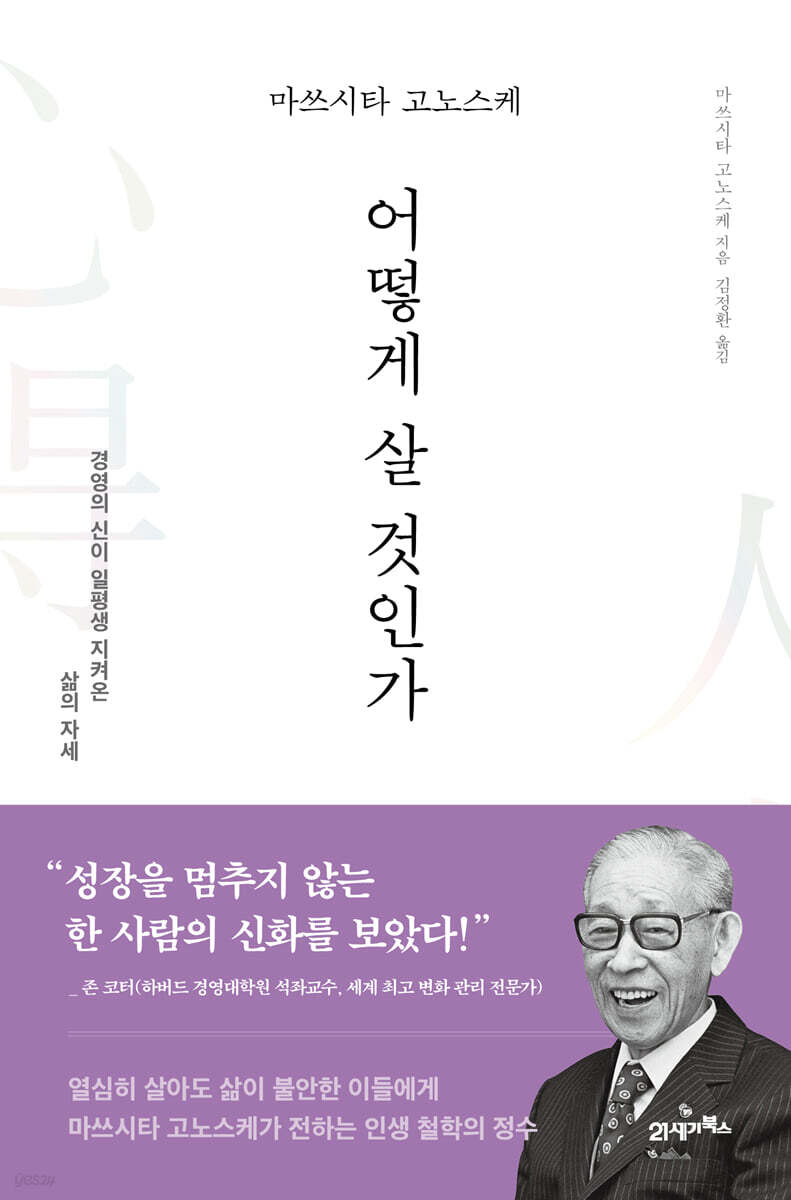
Konosuke Matsushita: How to Live
 |
Description
Book Introduction
★★★★★ Kazuo Inamori, founder of Kyocera Group, is the life mentor of SoftBank Chairman Masayoshi Son!
★★★★★ The culmination of the life philosophy of Konosuke Matsushita, the god of management!
“Fear an insincere attitude more than failure!”
Beyond the God of Management, to the Master of Life...
For those who live hard but still feel uneasy about life
The Essence of Konosuke Matsushita's Philosophy of Life
Would you believe that someone built a massive company with a market capitalization of approximately 38 trillion won with just 1,000 won? Someone has made the seemingly impossible a reality.
Konosuke Matsushita, founder of Panasonic and one of Japan's three great business gods.
"Konosuke Matsushita: How to Live" is a book that summarizes Matsushita's philosophy and attitude toward life as he neared his nineties.
This book, which is a collection of 『Employee's Attitude』 and 『Life's Attitude』, clearly reveals the principles that have supported him every day on the front lines of management and been the foundation of his life since he was a nine-year-old servant.
The book conveys in short but powerful sentences the mindset with which one should live as a human being and as a member of an organization.
Matsushita was noted as a businessman throughout his life, but what he ultimately pursued was not mere business performance, but 'success as a human being.'
The fact that he started this book by saying, “I’m still learning,” even though he is soon to be 90 years old, clearly shows his attitude.
The book contains the core of Matsushita's life experiences overcoming the limitations of poverty, illiteracy, and illness, the human suffering he saw amidst the ruins of war, and the enlightenment he reached while nurturing numerous employees, as he devoted his heart and soul to nurturing employees to the point of asserting, "Before making things, make people."
If there is something that does not change with the times, it is the desire for a humane life.
As he said, “Work is not a place to receive a salary, but a training ground for life,” his perspective of viewing the workplace not as a mere means of making a living but as a stage for personal development still resonates strongly today.
The sincerity, honesty, humility, and gratitude that Matsushita displayed remain a valid compass for us living today.
If you want to establish unwavering inner standards even in an uncertain world, this book will be a reliable companion as you find your own path.
★★★★★ The culmination of the life philosophy of Konosuke Matsushita, the god of management!
“Fear an insincere attitude more than failure!”
Beyond the God of Management, to the Master of Life...
For those who live hard but still feel uneasy about life
The Essence of Konosuke Matsushita's Philosophy of Life
Would you believe that someone built a massive company with a market capitalization of approximately 38 trillion won with just 1,000 won? Someone has made the seemingly impossible a reality.
Konosuke Matsushita, founder of Panasonic and one of Japan's three great business gods.
"Konosuke Matsushita: How to Live" is a book that summarizes Matsushita's philosophy and attitude toward life as he neared his nineties.
This book, which is a collection of 『Employee's Attitude』 and 『Life's Attitude』, clearly reveals the principles that have supported him every day on the front lines of management and been the foundation of his life since he was a nine-year-old servant.
The book conveys in short but powerful sentences the mindset with which one should live as a human being and as a member of an organization.
Matsushita was noted as a businessman throughout his life, but what he ultimately pursued was not mere business performance, but 'success as a human being.'
The fact that he started this book by saying, “I’m still learning,” even though he is soon to be 90 years old, clearly shows his attitude.
The book contains the core of Matsushita's life experiences overcoming the limitations of poverty, illiteracy, and illness, the human suffering he saw amidst the ruins of war, and the enlightenment he reached while nurturing numerous employees, as he devoted his heart and soul to nurturing employees to the point of asserting, "Before making things, make people."
If there is something that does not change with the times, it is the desire for a humane life.
As he said, “Work is not a place to receive a salary, but a training ground for life,” his perspective of viewing the workplace not as a mere means of making a living but as a stage for personal development still resonates strongly today.
The sincerity, honesty, humility, and gratitude that Matsushita displayed remain a valid compass for us living today.
If you want to establish unwavering inner standards even in an uncertain world, this book will be a reliable companion as you find your own path.
- You can preview some of the book's contents.
Preview
index
Before reading this book
Part 1: Reflecting on Daily Wisdom
On my attitude toward life as I approach my nineties
The Art of Navigating Life
My will adds brilliance to destiny
The human essence that shines when polished
What is success in life?
Discover your innate talent
Trust first
Let's not forget to be grateful
I know fear
Let us fathom the subtleties of the mind
Savoring everyday experiences
Both strengths and weaknesses are aspects of a character.
Listen but don't get carried away
Fate plays a role in work.
Heat and passion determine success or failure.
Use your knowledge, but don't get caught up in it.
Become friends with the bottle
Humans have no inherent worries.
I will continue, I will endure
The power of self-objectification
Nothing is useless
Don't make things ring
About age and age-likeness
Considering women's work
Following in the footsteps of one's parents
Live your life to the fullest
Why life's meaning matters
What is a good life?
I'm going to die
Part 2: Reflecting on Wisdom at Work
How to work
Chapter 1: To those who have just stepped foot into the company
If you are prepared for fate, it can sometimes be a source of strength.
I trust the company
Secret to Success
An ununderstanding boss
Know the company's history
Manners are the lubricant
Health care is also part of the job
Let's make suggestions actively
Know the taste of work
Let's strive to create more value
The company is public.
Chapter 2 To those who have become leaders
The attitude that I manage my own work
Love what you do enough to dream of doing it
Not bound by knowledge
Small considerations are the first step to trust.
Regular training is important
Self-improvement is a duty
Let's clearly separate hobbies from our main job.
Selling your skills is also a skill.
The Hidden Meaning of Being Reprimanded
I stake my life on my work
Overcome slumps with a beginner's mindset
The company is a place for training and learning.
The spirit of cooperation brings progress
Consideration for superiors
Chapter 3: To those who shoulder the weight of management
Is it 'the subordinate's fault'?
“It’s my responsibility.”
Develop your skills as a professional
The key to raising a person
Do not disturb subordinates
How to prevent conflict
Failure reveals one's true worth
Turning misfortune into blessing
Be honest about your abilities
Be a person who can help others in big things
There is a realm of life even in the midst of any trouble.
There's a better way to solve any problem.
Only those who love their work know the true joy of work.
Author's chronology
Part 1: Reflecting on Daily Wisdom
On my attitude toward life as I approach my nineties
The Art of Navigating Life
My will adds brilliance to destiny
The human essence that shines when polished
What is success in life?
Discover your innate talent
Trust first
Let's not forget to be grateful
I know fear
Let us fathom the subtleties of the mind
Savoring everyday experiences
Both strengths and weaknesses are aspects of a character.
Listen but don't get carried away
Fate plays a role in work.
Heat and passion determine success or failure.
Use your knowledge, but don't get caught up in it.
Become friends with the bottle
Humans have no inherent worries.
I will continue, I will endure
The power of self-objectification
Nothing is useless
Don't make things ring
About age and age-likeness
Considering women's work
Following in the footsteps of one's parents
Live your life to the fullest
Why life's meaning matters
What is a good life?
I'm going to die
Part 2: Reflecting on Wisdom at Work
How to work
Chapter 1: To those who have just stepped foot into the company
If you are prepared for fate, it can sometimes be a source of strength.
I trust the company
Secret to Success
An ununderstanding boss
Know the company's history
Manners are the lubricant
Health care is also part of the job
Let's make suggestions actively
Know the taste of work
Let's strive to create more value
The company is public.
Chapter 2 To those who have become leaders
The attitude that I manage my own work
Love what you do enough to dream of doing it
Not bound by knowledge
Small considerations are the first step to trust.
Regular training is important
Self-improvement is a duty
Let's clearly separate hobbies from our main job.
Selling your skills is also a skill.
The Hidden Meaning of Being Reprimanded
I stake my life on my work
Overcome slumps with a beginner's mindset
The company is a place for training and learning.
The spirit of cooperation brings progress
Consideration for superiors
Chapter 3: To those who shoulder the weight of management
Is it 'the subordinate's fault'?
“It’s my responsibility.”
Develop your skills as a professional
The key to raising a person
Do not disturb subordinates
How to prevent conflict
Failure reveals one's true worth
Turning misfortune into blessing
Be honest about your abilities
Be a person who can help others in big things
There is a realm of life even in the midst of any trouble.
There's a better way to solve any problem.
Only those who love their work know the true joy of work.
Author's chronology
Into the book
No matter how hard you try, not everyone can become a minister.
It is impossible for everyone to become a CEO.
It will be difficult for everyone to become wealthy.
However, if we put our minds to it, we can all develop our innate talents.
Moreover, people who utilize their innate talents in this way can live vibrant and fulfilling lives with the confidence and pride that their joy lies here, regardless of social status or wealth.
--- p.32~33, from “What is Success in Life”
We are able to live each day thanks to the people and things around us, such as our parents, siblings, seniors, and colleagues, and even the legacy of our ancestors.
Therefore, I think it is natural for humans to be grateful for such things, and it is an attitude that should not be forgotten.
(···) Only when you have a grateful heart can you begin to cherish things and be humble.
Additionally, life will become more joyful and relaxed, and unnecessary conflicts and arguments will decrease when dealing with others.
If you find yourself feeling clouded by anxiety or anger, ask yourself if you have forgotten to be grateful.
--- p.45~46, from “Let’s not forget to be grateful”
Humans have no inherent worries.
If you have any worries, it is because you are looking at things through a perspective that is bound to you.
--- p.82, from “Humans have no worries”
One thing we must never forget to live a fulfilling life is to know ourselves well, that is, to correctly understand our own characteristics, aptitudes, and strengths.
When you understand yourself correctly, you can display your unique characteristics and strengths without being arrogant or cowardly, and at that time, you can achieve things like the success that is desirable as a human being.
--- p.91, from “The Power of Self-Objectification”
Nothing constructive can ever come from an attitude of constant complaining.
That's why people who consistently maintain an attitude and mindset of praising the company are sure to be noticed in any company.
Because the company desperately wants such people.
Who else would you promote to a manager or executive position if not someone like that? I think someone like that could rise to an executive position without much effort.
--- p.147, from “The Secret of Success”
It seems that there are many cases where people who have studied under teachers who can be said to be unconventional become called masters.
Even things that deserve praise are harshly reprimanded.
'I can't stand it any longer.
I think to myself countless times, 'Let's just throw it away.'
But still, among those who persevere and endure, those who have learned something on their own will emerge as masters who surpass their teachers.
It is impossible for everyone to become a CEO.
It will be difficult for everyone to become wealthy.
However, if we put our minds to it, we can all develop our innate talents.
Moreover, people who utilize their innate talents in this way can live vibrant and fulfilling lives with the confidence and pride that their joy lies here, regardless of social status or wealth.
--- p.32~33, from “What is Success in Life”
We are able to live each day thanks to the people and things around us, such as our parents, siblings, seniors, and colleagues, and even the legacy of our ancestors.
Therefore, I think it is natural for humans to be grateful for such things, and it is an attitude that should not be forgotten.
(···) Only when you have a grateful heart can you begin to cherish things and be humble.
Additionally, life will become more joyful and relaxed, and unnecessary conflicts and arguments will decrease when dealing with others.
If you find yourself feeling clouded by anxiety or anger, ask yourself if you have forgotten to be grateful.
--- p.45~46, from “Let’s not forget to be grateful”
Humans have no inherent worries.
If you have any worries, it is because you are looking at things through a perspective that is bound to you.
--- p.82, from “Humans have no worries”
One thing we must never forget to live a fulfilling life is to know ourselves well, that is, to correctly understand our own characteristics, aptitudes, and strengths.
When you understand yourself correctly, you can display your unique characteristics and strengths without being arrogant or cowardly, and at that time, you can achieve things like the success that is desirable as a human being.
--- p.91, from “The Power of Self-Objectification”
Nothing constructive can ever come from an attitude of constant complaining.
That's why people who consistently maintain an attitude and mindset of praising the company are sure to be noticed in any company.
Because the company desperately wants such people.
Who else would you promote to a manager or executive position if not someone like that? I think someone like that could rise to an executive position without much effort.
--- p.147, from “The Secret of Success”
It seems that there are many cases where people who have studied under teachers who can be said to be unconventional become called masters.
Even things that deserve praise are harshly reprimanded.
'I can't stand it any longer.
I think to myself countless times, 'Let's just throw it away.'
But still, among those who persevere and endure, those who have learned something on their own will emerge as masters who surpass their teachers.
--- p.151, from “The Incomprehensible Boss”
Publisher's Review
“With what attitude are you living today?”
Konosuke Matsushita, who went beyond being a god of management to become a mentor in life.
A question for us living in a time of confusion
The world today is full of uncertainty and anxiety.
Young people weary of the unemployment crisis, workers shaken by the unstable economy, and those who have stopped in their tracks in the face of an unpredictable future... they are all facing a strong wind.
But Matsushita said this:
“The best time to fly a kite is when the wind is blowing hard.” A crisis is not the end, but a moment to fly higher.
Matsushita's life was a series of crises.
Numerous turbulent times blocked his path, including the Great Kanto Earthquake, the Great Depression, the devastation of the postwar period, two oil shocks, and pressures on international trade.
But he saw opportunity in the crisis.
His attitude of increasing sales during every recession and opening new paths in despair went beyond simply making Panasonic a global company; it became a legend.
The strength he left behind was in his ‘vision to turn adversity into a blessing.’
“Heaven gave me poverty, illiteracy, and a sickly body.
I consider this a blessing.” He learned the depth of learning through poverty, the depth of learning through not being educated, and the preciousness of life through illness.
This 'thanks to' mentality allowed him to work in his 90s and establish himself as a mentor to world-class managers.
His philosophy also had a profound influence on later managers.
Kazuo Inamori, founder of Kyocera, respected Matsushita as a “teacher and senior in management philosophy” and incorporated his teachings of “cultivating ideals in leisure and conducting management with a sense of mission” into his own management philosophy.
SoftBank Chairman Son Jeong-ui also repeatedly listened to Matsushita's lectures and books in the early days of his business and used his philosophy that "the future is not something to be predicted, but something to be created" as his compass.
The two masters remembered Matsushita not simply as a model of management, but as a teacher of humane living and unwavering leadership.
“The future is not something to be predicted, but something to be created!”
The life attitude that the god of management has maintained throughout his life
The power of "thanks" thinking to turn adversity into blessings
What standards did he hold onto in times of crisis, and how did he remain steadfast in the face of life's upheavals and ultimately achieve his goals? "Matsushita Konosuke: How to Live" isn't simply a collection of proverbs; it's a practical guide, guiding readers to the core of enlightenment for the countless choices and questions we face in life.
Part 1 of the book, "Reflecting on Daily Wisdom," shows how fundamental values like sincerity, gratitude, trust, and humility can strengthen a person.
He advises, “Observe yourself as objectively as you would someone else.”
The habit of looking at yourself objectively and checking your daily attitude is the first step toward establishing internal standards.
Part 2, ‘Reflecting on Wisdom at Work’, covers the attitudes needed in the workplace.
Matsushita left the following words: “Fear an insincere attitude more than failure.”
For modern people who are obsessed with performance and results, his message that doing your best in the process is already a success is powerful.
He considered every space he belonged to, whether it was at work, at home, or in society, as a 'seal of life.'
The realization that everyday life and work are opportunities to train oneself resonates not only with workers but also with students, parents, and all members of society.
He emphasized that “the essence of life is not in flashy success, but in the sincere steps taken every day,” and he did not bend even in moments of life or death.
I believed that there was a way, and I never lost my resolve and determination to forge that path myself.
Rather than a temporary measure to avoid the moment, we pursued a fair and equitable approach that would not waver under any circumstances, upholding our principles and beliefs.
His teachings—to prioritize process over results, people over profit, and place gratitude, trust, humility, and responsibility at the center of life—are particularly relevant to modern people struggling with burnout and uncertainty.
In fact, the book includes a sentence that says, “Observe yourself objectively as if you were observing someone else.”
The habit of looking at yourself objectively and checking your attitude every day is the way to establish unshakable internal standards.
His insight that doing one's best in the process is itself a success, coupled with his experience building a business from the ruins of war, provides profound inspiration to those seeking unwavering standards for growth even today.
His direct and clear messages naturally extend beyond the individual's attitude and workplace mindset to the attitude we should have as members of a community.
This is why, even after decades, this book is still considered a universal guide to how humans should live, transcending management theory.
“Check your attitude every day and establish an unshakable internal standard!”
A philosophy of life needed not for survival but for living.
A guide to life passed down from generation to generation from parents to their children
As he neared the age of 90, he possessed a deep and solid insight gained from experiencing poverty and illness in his youth and witnessing human suffering amid the ruins of war and defeat.
The power of his words and writings may be due to the fact that he personally experienced, realized, and practiced these principles throughout his life, proving that there are principles that can be applied in any situation.
In fact, in Japan, this book has been used as a training material for new employees and has been consistently read as a self-assessment tool for organizational leaders.
There is even an anecdote that "How to Live, Konosuke Matsushita" was used as a guidebook for living that parents passed down to their children for generations, and it contains a universal message that encompasses individual lives, organizations, and society.
This is also the reason why Matsushita, who was a manager, was called not only the 'god of management' but also the 'master of life'.
Konosuke Matsushita practiced one answer throughout his life.
This book tells us that the most certain path is to 'perform one's assigned role with sincerity and sincerity in this place today.'
He, who placed the utmost importance on developing people, appealed to his employees, “Show off your individuality and uniqueness to the fullest, and make your precious lives more fulfilling by working at the company.”
It was believed that daily habits such as sincerity at work, small courtesy, and attitude toward colleagues and customers determine a person's future.
The message that a single, small action builds character and trust, which in turn strengthens the entire organization, remains valid today.
In this age of endless anxiety and confusion, what can we truly rely on? It's not a flashy strategy or a complex theory.
It is a solid internal standard that cannot be shaken.
This book, which contains this indomitable spirit and practical philosophy, serves as a compass for life not only for managers, but also for students, office workers, parents, and all members of society.
Just by reading each chapter carefully, you will gain the strength to find a way out of the crisis and prepare for a new leap forward.
The sincerity, honesty, humility, and gratitude that Matsushita displayed remain a valid compass for us living today.
If you want to establish unwavering inner standards even in an uncertain world, this book will be a reliable companion as you find your own path.
Konosuke Matsushita, who went beyond being a god of management to become a mentor in life.
A question for us living in a time of confusion
The world today is full of uncertainty and anxiety.
Young people weary of the unemployment crisis, workers shaken by the unstable economy, and those who have stopped in their tracks in the face of an unpredictable future... they are all facing a strong wind.
But Matsushita said this:
“The best time to fly a kite is when the wind is blowing hard.” A crisis is not the end, but a moment to fly higher.
Matsushita's life was a series of crises.
Numerous turbulent times blocked his path, including the Great Kanto Earthquake, the Great Depression, the devastation of the postwar period, two oil shocks, and pressures on international trade.
But he saw opportunity in the crisis.
His attitude of increasing sales during every recession and opening new paths in despair went beyond simply making Panasonic a global company; it became a legend.
The strength he left behind was in his ‘vision to turn adversity into a blessing.’
“Heaven gave me poverty, illiteracy, and a sickly body.
I consider this a blessing.” He learned the depth of learning through poverty, the depth of learning through not being educated, and the preciousness of life through illness.
This 'thanks to' mentality allowed him to work in his 90s and establish himself as a mentor to world-class managers.
His philosophy also had a profound influence on later managers.
Kazuo Inamori, founder of Kyocera, respected Matsushita as a “teacher and senior in management philosophy” and incorporated his teachings of “cultivating ideals in leisure and conducting management with a sense of mission” into his own management philosophy.
SoftBank Chairman Son Jeong-ui also repeatedly listened to Matsushita's lectures and books in the early days of his business and used his philosophy that "the future is not something to be predicted, but something to be created" as his compass.
The two masters remembered Matsushita not simply as a model of management, but as a teacher of humane living and unwavering leadership.
“The future is not something to be predicted, but something to be created!”
The life attitude that the god of management has maintained throughout his life
The power of "thanks" thinking to turn adversity into blessings
What standards did he hold onto in times of crisis, and how did he remain steadfast in the face of life's upheavals and ultimately achieve his goals? "Matsushita Konosuke: How to Live" isn't simply a collection of proverbs; it's a practical guide, guiding readers to the core of enlightenment for the countless choices and questions we face in life.
Part 1 of the book, "Reflecting on Daily Wisdom," shows how fundamental values like sincerity, gratitude, trust, and humility can strengthen a person.
He advises, “Observe yourself as objectively as you would someone else.”
The habit of looking at yourself objectively and checking your daily attitude is the first step toward establishing internal standards.
Part 2, ‘Reflecting on Wisdom at Work’, covers the attitudes needed in the workplace.
Matsushita left the following words: “Fear an insincere attitude more than failure.”
For modern people who are obsessed with performance and results, his message that doing your best in the process is already a success is powerful.
He considered every space he belonged to, whether it was at work, at home, or in society, as a 'seal of life.'
The realization that everyday life and work are opportunities to train oneself resonates not only with workers but also with students, parents, and all members of society.
He emphasized that “the essence of life is not in flashy success, but in the sincere steps taken every day,” and he did not bend even in moments of life or death.
I believed that there was a way, and I never lost my resolve and determination to forge that path myself.
Rather than a temporary measure to avoid the moment, we pursued a fair and equitable approach that would not waver under any circumstances, upholding our principles and beliefs.
His teachings—to prioritize process over results, people over profit, and place gratitude, trust, humility, and responsibility at the center of life—are particularly relevant to modern people struggling with burnout and uncertainty.
In fact, the book includes a sentence that says, “Observe yourself objectively as if you were observing someone else.”
The habit of looking at yourself objectively and checking your attitude every day is the way to establish unshakable internal standards.
His insight that doing one's best in the process is itself a success, coupled with his experience building a business from the ruins of war, provides profound inspiration to those seeking unwavering standards for growth even today.
His direct and clear messages naturally extend beyond the individual's attitude and workplace mindset to the attitude we should have as members of a community.
This is why, even after decades, this book is still considered a universal guide to how humans should live, transcending management theory.
“Check your attitude every day and establish an unshakable internal standard!”
A philosophy of life needed not for survival but for living.
A guide to life passed down from generation to generation from parents to their children
As he neared the age of 90, he possessed a deep and solid insight gained from experiencing poverty and illness in his youth and witnessing human suffering amid the ruins of war and defeat.
The power of his words and writings may be due to the fact that he personally experienced, realized, and practiced these principles throughout his life, proving that there are principles that can be applied in any situation.
In fact, in Japan, this book has been used as a training material for new employees and has been consistently read as a self-assessment tool for organizational leaders.
There is even an anecdote that "How to Live, Konosuke Matsushita" was used as a guidebook for living that parents passed down to their children for generations, and it contains a universal message that encompasses individual lives, organizations, and society.
This is also the reason why Matsushita, who was a manager, was called not only the 'god of management' but also the 'master of life'.
Konosuke Matsushita practiced one answer throughout his life.
This book tells us that the most certain path is to 'perform one's assigned role with sincerity and sincerity in this place today.'
He, who placed the utmost importance on developing people, appealed to his employees, “Show off your individuality and uniqueness to the fullest, and make your precious lives more fulfilling by working at the company.”
It was believed that daily habits such as sincerity at work, small courtesy, and attitude toward colleagues and customers determine a person's future.
The message that a single, small action builds character and trust, which in turn strengthens the entire organization, remains valid today.
In this age of endless anxiety and confusion, what can we truly rely on? It's not a flashy strategy or a complex theory.
It is a solid internal standard that cannot be shaken.
This book, which contains this indomitable spirit and practical philosophy, serves as a compass for life not only for managers, but also for students, office workers, parents, and all members of society.
Just by reading each chapter carefully, you will gain the strength to find a way out of the crisis and prepare for a new leap forward.
The sincerity, honesty, humility, and gratitude that Matsushita displayed remain a valid compass for us living today.
If you want to establish unwavering inner standards even in an uncertain world, this book will be a reliable companion as you find your own path.
GOODS SPECIFICS
- Date of issue: October 22, 2025
- Format: Hardcover book binding method guide
- Page count, weight, size: 272 pages | 370g | 128*188*20mm
- ISBN13: 9791173575075
- ISBN10: 1173575073
You may also like
카테고리
korean


korean

![ELLE 엘르 스페셜 에디션 A형 : 12월 [2025]](http://librairie.coreenne.fr/cdn/shop/files/b8e27a3de6c9538896439686c6b0e8fb.jpg?v=1766436872&width=3840)


