

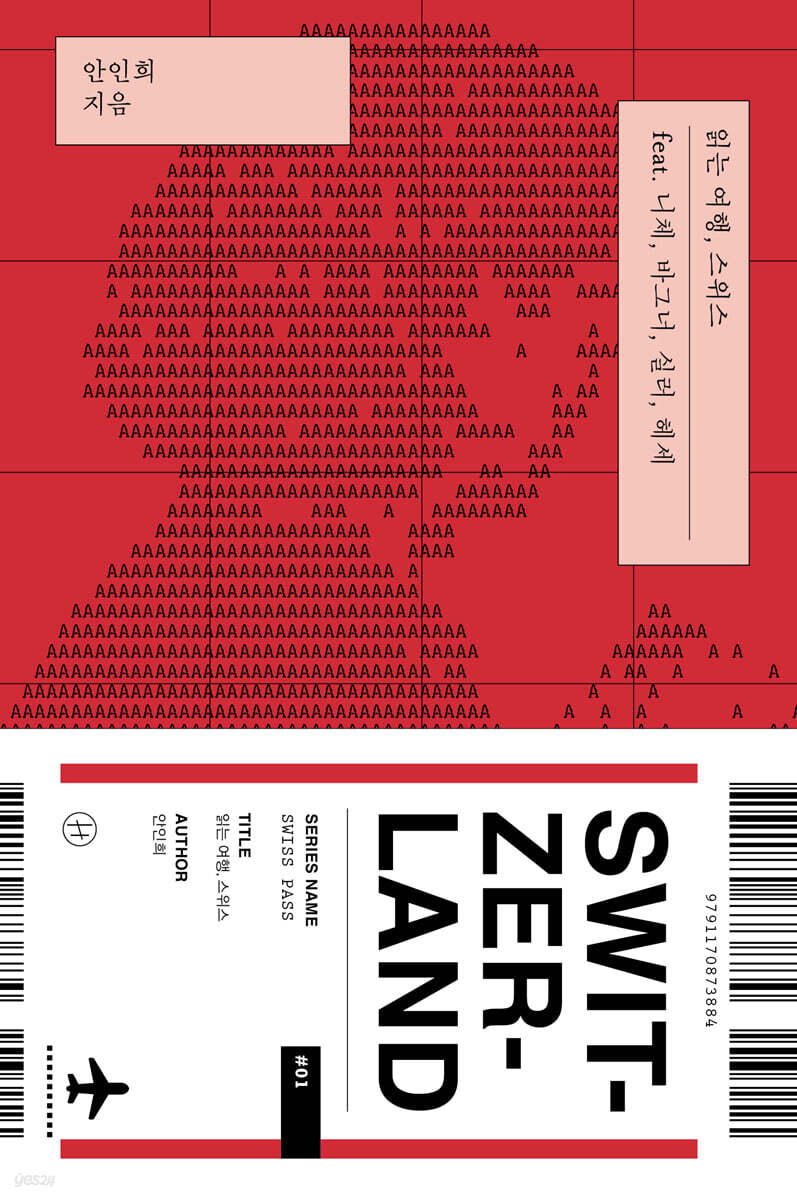
Reading Journey, Switzerland
 |
Description
Book Introduction
For the classic traveler
The most intelligent guide to Switzerland
Switzerland, the ancient capital of great works,
Engraved in Switzerland by four artists
Reading the defining moments of life and art
This is a unique guidebook that views Switzerland, previously perceived only as a travel destination with outstanding nature and scenery, as a classical capital that produced great works and a space of contemplation where masters of art resided.
Inhee Ahn, a German literature scholar who has been exploring European intellectual history for nearly 40 years, presents the "decisive moments" in the lives and art of four masters, Nietzsche, Wagner, Schiller, and Hesse, engraved in Switzerland, with vivid explanations and helpful research.
Why did the great philosopher Nietzsche avoid sunlight? What was the artistic magic of composer Wagner, who captivated Hitler? Why did the playwright Schiller suffer, even after his death, and be exhumed? Why was the wandering novelist Hesse captivated by the colors of Switzerland? Unlike typical guidebooks that simply list tourist attractions, hotels, and restaurants, this book unfilteredly reveals the traces of the masters who left their mark on Switzerland's turbulent past, along with the fascinating stories behind them.
This is a unique 'Swiss Guide' that will provide intellectual satisfaction and a different perspective to anyone interested in Switzerland.
In addition, we have published short classics that capture the Swiss culture of the three masters, Nietzsche, Schiller, and Hesse, along with this book so that you can carry them with you on your actual trip and enjoy the pleasure of reading classics on the spot.
The most intelligent guide to Switzerland
Switzerland, the ancient capital of great works,
Engraved in Switzerland by four artists
Reading the defining moments of life and art
This is a unique guidebook that views Switzerland, previously perceived only as a travel destination with outstanding nature and scenery, as a classical capital that produced great works and a space of contemplation where masters of art resided.
Inhee Ahn, a German literature scholar who has been exploring European intellectual history for nearly 40 years, presents the "decisive moments" in the lives and art of four masters, Nietzsche, Wagner, Schiller, and Hesse, engraved in Switzerland, with vivid explanations and helpful research.
Why did the great philosopher Nietzsche avoid sunlight? What was the artistic magic of composer Wagner, who captivated Hitler? Why did the playwright Schiller suffer, even after his death, and be exhumed? Why was the wandering novelist Hesse captivated by the colors of Switzerland? Unlike typical guidebooks that simply list tourist attractions, hotels, and restaurants, this book unfilteredly reveals the traces of the masters who left their mark on Switzerland's turbulent past, along with the fascinating stories behind them.
This is a unique 'Swiss Guide' that will provide intellectual satisfaction and a different perspective to anyone interested in Switzerland.
In addition, we have published short classics that capture the Swiss culture of the three masters, Nietzsche, Schiller, and Hesse, along with this book so that you can carry them with you on your actual trip and enjoy the pleasure of reading classics on the spot.
- You can preview some of the book's contents.
Preview
index
Introduction
Part 1: The Solitary Walker: Nietzsche
Chapter 1: Nietzsche in His Youth
Chapter 2: Thus Spoke Zarathustra, a work that stands alone in the "violet solitude"
Part 2: The Road to Success: Wagner the Seducer
Chapter 1: Seducing Boys
Chapter 2: Seducing Women, Wagner's Eternal Triangle
Part 3: Friedrich Schiller and Swiss Democracy
Chapter 1: William Tell: The Story of Swiss Independence
Chapter 2 Friedrich Schiller
Chapter 3: The Way of the Old Swiss Mercenaries
Part 4: In the midst of life, Hesse rises above frustration.
Chapter 1: Two Crises, Two Escapes
Chapter 2: Klingsor's Last Summer
Chapter 3: The Funicular of San Salvatore and the Walk through Montagnola
References
Search
Part 1: The Solitary Walker: Nietzsche
Chapter 1: Nietzsche in His Youth
Chapter 2: Thus Spoke Zarathustra, a work that stands alone in the "violet solitude"
Part 2: The Road to Success: Wagner the Seducer
Chapter 1: Seducing Boys
Chapter 2: Seducing Women, Wagner's Eternal Triangle
Part 3: Friedrich Schiller and Swiss Democracy
Chapter 1: William Tell: The Story of Swiss Independence
Chapter 2 Friedrich Schiller
Chapter 3: The Way of the Old Swiss Mercenaries
Part 4: In the midst of life, Hesse rises above frustration.
Chapter 1: Two Crises, Two Escapes
Chapter 2: Klingsor's Last Summer
Chapter 3: The Funicular of San Salvatore and the Walk through Montagnola
References
Search
Detailed image

Into the book
If you keep your eyes and mind open, travelers can have pleasant experiences anywhere (even unpleasant ones like being bitten by a tick, of course).
I'm very happy when the sun shines, but even when it rains, I wear a raincoat (jacket) and walk around with an umbrella.
If you use the Swiss Pass to cover all your transportation, pack a small, foldable shopping bag in your backpack, and buy fresh Swiss vegetables, meat, and fruit at the supermarket, your travel expenses will be less than you think.
Sometimes, a small cup of ramen is a real feast for us.
You can always carry a water bottle with you and drink from the overflowing taps all over the city.
It is the purest water in the world, coming down from the Alps.
--- p.16
All kinds of walking trails continue along the beautiful lakeside with snow-capped mountains in the background.
In the shade of the forest on the shore of the not-so-large Lake Silvaplana, the famous Nietzsche Rock rises tall.
It's not far from the main road, but it's a place you can reach by walking or cycling.
This is the famous rock where Nietzsche confessed that the idea of eternal recurrence, one of the two fundamental ideas that guide Zarathustra, suddenly came to him while he was walking near this rock.
--- p.27
Let's examine some episodes from Wagner's real life, especially from the perspective of "The Seducer," as he experienced almost all the history and hardships of his time and wrote extensively as a writer.
He was a seducer who exerted a powerful influence primarily on boys and women.
--- p.130
He built the imposing Renaissance-style Villa Wesendonk in the forests of the Enge district, overlooking Lake Zurich, and moved in in 1857.
Today, it is owned by the city of Zurich and used as the Rietberg Museum.
In April, shortly after moving into the mansion nestled in the woods, the Wesendonks offered the Wagners a separate building in the garden.
The Wagners stayed there until August of the following year, paying only a symbolic rent once or twice.
He called it “the refuge of the green hills.”
--- p.171
Friedrich Schiller, a representative German playwright, shows the process of Swiss independence in his last play, "Wilhelm Tell."
The only play of his to have a happy ending rather than a tragedy, this work skillfully blends medieval historical events and legends to successfully convey the exciting history of Swiss independence to future generations.
Naturally, it is considered one of the most important works in Switzerland rather than Germany, and is still frequently performed in Altdorf, known as the home of William Tell.
--- p.203
Today, you can easily find a Schiller statue in any German city.
But the most impressive are the heartfelt monuments dedicated to Schiller by the early Swiss cantons.
Schiller, who had no grave, was given a grand monument swaying on the waves of Lake Lucerne, a place he had never visited.
--- p.271
There were two decisive choices in Hesse's life.
The first was when I resisted fiercely and broke away from my father's world during my teenage years.
That determined his life and he became a writer as he wished.
The second choice was to move across the Alps to southern Switzerland, right in the middle of a dire crisis in my life.
From then on, he just sat down and died here, which also determined his future life.
I'm very happy when the sun shines, but even when it rains, I wear a raincoat (jacket) and walk around with an umbrella.
If you use the Swiss Pass to cover all your transportation, pack a small, foldable shopping bag in your backpack, and buy fresh Swiss vegetables, meat, and fruit at the supermarket, your travel expenses will be less than you think.
Sometimes, a small cup of ramen is a real feast for us.
You can always carry a water bottle with you and drink from the overflowing taps all over the city.
It is the purest water in the world, coming down from the Alps.
--- p.16
All kinds of walking trails continue along the beautiful lakeside with snow-capped mountains in the background.
In the shade of the forest on the shore of the not-so-large Lake Silvaplana, the famous Nietzsche Rock rises tall.
It's not far from the main road, but it's a place you can reach by walking or cycling.
This is the famous rock where Nietzsche confessed that the idea of eternal recurrence, one of the two fundamental ideas that guide Zarathustra, suddenly came to him while he was walking near this rock.
--- p.27
Let's examine some episodes from Wagner's real life, especially from the perspective of "The Seducer," as he experienced almost all the history and hardships of his time and wrote extensively as a writer.
He was a seducer who exerted a powerful influence primarily on boys and women.
--- p.130
He built the imposing Renaissance-style Villa Wesendonk in the forests of the Enge district, overlooking Lake Zurich, and moved in in 1857.
Today, it is owned by the city of Zurich and used as the Rietberg Museum.
In April, shortly after moving into the mansion nestled in the woods, the Wesendonks offered the Wagners a separate building in the garden.
The Wagners stayed there until August of the following year, paying only a symbolic rent once or twice.
He called it “the refuge of the green hills.”
--- p.171
Friedrich Schiller, a representative German playwright, shows the process of Swiss independence in his last play, "Wilhelm Tell."
The only play of his to have a happy ending rather than a tragedy, this work skillfully blends medieval historical events and legends to successfully convey the exciting history of Swiss independence to future generations.
Naturally, it is considered one of the most important works in Switzerland rather than Germany, and is still frequently performed in Altdorf, known as the home of William Tell.
--- p.203
Today, you can easily find a Schiller statue in any German city.
But the most impressive are the heartfelt monuments dedicated to Schiller by the early Swiss cantons.
Schiller, who had no grave, was given a grand monument swaying on the waves of Lake Lucerne, a place he had never visited.
--- p.271
There were two decisive choices in Hesse's life.
The first was when I resisted fiercely and broke away from my father's world during my teenage years.
That determined his life and he became a writer as he wished.
The second choice was to move across the Alps to southern Switzerland, right in the middle of a dire crisis in my life.
From then on, he just sat down and died here, which also determined his future life.
--- p.292
Publisher's Review
1.
A lonely walker who only walks along the shaded path - Nietzsche
At the age of twenty-four, Nietzsche, a graduate student who had not even finished his thesis, was invited to become a professor of philology at the University of Basel in Switzerland.
Nietzsche had been recognized for his talent and was called “the idol of the entire young literary world” from early on. In Basel, he met the composer Wagner, who was enjoying support throughout Europe, and they formed a friendship that transcended their 31-year age difference.
The friendship between a great artist and a poet-philosopher, whose fields of activity were completely different, was, as Nietzsche said, close to a “friendship of the stars,” and was indeed rare in human history.
After moving to Basel, Nietzsche experienced very special moments in many aspects of his life, and he later recalled this time as “the happiest time.”
But unfortunately, this time did not last long.
Even at the young age of 35, he had to give up his professorship after 10 years due to unbearable eye pain, headaches, and stomachaches.
So the author defines Nietzsche as “a man who was born with a talent as brilliant as the sun,” but who had to avoid the sunlight and walk only in the shade because of eye pain, as “a man who had to live a lonely life in the shadows.”
After leaving his professorship, Nietzsche often stayed in Sils Maria, which had many lakes and a pleasant environment that was not hot even in summer.
Even now, if you take a leisurely walk along the small Silvaplana Lakeside promenade, you will come across the towering 'Nietzsche Rock' under the shade of the forest.
The name 'Nietzsche Rock' comes from the fact that Nietzsche confessed that he was reminded of the idea of 'eternal recurrence' in 'Thus Spoke Zarathustra' while passing by this rock.
For Nietzsche, who had to live a “life of solitary shadow,” Switzerland was a place of rest and a land of inspiration.
They lived an extremely simple life, wandering mainly to resorts in southern Europe in search of weather that was tolerable to their bodies depending on the season.
This was possible because it wasn't a time when there were so many tourists like there are today.
(……) The “happiest period” in his painful life was the three years he spent close to the Wagner family living on the shores of Lake Lucerne. (p. 28)
2.
The Irresistible Seducer - Wagner
Wagner is still a respected composer today, but he was also a highly successful artist in his own time.
The author sheds light on Wagner and his life in Switzerland from the perspective of a 'seducer'.
Wagner was a seducer who had a particularly powerful influence on boys and women.
The same was true of the boy Hitler and Thomas Mann, as well as Cosima, the daughter of his close friend Liszt and the wife of his disciple.
Cosima, who wanted to “love an outstanding creator and artist to whom she could devote her whole life,” later became Wagner’s second wife.
According to Nietzsche, who had a special relationship with Wagner, this was because Wagner's large-scale stage had a "remarkable brainwashing effect" that was "similar to alcoholism."
Wagner, who was put on the wanted list after participating in the Dresden Uprising, escaped to Switzerland with Liszt's help.
Then, with the support of the wealthy businessman Otto Wesendonck, he lived a comfortable life in a forest mansion in the Enge district overlooking Lake Zurich.
Wagner called this place his “green hill refuge” and wrote prolifically there, but his first wife, Minna, could not stand his womanizing and the two were separated.
When the highly anticipated opera Tristan und Isolde was a huge failure, Wagner found himself in debt again.
However, this time, he was revived with the financial help of King Ludwig II, who was fascinated by Wagner's works.
Afterwards, he and Cosima stay at the Tripschen mansion on the shores of Lake Lucerne, living “without worrying about money” and “in luxury according to their own tastes.”
The author faithfully reveals episodes such as Wagner's womanizing, extravagance, and conflict and reconciliation with Nietzsche, set in places like Zurich and Lucerne, and realistically unfolds the fateful backdrop of Switzerland, which appears as a savior at several turning points in Wagner's life, as if on a large opera stage.
In Tripschen, Wagner was able for the first time to live comfortably and quietly with his family, in luxury and according to his own taste, without worrying about money.
(……) Whether life was difficult or stable, he never stopped creating with incredible concentration, even when his health was failing. (p. 36)
3.
A free man who suffered even in death - Schiller
Schiller, best known for his play "Wilhelm Tell," which depicts the process of Swiss independence, ironically never visited Switzerland.
How did Schiller address the issue of space in a play so crucial to spatial description? According to Goethe, who called him his rival, Schiller "scoured out as many unique maps of Switzerland as he could find and plastered them on every wall," and he read so diligently that he even memorized the alleyways, never leaving his seat until the play was completed.
The author tells in impressive sentences how Schiller skillfully combined the historical events of the three cantons surrounding Lake Lucerne with the legend of William Tell to create William Tell.
Schiller, who had suffered financial hardships during his lifetime, was buried 53rd in a mass grave, with coffins stacked one on top of the other, without a special funeral.
Twenty-one years later, when the cemetery had to be moved, the mayor at the time, Karl Schwabe, decided to find Schiller's remains.
However, Schwabe dug up the grave without any proper procedure, assembled a few bones, and declared them to be Schiller's.
It was not until 2008 that DNA testing revealed that the remains were not Schiller's, and Schiller's grave was ultimately left empty.
The author tells the story of the death of the great playwright Schiller, the misidentification of his remains for a long time, and the modern-day uproar that finally ended with an empty tomb, in a thrilling yet fascinating way, like a train crossing the winding Alps.
Schiller, whose grave had been dug up, was given a monument swaying on the waves of Lake Lucerne, a place he had never been to.
If you take a boat from Lucerne and go a long way towards Flüelen, you will see a huge rock pillar rising above the water, which is a monument dedicated to Schiller.
As it was created by manipulating natural rocks, it has the characteristics of a natural monument and is still considered the number one tourist destination in central Switzerland.
The Swiss have long struggled against harsh nature and lived in poverty (now incredibly wealthy), but it's hard to deny that their democracy and history reflect the vision Schiller envisioned. (p. 237)
4.
A wanderer intoxicated by the language of color - Hesse
Hesse, who experienced a rough adolescence, faced an even greater crisis in his life after the outbreak of World War I.
His father's death, his wife's schizophrenia, and Hesse himself suffering from a severe nervous breakdown.
Eventually, he moves into Casa Camuzzi in Montagnola, southern Switzerland, alone.
Although it was “an abandoned house without electricity or heating and without people,” he spent 12 years “here, gradually rediscovering himself as an artist and as a human being.”
The climate of the sunny southern region, unlike that of northern Switzerland, was of great help to Hesse.
From this time on, Hesse began to devote himself in earnest to writing novels and painting.
The author notes that his time in Montagnola marked a decisive turning point in Hesse's life, and clearly shows that this personal experience continued through Klingsor's Last Summer, a novel that, along with Demian, marked the beginning of Hesse's later work.
Klingsor's Last Summer is a novel about the mad creative fervor of a painter facing death, and the author describes it as a work that can even serve as a guide for those traveling to the beautiful southern city of Lugano.
He also says that although the sunlight in southern Switzerland is "shockingly" warmer than in the north, you will "slowly, unconsciously, unwind and feel a sense of drowsiness and happiness."
Perhaps this is why Hesse was able to escape a life crisis in southern Switzerland and find new sparks as an artist.
At the age of forty-two, the "Expressionist painter" Klingsor spent his last summer in southern Switzerland, where he painted his final paintings. (p. 319)
A lonely walker who only walks along the shaded path - Nietzsche
At the age of twenty-four, Nietzsche, a graduate student who had not even finished his thesis, was invited to become a professor of philology at the University of Basel in Switzerland.
Nietzsche had been recognized for his talent and was called “the idol of the entire young literary world” from early on. In Basel, he met the composer Wagner, who was enjoying support throughout Europe, and they formed a friendship that transcended their 31-year age difference.
The friendship between a great artist and a poet-philosopher, whose fields of activity were completely different, was, as Nietzsche said, close to a “friendship of the stars,” and was indeed rare in human history.
After moving to Basel, Nietzsche experienced very special moments in many aspects of his life, and he later recalled this time as “the happiest time.”
But unfortunately, this time did not last long.
Even at the young age of 35, he had to give up his professorship after 10 years due to unbearable eye pain, headaches, and stomachaches.
So the author defines Nietzsche as “a man who was born with a talent as brilliant as the sun,” but who had to avoid the sunlight and walk only in the shade because of eye pain, as “a man who had to live a lonely life in the shadows.”
After leaving his professorship, Nietzsche often stayed in Sils Maria, which had many lakes and a pleasant environment that was not hot even in summer.
Even now, if you take a leisurely walk along the small Silvaplana Lakeside promenade, you will come across the towering 'Nietzsche Rock' under the shade of the forest.
The name 'Nietzsche Rock' comes from the fact that Nietzsche confessed that he was reminded of the idea of 'eternal recurrence' in 'Thus Spoke Zarathustra' while passing by this rock.
For Nietzsche, who had to live a “life of solitary shadow,” Switzerland was a place of rest and a land of inspiration.
They lived an extremely simple life, wandering mainly to resorts in southern Europe in search of weather that was tolerable to their bodies depending on the season.
This was possible because it wasn't a time when there were so many tourists like there are today.
(……) The “happiest period” in his painful life was the three years he spent close to the Wagner family living on the shores of Lake Lucerne. (p. 28)
2.
The Irresistible Seducer - Wagner
Wagner is still a respected composer today, but he was also a highly successful artist in his own time.
The author sheds light on Wagner and his life in Switzerland from the perspective of a 'seducer'.
Wagner was a seducer who had a particularly powerful influence on boys and women.
The same was true of the boy Hitler and Thomas Mann, as well as Cosima, the daughter of his close friend Liszt and the wife of his disciple.
Cosima, who wanted to “love an outstanding creator and artist to whom she could devote her whole life,” later became Wagner’s second wife.
According to Nietzsche, who had a special relationship with Wagner, this was because Wagner's large-scale stage had a "remarkable brainwashing effect" that was "similar to alcoholism."
Wagner, who was put on the wanted list after participating in the Dresden Uprising, escaped to Switzerland with Liszt's help.
Then, with the support of the wealthy businessman Otto Wesendonck, he lived a comfortable life in a forest mansion in the Enge district overlooking Lake Zurich.
Wagner called this place his “green hill refuge” and wrote prolifically there, but his first wife, Minna, could not stand his womanizing and the two were separated.
When the highly anticipated opera Tristan und Isolde was a huge failure, Wagner found himself in debt again.
However, this time, he was revived with the financial help of King Ludwig II, who was fascinated by Wagner's works.
Afterwards, he and Cosima stay at the Tripschen mansion on the shores of Lake Lucerne, living “without worrying about money” and “in luxury according to their own tastes.”
The author faithfully reveals episodes such as Wagner's womanizing, extravagance, and conflict and reconciliation with Nietzsche, set in places like Zurich and Lucerne, and realistically unfolds the fateful backdrop of Switzerland, which appears as a savior at several turning points in Wagner's life, as if on a large opera stage.
In Tripschen, Wagner was able for the first time to live comfortably and quietly with his family, in luxury and according to his own taste, without worrying about money.
(……) Whether life was difficult or stable, he never stopped creating with incredible concentration, even when his health was failing. (p. 36)
3.
A free man who suffered even in death - Schiller
Schiller, best known for his play "Wilhelm Tell," which depicts the process of Swiss independence, ironically never visited Switzerland.
How did Schiller address the issue of space in a play so crucial to spatial description? According to Goethe, who called him his rival, Schiller "scoured out as many unique maps of Switzerland as he could find and plastered them on every wall," and he read so diligently that he even memorized the alleyways, never leaving his seat until the play was completed.
The author tells in impressive sentences how Schiller skillfully combined the historical events of the three cantons surrounding Lake Lucerne with the legend of William Tell to create William Tell.
Schiller, who had suffered financial hardships during his lifetime, was buried 53rd in a mass grave, with coffins stacked one on top of the other, without a special funeral.
Twenty-one years later, when the cemetery had to be moved, the mayor at the time, Karl Schwabe, decided to find Schiller's remains.
However, Schwabe dug up the grave without any proper procedure, assembled a few bones, and declared them to be Schiller's.
It was not until 2008 that DNA testing revealed that the remains were not Schiller's, and Schiller's grave was ultimately left empty.
The author tells the story of the death of the great playwright Schiller, the misidentification of his remains for a long time, and the modern-day uproar that finally ended with an empty tomb, in a thrilling yet fascinating way, like a train crossing the winding Alps.
Schiller, whose grave had been dug up, was given a monument swaying on the waves of Lake Lucerne, a place he had never been to.
If you take a boat from Lucerne and go a long way towards Flüelen, you will see a huge rock pillar rising above the water, which is a monument dedicated to Schiller.
As it was created by manipulating natural rocks, it has the characteristics of a natural monument and is still considered the number one tourist destination in central Switzerland.
The Swiss have long struggled against harsh nature and lived in poverty (now incredibly wealthy), but it's hard to deny that their democracy and history reflect the vision Schiller envisioned. (p. 237)
4.
A wanderer intoxicated by the language of color - Hesse
Hesse, who experienced a rough adolescence, faced an even greater crisis in his life after the outbreak of World War I.
His father's death, his wife's schizophrenia, and Hesse himself suffering from a severe nervous breakdown.
Eventually, he moves into Casa Camuzzi in Montagnola, southern Switzerland, alone.
Although it was “an abandoned house without electricity or heating and without people,” he spent 12 years “here, gradually rediscovering himself as an artist and as a human being.”
The climate of the sunny southern region, unlike that of northern Switzerland, was of great help to Hesse.
From this time on, Hesse began to devote himself in earnest to writing novels and painting.
The author notes that his time in Montagnola marked a decisive turning point in Hesse's life, and clearly shows that this personal experience continued through Klingsor's Last Summer, a novel that, along with Demian, marked the beginning of Hesse's later work.
Klingsor's Last Summer is a novel about the mad creative fervor of a painter facing death, and the author describes it as a work that can even serve as a guide for those traveling to the beautiful southern city of Lugano.
He also says that although the sunlight in southern Switzerland is "shockingly" warmer than in the north, you will "slowly, unconsciously, unwind and feel a sense of drowsiness and happiness."
Perhaps this is why Hesse was able to escape a life crisis in southern Switzerland and find new sparks as an artist.
At the age of forty-two, the "Expressionist painter" Klingsor spent his last summer in southern Switzerland, where he painted his final paintings. (p. 319)
GOODS SPECIFICS
- Date of issue: November 17, 2025
- Page count, weight, size: 352 pages | 374g | 126*188*22mm
- ISBN13: 9791170873884
- ISBN10: 117087388X
You may also like
카테고리
korean


korean

![GQ KOREA Mark (Monthly): December [2025]](http://librairie.coreenne.fr/cdn/shop/files/8ef265dbbfbf186523ed75ba7319009d.jpg?v=1765340328&width=3840)


