

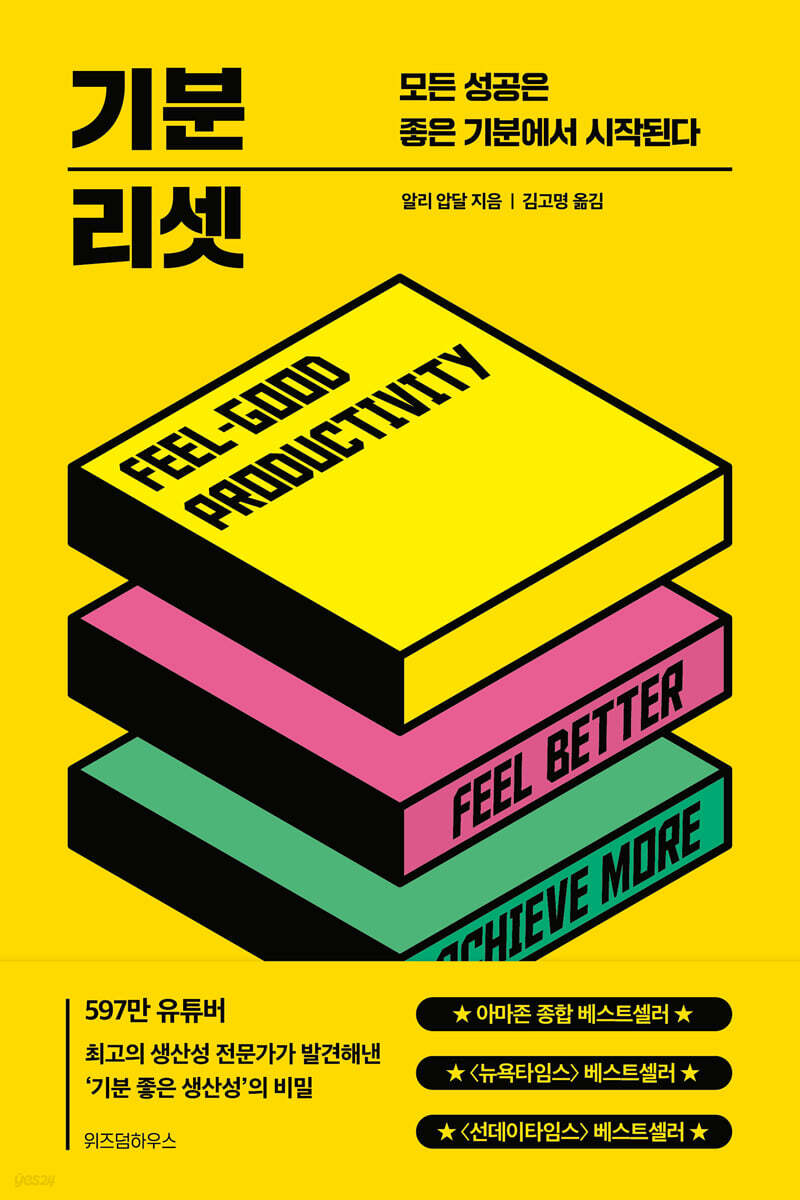
Mood reset
 |
Description
Book Introduction
Here's an easier, happier way to maximize your productivity and achieve success and happiness. Ali Abdal, the world's most followed productivity expert and YouTuber with 6 million followers, has finally discovered a new secret after analyzing decades of psychology research and using it to improve his productivity by juggling multiple tasks and projects. This is called 'feel-good productivity', meaning that if you can do anything with a good feeling, your productivity will naturally improve. In "Mood Reset," Ali Abdal shows how we can transform our lives by harnessing the science of feel-good productivity. By shifting your mindset and following the author's simple yet diverse action plans to achieve positive productivity, you'll find yourself achieving more and living a better life before you know it. |
- You can preview some of the book's contents.
Preview
index
To Korean readers
preface
The Surprising Secret to Feel-Good Productivity | Why Feel-Good Productivity Works | How to Use This Book
Charge Part 1
Chapter 1 Play
Create adventure | Find fun | Lighten the load
Chapter 2 Strength
Boost your confidence | Level up your skills | Become a master of your work
Chapter 3 People
Find the scene | Feel the pleasure of being a helper | Communicate abundantly
Remove part 2
Chapter 4: Seek Clarity
The Fog of Uncertainty | Ask 'Why?' | Ask 'What?' | Ask 'When?'
Chapter 5: Find Courage
Know the Truth About Fear | Alleviate Fear | Overcome Fear
Chapter 6: Start
Reduce friction | Take action | Support yourself
Continue Part 3
Chapter 7 Preserve
Overload Burnout and How to Fix It | Reduce Work | Reject Distractions | Get More Rest
Chapter 8 Recharge
Recharge creatively | Recharge with nature | Recharge unconsciously
Match Chapter 9
Long-term horizon | Medium-term horizon | Short-term horizon
Conclusion: Think Like a Productivity Scientist
Acknowledgements
main
preface
The Surprising Secret to Feel-Good Productivity | Why Feel-Good Productivity Works | How to Use This Book
Charge Part 1
Chapter 1 Play
Create adventure | Find fun | Lighten the load
Chapter 2 Strength
Boost your confidence | Level up your skills | Become a master of your work
Chapter 3 People
Find the scene | Feel the pleasure of being a helper | Communicate abundantly
Remove part 2
Chapter 4: Seek Clarity
The Fog of Uncertainty | Ask 'Why?' | Ask 'What?' | Ask 'When?'
Chapter 5: Find Courage
Know the Truth About Fear | Alleviate Fear | Overcome Fear
Chapter 6: Start
Reduce friction | Take action | Support yourself
Continue Part 3
Chapter 7 Preserve
Overload Burnout and How to Fix It | Reduce Work | Reject Distractions | Get More Rest
Chapter 8 Recharge
Recharge creatively | Recharge with nature | Recharge unconsciously
Match Chapter 9
Long-term horizon | Medium-term horizon | Short-term horizon
Conclusion: Think Like a Productivity Scientist
Acknowledgements
main
Detailed image

Into the book
One night, I was so inspired that I wrote a short post-it note asking, "What if this were fun?"
I stuck a post-it note on my computer monitor and went to bed.
The next day, I completely forgot about the post-it note.
I sat at my desk after work to review my biochemistry coursework for the exam.
With a bitter expression as usual.
Just then, I saw a post-it note.
So I thought.
If this were fun, what would it be like?
The first answer immediately came to mind.
If this is fun, there must be music.
When I was memorizing boring biochemical pathways, I listened to the soundtrack from The Lord of the Rings on my headphones, and strangely enough, it was a lot more fun.
In an instant, music became the most important element to make work more enjoyable.
I started using that method at work too.
At the time, I was doing my internship at a geriatric health care center and used a small, dreary room in the corner of the ward as a medical office.
One particularly tiring afternoon, sitting in the doctor's office with a mountain of work to do, the thought suddenly occurred to me that I should try applying the 'musical fun' technique.
Since there was no separate speaker, I brought a concave bowl from the restaurant, put my phone in it, and used it as a makeshift speaker.
I turned on Spotify and worked while listening to the soundtrack from the movie Pirates of the Caribbean at a low volume until I got off work.
The effect was amazing.
It was much more fun.
'What if this were fun?' has now become the guiding question of my life.
--- p.45~46
In June 2016, a story about a man who was fired from his job using the account FiletOfFish1066 on the online community Reddit became a hot topic.
He worked as a software developer for six years at a company, and his main job was testing software in the quality assurance department.
It was incredibly boring.
All I did every day was test the same software in the same way, with the same scenarios.
So FiletOfFish1066 came up with a solution.
After joining the company, I developed software to automate work without my boss's knowledge for eight months.
From then on, the program ran automatically and handled quality assurance testing perfectly.
Because everything was going smoothly, his boss didn't bother to check if he was doing a good job.
In a post on Reddit after he was fired, he wrote, “I haven’t done anything at the company since about 6 years ago.
I'm not kidding.
I worked 40 hours a week at the office, played League of Legends, read Reddit, and just lived my life the way I wanted.
In six years, I've only actually worked 50 hours. I haven't done anything.
But it says, “No one noticed.”
However, FiletOfFish1066's ingenious method was caught by an IT department employee after six years and reported to his superiors.
He was fired from his company for fearlessly automating tasks.
Of course, this isn't to say that FiletOfFish1066 did well at work or that he's a role model for others.
But his actions offer a first hint at how we can exercise ownership even in situations where our independence is not guaranteed.
If you can't be the master of the situation, then you can be the master of the process.
--- p.78
We tend to be more productive when we work simultaneously with others.
When we feel a sense of synchronicity, we want to help others.
And you want to help yourself too.
The implication is simple.
To reap the benefits of feeling good about others, you just need to find someone to work with at the same time.
There is no need to cooperate on exactly the same thing.
While writing this book, I was a frequent participant in the London Writers' Salon.
The London Writers' Salon runs a free, remote collaborative writing meetup called Writers' Hour.
Four times a weekday, hundreds of writers (and some non-writers) gather together via Zoom video conference.
The host will first deliver a five-minute motivational message, after which participants will write down in the chat what they will do during that time.
Then, for 50 minutes, everyone minimizes their Zoom window and diligently works on their computers.
I still see the great benefit of these simultaneous work groups in maintaining my energy these days.
Even if you're doing different things, working on them simultaneously can dramatically improve your concentration and make you feel better.
--- p.91~92
A simple cognitive reappraisal is to remember that even if something feels incredibly negative now, it probably won't matter in the future.
At this time, let's consider the following three questions:
I call this the 10/10/10 rule.
Let's see the effect through the example given above.
· [Trigger] Being rejected by someone you like.
Will this still matter in ten minutes? I'll still be a little depressed and probably won't want to see him.
Will this still matter in 10 weeks? Maybe, but I don't think it'll be as frustrating as it is now.
Because a lot can happen in the meantime.
Will this still matter in 10 years? Probably not.
By then, I would have met many people who could completely change my life.
· [Caution] Failing the hiring process.
Will this still matter in 10 minutes? Maybe.
I feel like I'm going to be upset all day.
Will this still matter in 10 weeks? Probably not.
Until then, I will apply to many other companies.
Will this still matter in 10 years? Not at all.
No one gets ahead without setbacks, and I will learn to see these as minor setbacks.
--- p.148
When I was working full-time as a doctor in 2018, I had a hard time getting into the habit of practicing guitar in the evenings.
I thought to myself every now and then, 'I need to practice guitar!' but I kept putting it off.
Instead, I sat on the living room sofa and scrolled through social media on my phone or watched television.
The guitar was barely visible, hidden by the bookshelf in the corner.
Then, after reading James Clear's "The Power of Small Habits," I came up with what seemed like an obvious solution.
All you had to do was put the guitar in the middle of the living room.
Then, as if nothing had happened, it became much easier to pick up the guitar.
These actions and the actions of the Dutch researchers can be seen as designing our environment.
The goal is to make it much easier to get started by reducing friction.
At its heart is what behavioral scientists call basic choice.
Default choices are the results that happen automatically when you don't actively choose them.
In a Dutch supermarket experiment, buying vegetables became the default because of the green paper on which fresh produce was placed.
So, customers filled their carts with fresh food without thinking much about it.
--- p.164~165
Not long after I finished complaining to my mother, I heard an interview with Tim Ferriss and world-renowned basketball player LeBron James.
I didn't really like basketball, but right after that, I started searching for LA Lakers-related videos on YouTube like I was possessed.
The more I learned about LeBron, the more one thing became clear.
It was essentially two versions of LeBron James.
The first is LeBron running.
A man who catches the ball at one end of the court and in the blink of an eye is standing under the opposing goal.
A man who can run at 27 kilometers per hour. He is considered one of the fastest players in NBA history.
The second is a walking LeBron.
A man who leisurely strolls around the court when he doesn't have the ball.
A man who doesn't feel the need to run even when he has the ball.
Well, why bother running when you can easily score a goal from 10 meters away?
Many commentators have said that this duality is the secret to LeBron's absurdly longevity as a player.
LeBron James has dominated the NBA since the mid-2000s. While NBA players average four and a half years in their prime and play an average of 50 games per season, LeBron has averaged over 70 games per season for 19 years.
How has he managed to maintain that position for nearly 20 years? The answer likely has to do with walking.
When sports analysts meticulously analyze the massive amounts of data on the playing and non-playing activities of NBA players, including LeBron, one thing invariably comes to light:
LeBron James can run as fast as a suburban car, yet he's still one of the slowest players in the NBA on average.
In the 2017-2018 season, LeBron James averaged a game-time speed of 6.2 kilometers per hour (similar to walking speed), placing him in the bottom 10 among players playing at least 20 minutes per game.
In the 2017-2018 regular season, he walked 74.4 percent of his playing time, which was virtually unmatched in the entire league.
I unexpectedly got my first hint on how to overcome fatigue from LeBron James.
As I've come to realize, the cause of overload burnout is the negative emotions that arise from doing too much too quickly.
We are given more work than we can handle and we don't get the rest we need while we're working.
It always runs like that.
--- p.187~188
“Because people kill only the spiders they see, they are effectively acting as agents of natural selection, allowing only the most stealthy and intelligent spiders to survive.
“We are making spiders smarter.”
“If you think about how strongly we can bond with people who dislike the same thing, a dating app based on dislikes would be a huge success.”
“The true measure of a friend is how clean you clean your house when you invite him in.”
These are all quotes from the Reddit board r/Showerthoughts, one of my favorite pages on the internet.
This bulletin board is a place to post very profound and unusual thoughts that suddenly come to mind while washing my body.
Most users who post here may not realize it, but they are actually proving a famous neuroscience theory.
You may have experienced it too.
Entering the bathroom and smelling the fragrant shampoo and soap under the hot water makes my body and mind relax.
Then, suddenly, your eyes light up, and the solution to the problem you've been struggling with comes to you with miraculous clarity! For example, you might recall the specific content of an email to send to your boss, or you might remember where you left your car keys.
The 'Shower Law' isn't just a Reddit user's fantasy.
Originally, when the brain is sufficiently relaxed, creative solutions come out.
At its core lies the power of mind-wandering, a form of unconscious recharging.
The latest research in neuroscience shows that even when we're 'doing nothing,' our brains don't rest.
The brain has a region called the default mode network (DMN), which governs the strange places our minds wander when we're idly idling. The DMN helps us recall memories, daydream, and imagine the future.
And the less we engage in mentally demanding tasks, the more active our DMN becomes.
The problem with modern people is that they don't often allow themselves the time and space to activate their DMN.
Rather, mind wandering is stigmatized and often equated with wasting time.
Because we don't often remember what we think about while daydreaming, we often have trouble thinking about how something beneficial could come out of it.
It's a mistake.
We can be amazingly productive when we do nothing.
I stuck a post-it note on my computer monitor and went to bed.
The next day, I completely forgot about the post-it note.
I sat at my desk after work to review my biochemistry coursework for the exam.
With a bitter expression as usual.
Just then, I saw a post-it note.
So I thought.
If this were fun, what would it be like?
The first answer immediately came to mind.
If this is fun, there must be music.
When I was memorizing boring biochemical pathways, I listened to the soundtrack from The Lord of the Rings on my headphones, and strangely enough, it was a lot more fun.
In an instant, music became the most important element to make work more enjoyable.
I started using that method at work too.
At the time, I was doing my internship at a geriatric health care center and used a small, dreary room in the corner of the ward as a medical office.
One particularly tiring afternoon, sitting in the doctor's office with a mountain of work to do, the thought suddenly occurred to me that I should try applying the 'musical fun' technique.
Since there was no separate speaker, I brought a concave bowl from the restaurant, put my phone in it, and used it as a makeshift speaker.
I turned on Spotify and worked while listening to the soundtrack from the movie Pirates of the Caribbean at a low volume until I got off work.
The effect was amazing.
It was much more fun.
'What if this were fun?' has now become the guiding question of my life.
--- p.45~46
In June 2016, a story about a man who was fired from his job using the account FiletOfFish1066 on the online community Reddit became a hot topic.
He worked as a software developer for six years at a company, and his main job was testing software in the quality assurance department.
It was incredibly boring.
All I did every day was test the same software in the same way, with the same scenarios.
So FiletOfFish1066 came up with a solution.
After joining the company, I developed software to automate work without my boss's knowledge for eight months.
From then on, the program ran automatically and handled quality assurance testing perfectly.
Because everything was going smoothly, his boss didn't bother to check if he was doing a good job.
In a post on Reddit after he was fired, he wrote, “I haven’t done anything at the company since about 6 years ago.
I'm not kidding.
I worked 40 hours a week at the office, played League of Legends, read Reddit, and just lived my life the way I wanted.
In six years, I've only actually worked 50 hours. I haven't done anything.
But it says, “No one noticed.”
However, FiletOfFish1066's ingenious method was caught by an IT department employee after six years and reported to his superiors.
He was fired from his company for fearlessly automating tasks.
Of course, this isn't to say that FiletOfFish1066 did well at work or that he's a role model for others.
But his actions offer a first hint at how we can exercise ownership even in situations where our independence is not guaranteed.
If you can't be the master of the situation, then you can be the master of the process.
--- p.78
We tend to be more productive when we work simultaneously with others.
When we feel a sense of synchronicity, we want to help others.
And you want to help yourself too.
The implication is simple.
To reap the benefits of feeling good about others, you just need to find someone to work with at the same time.
There is no need to cooperate on exactly the same thing.
While writing this book, I was a frequent participant in the London Writers' Salon.
The London Writers' Salon runs a free, remote collaborative writing meetup called Writers' Hour.
Four times a weekday, hundreds of writers (and some non-writers) gather together via Zoom video conference.
The host will first deliver a five-minute motivational message, after which participants will write down in the chat what they will do during that time.
Then, for 50 minutes, everyone minimizes their Zoom window and diligently works on their computers.
I still see the great benefit of these simultaneous work groups in maintaining my energy these days.
Even if you're doing different things, working on them simultaneously can dramatically improve your concentration and make you feel better.
--- p.91~92
A simple cognitive reappraisal is to remember that even if something feels incredibly negative now, it probably won't matter in the future.
At this time, let's consider the following three questions:
I call this the 10/10/10 rule.
Let's see the effect through the example given above.
· [Trigger] Being rejected by someone you like.
Will this still matter in ten minutes? I'll still be a little depressed and probably won't want to see him.
Will this still matter in 10 weeks? Maybe, but I don't think it'll be as frustrating as it is now.
Because a lot can happen in the meantime.
Will this still matter in 10 years? Probably not.
By then, I would have met many people who could completely change my life.
· [Caution] Failing the hiring process.
Will this still matter in 10 minutes? Maybe.
I feel like I'm going to be upset all day.
Will this still matter in 10 weeks? Probably not.
Until then, I will apply to many other companies.
Will this still matter in 10 years? Not at all.
No one gets ahead without setbacks, and I will learn to see these as minor setbacks.
--- p.148
When I was working full-time as a doctor in 2018, I had a hard time getting into the habit of practicing guitar in the evenings.
I thought to myself every now and then, 'I need to practice guitar!' but I kept putting it off.
Instead, I sat on the living room sofa and scrolled through social media on my phone or watched television.
The guitar was barely visible, hidden by the bookshelf in the corner.
Then, after reading James Clear's "The Power of Small Habits," I came up with what seemed like an obvious solution.
All you had to do was put the guitar in the middle of the living room.
Then, as if nothing had happened, it became much easier to pick up the guitar.
These actions and the actions of the Dutch researchers can be seen as designing our environment.
The goal is to make it much easier to get started by reducing friction.
At its heart is what behavioral scientists call basic choice.
Default choices are the results that happen automatically when you don't actively choose them.
In a Dutch supermarket experiment, buying vegetables became the default because of the green paper on which fresh produce was placed.
So, customers filled their carts with fresh food without thinking much about it.
--- p.164~165
Not long after I finished complaining to my mother, I heard an interview with Tim Ferriss and world-renowned basketball player LeBron James.
I didn't really like basketball, but right after that, I started searching for LA Lakers-related videos on YouTube like I was possessed.
The more I learned about LeBron, the more one thing became clear.
It was essentially two versions of LeBron James.
The first is LeBron running.
A man who catches the ball at one end of the court and in the blink of an eye is standing under the opposing goal.
A man who can run at 27 kilometers per hour. He is considered one of the fastest players in NBA history.
The second is a walking LeBron.
A man who leisurely strolls around the court when he doesn't have the ball.
A man who doesn't feel the need to run even when he has the ball.
Well, why bother running when you can easily score a goal from 10 meters away?
Many commentators have said that this duality is the secret to LeBron's absurdly longevity as a player.
LeBron James has dominated the NBA since the mid-2000s. While NBA players average four and a half years in their prime and play an average of 50 games per season, LeBron has averaged over 70 games per season for 19 years.
How has he managed to maintain that position for nearly 20 years? The answer likely has to do with walking.
When sports analysts meticulously analyze the massive amounts of data on the playing and non-playing activities of NBA players, including LeBron, one thing invariably comes to light:
LeBron James can run as fast as a suburban car, yet he's still one of the slowest players in the NBA on average.
In the 2017-2018 season, LeBron James averaged a game-time speed of 6.2 kilometers per hour (similar to walking speed), placing him in the bottom 10 among players playing at least 20 minutes per game.
In the 2017-2018 regular season, he walked 74.4 percent of his playing time, which was virtually unmatched in the entire league.
I unexpectedly got my first hint on how to overcome fatigue from LeBron James.
As I've come to realize, the cause of overload burnout is the negative emotions that arise from doing too much too quickly.
We are given more work than we can handle and we don't get the rest we need while we're working.
It always runs like that.
--- p.187~188
“Because people kill only the spiders they see, they are effectively acting as agents of natural selection, allowing only the most stealthy and intelligent spiders to survive.
“We are making spiders smarter.”
“If you think about how strongly we can bond with people who dislike the same thing, a dating app based on dislikes would be a huge success.”
“The true measure of a friend is how clean you clean your house when you invite him in.”
These are all quotes from the Reddit board r/Showerthoughts, one of my favorite pages on the internet.
This bulletin board is a place to post very profound and unusual thoughts that suddenly come to mind while washing my body.
Most users who post here may not realize it, but they are actually proving a famous neuroscience theory.
You may have experienced it too.
Entering the bathroom and smelling the fragrant shampoo and soap under the hot water makes my body and mind relax.
Then, suddenly, your eyes light up, and the solution to the problem you've been struggling with comes to you with miraculous clarity! For example, you might recall the specific content of an email to send to your boss, or you might remember where you left your car keys.
The 'Shower Law' isn't just a Reddit user's fantasy.
Originally, when the brain is sufficiently relaxed, creative solutions come out.
At its core lies the power of mind-wandering, a form of unconscious recharging.
The latest research in neuroscience shows that even when we're 'doing nothing,' our brains don't rest.
The brain has a region called the default mode network (DMN), which governs the strange places our minds wander when we're idly idling. The DMN helps us recall memories, daydream, and imagine the future.
And the less we engage in mentally demanding tasks, the more active our DMN becomes.
The problem with modern people is that they don't often allow themselves the time and space to activate their DMN.
Rather, mind wandering is stigmatized and often equated with wasting time.
Because we don't often remember what we think about while daydreaming, we often have trouble thinking about how something beneficial could come out of it.
It's a mistake.
We can be amazingly productive when we do nothing.
--- p.223~224
Publisher's Review
The formula "happiness begins after hardship" has been broken.
Take care of your mood today for tomorrow's productivity!
“A book so important that it will make your eyes sparkle.
“It overturns the stereotypical narrative about productivity.”
_Cal Newport, author of Slow Work and Deep Work
“A much-needed antidote to the hustle culture that equates work with life.”
Mark Manson, author of The Art of Not Giving a F*ck
*** Amazon Comprehensive Bestseller ***
*** New York Times Bestseller ***
*** Sunday Times Bestseller ***
*** 150,000 copies sold in the UK ***
*** Worldwide copyright agreement in 37 languages ***
"No matter how difficult it is, let's just endure it and work harder." "If you struggle now, you'll be happy later."
Is it true that you have to constantly push and challenge yourself to be productive and successful?
When people talk about increasing productivity, these are the things that often come to mind.
A tight schedule, tightly regulated habits, a plethora of productivity-enhancing tools both online and offline, and the arduous effort and discipline required to maintain it all.
However, these attempts often end in a three-day fiasco, and people struggle to learn and implement productivity improvement know-how, ultimately leading to self-abandonment or burnout.
I think it's hard to live like this, but I don't want to feel like I'm wasting my life.
In a modern society where overwork is glorified and even encouraged, is there a way to be productive without sacrificing everyday pleasures and joys? Ali Abdal, the world's most followed productivity expert, YouTuber with 6 million followers, and author of "Mood Reset," confidently answers, "Yes."
He argues that the secret to productivity is not hardship and self-denial, but rather 'good mood' and 'positive emotions', and that success and happiness can and must go together.
According to Barbara Fredrickson, a professor at the University of North Carolina at Chapel Hill and an authority on positive psychology introduced in this book, positive emotions are the fuel for a prosperous life.
Positive emotions change the way our brain works.
Step 1: Feel better.
Step 2: Do more important things.
Why is that? Hormones secreted when you feel good increase energy, and that energy boosts productivity.
When you achieve results with increased productivity, you feel a sense of accomplishment and feel good again.
And while negative emotions trigger the release of stress hormones, positive emotions, on the other hand, have the effect of 'resetting' the nervous system and eliminating stress.
The most important realization is that when you feel good, your life becomes richer.
Psychological research shows that people who frequently experience positive emotions achieve more, spread that energy around them, and generally have better relationships, earn more money, and have successful careers.
Simply put, success doesn't bring good feelings.
A good mood brings success.
It's not that productivity makes you feel good, it's that feeling good makes you productive!
If you've been constantly procrastinating and looking away, and have reached a point where you're in a "I can't do this anymore" state, focus on "feel-good productivity"!
Ali Abdal, a first-year doctor, was on duty on Christmas Day when he felt so drained and exhausted that he began to wonder:
I firmly believed that if I worked harder during difficult times, things would improve. But was that true? Was the advice I'd blindly followed until then—"Hardship is essential for success"—true? Can a person live a life of constant hardship? Does it make sense to constantly push yourself to achieve success? To address these questions, Ali Abdal drew on numerous psychological studies, diverse case studies, and his own experiences and reflections to arrive at a completely new conclusion.
The important thing was not to work so hard that you would die, but to make the hard work more enjoyable.
On that path, happiness came first, and happiness brought focus and motivation.
I later named that path feel-good productivity.
(Page 16)
In this book, Ali Abdal offers simple, scientifically proven methods for achieving more of what matters most while feeling better about your life—all in an accessible and engaging way.
Part 1 explains how to recharge your energy using the principles of feel-good productivity.
We examine how the three major "energy sources"—play, power, and people—induce positive emotions and introduce ways to incorporate these principles into daily life.
Part 2 explains how to overcome procrastination with pleasant productivity.
We explore the three biggest "hurdles" that can cause you to feel bad: uncertainty, fear, and inertia, and how to overcome them.
Removing these obstacles will not only help you stop procrastinating, but it will also make you feel better.
In Part 3, we explore how to sustain a long-term productive life through feel-good productivity.
We analyze three types of burnout: overload burnout, exhaustion burnout, and mismatch burnout.
And we'll talk about how to use three simple "sustainers" to keep you feeling better for days, weeks, months, and even years: Conserve, Recharge, and Align.
The first book by Ali Abdal, a 6 million YouTuber and productivity expert who went from being a doctor to a self-improvement icon!
If you want to become a cheerful and hard-working person, start by resetting your mood!
Ali Abdal graduated from Cambridge University Medical School in the UK and worked as a doctor while also working as a YouTuber, consistently posting videos introducing his study methods and techniques for improving productivity.
Then, I realized that I wanted to pursue a different path than becoming a doctor, and so I decided to become a full-time YouTuber.
Currently, the company is actively creating content centered around the keyword "productivity" and conducting lectures and consulting activities, achieving annual sales of over 7 billion won.
Mood Reset is the culmination of nearly a decade of learning how to feel better and achieve more.
Korea is famous for its culture that values hard work and the pursuit of excellence.
But on the other hand, there is growing interest in the importance of work-life balance and mental health.
I hope the concepts in this book will be helpful in Korean society's discussion of the issue of pursuing both success and happiness simultaneously.
I have something to say, especially to young Koreans who are interested in productivity and self-development.
Don't think of success and happiness as separate things.
Success and happiness can and must go together.
(Page 11)
Feel-good productivity is a strategy and skill you can use in every aspect of your life.
Feel-good productivity turns a burdensome task into an exciting challenge.
It helps you connect more deeply with the people around you.
Create meaningful interactions in your everyday work.
The most important thing is that when you know and utilize what makes you feel good, it's not just work that changes.
Life changes.
If you want to excel at what you do now, fulfill your daily routine and relationships, and create a meaningful and enjoyable life, pleasant productivity is the keyword you should focus on and try right now.
Don't constantly beat yourself up over the idea that if you're productive and achieve results, you'll feel good.
You need to reset your mood first, and only then can you increase your productivity and achieve results.
That's how you can live a good life.
Take care of your mood today for tomorrow's productivity!
“A book so important that it will make your eyes sparkle.
“It overturns the stereotypical narrative about productivity.”
_Cal Newport, author of Slow Work and Deep Work
“A much-needed antidote to the hustle culture that equates work with life.”
Mark Manson, author of The Art of Not Giving a F*ck
*** Amazon Comprehensive Bestseller ***
*** New York Times Bestseller ***
*** Sunday Times Bestseller ***
*** 150,000 copies sold in the UK ***
*** Worldwide copyright agreement in 37 languages ***
"No matter how difficult it is, let's just endure it and work harder." "If you struggle now, you'll be happy later."
Is it true that you have to constantly push and challenge yourself to be productive and successful?
When people talk about increasing productivity, these are the things that often come to mind.
A tight schedule, tightly regulated habits, a plethora of productivity-enhancing tools both online and offline, and the arduous effort and discipline required to maintain it all.
However, these attempts often end in a three-day fiasco, and people struggle to learn and implement productivity improvement know-how, ultimately leading to self-abandonment or burnout.
I think it's hard to live like this, but I don't want to feel like I'm wasting my life.
In a modern society where overwork is glorified and even encouraged, is there a way to be productive without sacrificing everyday pleasures and joys? Ali Abdal, the world's most followed productivity expert, YouTuber with 6 million followers, and author of "Mood Reset," confidently answers, "Yes."
He argues that the secret to productivity is not hardship and self-denial, but rather 'good mood' and 'positive emotions', and that success and happiness can and must go together.
According to Barbara Fredrickson, a professor at the University of North Carolina at Chapel Hill and an authority on positive psychology introduced in this book, positive emotions are the fuel for a prosperous life.
Positive emotions change the way our brain works.
Step 1: Feel better.
Step 2: Do more important things.
Why is that? Hormones secreted when you feel good increase energy, and that energy boosts productivity.
When you achieve results with increased productivity, you feel a sense of accomplishment and feel good again.
And while negative emotions trigger the release of stress hormones, positive emotions, on the other hand, have the effect of 'resetting' the nervous system and eliminating stress.
The most important realization is that when you feel good, your life becomes richer.
Psychological research shows that people who frequently experience positive emotions achieve more, spread that energy around them, and generally have better relationships, earn more money, and have successful careers.
Simply put, success doesn't bring good feelings.
A good mood brings success.
It's not that productivity makes you feel good, it's that feeling good makes you productive!
If you've been constantly procrastinating and looking away, and have reached a point where you're in a "I can't do this anymore" state, focus on "feel-good productivity"!
Ali Abdal, a first-year doctor, was on duty on Christmas Day when he felt so drained and exhausted that he began to wonder:
I firmly believed that if I worked harder during difficult times, things would improve. But was that true? Was the advice I'd blindly followed until then—"Hardship is essential for success"—true? Can a person live a life of constant hardship? Does it make sense to constantly push yourself to achieve success? To address these questions, Ali Abdal drew on numerous psychological studies, diverse case studies, and his own experiences and reflections to arrive at a completely new conclusion.
The important thing was not to work so hard that you would die, but to make the hard work more enjoyable.
On that path, happiness came first, and happiness brought focus and motivation.
I later named that path feel-good productivity.
(Page 16)
In this book, Ali Abdal offers simple, scientifically proven methods for achieving more of what matters most while feeling better about your life—all in an accessible and engaging way.
Part 1 explains how to recharge your energy using the principles of feel-good productivity.
We examine how the three major "energy sources"—play, power, and people—induce positive emotions and introduce ways to incorporate these principles into daily life.
Part 2 explains how to overcome procrastination with pleasant productivity.
We explore the three biggest "hurdles" that can cause you to feel bad: uncertainty, fear, and inertia, and how to overcome them.
Removing these obstacles will not only help you stop procrastinating, but it will also make you feel better.
In Part 3, we explore how to sustain a long-term productive life through feel-good productivity.
We analyze three types of burnout: overload burnout, exhaustion burnout, and mismatch burnout.
And we'll talk about how to use three simple "sustainers" to keep you feeling better for days, weeks, months, and even years: Conserve, Recharge, and Align.
The first book by Ali Abdal, a 6 million YouTuber and productivity expert who went from being a doctor to a self-improvement icon!
If you want to become a cheerful and hard-working person, start by resetting your mood!
Ali Abdal graduated from Cambridge University Medical School in the UK and worked as a doctor while also working as a YouTuber, consistently posting videos introducing his study methods and techniques for improving productivity.
Then, I realized that I wanted to pursue a different path than becoming a doctor, and so I decided to become a full-time YouTuber.
Currently, the company is actively creating content centered around the keyword "productivity" and conducting lectures and consulting activities, achieving annual sales of over 7 billion won.
Mood Reset is the culmination of nearly a decade of learning how to feel better and achieve more.
Korea is famous for its culture that values hard work and the pursuit of excellence.
But on the other hand, there is growing interest in the importance of work-life balance and mental health.
I hope the concepts in this book will be helpful in Korean society's discussion of the issue of pursuing both success and happiness simultaneously.
I have something to say, especially to young Koreans who are interested in productivity and self-development.
Don't think of success and happiness as separate things.
Success and happiness can and must go together.
(Page 11)
Feel-good productivity is a strategy and skill you can use in every aspect of your life.
Feel-good productivity turns a burdensome task into an exciting challenge.
It helps you connect more deeply with the people around you.
Create meaningful interactions in your everyday work.
The most important thing is that when you know and utilize what makes you feel good, it's not just work that changes.
Life changes.
If you want to excel at what you do now, fulfill your daily routine and relationships, and create a meaningful and enjoyable life, pleasant productivity is the keyword you should focus on and try right now.
Don't constantly beat yourself up over the idea that if you're productive and achieve results, you'll feel good.
You need to reset your mood first, and only then can you increase your productivity and achieve results.
That's how you can live a good life.
GOODS SPECIFICS
- Date of issue: December 4, 2024
- Page count, weight, size: 280 pages | 518g | 150*225*19mm
- ISBN13: 9791171713189
- ISBN10: 1171713185
You may also like
카테고리
korean


korean

![ELLE 엘르 스페셜 에디션 A형 : 12월 [2025]](http://librairie.coreenne.fr/cdn/shop/files/b8e27a3de6c9538896439686c6b0e8fb.jpg?v=1766436872&width=3840)


