

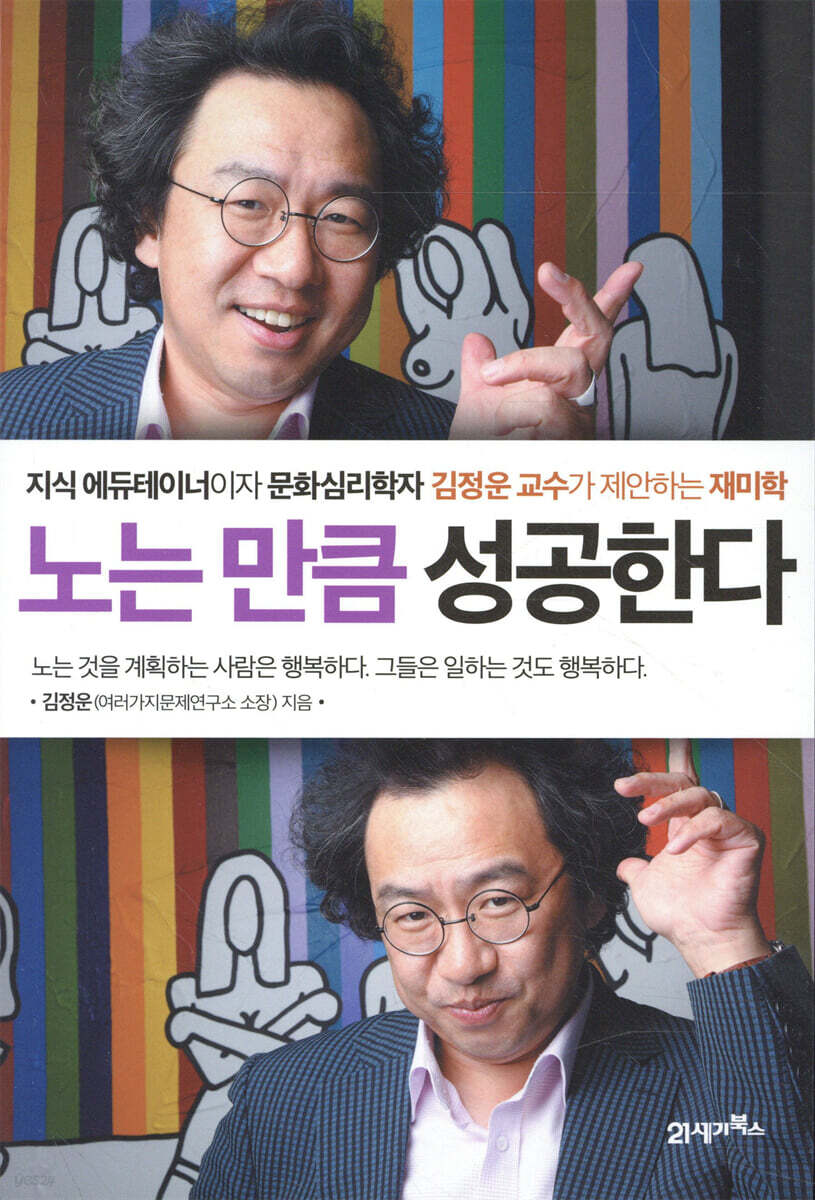
The more you play, the more successful you become.
 |
Description
Book Introduction
“You taught me everything else, so why didn’t you teach me how to rest?”
The Real Problem in Korean Society: Koreans Suffer from "Anxiety When Playing"
These are the words of protest to her father from Se Ri Pak, who rose to the position of a glamorous golf queen after being surrounded solely by golf for 15 years and who is currently in a slump.
“I’m tired of golf.
Now I want to take a break from golf.
“I need to enjoy everyday life other than golf.” Se-ri Pak’s lament sums up the overall crisis in South Korea in one word.
In order to overcome hunger, we rushed forward, making the whole world afraid, but now that hunger has disappeared, we can no longer find a direction.
In this book, Professor Kim Jeong-un argues that our country's real problem is not economic.
The real problem is a collective psychological disease that makes life uninteresting, or 'play-related anxiety disorder.'
It is said that the psychological structure of Koreans, who cannot imagine leisure culture without bomb shots, room salons, and karaoke, is based on a dual attitude toward happiness and fun.
Such shallow leisure culture in Korea ultimately hinders not only individuals but also the nation's competitiveness.
The author defines creativity, which is valued in a knowledge-based society, as psychologically synonymous with fun.
This book provides a detailed and easy-to-understand explanation of the vague claim that people who play well are creative and successful, using various cultural psychological concepts.
In particular, the author's argument that the lack of communication, the most critical problem in Korean society, can be overcome through the restoration of play and fun is quite persuasive.
A truly competitive society is one where everyone can pursue a variety of small pleasures, rather than one where people hide in a dark place and enjoy them with a sense of guilt.
The Real Problem in Korean Society: Koreans Suffer from "Anxiety When Playing"
These are the words of protest to her father from Se Ri Pak, who rose to the position of a glamorous golf queen after being surrounded solely by golf for 15 years and who is currently in a slump.
“I’m tired of golf.
Now I want to take a break from golf.
“I need to enjoy everyday life other than golf.” Se-ri Pak’s lament sums up the overall crisis in South Korea in one word.
In order to overcome hunger, we rushed forward, making the whole world afraid, but now that hunger has disappeared, we can no longer find a direction.
In this book, Professor Kim Jeong-un argues that our country's real problem is not economic.
The real problem is a collective psychological disease that makes life uninteresting, or 'play-related anxiety disorder.'
It is said that the psychological structure of Koreans, who cannot imagine leisure culture without bomb shots, room salons, and karaoke, is based on a dual attitude toward happiness and fun.
Such shallow leisure culture in Korea ultimately hinders not only individuals but also the nation's competitiveness.
The author defines creativity, which is valued in a knowledge-based society, as psychologically synonymous with fun.
This book provides a detailed and easy-to-understand explanation of the vague claim that people who play well are creative and successful, using various cultural psychological concepts.
In particular, the author's argument that the lack of communication, the most critical problem in Korean society, can be overcome through the restoration of play and fun is quite persuasive.
A truly competitive society is one where everyone can pursue a variety of small pleasures, rather than one where people hide in a dark place and enjoy them with a sense of guilt.
index
Prologue: When I'm immersed in work, my mind becomes most incompetent.
Part 1: There's a guy playing above me.
Chapter 1: Korea, Not Knowing How to Have Fun, May Fail
Are you arguing too much?
In the 5-day workweek, manage your free time.
Chapter 2 The opposite of work is not leisure, but laziness.
Pride over incentives
The Workaholic Leader's Misconception: Overthinking
People who have studied play academically(?)
Chapter 3: Play is Synonymous with Creativity
The source of creativity is 'making things strange'
Mona Lisa from Da Vinci's database
Why Only Those Who Have Played Can Be Creative
The most creative brain is the one that spends time staring blankly out the window.
Maybe... ... and maybe?_A Method of Creative Thinking
Chapter 4: Play is the best communication training
'What kind of Batman is this?'_Virtual Play as if
Why mothers around the world speak the same way
The Special Abilities of People Who Play Well: The Ritual of Emotional Sharing
Play is communication
Hutech_Let's risk our lives for small pleasures
Part 2: Let's Make Life a Festival
Chapter 5: If It's Not Fun, It's Not Success
Why do I feel lonely when I am successful?
7 Habits of Successful but Unhappy People
Sudden depression and lethargy_depletion of psychological energy
Manage emotionally!
Let's stick the Eskimo stick in!
Chapter 6 Balance Management_ Work-Life Harmony
If you find yourself mumbling to yourself more often...
Swapping "Important" and "Unimportant": Gestalt Principles
Become the master of your life through festivals
'Even if life deceives you' is fake!
Are you using all your vacation time according to the rules?
21st Century Management Paradigm_Balance Management
Epilogue How do you play like that?
Part 1: There's a guy playing above me.
Chapter 1: Korea, Not Knowing How to Have Fun, May Fail
Are you arguing too much?
In the 5-day workweek, manage your free time.
Chapter 2 The opposite of work is not leisure, but laziness.
Pride over incentives
The Workaholic Leader's Misconception: Overthinking
People who have studied play academically(?)
Chapter 3: Play is Synonymous with Creativity
The source of creativity is 'making things strange'
Mona Lisa from Da Vinci's database
Why Only Those Who Have Played Can Be Creative
The most creative brain is the one that spends time staring blankly out the window.
Maybe... ... and maybe?_A Method of Creative Thinking
Chapter 4: Play is the best communication training
'What kind of Batman is this?'_Virtual Play as if
Why mothers around the world speak the same way
The Special Abilities of People Who Play Well: The Ritual of Emotional Sharing
Play is communication
Hutech_Let's risk our lives for small pleasures
Part 2: Let's Make Life a Festival
Chapter 5: If It's Not Fun, It's Not Success
Why do I feel lonely when I am successful?
7 Habits of Successful but Unhappy People
Sudden depression and lethargy_depletion of psychological energy
Manage emotionally!
Let's stick the Eskimo stick in!
Chapter 6 Balance Management_ Work-Life Harmony
If you find yourself mumbling to yourself more often...
Swapping "Important" and "Unimportant": Gestalt Principles
Become the master of your life through festivals
'Even if life deceives you' is fake!
Are you using all your vacation time according to the rules?
21st Century Management Paradigm_Balance Management
Epilogue How do you play like that?
Into the book
“When the economy is in such difficult times, why are we talking about ‘playing around’?”
This is the story I hear most these days.
Honestly, every time I hear a story like this, there's an answer that comes to mind.
“It is precisely because of you who think like that that the economy is in trouble.” (…omitted…)
The 'play stories' I tell are definitely not just fun stories.
This is a really important story that affects the future of Korea.
There is a reason why I, who studied psychology for 13 years in Germany, go around talking about 'playing games(?)'.
This is because the fundamental problem of Korean society stems from a distorted leisure culture.
--- p.14~16
Psychologically, creativity and fun are synonymous.
It is impossible for a person who finds life completely boring to be creative.
People who are only honest will never survive in the 21st century.
The only people in the world who are stifled are those who are hard-working and honest.
Of course, even in the 21st century, diligence and sincerity are essential virtues.
But that alone is not worth even a penny.
We need to get the fun back.
But take a good look at the expressions on the faces of people walking down the street.
How many happy people are there?
Everyone has an expression on their face as if they can't die.
It's not just adults.
The lives of the youth who will lead Korean society in the 21st century are even more serious.
--- p.16
Freedom, democracy, and equality are instrumental values, but happiness and fun are ultimate values.
But there are too many obstacles to all of us being happy.
These obstacles can be overcome once freedom, democracy and equality are achieved.
But that's not the end of it.
We must constantly learn how to pursue the ultimate values of fun and happiness.
--- p.21
Let's summarize.
People who play well are good at reading other people's minds.
So, listen carefully to what is being said.
And people who play well are comfortable in virtual situations.
Because play always requires imagination about virtual situations.
People who play well are also very good at reflecting on themselves.
Because the ability to look at myself objectively is to place myself in another hypothetical situation.
In the end, people who play well are destined to be happy and live well.
So we have to play well.
Because the essence of play is imagination.
--- p.153~154
The Japanese right wing, who insist that Dokdo is their land, is not something to be feared at all.
But the truly scary Japanese people are the Japanese housewives who chase after Yonsama.
Let's think about it.
How many Korean husbands would be able to tolerate their wives going crazy over a Japanese movie star, flying to Japan and spending days in a state of excitement? In Japan, even this pathetic amusement is accepted.
Husbands also acknowledge it, and Japanese society also recognizes it as a cultural phenomenon.
This is something unimaginable in Korean society.
It is not at all something to be foolishly happy about if our cultural products are sold.
Honestly, I'm scared.
The cultural potential of Japan, which is recognized by the Korean Wave fever of Japanese housewives who are crazy about Yonsama, will take us back in time.
--- p.202~203
It is said that Eskimos walk aimlessly when they feel sadness, worry, or anger welling up inside them.
It is said that you should walk endlessly until your sadness subsides and your worries and anger are relieved, and then turn back when you find peace of mind.
And then, right at that point where you turn around, you put a stick in there.
If you find yourself walking around feeling angry and not knowing what to do, and you find the stick you had previously placed there, it means that life has become more difficult these days. If you can't see the stick, it means that life is bearable.
Rest is a way to put a stop to my life.
It's about having endless conversations with the person inside me and going until peace comes.
And then you come back with a stick stuck in there.
This is the story I hear most these days.
Honestly, every time I hear a story like this, there's an answer that comes to mind.
“It is precisely because of you who think like that that the economy is in trouble.” (…omitted…)
The 'play stories' I tell are definitely not just fun stories.
This is a really important story that affects the future of Korea.
There is a reason why I, who studied psychology for 13 years in Germany, go around talking about 'playing games(?)'.
This is because the fundamental problem of Korean society stems from a distorted leisure culture.
--- p.14~16
Psychologically, creativity and fun are synonymous.
It is impossible for a person who finds life completely boring to be creative.
People who are only honest will never survive in the 21st century.
The only people in the world who are stifled are those who are hard-working and honest.
Of course, even in the 21st century, diligence and sincerity are essential virtues.
But that alone is not worth even a penny.
We need to get the fun back.
But take a good look at the expressions on the faces of people walking down the street.
How many happy people are there?
Everyone has an expression on their face as if they can't die.
It's not just adults.
The lives of the youth who will lead Korean society in the 21st century are even more serious.
--- p.16
Freedom, democracy, and equality are instrumental values, but happiness and fun are ultimate values.
But there are too many obstacles to all of us being happy.
These obstacles can be overcome once freedom, democracy and equality are achieved.
But that's not the end of it.
We must constantly learn how to pursue the ultimate values of fun and happiness.
--- p.21
Let's summarize.
People who play well are good at reading other people's minds.
So, listen carefully to what is being said.
And people who play well are comfortable in virtual situations.
Because play always requires imagination about virtual situations.
People who play well are also very good at reflecting on themselves.
Because the ability to look at myself objectively is to place myself in another hypothetical situation.
In the end, people who play well are destined to be happy and live well.
So we have to play well.
Because the essence of play is imagination.
--- p.153~154
The Japanese right wing, who insist that Dokdo is their land, is not something to be feared at all.
But the truly scary Japanese people are the Japanese housewives who chase after Yonsama.
Let's think about it.
How many Korean husbands would be able to tolerate their wives going crazy over a Japanese movie star, flying to Japan and spending days in a state of excitement? In Japan, even this pathetic amusement is accepted.
Husbands also acknowledge it, and Japanese society also recognizes it as a cultural phenomenon.
This is something unimaginable in Korean society.
It is not at all something to be foolishly happy about if our cultural products are sold.
Honestly, I'm scared.
The cultural potential of Japan, which is recognized by the Korean Wave fever of Japanese housewives who are crazy about Yonsama, will take us back in time.
--- p.202~203
It is said that Eskimos walk aimlessly when they feel sadness, worry, or anger welling up inside them.
It is said that you should walk endlessly until your sadness subsides and your worries and anger are relieved, and then turn back when you find peace of mind.
And then, right at that point where you turn around, you put a stick in there.
If you find yourself walking around feeling angry and not knowing what to do, and you find the stick you had previously placed there, it means that life has become more difficult these days. If you can't see the stick, it means that life is bearable.
Rest is a way to put a stop to my life.
It's about having endless conversations with the person inside me and going until peace comes.
And then you come back with a stick stuck in there.
--- p.263~264
Publisher's Review
The 386 generation that can't play is ruining the country!
Our current society is driven only by anger and hatred.
Professor Kim Jeong-un argues that the biggest reason is that the 386 generation has become the mainstream of Korean society.
The 386 generation, including the author, who spent his college years during the military dictatorship of the early 1980s, is a generation that has been 'consciously' made to feel guilty about pursuing fun and happiness.
They are good at pursuing instrumental values such as freedom, democracy, and equality, but they are ignorant of the ultimate values of fun and happiness that are the purpose of those values.
Because such people have become the mainstream of Korean society and are leading it, this society is still filled with hostility.
The era of struggle is over.
This is not a world where only those who are patient succeed.
It is a world where only those who find life fun and happy succeed.
The paradoxical claim that success does not make you happy, but that you must be happy to be successful is refreshing.
Will I be happy if I play one more day?
He points out that the root cause of Korea's crisis is that too many people have not learned the joy of living because they are working themselves to death to survive, which ultimately leads to a depletion of energy and a paralysis of creativity.
In particular, as the five-day workweek expands, they warn that without a groundbreaking change in leisure culture, rather than improving the quality of life, the phenomenon of two jobs and three jobs, such as the "Brazilianization of labor," will worsen and various side effects such as increased divorce rates, youth problems, and an aging society will arise.
This is presented persuasively along with examples from countries such as Germany and Japan that have previously experienced similar side effects.
The eight-hour workday, or shortening of working hours, became the core agenda of the First International and led to the socialist revolution.
Shorter working hours mean more leisure time.
The 300-year process of modernization in Western society can be summarized as a shortening of working hours and an increase in leisure time.
In other words, today's Western society was possible because there was a period of 300 years during which a leisure culture was formed.
On the other hand, our history of shortening working hours is only 50 years.
It is difficult to imagine our culture as a leisure culture.
It is regrettable that Korean society is truly thoughtless about the introduction of the five-day workweek, which was like the Cultural Revolution.
There is a 'playing guy' above the 'I' guy!'
Workaholics believe they work 70 hours a week.
However, it is said that people who are really good at their jobs only work 40 hours a week.
If you look closely at how workaholics work, you'll find that workaholics who think they work 70 hours a week actually only work 30 hours.
They say that the remaining 40 hours are spent worrying about work rather than working.
The Jewish work philosophy, which has produced a particularly large number of creative talents, is not 'work hard' but 'get a good rest first.'
The philosophy of rest, such as the Sabbath, which requires one day of rest every week, the Sabbath year, which requires one year of rest after six years of work, and the Jubilee year, which requires a rest from laws, institutions, and even nature in the fiftieth year after seven periods of seven years of work, is the most important principle that governs the lives of Jews, regardless of where they live in the world.
In a knowledge-based society where creativity is paramount, diligence and honesty are no longer the highest moral virtues.
It is argued that a creative leisure culture that brings fun and happiness is the core of individual and national competitiveness.
This is because leisure culture is an area where culture is produced and consumed.
In the 20th century, there was a 'flying guy' above a 'running guy', but in the 21st century, there is a 'playing guy' above a 'flying guy'.
Let go of the fantasy of world-changing fun - fun comes from the little things.
Professor Kim Jeong-un says that competitiveness is hidden in small pleasures.
For those who find joy in the little things in life, every day is a festival.
The ability to see the commonplace in a new context and in a 'strange' way is what leads to creativity.
To achieve this, we provide an easy-to-understand explanation, based on case studies and psychological theories, of how to shift your perception, such as by spacing out from time to time and finding small pleasures in everyday life.
Our current society is driven only by anger and hatred.
Professor Kim Jeong-un argues that the biggest reason is that the 386 generation has become the mainstream of Korean society.
The 386 generation, including the author, who spent his college years during the military dictatorship of the early 1980s, is a generation that has been 'consciously' made to feel guilty about pursuing fun and happiness.
They are good at pursuing instrumental values such as freedom, democracy, and equality, but they are ignorant of the ultimate values of fun and happiness that are the purpose of those values.
Because such people have become the mainstream of Korean society and are leading it, this society is still filled with hostility.
The era of struggle is over.
This is not a world where only those who are patient succeed.
It is a world where only those who find life fun and happy succeed.
The paradoxical claim that success does not make you happy, but that you must be happy to be successful is refreshing.
Will I be happy if I play one more day?
He points out that the root cause of Korea's crisis is that too many people have not learned the joy of living because they are working themselves to death to survive, which ultimately leads to a depletion of energy and a paralysis of creativity.
In particular, as the five-day workweek expands, they warn that without a groundbreaking change in leisure culture, rather than improving the quality of life, the phenomenon of two jobs and three jobs, such as the "Brazilianization of labor," will worsen and various side effects such as increased divorce rates, youth problems, and an aging society will arise.
This is presented persuasively along with examples from countries such as Germany and Japan that have previously experienced similar side effects.
The eight-hour workday, or shortening of working hours, became the core agenda of the First International and led to the socialist revolution.
Shorter working hours mean more leisure time.
The 300-year process of modernization in Western society can be summarized as a shortening of working hours and an increase in leisure time.
In other words, today's Western society was possible because there was a period of 300 years during which a leisure culture was formed.
On the other hand, our history of shortening working hours is only 50 years.
It is difficult to imagine our culture as a leisure culture.
It is regrettable that Korean society is truly thoughtless about the introduction of the five-day workweek, which was like the Cultural Revolution.
There is a 'playing guy' above the 'I' guy!'
Workaholics believe they work 70 hours a week.
However, it is said that people who are really good at their jobs only work 40 hours a week.
If you look closely at how workaholics work, you'll find that workaholics who think they work 70 hours a week actually only work 30 hours.
They say that the remaining 40 hours are spent worrying about work rather than working.
The Jewish work philosophy, which has produced a particularly large number of creative talents, is not 'work hard' but 'get a good rest first.'
The philosophy of rest, such as the Sabbath, which requires one day of rest every week, the Sabbath year, which requires one year of rest after six years of work, and the Jubilee year, which requires a rest from laws, institutions, and even nature in the fiftieth year after seven periods of seven years of work, is the most important principle that governs the lives of Jews, regardless of where they live in the world.
In a knowledge-based society where creativity is paramount, diligence and honesty are no longer the highest moral virtues.
It is argued that a creative leisure culture that brings fun and happiness is the core of individual and national competitiveness.
This is because leisure culture is an area where culture is produced and consumed.
In the 20th century, there was a 'flying guy' above a 'running guy', but in the 21st century, there is a 'playing guy' above a 'flying guy'.
Let go of the fantasy of world-changing fun - fun comes from the little things.
Professor Kim Jeong-un says that competitiveness is hidden in small pleasures.
For those who find joy in the little things in life, every day is a festival.
The ability to see the commonplace in a new context and in a 'strange' way is what leads to creativity.
To achieve this, we provide an easy-to-understand explanation, based on case studies and psychological theories, of how to shift your perception, such as by spacing out from time to time and finding small pleasures in everyday life.
GOODS SPECIFICS
- Date of issue: June 2, 2021
- Page count, weight, size: 336 pages | 152*225*30mm
- ISBN13: 9788950995515
- ISBN10: 8950995514
You may also like
카테고리
korean


korean

![GQ KOREA Mark (Monthly): December [2025]](http://librairie.coreenne.fr/cdn/shop/files/8ef265dbbfbf186523ed75ba7319009d.jpg?v=1765340328&width=3840)


