

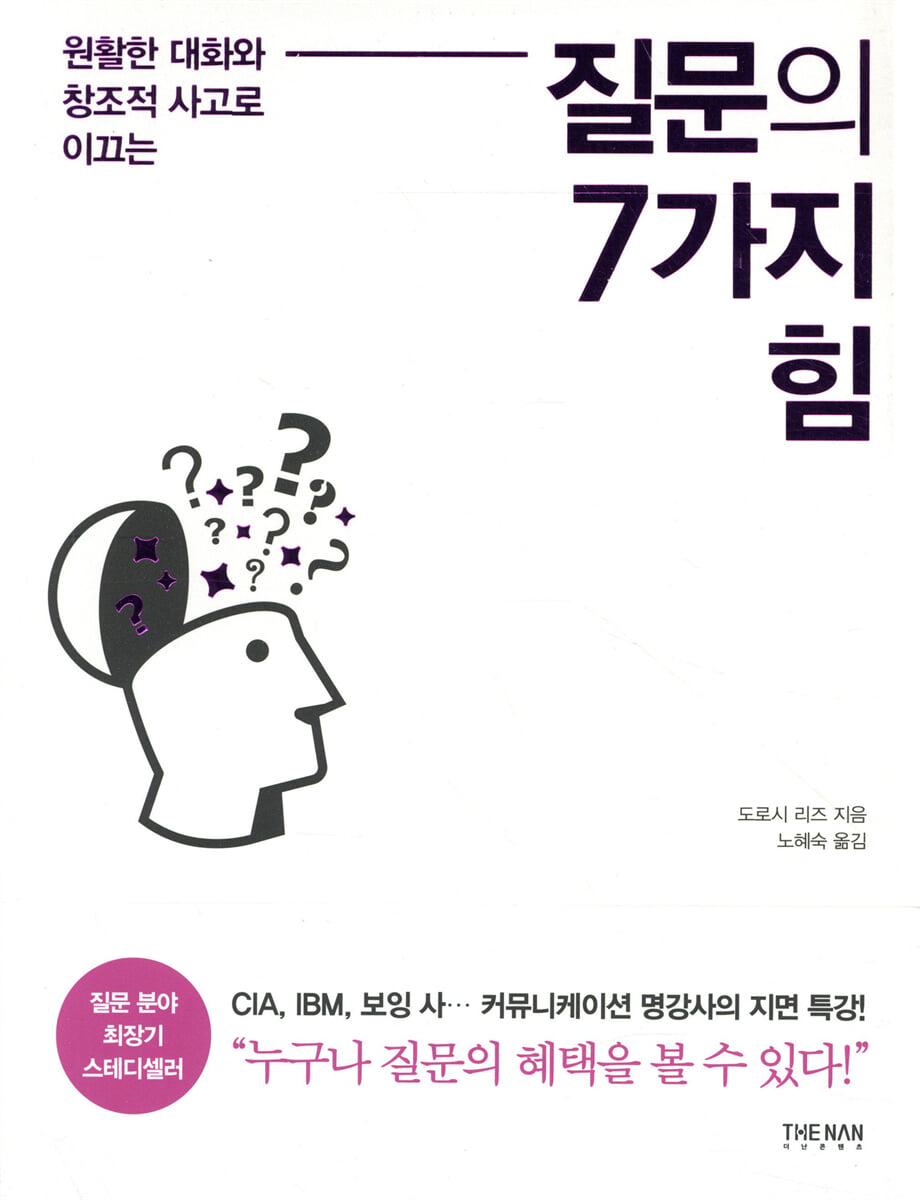
The Seven Powers of Questions
 |
Description
Book Introduction
The longest-running steady seller in the question field
CIA, IBM, Boeing… A special lecture by a renowned communications instructor!
“Good questions lead us to wonderful places.”
Let's keep asking questions until we get a satisfactory answer.
Everything around us is changing due to new technologies such as artificial intelligence, big data, and the Internet of Things.
This is the so-called 4th industrial revolution.
What is most needed in the face of this wave of change is “creative innovation.”
The hallmark of creative people is the ability to ask questions.
Einstein said, “The most important thing is to never stop asking questions.”
In these times when questions are more important than ever, this book, "The 7 Powers of Questions," is a classic in the field of questions that has been loved for over 15 years since its publication.
It explains the seven powers of questions and how appropriate questions asked in everyday life can change our lives, and teaches us how to ask questions that can guide our lives.
The author, a world-renowned motivational speaker and communications consultant, says in one word about questions: “If you harness the power of questions, you can take charge of your own life and decide which path to take.”
Asking questions gives you a chance to think, helps you understand what the other person wants, and stimulates their thinking to generate new ideas.
Additionally, by asking yourself questions in difficult situations, you can control the problems that you might otherwise deal with emotionally, and by consciously and intentionally repeating the questions, you can come up with better solutions.
This book shows how questions are actually used through numerous examples and quotes from famous people about questions.
CIA, IBM, Boeing… A special lecture by a renowned communications instructor!
“Good questions lead us to wonderful places.”
Let's keep asking questions until we get a satisfactory answer.
Everything around us is changing due to new technologies such as artificial intelligence, big data, and the Internet of Things.
This is the so-called 4th industrial revolution.
What is most needed in the face of this wave of change is “creative innovation.”
The hallmark of creative people is the ability to ask questions.
Einstein said, “The most important thing is to never stop asking questions.”
In these times when questions are more important than ever, this book, "The 7 Powers of Questions," is a classic in the field of questions that has been loved for over 15 years since its publication.
It explains the seven powers of questions and how appropriate questions asked in everyday life can change our lives, and teaches us how to ask questions that can guide our lives.
The author, a world-renowned motivational speaker and communications consultant, says in one word about questions: “If you harness the power of questions, you can take charge of your own life and decide which path to take.”
Asking questions gives you a chance to think, helps you understand what the other person wants, and stimulates their thinking to generate new ideas.
Additionally, by asking yourself questions in difficult situations, you can control the problems that you might otherwise deal with emotionally, and by consciously and intentionally repeating the questions, you can come up with better solutions.
This book shows how questions are actually used through numerous examples and quotes from famous people about questions.
index
1.
Why Questions Matter
2.
The first power - when you ask a question, you get an answer.
3.
Second Power - Questions Stimulate Thought
4.
The Third Power: Asking Questions Gets You Information
5.
The Fourth Power: Asking Questions Brings Control
6.
The Fifth Power - Questions Open the Mind
7.
The Sixth Power - Questions Make People Listen
8.
The Seventh Power: Answering Questions Persuades You
9.
Selling, Leading, Thinking - Questions Transform Organizations
10.
Questions to Strengthen Family Bonds
11.
Rediscovering Questions: Reclaiming Curiosity
12.
50 Thought-Provoking Questions
Why Questions Matter
2.
The first power - when you ask a question, you get an answer.
3.
Second Power - Questions Stimulate Thought
4.
The Third Power: Asking Questions Gets You Information
5.
The Fourth Power: Asking Questions Brings Control
6.
The Fifth Power - Questions Open the Mind
7.
The Sixth Power - Questions Make People Listen
8.
The Seventh Power: Answering Questions Persuades You
9.
Selling, Leading, Thinking - Questions Transform Organizations
10.
Questions to Strengthen Family Bonds
11.
Rediscovering Questions: Reclaiming Curiosity
12.
50 Thought-Provoking Questions
Into the book
Often we ask questions that make other people think negatively.
Questions like “Why are you always like that?” or “Why are you so reckless?” cannot be expected to give a rational and positive answer.
Changing the question you ask can change your perspective on the world.
Asking the right questions can help you move forward and get through difficult times.
Asking better questions leads to better answers, and giving better answers leads to better solutions.
Improving your questioning will improve your relationships at home and at work.
--- p.18
Just because someone has the same talent and ability doesn't mean they will necessarily be equally successful.
There are people in various fields who rise above all adversity and failure.
What is the common denominator that enabled them to succeed? I believe it lies in the questions they ask themselves and others.
People who don't succeed ask, "Why me?" But successful people ask,
"How can I leverage this experience? What can I learn from it?" --- p.55
Asking accusatory questions will make the conversation unstable.
And once emotions and excuses get involved, it's difficult to return to a logical conversation.
On the other hand, asking effective questions can get the other person to follow your way of thinking.
If you want the other person to think like you, try using the power of questions to stimulate them.
If you ask questions thoughtfully and sincerely, you can gain information and wisdom by getting the other person to think, solve problems, and devise better ways to handle things.
--- p.119
As a management consultant, I teach about the power of questioning and suggest becoming a "questioning organization" as a more productive and practical alternative to a learning organization.
Many businesses and entrepreneurs remain stuck in automatic, mechanical patterns of behavior.
They do not try to explore the rationality, meaning, and purpose behind their actions.
--- p.182
But there are many reasons why the voices asking questions become quieter as people get older.
When we meet someone who seems smarter, more authoritative, or more accomplished than us, we are afraid that we will appear foolish or inadequate.
They may feel shy in front of strangers or keep their mouths shut because they cannot express their thoughts clearly in words.
Often times, you don't even know what questions to ask.
--- p.230
When you become an adult, you only ask questions once and then stop.
Don't repeat the question.
Don't ask why other people do something.
My curiosity about the world has disappeared.
Rather, we fear what we will learn about the world, people, and especially ourselves.
Earlier I talked about the child within us.
Let us discover the curious child asking questions in our hearts, even now.
Let's keep asking questions until we get a satisfactory answer.
Questions like “Why are you always like that?” or “Why are you so reckless?” cannot be expected to give a rational and positive answer.
Changing the question you ask can change your perspective on the world.
Asking the right questions can help you move forward and get through difficult times.
Asking better questions leads to better answers, and giving better answers leads to better solutions.
Improving your questioning will improve your relationships at home and at work.
--- p.18
Just because someone has the same talent and ability doesn't mean they will necessarily be equally successful.
There are people in various fields who rise above all adversity and failure.
What is the common denominator that enabled them to succeed? I believe it lies in the questions they ask themselves and others.
People who don't succeed ask, "Why me?" But successful people ask,
"How can I leverage this experience? What can I learn from it?" --- p.55
Asking accusatory questions will make the conversation unstable.
And once emotions and excuses get involved, it's difficult to return to a logical conversation.
On the other hand, asking effective questions can get the other person to follow your way of thinking.
If you want the other person to think like you, try using the power of questions to stimulate them.
If you ask questions thoughtfully and sincerely, you can gain information and wisdom by getting the other person to think, solve problems, and devise better ways to handle things.
--- p.119
As a management consultant, I teach about the power of questioning and suggest becoming a "questioning organization" as a more productive and practical alternative to a learning organization.
Many businesses and entrepreneurs remain stuck in automatic, mechanical patterns of behavior.
They do not try to explore the rationality, meaning, and purpose behind their actions.
--- p.182
But there are many reasons why the voices asking questions become quieter as people get older.
When we meet someone who seems smarter, more authoritative, or more accomplished than us, we are afraid that we will appear foolish or inadequate.
They may feel shy in front of strangers or keep their mouths shut because they cannot express their thoughts clearly in words.
Often times, you don't even know what questions to ask.
--- p.230
When you become an adult, you only ask questions once and then stop.
Don't repeat the question.
Don't ask why other people do something.
My curiosity about the world has disappeared.
Rather, we fear what we will learn about the world, people, and especially ourselves.
Earlier I talked about the child within us.
Let us discover the curious child asking questions in our hearts, even now.
Let's keep asking questions until we get a satisfactory answer.
--- p.275
Publisher's Review
When you ask questions, you get surprising and surprising results!
One day, the author was diagnosed with breast cancer.
Unfortunately, I asked the not-so-detailed doctor, “What are my options?” and he said a mastectomy was my only option.
After visiting other doctors and asking questions, the author learned about a new treatment at the time and was cured.
In the process, the author realized that questions can save lives.
Additionally, the author confesses that most of the important events that occurred in his life were the result of questions.
Human progress has not been achieved without questions.
Every invention, discovery, or theory is the result of a question that stimulates thought.
"Can't I fly like a bird?", "Why do we live?", "Can't we live more comfortably?", "Is there a way to sell products to customers?" We are surrounded by countless things that would never have seen the light of day if it weren't for the questions that began with simple curiosity.
The author prides himself on knowing more about questions than anyone else, and hopes that through this book, anyone can benefit from the power of questions, just as he has.
It also provides a new perspective by covering in detail the questions that have great power in interpersonal relationships, communication skills, and problem solving.
When you ask questions, you get surprising and surprising results.
Most people don't realize that using questions wisely can greatly improve their lives.
In my youth, I benefited greatly from questions, yet I never really thought much about their power.
Then, as I became more active in my work, I began to realize the tremendous value of questions, not only in the economy but also in all aspects of life.
-Page 12
What and how should we ask?
We ask questions to generate fresher and more original thinking, to understand the situations we face every day more clearly, or to create mental and emotional turning points.
But can everything be solved by simply asking “Why?” or “For what reason?”?
Of course not.
First, you must get rid of the fear of the other person's status, power, and amount of knowledge, and the fear that you might appear ignorant and shabby.
Only then can we feel and utilize the power of the questions this book seeks to convey.
And before you ask a question, you must ask a question.
“Why do I want to ask the question?”
And what and how should we ask?
The method and content of your questions should vary depending on whether the person you're talking to is your boss, a purchasing agent, a customer looking to buy a car, a husband who's indifferent to household chores, or a teenager, and whether you're simply trying to make conversation, sell something, or persuade someone to agree with you.
Questions are a powerful tool not only for interpersonal relationships but also for self-reflection.
You can change the direction of your thinking by asking yourself questions.
This book guides us to a wonderful place by presenting a variety of questions that organizations and individuals can immediately try.
The 7 Powers of Questions!
So what are the seven powers of questions that the author speaks of?
The first power - Asking questions leads to answers: Will asking questions always lead to answers? No.
Because we don't want an answer like 3+3=6.
In other words, the question should be “What can I help you with?” rather than “Can I help you?”
Instead of asking, “What should I have for dinner tonight?” you should ask, “I can prepare chicken or fish for dinner tonight. Which would be better?”
Although it may seem like the same question, it gives the person answering the question time to think concretely, and it sets a radius in which the person asking the question can act.
Second Power - Questions Provoke Thought: Let's say you get scolded after submitting a report.
When that happens, our common thoughts turn into complaints like, "Why am I so stupid? Why can't I do anything right? Can you expect me to do something right without giving me the proper information?"
Here we need to change the question into a realistic and answerable one.
"How do I submit a complete report? Do I fully understand the assignment? Do I need more detailed explanations from my supervisor? What parts of the report were successful? What areas need improvement? Is there someone I can turn to for help or guidance?"
Third Power - Asking Questions Gets You Information: Going to a sales pitch and trying to explain things to someone who isn't in charge is pointless.
“Is there anyone who can give me information about this issue?”, “Who has the authority to make decisions on this issue?” In other words, you need to ask ‘who, when, where, what (which), and why’ precisely.
We need to study how investigators and detectives ask questions.
That way, you can get the information and answers you want on the spot.
The Fourth Power - Asking Questions Takes Control: On a day when you're so busy that you don't even have time to blink, when your to-do list is piling up, and you're panting and frustrated, ask yourself a question.
"Is this situation really something that should be bothering me? What absolutely must be done today, and what can be put off until tomorrow, the day after tomorrow, or next week?" These questions help you control your emotions and your situation.
And sometimes you can ask questions that control the other person.
However, questions that are meant to control the other person can sometimes lead to excuses or feelings of shame.
You must learn to control your questions to solve problems, make others cooperative, defuse anger, and get them to think in a certain direction through positive control.
The Fifth Power - Questions Open Minds: Sometimes we make the mistake of asking a question and then formulating the answer before the other person even opens their mouth.
If you don't open your heart to the other person, you can't have a conversation and you can't expect answers to your questions.
First, you should try to establish rapport with the other person and ask open-ended questions so that the other person can fully reveal themselves.
If you want to know about facts and feelings, ask for the facts first and talk about your feelings about the situation later.
And you have to make sure that the other person feels comfortable enough to tell their story.
The sixth power - questions make you listen: When you listen to someone, you don't just nod your head.
You must prepare to listen with your eyes, ears, brain, and heart.
And when the other person is talking to me, when I ask questions, I should listen while thinking about what the most important purpose is.
That is, “Do you want me to just listen?”, “Do you want me to talk and ask questions?”, “Do you want me to give you advice?”
The Seventh Power - Answering Questions Persuades You: Nobody likes to be nagged.
If you ask a child who doesn't clean his room, "Why do you make a mess and never clean it?" the child will say, "My room can be messy, my way.
All I get back is a retort, “Don’t worry about it.”
You shouldn't insist that you buy a new car no matter what.
You need to know how much it costs to maintain your existing car and how it compares to buying a new car.
To customers who complain that your company's products are expensive, you need to explain why they are expensive and what benefits they receive in return for the high price.
Sometimes persuasion becomes a natural process that is accepted through questions.
Questions Transform Organizations: We also cover how to use questions to create organizations that think, change, and thrive.
And questions that strengthen family bonds: We teach you how to ask questions that foster smooth communication and creative thinking with children and spouses within the home.
Rediscovering Questions: Rediscovering Curiosity: Another way to cultivate the power of questions is to rediscover the innocent self that used to ask questions like “What is this?”, “Why is that?”, and “Why does it happen that way?” with eyes full of curiosity as a child.
Recommendation
This special book can improve our interpersonal relationships.
Let us enjoy the joy of reading this book, digesting it, and reaping the harvest.
-Steven R.
Dr. Covey, author of The 7 Habits of Highly Effective People
This book, brimming with insight and practical application, teaches us a radically new way to transform ordinary conversation tools into powerful allies.
-Michael R.
Bloomberg, former New York City mayor
'Ask and you will receive' This leads to a very important question.
“What should I seek?” and “How should I obtain what I seek?” can be found out by reading this book.
-Dr. Michael LeBoeuf, author of "How to Create Customers for Life"
Conversations with colleagues, business partners, customers, and friends require asking the right questions.
This book provides the necessary guidance for such encounters and teaches the power of questions that can shine in any setting.
-Susan Roan, author of "How to Make Space and What to Say Next"
Serious, wise questions transform our lives, our work, and our relationships.
Learn the art of asking questions and see how your life becomes richer.
-Terry Williams, author of Human Touch
One day, the author was diagnosed with breast cancer.
Unfortunately, I asked the not-so-detailed doctor, “What are my options?” and he said a mastectomy was my only option.
After visiting other doctors and asking questions, the author learned about a new treatment at the time and was cured.
In the process, the author realized that questions can save lives.
Additionally, the author confesses that most of the important events that occurred in his life were the result of questions.
Human progress has not been achieved without questions.
Every invention, discovery, or theory is the result of a question that stimulates thought.
"Can't I fly like a bird?", "Why do we live?", "Can't we live more comfortably?", "Is there a way to sell products to customers?" We are surrounded by countless things that would never have seen the light of day if it weren't for the questions that began with simple curiosity.
The author prides himself on knowing more about questions than anyone else, and hopes that through this book, anyone can benefit from the power of questions, just as he has.
It also provides a new perspective by covering in detail the questions that have great power in interpersonal relationships, communication skills, and problem solving.
When you ask questions, you get surprising and surprising results.
Most people don't realize that using questions wisely can greatly improve their lives.
In my youth, I benefited greatly from questions, yet I never really thought much about their power.
Then, as I became more active in my work, I began to realize the tremendous value of questions, not only in the economy but also in all aspects of life.
-Page 12
What and how should we ask?
We ask questions to generate fresher and more original thinking, to understand the situations we face every day more clearly, or to create mental and emotional turning points.
But can everything be solved by simply asking “Why?” or “For what reason?”?
Of course not.
First, you must get rid of the fear of the other person's status, power, and amount of knowledge, and the fear that you might appear ignorant and shabby.
Only then can we feel and utilize the power of the questions this book seeks to convey.
And before you ask a question, you must ask a question.
“Why do I want to ask the question?”
And what and how should we ask?
The method and content of your questions should vary depending on whether the person you're talking to is your boss, a purchasing agent, a customer looking to buy a car, a husband who's indifferent to household chores, or a teenager, and whether you're simply trying to make conversation, sell something, or persuade someone to agree with you.
Questions are a powerful tool not only for interpersonal relationships but also for self-reflection.
You can change the direction of your thinking by asking yourself questions.
This book guides us to a wonderful place by presenting a variety of questions that organizations and individuals can immediately try.
The 7 Powers of Questions!
So what are the seven powers of questions that the author speaks of?
The first power - Asking questions leads to answers: Will asking questions always lead to answers? No.
Because we don't want an answer like 3+3=6.
In other words, the question should be “What can I help you with?” rather than “Can I help you?”
Instead of asking, “What should I have for dinner tonight?” you should ask, “I can prepare chicken or fish for dinner tonight. Which would be better?”
Although it may seem like the same question, it gives the person answering the question time to think concretely, and it sets a radius in which the person asking the question can act.
Second Power - Questions Provoke Thought: Let's say you get scolded after submitting a report.
When that happens, our common thoughts turn into complaints like, "Why am I so stupid? Why can't I do anything right? Can you expect me to do something right without giving me the proper information?"
Here we need to change the question into a realistic and answerable one.
"How do I submit a complete report? Do I fully understand the assignment? Do I need more detailed explanations from my supervisor? What parts of the report were successful? What areas need improvement? Is there someone I can turn to for help or guidance?"
Third Power - Asking Questions Gets You Information: Going to a sales pitch and trying to explain things to someone who isn't in charge is pointless.
“Is there anyone who can give me information about this issue?”, “Who has the authority to make decisions on this issue?” In other words, you need to ask ‘who, when, where, what (which), and why’ precisely.
We need to study how investigators and detectives ask questions.
That way, you can get the information and answers you want on the spot.
The Fourth Power - Asking Questions Takes Control: On a day when you're so busy that you don't even have time to blink, when your to-do list is piling up, and you're panting and frustrated, ask yourself a question.
"Is this situation really something that should be bothering me? What absolutely must be done today, and what can be put off until tomorrow, the day after tomorrow, or next week?" These questions help you control your emotions and your situation.
And sometimes you can ask questions that control the other person.
However, questions that are meant to control the other person can sometimes lead to excuses or feelings of shame.
You must learn to control your questions to solve problems, make others cooperative, defuse anger, and get them to think in a certain direction through positive control.
The Fifth Power - Questions Open Minds: Sometimes we make the mistake of asking a question and then formulating the answer before the other person even opens their mouth.
If you don't open your heart to the other person, you can't have a conversation and you can't expect answers to your questions.
First, you should try to establish rapport with the other person and ask open-ended questions so that the other person can fully reveal themselves.
If you want to know about facts and feelings, ask for the facts first and talk about your feelings about the situation later.
And you have to make sure that the other person feels comfortable enough to tell their story.
The sixth power - questions make you listen: When you listen to someone, you don't just nod your head.
You must prepare to listen with your eyes, ears, brain, and heart.
And when the other person is talking to me, when I ask questions, I should listen while thinking about what the most important purpose is.
That is, “Do you want me to just listen?”, “Do you want me to talk and ask questions?”, “Do you want me to give you advice?”
The Seventh Power - Answering Questions Persuades You: Nobody likes to be nagged.
If you ask a child who doesn't clean his room, "Why do you make a mess and never clean it?" the child will say, "My room can be messy, my way.
All I get back is a retort, “Don’t worry about it.”
You shouldn't insist that you buy a new car no matter what.
You need to know how much it costs to maintain your existing car and how it compares to buying a new car.
To customers who complain that your company's products are expensive, you need to explain why they are expensive and what benefits they receive in return for the high price.
Sometimes persuasion becomes a natural process that is accepted through questions.
Questions Transform Organizations: We also cover how to use questions to create organizations that think, change, and thrive.
And questions that strengthen family bonds: We teach you how to ask questions that foster smooth communication and creative thinking with children and spouses within the home.
Rediscovering Questions: Rediscovering Curiosity: Another way to cultivate the power of questions is to rediscover the innocent self that used to ask questions like “What is this?”, “Why is that?”, and “Why does it happen that way?” with eyes full of curiosity as a child.
Recommendation
This special book can improve our interpersonal relationships.
Let us enjoy the joy of reading this book, digesting it, and reaping the harvest.
-Steven R.
Dr. Covey, author of The 7 Habits of Highly Effective People
This book, brimming with insight and practical application, teaches us a radically new way to transform ordinary conversation tools into powerful allies.
-Michael R.
Bloomberg, former New York City mayor
'Ask and you will receive' This leads to a very important question.
“What should I seek?” and “How should I obtain what I seek?” can be found out by reading this book.
-Dr. Michael LeBoeuf, author of "How to Create Customers for Life"
Conversations with colleagues, business partners, customers, and friends require asking the right questions.
This book provides the necessary guidance for such encounters and teaches the power of questions that can shine in any setting.
-Susan Roan, author of "How to Make Space and What to Say Next"
Serious, wise questions transform our lives, our work, and our relationships.
Learn the art of asking questions and see how your life becomes richer.
-Terry Williams, author of Human Touch
GOODS SPECIFICS
- Date of issue: June 1, 2016
- Page count, weight, size: 288 pages | 490g | 170*225*20mm
- ISBN13: 9788984058552
- ISBN10: 8984058556
You may also like
카테고리
korean


korean

![GQ KOREA Mark (Monthly): December [2025]](http://librairie.coreenne.fr/cdn/shop/files/8ef265dbbfbf186523ed75ba7319009d.jpg?v=1765340328&width=3840)


