

Practice not responding
 |
Description
Book Introduction
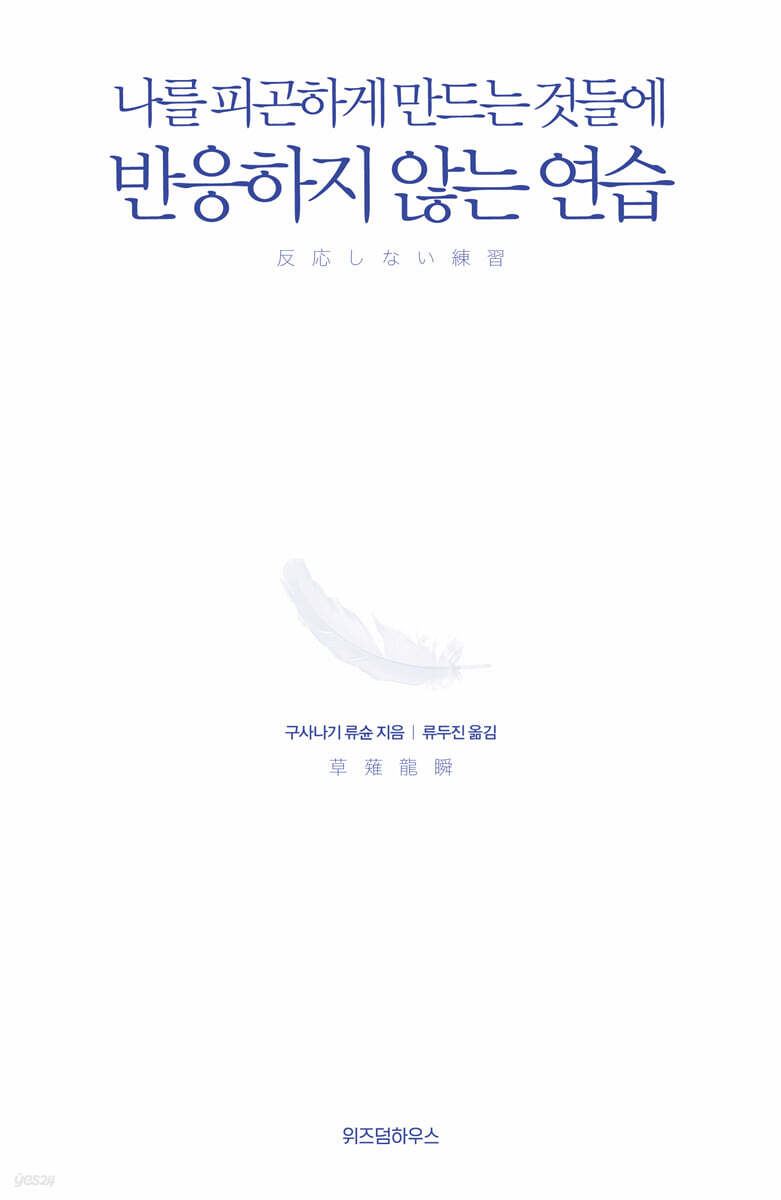
Bestseller on Amazon Japan for 22 consecutive weeks!! Practice freeing yourself from things and people that tire you out! The message is overflowing that quick decision-making is valued in pursuit of greater profits, and that even lunch hours and commuting times must be utilized to avoid being left behind in the competition. This message of each for himself is valid not only in Korean society but also in Japan, which is desperately trying to recover its economy after 20 lost years. Reflecting this social climate, in Japanese bookstores where self-help books with messages like "Don't rest and keep sensing the changes in the world" and "Survive the competition" were very popular, there is a book that has been a long-term bestseller with the message "Don't react to external stimuli." It is “Practice of Not Reacting” (published by Wisdom House). The message this book wants to convey is simple. To get away from all the things that make me tired, I have to stop the useless 'reactions'. This reaction becomes the starting point of all worries, including anger and anxiety. Moreover, modern people are constantly exposed to stimulating information and messages in addition to the worries that arise in daily life, making it difficult to maintain normal emotions and becoming constantly engulfed in anxiety. The author counsels people whose lives are wracked by unnecessary, excessive emotions and self-created worries, and he realizes that to escape suffering, one must stop reacting to the unnecessary stimuli that dominate daily life. This book, written with the aim of alleviating even a single bit of life's suffering, contains the message of restoring positivity in life and freeing oneself from negative emotions by not reacting to every passing event. This book has been well-received locally since its publication, with reviews praising it as helping people who have struggled with interpersonal relationships and those who have been dwelling on past mistakes to reflect on themselves and free themselves from a life of constant pressure. |
- You can preview some of the book's contents.
Preview
index
Practice not responding
Prologue - All suffering begins with the mind's reaction.
Chapter 1: Before Reacting, Understand First
Worries don't get rid of you, they just disappear.
Focus on the cause of the problem
Read the state of mind as it is
Chapter 2: Practice Not Judging Good or Bad
Useless judgments increase worry.
Excessive positivity can also cause suffering.
Break free from the habit of making rash judgments
Never deny me at any moment
The moment you stop judging, your confidence increases.
Chapter 3: Practice Letting Go of Negative Emotions
Avoid harm by reacting emotionally
How to Relate Easily to Uncomfortable People
The Emotional Principles That Make Everyday Life Enjoyable
Chapter 4: Practice Feeling Free from the Gaze of Others
Other people's opinions don't matter
Keep your distance from annoying people
I focus on my work and avoid comparisons.
Chapter 5: Practice Breaking Free from the False Reality of Competition
Competition is nothing but an illusion
Life is not an either/or choice.
If you want to achieve your goals, be aware of the 'five obstacles'.
Free yourself from the thought that 'I lost'
Chapter 6: I don't react to things that make me tired.
Create a place of refuge you can return to at any time
The hope that tomorrow will be better
The courage to believe in my life
Prologue - All suffering begins with the mind's reaction.
Chapter 1: Before Reacting, Understand First
Worries don't get rid of you, they just disappear.
Focus on the cause of the problem
Read the state of mind as it is
Chapter 2: Practice Not Judging Good or Bad
Useless judgments increase worry.
Excessive positivity can also cause suffering.
Break free from the habit of making rash judgments
Never deny me at any moment
The moment you stop judging, your confidence increases.
Chapter 3: Practice Letting Go of Negative Emotions
Avoid harm by reacting emotionally
How to Relate Easily to Uncomfortable People
The Emotional Principles That Make Everyday Life Enjoyable
Chapter 4: Practice Feeling Free from the Gaze of Others
Other people's opinions don't matter
Keep your distance from annoying people
I focus on my work and avoid comparisons.
Chapter 5: Practice Breaking Free from the False Reality of Competition
Competition is nothing but an illusion
Life is not an either/or choice.
If you want to achieve your goals, be aware of the 'five obstacles'.
Free yourself from the thought that 'I lost'
Chapter 6: I don't react to things that make me tired.
Create a place of refuge you can return to at any time
The hope that tomorrow will be better
The courage to believe in my life
Detailed image
Into the book
Practice not responding
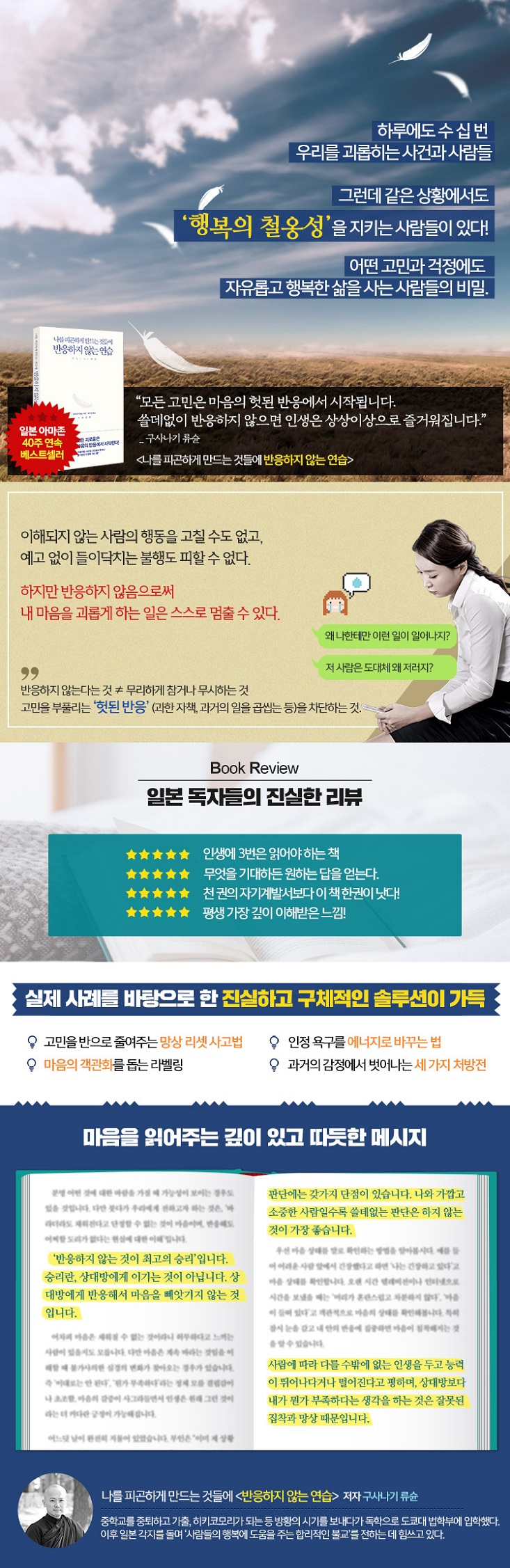
People often say that worries are inseparable from life.
However, not many people know the true nature of the problem.
Even if you feel a vague sense of deficiency and think, "Is this okay?", the problem is not easily solved because you don't know the true nature of your worries.
We harbor negative emotions like regret, anger, disappointment, depression, and anxiety at work or at home, but we don't know how to think about them in order to resolve them.
Because of this, the feeling of lack for no reason will remain inside me forever.
---From "Understand First Before Reacting"
One of the reasons people get into trouble is because they are overly judgmental.
Judgment is the act of forming conclusions or preconceived notions about whether something is meaningful or not, whether life is worth living or not, or whether one is superior or inferior when comparing oneself to another.
Self-deprecation like, "I'm the same anyway," is a judgment, disappointment or discouragement like, "I failed," "This is the worst," or "The bullies are fierce," anxiety or hesitation like, "What if things don't go well?", and character evaluations like, "I don't like that person and it's hard to deal with them" are also judgments.
Such judgments create a lot of troubles, such as dissatisfaction, depression, and anxiety.
---From "Chapter 2: Practice Not Judging Good and Bad"
To begin with, each person thinks with a different 'brain'.
So, naturally, the way of thinking is bound to be different.
People often secretly expect others to think the same way they do, but these expectations and preconceptions are nothing more than delusions.
Moreover, the desire to be acknowledged, which is the desire to be right, is always at work in the mind of ‘I am right’.
So when we encounter different opinions, we feel like we have been rejected and react with anger.
(Omitted) ‘Distinguish between the other person’s reactions and my own’, ‘Leave the other person’s reactions to the other person.’ This is the basic mindset to avoid worrying about interpersonal relationships.
---From "Chapter 3: Practice Shaking Off Negative Emotions"
Why do people want to compare themselves to others? Reading an article in a magazine about the average salary of people my age can be both reassuring and depressing.
When I read articles about people active in all walks of life, I sometimes feel a sense of burden or anxiety.
The mind is always turned towards the outside world, gathering various information such as occupation, status, income, appearance, education, and evaluation to gauge one's own position.
What is the source of this psychology? The purpose of comparison is simple.
After all, it is about wanting to satisfy the need for recognition and feel secure.
I want to think, 'I'm a pretty good person, and I'm not that bad.'
---From "Chapter 4: Practice of Feeling Free from the Gaze of Others"
What is competition in the first place? (Omitted) All living things desire to have their greed satisfied.
It is programmed into our brains that the purpose of our lives is to acquire something that will satisfy our greed.
However, the visible things necessary for survival, such as food, shelter, and clothing, do not satisfy human desires.
Symbolic signs that satisfy a person's need for recognition, such as status, education, appearance, career, and brand, are also included in satisfying human greed.
However, these symbols are limited in quantity.
So begins a scramble among people who want the same thing.
Conquest is victory.
This is where the competition begins.
---From "Chapter 5: Practice to Escape the False Reality of Competition"
This is because we believe that the answer to our own happiness lies within the world, and that if we work hard to acquire something of social value, we will surely be satisfied.
But if you think about it, what that 'desire' always brought was a thirst in my heart that 'there's something missing'.
People are inherently greedy, angry, and delusional.
In a way, the world turns by cleverly stimulating and exploiting these human anxieties.
If so, seeking answers in such a world will only result in greed, anger, and delusion.
Therefore, people cannot escape the cycle of hope and disappointment, that is, the cycle of the mind.
We must realize the true nature of the world.
People often say that worries are inseparable from life.
However, not many people know the true nature of the problem.
Even if you feel a vague sense of deficiency and think, "Is this okay?", the problem is not easily solved because you don't know the true nature of your worries.
We harbor negative emotions like regret, anger, disappointment, depression, and anxiety at work or at home, but we don't know how to think about them in order to resolve them.
Because of this, the feeling of lack for no reason will remain inside me forever.
---From "Understand First Before Reacting"
One of the reasons people get into trouble is because they are overly judgmental.
Judgment is the act of forming conclusions or preconceived notions about whether something is meaningful or not, whether life is worth living or not, or whether one is superior or inferior when comparing oneself to another.
Self-deprecation like, "I'm the same anyway," is a judgment, disappointment or discouragement like, "I failed," "This is the worst," or "The bullies are fierce," anxiety or hesitation like, "What if things don't go well?", and character evaluations like, "I don't like that person and it's hard to deal with them" are also judgments.
Such judgments create a lot of troubles, such as dissatisfaction, depression, and anxiety.
---From "Chapter 2: Practice Not Judging Good and Bad"
To begin with, each person thinks with a different 'brain'.
So, naturally, the way of thinking is bound to be different.
People often secretly expect others to think the same way they do, but these expectations and preconceptions are nothing more than delusions.
Moreover, the desire to be acknowledged, which is the desire to be right, is always at work in the mind of ‘I am right’.
So when we encounter different opinions, we feel like we have been rejected and react with anger.
(Omitted) ‘Distinguish between the other person’s reactions and my own’, ‘Leave the other person’s reactions to the other person.’ This is the basic mindset to avoid worrying about interpersonal relationships.
---From "Chapter 3: Practice Shaking Off Negative Emotions"
Why do people want to compare themselves to others? Reading an article in a magazine about the average salary of people my age can be both reassuring and depressing.
When I read articles about people active in all walks of life, I sometimes feel a sense of burden or anxiety.
The mind is always turned towards the outside world, gathering various information such as occupation, status, income, appearance, education, and evaluation to gauge one's own position.
What is the source of this psychology? The purpose of comparison is simple.
After all, it is about wanting to satisfy the need for recognition and feel secure.
I want to think, 'I'm a pretty good person, and I'm not that bad.'
---From "Chapter 4: Practice of Feeling Free from the Gaze of Others"
What is competition in the first place? (Omitted) All living things desire to have their greed satisfied.
It is programmed into our brains that the purpose of our lives is to acquire something that will satisfy our greed.
However, the visible things necessary for survival, such as food, shelter, and clothing, do not satisfy human desires.
Symbolic signs that satisfy a person's need for recognition, such as status, education, appearance, career, and brand, are also included in satisfying human greed.
However, these symbols are limited in quantity.
So begins a scramble among people who want the same thing.
Conquest is victory.
This is where the competition begins.
---From "Chapter 5: Practice to Escape the False Reality of Competition"
This is because we believe that the answer to our own happiness lies within the world, and that if we work hard to acquire something of social value, we will surely be satisfied.
But if you think about it, what that 'desire' always brought was a thirst in my heart that 'there's something missing'.
People are inherently greedy, angry, and delusional.
In a way, the world turns by cleverly stimulating and exploiting these human anxieties.
If so, seeking answers in such a world will only result in greed, anger, and delusion.
Therefore, people cannot escape the cycle of hope and disappointment, that is, the cycle of the mind.
We must realize the true nature of the world.
---From "Chapter 6: I Don't Respond to Things That Make Me Tired"
Publisher's Review
Practice not responding
In the vicious cycle of misfortune, there are 'emotions that create worry'!
One truth realized by the author who experienced life's roller coaster.
The author, who dropped out of middle school, went through a period of wandering, and then entered the University of Tokyo through self-study, experienced both the lowest points of life and the places where the best talents gathered, and witnessed people who drove themselves into misery.
Everywhere, people have always been obsessed with invisible standards like grades and rankings, throwing themselves into the whirlpool of competition, but they have achieved nothing until the end of their lives.
All they had left were negative emotions like anger and dissatisfaction, and a sense of defeat at living a life that was left behind.
Through this experience, the author realized that he must break the vicious cycle of "vain reactions" that lead people's lives to misery. After becoming a monk, he gained a stronger conviction through counseling various people.
The book says that in order to stop the 'futile reactions of the mind', it is important to look at 'the state of mind as it is' and judge the problems we encounter in daily life by whether they 'help life'.
By understanding the reactions of your own mind as they are and not reacting to anything that is not beneficial to your life, you can gain the strength to fully accept yourself in this moment and live your life going forward.
Not reacting is the best victory!
Practical solutions you can use right away in your daily life
The book's greatest strength is that it presents simple and easy-to-practice methods for coping with the fatigue that comes from work and relationships.
It teaches you ways to 'not react in vain' that can be used in everyday life, such as 'checking your state of mind with words' to prevent your thoughts from flowing in a negative direction by expressing your current actions and state of mind in words, 'concentrating on the sensations of your body' such as your fingertips and toes while walking outside when you feel negative emotions to prevent unnecessary reactions, and 'how to build relationships with uncomfortable people' to treat each meeting as if it were the first time you had met.
From now on, through the practice of non-reaction, you will gain the wisdom to break free from all that has been weighing you down, and experience a life-changing change that will allow you to face each day with greater positivity.
Also, if you keep it by your side and read it slowly and thoughtfully, the simple and clear solution called “practice of non-reaction” will become an exit from your frustrating life.
☆☆☆☆☆Reactions from readers who read this book first!
* This book will make you feel at ease, as if you were receiving psychiatric counseling, and will help you endure difficult emotions as the master of your own emotions.
* I used to always hurt and hurt myself over trivial things, but after reading the book, I gained the courage to face my heart.
* I have found hope that I can live happily just by not reacting to things that hurt me.
* This book offers comfort and solutions to those who only blame themselves for any problem.
* I would like to recommend this to people who have been hurt in their relationships with others and who find life difficult.
In the vicious cycle of misfortune, there are 'emotions that create worry'!
One truth realized by the author who experienced life's roller coaster.
The author, who dropped out of middle school, went through a period of wandering, and then entered the University of Tokyo through self-study, experienced both the lowest points of life and the places where the best talents gathered, and witnessed people who drove themselves into misery.
Everywhere, people have always been obsessed with invisible standards like grades and rankings, throwing themselves into the whirlpool of competition, but they have achieved nothing until the end of their lives.
All they had left were negative emotions like anger and dissatisfaction, and a sense of defeat at living a life that was left behind.
Through this experience, the author realized that he must break the vicious cycle of "vain reactions" that lead people's lives to misery. After becoming a monk, he gained a stronger conviction through counseling various people.
The book says that in order to stop the 'futile reactions of the mind', it is important to look at 'the state of mind as it is' and judge the problems we encounter in daily life by whether they 'help life'.
By understanding the reactions of your own mind as they are and not reacting to anything that is not beneficial to your life, you can gain the strength to fully accept yourself in this moment and live your life going forward.
Not reacting is the best victory!
Practical solutions you can use right away in your daily life
The book's greatest strength is that it presents simple and easy-to-practice methods for coping with the fatigue that comes from work and relationships.
It teaches you ways to 'not react in vain' that can be used in everyday life, such as 'checking your state of mind with words' to prevent your thoughts from flowing in a negative direction by expressing your current actions and state of mind in words, 'concentrating on the sensations of your body' such as your fingertips and toes while walking outside when you feel negative emotions to prevent unnecessary reactions, and 'how to build relationships with uncomfortable people' to treat each meeting as if it were the first time you had met.
From now on, through the practice of non-reaction, you will gain the wisdom to break free from all that has been weighing you down, and experience a life-changing change that will allow you to face each day with greater positivity.
Also, if you keep it by your side and read it slowly and thoughtfully, the simple and clear solution called “practice of non-reaction” will become an exit from your frustrating life.
☆☆☆☆☆Reactions from readers who read this book first!
* This book will make you feel at ease, as if you were receiving psychiatric counseling, and will help you endure difficult emotions as the master of your own emotions.
* I used to always hurt and hurt myself over trivial things, but after reading the book, I gained the courage to face my heart.
* I have found hope that I can live happily just by not reacting to things that hurt me.
* This book offers comfort and solutions to those who only blame themselves for any problem.
* I would like to recommend this to people who have been hurt in their relationships with others and who find life difficult.
GOODS SPECIFICS
- Date of issue: May 12, 2016
- Page count, weight, size: 216 pages | 310g | 140*215*16mm
- ISBN13: 9788960869363
- ISBN10: 8960869368
You may also like
카테고리
korean


korean

![GQ KOREA Mark (Monthly): December [2025]](http://librairie.coreenne.fr/cdn/shop/files/8ef265dbbfbf186523ed75ba7319009d.jpg?v=1765340328&width=3840)


