

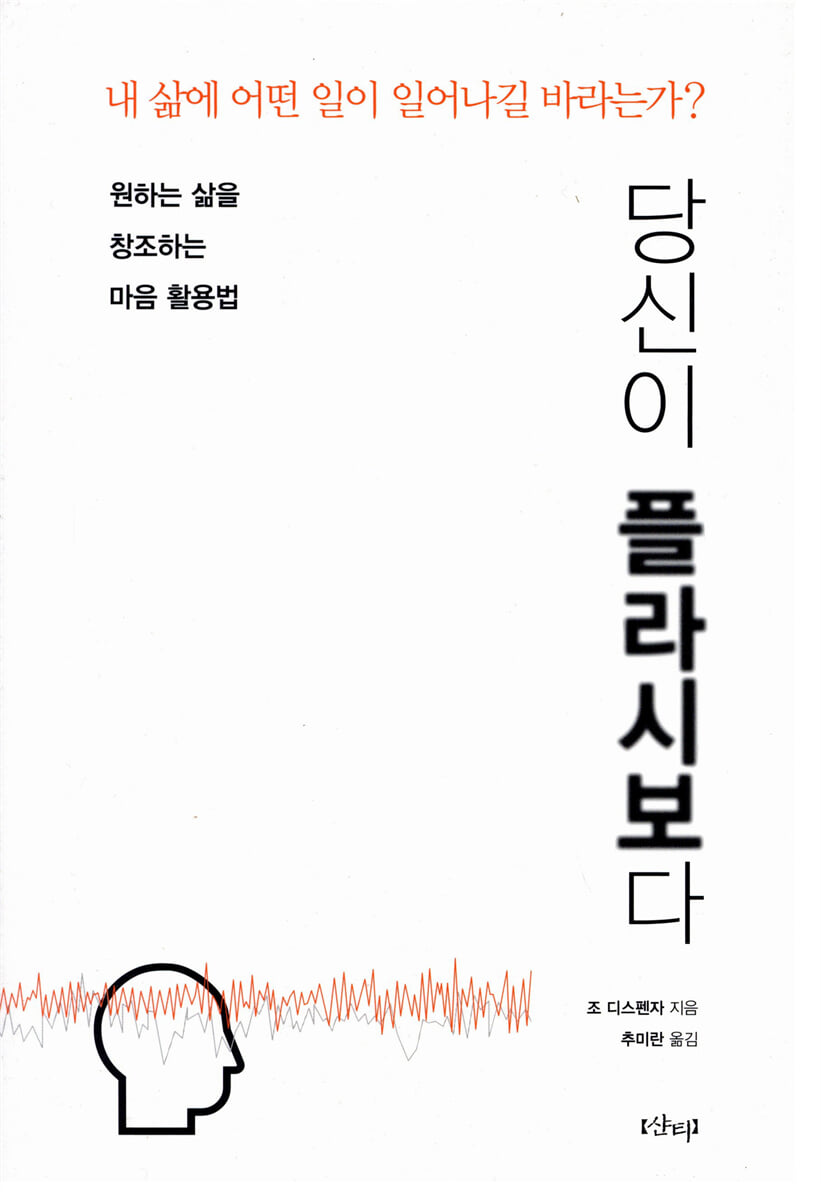
You are better than Plasti
 |
Description
Book Introduction
The book begins with the author's own devastating accident, in which he broke six vertebrae.
All the doctors recommended surgery.
But he believed that there was an intelligence within us that made our hearts beat hundreds of thousands of times a day and orchestrated hundreds of thousands of chemical reactions in each cell every second, and that this inner intelligence could bring about healing.
He began to go inward twice a day, for two hours at a time, and visualize a picture of a completely healed spine.
If distracting thoughts come into play, I start over from the beginning.
Then, something suddenly became clear and there came a moment when I was certain that I would be healed.
And after 9 weeks, I woke up and made a full recovery.
All the doctors recommended surgery.
But he believed that there was an intelligence within us that made our hearts beat hundreds of thousands of times a day and orchestrated hundreds of thousands of chemical reactions in each cell every second, and that this inner intelligence could bring about healing.
He began to go inward twice a day, for two hours at a time, and visualize a picture of a completely healed spine.
If distracting thoughts come into play, I start over from the beginning.
Then, something suddenly became clear and there came a moment when I was certain that I would be healed.
And after 9 weeks, I woke up and made a full recovery.
- You can preview some of the book's contents.
Preview
index
Dawson Church's Preface 13
Preface: Awakening 19
Introduction: Turning Ideas into Reality 37
PART 1 INFORMATION
01 Is this possible? 52
Placebo Overdose? 55/ Chronic Depression Magically Disappears 58/ One 'Miracle' Cure: Appeared and Disappeared 61/ The Knee Surgery I Never Had 63/ The Heart Surgery I Never Had 65/ It's All in the Mindset 67/ Nauseating Before the Needle Is Even Sticking in 68/ Indigestion Disappears 69/ Parkinson's Disease vs. Placebo 71/ On Vipers and Strychnine 72/ Defeating Voodoo 75
02 A Brief History of Placebos 79
Hypnosis in the Magnetic Field 81 / Research on the Nocebo Effect 87 / The First Leap 91 / East Meets West 94 / Placebos Surpass Antidepressants 97 / The Neurobiology of Placebos 99 / The Problem of Mental Power in My Hands 102 / Can You Be Your Own Placebo? 108
03 The Placebo Effect in the Brain 111
Placebo: The Anatomy of Thought 115 / A Simple Explanation of How the Brain Works 121 / Neuroplasticity 127 / Crossing the River of Change 129 / Overcoming Circumstances 133 / Feeling What You Think, Thinking What You Feel 135 / What It Takes to Become Your Own Placebo 141
04 The Placebo Effect in the Body 149
Debunking the DNA Myth 151 / Your Genius Genes 156 / The Biology of Gene Expression 159 / Epigenetics: How Humans Become Gods 163 / The Stress That Forces Us into Survival Mode 169 / The Legacy of Negative Emotions 173
05 How Thoughts Change the Brain and Body 179
A Few Success Stories of Mental Demonstrations 182/ Expressing New Genes in Your Body with a New Mind 186/ Stem Cells: A Powerful Pool of Possibilities 191/ How Intention and Elevated Emotions Transform Our Bodies 193/ Back to the Monastery 198
06 Suggestibility 201
Programming the Subconscious 208 / Acceptance, Faith, and Surrender 212 / Adding Emotions 214 / The Two Faces of the Analytical Mind 218 / How the Mind Works 222 / Opening the Doors of the Subconscious 228 / Demystifying Meditation 232 / Why Meditation Is Difficult 234 / Manipulating Brain Waves 237 / Analyzing the Crime of 'Assassination' 241
07 Attitudes, Beliefs, and Perceptions 243
Where Does Belief Come From? 245 / Changing Beliefs 253 / The Power of Perception 258 / The Power of Environment 262 / Changing Energy 268
08 Quantum Mind 273
Energy in the Quantum World 278/ Receiving the Right Energy Signals 284/ Beyond the Gates of the Quantum World 292
09 Three Transformation Stories, Part 295
Lowry's Story 295 / A Fearful Father 297 / Illness Becomes Identity 299 / Lowry Discovers Possibilities 303 / Success and Frustration 307 / New Heart, New Body 311 / Candice's Story 314 / Paying the Price 317 / Candice Gets Busy 319 / Sweet, Sweet Success 324 / Joan's Story 326 / Joan Changes Her Mind 330 / The Next Step in Healing 332 / The Miracles That Follow 335
10 Transforming Information: Proving You Are a Placebo 337
From Information to Experience 340/ Measuring Change 344/ One Brilliant Idea 349/ A Brief Explanation of Brain Scans 351/ Consistency vs. Inconsistency 354/ Curing Parkinson's Disease Without Placebos or Drugs 356/ Healing Brain and Spinal Cord Damage with Thoughts Only 361/ Overcoming the Analytical Mind and Finding Joy 366/ Healing Uterine Fibroids with Energy Transformations 369/ Experiencing Ecstasy 373/ Blessing: Liberating the Mind 376/ Now It's Your Turn 377
PART 2 Transformation
11 Preparing for Meditation 380
When to Meditate? 380 / Where to Meditate? 381 / Relax Your Body 382 / How Long Should You Meditate? 383 / Become a Master of Your Will 384 / Enter the Transformed State 387 / The Sweet Spot of the Present Moment 390 / Close Your Eyes and See 396
12 Meditations that Change Belief and Perception 399
Induction 403/ Becoming Possibility Itself 406/ Changing Your Beliefs or Perceptions About Yourself and Your Life 408
Review: Becoming Supernatural 415
Appendix: Script 423 for Meditation to Change Beliefs and Perceptions
Week 438
Acknowledgments 454
Translator's Note 458
Preface: Awakening 19
Introduction: Turning Ideas into Reality 37
PART 1 INFORMATION
01 Is this possible? 52
Placebo Overdose? 55/ Chronic Depression Magically Disappears 58/ One 'Miracle' Cure: Appeared and Disappeared 61/ The Knee Surgery I Never Had 63/ The Heart Surgery I Never Had 65/ It's All in the Mindset 67/ Nauseating Before the Needle Is Even Sticking in 68/ Indigestion Disappears 69/ Parkinson's Disease vs. Placebo 71/ On Vipers and Strychnine 72/ Defeating Voodoo 75
02 A Brief History of Placebos 79
Hypnosis in the Magnetic Field 81 / Research on the Nocebo Effect 87 / The First Leap 91 / East Meets West 94 / Placebos Surpass Antidepressants 97 / The Neurobiology of Placebos 99 / The Problem of Mental Power in My Hands 102 / Can You Be Your Own Placebo? 108
03 The Placebo Effect in the Brain 111
Placebo: The Anatomy of Thought 115 / A Simple Explanation of How the Brain Works 121 / Neuroplasticity 127 / Crossing the River of Change 129 / Overcoming Circumstances 133 / Feeling What You Think, Thinking What You Feel 135 / What It Takes to Become Your Own Placebo 141
04 The Placebo Effect in the Body 149
Debunking the DNA Myth 151 / Your Genius Genes 156 / The Biology of Gene Expression 159 / Epigenetics: How Humans Become Gods 163 / The Stress That Forces Us into Survival Mode 169 / The Legacy of Negative Emotions 173
05 How Thoughts Change the Brain and Body 179
A Few Success Stories of Mental Demonstrations 182/ Expressing New Genes in Your Body with a New Mind 186/ Stem Cells: A Powerful Pool of Possibilities 191/ How Intention and Elevated Emotions Transform Our Bodies 193/ Back to the Monastery 198
06 Suggestibility 201
Programming the Subconscious 208 / Acceptance, Faith, and Surrender 212 / Adding Emotions 214 / The Two Faces of the Analytical Mind 218 / How the Mind Works 222 / Opening the Doors of the Subconscious 228 / Demystifying Meditation 232 / Why Meditation Is Difficult 234 / Manipulating Brain Waves 237 / Analyzing the Crime of 'Assassination' 241
07 Attitudes, Beliefs, and Perceptions 243
Where Does Belief Come From? 245 / Changing Beliefs 253 / The Power of Perception 258 / The Power of Environment 262 / Changing Energy 268
08 Quantum Mind 273
Energy in the Quantum World 278/ Receiving the Right Energy Signals 284/ Beyond the Gates of the Quantum World 292
09 Three Transformation Stories, Part 295
Lowry's Story 295 / A Fearful Father 297 / Illness Becomes Identity 299 / Lowry Discovers Possibilities 303 / Success and Frustration 307 / New Heart, New Body 311 / Candice's Story 314 / Paying the Price 317 / Candice Gets Busy 319 / Sweet, Sweet Success 324 / Joan's Story 326 / Joan Changes Her Mind 330 / The Next Step in Healing 332 / The Miracles That Follow 335
10 Transforming Information: Proving You Are a Placebo 337
From Information to Experience 340/ Measuring Change 344/ One Brilliant Idea 349/ A Brief Explanation of Brain Scans 351/ Consistency vs. Inconsistency 354/ Curing Parkinson's Disease Without Placebos or Drugs 356/ Healing Brain and Spinal Cord Damage with Thoughts Only 361/ Overcoming the Analytical Mind and Finding Joy 366/ Healing Uterine Fibroids with Energy Transformations 369/ Experiencing Ecstasy 373/ Blessing: Liberating the Mind 376/ Now It's Your Turn 377
PART 2 Transformation
11 Preparing for Meditation 380
When to Meditate? 380 / Where to Meditate? 381 / Relax Your Body 382 / How Long Should You Meditate? 383 / Become a Master of Your Will 384 / Enter the Transformed State 387 / The Sweet Spot of the Present Moment 390 / Close Your Eyes and See 396
12 Meditations that Change Belief and Perception 399
Induction 403/ Becoming Possibility Itself 406/ Changing Your Beliefs or Perceptions About Yourself and Your Life 408
Review: Becoming Supernatural 415
Appendix: Script 423 for Meditation to Change Beliefs and Perceptions
Week 438
Acknowledgments 454
Translator's Note 458
Detailed image

Into the book
When a person continues to take a substance, their brain continues to activate the same neural circuits in the same way.
As a result, the brain memorizes what the substance does.
When a person mentally connects a certain drug or injection with an internal change that feels familiar from past experiences, he or she can easily become conditioned to the effects of that drug or injection.
Because of this conditioning, taking a placebo activates the same pre-existing neural circuits as taking the real drug.
Associative memories in our heads trigger subconscious programs that link the drug or injection to hormonal changes in our bodies, and those programs automatically send signals to our bodies to produce the chemicals found in the actual drug. … … Isn’t that amazing? (p. 101)
- It is to pick up a future possibility in your mind and hope, anticipate, and expect that new outcome.
When we emotionally accept and embrace that new outcome of our choice, and when that emotion is strong enough, our brain and body mistake it for real, even though we are only imagining that our state of being has shifted to a pain-free state.
Because to the brain and the body, they are the same thing. (p. 113)
- We are products of our habits.
We have 60,000 to 70,000 thoughts a day, and 90 percent of those thoughts are the same thoughts we had yesterday. … … The same thoughts lead to the same choices.
Same choices lead to same actions.
Same actions create same experiences.
Same experiences produce same emotions.
And the same emotion again brings about the same thought (pp. 115-116)
- So, in effect, your past becomes your future.
If we agree with what we've said so far, we can now say that the familiar feeling we've just described is "you" (your identity or your personality).
That is your state of being… … If you want to create a new personal reality (a new life), it also means that you must examine and change the thinking you have been having up to now.
You must become aware of the unconscious choices you've made over time that have only brought about the same experiences, and then you must make new choices, take new actions, and create new experiences. (p. 118)
- The unknown world is the perfect place to begin creation.
It is a place of possibility… … The best way to predict the future is to create it.
Creation not in a known place, but in an unknown place. (pp. 132-133)
- If thoughts are the language of the brain, feelings are the language of the body.
And the way you think and feel creates your state of being.
When your mind and body work together, a state of being arises.
In other words, your current state of being clearly shows how your mind and body are currently connected. (p. 135)
- The cycle of feeling what you think and thinking what you feel is the process by which the conscious mind conditions the body.
Then, once the body becomes the mind, it becomes a state that we call a habit.
In other words, when the body becomes the mind, habits are formed.
By the time you're 35, 95 percent of you will be a collection of remembered behaviors, skills, emotional responses, beliefs, perceptions, and attitudes that function like an unconscious, automatic computer program. (p. 140)
- Most people have a common misconception and believe that our fate is genetically predetermined, that we are born with genes that cause certain cancers, heart disease, diabetes, or other conditions, and that we are destined to develop them, just as we cannot change the color of our eyes or the shape of our nose. … … Our genes are not like eggs that are destined to hatch one day.
Genes don't work that way.
The real question is whether the genes we have are expressed, and how we turn them on and off. (pp. 154-155)
- Epigenetics says that our fate is not determined by our genes, but that we can physically change both the structure and function of our bodies by changing our consciousness.
We can modify our destiny at the genetic level by controlling various environmental factors that create our genetic program, turning on desired genes and putting unwanted ones to sleep.
Such factors (signals) can come from within the body, such as feelings or thoughts, or from the body's reactions to external factors, such as pollution or sunlight. (p. 164)
- Only when cells receive new information and fire in new ways can they change the same genes into thousands of different versions to create new proteins, and then their bodies change too.
We cannot control every element of the external world, but we can control many things within ourselves.
Your beliefs, your perceptions, and how you relate to your external environment all affect your internal environment (which is the external environment from the cell's perspective).
It is you, not your pre-programmed biological body, that holds the key to your genetic destiny.
You just need to find the key that fits the hole in the bucket that will unlock your potential. (pp. 168-169)
- In fight or flight mode, life-sustaining energy is mobilized to cause the body to either run away or fight.
However, if you continue to feel threatened in that state and cannot return to a state of homeostasis, you will run out of life energy.
If energy is being used elsewhere, there is less energy available for cellular growth and repair, that is, for long-term building projects or healing at the cellular level.
At that point, the cells close their doors, no longer communicate with each other, and become 'selfish'.
I think that this is a time when we should not even do the things we have been doing on a daily basis, let alone improve.
Because it is a time when we must defend ourselves. (Page 171)
- When we live in survival mode and are constantly in a state of stress response, there are only three things we can really focus on.
These are the body (am I okay?), the environment (where is safe?), and time (when will this threat end?).
If we continue to focus only on these three things, we will not become more spiritual or more aware.
You will only become more self-absorbed and more focused on your body.
We become focused only on material things: what we have, where we live, how much money we have, etc.
As a result, we become obsessed with time.
Because we must prepare for the worst-case scenarios in the future, similar to the shocking experiences of the past. (p. 177)
- Jim Carrey first wrote down on a piece of paper, in length, that he would do the role he wanted, with the people he wanted, in the movie he wanted, and that he would succeed as an actor and contribute to the world by doing valuable work. … … He then recited the words he wrote on the piece of paper as if he were saying them to himself, imagining that it was actually happening. … … He even wrote a check for ten million dollars and carried it around with him.
It said 'Appearance Fee' and the payment deadline was 'Thanksgiving 1995'.
In 1994, three films were released that would finally make Jim Carrey a star.
He received a check for exactly $10 million for his roles in Ace Ventura: Pet Detective, The Mask, and his third film, Dumb and Dumber, which was released in December.
He created exactly what he had envisioned in his mind. (Page 184)
- The moment someone begins to have a clear intention about a new future (i.e., to live without pain or disease), and combines that intention with heightened emotions (such as excitement, hope, and the expectation of actually living without pain or disease), our bodies stop living in the past and start living in that new future.
As we have seen so far, our bodies cannot distinguish between emotions that come from actual experience and emotions that we feel only through our thoughts.
Therefore, maintaining a heightened emotional state while responding to new ideas is the most important factor in this entire process.
From the cell's perspective, heightened emotions are new information coming from outside the cell.
And because our bodies perceive our actual experiences and our mental experiences as being the same (p. 194).
- When the ego is thrown out of balance by the concentrated saturation of stress hormones, the analytical mind becomes very active and overstimulated.
At this point, the analytical mind no longer works for us but against us.
We become overly analytical.
And the ego becomes extremely selfish and is satisfied only when it puts itself first.
Because that's the ego's job.
The ego thinks and feels that our identity must be controlled to be protected.
The ego wants to exert power over the outcome and tells you in advance what to do to ensure a safe situation.
And we cling to familiar things and refuse to let them go.
So, I feel wronged, hurt, and in pain.
It is not possible to escape from the victim state.
The ego sees the unknown as dangerous and tries to avoid it at all costs.
To the ego, the unknown is unreliable. (p. 221)
- Therefore, when stress hormones support the analytical mind, thinking becomes narrow, we are less likely to believe or trust anything new, and our suggestibility, which allows us to believe only in our thoughts or to make the unknown known, becomes low.
You can use your analytical mind or ego to your advantage or against you. (p. 222)
- Meditation moves us from survival to creation, from separation to connection, from imbalance to balance, from emergency mode to growth and regeneration mode, and from limiting emotional states like fear, anger, and sadness to expansive emotional states like joy, freedom, and love.
Fundamentally, through meditation, we move from clinging to what we already know to embracing what we don't yet know. (p. 233)
- 'Quiet your mind' means that you have to declare a 'power outage' to all the neural networks in your brain that are responsible for thinking, which have become automatic by habitually turning on the lights every day.
That means you have to stop constantly reminding yourself of who you think you are, while repeatedly producing the same level of mind. (p. 234)
- Essentially, beliefs are just thoughts and feelings (these are attitudes) that you repeat over and over again until you fix them in your brain and emotionally condition your body accordingly.
You are addicted to those beliefs.
That's why it's so hard to change beliefs, and why we instinctively feel bad when our beliefs are challenged. ... ... If we keep replaying past feelings and feeling exactly the same way each time the event happened, we subconsciously condition our bodies to have those same feelings.
And our bodies unconsciously live in the past. (pp. 248-249)
- We are addicted to past emotions.
We see our beliefs as truth, not as thoughts that can be changed.
If you have a very strong belief about something, you may not see the contrary evidence even when it is right in front of you.
Because we perceive something completely different from what the evidence before our eyes says.
We have conditioned ourselves to believe many things that are not necessarily true, and these beliefs negatively impact our health and well-being. (p. 255)
- Changing beliefs is difficult, but it is not impossible.
Just think what happens when you break through your unconscious beliefs.
Instead of thinking and feeling, 'I absolutely don't have enough time to do all this,' say, 'I'm not bound by time.
What would happen if you thought and felt, "I can do it all?" Instead of believing, "The universe is against me," what if you believed, "The universe is kindly working for me." What a wonderful belief! If you believed the universe was working for you, how would you think, how would you live, how would you walk down the street? ... If you want to change your beliefs, you must first accept that it is possible.
Then, as explained earlier, you need to raise your energy level with elevated emotions.
And finally, you have to let your body recognize the change… …when the energy or amplitude of that decision becomes greater than the entrenched programs in your brain and the emotional addictions in your body, you will become greater than you were before and your body will respond to the new mind.
And that's when real change can happen. (p. 257)
- What this means is that the things you imagine you want to experience in life already exist as possibilities somewhere in the quantum field beyond space and time.
Just waiting for you to observe.
If your mind (through thoughts and emotions) can control where and when an electron appears, then theoretically you can achieve anything you can imagine. … … The quantum model, which tells us that all possibilities exist within this moment, actually gives us permission to choose a new future and make it a reality by observing it… … By focusing more on what we want than on what we don’t want, we can bring about the desired state of being, and at the same time, we can make what we don’t want ‘disappear’ by no longer paying attention to it.
Your energy is placed where you pay attention and interest.
If you pay attention to a possibility and put your consciousness or mind on it, you are giving energy to that possibility.
As a result, through your attention or observation, you exert influence over matter.
The placebo effect is not a fantasy, but a quantum mechanical fact. (pp. 276-278)
- So when you shift your energy to change your beliefs or perceptions about yourself or your life, you are actually amplifying your energy field by raising the frequency of the atoms and molecules within your body.
It makes the atomic fans that make up your body spin faster.
When you embrace emotionally uplifting, creative states such as feeling inspired, empowered, grateful, or resilient, you are spinning the fan blades of your atoms faster and sending a stronger energy field through your body.
That's when your body starts to feel the effects.
The material particles that make up your body now respond to the heightened energy.
You become more and more energy rather than matter.
Also, you are becoming more and more like a wave rather than a particle.
We can consciously create more energy, and as a result, matter rises to a new frequency state (higher frequency), and our bodies become responsive to the new mind (pp. 282-283).
- This invisible field of consciousness directs all functions of our body's cells, tissues, organs, and systems.
How do the chemicals and molecules within your cells know what to do and how do they interact so precisely? Cells are made up of atoms, molecules, and chemicals working together in a balanced manner, but it's the energy field surrounding them that creates matter.
Ultimately, it is the field of information (the field of consciousness) that plays the most important role. (pp. 285-286)
- So, according to the quantum model of reality, we can say that all diseases are a decrease in frequency. … … We overuse the life energy surrounding our cells to cope with emergencies, and our attention is completely turned to the external world: our environment, our body, and time.
If such a stress response persists for a long time, the body's energy vibrations will slow down (lower in frequency) in the long run, resulting in the body becoming more and more like particles rather than waves.
This means that the consciousness, energy, and information shared between atoms, molecules, and chemicals is reduced.
As a result, we are left trying in vain to change matter from one state to another.
It is a pointless effort to change the body with the body.
Not only do the individual subatomic fans that make up our bodies slow down, but their rhythms also begin to shift out of sync with each other.
As the coherence between atoms and molecules disappears, the signals between them weaken, and eventually the body begins to break down. (p. 287)
- When you meditate and let go of your ego and move from selfishness to selflessness, when you enter a state of pure consciousness, when you are no longer a physical body in a physical environment or linear time, but are outside of time and space, not a body, not a person, not an object, then you become one with that loving intelligence.
Then you become just an awareness in a field of infinite possibilities.
At that time, you are in an unknown world.
And everything is created in that unknown world.
You are in a quantum field.
You and I already have all the biological tools necessary to become that pure consciousness. (p. 294)
- Joan became a different person when she overcame her identity as a person with multiple sclerosis, and that happened when she gave up on attempts to slow, stop, or reverse the symptoms of her multiple sclerosis.
She no longer tried to show anything to herself, her family, her doctors, or anyone else.
For the first time in her life, Joan understood and experienced that the only true journey we must take is the one that leads to wholeness.
Only when we become whole can we say that we are truly healed.
Joan forgot that she was officially a patient, and in that moment, she was free of that identity. (p. 334)
- Complete healing already exists as an unknown possibility in the quantum field.
Until we observe it, realize it and concretize it.
In other words, complete healing may seem like a non-existent thing in the material world, but it actually exists as a possibility in the infinite field of information where all material possibilities are combined.
The possibility that a disease will spontaneously heal in the future exists outside of space and time in an unknown state until it is personally experienced and made known in this space and time.
When this unknown beyond your senses becomes an experience you already know through your senses, you have now entered the path of evolution. (p. 338)
- If we try to change matter while we are matter, we can never change it.
If we try to change a particle while it is still a particle, nothing happens.
Because it vibrates at the same speed as matter, it cannot have any significant effect on it.
What affects matter is our consciousness (our intentional thoughts) and our energy (our heightened emotions).
Only when we become conscious can we change our brain, our body, and our life, and ultimately create a new future.
And since consciousness is what gives form to everything, and it is consciousness that the brain and body use to create other levels of mind, when we become purely conscious, we become free.
So I began encouraging participants to stay in the meditative state longer, to become no one, no body, no space, no time, until they could comfortably reside in the field of infinite possibility (pp. 349–350).
- Think of practicing meditation as taking a placebo every day.
But instead of swallowing a pill, it goes inside.
Over time, you will come to view meditation as something you need to do, just as you would take medicine when you are sick. (p. 380)
As a result, the brain memorizes what the substance does.
When a person mentally connects a certain drug or injection with an internal change that feels familiar from past experiences, he or she can easily become conditioned to the effects of that drug or injection.
Because of this conditioning, taking a placebo activates the same pre-existing neural circuits as taking the real drug.
Associative memories in our heads trigger subconscious programs that link the drug or injection to hormonal changes in our bodies, and those programs automatically send signals to our bodies to produce the chemicals found in the actual drug. … … Isn’t that amazing? (p. 101)
- It is to pick up a future possibility in your mind and hope, anticipate, and expect that new outcome.
When we emotionally accept and embrace that new outcome of our choice, and when that emotion is strong enough, our brain and body mistake it for real, even though we are only imagining that our state of being has shifted to a pain-free state.
Because to the brain and the body, they are the same thing. (p. 113)
- We are products of our habits.
We have 60,000 to 70,000 thoughts a day, and 90 percent of those thoughts are the same thoughts we had yesterday. … … The same thoughts lead to the same choices.
Same choices lead to same actions.
Same actions create same experiences.
Same experiences produce same emotions.
And the same emotion again brings about the same thought (pp. 115-116)
- So, in effect, your past becomes your future.
If we agree with what we've said so far, we can now say that the familiar feeling we've just described is "you" (your identity or your personality).
That is your state of being… … If you want to create a new personal reality (a new life), it also means that you must examine and change the thinking you have been having up to now.
You must become aware of the unconscious choices you've made over time that have only brought about the same experiences, and then you must make new choices, take new actions, and create new experiences. (p. 118)
- The unknown world is the perfect place to begin creation.
It is a place of possibility… … The best way to predict the future is to create it.
Creation not in a known place, but in an unknown place. (pp. 132-133)
- If thoughts are the language of the brain, feelings are the language of the body.
And the way you think and feel creates your state of being.
When your mind and body work together, a state of being arises.
In other words, your current state of being clearly shows how your mind and body are currently connected. (p. 135)
- The cycle of feeling what you think and thinking what you feel is the process by which the conscious mind conditions the body.
Then, once the body becomes the mind, it becomes a state that we call a habit.
In other words, when the body becomes the mind, habits are formed.
By the time you're 35, 95 percent of you will be a collection of remembered behaviors, skills, emotional responses, beliefs, perceptions, and attitudes that function like an unconscious, automatic computer program. (p. 140)
- Most people have a common misconception and believe that our fate is genetically predetermined, that we are born with genes that cause certain cancers, heart disease, diabetes, or other conditions, and that we are destined to develop them, just as we cannot change the color of our eyes or the shape of our nose. … … Our genes are not like eggs that are destined to hatch one day.
Genes don't work that way.
The real question is whether the genes we have are expressed, and how we turn them on and off. (pp. 154-155)
- Epigenetics says that our fate is not determined by our genes, but that we can physically change both the structure and function of our bodies by changing our consciousness.
We can modify our destiny at the genetic level by controlling various environmental factors that create our genetic program, turning on desired genes and putting unwanted ones to sleep.
Such factors (signals) can come from within the body, such as feelings or thoughts, or from the body's reactions to external factors, such as pollution or sunlight. (p. 164)
- Only when cells receive new information and fire in new ways can they change the same genes into thousands of different versions to create new proteins, and then their bodies change too.
We cannot control every element of the external world, but we can control many things within ourselves.
Your beliefs, your perceptions, and how you relate to your external environment all affect your internal environment (which is the external environment from the cell's perspective).
It is you, not your pre-programmed biological body, that holds the key to your genetic destiny.
You just need to find the key that fits the hole in the bucket that will unlock your potential. (pp. 168-169)
- In fight or flight mode, life-sustaining energy is mobilized to cause the body to either run away or fight.
However, if you continue to feel threatened in that state and cannot return to a state of homeostasis, you will run out of life energy.
If energy is being used elsewhere, there is less energy available for cellular growth and repair, that is, for long-term building projects or healing at the cellular level.
At that point, the cells close their doors, no longer communicate with each other, and become 'selfish'.
I think that this is a time when we should not even do the things we have been doing on a daily basis, let alone improve.
Because it is a time when we must defend ourselves. (Page 171)
- When we live in survival mode and are constantly in a state of stress response, there are only three things we can really focus on.
These are the body (am I okay?), the environment (where is safe?), and time (when will this threat end?).
If we continue to focus only on these three things, we will not become more spiritual or more aware.
You will only become more self-absorbed and more focused on your body.
We become focused only on material things: what we have, where we live, how much money we have, etc.
As a result, we become obsessed with time.
Because we must prepare for the worst-case scenarios in the future, similar to the shocking experiences of the past. (p. 177)
- Jim Carrey first wrote down on a piece of paper, in length, that he would do the role he wanted, with the people he wanted, in the movie he wanted, and that he would succeed as an actor and contribute to the world by doing valuable work. … … He then recited the words he wrote on the piece of paper as if he were saying them to himself, imagining that it was actually happening. … … He even wrote a check for ten million dollars and carried it around with him.
It said 'Appearance Fee' and the payment deadline was 'Thanksgiving 1995'.
In 1994, three films were released that would finally make Jim Carrey a star.
He received a check for exactly $10 million for his roles in Ace Ventura: Pet Detective, The Mask, and his third film, Dumb and Dumber, which was released in December.
He created exactly what he had envisioned in his mind. (Page 184)
- The moment someone begins to have a clear intention about a new future (i.e., to live without pain or disease), and combines that intention with heightened emotions (such as excitement, hope, and the expectation of actually living without pain or disease), our bodies stop living in the past and start living in that new future.
As we have seen so far, our bodies cannot distinguish between emotions that come from actual experience and emotions that we feel only through our thoughts.
Therefore, maintaining a heightened emotional state while responding to new ideas is the most important factor in this entire process.
From the cell's perspective, heightened emotions are new information coming from outside the cell.
And because our bodies perceive our actual experiences and our mental experiences as being the same (p. 194).
- When the ego is thrown out of balance by the concentrated saturation of stress hormones, the analytical mind becomes very active and overstimulated.
At this point, the analytical mind no longer works for us but against us.
We become overly analytical.
And the ego becomes extremely selfish and is satisfied only when it puts itself first.
Because that's the ego's job.
The ego thinks and feels that our identity must be controlled to be protected.
The ego wants to exert power over the outcome and tells you in advance what to do to ensure a safe situation.
And we cling to familiar things and refuse to let them go.
So, I feel wronged, hurt, and in pain.
It is not possible to escape from the victim state.
The ego sees the unknown as dangerous and tries to avoid it at all costs.
To the ego, the unknown is unreliable. (p. 221)
- Therefore, when stress hormones support the analytical mind, thinking becomes narrow, we are less likely to believe or trust anything new, and our suggestibility, which allows us to believe only in our thoughts or to make the unknown known, becomes low.
You can use your analytical mind or ego to your advantage or against you. (p. 222)
- Meditation moves us from survival to creation, from separation to connection, from imbalance to balance, from emergency mode to growth and regeneration mode, and from limiting emotional states like fear, anger, and sadness to expansive emotional states like joy, freedom, and love.
Fundamentally, through meditation, we move from clinging to what we already know to embracing what we don't yet know. (p. 233)
- 'Quiet your mind' means that you have to declare a 'power outage' to all the neural networks in your brain that are responsible for thinking, which have become automatic by habitually turning on the lights every day.
That means you have to stop constantly reminding yourself of who you think you are, while repeatedly producing the same level of mind. (p. 234)
- Essentially, beliefs are just thoughts and feelings (these are attitudes) that you repeat over and over again until you fix them in your brain and emotionally condition your body accordingly.
You are addicted to those beliefs.
That's why it's so hard to change beliefs, and why we instinctively feel bad when our beliefs are challenged. ... ... If we keep replaying past feelings and feeling exactly the same way each time the event happened, we subconsciously condition our bodies to have those same feelings.
And our bodies unconsciously live in the past. (pp. 248-249)
- We are addicted to past emotions.
We see our beliefs as truth, not as thoughts that can be changed.
If you have a very strong belief about something, you may not see the contrary evidence even when it is right in front of you.
Because we perceive something completely different from what the evidence before our eyes says.
We have conditioned ourselves to believe many things that are not necessarily true, and these beliefs negatively impact our health and well-being. (p. 255)
- Changing beliefs is difficult, but it is not impossible.
Just think what happens when you break through your unconscious beliefs.
Instead of thinking and feeling, 'I absolutely don't have enough time to do all this,' say, 'I'm not bound by time.
What would happen if you thought and felt, "I can do it all?" Instead of believing, "The universe is against me," what if you believed, "The universe is kindly working for me." What a wonderful belief! If you believed the universe was working for you, how would you think, how would you live, how would you walk down the street? ... If you want to change your beliefs, you must first accept that it is possible.
Then, as explained earlier, you need to raise your energy level with elevated emotions.
And finally, you have to let your body recognize the change… …when the energy or amplitude of that decision becomes greater than the entrenched programs in your brain and the emotional addictions in your body, you will become greater than you were before and your body will respond to the new mind.
And that's when real change can happen. (p. 257)
- What this means is that the things you imagine you want to experience in life already exist as possibilities somewhere in the quantum field beyond space and time.
Just waiting for you to observe.
If your mind (through thoughts and emotions) can control where and when an electron appears, then theoretically you can achieve anything you can imagine. … … The quantum model, which tells us that all possibilities exist within this moment, actually gives us permission to choose a new future and make it a reality by observing it… … By focusing more on what we want than on what we don’t want, we can bring about the desired state of being, and at the same time, we can make what we don’t want ‘disappear’ by no longer paying attention to it.
Your energy is placed where you pay attention and interest.
If you pay attention to a possibility and put your consciousness or mind on it, you are giving energy to that possibility.
As a result, through your attention or observation, you exert influence over matter.
The placebo effect is not a fantasy, but a quantum mechanical fact. (pp. 276-278)
- So when you shift your energy to change your beliefs or perceptions about yourself or your life, you are actually amplifying your energy field by raising the frequency of the atoms and molecules within your body.
It makes the atomic fans that make up your body spin faster.
When you embrace emotionally uplifting, creative states such as feeling inspired, empowered, grateful, or resilient, you are spinning the fan blades of your atoms faster and sending a stronger energy field through your body.
That's when your body starts to feel the effects.
The material particles that make up your body now respond to the heightened energy.
You become more and more energy rather than matter.
Also, you are becoming more and more like a wave rather than a particle.
We can consciously create more energy, and as a result, matter rises to a new frequency state (higher frequency), and our bodies become responsive to the new mind (pp. 282-283).
- This invisible field of consciousness directs all functions of our body's cells, tissues, organs, and systems.
How do the chemicals and molecules within your cells know what to do and how do they interact so precisely? Cells are made up of atoms, molecules, and chemicals working together in a balanced manner, but it's the energy field surrounding them that creates matter.
Ultimately, it is the field of information (the field of consciousness) that plays the most important role. (pp. 285-286)
- So, according to the quantum model of reality, we can say that all diseases are a decrease in frequency. … … We overuse the life energy surrounding our cells to cope with emergencies, and our attention is completely turned to the external world: our environment, our body, and time.
If such a stress response persists for a long time, the body's energy vibrations will slow down (lower in frequency) in the long run, resulting in the body becoming more and more like particles rather than waves.
This means that the consciousness, energy, and information shared between atoms, molecules, and chemicals is reduced.
As a result, we are left trying in vain to change matter from one state to another.
It is a pointless effort to change the body with the body.
Not only do the individual subatomic fans that make up our bodies slow down, but their rhythms also begin to shift out of sync with each other.
As the coherence between atoms and molecules disappears, the signals between them weaken, and eventually the body begins to break down. (p. 287)
- When you meditate and let go of your ego and move from selfishness to selflessness, when you enter a state of pure consciousness, when you are no longer a physical body in a physical environment or linear time, but are outside of time and space, not a body, not a person, not an object, then you become one with that loving intelligence.
Then you become just an awareness in a field of infinite possibilities.
At that time, you are in an unknown world.
And everything is created in that unknown world.
You are in a quantum field.
You and I already have all the biological tools necessary to become that pure consciousness. (p. 294)
- Joan became a different person when she overcame her identity as a person with multiple sclerosis, and that happened when she gave up on attempts to slow, stop, or reverse the symptoms of her multiple sclerosis.
She no longer tried to show anything to herself, her family, her doctors, or anyone else.
For the first time in her life, Joan understood and experienced that the only true journey we must take is the one that leads to wholeness.
Only when we become whole can we say that we are truly healed.
Joan forgot that she was officially a patient, and in that moment, she was free of that identity. (p. 334)
- Complete healing already exists as an unknown possibility in the quantum field.
Until we observe it, realize it and concretize it.
In other words, complete healing may seem like a non-existent thing in the material world, but it actually exists as a possibility in the infinite field of information where all material possibilities are combined.
The possibility that a disease will spontaneously heal in the future exists outside of space and time in an unknown state until it is personally experienced and made known in this space and time.
When this unknown beyond your senses becomes an experience you already know through your senses, you have now entered the path of evolution. (p. 338)
- If we try to change matter while we are matter, we can never change it.
If we try to change a particle while it is still a particle, nothing happens.
Because it vibrates at the same speed as matter, it cannot have any significant effect on it.
What affects matter is our consciousness (our intentional thoughts) and our energy (our heightened emotions).
Only when we become conscious can we change our brain, our body, and our life, and ultimately create a new future.
And since consciousness is what gives form to everything, and it is consciousness that the brain and body use to create other levels of mind, when we become purely conscious, we become free.
So I began encouraging participants to stay in the meditative state longer, to become no one, no body, no space, no time, until they could comfortably reside in the field of infinite possibility (pp. 349–350).
- Think of practicing meditation as taking a placebo every day.
But instead of swallowing a pill, it goes inside.
Over time, you will come to view meditation as something you need to do, just as you would take medicine when you are sick. (p. 380)
__From the text
Publisher's Review
Our brains can produce the placebo effect on their own, without drugs or injections.
The book begins with the author's own devastating accident, in which he broke six vertebrae.
All the doctors recommended surgery.
But he believed that there was an intelligence within us that made our hearts beat hundreds of thousands of times a day and orchestrated hundreds of thousands of chemical reactions in each cell every second, and that this inner intelligence could bring about healing.
He began to go inward twice a day, for two hours at a time, and visualize a picture of a completely healed spine.
If distracting thoughts come into play, I start over from the beginning.
Then, something suddenly became clear and there came a moment when I was certain that I would be healed.
And after 9 weeks, I woke up and made a full recovery.
The experience changed his life.
It was then that he decided to dedicate the rest of his life to studying the relationship between body and mind, and the concept of mind dominating matter.
Now, 30 years later, he says:
“At the time, I didn’t know what I was doing, but now I know.
In those moments when I deliberately chose a future and felt the heightened emotions I would feel in that future, the cells in my body reorganized themselves, I sent signals to new genes in new ways, and each time, my body quickly recovered.
“I became my own placebo.”
For the next 30 years, he dedicated himself to understanding the principles that had healed him, finding similar cases, explaining them scientifically, and ultimately finding a universal healing method that could be applied to anyone.
To achieve this, I returned to university classes to study the latest research in neuroscience, went on to graduate school to study brain science, neuroplasticity, epigenetics, and psychoneuroimmunology, and conducted workshops to help people heal.
And recently, through real-time EEG recordings of workshop participants, we have been able to empirically measure the energy changes during healing meditation (see EEG images inserted separately at the back of this book), and it has been revealed that the intelligence that healed oneself is an unlimited potential that exists as an unknown possibility in the quantum field, in other words, an invisible field of consciousness and information.
He was inspired by the idea of a placebo, with the incredible results of patients being cured at workshops and the scientific data from brain scans of people whose conditions were so severe that they considered their "illness" to be their identity.
And then I asked a question.
"What if people believed in themselves, not in something external like a placebo, but in their ability to change something within themselves? What if they could create the same state as someone who took a placebo? If we truly understood the nature of the placebo effect, wouldn't we be able to do the same thing that a drug or injection does?"
This book contains answers to these questions that the author himself found in surprise.
In short, the author answers, “We can create the placebo effect ourselves without relying on something external (placebo).”
And he says that such biological and neurological placebos are already at work in our brains, and that if we know how to change our beliefs and perceptions and elevate our emotions, we can achieve any desired outcome.
To prove this, he faithfully utilizes the latest scientific findings, including the theory of how placebos work: conditioning, expectation, and meaning-making; epigenetics, which suggests that our intentions and heightened emotions can change the potential for our genes to express themselves; and quantum models, which suggest that the process by which such unknown potentials manifest is identical to how high-frequency energy states can be observed as low-frequency matter.
Furthermore, numerous case studies and electroencephalography data clearly demonstrate how meditation can help us stop habitual responses from the past, which would have turned on the same genes to the same stimuli.
Placebos, neuroscience, epigenetics, quantum mechanics, and meditation
This book is divided into two parts.
Part 1 begins by examining what the placebo effect is, how it works in our brains and bodies, with numerous case studies, and reveals how we can create these miraculous changes in our brains and bodies using only our thoughts.
Chapter 1 presents several stories that demonstrate the amazing power of the mind.
These are stories that demonstrate the amazing power of the human mind: a man who died after being diagnosed with cancer and was convinced and feared he would die, only to have his autopsy reveal his diagnosis was misdiagnosed; a woman who dramatically recovered from decades of depression after being treated with an antidepressant that was actually a placebo; veterans who had been crippled for years by osteoarthritis but miraculously recovered after fake knee surgery.
Chapter 2 briefly examines the history of placebos.
This fascinating account presents the scientific discoveries surrounding placebos, from the 1770s when placebos were first used for therapeutic purposes to modern times when neuroscientists are unraveling the complex mysteries of how the mind works.
Chapter 3 examines the physiology of what happens in the brain when the placebo effect occurs.
We find that placebos work because they replace the old thought, "I'll always be sick," with a new thought, "I can be healthy," and we can enjoy that thought.
The author also explains, through the physiology of the brain, how when we keep thinking the same thoughts, it leads to the same choices, which in turn leads to the same actions, which in turn create the same experiences and produce the same emotions, which ultimately leads to the original thoughts again.
At the same time, it explains the concept of neuroplasticity, which states that we can create new neural connections in our brains and thus change them.
Chapter 4 presents the results of an experiment in which a group of older adults were asked to act as if they had become 20 years younger during a week-long retreat, and the older adults actually became physiologically younger.
The author explains how the theory of epigenetics dispels the traditional notion that “genes are destiny,” showing that our bodies have sophisticated mechanisms for turning genes on and off, and that we can actually change our bodies by rewiring our neural circuits and selecting new genes.
Chapter 5 explains how thoughts change the brain and body.
It also describes the use of a technique called "mental rehearsal," which combines clear intention and heightened emotion to experience a future event that has not yet arrived in the present moment.
The idea is that when we react emotionally to an imagined future event as if it were happening now, our bodies undergo epigenetic mutations, activating new genes in new ways, and we can then immediately step into that new reality and become a placebo.
Chapter 6 explains the concept of 'suggestibility'.
Everyone has the ability to respond to suggestion to varying degrees, and the greater this suggestibility, the more easily we can enter the subconscious mind (which makes up 95% of our mind).
When our bodies are under the control of our subconscious mind, they act as if they are our minds (this is the placebo effect of our minds), so if we want to change our genetic destiny, we must enter the operating systems of this subconscious mind and allow new perceptions and beliefs to take root there.
We will see how meditation can be a powerful tool for entering this subconscious mind.
Chapter 7 shows how attitudes, beliefs, and perceptions change our state of being, and how we can change them to create a new reality.
We come to understand that this shift in state of being occurs when we deliberately choose a reality that is still a possibility within the quantum field and combine it with heightened emotions as if it had already happened.
It is important that our emotions be greatly heightened so that our choices have a greater energy amplitude than the fixed programs in our brains or the addictive emotions in our bodies, because only then can we change the electrical circuitry of our brains and the genetic expression of our bodies, recalibrating our bodies to a new state of mind.
Chapter 8 introduces the quantum universe.
The quantum universe, this unpredictable world of matter and energy that makes up the atoms and molecules of everything, is clearly closer to energy (which appears like empty space) than to solid matter.
And we also find that the key to using the placebo effect for healing is this quantum model that says, 'All possibilities exist in the moment.'
Because quantum models give us the basis for choosing new futures for ourselves and then observing them in practice.
Chapter 9 introduces three people who attended the author's workshops and achieved dramatic results using the techniques mentioned above.
First, there's Lowry, who was diagnosed with an incurable degenerative bone disease at age 19 but now walks completely normally without a cane; Candice, who was diagnosed with Hashimoto's and suffered from severe thyroid disease but thanks to meditation has stopped taking medication and her blood tests have returned to normal; and Joan, who was diagnosed with multiple sclerosis and was completely immobile for years until, after just an hour of meditation, she can now walk around her room without any assistance.
Chapter 10 tells the stories of ordinary people who experienced remarkable changes through meditation, along with brain scans of their meditation sessions.
Before-and-after brain scans of many people, including Michelle, who was completely cured of Parkinson's disease, and John, a paraplegic who got out of his wheelchair after meditating, show astonishingly large changes.
The author says the greatest significance of these photographs is that they show that “we don’t need to be practitioners, scholars, scientists, or spiritual leaders, or have a Ph.D. or a medical license, to achieve such remarkable transformations.”
Anyone who reads the book will realize that what these people did was neither magic nor miraculous.
They simply learned and applied techniques that anyone can hone.
And the author emphasizes that if we practice such techniques, we too can create similar changes.
Part 2 of this book details meditation techniques for real change.
Chapter 11 presents simple preparatory steps for meditation and introduces specific techniques that can help us, and Chapter 12 explains, one by one, what is needed to utilize the meditation techniques the author teaches in workshops.
The book begins with the author's own devastating accident, in which he broke six vertebrae.
All the doctors recommended surgery.
But he believed that there was an intelligence within us that made our hearts beat hundreds of thousands of times a day and orchestrated hundreds of thousands of chemical reactions in each cell every second, and that this inner intelligence could bring about healing.
He began to go inward twice a day, for two hours at a time, and visualize a picture of a completely healed spine.
If distracting thoughts come into play, I start over from the beginning.
Then, something suddenly became clear and there came a moment when I was certain that I would be healed.
And after 9 weeks, I woke up and made a full recovery.
The experience changed his life.
It was then that he decided to dedicate the rest of his life to studying the relationship between body and mind, and the concept of mind dominating matter.
Now, 30 years later, he says:
“At the time, I didn’t know what I was doing, but now I know.
In those moments when I deliberately chose a future and felt the heightened emotions I would feel in that future, the cells in my body reorganized themselves, I sent signals to new genes in new ways, and each time, my body quickly recovered.
“I became my own placebo.”
For the next 30 years, he dedicated himself to understanding the principles that had healed him, finding similar cases, explaining them scientifically, and ultimately finding a universal healing method that could be applied to anyone.
To achieve this, I returned to university classes to study the latest research in neuroscience, went on to graduate school to study brain science, neuroplasticity, epigenetics, and psychoneuroimmunology, and conducted workshops to help people heal.
And recently, through real-time EEG recordings of workshop participants, we have been able to empirically measure the energy changes during healing meditation (see EEG images inserted separately at the back of this book), and it has been revealed that the intelligence that healed oneself is an unlimited potential that exists as an unknown possibility in the quantum field, in other words, an invisible field of consciousness and information.
He was inspired by the idea of a placebo, with the incredible results of patients being cured at workshops and the scientific data from brain scans of people whose conditions were so severe that they considered their "illness" to be their identity.
And then I asked a question.
"What if people believed in themselves, not in something external like a placebo, but in their ability to change something within themselves? What if they could create the same state as someone who took a placebo? If we truly understood the nature of the placebo effect, wouldn't we be able to do the same thing that a drug or injection does?"
This book contains answers to these questions that the author himself found in surprise.
In short, the author answers, “We can create the placebo effect ourselves without relying on something external (placebo).”
And he says that such biological and neurological placebos are already at work in our brains, and that if we know how to change our beliefs and perceptions and elevate our emotions, we can achieve any desired outcome.
To prove this, he faithfully utilizes the latest scientific findings, including the theory of how placebos work: conditioning, expectation, and meaning-making; epigenetics, which suggests that our intentions and heightened emotions can change the potential for our genes to express themselves; and quantum models, which suggest that the process by which such unknown potentials manifest is identical to how high-frequency energy states can be observed as low-frequency matter.
Furthermore, numerous case studies and electroencephalography data clearly demonstrate how meditation can help us stop habitual responses from the past, which would have turned on the same genes to the same stimuli.
Placebos, neuroscience, epigenetics, quantum mechanics, and meditation
This book is divided into two parts.
Part 1 begins by examining what the placebo effect is, how it works in our brains and bodies, with numerous case studies, and reveals how we can create these miraculous changes in our brains and bodies using only our thoughts.
Chapter 1 presents several stories that demonstrate the amazing power of the mind.
These are stories that demonstrate the amazing power of the human mind: a man who died after being diagnosed with cancer and was convinced and feared he would die, only to have his autopsy reveal his diagnosis was misdiagnosed; a woman who dramatically recovered from decades of depression after being treated with an antidepressant that was actually a placebo; veterans who had been crippled for years by osteoarthritis but miraculously recovered after fake knee surgery.
Chapter 2 briefly examines the history of placebos.
This fascinating account presents the scientific discoveries surrounding placebos, from the 1770s when placebos were first used for therapeutic purposes to modern times when neuroscientists are unraveling the complex mysteries of how the mind works.
Chapter 3 examines the physiology of what happens in the brain when the placebo effect occurs.
We find that placebos work because they replace the old thought, "I'll always be sick," with a new thought, "I can be healthy," and we can enjoy that thought.
The author also explains, through the physiology of the brain, how when we keep thinking the same thoughts, it leads to the same choices, which in turn leads to the same actions, which in turn create the same experiences and produce the same emotions, which ultimately leads to the original thoughts again.
At the same time, it explains the concept of neuroplasticity, which states that we can create new neural connections in our brains and thus change them.
Chapter 4 presents the results of an experiment in which a group of older adults were asked to act as if they had become 20 years younger during a week-long retreat, and the older adults actually became physiologically younger.
The author explains how the theory of epigenetics dispels the traditional notion that “genes are destiny,” showing that our bodies have sophisticated mechanisms for turning genes on and off, and that we can actually change our bodies by rewiring our neural circuits and selecting new genes.
Chapter 5 explains how thoughts change the brain and body.
It also describes the use of a technique called "mental rehearsal," which combines clear intention and heightened emotion to experience a future event that has not yet arrived in the present moment.
The idea is that when we react emotionally to an imagined future event as if it were happening now, our bodies undergo epigenetic mutations, activating new genes in new ways, and we can then immediately step into that new reality and become a placebo.
Chapter 6 explains the concept of 'suggestibility'.
Everyone has the ability to respond to suggestion to varying degrees, and the greater this suggestibility, the more easily we can enter the subconscious mind (which makes up 95% of our mind).
When our bodies are under the control of our subconscious mind, they act as if they are our minds (this is the placebo effect of our minds), so if we want to change our genetic destiny, we must enter the operating systems of this subconscious mind and allow new perceptions and beliefs to take root there.
We will see how meditation can be a powerful tool for entering this subconscious mind.
Chapter 7 shows how attitudes, beliefs, and perceptions change our state of being, and how we can change them to create a new reality.
We come to understand that this shift in state of being occurs when we deliberately choose a reality that is still a possibility within the quantum field and combine it with heightened emotions as if it had already happened.
It is important that our emotions be greatly heightened so that our choices have a greater energy amplitude than the fixed programs in our brains or the addictive emotions in our bodies, because only then can we change the electrical circuitry of our brains and the genetic expression of our bodies, recalibrating our bodies to a new state of mind.
Chapter 8 introduces the quantum universe.
The quantum universe, this unpredictable world of matter and energy that makes up the atoms and molecules of everything, is clearly closer to energy (which appears like empty space) than to solid matter.
And we also find that the key to using the placebo effect for healing is this quantum model that says, 'All possibilities exist in the moment.'
Because quantum models give us the basis for choosing new futures for ourselves and then observing them in practice.
Chapter 9 introduces three people who attended the author's workshops and achieved dramatic results using the techniques mentioned above.
First, there's Lowry, who was diagnosed with an incurable degenerative bone disease at age 19 but now walks completely normally without a cane; Candice, who was diagnosed with Hashimoto's and suffered from severe thyroid disease but thanks to meditation has stopped taking medication and her blood tests have returned to normal; and Joan, who was diagnosed with multiple sclerosis and was completely immobile for years until, after just an hour of meditation, she can now walk around her room without any assistance.
Chapter 10 tells the stories of ordinary people who experienced remarkable changes through meditation, along with brain scans of their meditation sessions.
Before-and-after brain scans of many people, including Michelle, who was completely cured of Parkinson's disease, and John, a paraplegic who got out of his wheelchair after meditating, show astonishingly large changes.
The author says the greatest significance of these photographs is that they show that “we don’t need to be practitioners, scholars, scientists, or spiritual leaders, or have a Ph.D. or a medical license, to achieve such remarkable transformations.”
Anyone who reads the book will realize that what these people did was neither magic nor miraculous.
They simply learned and applied techniques that anyone can hone.
And the author emphasizes that if we practice such techniques, we too can create similar changes.
Part 2 of this book details meditation techniques for real change.
Chapter 11 presents simple preparatory steps for meditation and introduces specific techniques that can help us, and Chapter 12 explains, one by one, what is needed to utilize the meditation techniques the author teaches in workshops.
GOODS SPECIFICS
- Date of issue: April 20, 2016
- Page count, weight, size: 464 pages | 660g | 152*225*30mm
- ISBN13: 9788991075030
- ISBN10: 8991075037
You may also like
카테고리
korean


korean

![ELLE 엘르 스페셜 에디션 A형 : 12월 [2025]](http://librairie.coreenne.fr/cdn/shop/files/b8e27a3de6c9538896439686c6b0e8fb.jpg?v=1766436872&width=3840)


