

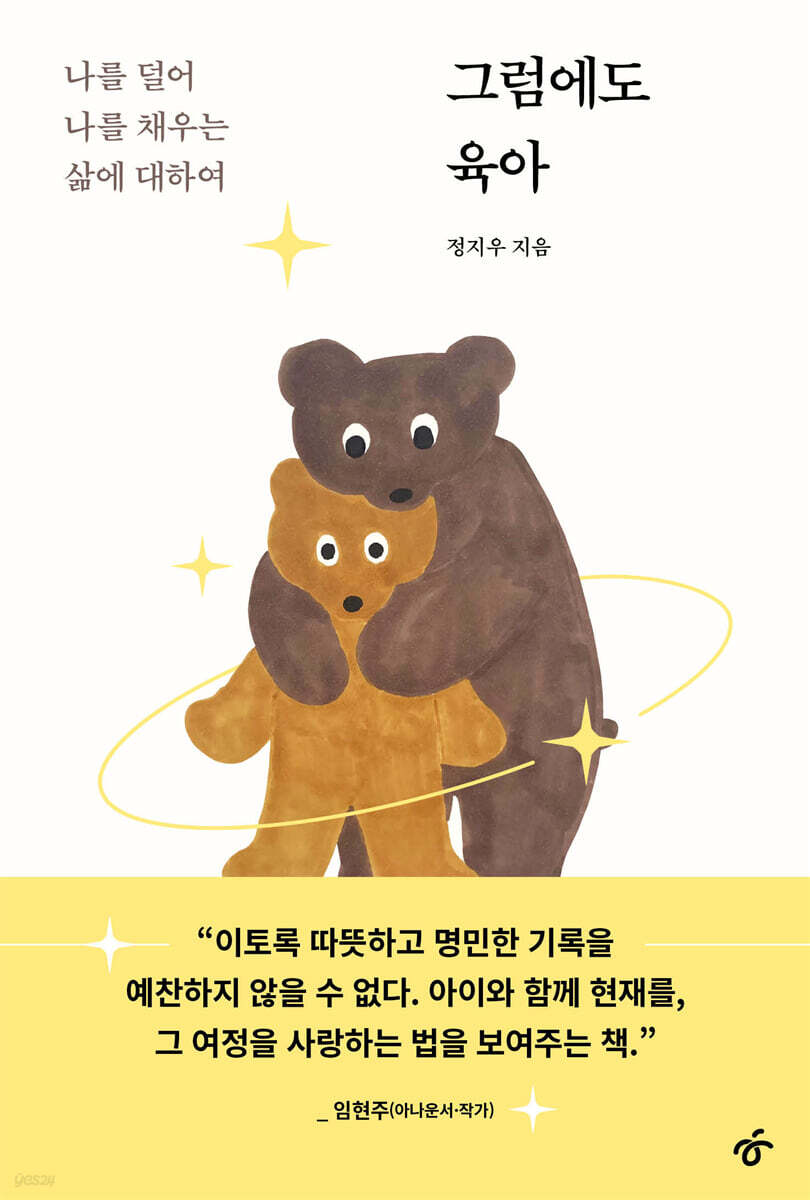
Still, parenting
 |
Description
Book Introduction
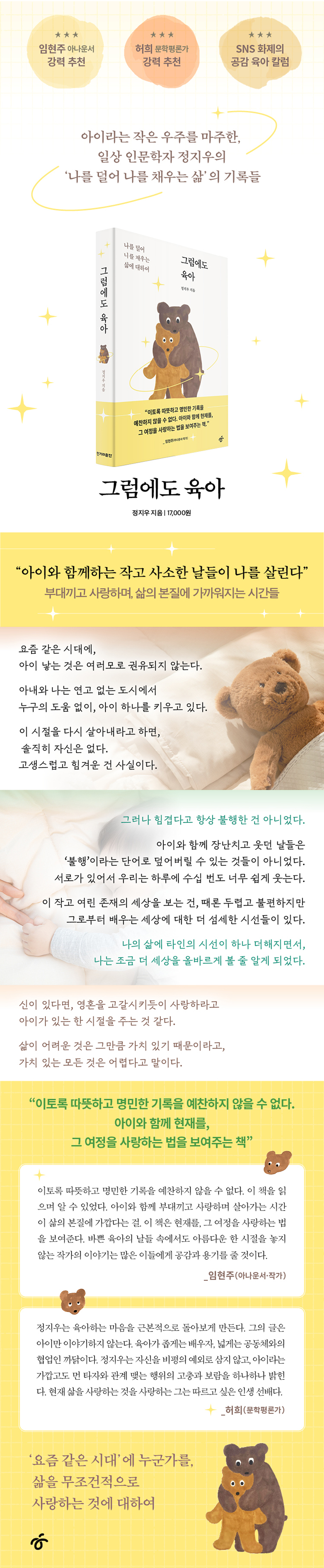
★★★ “I cannot help but praise such a warm and insightful record.
"A book that shows how to love the present and the journey with your child" - Lim Hyeon-ju (announcer/author)
★★★ “Ira is an act of forming relationships with others who are both close and distant.
“It reveals the hardships and rewards one by one”_Heo Hee (literary critic)
“The small, insignificant days I spend with my child save me.”
A young humanities writer talks about a life of "relieving myself and filling myself."
Author Jiwoo Jeong, who has built a unique genre that crosses the fields of humanities and social sciences and essays based on intellect and sensibility, such as “There is no despair on Instagram” and “Love asks and humanities answer,” presents a new essay, “Parenting Nonetheless.”
The author's column, "Parenting Still," which she contributed to Maeil Business Newspaper, was a hot topic in numerous mom cafes and was widely circulated on social media as a sympathetic parenting column, reminding us of the importance of the time spent interacting with young children.
The book, “Parenting Still,” is a parenting essay inspired by this popular column.
Not only did I supplement the column, but I also recorded the days when I was able to love someone other than myself and, by letting go of myself in that way, fill and save myself in 'these days' when having children is practically discouraged.
After facing “the irreversible moment of taking responsibility for a life” (page 25), she unfolds the changes in her life, the hardships of real-life parenting, and the life philosophy and values she learned through playing, talking, and interacting with her child.
In this way, it expands into a rich humanistic reflection on parenting and a story about a fulfilling sense of belonging more deeply to life, displaying a different appeal from existing parenting essays that focus on practical coaching and sharing personal experiences.
For over 20 years, Jeong Ji-woo has been writing every day, steadily delving into the meaning and attitude of life.
His humanistic insight becomes deeper, broader, and more delicate as he encounters the 'small universe' of children.
To paraphrase critic Heo Hee, the author's writing "reveals, one by one, the hardships and rewards of forming relationships with children, a close yet distant other."
For example, the author, while spending time washing, feeding, and putting his child to bed alone in a city where he has no connection with his wife, suddenly realizes that “what we needed was a different kind of attitude” (p. 24) and that “life is no longer about adjusting the distance between what is mine and what is yours, but about creating what is ours together” (p. 25).
Even though I live my life as if I am going through a repetitive, mindless routine, I discover that this time of “loving as if it were exhausting my soul” (p. 20) is like a fleeting moment, and that the time spent loving and spending time with a child from my childhood, whom I cannot even remember, is paradoxically meaningful and valuable because of its fragility and finitude.
This book neither denies the hardships of parenting nor praises raising children as the only path to happiness.
As announcer Lim Hyeon-ju wrote in her recommendation, it simply shows “how to love the present and the journey with your child.”
It resonates deeply by making us reconsider the fundamental values of living together and loving each other.
- In a time when loving oneself was the only supreme task, I could not understand the heart of a 'parent who loves their child'.
It felt like a bit of a silly sacrifice, you know?
But when I actually entered this world of love, I felt even more insignificant because I only loved myself.
There comes a moment when you realize that this place is like another universe, a territory you can only know if you go there.
Page 46
"A book that shows how to love the present and the journey with your child" - Lim Hyeon-ju (announcer/author)
★★★ “Ira is an act of forming relationships with others who are both close and distant.
“It reveals the hardships and rewards one by one”_Heo Hee (literary critic)
“The small, insignificant days I spend with my child save me.”
A young humanities writer talks about a life of "relieving myself and filling myself."
Author Jiwoo Jeong, who has built a unique genre that crosses the fields of humanities and social sciences and essays based on intellect and sensibility, such as “There is no despair on Instagram” and “Love asks and humanities answer,” presents a new essay, “Parenting Nonetheless.”
The author's column, "Parenting Still," which she contributed to Maeil Business Newspaper, was a hot topic in numerous mom cafes and was widely circulated on social media as a sympathetic parenting column, reminding us of the importance of the time spent interacting with young children.
The book, “Parenting Still,” is a parenting essay inspired by this popular column.
Not only did I supplement the column, but I also recorded the days when I was able to love someone other than myself and, by letting go of myself in that way, fill and save myself in 'these days' when having children is practically discouraged.
After facing “the irreversible moment of taking responsibility for a life” (page 25), she unfolds the changes in her life, the hardships of real-life parenting, and the life philosophy and values she learned through playing, talking, and interacting with her child.
In this way, it expands into a rich humanistic reflection on parenting and a story about a fulfilling sense of belonging more deeply to life, displaying a different appeal from existing parenting essays that focus on practical coaching and sharing personal experiences.
For over 20 years, Jeong Ji-woo has been writing every day, steadily delving into the meaning and attitude of life.
His humanistic insight becomes deeper, broader, and more delicate as he encounters the 'small universe' of children.
To paraphrase critic Heo Hee, the author's writing "reveals, one by one, the hardships and rewards of forming relationships with children, a close yet distant other."
For example, the author, while spending time washing, feeding, and putting his child to bed alone in a city where he has no connection with his wife, suddenly realizes that “what we needed was a different kind of attitude” (p. 24) and that “life is no longer about adjusting the distance between what is mine and what is yours, but about creating what is ours together” (p. 25).
Even though I live my life as if I am going through a repetitive, mindless routine, I discover that this time of “loving as if it were exhausting my soul” (p. 20) is like a fleeting moment, and that the time spent loving and spending time with a child from my childhood, whom I cannot even remember, is paradoxically meaningful and valuable because of its fragility and finitude.
This book neither denies the hardships of parenting nor praises raising children as the only path to happiness.
As announcer Lim Hyeon-ju wrote in her recommendation, it simply shows “how to love the present and the journey with your child.”
It resonates deeply by making us reconsider the fundamental values of living together and loving each other.
- In a time when loving oneself was the only supreme task, I could not understand the heart of a 'parent who loves their child'.
It felt like a bit of a silly sacrifice, you know?
But when I actually entered this world of love, I felt even more insignificant because I only loved myself.
There comes a moment when you realize that this place is like another universe, a territory you can only know if you go there.
Page 46
- You can preview some of the book's contents.
Preview
index
Prologue: Capturing the Heart of a Past
Part 1: Into the Unfamiliar World of Ira
Still, parenting
In the face of the irreversible event of birth
Entering an unfamiliar world
The world exists outside the no-kids zone.
Childcare: The Era of Human Extinction
Having childhood by my side
What are we struggling for?
When the child is sick
Happiness as much as you gave me
On double affirmation
An afternoon in a villa village
The correlation between chance and happiness
I got home from work and the house was a mess.
My lovely emotional destroyer
Cockroach fight
The animal called human
Eyes that read eyes
Because I am an adult with responsibilities
Parents' seat
Tears shed for me
No noise of the world can penetrate
Part 2: Time to learn from each other
The moment you pull out the first tooth
Just the right amount of happiness
Small, insignificant days save me
My heart is gone?
Imagine other people's positions
Fight with the little lion
The beginning of a relationship begins with listening.
It's okay to fall
Panorama of the way to school
Special outing day
The joy of being loved as last place
Real events in life
Why we join hands with other beings
May you grow up with a full heart
To be remembered as a landmark in life
Everyone grows in their own way
The need for self-pickling
If you're afraid of something
Practice loving life
I guess you were trying to come here
Running at the height of a child
Part 3: A Life Painted with Love
The problem of love distribution
Language about family happiness
For the life that comes back every day
Romantic fantasy, and beyond
Relationships are like a merry-go-round
I wish I could love the flower lantern
While having a highball with my wife
Living together makes me want to feel funny
A time when we were stuck together for a while
We will probably live well
Love for the world
Life is always filled with days that I miss
If we can face oblivion and loss
Everything else is fine
Appeal of Love
To protect each other's smiles
The structure of life that suits me
The sea with my child
I'll love you a little more and leave
Pieces of the three of us
To the end of the rainbow
Part 1: Into the Unfamiliar World of Ira
Still, parenting
In the face of the irreversible event of birth
Entering an unfamiliar world
The world exists outside the no-kids zone.
Childcare: The Era of Human Extinction
Having childhood by my side
What are we struggling for?
When the child is sick
Happiness as much as you gave me
On double affirmation
An afternoon in a villa village
The correlation between chance and happiness
I got home from work and the house was a mess.
My lovely emotional destroyer
Cockroach fight
The animal called human
Eyes that read eyes
Because I am an adult with responsibilities
Parents' seat
Tears shed for me
No noise of the world can penetrate
Part 2: Time to learn from each other
The moment you pull out the first tooth
Just the right amount of happiness
Small, insignificant days save me
My heart is gone?
Imagine other people's positions
Fight with the little lion
The beginning of a relationship begins with listening.
It's okay to fall
Panorama of the way to school
Special outing day
The joy of being loved as last place
Real events in life
Why we join hands with other beings
May you grow up with a full heart
To be remembered as a landmark in life
Everyone grows in their own way
The need for self-pickling
If you're afraid of something
Practice loving life
I guess you were trying to come here
Running at the height of a child
Part 3: A Life Painted with Love
The problem of love distribution
Language about family happiness
For the life that comes back every day
Romantic fantasy, and beyond
Relationships are like a merry-go-round
I wish I could love the flower lantern
While having a highball with my wife
Living together makes me want to feel funny
A time when we were stuck together for a while
We will probably live well
Love for the world
Life is always filled with days that I miss
If we can face oblivion and loss
Everything else is fine
Appeal of Love
To protect each other's smiles
The structure of life that suits me
The sea with my child
I'll love you a little more and leave
Pieces of the three of us
To the end of the rainbow
Detailed image
Into the book
A child is the easiest thing in the world for me to make happy.
If you just lie down together and tell your child a story that comes to mind, he will laugh out loud and ask you to tell him more.
So, my child is the easiest thing in the world to make me happy.
Because we have children, my wife and I laugh so easily, dozens, hundreds of times a day.
We are always conscious of the shortness of this time, and so we often become sad.
--- p.19
From then on, we realized that what we needed was a different kind of attitude.
You learn that by keeping the 'possibility' open like a breathing hole, and not by being ready to doubt and run away at any time or by keeping a 'distance' in a relationship, but on the contrary, by closing the distance and permeating each other, you begin a life where you begin to live together.
I feel that a new way of life has arrived in which we must persistently understand each other, compromise, adjust, and fix each other to move towards a better life 'together' in order to 'live together'.
Now life is not about adjusting the distance between what is mine and what is yours, but about creating what is ours together.
--- pp.24~25
If I were asked to relive those days, I honestly wouldn't be confident.
It was indeed difficult, and I also feel like I was in a kind of giant 'swamp' due to my wife's depression, lack of sleep, and lack of physical strength day after day.
Yet, in fact, such memories have almost faded.
(...) It wasn't always unfortunate that things were difficult.
The days when my child first crawled, stood up, walked, rolled around in bed, played and laughed together were not things that could be covered up with just one word, 'unhappy.'
--- pp.29~30
Our perspective expands from thinking only of ourselves to considering others, and further to seeing the world from a child's perspective.
It is sometimes scary and uncomfortable to see the world through the eyes of this small and fragile being called Ira, but even so, from that, we learn a more delicate perspective on the world.
(...) As another person's perspective was added to my life, I learned to see the world a little more correctly.
--- p.34
I've given my years, my time, my life to this.
What kind of life is that of a time and a day, not to save the country, win the Nobel Prize, or amass vast wealth, but to choose to love, consume, and let go, putting all of those things aside as insignificant.
(...) Sometimes I feel like I'm living my entire life in one moment.
Strangely enough, I feel a kind of sad blessing, a lonely gratitude, in having a child's childhood by my side.
I am living a windy life here for a while.
--- pp.42~43
On nights like that, I think about this new life that has come to me.
I think about how much I will miss this shattered piece of my life.
As the quiet I love returns, and the world of late mornings and afternoons returns, I think about how much I will miss the bustle of this life that came and went.
About those days when I realized that life had a kind of laughter and liveliness and love that I had never even imagined before, (...) something like a very close truth about life.
--- pp.76~77
A child's desires have limits, and a child's curiosity sees infinity in small places.
The little details in the park, such as caterpillars, ants, snails, three slides, and grains of sand that can be sold all day, are 'appropriate' spaces where children can express their desires.
When the child is that satisfied, I don't feel like I need him anymore.
When three people are together, they learn the limits of appropriateness, contentment, and desire.
--- p.122
I think that 'imagining' the position of another creature is also a form of education.
If you develop the habit of imagining what other creatures think, you will become accustomed to imagining what other people think.
I believe that imagining other people's positions is the ability to empathize, and that this ability is in fact the most important ability for humans to survive.
My child and I practice every day to develop empathy, the ability to imagine another being's perspective.
This is not simply ‘let’s live well’, but rather closer to ‘let’s know accurately’.
If you just lie down together and tell your child a story that comes to mind, he will laugh out loud and ask you to tell him more.
So, my child is the easiest thing in the world to make me happy.
Because we have children, my wife and I laugh so easily, dozens, hundreds of times a day.
We are always conscious of the shortness of this time, and so we often become sad.
--- p.19
From then on, we realized that what we needed was a different kind of attitude.
You learn that by keeping the 'possibility' open like a breathing hole, and not by being ready to doubt and run away at any time or by keeping a 'distance' in a relationship, but on the contrary, by closing the distance and permeating each other, you begin a life where you begin to live together.
I feel that a new way of life has arrived in which we must persistently understand each other, compromise, adjust, and fix each other to move towards a better life 'together' in order to 'live together'.
Now life is not about adjusting the distance between what is mine and what is yours, but about creating what is ours together.
--- pp.24~25
If I were asked to relive those days, I honestly wouldn't be confident.
It was indeed difficult, and I also feel like I was in a kind of giant 'swamp' due to my wife's depression, lack of sleep, and lack of physical strength day after day.
Yet, in fact, such memories have almost faded.
(...) It wasn't always unfortunate that things were difficult.
The days when my child first crawled, stood up, walked, rolled around in bed, played and laughed together were not things that could be covered up with just one word, 'unhappy.'
--- pp.29~30
Our perspective expands from thinking only of ourselves to considering others, and further to seeing the world from a child's perspective.
It is sometimes scary and uncomfortable to see the world through the eyes of this small and fragile being called Ira, but even so, from that, we learn a more delicate perspective on the world.
(...) As another person's perspective was added to my life, I learned to see the world a little more correctly.
--- p.34
I've given my years, my time, my life to this.
What kind of life is that of a time and a day, not to save the country, win the Nobel Prize, or amass vast wealth, but to choose to love, consume, and let go, putting all of those things aside as insignificant.
(...) Sometimes I feel like I'm living my entire life in one moment.
Strangely enough, I feel a kind of sad blessing, a lonely gratitude, in having a child's childhood by my side.
I am living a windy life here for a while.
--- pp.42~43
On nights like that, I think about this new life that has come to me.
I think about how much I will miss this shattered piece of my life.
As the quiet I love returns, and the world of late mornings and afternoons returns, I think about how much I will miss the bustle of this life that came and went.
About those days when I realized that life had a kind of laughter and liveliness and love that I had never even imagined before, (...) something like a very close truth about life.
--- pp.76~77
A child's desires have limits, and a child's curiosity sees infinity in small places.
The little details in the park, such as caterpillars, ants, snails, three slides, and grains of sand that can be sold all day, are 'appropriate' spaces where children can express their desires.
When the child is that satisfied, I don't feel like I need him anymore.
When three people are together, they learn the limits of appropriateness, contentment, and desire.
--- p.122
I think that 'imagining' the position of another creature is also a form of education.
If you develop the habit of imagining what other creatures think, you will become accustomed to imagining what other people think.
I believe that imagining other people's positions is the ability to empathize, and that this ability is in fact the most important ability for humans to survive.
My child and I practice every day to develop empathy, the ability to imagine another being's perspective.
This is not simply ‘let’s live well’, but rather closer to ‘let’s know accurately’.
--- p.134
Publisher's Review
“I live a plural life, not a singular life.”
Ira means forming relationships with others, both close and distant.
First, Part 1, 'Into the Unfamiliar World of Childhood', contains the difficulties, worries, and ups and downs of daily life felt while taking responsibility for a small life in a Korean society where children are not welcomed.
In Part 2, ‘Time to Learn from Each Other,’ the author reveals the truths of life and the more flexible attitude toward life that she has learned through her days with her child.
The final part, 'Life Painted with Love', talks about the infinite love that a child experiences more deeply because his or her childhood is finite.
For the author, the birth of a child was the greatest and most unprecedented event in his life.
This is because, for someone like me who had never given much thought to life with children before or after marriage, it was as if “a completely different world had arrived, like life on Earth after a meteorite had fallen” (p. 9).
A child who cannot sleep alone spends each day half-asleep, and a child who cannot walk well can only go on outings to shopping malls where strollers are easily accessible.
Parents become the 'gods of half-day leave' at work for their small, frail, and often sick children.
Is that all?
Living with a "lovely emotional destroyer" who interrupts leisurely weekend reading and fills the house with the sound of cartoon theme songs, he feels a small existential crisis as a humanities writer, "destroying the emotions in life that had been captivating him" (p. 75).
After work, I drag my tired body to wash, feed, and put my child to bed frantically, and sometimes talk with my wife about 'what are we living like this for?'
However, the author's gaze does not stop at a simple description of actions, but goes beyond that to the meaning of 'forming relationships'.
Behind the acts of compromise and accommodation, sacrifice and patience, there exists the joy of togetherness, the pleasure of seeing the world through the eyes of a child, and the fulfillment of living together.
The relationship with the child cannot be explained logically.
It is not meaningful because it has a specific purpose or a profitable outcome, but because the process of making it happen is itself meaningful.
The author, through the process of forming relationships with a close yet distant other called Ira, finally comes to believe that “life is ultimately ‘the sum total of those who have shared love with me’” (p. 54), and thus discovers the meaning of living a ‘multiple life’ rather than a ‘singular life’ for oneself.
I am coming to realize that I have just as much to gain from diluting and withdrawing myself as I do from focusing solely on my desires and pleasures.
The life I am learning whispers that there is another form of happiness.
(...) I am not living a singular life, but a plural life.
I truly believe that life is about relationships, and that the more I bring true relationships into my life, the more deeply I belong to life.
Pages 53-54
"In this day and age, I support those who have entered another stage of life: parenting."
An essay that offers comfort and empathy, like a gift.
If there is a God, it seems that God gives us a time to love our children, to the point where we deplete our entire souls.
You only live once, so take the time to love, take a sip of life's deepest essence, and come back.
And I think.
Life is difficult because it is worth it, and everything worthwhile is difficult.
I don't think life's difficulties can diminish the value of living with children.
Pages 20-21
The author likens parenting to "flowers blooming in the midst of hectic days," and confesses that parenting life is like the process of slowly creating a bouquet by picking out flowers one by one that bloom among lush grass and rocks.
The process of bending down to pick flowers is arduous, and last year, I forgot how beautiful the bouquet I was holding in my hands was.
Vivid episodes that touch the heart and sometimes bring a smile to the face allow readers to experience picking flowers from the field together and making a bouquet, reminding them of their value and beauty.
Children sometimes inspire the author's life like 'little poets', and with their unique innocent and honest words and actions, they bring unexpected laughter and emotion.
One day, the author encounters a cockroach in the bathroom and argues with a child who says he should not kill the innocent cockroach.
The anecdote ends bitterly, failing to fully convince the child who argues that it is not the cockroaches but the bacteria on them that are bad, and makes people laugh by retelling the embarrassing encounter with the cockroaches through the child's innocent perspective.
The author also describes the moment when he and his child recited the names of all kinds of dinosaurs and Pokémon, and the scene of walking while holding the child's small hand and looking at the sunset sky, and the healing experience of being temporarily freed from all kinds of pressure, responsibility, stress, and burden when focusing on the moment with the child.
This book, filled with the author's uniquely delicate and warm perspective, is like a gift, gathering together the values of parenting and the happiness of living with children, which are easily forgotten in our busy daily lives, and supporting those who live their lives loving their children with all their heart and soul.
I support all the moms and dads in the world.
(...) I support the journey of learning about life together, which is difficult, but also a journey of understanding faith, accepting dependence, and thus taking another step in life.
I congratulate you on becoming adults.
Pages 24-26
Ira means forming relationships with others, both close and distant.
First, Part 1, 'Into the Unfamiliar World of Childhood', contains the difficulties, worries, and ups and downs of daily life felt while taking responsibility for a small life in a Korean society where children are not welcomed.
In Part 2, ‘Time to Learn from Each Other,’ the author reveals the truths of life and the more flexible attitude toward life that she has learned through her days with her child.
The final part, 'Life Painted with Love', talks about the infinite love that a child experiences more deeply because his or her childhood is finite.
For the author, the birth of a child was the greatest and most unprecedented event in his life.
This is because, for someone like me who had never given much thought to life with children before or after marriage, it was as if “a completely different world had arrived, like life on Earth after a meteorite had fallen” (p. 9).
A child who cannot sleep alone spends each day half-asleep, and a child who cannot walk well can only go on outings to shopping malls where strollers are easily accessible.
Parents become the 'gods of half-day leave' at work for their small, frail, and often sick children.
Is that all?
Living with a "lovely emotional destroyer" who interrupts leisurely weekend reading and fills the house with the sound of cartoon theme songs, he feels a small existential crisis as a humanities writer, "destroying the emotions in life that had been captivating him" (p. 75).
After work, I drag my tired body to wash, feed, and put my child to bed frantically, and sometimes talk with my wife about 'what are we living like this for?'
However, the author's gaze does not stop at a simple description of actions, but goes beyond that to the meaning of 'forming relationships'.
Behind the acts of compromise and accommodation, sacrifice and patience, there exists the joy of togetherness, the pleasure of seeing the world through the eyes of a child, and the fulfillment of living together.
The relationship with the child cannot be explained logically.
It is not meaningful because it has a specific purpose or a profitable outcome, but because the process of making it happen is itself meaningful.
The author, through the process of forming relationships with a close yet distant other called Ira, finally comes to believe that “life is ultimately ‘the sum total of those who have shared love with me’” (p. 54), and thus discovers the meaning of living a ‘multiple life’ rather than a ‘singular life’ for oneself.
I am coming to realize that I have just as much to gain from diluting and withdrawing myself as I do from focusing solely on my desires and pleasures.
The life I am learning whispers that there is another form of happiness.
(...) I am not living a singular life, but a plural life.
I truly believe that life is about relationships, and that the more I bring true relationships into my life, the more deeply I belong to life.
Pages 53-54
"In this day and age, I support those who have entered another stage of life: parenting."
An essay that offers comfort and empathy, like a gift.
If there is a God, it seems that God gives us a time to love our children, to the point where we deplete our entire souls.
You only live once, so take the time to love, take a sip of life's deepest essence, and come back.
And I think.
Life is difficult because it is worth it, and everything worthwhile is difficult.
I don't think life's difficulties can diminish the value of living with children.
Pages 20-21
The author likens parenting to "flowers blooming in the midst of hectic days," and confesses that parenting life is like the process of slowly creating a bouquet by picking out flowers one by one that bloom among lush grass and rocks.
The process of bending down to pick flowers is arduous, and last year, I forgot how beautiful the bouquet I was holding in my hands was.
Vivid episodes that touch the heart and sometimes bring a smile to the face allow readers to experience picking flowers from the field together and making a bouquet, reminding them of their value and beauty.
Children sometimes inspire the author's life like 'little poets', and with their unique innocent and honest words and actions, they bring unexpected laughter and emotion.
One day, the author encounters a cockroach in the bathroom and argues with a child who says he should not kill the innocent cockroach.
The anecdote ends bitterly, failing to fully convince the child who argues that it is not the cockroaches but the bacteria on them that are bad, and makes people laugh by retelling the embarrassing encounter with the cockroaches through the child's innocent perspective.
The author also describes the moment when he and his child recited the names of all kinds of dinosaurs and Pokémon, and the scene of walking while holding the child's small hand and looking at the sunset sky, and the healing experience of being temporarily freed from all kinds of pressure, responsibility, stress, and burden when focusing on the moment with the child.
This book, filled with the author's uniquely delicate and warm perspective, is like a gift, gathering together the values of parenting and the happiness of living with children, which are easily forgotten in our busy daily lives, and supporting those who live their lives loving their children with all their heart and soul.
I support all the moms and dads in the world.
(...) I support the journey of learning about life together, which is difficult, but also a journey of understanding faith, accepting dependence, and thus taking another step in life.
I congratulate you on becoming adults.
Pages 24-26
GOODS SPECIFICS
- Date of issue: April 3, 2024
- Page count, weight, size: 300 pages | 312g | 125*185*18mm
- ISBN13: 9791172130435
You may also like
카테고리
korean


korean

![GQ KOREA Mark (Monthly): December [2025]](http://librairie.coreenne.fr/cdn/shop/files/8ef265dbbfbf186523ed75ba7319009d.jpg?v=1765340328&width=3840)


