

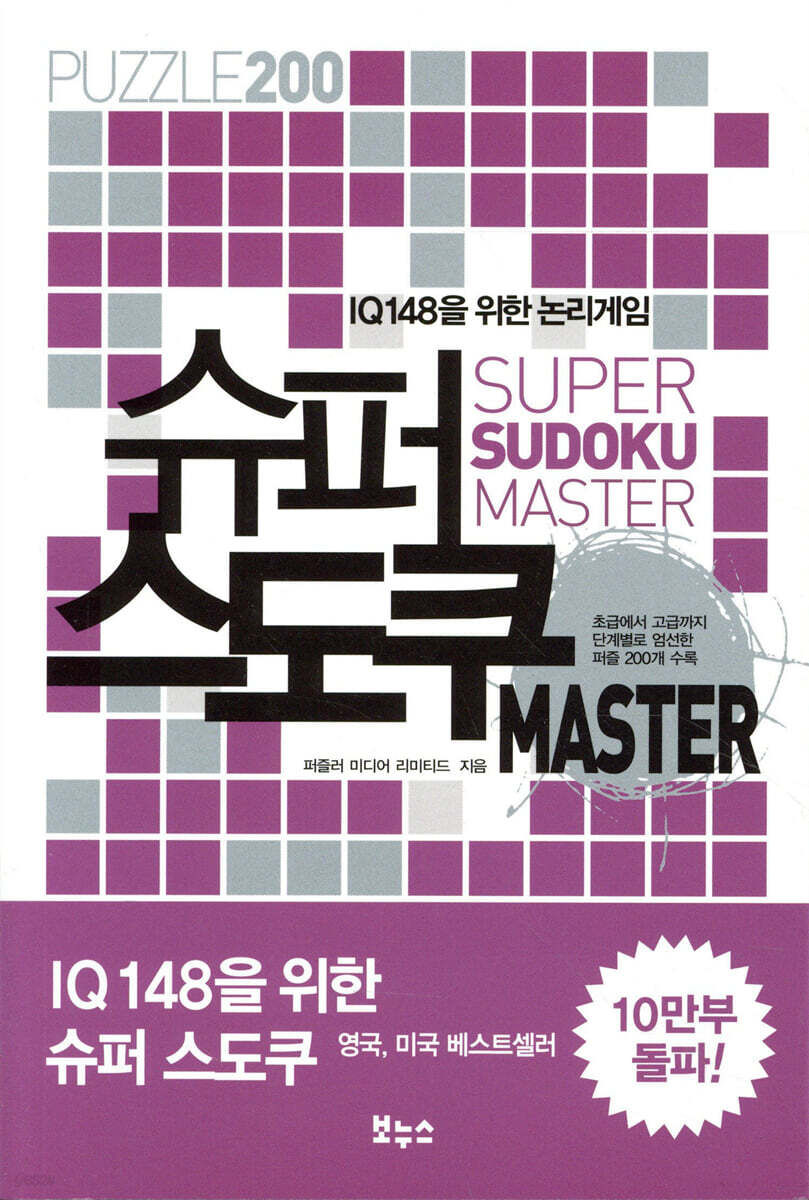
Super Sudoku Master
 |
Description
Book Introduction
From Super Sudoku to Mega Sudoku, this is a book of the best Sudoku puzzles, carefully selected by the British Sudoku research team.
This book is written by James E., a world-renowned mathematician and Britain's leading Sudoku expert.
It consists of only the highest level Sudoku puzzles, much more upgraded than 『Super Sudoku Special』, which was the sequel to 『Super Sudoku 1, 2』 written by Dr. Lilly.
Additionally, the 200 Sudoku puzzles included in this book are not mechanical puzzles assembled using a computer program, but are authentic Sudoku puzzles that were handcrafted through repeated research by 'Puzzler Media Limited', a British puzzle expert team.
Furthermore, the last 10 problems are 'Mega Sudoku', which consists of 625 squares (25x25), unlike the regular Sudoku which has 81 squares (9x9).
It can be said to be the king of Sudoku puzzles.
Therefore, Sudoku enthusiasts who have tried 『Super Sudoku Special』 will be able to encounter the 'ultimate' Sudoku puzzle through this book.
But that doesn't mean Sudoku beginners need to be afraid.
Excluding Mega Sudoku, even readers who have become proficient at solving Sudoku puzzles through 『Super Sudoku 1, 2』, as well as Sudoku beginners, can easily solve it.
Also, puzzlers who have surpassed Mega Sudoku, which is considered a 'super level', can now be said to have reached the realm of 'Sudoku Master'.
This book is written by James E., a world-renowned mathematician and Britain's leading Sudoku expert.
It consists of only the highest level Sudoku puzzles, much more upgraded than 『Super Sudoku Special』, which was the sequel to 『Super Sudoku 1, 2』 written by Dr. Lilly.
Additionally, the 200 Sudoku puzzles included in this book are not mechanical puzzles assembled using a computer program, but are authentic Sudoku puzzles that were handcrafted through repeated research by 'Puzzler Media Limited', a British puzzle expert team.
Furthermore, the last 10 problems are 'Mega Sudoku', which consists of 625 squares (25x25), unlike the regular Sudoku which has 81 squares (9x9).
It can be said to be the king of Sudoku puzzles.
Therefore, Sudoku enthusiasts who have tried 『Super Sudoku Special』 will be able to encounter the 'ultimate' Sudoku puzzle through this book.
But that doesn't mean Sudoku beginners need to be afraid.
Excluding Mega Sudoku, even readers who have become proficient at solving Sudoku puzzles through 『Super Sudoku 1, 2』, as well as Sudoku beginners, can easily solve it.
Also, puzzlers who have surpassed Mega Sudoku, which is considered a 'super level', can now be said to have reached the realm of 'Sudoku Master'.
- You can preview some of the book's contents.
Preview
index
SUPER SUDOKU MASTER GUIDE
SUPER SUDOKU MASTER LEVEL 1
SUPER SUDOKU MASTER LEVEL 2
MEGA SUDOKU MASTER SUPER LEVEL
SUPER SUDOKU SOLUTION
SUPER SUDOKU MASTER LEVEL 1
SUPER SUDOKU MASTER LEVEL 2
MEGA SUDOKU MASTER SUPER LEVEL
SUPER SUDOKU SOLUTION
Publisher's Review
The meaning and origin of Sudoku
Sudoku is a puzzle designed to test logical thinking using numbers.
The Japanese word Sudoku is a combination of the word su (數, su) meaning number and doku (doku, doku) meaning single. In other words, it can be understood as a 'single-digit number'.
Sudoku is basically made up of 81 squares, 9 squares wide and 9 squares high. Individual puzzles may vary in difficulty depending on the level, but the rules are basically the same.
That is, each row and column of 9 squares and each small box of 3 squares x 3 squares must be filled in using the numbers 1 through 9 only once.
Some boxes are already numbered according to the level of each step.
The lower the level, the more numbers are entered, but usually there are no more than 30.
These numbers are written symmetrically and balanced horizontally and vertically.
The exact origins of Sudoku are unknown.
However, the recent explosive Sudoku craze can be traced back to 1984, when a Japanese publisher called Nicoli published an early version of a Sudoku puzzle book.
At the time, Nicolli Publishing stated that the initial version of the Sudoku puzzle book was inspired by a number puzzle book called "Number Place" published in the United States in the 1970s.
Around 1986, Nicolli Publishing Company significantly increased the popularity of Sudoku by re-inventing the rules of an early version of the game.
The new rules devised by Nicolli are as follows:
First, the numbers already entered should be balanced symmetrically horizontally and vertically within the table.
Second, each horizontal line 1 and each vertical line 9 must contain two numbers, and each vertical line 1 and each vertical line 9 must contain one number.
Third, the total number of numbers presented in advance in the table must not exceed 30.
Sudoku, now organized according to these new rules, became the most popular puzzle game in Japan and quickly spread to Europe, the United States, India, and other countries.
The Sudoku Craze and Its Effects
What makes Sudoku so incredibly popular is that it is a game based on mathematical principles, yet requires pure logic.
This game can be adapted to fill in the squares using symbols, alphabets, or colors instead of numbers, but the basic principle remains the same.
Almost all Sudoku puzzles can be solved logically and do not require any complex mathematical calculations.
Therefore, even people with number phobia, who get motion sickness just thinking about numbers, don't have to worry at all about Sudoku.
Here, numbers are simply a means to solve Sudoku.
Thanks to this, anyone, regardless of age or gender, can challenge Sudoku.
Of course, just because it's too easy doesn't mean the fun of solving the puzzle is diminished.
Sudoku is something that seems relatively easy, but the process of getting to the correct answer is not so smooth.
This logic puzzle has a special charm that will have players hooked on the easy stages and then gradually tighten their grip on the difficult stages.
Sudoku now has such a strong appeal that it's almost universally popular.
Sudoku is producing addicts (in a positive sense), and its effects are as follows:
Even with the same puzzle, some people can solve it in 30 minutes, while others can't solve it even after two hours.
This is because some people are naturally good at finding clues to solve puzzles.
So, if it takes you a long time to solve a puzzle, you don't have to think that you are stupid.
If you consistently solve Sudoku, your logical thinking and creativity will develop without you even realizing it.
Thanks to this, puzzles that were completely daunting at first can now be easily solved.
Also, because solving Sudoku requires you to concentrate your thoughts, your concentration naturally improves.
In Europe, many people enjoy playing Sudoku in their spare time to prevent dementia in old age.
Additionally, to improve children's logical thinking skills, Sudoku competitions are being held by broadcasting stations and local communities, and an increasing number of schools are even including it in their curriculum.
Sudoku is no longer just a fun number game, but is also showing both clinical benefits in preventing dementia and educational benefits in improving logical thinking.
This is also an important reason why Sudoku produces addicts in a positive sense.
Sudoku is a puzzle designed to test logical thinking using numbers.
The Japanese word Sudoku is a combination of the word su (數, su) meaning number and doku (doku, doku) meaning single. In other words, it can be understood as a 'single-digit number'.
Sudoku is basically made up of 81 squares, 9 squares wide and 9 squares high. Individual puzzles may vary in difficulty depending on the level, but the rules are basically the same.
That is, each row and column of 9 squares and each small box of 3 squares x 3 squares must be filled in using the numbers 1 through 9 only once.
Some boxes are already numbered according to the level of each step.
The lower the level, the more numbers are entered, but usually there are no more than 30.
These numbers are written symmetrically and balanced horizontally and vertically.
The exact origins of Sudoku are unknown.
However, the recent explosive Sudoku craze can be traced back to 1984, when a Japanese publisher called Nicoli published an early version of a Sudoku puzzle book.
At the time, Nicolli Publishing stated that the initial version of the Sudoku puzzle book was inspired by a number puzzle book called "Number Place" published in the United States in the 1970s.
Around 1986, Nicolli Publishing Company significantly increased the popularity of Sudoku by re-inventing the rules of an early version of the game.
The new rules devised by Nicolli are as follows:
First, the numbers already entered should be balanced symmetrically horizontally and vertically within the table.
Second, each horizontal line 1 and each vertical line 9 must contain two numbers, and each vertical line 1 and each vertical line 9 must contain one number.
Third, the total number of numbers presented in advance in the table must not exceed 30.
Sudoku, now organized according to these new rules, became the most popular puzzle game in Japan and quickly spread to Europe, the United States, India, and other countries.
The Sudoku Craze and Its Effects
What makes Sudoku so incredibly popular is that it is a game based on mathematical principles, yet requires pure logic.
This game can be adapted to fill in the squares using symbols, alphabets, or colors instead of numbers, but the basic principle remains the same.
Almost all Sudoku puzzles can be solved logically and do not require any complex mathematical calculations.
Therefore, even people with number phobia, who get motion sickness just thinking about numbers, don't have to worry at all about Sudoku.
Here, numbers are simply a means to solve Sudoku.
Thanks to this, anyone, regardless of age or gender, can challenge Sudoku.
Of course, just because it's too easy doesn't mean the fun of solving the puzzle is diminished.
Sudoku is something that seems relatively easy, but the process of getting to the correct answer is not so smooth.
This logic puzzle has a special charm that will have players hooked on the easy stages and then gradually tighten their grip on the difficult stages.
Sudoku now has such a strong appeal that it's almost universally popular.
Sudoku is producing addicts (in a positive sense), and its effects are as follows:
Even with the same puzzle, some people can solve it in 30 minutes, while others can't solve it even after two hours.
This is because some people are naturally good at finding clues to solve puzzles.
So, if it takes you a long time to solve a puzzle, you don't have to think that you are stupid.
If you consistently solve Sudoku, your logical thinking and creativity will develop without you even realizing it.
Thanks to this, puzzles that were completely daunting at first can now be easily solved.
Also, because solving Sudoku requires you to concentrate your thoughts, your concentration naturally improves.
In Europe, many people enjoy playing Sudoku in their spare time to prevent dementia in old age.
Additionally, to improve children's logical thinking skills, Sudoku competitions are being held by broadcasting stations and local communities, and an increasing number of schools are even including it in their curriculum.
Sudoku is no longer just a fun number game, but is also showing both clinical benefits in preventing dementia and educational benefits in improving logical thinking.
This is also an important reason why Sudoku produces addicts in a positive sense.
GOODS SPECIFICS
- Date of issue: August 25, 2008
- Page count, weight, size: 279 pages | 325g | 128*188*20mm
- ISBN13: 9788991360631
- ISBN10: 8991360637
You may also like
카테고리
korean


korean

![GQ KOREA Mark (Monthly): December [2025]](http://librairie.coreenne.fr/cdn/shop/files/8ef265dbbfbf186523ed75ba7319009d.jpg?v=1765340328&width=3840)


