

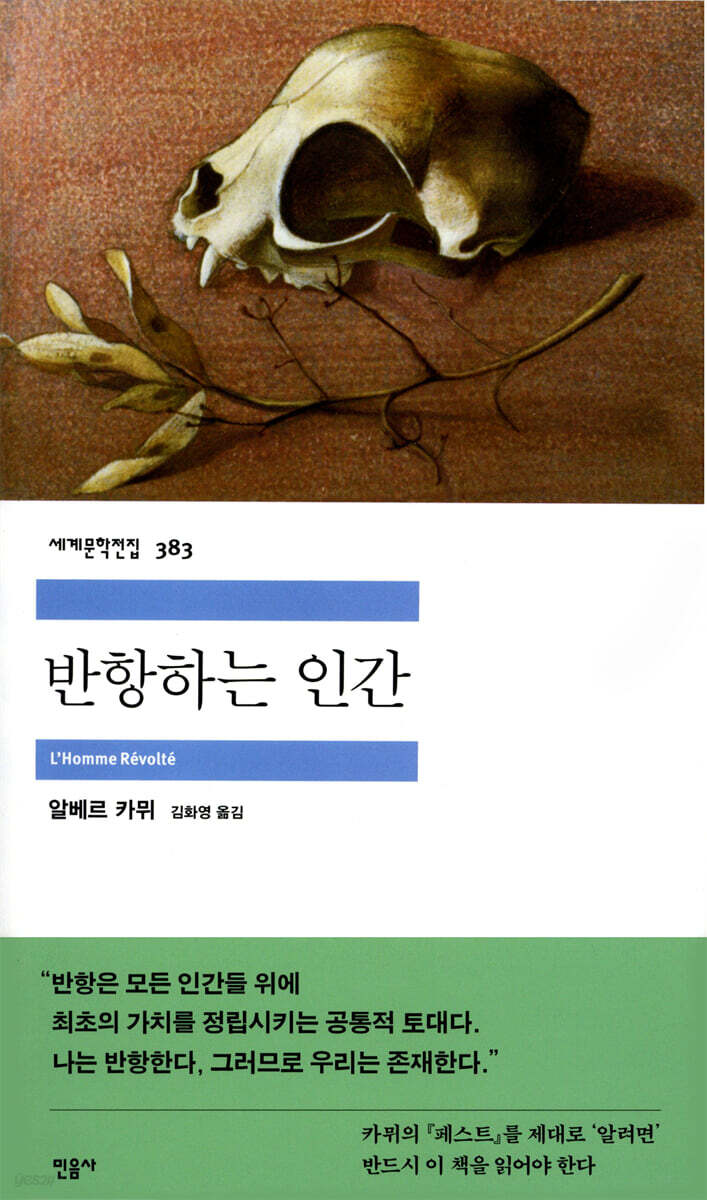
rebellious human
 |
Description
Book Introduction
Albert Camus, the writer who appeared as a stranger in the French literary world and became a legend.
A work that allows for a deeper understanding of Camus' philosophy, along with The Myth of Sisyphus.
Albert Camus, the greatest French novelist and Nobel Prize winner in Literature, known as the author of “The Stranger” and “The Plague.”
Camus left behind not only novels but also numerous plays and political columns, as well as numerous essays that help readers understand his thoughts and aesthetics.
Camus's prose is grounded in ethical, philosophical, and political thought, yet it never abstracts from historical reality but rather confronts and observes it concretely.
Therefore, in order to fully 'understand' the voice of reflection contained in Camus's 'The Stranger' and 'The Plague', one must also read his theoretical works.
Camus's philosophical problematic work, "The Rebel," which occupies a position of great importance alongside "The Myth of Sisyphus," has been translated by Kim Hwa-young, the best translator of French literature, and published as volume 383 in the Minumsa World Literature Collection.
This edition of the World Literature Collection, published this time, is a complete revision of the works included in the 2003 Camus Collection by translator Kim Hwa-young, from beginning to end. Furthermore, the text of the new edition was carefully compared and referenced, and numerous detailed footnotes were added separately from the original notes added by Camus himself.
In this book, which Camus began to conceive in 1942, when the outcome of World War II was unpredictable, he begins with the absurdity of the individual and extends it to the rebellion of the group.
In this book, Camus first reflects on the problematic individuals who recognized the absurdity and took rebellion to the extreme, such as the descendants of Cain, namely Sade, Nietzsche, Dostoevsky, Rimbaud, and Lautréamont, and then reflects on what rebellion is and what results from the primal spirit contained within that rebellion.
It then recalls the extreme rebellion and terrorism brought about by Hitler's German Nazism and Stalin's Russian communism, and raises the ethical question, "How should we behave in an age dominated by history? What should we choose in a world of violence?" and presents its own answer to this question.
A work that allows for a deeper understanding of Camus' philosophy, along with The Myth of Sisyphus.
Albert Camus, the greatest French novelist and Nobel Prize winner in Literature, known as the author of “The Stranger” and “The Plague.”
Camus left behind not only novels but also numerous plays and political columns, as well as numerous essays that help readers understand his thoughts and aesthetics.
Camus's prose is grounded in ethical, philosophical, and political thought, yet it never abstracts from historical reality but rather confronts and observes it concretely.
Therefore, in order to fully 'understand' the voice of reflection contained in Camus's 'The Stranger' and 'The Plague', one must also read his theoretical works.
Camus's philosophical problematic work, "The Rebel," which occupies a position of great importance alongside "The Myth of Sisyphus," has been translated by Kim Hwa-young, the best translator of French literature, and published as volume 383 in the Minumsa World Literature Collection.
This edition of the World Literature Collection, published this time, is a complete revision of the works included in the 2003 Camus Collection by translator Kim Hwa-young, from beginning to end. Furthermore, the text of the new edition was carefully compared and referenced, and numerous detailed footnotes were added separately from the original notes added by Camus himself.
In this book, which Camus began to conceive in 1942, when the outcome of World War II was unpredictable, he begins with the absurdity of the individual and extends it to the rebellion of the group.
In this book, Camus first reflects on the problematic individuals who recognized the absurdity and took rebellion to the extreme, such as the descendants of Cain, namely Sade, Nietzsche, Dostoevsky, Rimbaud, and Lautréamont, and then reflects on what rebellion is and what results from the primal spirit contained within that rebellion.
It then recalls the extreme rebellion and terrorism brought about by Hitler's German Nazism and Stalin's Russian communism, and raises the ethical question, "How should we behave in an age dominated by history? What should we choose in a world of violence?" and presents its own answer to this question.
- You can preview some of the book's contents.
Preview
index
Translator's Note 9
Introduction 13
1 Rebellious Man 29
2 Metaphysical Rebellion 49
3 Historical Rebellion 187
4 Rebellion and Art 435
5 Thoughts at Noon 479
Commentary on the work 529
Author's Chronology 572
Introduction 13
1 Rebellious Man 29
2 Metaphysical Rebellion 49
3 Historical Rebellion 187
4 Rebellion and Art 435
5 Thoughts at Noon 479
Commentary on the work 529
Author's Chronology 572
Detailed image

Into the book
The question that Ivan finally raises in his mind, the question that is the core of the true progress that Dostoevsky makes the rebel achieve, is the only thing that concerns us here.
So, can humans survive in rebellion, and can they continue to endure in rebellion? Ivan offers this answer.
That is, humans can live in rebellion only by pushing rebellion to the ultimate.
--- p.111
This very fact, that the teachings of the superhuman have ended up as methodological fabrications of inferior humans, must be denounced and, moreover, explained and interpreted.
If the final outcome of the great rebellious movements of the 19th and 20th centuries is this ruthless submission, then shouldn't we turn our backs on rebellion and once again utter the desperate cry Nietzsche addressed to his time: "Are my conscience and yours no longer the same conscience?"
--- pp.140-141
In the late 19th and early 20th centuries, rebellious poetry constantly oscillated between these two extremes.
That is, it went back and forth between literature and the will to power, between irrationality and rationality, between desperate dreams and ruthless actions.
At the end of their oscillation, these poets, especially the Surrealists, reveal to us a remarkable abridgement of the path from appearance to action.
--- pp.148-149
This very fact, that the teachings of the superhuman have ended up as methodological fabrications of inferior humans, must be denounced and, moreover, explained and interpreted.
If the final outcome of the great rebellious movements of the 19th and 20th centuries is this ruthless submission, then shouldn't we turn our backs on rebellion and once again utter the desperate cry Nietzsche addressed to his time: "Are my conscience and yours no longer the same conscience?"
--- pp.140-140
Marx's originality lies in his assertion that history is both dialectical and economic.
A more confident Hegel argued that history is both material and spiritual.
Moreover, history can be material only insofar as it is spiritual, and vice versa.
Marx denies the spirit as the ultimate reality and advocates historical materialism.
We can immediately counter this by pointing out, along with Berdyaev, that dialectics and materialism are incompatible.
--- pp.346-347
Marx believed that the end of history would at least prove to be moral and rational.
That's where his utopia lies.
But as he himself knew, Utopia was destined to serve a cynicism he did not want.
Marx destroys all transcendence and then carries out the transition from fact to duty.
But the principle of duty is derived only from facts.
The demand for justice ends up injustice if it is not based on the ethical legitimacy of justice from the beginning.
If we forget this fact, even crime will one day become justifiable.
--- p.365
Marxism is not scientific.
It is at best scientific.
Marxism vividly reveals the profound disconnect between scientific reason, a rewarding tool for inquiry, thought, and even rebellion, and the historical reason created by German idealism, which denied all principles.
Historical reason, in its original function, is not reason that judges the world.
Yet, historical reason claims to judge the world while simultaneously leading it.
--- p.383
The rebellion that is now wrestling with history needs to remember that, in addition to the 'I rebel, therefore we are' and the 'and we are alone' of the metaphysical rebellion, it must also say that we must not kill and be killed to produce what we are not, but that we must live and let others live in order to create what we are.
--- p.434
In fact, at the level of absurdity, murder merely created logical contradictions.
But when it comes to the stage of rebellion, murder is a heartbreaking pain.
Because it's a question of deciding whether or not it's possible to kill someone we've just recognized as being similar to ourselves and have recognized our identity with—whoever that person may be.
Now that I've finally overcome loneliness, am I supposed to justify depriving myself of everything and thus return to that irreversible loneliness? Isn't forcing loneliness on someone who's just finally realized they're not alone a truly crippling crime against humanity?
--- p.484
In rebellion, politics must be about obeying this truth.
Ultimately, rebellion advances history and alleviates human suffering, not without violence, but without resorting to terrorism, and under the most diverse political conditions.
--- p.513
The purest impulse of rebellion thus culminates in Karamazov's bitter cry: "What good is the salvation of one man if all men cannot be saved!"
--- pp.523-524
Rebellion proves that it is the very movement of life, and that rebellion cannot be denied without giving up on living.
The purest cry of rebellion always raises a being.
Rebellion is therefore love and abundance.
Otherwise it's nothing.
So, can humans survive in rebellion, and can they continue to endure in rebellion? Ivan offers this answer.
That is, humans can live in rebellion only by pushing rebellion to the ultimate.
--- p.111
This very fact, that the teachings of the superhuman have ended up as methodological fabrications of inferior humans, must be denounced and, moreover, explained and interpreted.
If the final outcome of the great rebellious movements of the 19th and 20th centuries is this ruthless submission, then shouldn't we turn our backs on rebellion and once again utter the desperate cry Nietzsche addressed to his time: "Are my conscience and yours no longer the same conscience?"
--- pp.140-141
In the late 19th and early 20th centuries, rebellious poetry constantly oscillated between these two extremes.
That is, it went back and forth between literature and the will to power, between irrationality and rationality, between desperate dreams and ruthless actions.
At the end of their oscillation, these poets, especially the Surrealists, reveal to us a remarkable abridgement of the path from appearance to action.
--- pp.148-149
This very fact, that the teachings of the superhuman have ended up as methodological fabrications of inferior humans, must be denounced and, moreover, explained and interpreted.
If the final outcome of the great rebellious movements of the 19th and 20th centuries is this ruthless submission, then shouldn't we turn our backs on rebellion and once again utter the desperate cry Nietzsche addressed to his time: "Are my conscience and yours no longer the same conscience?"
--- pp.140-140
Marx's originality lies in his assertion that history is both dialectical and economic.
A more confident Hegel argued that history is both material and spiritual.
Moreover, history can be material only insofar as it is spiritual, and vice versa.
Marx denies the spirit as the ultimate reality and advocates historical materialism.
We can immediately counter this by pointing out, along with Berdyaev, that dialectics and materialism are incompatible.
--- pp.346-347
Marx believed that the end of history would at least prove to be moral and rational.
That's where his utopia lies.
But as he himself knew, Utopia was destined to serve a cynicism he did not want.
Marx destroys all transcendence and then carries out the transition from fact to duty.
But the principle of duty is derived only from facts.
The demand for justice ends up injustice if it is not based on the ethical legitimacy of justice from the beginning.
If we forget this fact, even crime will one day become justifiable.
--- p.365
Marxism is not scientific.
It is at best scientific.
Marxism vividly reveals the profound disconnect between scientific reason, a rewarding tool for inquiry, thought, and even rebellion, and the historical reason created by German idealism, which denied all principles.
Historical reason, in its original function, is not reason that judges the world.
Yet, historical reason claims to judge the world while simultaneously leading it.
--- p.383
The rebellion that is now wrestling with history needs to remember that, in addition to the 'I rebel, therefore we are' and the 'and we are alone' of the metaphysical rebellion, it must also say that we must not kill and be killed to produce what we are not, but that we must live and let others live in order to create what we are.
--- p.434
In fact, at the level of absurdity, murder merely created logical contradictions.
But when it comes to the stage of rebellion, murder is a heartbreaking pain.
Because it's a question of deciding whether or not it's possible to kill someone we've just recognized as being similar to ourselves and have recognized our identity with—whoever that person may be.
Now that I've finally overcome loneliness, am I supposed to justify depriving myself of everything and thus return to that irreversible loneliness? Isn't forcing loneliness on someone who's just finally realized they're not alone a truly crippling crime against humanity?
--- p.484
In rebellion, politics must be about obeying this truth.
Ultimately, rebellion advances history and alleviates human suffering, not without violence, but without resorting to terrorism, and under the most diverse political conditions.
--- p.513
The purest impulse of rebellion thus culminates in Karamazov's bitter cry: "What good is the salvation of one man if all men cannot be saved!"
--- pp.523-524
Rebellion proves that it is the very movement of life, and that rebellion cannot be denied without giving up on living.
The purest cry of rebellion always raises a being.
Rebellion is therefore love and abundance.
Otherwise it's nothing.
--- p.524
Publisher's Review
“At last, in this hour when a human being is born, the enthusiasm of the times and the times
“Youth must remain as it was.”
▶ Camus has become a myth.
It doesn't matter anymore whether you acknowledge him or not.
―Roland Barthes
▶ The important thing is to know how to behave in this world, because the world before your eyes is reality.
—Albert Camus
To understand Camus's The Plague, you must read this book.
How do we act and what do we choose in a world of violence?
Albert Camus, the greatest French novelist and Nobel Prize winner in Literature, is known to us as the author of “The Stranger” and “The Plague.”
Camus left behind not only novels but also numerous plays and political columns, as well as numerous essays that help readers understand his thoughts and aesthetics.
Camus's prose is grounded in ethical, philosophical, and political thought, yet it never abstracts from historical reality but rather confronts and observes it concretely.
Therefore, in order to fully 'understand' the voice of reflection contained in Camus's 'The Stranger' and 'The Plague', one must also read his theoretical works.
Camus's philosophical problematic work, "The Rebel," which occupies a position of great importance alongside "The Myth of Sisyphus," has been translated by Kim Hwa-young, the best translator of French literature, and published as volume 383 in the Minumsa World Literature Collection.
This edition of the World Literature Collection, published this time, is a complete revision of the works included in the 2003 Camus Collection by translator Kim Hwa-young, from beginning to end. Furthermore, the text of the new edition was carefully compared and referenced, and numerous detailed footnotes were added separately from the original notes added by Camus himself.
In this book, which Camus began to conceive in 1942, when the outcome of World War II was unpredictable, he begins with the absurdity of the individual and extends it to the rebellion of the group.
In this book, Camus first reflects on the problematic individuals who recognized the absurdity and took rebellion to the extreme, such as the descendants of Cain, namely Sade, Nietzsche, Dostoevsky, Rimbaud, and Lautréamont, and then reflects on what rebellion is and what results from the primal spirit contained within that rebellion.
It then recalls the extreme rebellion and terrorism brought about by Hitler's German Nazism and Stalin's Russian communism, and raises the ethical question, "How should we behave in an age dominated by history? What should we choose in a world of violence?" and presents its own answer to this question.
Camus's answer is clear.
First, violence is both inevitable and unjustifiable.
Second, ‘limits’ are inevitable in order to protect justice, freedom, and human dignity.
Third, the nature of violent acts as an 'exception' must be clearly and consistently made clear.
Three Codes for Understanding Camus: Absurdity, Rebellion, and Love
Camus had already written down the outline of his work in his notebooks early on:
1.
Rejection (absurdity); the stranger, Caligula, misunderstanding, the myth of Sisyphus - methodological doubt.
2.
Affirmation (rebellion); plague, righteous people, martial law, rebellious man
3.
Love: Currently planning, writing.
Camus's youth was marked by rebellion.
Joining the Communist Party, refusing to teach, writing and creating, protesting against the injustice suffered by French North African workers and the miserable lives of the Kabylian people, censorship, and the poets of war.
All of this was a rebellion on many levels.
Camus's rebellion continues in his writing and is literarily represented in detail in his problematic works.
The poet Cerea murders Caligula, who has become an absolute monarch.
Sisyphus and Meursault, who have been pushed to the brink of nothingness, reject the fatal logic that advises suicide and decide for themselves whether to live or die with their persistent passion, curiosity, and sense of adventure.
The rebellion of individuals who have not witnessed the absurdity now moves towards us.
The righteous join forces to overthrow the dictator, and Tarrou, who resists the plague of terrorism, joins the righteous, but eventually dies of the plague as it recedes.
In the introduction to The Rebel, a true study of rebellion and violence that rejects the justification of murder, Camus says:
“The important thing is not to go back to the root of things and delve into them, but rather to look at what is right in front of you.
“Since the world is reality, the first thing to do is to know how to behave in this world.” (Page 15)
For Camus, what matters is how to act, that is, the question of ethics.
So, the theme of this book constantly reminds us that, before being an abstract concept of rebellion, it is a reflection on living human beings and their concrete lives: the 'rebellious human being.'
Camus then reveals that this book is an extension of his previous writings.
“In this essay, we would like to continue a reflection that we started with the concepts of suicide and the absurd, by placing the problem of murder and rebellion before it.” Camus’s reflection that we started with the concepts of suicide and the absurd is ‘The Stranger’ and ‘The Myth of Sisyphus’, and the problem of rebellion that we will continue with is incorporated into ‘The Plague’ and ‘The Rebel Man’.
For Camus, absurdity and rebellion are simultaneous.
The moment he questions the meaning of life, a feeling of absurdity is born.
But at the same time, a rebellion against the meaninglessness of life is born.
In "The Stranger" and "The Myth of Sisyphus," we struggle with the question of why we must continue to live in this absurd feeling, this nakedness, this lack of understanding, this loneliness.
In The Plague and The Rebel, he goes beyond the questioning individual and addresses the group as follows:
'No, we exist.'
“Rebellion is the common foundation that establishes the first value above all human beings.
I rebel,
Therefore, we exist.” (Page 47)
The book that sparked the Camus-Sartre debate, a showdown between French intellectuals.
Whose hand has history actually given?
Camus believed that the lessons he learned from his intense reflections on rebellion, namely, the philosophy of limits and moderation, had now overtaken the era of absolute negation, and thus opened up a difficult and difficult path to overcoming nihilism.
Camus pointed out this problem in this book and mercilessly criticized Hegel and Marx, the gods or heroes of the Parisian left who were hardened to the communist worldview at the time, and Lenin and Stalin, the leaders of the world revolution.
As a result, 『The Rebellious Man』 became the subject of praise, discussion, criticism, and bitter attacks everywhere immediately after its publication.
The most representative of these is the 'Camus-Sartre debate'.
When the book was published, Francis Janson published a brutal review in L'Etham Moderne, a magazine led by Sartre and others, saying that Camus "makes revolution impossible by fleeing from history and preaches Red Cross ethics." Camus responded by sending a rebuttal not to Janson, but to Sartre, the magazine's editor.
Sartre, who realized that he was the target, did not remain still and responded fiercely, and the two eventually split up due to ideological conflict.
Camus's rebellion does not advocate terrorism or absolute violence, unlike Marxism or totalitarianism, nor does it add further misfortune to the world's misfortunes, but respects certain limits.
There are limits to rebellion and violence, and they are only used in exceptional circumstances to protect human dignity and justice.
No cause can justify the death of an innocent person, and Camus appeals to us to unite not for the sake of an individual or a nation, but for justice.
The purest impulse of rebellion is thus, if not all men are saved,
It ends with Karamazov's heartbreaking cry: "What good is the salvation of just one person?"
(Pages 523-524)
Whose hand did history give?
We can see how far ahead Camus was in seeing the true course of world order.
Camus's writings were suspended on January 4, 1960, without him even being able to write about love.
Camus never saw an independent Algeria.
How does Camus view the current situation and the world today? While we cannot answer for him, Camus's thoughts and ideas can help us reflect on terrorism.
When will we finally be able to imagine the day when Camus's words will finally calm people down and break the vicious cycle of violence and being subjected to it?
Even in the midst of the unbearable vicious cycle of terrorism, the ethics Camus speaks of in "The Rebel" will help us assess reality.
That violence, though inevitable, cannot be justified; that there must be limits to rebellion and violence; that violence and terrorism are only exceptions.
True rebellion is the negation of violence and the affirmation of values.
By the taut bow of these two poles, our thoughts and happiness of noon can soar far and high.
Today, after more than a year of walking alone in the streets wearing masks that cover half of our faces, confined to our homes, rooms, and yards, forced to live “at a distance” from those we miss, and longing for the elusive moment of “herd immunity,” we live like ghosts, and we are painfully reminded of Camus’ words.
“Man adds, ‘I rebel, therefore we are,’ and, while pondering all the wonderful possibilities of rebellion, even the death of rebellion,
“And it’s just us.” (From the translator’s note)
“Youth must remain as it was.”
▶ Camus has become a myth.
It doesn't matter anymore whether you acknowledge him or not.
―Roland Barthes
▶ The important thing is to know how to behave in this world, because the world before your eyes is reality.
—Albert Camus
To understand Camus's The Plague, you must read this book.
How do we act and what do we choose in a world of violence?
Albert Camus, the greatest French novelist and Nobel Prize winner in Literature, is known to us as the author of “The Stranger” and “The Plague.”
Camus left behind not only novels but also numerous plays and political columns, as well as numerous essays that help readers understand his thoughts and aesthetics.
Camus's prose is grounded in ethical, philosophical, and political thought, yet it never abstracts from historical reality but rather confronts and observes it concretely.
Therefore, in order to fully 'understand' the voice of reflection contained in Camus's 'The Stranger' and 'The Plague', one must also read his theoretical works.
Camus's philosophical problematic work, "The Rebel," which occupies a position of great importance alongside "The Myth of Sisyphus," has been translated by Kim Hwa-young, the best translator of French literature, and published as volume 383 in the Minumsa World Literature Collection.
This edition of the World Literature Collection, published this time, is a complete revision of the works included in the 2003 Camus Collection by translator Kim Hwa-young, from beginning to end. Furthermore, the text of the new edition was carefully compared and referenced, and numerous detailed footnotes were added separately from the original notes added by Camus himself.
In this book, which Camus began to conceive in 1942, when the outcome of World War II was unpredictable, he begins with the absurdity of the individual and extends it to the rebellion of the group.
In this book, Camus first reflects on the problematic individuals who recognized the absurdity and took rebellion to the extreme, such as the descendants of Cain, namely Sade, Nietzsche, Dostoevsky, Rimbaud, and Lautréamont, and then reflects on what rebellion is and what results from the primal spirit contained within that rebellion.
It then recalls the extreme rebellion and terrorism brought about by Hitler's German Nazism and Stalin's Russian communism, and raises the ethical question, "How should we behave in an age dominated by history? What should we choose in a world of violence?" and presents its own answer to this question.
Camus's answer is clear.
First, violence is both inevitable and unjustifiable.
Second, ‘limits’ are inevitable in order to protect justice, freedom, and human dignity.
Third, the nature of violent acts as an 'exception' must be clearly and consistently made clear.
Three Codes for Understanding Camus: Absurdity, Rebellion, and Love
Camus had already written down the outline of his work in his notebooks early on:
1.
Rejection (absurdity); the stranger, Caligula, misunderstanding, the myth of Sisyphus - methodological doubt.
2.
Affirmation (rebellion); plague, righteous people, martial law, rebellious man
3.
Love: Currently planning, writing.
Camus's youth was marked by rebellion.
Joining the Communist Party, refusing to teach, writing and creating, protesting against the injustice suffered by French North African workers and the miserable lives of the Kabylian people, censorship, and the poets of war.
All of this was a rebellion on many levels.
Camus's rebellion continues in his writing and is literarily represented in detail in his problematic works.
The poet Cerea murders Caligula, who has become an absolute monarch.
Sisyphus and Meursault, who have been pushed to the brink of nothingness, reject the fatal logic that advises suicide and decide for themselves whether to live or die with their persistent passion, curiosity, and sense of adventure.
The rebellion of individuals who have not witnessed the absurdity now moves towards us.
The righteous join forces to overthrow the dictator, and Tarrou, who resists the plague of terrorism, joins the righteous, but eventually dies of the plague as it recedes.
In the introduction to The Rebel, a true study of rebellion and violence that rejects the justification of murder, Camus says:
“The important thing is not to go back to the root of things and delve into them, but rather to look at what is right in front of you.
“Since the world is reality, the first thing to do is to know how to behave in this world.” (Page 15)
For Camus, what matters is how to act, that is, the question of ethics.
So, the theme of this book constantly reminds us that, before being an abstract concept of rebellion, it is a reflection on living human beings and their concrete lives: the 'rebellious human being.'
Camus then reveals that this book is an extension of his previous writings.
“In this essay, we would like to continue a reflection that we started with the concepts of suicide and the absurd, by placing the problem of murder and rebellion before it.” Camus’s reflection that we started with the concepts of suicide and the absurd is ‘The Stranger’ and ‘The Myth of Sisyphus’, and the problem of rebellion that we will continue with is incorporated into ‘The Plague’ and ‘The Rebel Man’.
For Camus, absurdity and rebellion are simultaneous.
The moment he questions the meaning of life, a feeling of absurdity is born.
But at the same time, a rebellion against the meaninglessness of life is born.
In "The Stranger" and "The Myth of Sisyphus," we struggle with the question of why we must continue to live in this absurd feeling, this nakedness, this lack of understanding, this loneliness.
In The Plague and The Rebel, he goes beyond the questioning individual and addresses the group as follows:
'No, we exist.'
“Rebellion is the common foundation that establishes the first value above all human beings.
I rebel,
Therefore, we exist.” (Page 47)
The book that sparked the Camus-Sartre debate, a showdown between French intellectuals.
Whose hand has history actually given?
Camus believed that the lessons he learned from his intense reflections on rebellion, namely, the philosophy of limits and moderation, had now overtaken the era of absolute negation, and thus opened up a difficult and difficult path to overcoming nihilism.
Camus pointed out this problem in this book and mercilessly criticized Hegel and Marx, the gods or heroes of the Parisian left who were hardened to the communist worldview at the time, and Lenin and Stalin, the leaders of the world revolution.
As a result, 『The Rebellious Man』 became the subject of praise, discussion, criticism, and bitter attacks everywhere immediately after its publication.
The most representative of these is the 'Camus-Sartre debate'.
When the book was published, Francis Janson published a brutal review in L'Etham Moderne, a magazine led by Sartre and others, saying that Camus "makes revolution impossible by fleeing from history and preaches Red Cross ethics." Camus responded by sending a rebuttal not to Janson, but to Sartre, the magazine's editor.
Sartre, who realized that he was the target, did not remain still and responded fiercely, and the two eventually split up due to ideological conflict.
Camus's rebellion does not advocate terrorism or absolute violence, unlike Marxism or totalitarianism, nor does it add further misfortune to the world's misfortunes, but respects certain limits.
There are limits to rebellion and violence, and they are only used in exceptional circumstances to protect human dignity and justice.
No cause can justify the death of an innocent person, and Camus appeals to us to unite not for the sake of an individual or a nation, but for justice.
The purest impulse of rebellion is thus, if not all men are saved,
It ends with Karamazov's heartbreaking cry: "What good is the salvation of just one person?"
(Pages 523-524)
Whose hand did history give?
We can see how far ahead Camus was in seeing the true course of world order.
Camus's writings were suspended on January 4, 1960, without him even being able to write about love.
Camus never saw an independent Algeria.
How does Camus view the current situation and the world today? While we cannot answer for him, Camus's thoughts and ideas can help us reflect on terrorism.
When will we finally be able to imagine the day when Camus's words will finally calm people down and break the vicious cycle of violence and being subjected to it?
Even in the midst of the unbearable vicious cycle of terrorism, the ethics Camus speaks of in "The Rebel" will help us assess reality.
That violence, though inevitable, cannot be justified; that there must be limits to rebellion and violence; that violence and terrorism are only exceptions.
True rebellion is the negation of violence and the affirmation of values.
By the taut bow of these two poles, our thoughts and happiness of noon can soar far and high.
Today, after more than a year of walking alone in the streets wearing masks that cover half of our faces, confined to our homes, rooms, and yards, forced to live “at a distance” from those we miss, and longing for the elusive moment of “herd immunity,” we live like ghosts, and we are painfully reminded of Camus’ words.
“Man adds, ‘I rebel, therefore we are,’ and, while pondering all the wonderful possibilities of rebellion, even the death of rebellion,
“And it’s just us.” (From the translator’s note)
GOODS SPECIFICS
- Publication date: June 18, 2021
- Page count, weight, size: 640 pages | 702g | 132*225*31mm
- ISBN13: 9788937463839
- ISBN10: 8937463830
You may also like
카테고리
korean


korean

![GQ KOREA Mark (Monthly): December [2025]](http://librairie.coreenne.fr/cdn/shop/files/8ef265dbbfbf186523ed75ba7319009d.jpg?v=1765340328&width=3840)


