

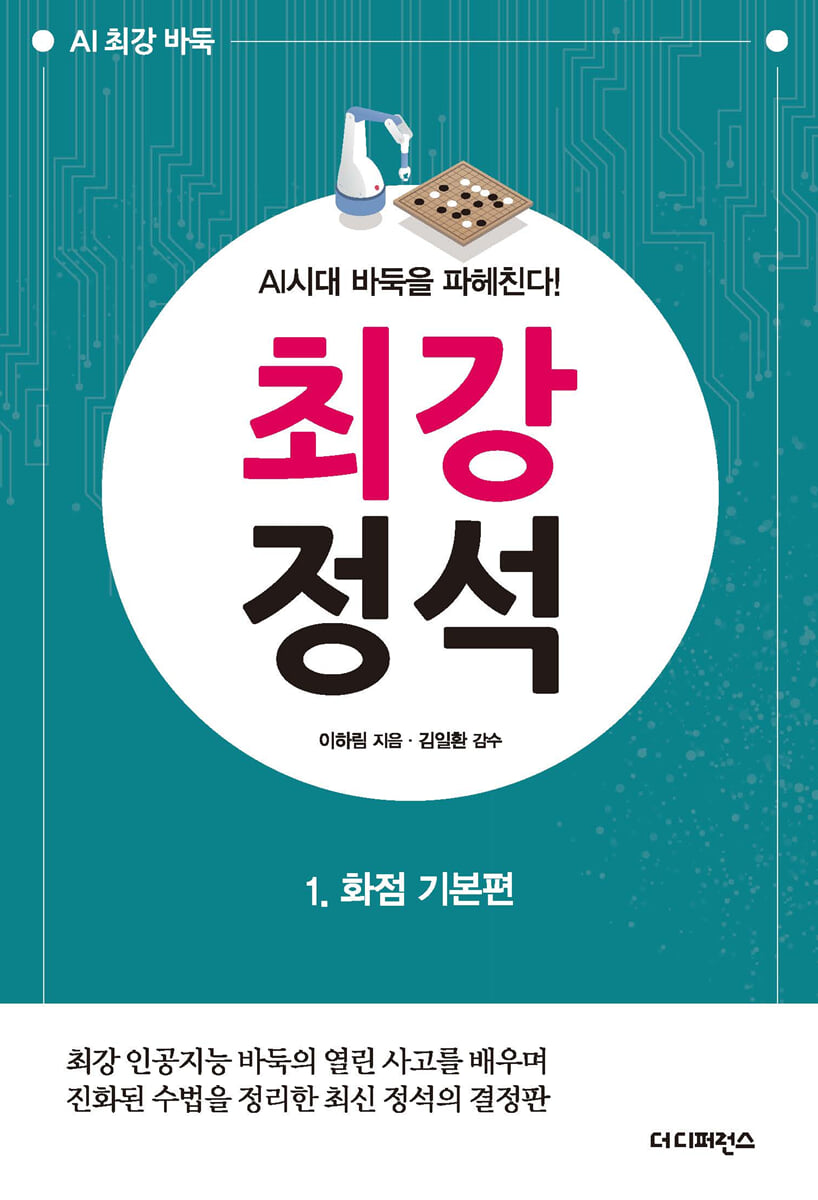
Uncovering the Art of Go in the AI Era! The Ultimate Classic 1: The Basics of Hwajeom
 |
Description
Book Introduction
The world of Go is now dominated by artificial intelligence (AI). Initially, AI was considered a worthwhile endeavor, but as AI continues to evolve, it's now considered a mentor rather than a rival.
The world of Go shown by AI is truly mysterious.
He is a genius in shape-shifting, able to transform depending on the situation, and his powers are surprisingly powerful even when his numbers are beyond common sense.
Humans only trust visible forces, but AI uses invisible forces to analyze in detail and make comprehensive judgments.
In particular, the early stages of Baduk were a time and space dominated by emotions and sensations, a taboo area where simple artificial intelligence calculations could not surpass human intelligence. However, increasingly powerful artificial intelligence has shattered these stereotypes and overwhelmed human emotions.
Even in the early days of the unknown world, the elusive AI made calculations without hesitation, and as a result, a revolution occurred in the rules and strategies.
While artificial intelligence has been exploring the human world of Go with cold reason, it is now time to analyze the profound world of AI Go with warm human emotions.
The purpose of this book is to show the changed Go techniques through the new perspective of AI.
In the field of Jeongseok, it is planned to be completed as a three-volume series.
The topic of this book is the topic of the fire point, and among them, it covers the most basic principles that are encountered most often.
In the next two volumes, we will cover the joint attack among the basic techniques of fire point, and in the third volume, we will cover the basic techniques of small wood.
For convenience, this book is subtitled 'Basic Fire Points' and is divided into parts with topics to help readers understand the content.
The world of Go shown by AI is truly mysterious.
He is a genius in shape-shifting, able to transform depending on the situation, and his powers are surprisingly powerful even when his numbers are beyond common sense.
Humans only trust visible forces, but AI uses invisible forces to analyze in detail and make comprehensive judgments.
In particular, the early stages of Baduk were a time and space dominated by emotions and sensations, a taboo area where simple artificial intelligence calculations could not surpass human intelligence. However, increasingly powerful artificial intelligence has shattered these stereotypes and overwhelmed human emotions.
Even in the early days of the unknown world, the elusive AI made calculations without hesitation, and as a result, a revolution occurred in the rules and strategies.
While artificial intelligence has been exploring the human world of Go with cold reason, it is now time to analyze the profound world of AI Go with warm human emotions.
The purpose of this book is to show the changed Go techniques through the new perspective of AI.
In the field of Jeongseok, it is planned to be completed as a three-volume series.
The topic of this book is the topic of the fire point, and among them, it covers the most basic principles that are encountered most often.
In the next two volumes, we will cover the joint attack among the basic techniques of fire point, and in the third volume, we will cover the basic techniques of small wood.
For convenience, this book is subtitled 'Basic Fire Points' and is divided into parts with topics to help readers understand the content.
- You can preview some of the book's contents.
Preview
index
PART 1: The AI Era's Classics
Type 1 Early 3-Three Invasion - Evolved Basic Strategy
Type 2 Early 3-3 Intrusion - If cut from the inside
3rd type early 3th intrusion - an attachment foreshadowing a fight
Type 4 Early 3-3 Invasion - Increasing Change
When attached to the 5th type fire point and wet-connected
In case of attaching to the 6th point and wetting-penetrating
Practical application of the basic principles
PART 2: Strategy after the opening ceremony
Utilized in the 7-type two-kanbeollim standard
Aiming at the 8-type two-spaced game
Invasion of the 9-type garlic clove attachment standard
10-type garlic clove attachment, a variation from the standard
Invasion of the ears from the 11-type garlic clove attachment standard
Leading idea from the 12-type garlic clove attachment standard
Invasion of the 13-type three-compartment high-rise building
Attached to the 14-type three-compartment high-beam
Practical application of the basic principles
PART 3: The Active Tense
Received a 15-year-old sagging day
Attached to the 16th day date - basic changes
Attached to the 17th day date - attached and connected
18-type day-to-day attack from behind - one-space pincer attack
19-type day-to-day running attack from behind - attached
Practical application of the basic principles
PART 4: Evolved Topping Classics
Reevaluation of Type 20 attachments and countermeasures
21-type extension - ear attachment and garlic hair movement
22-type extension - connect to 3-three penetration
23-type extension - blocking the 3-three intrusion
24-type blocking - aka Lee Chang-ho's classic
Practical application of the basic principles
PART 5: The Classic of Receiving a Space and a Eye
Basic strategy for receiving 25-type single-space
A peek into the 26-inch single-room apartment
27-type eye protection - Basic changes to the 3-three invasion
28-type eye-catching - interrogating from the ears
Practical application of the basic principles
PART 6: AI's Specialty: Double-Headed Stance
29-type double-headed slingshot - changes and diagnosis of the old model
30-type double-barreled firearm - active push-up
31-type double-sided tape - the latest ear attachment
32-type double-barreled gun - evolved high-barreled gun
Practical application of the basic principles
Appendix - A Brief Guide to the AI Era
Type 1 Early 3-Three Invasion - Evolved Basic Strategy
Type 2 Early 3-3 Intrusion - If cut from the inside
3rd type early 3th intrusion - an attachment foreshadowing a fight
Type 4 Early 3-3 Invasion - Increasing Change
When attached to the 5th type fire point and wet-connected
In case of attaching to the 6th point and wetting-penetrating
Practical application of the basic principles
PART 2: Strategy after the opening ceremony
Utilized in the 7-type two-kanbeollim standard
Aiming at the 8-type two-spaced game
Invasion of the 9-type garlic clove attachment standard
10-type garlic clove attachment, a variation from the standard
Invasion of the ears from the 11-type garlic clove attachment standard
Leading idea from the 12-type garlic clove attachment standard
Invasion of the 13-type three-compartment high-rise building
Attached to the 14-type three-compartment high-beam
Practical application of the basic principles
PART 3: The Active Tense
Received a 15-year-old sagging day
Attached to the 16th day date - basic changes
Attached to the 17th day date - attached and connected
18-type day-to-day attack from behind - one-space pincer attack
19-type day-to-day running attack from behind - attached
Practical application of the basic principles
PART 4: Evolved Topping Classics
Reevaluation of Type 20 attachments and countermeasures
21-type extension - ear attachment and garlic hair movement
22-type extension - connect to 3-three penetration
23-type extension - blocking the 3-three intrusion
24-type blocking - aka Lee Chang-ho's classic
Practical application of the basic principles
PART 5: The Classic of Receiving a Space and a Eye
Basic strategy for receiving 25-type single-space
A peek into the 26-inch single-room apartment
27-type eye protection - Basic changes to the 3-three invasion
28-type eye-catching - interrogating from the ears
Practical application of the basic principles
PART 6: AI's Specialty: Double-Headed Stance
29-type double-headed slingshot - changes and diagnosis of the old model
30-type double-barreled firearm - active push-up
31-type double-sided tape - the latest ear attachment
32-type double-barreled gun - evolved high-barreled gun
Practical application of the basic principles
Appendix - A Brief Guide to the AI Era
Detailed image

Publisher's Review
To summarize the content of each part, "Part 1" covers the most representative classics of the AI era. From the outset, AI favors the 3-3 infiltration strategy, and even when it's caught in the crossfire, it displays aggressive tendencies with tight attachments.
'Part 2' deals with the invasion after receiving and opening the ear.
Here too, we can see creative ideas such as AI's second-line invasion.
Part 3 covers aggressive and proactive tactics.
Although it shows the standard methods that have been used a lot, it focuses on AI's diagnosis that examines the real and the false.
'Part 4' deals with the classic method of attaching stones from above, which has been considered a method of Go.
We focused on the advanced AI techniques that can be applied without hesitation to the ear.
'Part 5' covers the key changes to the Hankan and Nunmokja rules.
Part 6 covers the classic double-crossing strategy that AI likes to use.
Due to the influence of AI that is good at taking out hands, the double-crossing strategy is bound to appear frequently in real-life situations.
The text is divided into 32 types, organized by type.
For supplementary learning, we have included 'One-Point Lessons' at the end of each type as needed, and for three-dimensional learning, we have included 'Practical Application of the Classics' at the end of each part.
Lastly, in the 'Appendix', we have listed the classics that symbolize the AI era in connection with the main text, allowing you to visually view the latest trends in classics.
Overall, we've strived to create a systematic, practical, and engaging guide to the AI era, tailored to the reader's level, from low to high.
What we can learn from AI is a comprehensive perspective on the big picture and creative thinking based on open thinking.
This book presents various principles and variations learned from AI, but in reality, AI doesn't even know what principles are. It simply calculates and applies them to the board.
Since the Jeongseok, which is part of the overall situation, is also a human language, how you utilize it will depend on your perspective as you look at the whole country.
'Part 2' deals with the invasion after receiving and opening the ear.
Here too, we can see creative ideas such as AI's second-line invasion.
Part 3 covers aggressive and proactive tactics.
Although it shows the standard methods that have been used a lot, it focuses on AI's diagnosis that examines the real and the false.
'Part 4' deals with the classic method of attaching stones from above, which has been considered a method of Go.
We focused on the advanced AI techniques that can be applied without hesitation to the ear.
'Part 5' covers the key changes to the Hankan and Nunmokja rules.
Part 6 covers the classic double-crossing strategy that AI likes to use.
Due to the influence of AI that is good at taking out hands, the double-crossing strategy is bound to appear frequently in real-life situations.
The text is divided into 32 types, organized by type.
For supplementary learning, we have included 'One-Point Lessons' at the end of each type as needed, and for three-dimensional learning, we have included 'Practical Application of the Classics' at the end of each part.
Lastly, in the 'Appendix', we have listed the classics that symbolize the AI era in connection with the main text, allowing you to visually view the latest trends in classics.
Overall, we've strived to create a systematic, practical, and engaging guide to the AI era, tailored to the reader's level, from low to high.
What we can learn from AI is a comprehensive perspective on the big picture and creative thinking based on open thinking.
This book presents various principles and variations learned from AI, but in reality, AI doesn't even know what principles are. It simply calculates and applies them to the board.
Since the Jeongseok, which is part of the overall situation, is also a human language, how you utilize it will depend on your perspective as you look at the whole country.
GOODS SPECIFICS
- Date of issue: November 17, 2025
- Page count, weight, size: 320 pages | 153*225*30mm
- ISBN13: 9791161255682
- ISBN10: 1161255680
You may also like
카테고리
korean


korean

![GQ KOREA Mark (Monthly): December [2025]](http://librairie.coreenne.fr/cdn/shop/files/8ef265dbbfbf186523ed75ba7319009d.jpg?v=1765340328&width=3840)


