

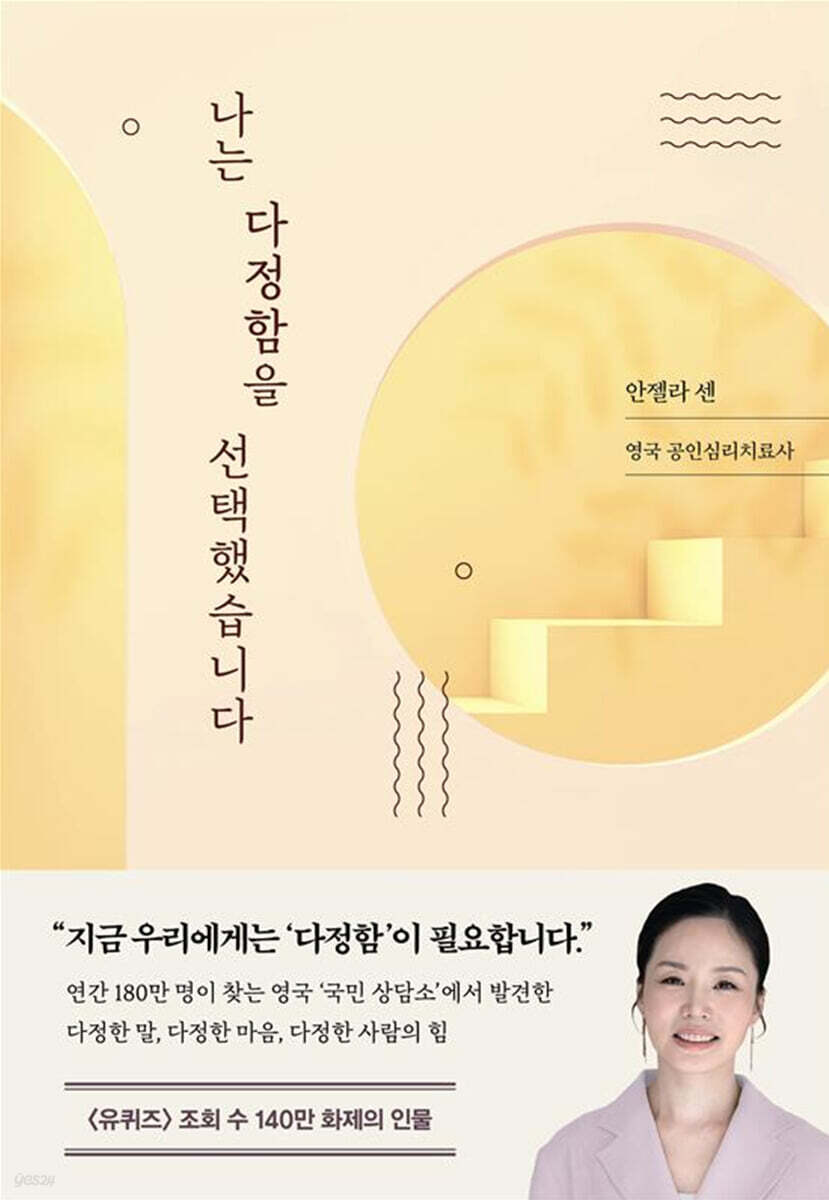
I chose affection
 |
Description
Book Introduction
★★★ A hot topic on tvN's "You Quiz" with 3.2 million cumulative YouTube views
★★★ A licensed psychotherapist at the UK's National Counselling Service, which receives 1.8 million visits annually.
★★★ New book from the author of the best-selling book "Relationships That Protect Me Come First"
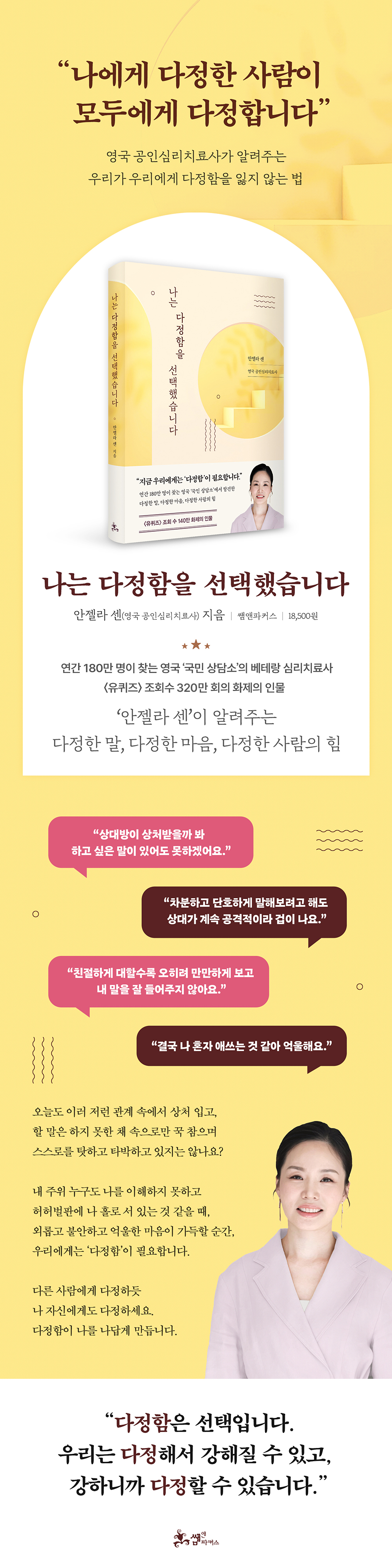
“He who is kind to me is kind to all.”
A certified psychotherapist from the UK's National Counselling Service says:
The power of true 'affection' that protects both me and my relationships
Angela Sen, a licensed psychotherapist and bestselling author who has been healing the wounds of countless people for 18 years at the National Psychiatric Clinic in the UK, which sees 1.8 million people a year, has released her new book, "I Chose Kindness," a mind class that points out the fundamental cause of our being hurt and despairing in various relationships, including at home, school, and work, and teaches us "kindness" as a solution.
As the title suggests, the author explores the meaning of true affection, focusing on the two themes of 'affection' and 'choice', and explains why affection is important to us today.
The 'affection' discussed in this book is not simply being kind to people or unconditionally yielding, but rather a mature way of communicating that also includes firmness.
Expressing your thoughts and feelings clearly in a kind and considerate manner.
This allows us to appropriately adjust the distance and boundaries between ourselves and others.
So, maintaining a balance between what I can and cannot do.
That is the key to a healthy human relationship where neither I nor the other person gets hurt.
The author points out common misconceptions and prejudices people have about affection and explains step by step how affection can benefit us scientifically and practically.
Through this process, readers learn that choosing kindness is a courageous decision that respects and protects both themselves and others.
Above all, I look back on my mistakes of being kind to others but not to myself, and realize that I need to be kind to myself too.
★★★ A licensed psychotherapist at the UK's National Counselling Service, which receives 1.8 million visits annually.
★★★ New book from the author of the best-selling book "Relationships That Protect Me Come First"
“He who is kind to me is kind to all.”
A certified psychotherapist from the UK's National Counselling Service says:
The power of true 'affection' that protects both me and my relationships
Angela Sen, a licensed psychotherapist and bestselling author who has been healing the wounds of countless people for 18 years at the National Psychiatric Clinic in the UK, which sees 1.8 million people a year, has released her new book, "I Chose Kindness," a mind class that points out the fundamental cause of our being hurt and despairing in various relationships, including at home, school, and work, and teaches us "kindness" as a solution.
As the title suggests, the author explores the meaning of true affection, focusing on the two themes of 'affection' and 'choice', and explains why affection is important to us today.
The 'affection' discussed in this book is not simply being kind to people or unconditionally yielding, but rather a mature way of communicating that also includes firmness.
Expressing your thoughts and feelings clearly in a kind and considerate manner.
This allows us to appropriately adjust the distance and boundaries between ourselves and others.
So, maintaining a balance between what I can and cannot do.
That is the key to a healthy human relationship where neither I nor the other person gets hurt.
The author points out common misconceptions and prejudices people have about affection and explains step by step how affection can benefit us scientifically and practically.
Through this process, readers learn that choosing kindness is a courageous decision that respects and protects both themselves and others.
Above all, I look back on my mistakes of being kind to others but not to myself, and realize that I need to be kind to myself too.
- You can preview some of the book's contents.
Preview
index
Introduction | Kindness Makes Me Who I Am
Chapter 1: Choosing Kindness
Until your wounds heal
The cut-off list is not the answer.
Still, we must be together
Why the wounds repeat themselves
The past doesn't go away, but its wounds do heal.
What can you bear to think about?
Chapter 2: Affection is not weak
No one is completely harmless
Someone who understands me completely
How long does it take to become friends?
The power of kind words
The closer you are, the more distance you need.
To those who take advantage of my kindness
Between affection and firmness
Chapter 3: In the end, affection remains.
Taking control of your raging emotions
How to stop, to stop the acceleration of the reaction
Things you only see when you stop to notice
Signals of body, emotions, and thoughts
Respond, regulate, not control
You have to be kind to me too to continue
Chapter 4: How to Remain Affectionate Even in Conflict
There is a way to reject
There are A and B in relationships too.
Be firm in your content, be kind in your attitude
How to handle rude criticism gracefully
Sometimes I want to complain too
Why do we keep taking sides?
Getting closer, staying, moving away
Not all relationships have to be protected
Chapter 1: Choosing Kindness
Until your wounds heal
The cut-off list is not the answer.
Still, we must be together
Why the wounds repeat themselves
The past doesn't go away, but its wounds do heal.
What can you bear to think about?
Chapter 2: Affection is not weak
No one is completely harmless
Someone who understands me completely
How long does it take to become friends?
The power of kind words
The closer you are, the more distance you need.
To those who take advantage of my kindness
Between affection and firmness
Chapter 3: In the end, affection remains.
Taking control of your raging emotions
How to stop, to stop the acceleration of the reaction
Things you only see when you stop to notice
Signals of body, emotions, and thoughts
Respond, regulate, not control
You have to be kind to me too to continue
Chapter 4: How to Remain Affectionate Even in Conflict
There is a way to reject
There are A and B in relationships too.
Be firm in your content, be kind in your attitude
How to handle rude criticism gracefully
Sometimes I want to complain too
Why do we keep taking sides?
Getting closer, staying, moving away
Not all relationships have to be protected
Detailed image
Into the book
My role as a psychotherapist is not to assert the ethical imperative that affection is a good value, but to rationally explain why affection is beneficial to us and to suggest specific ways to put it into practice.
But above all, the reason why affection was the answer was because affection actually saved me from the pain of the past and healed my wounded heart.
So, before I became a therapist, as an individual, I chose compassion.
--- From the "Introductory Note"
I naturally realized this as I met people of all ages, regardless of gender, listened to their troubles, shared stories, and comforted them.
Regardless of nationality or status, people all live carrying their own burden of pain.
Everyone goes through difficult times, to varying degrees.
This human fate is not an exception for even experts, and there are statistics showing that about half of British clinical psychologists suffer from depression.
In the end, it wasn't just me who was hurt.
--- From "Until Your Wounds Heal"
You can't change the past, but you can re-edit your memories.
And we can choose what that memory means.
The scar may remain, but it may not hurt anymore.
You can watch the painful past from beginning to end without much emotional turmoil, as if you were watching a weekend classic rerun on a boring Sunday afternoon at 3 o'clock, or as if you were watching the scenery passing by outside the car window.
That's how you survive life.
--- From "The past does not disappear, but wounds heal"
The more difficult the times, the more I need to connect with myself.
It has to connect with the tenderness within me and it has to connect with the safe space within me.
I must be able to look at my ugly aspects and uncomfortable feelings with affection.
The more so, the more we need to connect with people.
You may not believe it now, but this world is full of silent support.
We can be together because I am not the only one who has been hurt.
Now, it's time to enter the world.
--- From "What Can You Think About to Endure"
The vessel of the mind contains thoughts, emotions, and desires.
Just as a car carrying a vessel of the heart runs on the road, we must maintain a safe distance from each other without crossing each other's boundaries to protect everyone and reach our desired destination.
The relationship is similar.
When boundaries are blurred, we find ourselves taking on too much of the other person's thoughts, feelings, and desires.
--- From "The closer you are, the more distance you need"
Affection is refinement, firmness is clarity.
If you want to be considerate with a loving heart, you must filter the honest voice of your heart through a sieve.
To avoid being rude, honesty must be filtered and considered once more to ensure it is reborn as sincerity.
Just as being honest doesn't mean you can strip down and walk down the street, if you pour out your heart without filtering it, this too will be naked speech.
So whose share is shame? For honesty to become sincerity, words must be clothed in affection.
Dressing a horse does not mean hiding yourself or pretending to be someone else, but rather dressing yourself in a way that best reveals your true self.
Kind words are the finely filtered and dressed up honest feelings.
--- From "Between Tenderness and Firmness"
We can't always grant everyone's every request.
This is an unrealistic and unsustainable expectation.
Even if this were possible, there is no guarantee that they would love and accept you, nor would the relationship last long.
If you feel tired of one-sided relationships where you only give and receive nothing, doesn't that mean you're kind to everyone but not to yourself?
--- From "You have to be kind to me to continue"
We often forget that we need to be kind to ourselves because we think we need to be kind to others.
But if you are only kind to others and not to yourself, you will end up not being kind to anyone else.
A relationship that continues with one side enduring and sacrificing is unhealthy and cannot be called a 'relationship' in the full sense of the word.
Be kind to me too.
At times like that, you become a kind person to others.
But above all, the reason why affection was the answer was because affection actually saved me from the pain of the past and healed my wounded heart.
So, before I became a therapist, as an individual, I chose compassion.
--- From the "Introductory Note"
I naturally realized this as I met people of all ages, regardless of gender, listened to their troubles, shared stories, and comforted them.
Regardless of nationality or status, people all live carrying their own burden of pain.
Everyone goes through difficult times, to varying degrees.
This human fate is not an exception for even experts, and there are statistics showing that about half of British clinical psychologists suffer from depression.
In the end, it wasn't just me who was hurt.
--- From "Until Your Wounds Heal"
You can't change the past, but you can re-edit your memories.
And we can choose what that memory means.
The scar may remain, but it may not hurt anymore.
You can watch the painful past from beginning to end without much emotional turmoil, as if you were watching a weekend classic rerun on a boring Sunday afternoon at 3 o'clock, or as if you were watching the scenery passing by outside the car window.
That's how you survive life.
--- From "The past does not disappear, but wounds heal"
The more difficult the times, the more I need to connect with myself.
It has to connect with the tenderness within me and it has to connect with the safe space within me.
I must be able to look at my ugly aspects and uncomfortable feelings with affection.
The more so, the more we need to connect with people.
You may not believe it now, but this world is full of silent support.
We can be together because I am not the only one who has been hurt.
Now, it's time to enter the world.
--- From "What Can You Think About to Endure"
The vessel of the mind contains thoughts, emotions, and desires.
Just as a car carrying a vessel of the heart runs on the road, we must maintain a safe distance from each other without crossing each other's boundaries to protect everyone and reach our desired destination.
The relationship is similar.
When boundaries are blurred, we find ourselves taking on too much of the other person's thoughts, feelings, and desires.
--- From "The closer you are, the more distance you need"
Affection is refinement, firmness is clarity.
If you want to be considerate with a loving heart, you must filter the honest voice of your heart through a sieve.
To avoid being rude, honesty must be filtered and considered once more to ensure it is reborn as sincerity.
Just as being honest doesn't mean you can strip down and walk down the street, if you pour out your heart without filtering it, this too will be naked speech.
So whose share is shame? For honesty to become sincerity, words must be clothed in affection.
Dressing a horse does not mean hiding yourself or pretending to be someone else, but rather dressing yourself in a way that best reveals your true self.
Kind words are the finely filtered and dressed up honest feelings.
--- From "Between Tenderness and Firmness"
We can't always grant everyone's every request.
This is an unrealistic and unsustainable expectation.
Even if this were possible, there is no guarantee that they would love and accept you, nor would the relationship last long.
If you feel tired of one-sided relationships where you only give and receive nothing, doesn't that mean you're kind to everyone but not to yourself?
--- From "You have to be kind to me to continue"
We often forget that we need to be kind to ourselves because we think we need to be kind to others.
But if you are only kind to others and not to yourself, you will end up not being kind to anyone else.
A relationship that continues with one side enduring and sacrificing is unhealthy and cannot be called a 'relationship' in the full sense of the word.
Be kind to me too.
At times like that, you become a kind person to others.
--- From "Not all relationships have to be protected"
Publisher's Review
“We need ‘affection’ now.”
A veteran psychotherapist with 18 years of experience tells you
How we don't lose our affection for ourselves
A colleague who keeps asking me for unreasonable requests, a friend who doesn't listen to me and just talks about his own hardships, a family member who keeps interfering with my life and criticizing me in the name of love...
We are swayed and hurt by various surrounding relationships.
I thought I just had to endure a little longer, that I just had to help this once, but the things I had been holding on to have grown like a snowball and now seem to be swallowing me up.
If you suffer alone like that, at first you will resent the people who made it difficult for you, but in the end, the arrows will turn back on you.
Why am I so incapable of saying no? Am I being too gentle? Was it because I was born with such a weak personality? Is there no other way?
Angela Sen, author of "I Choose Kindness," answers these questions clearly.
“No.”
As a veteran psychotherapist who has counseled countless people, the author points out that the reason we are constantly swayed and hurt is never due to our personality, but simply due to our inner 'fear'.
And he talks about 'affection' as a solution that can help me escape these fears and protect both myself and my relationships.
The "kindness" the author speaks of in this book is not an ethical teaching that we should be considerate of others or a barter message that we should be kind to one another to maintain community.
It is a realization and lesson learned through direct experience.
In fact, it was affection that saved the author from the pain of the past and healed his wounded heart.
Author Angela Sen tells the honest truth about how the pain she experienced devastated her and how she overcame it.
And, through numerous experimental cases, we prove that the power of this affection is not limited to personal experience but is also scientifically based.
Affectionate people are not 'weak' people.
Gentle attitude, clear content
How to be both affectionate and firm
As the title suggests, this book deals with two main topics.
One is about 'affection' and the other is about 'choice'.
Many people think that affection means being kind to others, making concessions, and being considerate.
Even affection is often misunderstood as weakness or softness.
Then, I worry, “If I treat you too affectionately, will you ignore me or take me lightly?”
But this is not true affection, and true affection is rather accompanied by firmness.
True affection is to convey your thoughts and requests to the other person through a sieve of affection without being rude, but clearly conveying them without confusion or obscurity. In other words, communicating gently in attitude but clearly in content is true affection.
Having counseled countless clients and realized that many problems arise from relationships where the other party is unilaterally swayed, the author emphasizes that the balance between 'affection' and 'firmness' is the key to healthy communication.
The appropriate ratio of affection and firmness can vary depending on the situation and the person.
The important thing is the process of finding that delicate balance.
There's no one-size-fits-all principle or single right answer that will solve every problem, but if we simply know that we can be both compassionate and firm, we can maintain our balance even in the face of ever-changing circumstances.
Affection is a choice, not a personality trait.
Negative affection that comes from fear
Positive affection that comes from sincerity
Another common misconception people have about 'affection' is that it is a personality trait.
As a cognitive-behavioral psychotherapist, author Angela Sen makes it clear that affection is a choice, not a personality trait.
It means that I decide to speak and act kindly rather than accepting it despite my inner unwillingness.
In other words, affection is not an innate trait, but a 'skill' that is acquired and developed through practice and practice.
When someone makes an unreasonable request or does something we don't want, we tend to accept it even if we don't want to, for fear that if we refuse, the other person will be disappointed or hate us, or that they will be hurt and distance themselves from us.
This is a fake affection that comes from ‘fear’.
In reality, the other person doesn't even know about my hard work and sacrifice, and I end up giving up after enduring it all by myself.
If you work so hard and try to get along, and then the relationship breaks down, isn't that the worst outcome?
The author points out that a relationship where one party unilaterally endures can never last long, and that setting appropriate boundaries between you and the other person through appropriate rejection and managing expectations is the way to avoid hurting both parties.
This is what it means to 'choose' affection.
Choosing to be kind can sometimes feel difficult.
This is a courageous choice.
But through that choice we can become stronger.
This book, which honestly captures the author's painful past, not just as a psychotherapist, reminds us that even those with wounds can heal and grow, and become stronger and more compassionate than anyone else.
We often get so caught up in being kind to others that we forget that we need to be kind to ourselves too.
Let us remember that we are the main characters in every relationship.
Affection makes me who I am.
A veteran psychotherapist with 18 years of experience tells you
How we don't lose our affection for ourselves
A colleague who keeps asking me for unreasonable requests, a friend who doesn't listen to me and just talks about his own hardships, a family member who keeps interfering with my life and criticizing me in the name of love...
We are swayed and hurt by various surrounding relationships.
I thought I just had to endure a little longer, that I just had to help this once, but the things I had been holding on to have grown like a snowball and now seem to be swallowing me up.
If you suffer alone like that, at first you will resent the people who made it difficult for you, but in the end, the arrows will turn back on you.
Why am I so incapable of saying no? Am I being too gentle? Was it because I was born with such a weak personality? Is there no other way?
Angela Sen, author of "I Choose Kindness," answers these questions clearly.
“No.”
As a veteran psychotherapist who has counseled countless people, the author points out that the reason we are constantly swayed and hurt is never due to our personality, but simply due to our inner 'fear'.
And he talks about 'affection' as a solution that can help me escape these fears and protect both myself and my relationships.
The "kindness" the author speaks of in this book is not an ethical teaching that we should be considerate of others or a barter message that we should be kind to one another to maintain community.
It is a realization and lesson learned through direct experience.
In fact, it was affection that saved the author from the pain of the past and healed his wounded heart.
Author Angela Sen tells the honest truth about how the pain she experienced devastated her and how she overcame it.
And, through numerous experimental cases, we prove that the power of this affection is not limited to personal experience but is also scientifically based.
Affectionate people are not 'weak' people.
Gentle attitude, clear content
How to be both affectionate and firm
As the title suggests, this book deals with two main topics.
One is about 'affection' and the other is about 'choice'.
Many people think that affection means being kind to others, making concessions, and being considerate.
Even affection is often misunderstood as weakness or softness.
Then, I worry, “If I treat you too affectionately, will you ignore me or take me lightly?”
But this is not true affection, and true affection is rather accompanied by firmness.
True affection is to convey your thoughts and requests to the other person through a sieve of affection without being rude, but clearly conveying them without confusion or obscurity. In other words, communicating gently in attitude but clearly in content is true affection.
Having counseled countless clients and realized that many problems arise from relationships where the other party is unilaterally swayed, the author emphasizes that the balance between 'affection' and 'firmness' is the key to healthy communication.
The appropriate ratio of affection and firmness can vary depending on the situation and the person.
The important thing is the process of finding that delicate balance.
There's no one-size-fits-all principle or single right answer that will solve every problem, but if we simply know that we can be both compassionate and firm, we can maintain our balance even in the face of ever-changing circumstances.
Affection is a choice, not a personality trait.
Negative affection that comes from fear
Positive affection that comes from sincerity
Another common misconception people have about 'affection' is that it is a personality trait.
As a cognitive-behavioral psychotherapist, author Angela Sen makes it clear that affection is a choice, not a personality trait.
It means that I decide to speak and act kindly rather than accepting it despite my inner unwillingness.
In other words, affection is not an innate trait, but a 'skill' that is acquired and developed through practice and practice.
When someone makes an unreasonable request or does something we don't want, we tend to accept it even if we don't want to, for fear that if we refuse, the other person will be disappointed or hate us, or that they will be hurt and distance themselves from us.
This is a fake affection that comes from ‘fear’.
In reality, the other person doesn't even know about my hard work and sacrifice, and I end up giving up after enduring it all by myself.
If you work so hard and try to get along, and then the relationship breaks down, isn't that the worst outcome?
The author points out that a relationship where one party unilaterally endures can never last long, and that setting appropriate boundaries between you and the other person through appropriate rejection and managing expectations is the way to avoid hurting both parties.
This is what it means to 'choose' affection.
Choosing to be kind can sometimes feel difficult.
This is a courageous choice.
But through that choice we can become stronger.
This book, which honestly captures the author's painful past, not just as a psychotherapist, reminds us that even those with wounds can heal and grow, and become stronger and more compassionate than anyone else.
We often get so caught up in being kind to others that we forget that we need to be kind to ourselves too.
Let us remember that we are the main characters in every relationship.
Affection makes me who I am.
GOODS SPECIFICS
- Date of issue: November 19, 2025
- Page count, weight, size: 280 pages | 440g | 145*210*16mm
- ISBN13: 9791124070086
- ISBN10: 1124070087
You may also like
카테고리
korean


korean

![GQ KOREA Mark (Monthly): December [2025]](http://librairie.coreenne.fr/cdn/shop/files/8ef265dbbfbf186523ed75ba7319009d.jpg?v=1765340328&width=3840)


