

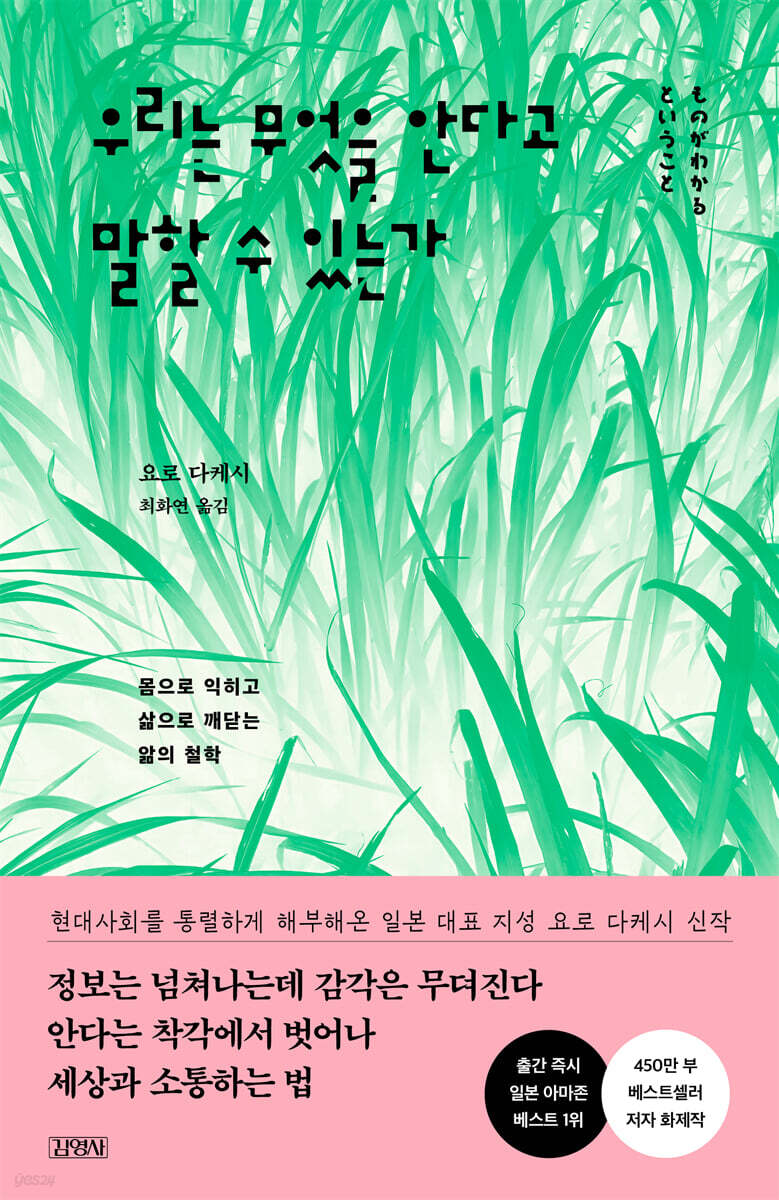
What can we say we know?
 |
Description
Book Introduction
“It took me over 10 years to reach this conclusion.”
A new work by Takeshi Yoro, a leading Japanese intellectual who has sharply dissected modern society.
The meaning of knowledge and learning discovered across humanity, society, and nature
What does it mean to know myself? How can we communicate with others? What does it mean to understand the world? "What Can We Say We Know?" contains enlightenment and insight into knowledge and learning, questions that remain elusive no matter how much we ponder them.
This book, which was praised as the culmination of 'urinary philosophy', garnered much attention from young readers for its fresh perspective on life from a senior in life, and immediately became a bestseller, selling over 100,000 copies in the local market.
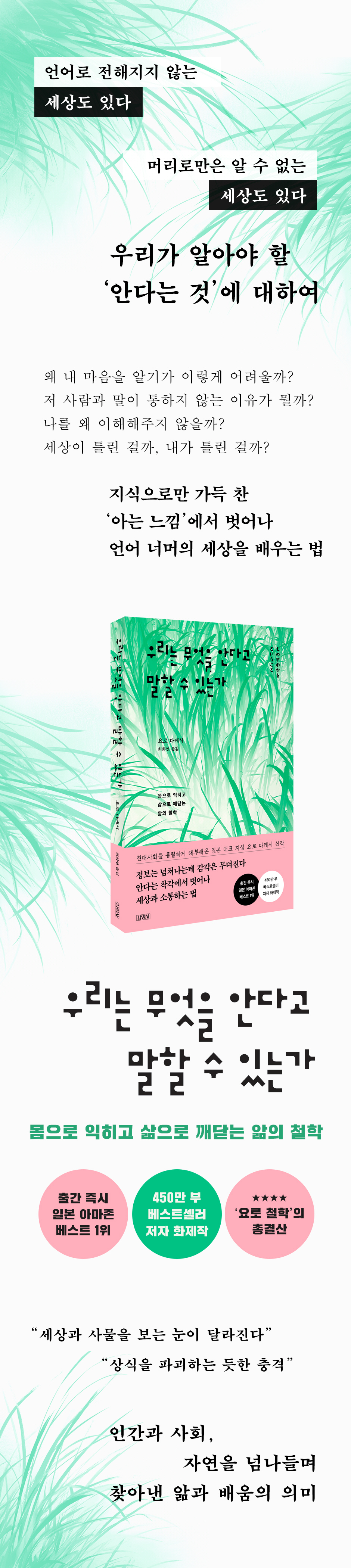
It guides you to learn about the world beyond language, breaking away from the 'feeling of knowing' filled only with knowledge.
A new work by Takeshi Yoro, a leading Japanese intellectual who has sharply dissected modern society.
The meaning of knowledge and learning discovered across humanity, society, and nature
What does it mean to know myself? How can we communicate with others? What does it mean to understand the world? "What Can We Say We Know?" contains enlightenment and insight into knowledge and learning, questions that remain elusive no matter how much we ponder them.
This book, which was praised as the culmination of 'urinary philosophy', garnered much attention from young readers for its fresh perspective on life from a senior in life, and immediately became a bestseller, selling over 100,000 copies in the local market.
It guides you to learn about the world beyond language, breaking away from the 'feeling of knowing' filled only with knowledge.
- You can preview some of the book's contents.
Preview
index
Entering
Chapter 1: Knowing
I don't understand math
Understand other people's minds
The ever-changing reality and humans
A society buried in information and symbols
There are worlds that cannot be conveyed through language.
Understand with your body
Knowing 'proportion'
You can't tell just by hearing it
To know is to change oneself
Learning is a change in one's views.
Urbanization makes nature 'nonexistent'
Children who are urged to grow up quickly
Parenting and nature are unpredictable.
Chapter 2: The Lie of Knowing Yourself
'Knowing' is thinking with your head
Many worlds in the head
Knowing from experience, knowing only in the head
Learning methods that form the basis of 'knowing'
Humans share symbols
The brain doesn't handle the 'changing me' well.
How the West and Japan perceive themselves
Intrusion of the modern self
Humans themselves become information
Modern people who do not understand death
The mind has commonality
When you want to be recognized, you become obsessed with individuality.
Knowledge and culture are acquired through repetition.
Background of the appearance of the manual human
It seems clear what you like, but it's not clear
The fun of thinking you like something you hate
One does not find oneself, but creates oneself.
Chapter 3: How to Deal with the World and Other People
How to avoid conflict even if you don't understand
The information society where everything is directly connected to meaning
Starting from the premise that it doesn't work
Me, who doesn't fit with common sense
Japan, where the world and its people are one
How to compromise with the world
People are originally unknowable
To avoid conflict in interpersonal relationships
Modern people with dulled senses
Social media is a purely brainwashing society
My discomfort is someone else's fault
When you are tired of people, go to the world of things
I know things don't go as planned
Chapter 4: Questioning Common Sense and Data
A brain-dead society hates "difference."
The information society where numbers are replaced with facts
What you need to hear your body
To think about the news in my head
How to understand the problem of global warming
Predicting the future while overlooking your own changes
The contradiction felt in the term 'biodiversity'
Environmental issues are physical problems
Modern times, trying to simplify a complex world
A brain-enhanced society where humans become more like machines
Chapter 5: Living in Nature and Resonating with It
Progress in urbanization, a society driven by the mind
Wisdom in dealing with nature
The Edo period, which pursued a circular society
The heart to nurture and care for something
Starting with acknowledging the existence of nature
Children are the 'most precious future'
Prioritize language over senses
Stay out of the city for a while
When your body is tense, you can't see insects.
Stop thinking and look with your own eyes
The root of knowing
Developing a child's physicality
Informatize what you perceive with your five senses
In conclusion
Chapter 1: Knowing
I don't understand math
Understand other people's minds
The ever-changing reality and humans
A society buried in information and symbols
There are worlds that cannot be conveyed through language.
Understand with your body
Knowing 'proportion'
You can't tell just by hearing it
To know is to change oneself
Learning is a change in one's views.
Urbanization makes nature 'nonexistent'
Children who are urged to grow up quickly
Parenting and nature are unpredictable.
Chapter 2: The Lie of Knowing Yourself
'Knowing' is thinking with your head
Many worlds in the head
Knowing from experience, knowing only in the head
Learning methods that form the basis of 'knowing'
Humans share symbols
The brain doesn't handle the 'changing me' well.
How the West and Japan perceive themselves
Intrusion of the modern self
Humans themselves become information
Modern people who do not understand death
The mind has commonality
When you want to be recognized, you become obsessed with individuality.
Knowledge and culture are acquired through repetition.
Background of the appearance of the manual human
It seems clear what you like, but it's not clear
The fun of thinking you like something you hate
One does not find oneself, but creates oneself.
Chapter 3: How to Deal with the World and Other People
How to avoid conflict even if you don't understand
The information society where everything is directly connected to meaning
Starting from the premise that it doesn't work
Me, who doesn't fit with common sense
Japan, where the world and its people are one
How to compromise with the world
People are originally unknowable
To avoid conflict in interpersonal relationships
Modern people with dulled senses
Social media is a purely brainwashing society
My discomfort is someone else's fault
When you are tired of people, go to the world of things
I know things don't go as planned
Chapter 4: Questioning Common Sense and Data
A brain-dead society hates "difference."
The information society where numbers are replaced with facts
What you need to hear your body
To think about the news in my head
How to understand the problem of global warming
Predicting the future while overlooking your own changes
The contradiction felt in the term 'biodiversity'
Environmental issues are physical problems
Modern times, trying to simplify a complex world
A brain-enhanced society where humans become more like machines
Chapter 5: Living in Nature and Resonating with It
Progress in urbanization, a society driven by the mind
Wisdom in dealing with nature
The Edo period, which pursued a circular society
The heart to nurture and care for something
Starting with acknowledging the existence of nature
Children are the 'most precious future'
Prioritize language over senses
Stay out of the city for a while
When your body is tense, you can't see insects.
Stop thinking and look with your own eyes
The root of knowing
Developing a child's physicality
Informatize what you perceive with your five senses
In conclusion
Detailed image
Into the book
I learned and worked in a world that was not communicated in words.
Anatomy in college was more about practice than anything else.
I came face to face with the corpse and touched it with my bare hands.
Unlike now, back then, people didn't even wear gloves.
The insight that can be gained from touching a corpse with your bare hands can never be fully conveyed in words.
(…) It is quite a cumbersome process, but without this manual work, there is no true ‘learning’.
Learning is 'getting used to it', understanding it with your body.
--- From "There is a world that cannot be conveyed through language"
Humans are constantly changing, whether we like it or not.
No one knows how it will change.
As I change, the things that are important to me will also change.
So, we need to leave some space in our lives to accommodate the unexpected.
--- From "Learning is a change in one's own views"
“If you want to do what you love, you have no choice but to love what you have to do.” It took me over ten years to come to this conclusion.
(…) As you seriously face the tasks you have to do, you discover the parts you like and the parts you don’t.
That discovery is a great lesson in life.
--- From "It seems clear what I like, but it's not clear"
When I change, the world looks subtly different.
To put it a little hyperbolicly, the whole world changes.
That's what makes it interesting.
An encounter with the unknown is an encounter with a new self, not an encounter with an unfamiliar environment.
Encountering a new self is not ‘self-discovery.’
If we misunderstand this, we will end up trying to find a fixed, unchanging self in an unfamiliar environment.
Creating yourself is the work of changing yourself.
This is something you can do without having to go abroad.
You can enjoy the joy of meeting a new you wherever you are.
--- From "One does not find oneself, but creates oneself"
If you're tired of dealing with people, it's better to deal with something non-human.
Because we are dealing with living people, doubt dominates our minds.
(…) Listen to the birdsong and move your hands silently and touch the soil.
Just feel that you feel good.
--- From "When you're tired of people, turn to the world of things"
When we say that artificial intelligence is becoming more like humans, we are forgetting that humans are flexible creatures.
It's not that machines are becoming more like humans, it's that humans are becoming more like inflexible machines.
It is a characteristic of modern people that they are becoming less and less flexible, even though they are capable of it.
--- From "A Brain-Transformed Society Where Humans Become More Like Machines"
There are things you learn anew when a child is born.
A child is not born with a purpose.
That's how human life is.
Many people try to discuss the meaning or purpose of life, but we don't live for any purpose.
When you're immersed in your daily life, you don't have time to think about such things.
Life is not knowing what will happen to my life or why I should live.
You never know how your child will grow up.
But when you live in the city, you tend to forget such obvious truths.
--- From "Children are the 'most precious future'"
When we place ourselves in nature, the rules of nature resonate with the rules of nature within our bodies.
Then you will come to know something that you cannot understand no matter how much you think about it.
Whether we know nature or living things, I believe that the root of ‘knowing’ is ‘resonance.’
The same goes for human relationships.
Resonance is important.
(…) I resonate with my house cat.
'I'm working, you're sleeping?' 'What are you doing now?' Even without saying anything, we always resonate and interact with our cats.
Anatomy in college was more about practice than anything else.
I came face to face with the corpse and touched it with my bare hands.
Unlike now, back then, people didn't even wear gloves.
The insight that can be gained from touching a corpse with your bare hands can never be fully conveyed in words.
(…) It is quite a cumbersome process, but without this manual work, there is no true ‘learning’.
Learning is 'getting used to it', understanding it with your body.
--- From "There is a world that cannot be conveyed through language"
Humans are constantly changing, whether we like it or not.
No one knows how it will change.
As I change, the things that are important to me will also change.
So, we need to leave some space in our lives to accommodate the unexpected.
--- From "Learning is a change in one's own views"
“If you want to do what you love, you have no choice but to love what you have to do.” It took me over ten years to come to this conclusion.
(…) As you seriously face the tasks you have to do, you discover the parts you like and the parts you don’t.
That discovery is a great lesson in life.
--- From "It seems clear what I like, but it's not clear"
When I change, the world looks subtly different.
To put it a little hyperbolicly, the whole world changes.
That's what makes it interesting.
An encounter with the unknown is an encounter with a new self, not an encounter with an unfamiliar environment.
Encountering a new self is not ‘self-discovery.’
If we misunderstand this, we will end up trying to find a fixed, unchanging self in an unfamiliar environment.
Creating yourself is the work of changing yourself.
This is something you can do without having to go abroad.
You can enjoy the joy of meeting a new you wherever you are.
--- From "One does not find oneself, but creates oneself"
If you're tired of dealing with people, it's better to deal with something non-human.
Because we are dealing with living people, doubt dominates our minds.
(…) Listen to the birdsong and move your hands silently and touch the soil.
Just feel that you feel good.
--- From "When you're tired of people, turn to the world of things"
When we say that artificial intelligence is becoming more like humans, we are forgetting that humans are flexible creatures.
It's not that machines are becoming more like humans, it's that humans are becoming more like inflexible machines.
It is a characteristic of modern people that they are becoming less and less flexible, even though they are capable of it.
--- From "A Brain-Transformed Society Where Humans Become More Like Machines"
There are things you learn anew when a child is born.
A child is not born with a purpose.
That's how human life is.
Many people try to discuss the meaning or purpose of life, but we don't live for any purpose.
When you're immersed in your daily life, you don't have time to think about such things.
Life is not knowing what will happen to my life or why I should live.
You never know how your child will grow up.
But when you live in the city, you tend to forget such obvious truths.
--- From "Children are the 'most precious future'"
When we place ourselves in nature, the rules of nature resonate with the rules of nature within our bodies.
Then you will come to know something that you cannot understand no matter how much you think about it.
Whether we know nature or living things, I believe that the root of ‘knowing’ is ‘resonance.’
The same goes for human relationships.
Resonance is important.
(…) I resonate with my house cat.
'I'm working, you're sleeping?' 'What are you doing now?' Even without saying anything, we always resonate and interact with our cats.
--- From "The Root of Knowing"
Publisher's Review
“Your perspective on the world and things will change.”
"A shock that defies common sense"
When no matter how much you think about it, you can't find an answer
Encounter the 'essence' of knowledge as told by a life expert.
“Do what you love.” “Find your true self.” “Be your own person.” These are the most common phrases we hear today, and the most difficult pieces of advice to put into practice.
Takeshi Yoro, a veteran scholar who is often cited as an author recommended by Japanese celebrities to the younger generation, says, “There is no such thing as something you like to do in the first place.”
What I like most, my true self, my personality, society, and the world are not fixed to just one thing.
“What Can We Say We Know?” (original title: ものがわかるということ) began with the question, “What does it mean to know?”
To answer this question, the author has poured his lifelong explorations of humanity, society, and nature into this book.
It contains enlightenment and insight into fundamental questions that are difficult to resolve no matter how much you ponder them, such as the meaning of knowing, the difference between knowing and understanding, and how to view the world and things.
When I talk about the essence of 'knowing,' I often say, "Imagine being diagnosed with cancer."
What happens when a doctor tells you, "You only have six months left to live?" The moment you accept the cancer diagnosis, you change.
The world looks different now than it did before.
But what has changed is not the world, but the viewer, that is, myself.
To ‘know’ is to change myself.
When a person changes, it is like the past self dies and a new self is born.
“Repeating this is learning.” _From the text
This book, which was praised as the culmination of 'urinary philosophy', garnered much attention from young readers for its fresh perspective on life from a senior in life, and immediately became a bestseller, selling over 100,000 copies in the local market.
You'll encounter the author's unique and diverse thoughts that challenge conventional wisdom, including the fundamental differences between artificial intelligence and humans, how to think independently without being swayed by data, and the problems of urban society and social media that dull our senses.
■ What does it mean to know myself?
- One does not find oneself, but creates oneself.
This book points out that today's information society treats humans as if they were just 'information.'
Information is fixed.
Images, documents, and data do not change after they are produced.
But humans are constantly changing.
The body ages, and thoughts and emotions come and go.
Therefore, neither the ‘true self’ nor the ‘favorite thing to do’ are set as fixed answers.
Because as I change, so do the things I love to do.
Rather than trying to discover a fixed self, the author urges us to recognize our changing selves and understand life as a process of shaping ourselves.
The conclusion is that life is about creating a new self.
■ Why are we obsessed with individuality?
- Individuality is in the body, not the mind.
Individuality refers to unique characteristics that distinguish one from others.
We often believe that individuality lies in our unique thoughts and minds, but it is not our thoughts that make us unique, but our bodies that make us unique.
This book clearly states that individuality exists in the body.
For example, if you look at tea ceremony or kendo, which require following the master's method for many years, you can understand what individuality is.
No matter how long you practice in the same way, the gestures of a master and a disciple will never become the same.
The form in which this difference reaches its extreme is the individuality of the teacher and the student.
In other words, without repeated practice through the body, one cannot know one's individuality.
Because modern people simply idealize individuality without considering these points, they become confused and do not know how to find and develop their individuality.
■ What does it mean to understand others?
- To communicate with the world without conflict
Many people express their concerns about interpersonal relationships, saying, “The other person doesn’t understand me” or “I can’t understand the other person.”
The author asserts that “others are inherently incomprehensible beings.”
Just as I myself am a constantly changing being, others are also constantly changing.
It is difficult for even I to know exactly, so it is impossible to fully understand others who change.
So how should we communicate with others? We need an attitude that accepts that understanding is inherently imperfect.
The possibility of communication opens up only when we acknowledge that we have different prerequisites for each other's thinking.
This is the same when dealing with the world.
We can learn to face others and the world with tolerance, that is, by accepting that not everything goes our way.
■ How will you know?
- A philosophy of knowledge learned through experience and realized through life
It is often thought that knowing something means increasing knowledge.
The author, who has explored the meaning of knowledge and learning in nature, points out that this misconception stems from judging solely with the head while being disconnected from nature.
He says that true knowledge does not end with inputting knowledge into the brain, but begins with outputting knowledge into the body.
Only then can you learn, master, and finally know.
To do this, the author recommends returning to nature, facing it, and feeling it with your body.
When the laws of nature and the body resonate, we can regain our sense of body and realize that we are all beings that change, just like nature.
We will be able to truly understand and communicate with each other.
That is the path to knowledge.
We will guide you to learn about the world beyond language, breaking away from the 'feeling of knowing' that is filled only with knowledge.
"A shock that defies common sense"
When no matter how much you think about it, you can't find an answer
Encounter the 'essence' of knowledge as told by a life expert.
“Do what you love.” “Find your true self.” “Be your own person.” These are the most common phrases we hear today, and the most difficult pieces of advice to put into practice.
Takeshi Yoro, a veteran scholar who is often cited as an author recommended by Japanese celebrities to the younger generation, says, “There is no such thing as something you like to do in the first place.”
What I like most, my true self, my personality, society, and the world are not fixed to just one thing.
“What Can We Say We Know?” (original title: ものがわかるということ) began with the question, “What does it mean to know?”
To answer this question, the author has poured his lifelong explorations of humanity, society, and nature into this book.
It contains enlightenment and insight into fundamental questions that are difficult to resolve no matter how much you ponder them, such as the meaning of knowing, the difference between knowing and understanding, and how to view the world and things.
When I talk about the essence of 'knowing,' I often say, "Imagine being diagnosed with cancer."
What happens when a doctor tells you, "You only have six months left to live?" The moment you accept the cancer diagnosis, you change.
The world looks different now than it did before.
But what has changed is not the world, but the viewer, that is, myself.
To ‘know’ is to change myself.
When a person changes, it is like the past self dies and a new self is born.
“Repeating this is learning.” _From the text
This book, which was praised as the culmination of 'urinary philosophy', garnered much attention from young readers for its fresh perspective on life from a senior in life, and immediately became a bestseller, selling over 100,000 copies in the local market.
You'll encounter the author's unique and diverse thoughts that challenge conventional wisdom, including the fundamental differences between artificial intelligence and humans, how to think independently without being swayed by data, and the problems of urban society and social media that dull our senses.
■ What does it mean to know myself?
- One does not find oneself, but creates oneself.
This book points out that today's information society treats humans as if they were just 'information.'
Information is fixed.
Images, documents, and data do not change after they are produced.
But humans are constantly changing.
The body ages, and thoughts and emotions come and go.
Therefore, neither the ‘true self’ nor the ‘favorite thing to do’ are set as fixed answers.
Because as I change, so do the things I love to do.
Rather than trying to discover a fixed self, the author urges us to recognize our changing selves and understand life as a process of shaping ourselves.
The conclusion is that life is about creating a new self.
■ Why are we obsessed with individuality?
- Individuality is in the body, not the mind.
Individuality refers to unique characteristics that distinguish one from others.
We often believe that individuality lies in our unique thoughts and minds, but it is not our thoughts that make us unique, but our bodies that make us unique.
This book clearly states that individuality exists in the body.
For example, if you look at tea ceremony or kendo, which require following the master's method for many years, you can understand what individuality is.
No matter how long you practice in the same way, the gestures of a master and a disciple will never become the same.
The form in which this difference reaches its extreme is the individuality of the teacher and the student.
In other words, without repeated practice through the body, one cannot know one's individuality.
Because modern people simply idealize individuality without considering these points, they become confused and do not know how to find and develop their individuality.
■ What does it mean to understand others?
- To communicate with the world without conflict
Many people express their concerns about interpersonal relationships, saying, “The other person doesn’t understand me” or “I can’t understand the other person.”
The author asserts that “others are inherently incomprehensible beings.”
Just as I myself am a constantly changing being, others are also constantly changing.
It is difficult for even I to know exactly, so it is impossible to fully understand others who change.
So how should we communicate with others? We need an attitude that accepts that understanding is inherently imperfect.
The possibility of communication opens up only when we acknowledge that we have different prerequisites for each other's thinking.
This is the same when dealing with the world.
We can learn to face others and the world with tolerance, that is, by accepting that not everything goes our way.
■ How will you know?
- A philosophy of knowledge learned through experience and realized through life
It is often thought that knowing something means increasing knowledge.
The author, who has explored the meaning of knowledge and learning in nature, points out that this misconception stems from judging solely with the head while being disconnected from nature.
He says that true knowledge does not end with inputting knowledge into the brain, but begins with outputting knowledge into the body.
Only then can you learn, master, and finally know.
To do this, the author recommends returning to nature, facing it, and feeling it with your body.
When the laws of nature and the body resonate, we can regain our sense of body and realize that we are all beings that change, just like nature.
We will be able to truly understand and communicate with each other.
That is the path to knowledge.
We will guide you to learn about the world beyond language, breaking away from the 'feeling of knowing' that is filled only with knowledge.
GOODS SPECIFICS
- Date of issue: July 28, 2025
- Page count, weight, size: 228 pages | 278g | 130*200*18mm
- ISBN13: 9791173322488
You may also like
카테고리
korean


korean

![GQ KOREA Mark (Monthly): December [2025]](http://librairie.coreenne.fr/cdn/shop/files/8ef265dbbfbf186523ed75ba7319009d.jpg?v=1765340328&width=3840)


