

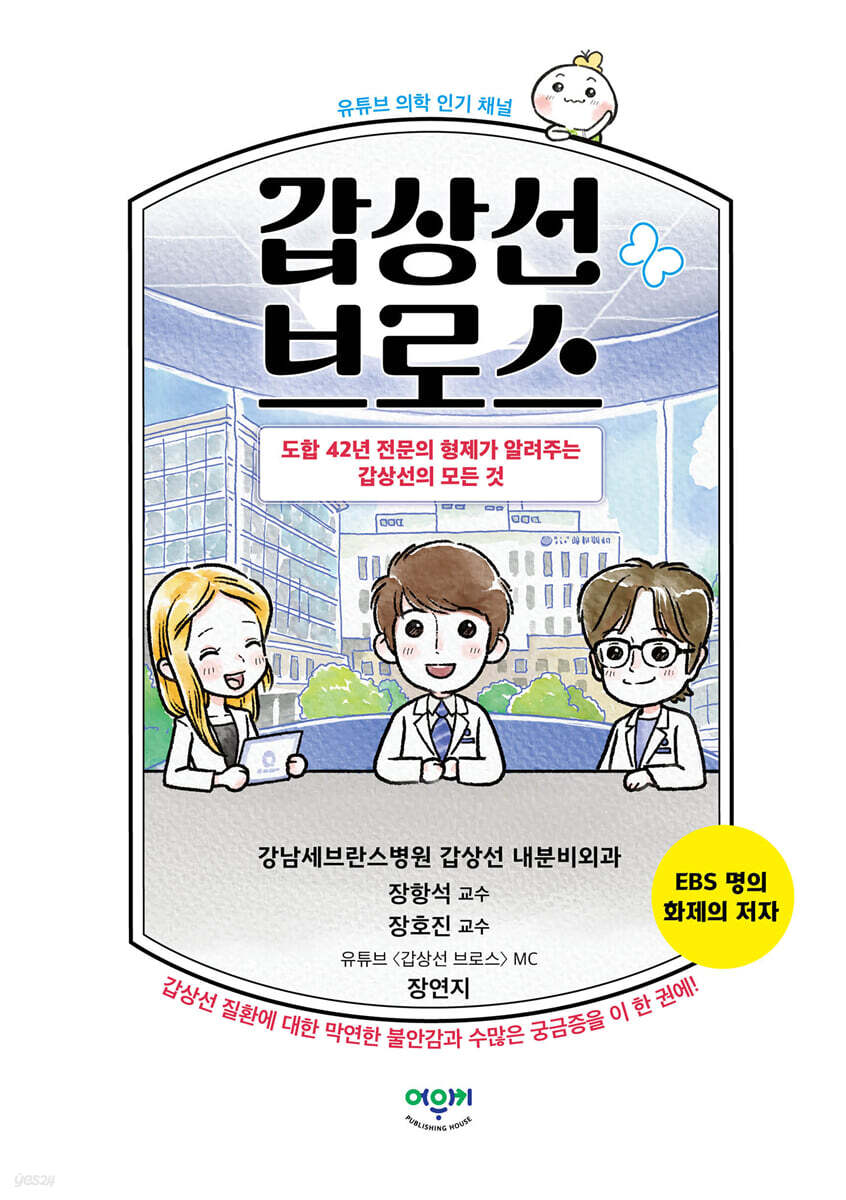
Thyroid broth
 |
Description
Book Introduction
All your vague anxieties and countless questions about thyroid disease in this one book!
Professor Jang Hang-seok and Professor Jang Ho-jin of the Department of Thyroid and Endocrine Surgery at Gangnam Severance Hospital,
Everything you need to know about thyroid disease from two brothers with 42 years of combined experience.
According to national cancer registry statistics in recent years, thyroid cancer is the most common cancer in Korea.
Thyroid cancer is called a "good cancer" because it has a high survival rate and good prognosis compared to other cancers, but the physical and social suffering that patients experience is by no means light.
Rather, if left untreated, it can often become irreversible.
Professors Jang Hang-seok and Jang Ho-jin of the Thyroid Endocrine Surgery Department at Gangnam Severance Hospital felt the urgent need for accurate information and communication about thyroid cancer while treating numerous patients.
On the YouTube medical channel "Thyroid Broth," which has been running for several years, breaking the barrier of "3-hour wait, 3-minute consultation," host Jang Yeon-ji communicates with people being treated for thyroid disease by explaining the medical knowledge of two specialists in an easy-to-understand way from the patient's perspective.
This book includes a variety of materials on thyroid disease and cancer that were covered in the "Thyroid Bros" broadcast, as well as accumulated through treatment, research, and clinical practice in the field.
Covering everything from thyroid dysfunction to tumor and cancer treatment, surgery and management, relapse treatment, special cancers, targeted therapies, and real-life cases, this book will serve as a sound guide for those suffering from thyroid disease.
Professor Jang Hang-seok and Professor Jang Ho-jin of the Department of Thyroid and Endocrine Surgery at Gangnam Severance Hospital,
Everything you need to know about thyroid disease from two brothers with 42 years of combined experience.
According to national cancer registry statistics in recent years, thyroid cancer is the most common cancer in Korea.
Thyroid cancer is called a "good cancer" because it has a high survival rate and good prognosis compared to other cancers, but the physical and social suffering that patients experience is by no means light.
Rather, if left untreated, it can often become irreversible.
Professors Jang Hang-seok and Jang Ho-jin of the Thyroid Endocrine Surgery Department at Gangnam Severance Hospital felt the urgent need for accurate information and communication about thyroid cancer while treating numerous patients.
On the YouTube medical channel "Thyroid Broth," which has been running for several years, breaking the barrier of "3-hour wait, 3-minute consultation," host Jang Yeon-ji communicates with people being treated for thyroid disease by explaining the medical knowledge of two specialists in an easy-to-understand way from the patient's perspective.
This book includes a variety of materials on thyroid disease and cancer that were covered in the "Thyroid Bros" broadcast, as well as accumulated through treatment, research, and clinical practice in the field.
Covering everything from thyroid dysfunction to tumor and cancer treatment, surgery and management, relapse treatment, special cancers, targeted therapies, and real-life cases, this book will serve as a sound guide for those suffering from thyroid disease.
- You can preview some of the book's contents.
Preview
index
Welcome to Thyroid Bros, the friendliest clinic in the world.
8
Introducing Thyroid Broth.
10
Know the Truth About Cancer
01 About Cancer
Cancer Development 17
Cancer Process 22
25 Causes of Cancer
Genetics of Cancer 28
Understanding the Thyroid
02 About the thyroid gland
The Origin of the Thyroid Name 33
The Role of the Thyroid Gland 35
Early Diagnosis of Thyroid Disease 37
Thyroid hormone abnormality 40
Hypothyroidism 41
Hyperthyroidism 42
Symptoms and Treatment of Thyroid Disease
03 Hypothyroidism
Symptoms of Hypothyroidism 47
Treatment of Hypothyroidism 52
04 Hyperthyroidism
Symptoms of Hyperthyroidism 56
Symptoms of Graves' Disease 61
Treatment of Graves' Disease 62
Thyroid tumors and cancer
05 Thyroid tumor
Diagnosis of Thyroid Tumors 73
06 After diagnosis of thyroid tumor
Surgery for Thyroid Tumors 83
07 Treatment of benign thyroid tumors
Benign tumor 91
Treatment of Benign Tumors 94
Radiofrequency ablation 96
08 Causes of thyroid cancer
Thyroid Cancer Causes 101
The Relationship Between Radiation and Thyroid Cancer 104
The Relationship Between Breast Cancer and Thyroid Cancer 106
Is Thyroid Cancer Genetic? 109
09 Types of Thyroid Cancer
Type 112 of Thyroid Cancer
Thyroid cancer worsening 115
Characteristics of Papillary Cancer 116
Type 117 of Papillary Cancer
Prognosis by stage 119
10 After being diagnosed with thyroid cancer
Cancer Screening Test 125
Thyroid cancer staging system 130
Lymph node metastasis test 133
Treatment of thyroid cancer
11 Nonsurgical Treatment of Thyroid Cancer
Nonsurgical Treatment 139
142 If you need surgery
12 Surgical treatment of thyroid cancer
Thyroid cancer surgery 148
13 Surgical methods for thyroid cancer
Traditional Thyroid Surgery Incision 159
Minimally invasive, minimally invasive surgery 161
Minimally invasive lateral neck dissection 162
Endoscopic surgery 163
Robotic Surgery 167
Peroral Thyroidectomy 170
14. Advanced thyroid cancer surgery
Advanced thyroid cancer 172
Intractable thyroid cancer 174
Locally advanced thyroid cancer 175
178 refractory thyroid cancer
15 Thyroid Cancer Surgery Side Effects
Surgical side effects 182
Bleeding 184
Voice Transformation 185
Temporary degeneration 187
Horner's syndrome 188
Hypocalcemia 190
Surgical site adhesion 192
Paresthesia at the surgical site 195
Yumiru 196
Post-operative treatment for thyroid cancer
16 Radioactive iodine treatment
Radioactive iodine therapy 204
Radioactive Iodine Therapy Method 207
Contraindications to radioactive iodine therapy 211
Thyroid stimulating hormone 214
17 Iodine-restricted diet
Iodine-restricted diet 216
Radioactive iodine dose 220
Daily Life Precautions 223
Side Effects of Radioactive Iodine Therapy 226
18 Thyroid Hormone Therapy
Thyroid Hormone Therapy 228
Sequential regulation of thyroid hormones 233
Thyroid hormone dosage adjustment 236
19 Treatment of special situations
Thyroid hormone therapy in children and adolescents 241
Adolescent Thyroid Hormone Therapy 244
Thyroid Hormone Therapy During Pregnancy 244
Osteoporosis and Thyroid Hormones 248
History of Thyroid Surgery
20 History of Endocrine Surgery
History of Thyroid Surgery 255
History of Endocrine Surgery 256
Beginning of Thyroid Surgery 260
History of the Development of Thyroid Surgery 264
The Dawn of Endocrine Surgery in Korea 271
Get healthy through management
21 Nutritional management of thyroid cancer patients
Post-Surgery Recovery Meal 279
High-calcium diet 282
How to Help Calcium Absorption 285
Fat Restriction Guide 286
Nutritional management after treatment 288
Preparing for Surgery 289
22 Follow-up management of thyroid cancer
Blood test 291
Differentiated Thyroid Cancer Blood Test 1,293
Differentiated Thyroid Cancer Blood Test 2 297
Differentiated Thyroid Cancer Blood Test 3 299
1301 Water Cancer Blood Test
2 303 medullary cancer blood test
Parathyroid Blood Test 304
23 Thyroid cancer follow-up examination
Thyroid cancer follow-up examination 305
Thyroid cancer recurrence and treatment
24 Thyroid cancer recurrence and metastasis
Recurrence and Metastasis in Individual Cases 317
Recurrence according to treatment plan 325
25 Special recurrences and distant metastases
Local recurrence 332
Bone metastases 334
Brain metastasis 336
Hadron Therapy 338
Mediastinal metastasis 339
Multiple metastases 340
Recurrence after robotic surgery 342
Special thyroid cancer
26 Intractable thyroid cancer
Intractable thyroid cancer 347
Treatment of Intractable Thyroid Cancer 351
27 Thyroid cancer targeted therapy
Indications for Targeted Therapy 356
Clinical Trials of Targeted Therapeutics 360
Targeted Therapy Resistance 362
28 Medullary thyroid cancer
Medullary cancer 367
Characteristics of medullary cancer 372
Treatment of medullary cancer 378
Principles of medullary carcinoma surgery 381
Risk of familial medullary carcinoma 384
Postoperative follow-up after medullary carcinoma surgery 386
29 Thyroid follicular cancer
Characteristics of Follicular Cancer 391
Type 396 of Follicular Cancer
Acidophilic granular cell carcinoma (Hurthle cell carcinoma) 398
30 Undifferentiated thyroid cancer
Characteristics of Undifferentiated Carcinoma 401
Treatment Principles for Undifferentiated Carcinoma 405
New Protocol 407 for Undifferentiated Carcinoma
Gangnam Severance Hospital Thyroid Cancer Center Educational Materials
8
Introducing Thyroid Broth.
10
Know the Truth About Cancer
01 About Cancer
Cancer Development 17
Cancer Process 22
25 Causes of Cancer
Genetics of Cancer 28
Understanding the Thyroid
02 About the thyroid gland
The Origin of the Thyroid Name 33
The Role of the Thyroid Gland 35
Early Diagnosis of Thyroid Disease 37
Thyroid hormone abnormality 40
Hypothyroidism 41
Hyperthyroidism 42
Symptoms and Treatment of Thyroid Disease
03 Hypothyroidism
Symptoms of Hypothyroidism 47
Treatment of Hypothyroidism 52
04 Hyperthyroidism
Symptoms of Hyperthyroidism 56
Symptoms of Graves' Disease 61
Treatment of Graves' Disease 62
Thyroid tumors and cancer
05 Thyroid tumor
Diagnosis of Thyroid Tumors 73
06 After diagnosis of thyroid tumor
Surgery for Thyroid Tumors 83
07 Treatment of benign thyroid tumors
Benign tumor 91
Treatment of Benign Tumors 94
Radiofrequency ablation 96
08 Causes of thyroid cancer
Thyroid Cancer Causes 101
The Relationship Between Radiation and Thyroid Cancer 104
The Relationship Between Breast Cancer and Thyroid Cancer 106
Is Thyroid Cancer Genetic? 109
09 Types of Thyroid Cancer
Type 112 of Thyroid Cancer
Thyroid cancer worsening 115
Characteristics of Papillary Cancer 116
Type 117 of Papillary Cancer
Prognosis by stage 119
10 After being diagnosed with thyroid cancer
Cancer Screening Test 125
Thyroid cancer staging system 130
Lymph node metastasis test 133
Treatment of thyroid cancer
11 Nonsurgical Treatment of Thyroid Cancer
Nonsurgical Treatment 139
142 If you need surgery
12 Surgical treatment of thyroid cancer
Thyroid cancer surgery 148
13 Surgical methods for thyroid cancer
Traditional Thyroid Surgery Incision 159
Minimally invasive, minimally invasive surgery 161
Minimally invasive lateral neck dissection 162
Endoscopic surgery 163
Robotic Surgery 167
Peroral Thyroidectomy 170
14. Advanced thyroid cancer surgery
Advanced thyroid cancer 172
Intractable thyroid cancer 174
Locally advanced thyroid cancer 175
178 refractory thyroid cancer
15 Thyroid Cancer Surgery Side Effects
Surgical side effects 182
Bleeding 184
Voice Transformation 185
Temporary degeneration 187
Horner's syndrome 188
Hypocalcemia 190
Surgical site adhesion 192
Paresthesia at the surgical site 195
Yumiru 196
Post-operative treatment for thyroid cancer
16 Radioactive iodine treatment
Radioactive iodine therapy 204
Radioactive Iodine Therapy Method 207
Contraindications to radioactive iodine therapy 211
Thyroid stimulating hormone 214
17 Iodine-restricted diet
Iodine-restricted diet 216
Radioactive iodine dose 220
Daily Life Precautions 223
Side Effects of Radioactive Iodine Therapy 226
18 Thyroid Hormone Therapy
Thyroid Hormone Therapy 228
Sequential regulation of thyroid hormones 233
Thyroid hormone dosage adjustment 236
19 Treatment of special situations
Thyroid hormone therapy in children and adolescents 241
Adolescent Thyroid Hormone Therapy 244
Thyroid Hormone Therapy During Pregnancy 244
Osteoporosis and Thyroid Hormones 248
History of Thyroid Surgery
20 History of Endocrine Surgery
History of Thyroid Surgery 255
History of Endocrine Surgery 256
Beginning of Thyroid Surgery 260
History of the Development of Thyroid Surgery 264
The Dawn of Endocrine Surgery in Korea 271
Get healthy through management
21 Nutritional management of thyroid cancer patients
Post-Surgery Recovery Meal 279
High-calcium diet 282
How to Help Calcium Absorption 285
Fat Restriction Guide 286
Nutritional management after treatment 288
Preparing for Surgery 289
22 Follow-up management of thyroid cancer
Blood test 291
Differentiated Thyroid Cancer Blood Test 1,293
Differentiated Thyroid Cancer Blood Test 2 297
Differentiated Thyroid Cancer Blood Test 3 299
1301 Water Cancer Blood Test
2 303 medullary cancer blood test
Parathyroid Blood Test 304
23 Thyroid cancer follow-up examination
Thyroid cancer follow-up examination 305
Thyroid cancer recurrence and treatment
24 Thyroid cancer recurrence and metastasis
Recurrence and Metastasis in Individual Cases 317
Recurrence according to treatment plan 325
25 Special recurrences and distant metastases
Local recurrence 332
Bone metastases 334
Brain metastasis 336
Hadron Therapy 338
Mediastinal metastasis 339
Multiple metastases 340
Recurrence after robotic surgery 342
Special thyroid cancer
26 Intractable thyroid cancer
Intractable thyroid cancer 347
Treatment of Intractable Thyroid Cancer 351
27 Thyroid cancer targeted therapy
Indications for Targeted Therapy 356
Clinical Trials of Targeted Therapeutics 360
Targeted Therapy Resistance 362
28 Medullary thyroid cancer
Medullary cancer 367
Characteristics of medullary cancer 372
Treatment of medullary cancer 378
Principles of medullary carcinoma surgery 381
Risk of familial medullary carcinoma 384
Postoperative follow-up after medullary carcinoma surgery 386
29 Thyroid follicular cancer
Characteristics of Follicular Cancer 391
Type 396 of Follicular Cancer
Acidophilic granular cell carcinoma (Hurthle cell carcinoma) 398
30 Undifferentiated thyroid cancer
Characteristics of Undifferentiated Carcinoma 401
Treatment Principles for Undifferentiated Carcinoma 405
New Protocol 407 for Undifferentiated Carcinoma
Gangnam Severance Hospital Thyroid Cancer Center Educational Materials
Detailed image

Into the book
MC Yeonji: Can eating iodine-rich seaweed help with thyroid health?
Young Brother: Since thyroid hormones are made from iodine, most people would think that eating iodine-rich seaweed would help support thyroid health.
In inland areas, there aren't many ways to consume seaweed.
In countries with low iodine intake, there were times when iodine intake was mandated as a national policy because there were many problems such as decreased thyroid function, and iodine pills were also made and taken.
However, our country is surrounded by the sea on three sides, and we already eat a lot of iodine-rich seaweed in our diet, so there is no need to eat more.
Our country has the highest iodine intake in the world.
Seaweed, wakame, and kelp, which we often eat, are rich in iodine.
--- p.36
There are some common symptoms that many people can feel even if there is no particular problem, so it may seem ambiguous, but it is still recommended to check and if you have more than 5 of these, visit a hospital to see a specialist and get a blood test.
Symptoms such as feeling hot and experiencing mood swings can be similar to those of menopause and can be confusing, so it is necessary to consult a specialist.
There has never been a checklist like this before.
I made this recently, and I think it will be helpful to readers.
A thyroid specialist can tell a patient's condition just by looking at their face.
But it is not easy for ordinary people to get used to that feeling.
These symptoms may also be caused by other diseases.
So, on this checklist, we conservatively recommend that you get tested if you have five or more symptoms.
Please note that if even one or two of the symptoms are very severe, you should also get tested.
--- p.43
MC Yeonji: These days, if stomach cancer is detected early, they just remove a small part of it with an endoscope.
So, can this be done for the thyroid gland as well? Or are there only two options: removing half or completely removing it?
Big Brother: There are differences between stomach cancer and thyroid cancer in determining the extent of surgery.
Thyroid cancer is not limited to what can be seen on ultrasound or CT scans.
It's nice to think of a scene where people are doing sand art.
The area where sand has piled up like that creates a shadow and can be seen in the video, but it also has the characteristic of having rocks sporadically appear around it, as if sand grains have been scattered.
Since these areas cannot be identified through preoperative examination, if only the cancer is removed, the main cancer area is removed, but the cancer that has spread like grains of sand around it remains, and eventually multiple recurrences occur.
We must remember that cancer will recur if even a single cell remains, and eventually it will become unmanageable.
--- p.151
Young Brother: Let me explain in detail the purpose and method of radioactive iodine treatment.
The first treatment is used after thyroid surgery to burn away any remaining tissue.
During surgery, we try to remove as much thyroid tissue as possible, but the human body cannot be made to fall off like a machine, so residual cells inevitably remain in the thyroid area.
So, it is radioactive iodine treatment that aims to remove residual tissue using radioactive iodine.
This treatment is called Ablation Therapy, and low doses are sufficient.
The second is high-dose therapy, which is used when surgery cannot remove the tumor or when all visible tissue has been removed but there is a possibility that cancer cells may remain elsewhere.
--- p.207
MC Yeonji: The patient was doing well after the surgery and taking medication well, but suddenly, after 5 years, it relapsed, so I think the patient must have been very upset.
Big Brother: Yes, the patient must have been very disappointed and sad.
I was the attending physician and I was also very heartbroken.
What we can learn from this case is that a hemi-resection has a significantly lower recurrence rate than a total resection.
Moreover, it is more dangerous if there is invasion of the membrane or lymph node metastasis.
Even with all the thyroid hormone therapy, I couldn't prevent all cancer recurrences.
Blood tests didn't show it, but regular ultrasounds found a hidden recurrence of the cancer.
And I needed a CT to see other hidden parts.
Young Brother: Since thyroid hormones are made from iodine, most people would think that eating iodine-rich seaweed would help support thyroid health.
In inland areas, there aren't many ways to consume seaweed.
In countries with low iodine intake, there were times when iodine intake was mandated as a national policy because there were many problems such as decreased thyroid function, and iodine pills were also made and taken.
However, our country is surrounded by the sea on three sides, and we already eat a lot of iodine-rich seaweed in our diet, so there is no need to eat more.
Our country has the highest iodine intake in the world.
Seaweed, wakame, and kelp, which we often eat, are rich in iodine.
--- p.36
There are some common symptoms that many people can feel even if there is no particular problem, so it may seem ambiguous, but it is still recommended to check and if you have more than 5 of these, visit a hospital to see a specialist and get a blood test.
Symptoms such as feeling hot and experiencing mood swings can be similar to those of menopause and can be confusing, so it is necessary to consult a specialist.
There has never been a checklist like this before.
I made this recently, and I think it will be helpful to readers.
A thyroid specialist can tell a patient's condition just by looking at their face.
But it is not easy for ordinary people to get used to that feeling.
These symptoms may also be caused by other diseases.
So, on this checklist, we conservatively recommend that you get tested if you have five or more symptoms.
Please note that if even one or two of the symptoms are very severe, you should also get tested.
--- p.43
MC Yeonji: These days, if stomach cancer is detected early, they just remove a small part of it with an endoscope.
So, can this be done for the thyroid gland as well? Or are there only two options: removing half or completely removing it?
Big Brother: There are differences between stomach cancer and thyroid cancer in determining the extent of surgery.
Thyroid cancer is not limited to what can be seen on ultrasound or CT scans.
It's nice to think of a scene where people are doing sand art.
The area where sand has piled up like that creates a shadow and can be seen in the video, but it also has the characteristic of having rocks sporadically appear around it, as if sand grains have been scattered.
Since these areas cannot be identified through preoperative examination, if only the cancer is removed, the main cancer area is removed, but the cancer that has spread like grains of sand around it remains, and eventually multiple recurrences occur.
We must remember that cancer will recur if even a single cell remains, and eventually it will become unmanageable.
--- p.151
Young Brother: Let me explain in detail the purpose and method of radioactive iodine treatment.
The first treatment is used after thyroid surgery to burn away any remaining tissue.
During surgery, we try to remove as much thyroid tissue as possible, but the human body cannot be made to fall off like a machine, so residual cells inevitably remain in the thyroid area.
So, it is radioactive iodine treatment that aims to remove residual tissue using radioactive iodine.
This treatment is called Ablation Therapy, and low doses are sufficient.
The second is high-dose therapy, which is used when surgery cannot remove the tumor or when all visible tissue has been removed but there is a possibility that cancer cells may remain elsewhere.
--- p.207
MC Yeonji: The patient was doing well after the surgery and taking medication well, but suddenly, after 5 years, it relapsed, so I think the patient must have been very upset.
Big Brother: Yes, the patient must have been very disappointed and sad.
I was the attending physician and I was also very heartbroken.
What we can learn from this case is that a hemi-resection has a significantly lower recurrence rate than a total resection.
Moreover, it is more dangerous if there is invasion of the membrane or lymph node metastasis.
Even with all the thyroid hormone therapy, I couldn't prevent all cancer recurrences.
Blood tests didn't show it, but regular ultrasounds found a hidden recurrence of the cancer.
And I needed a CT to see other hidden parts.
--- p.319
Publisher's Review
“Professor, can I ask you one more question?”
Every time we left the university hospital clinic, we had to swallow regrets and unanswered questions.
The YouTube medical channel "Thyroid Bros" started from that very regret.
Over the past few years, we have overcome the barriers of reality, such as "3-hour wait, 3-minute consultation," and created a space for communication like no other, where Korea's top experts directly answer patients' questions.
This book contains the vast knowledge of thyroid disease and cancer accumulated in the field by two specialist brothers, Jang Hang-seok and Jang Ho-jin, as well as actual treatment cases, and clear answers to questions patients have through “Thyroid Broth.”
Now, this book will serve as a reliable, expert companion to those who harbor vague anxiety and curiosity about thyroid disease.
Author's Note
“Cancer is not a simple or easy enemy.
Everyone says it's easy, it's nothing, but once it becomes your own thing, it's like a bolt from the blue.
There are certainly some things that modern science cannot prevent, but it is not that there is no way at all.
There are definitely at least one or two chances.
It is important to make wise decisions and not miss that opportunity.
You must base your judgment on accurate evidence and not be deceived by strange methods.
And above all, do not despair.
We must not give up hope and do our best to treat the condition.
Even if the probability is low, if you do nothing, the probability is ultimately zero.
There is hope if we do anything.
So, patients, their families, and medical staff must all work together to find a way.”
Every time we left the university hospital clinic, we had to swallow regrets and unanswered questions.
The YouTube medical channel "Thyroid Bros" started from that very regret.
Over the past few years, we have overcome the barriers of reality, such as "3-hour wait, 3-minute consultation," and created a space for communication like no other, where Korea's top experts directly answer patients' questions.
This book contains the vast knowledge of thyroid disease and cancer accumulated in the field by two specialist brothers, Jang Hang-seok and Jang Ho-jin, as well as actual treatment cases, and clear answers to questions patients have through “Thyroid Broth.”
Now, this book will serve as a reliable, expert companion to those who harbor vague anxiety and curiosity about thyroid disease.
Author's Note
“Cancer is not a simple or easy enemy.
Everyone says it's easy, it's nothing, but once it becomes your own thing, it's like a bolt from the blue.
There are certainly some things that modern science cannot prevent, but it is not that there is no way at all.
There are definitely at least one or two chances.
It is important to make wise decisions and not miss that opportunity.
You must base your judgment on accurate evidence and not be deceived by strange methods.
And above all, do not despair.
We must not give up hope and do our best to treat the condition.
Even if the probability is low, if you do nothing, the probability is ultimately zero.
There is hope if we do anything.
So, patients, their families, and medical staff must all work together to find a way.”
GOODS SPECIFICS
- Date of issue: August 1, 2025
- Page count, weight, size: 432 pages | 582g | 148*210*27mm
- ISBN13: 9791193992784
- ISBN10: 1193992788
You may also like
카테고리
korean


korean

![GQ KOREA Mark (Monthly): December [2025]](http://librairie.coreenne.fr/cdn/shop/files/8ef265dbbfbf186523ed75ba7319009d.jpg?v=1765340328&width=3840)


