

The Science of Stretching
 |
Description
Book Introduction
From warm-up to cool-down
85 Stretches in 3D Infographics
This book is a guide that will lead you beyond passive static stretching to analyzing your own movements.
It's also a tribute to the human body and the wonderful and complex ways it moves.
- In the text
According to the 2023 National Sports Survey conducted by the Ministry of Culture, Sports and Tourism, 46.4 percent of the total surveyed respondents have not participated in any sports activities in the past year.
The reasons given for not participating in physical activities at all included ‘lack of time for physical activities’ and ‘lack of interest in physical activities.’
For modern people living busy lives, moving their bodies and exercising often feels like a labor that requires time and passion.
So what about stretching? Can short stretches, performed anywhere, be considered effective exercise? A study published in the sports medicine journal Sports Medicine found that consistently performing short, sustained stretches of 15 to 60 seconds not only improves flexibility but also increases muscle cross-sectional area and momentary strength.
Stretching, which was once considered only an auxiliary exercise, can now be used as the optimal exercise for busy modern people.
"Science of Stretch: Anatomy and Physiology for Flexible Joints and Vibrant Muscles," published by Science Books, Inc., is the best science book for understanding stretching and will serve as a compass for a healthier life.
The author of this book, Leada Malek, is a PhD in Physical Therapy and a Certified Strength and Conditioning Specialist (NSCA) from the National Strength and Conditioning Association. She is an active sports clinical specialist who constructs stretching routines for various levels, starting with physiological and anatomical information such as muscle, skeletal, and nervous system information.
『The Science of Stretching』, the latest book in the "Science of Exercise" series published by Science Books in collaboration with Dorling Kindersley (DK), a renowned British publisher that has presented analytical and clear anatomy infographics in 『The Complete Human Body』, 『The Principles of the Human Body』, and the previous five volumes of the "Science of Exercise" series, is an introductory book that contains everything about stretching that scientifically and systematically enhances the strength and flexibility needed for daily physical activities.
85 Stretches in 3D Infographics
This book is a guide that will lead you beyond passive static stretching to analyzing your own movements.
It's also a tribute to the human body and the wonderful and complex ways it moves.
- In the text
According to the 2023 National Sports Survey conducted by the Ministry of Culture, Sports and Tourism, 46.4 percent of the total surveyed respondents have not participated in any sports activities in the past year.
The reasons given for not participating in physical activities at all included ‘lack of time for physical activities’ and ‘lack of interest in physical activities.’
For modern people living busy lives, moving their bodies and exercising often feels like a labor that requires time and passion.
So what about stretching? Can short stretches, performed anywhere, be considered effective exercise? A study published in the sports medicine journal Sports Medicine found that consistently performing short, sustained stretches of 15 to 60 seconds not only improves flexibility but also increases muscle cross-sectional area and momentary strength.
Stretching, which was once considered only an auxiliary exercise, can now be used as the optimal exercise for busy modern people.
"Science of Stretch: Anatomy and Physiology for Flexible Joints and Vibrant Muscles," published by Science Books, Inc., is the best science book for understanding stretching and will serve as a compass for a healthier life.
The author of this book, Leada Malek, is a PhD in Physical Therapy and a Certified Strength and Conditioning Specialist (NSCA) from the National Strength and Conditioning Association. She is an active sports clinical specialist who constructs stretching routines for various levels, starting with physiological and anatomical information such as muscle, skeletal, and nervous system information.
『The Science of Stretching』, the latest book in the "Science of Exercise" series published by Science Books in collaboration with Dorling Kindersley (DK), a renowned British publisher that has presented analytical and clear anatomy infographics in 『The Complete Human Body』, 『The Principles of the Human Body』, and the previous five volumes of the "Science of Exercise" series, is an introductory book that contains everything about stretching that scientifically and systematically enhances the strength and flexibility needed for daily physical activities.
index
Preface 6 / What is Stretching? 8
The Physiology of Stretching 10
Anatomy of Movement 12 / Types of Movement 14 / Muscular System 16 / Muscle Chains and Muscle Groups 18 / How Muscles Work 20 / Skeletal System 24 / Joints 28 / Nervous System 30 / Nature and Theory of Pain 32 / Movement and Brain Function 34 / Range of Motion and Flexibility 36 / Types of Stretching 40 / Effects and Benefits of Stretching 44 / Stretching and Health Management 48 / Stretching for Injury Recovery and Pain Relief 50 / Stretching and Healthy Aging 54 / When Not to Stretch 58
Stretching Exercises 60
Introduction to Stretching 62
Neck and Spine Movements 64 / Neck and Spine Stretches 66 / Levator Stretch 68 / Manual Suboccipital Stretch 69 / Sternoclaidomastoid Stretch 70 / Scalene Stretch 72 / Cat-Cow Stretch 74 / Quadratus Rumborum Stretch 76 / Child's Pose 78 / Cobra Pose 80 / Adapted Movements 82 / Standing Soar-Shaped Extension Wall Stretch 84 / Half-Nile Soar-Shaped Rotation 88 / Adapted Movements 90 / Standing Half-Moon 92 / Thread the Needle 94 / Adapted Movements 96
Shoulder, Arm, and Hand Movements 98 / Shoulder, Arm, and Hand Stretches 100 / Doorway Peck Stretch 102 / Adapted Movements 104 / Floor Angel 106 / Wrist Extensions 108 / Wrist Flexions 108 / Adapted Movements 110 / Lumbric Stretch 112
Hip Movement 114 / Hip Stretch 116 / Quadruped Rockback 118 / Adapted Movement 120 / Half-Neck Hip Flexor Lock 122 / Adapted Movement 124 / Garland Pose 126 / Figure Four Stretch 128 / Cross Body Glute Stretch 130 / Figure Four Hip Internal Rotation Stretch 132 / Half-Neck Hip Flexor Stretch 134 / Adapted Movement 136 / Pigeon Stretch 138 / World's Greatest Stretch 140 / Pancake Stretch 142 / Happy Baby Pose 144 / Seated Butterfly Stretch 146 / Standing Hip Circle 148 / Adapted Movement 150
Leg and Foot Movements 152 / Leg and Foot Stretches 154 / Standing Quad Stretch 156 / Adapted Movements 158 / Static Hamstring Stretch 160 / Adapted Movements 162 / Gastronomy Step Stretch 164 / Gastronomy Wall Stretch 166 / Adapted Movements 168 / Kneeling Toe Flexor Stretch 170 / Adapted Movements 172
Neuromobility Movement 174 / Neuromobility Stretch 176 / Radial Nerve Glide 178 / Applied Movement 180 / Scientific Nerve Glide 182 / Applied Movement 184 / Femoral Nerve Glide 186
Stretching Routine 188
What is a Stretching Routine? 190 / Neck and Shoulder Routine 192 / Spine Routine 193 / Hip and Knee Routine 194 / Foot and Ankle Routine 195 / Full Body Routine 196 / Routine for Office Workers 198 / Routine for Seniors 199 / Routine for Walking 200 / Routine for Running 201 / Routine for Cycling 202 / Routine for Swimming 203 / Routine for Strength Training 204 / Routine for Athletes 205 / Routine for Ball and Racket Sports 206 / Routine for Martial Arts Practitioners 207
Glossary 208 / Index 210 / References 218 / About the Author 223 / Acknowledgments 223
The Physiology of Stretching 10
Anatomy of Movement 12 / Types of Movement 14 / Muscular System 16 / Muscle Chains and Muscle Groups 18 / How Muscles Work 20 / Skeletal System 24 / Joints 28 / Nervous System 30 / Nature and Theory of Pain 32 / Movement and Brain Function 34 / Range of Motion and Flexibility 36 / Types of Stretching 40 / Effects and Benefits of Stretching 44 / Stretching and Health Management 48 / Stretching for Injury Recovery and Pain Relief 50 / Stretching and Healthy Aging 54 / When Not to Stretch 58
Stretching Exercises 60
Introduction to Stretching 62
Neck and Spine Movements 64 / Neck and Spine Stretches 66 / Levator Stretch 68 / Manual Suboccipital Stretch 69 / Sternoclaidomastoid Stretch 70 / Scalene Stretch 72 / Cat-Cow Stretch 74 / Quadratus Rumborum Stretch 76 / Child's Pose 78 / Cobra Pose 80 / Adapted Movements 82 / Standing Soar-Shaped Extension Wall Stretch 84 / Half-Nile Soar-Shaped Rotation 88 / Adapted Movements 90 / Standing Half-Moon 92 / Thread the Needle 94 / Adapted Movements 96
Shoulder, Arm, and Hand Movements 98 / Shoulder, Arm, and Hand Stretches 100 / Doorway Peck Stretch 102 / Adapted Movements 104 / Floor Angel 106 / Wrist Extensions 108 / Wrist Flexions 108 / Adapted Movements 110 / Lumbric Stretch 112
Hip Movement 114 / Hip Stretch 116 / Quadruped Rockback 118 / Adapted Movement 120 / Half-Neck Hip Flexor Lock 122 / Adapted Movement 124 / Garland Pose 126 / Figure Four Stretch 128 / Cross Body Glute Stretch 130 / Figure Four Hip Internal Rotation Stretch 132 / Half-Neck Hip Flexor Stretch 134 / Adapted Movement 136 / Pigeon Stretch 138 / World's Greatest Stretch 140 / Pancake Stretch 142 / Happy Baby Pose 144 / Seated Butterfly Stretch 146 / Standing Hip Circle 148 / Adapted Movement 150
Leg and Foot Movements 152 / Leg and Foot Stretches 154 / Standing Quad Stretch 156 / Adapted Movements 158 / Static Hamstring Stretch 160 / Adapted Movements 162 / Gastronomy Step Stretch 164 / Gastronomy Wall Stretch 166 / Adapted Movements 168 / Kneeling Toe Flexor Stretch 170 / Adapted Movements 172
Neuromobility Movement 174 / Neuromobility Stretch 176 / Radial Nerve Glide 178 / Applied Movement 180 / Scientific Nerve Glide 182 / Applied Movement 184 / Femoral Nerve Glide 186
Stretching Routine 188
What is a Stretching Routine? 190 / Neck and Shoulder Routine 192 / Spine Routine 193 / Hip and Knee Routine 194 / Foot and Ankle Routine 195 / Full Body Routine 196 / Routine for Office Workers 198 / Routine for Seniors 199 / Routine for Walking 200 / Routine for Running 201 / Routine for Cycling 202 / Routine for Swimming 203 / Routine for Strength Training 204 / Routine for Athletes 205 / Routine for Ball and Racket Sports 206 / Routine for Martial Arts Practitioners 207
Glossary 208 / Index 210 / References 218 / About the Author 223 / Acknowledgments 223
Detailed image

Publisher's Review
100,000 copies published in 10 countries
The Stretching Bible for Everyone
You are never too old or too young to start.
Enjoy the process of analyzing new aspects of physical activity and understanding the complex characteristics of your own body.
- In the text
Humanity's curiosity about free-spirited physical activity, such as yoga in India and qigong in China, has a long history.
Stretching, a popular fitness practice since the 1940s, has offered solutions tailored to each individual's unique physical condition, circumstances, and challenges.
In other words, the key to stretching is to find a routine that suits you.
The point Dr. Malek wants to convey is no different.
As you experience different postures, holding times, and intensities and come to understand your own movements, you will naturally discover the exercise method that suits you best.
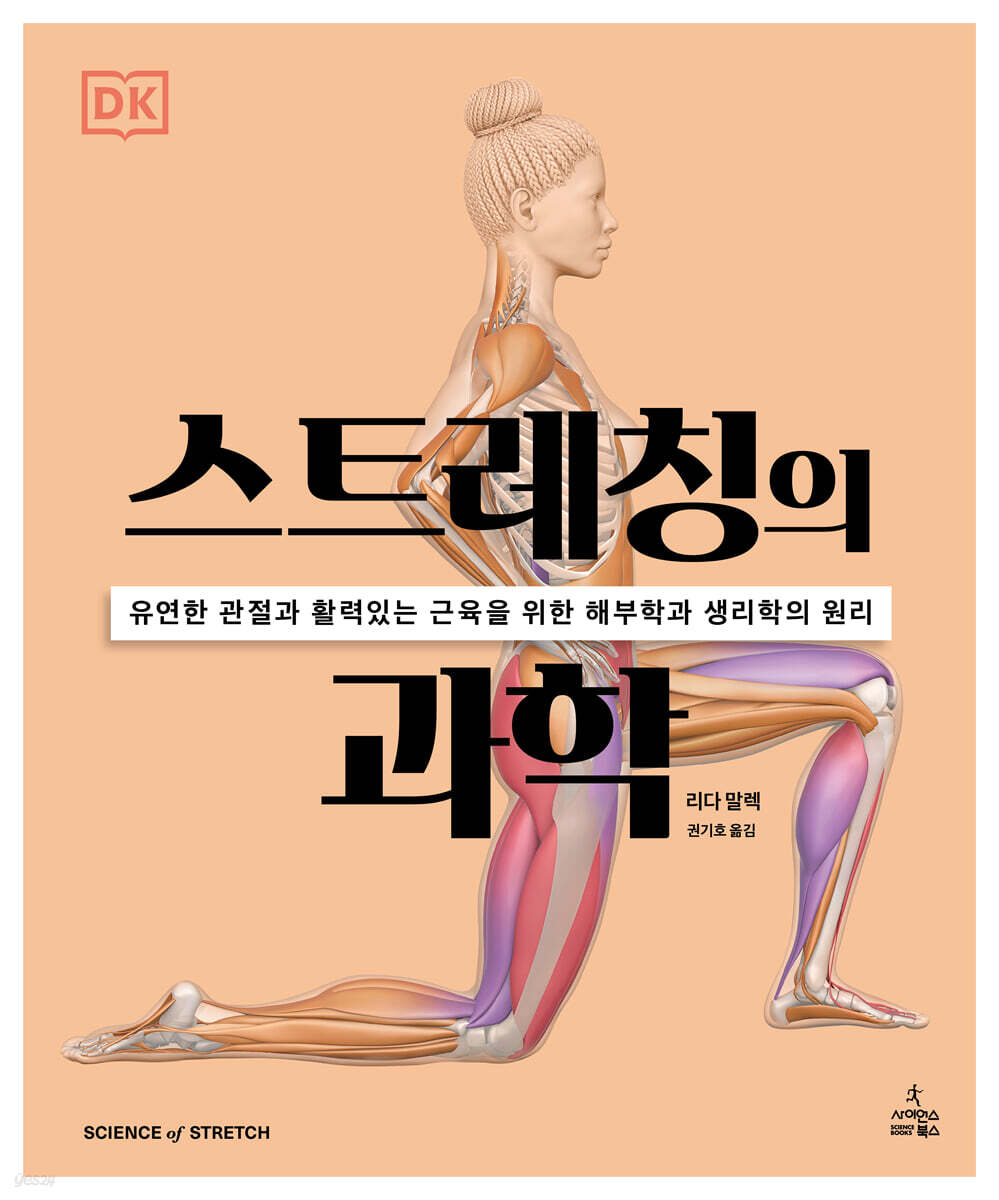
The book's 85 3D infographics of human muscles help clarify the challenges of performing stretching exercises.
You can easily distinguish which muscles are stretched or contracted when performing a specific movement by color, and tips and precautions to keep in mind for each movement are also organized, so you can easily understand the movements you need.
Rather than just stretching when you're sore and stiff, both beginners and experts can have a new and unprecedented experience by finding stretching that's right for their body.
Compensate for lack of physical activity and relieve pain
Scientific Stretching
Common beliefs like, "All stretching is the same," "Stretching before exercise can negatively impact athletic performance," and "Stretching only affects the nervous system," relegate stretching to being a supplement to "real exercise" or a form of exercise with minimal real impact, preventing people from challenging themselves with free movement.
Stretching includes not only the well-known static movements but also dynamic and active types, and when performed before exercises that involve a large range of joint motion, it helps improve athletic performance.
Above all, stretching can be said to be a scientific exercise that creates changes in the body by itself.
"The Science of Stretching" is divided into three parts: "The Physiology of Stretching," "Stretching Movements," and "Stretching Routines."
Part 1, "The Physiology of Stretching," connects the musculoskeletal system, nervous system, brain, pain science, and the adaptability of the human body, and introduces the benefits of stretching for all ages.
You can understand the principles of movement by looking at the overall body mechanism as well as muscle movement.
Part 2, "Stretching Movements," divides the target muscle groups for stretching into five areas and introduces them as neck and spine movements (12 basic stretches), shoulder, arm, and hand movements (5 basic stretches), hip movements (13 basic stretches), leg and foot movements (5 basic stretches), and nerve mobility movements (3 basic stretches).
To make it easier to see the changes in muscles when performing movements, each movement is broken down into muscle units and clearly introduced in color infographics. In addition to basic movements, applied movements are included, so you can adjust the difficulty level to suit each individual's level and experience stretching according to the situation.
Additionally, each movement includes precautions to prevent injury.
Part 3, "Stretching Routines," contains a variety of stretching routines tailored to specific muscle groups or lifestyles.
Starting with information on stretching frequency, duration, and number of repetitions suitable for beginners and experts, we introduce specialized routines for body parts such as the neck, shoulders, and spine, as well as routines suitable for specific lifestyles such as office workers and the elderly.
Even if it is the same routine, the program structure may be changed depending on the level of skill, or upper body and lower body routines may be introduced separately.
The stretches included in the routine are written on a detailed page, so you can go to that stretch page at any time.
If you're an office worker who spends an average of 75 percent of your workday sitting, the routine outlined on page 198 of "The Science of Stretching" can help relieve neck, shoulder, and back pain and improve your overall health.
For a basic relaxation routine, we recommend the levator stretch (page 68) to work the levator scapulae, the manual suboccipital stretch (page 69) to stimulate the occiput, the sternoclavicular stretch (page 70) to help with sternocleidomastoid pain, the cat-cow stretch (page 75) which is an adaptation of the familiar cat and cow poses, the quadratus lumborum stretch (page 77) to work the quadratus lumborum, the wrist extension and flexion (page 108) to release wrist tension, and the figure-four stretch (page 129) which increases hip mobility by assuming a figure-four position.
Anyone, including students who sit at their desks for long periods of time and those who lack physical activity, can use it by adjusting the number of repetitions and intensity to suit their abilities.
Once you're familiar with the 17 core routines, you can create your own combination of stretches to suit your needs.
By combining 38 basic movements and 47 applied movements to create your own stretching routine, you'll soon find yourself with a complete understanding of your body.
Additionally, for readers unfamiliar with anatomical and physiological terminology, the latter part of the book contains additional explanations of approximately 70 key concepts that appear in the text.
Features of this book
★ A comprehensive compilation of anatomy and physiology knowledge to understand stretching, from muscles to the nervous system.
★ A collection of 85 stretches, including 38 basic movements and 47 applied movements.
★ 3D human body infographic with muscle names and function patterns
★ Stretch not only your muscles, but also your nerves! Includes anatomy of the nervous system and three nerve mobility exercises.
★ 15 stretching routines that work the muscle groups you need and fit your lifestyle.
This book's primary audience
★ People who want to understand the anatomy and physiology of stretching
★ People who want to do stretching exercises that help strengthen specific muscle groups and joints
★ People who want to create their own stretching routine
The Science of Exercise series, which summarizes the latest sports science from anatomy and physiology perspectives.
★ The Science of Yoga by Ann Swanson | Translated by Kwon Ki-ho
★ The Science of Running by Chris Napier | Translated by Kim Ho-jeong
★ The Science of Strength Training by Austin Current | Translated by Kwon Ki-ho
★ The Science of HIIT, by Ingrid Clay | Translated by Lee Min-ah
★ The Science of Pilates by Tracy Ward | Translated by Kwon Ki-ho
★ The Science of Stretching by Lida Malek | Translated by Kwon Ki-ho
The Stretching Bible for Everyone
You are never too old or too young to start.
Enjoy the process of analyzing new aspects of physical activity and understanding the complex characteristics of your own body.
- In the text
Humanity's curiosity about free-spirited physical activity, such as yoga in India and qigong in China, has a long history.
Stretching, a popular fitness practice since the 1940s, has offered solutions tailored to each individual's unique physical condition, circumstances, and challenges.
In other words, the key to stretching is to find a routine that suits you.
The point Dr. Malek wants to convey is no different.
As you experience different postures, holding times, and intensities and come to understand your own movements, you will naturally discover the exercise method that suits you best.
The book's 85 3D infographics of human muscles help clarify the challenges of performing stretching exercises.
You can easily distinguish which muscles are stretched or contracted when performing a specific movement by color, and tips and precautions to keep in mind for each movement are also organized, so you can easily understand the movements you need.
Rather than just stretching when you're sore and stiff, both beginners and experts can have a new and unprecedented experience by finding stretching that's right for their body.
Compensate for lack of physical activity and relieve pain
Scientific Stretching
Common beliefs like, "All stretching is the same," "Stretching before exercise can negatively impact athletic performance," and "Stretching only affects the nervous system," relegate stretching to being a supplement to "real exercise" or a form of exercise with minimal real impact, preventing people from challenging themselves with free movement.
Stretching includes not only the well-known static movements but also dynamic and active types, and when performed before exercises that involve a large range of joint motion, it helps improve athletic performance.
Above all, stretching can be said to be a scientific exercise that creates changes in the body by itself.
"The Science of Stretching" is divided into three parts: "The Physiology of Stretching," "Stretching Movements," and "Stretching Routines."
Part 1, "The Physiology of Stretching," connects the musculoskeletal system, nervous system, brain, pain science, and the adaptability of the human body, and introduces the benefits of stretching for all ages.
You can understand the principles of movement by looking at the overall body mechanism as well as muscle movement.
Part 2, "Stretching Movements," divides the target muscle groups for stretching into five areas and introduces them as neck and spine movements (12 basic stretches), shoulder, arm, and hand movements (5 basic stretches), hip movements (13 basic stretches), leg and foot movements (5 basic stretches), and nerve mobility movements (3 basic stretches).
To make it easier to see the changes in muscles when performing movements, each movement is broken down into muscle units and clearly introduced in color infographics. In addition to basic movements, applied movements are included, so you can adjust the difficulty level to suit each individual's level and experience stretching according to the situation.
Additionally, each movement includes precautions to prevent injury.
Part 3, "Stretching Routines," contains a variety of stretching routines tailored to specific muscle groups or lifestyles.
Starting with information on stretching frequency, duration, and number of repetitions suitable for beginners and experts, we introduce specialized routines for body parts such as the neck, shoulders, and spine, as well as routines suitable for specific lifestyles such as office workers and the elderly.
Even if it is the same routine, the program structure may be changed depending on the level of skill, or upper body and lower body routines may be introduced separately.
The stretches included in the routine are written on a detailed page, so you can go to that stretch page at any time.
If you're an office worker who spends an average of 75 percent of your workday sitting, the routine outlined on page 198 of "The Science of Stretching" can help relieve neck, shoulder, and back pain and improve your overall health.
For a basic relaxation routine, we recommend the levator stretch (page 68) to work the levator scapulae, the manual suboccipital stretch (page 69) to stimulate the occiput, the sternoclavicular stretch (page 70) to help with sternocleidomastoid pain, the cat-cow stretch (page 75) which is an adaptation of the familiar cat and cow poses, the quadratus lumborum stretch (page 77) to work the quadratus lumborum, the wrist extension and flexion (page 108) to release wrist tension, and the figure-four stretch (page 129) which increases hip mobility by assuming a figure-four position.
Anyone, including students who sit at their desks for long periods of time and those who lack physical activity, can use it by adjusting the number of repetitions and intensity to suit their abilities.
Once you're familiar with the 17 core routines, you can create your own combination of stretches to suit your needs.
By combining 38 basic movements and 47 applied movements to create your own stretching routine, you'll soon find yourself with a complete understanding of your body.
Additionally, for readers unfamiliar with anatomical and physiological terminology, the latter part of the book contains additional explanations of approximately 70 key concepts that appear in the text.
Features of this book
★ A comprehensive compilation of anatomy and physiology knowledge to understand stretching, from muscles to the nervous system.
★ A collection of 85 stretches, including 38 basic movements and 47 applied movements.
★ 3D human body infographic with muscle names and function patterns
★ Stretch not only your muscles, but also your nerves! Includes anatomy of the nervous system and three nerve mobility exercises.
★ 15 stretching routines that work the muscle groups you need and fit your lifestyle.
This book's primary audience
★ People who want to understand the anatomy and physiology of stretching
★ People who want to do stretching exercises that help strengthen specific muscle groups and joints
★ People who want to create their own stretching routine
The Science of Exercise series, which summarizes the latest sports science from anatomy and physiology perspectives.
★ The Science of Yoga by Ann Swanson | Translated by Kwon Ki-ho
★ The Science of Running by Chris Napier | Translated by Kim Ho-jeong
★ The Science of Strength Training by Austin Current | Translated by Kwon Ki-ho
★ The Science of HIIT, by Ingrid Clay | Translated by Lee Min-ah
★ The Science of Pilates by Tracy Ward | Translated by Kwon Ki-ho
★ The Science of Stretching by Lida Malek | Translated by Kwon Ki-ho
GOODS SPECIFICS
- Date of issue: December 31, 2024
- Format: Paperback book binding method guide
- Page count, weight, size: 224 pages | 670g | 195*230*20mm
- ISBN13: 9791194087014
- ISBN10: 1194087019
You may also like
카테고리
korean


korean

![GQ KOREA Mark (Monthly): December [2025]](http://librairie.coreenne.fr/cdn/shop/files/8ef265dbbfbf186523ed75ba7319009d.jpg?v=1765340328&width=3840)


