

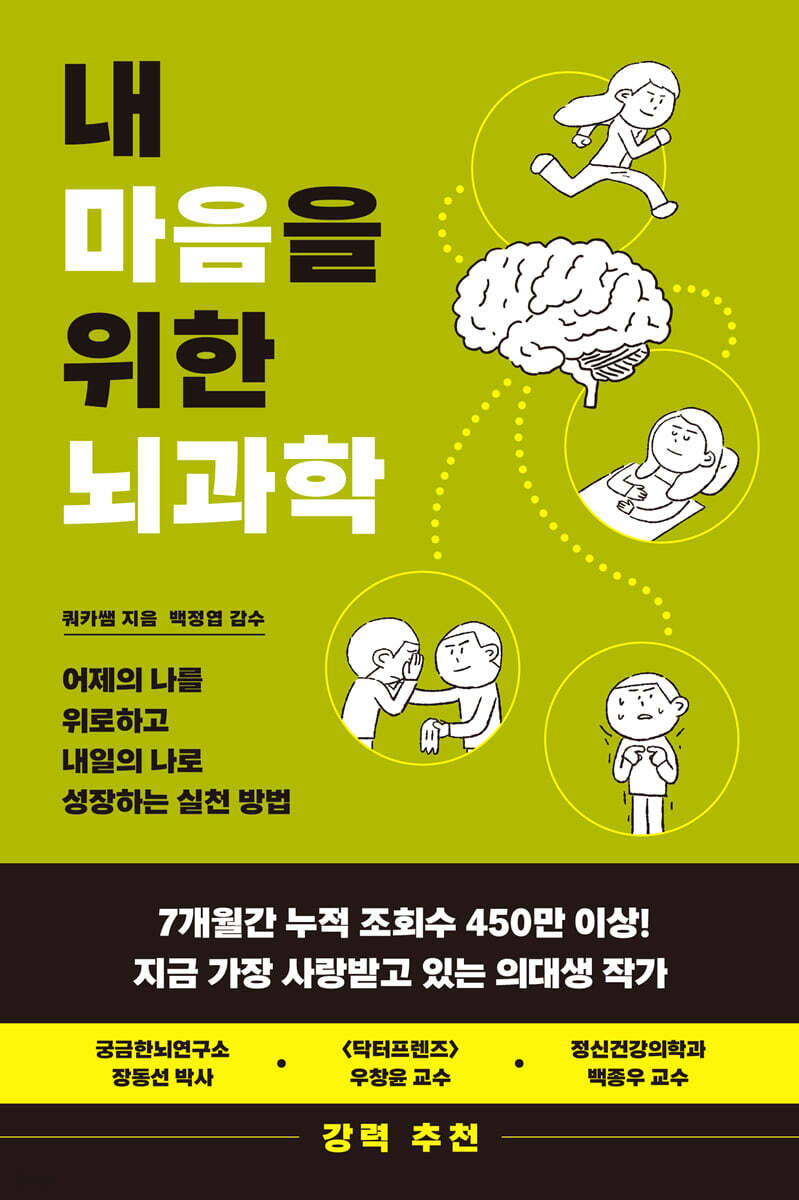
Brain Science for My Mind
 |
Description
Book Introduction
* Recommended by neuroscientist Dr. Jang Dong-seon, Professor Woo Chang-yoon of “Doctor Friends,” and Professor Baek Jong-woo of the Department of Psychiatry at Kyung Hee University!
* How did he, who was a worrier and always on guard, learn to control his mind?
* Over 4.5 million thread views in 7 months! The story of the growth of the mind of the most beloved medical student writer.
“I’m always anxious, overthinking, having trouble concentrating, feeling lethargic and even depressed… What on earth is wrong with me that makes me like this?” “It’s all just a natural process in the brain.”
The brain science story of medical student "Quokka Teacher," a hot topic on the thread, is now available as a book.
We explain and introduce solutions to various problems such as lethargy, depression, distraction, and anxiety from a brain science perspective.
Those times when I was miserable because my mind didn't do what I wanted, it was just because I wasn't handling my brain well.
Once you understand how your brain works, you'll have the power to solve problems that plague you and find ways to grow into the person you want to be.
* How did he, who was a worrier and always on guard, learn to control his mind?
* Over 4.5 million thread views in 7 months! The story of the growth of the mind of the most beloved medical student writer.
“I’m always anxious, overthinking, having trouble concentrating, feeling lethargic and even depressed… What on earth is wrong with me that makes me like this?” “It’s all just a natural process in the brain.”
The brain science story of medical student "Quokka Teacher," a hot topic on the thread, is now available as a book.
We explain and introduce solutions to various problems such as lethargy, depression, distraction, and anxiety from a brain science perspective.
Those times when I was miserable because my mind didn't do what I wanted, it was just because I wasn't handling my brain well.
Once you understand how your brain works, you'll have the power to solve problems that plague you and find ways to grow into the person you want to be.
- You can preview some of the book's contents.
Preview
index
Recommendation
Reviewer's note
Welcome to a journey to become familiar with the brain.
Brain structure and functions you should know before reading this book
Part 1.
The Brain Science of Comfort_It's okay, it's just your brain's reaction.
The Self-Blaming Brain - Why Do I Keep Blaming Myself?
The avoidant brain - When you're afraid, just take one step.
The Worried Brain - How to Stop Being Ruled by Worry
The Sensitive Brain - How Highly Sensitive People Live
The Overthinking Brain - When the Radio in My Head Is Noisy
A brain that is sensitive to other people's gaze
A wounded brain - small wounds can hurt for a long time
Lonely Brain - Don't Be Isolated
The Hateful Brain - If You Hate Someone Deeply
The Jealous Brain: Why Other People's Success Makes Us Feel Sick
Depressed Brain - When You're Trapped in a Gray World
Stressed Brain - Warning Signals Your Brain Sends
Burnout on the brain - when all your energy is exhausted
The Bored Brain - The Emptiness Behind Pleasure
The Addicted Brain - Why We Can't Stop
Part 2.
The Neuroscience of Growth: How to Use Your Brain to Unleash Your Potential
The Grateful Brain - A Powerful Life-Changing Habit
The Brain That Remembers - Time to Open the Brain's Treasure Chest
The Praise Brain - The Brain's Greatest Reward
The Empathetic Brain: The Empathy Skills You Need to Know, Whether You're a T or F
The Social Brain - Different Thinking, Different Brains
The Steady Brain - What Makes a Steady Person Different
The Focused Brain - How to Control a Distracted Mind
The Brain That Remembers - The Memory Secrets of a Medical School Top Student
A Resting Brain - Resting is Not an Option, It's a Must
Awakening Brain - If you want to have an energetic day
The Sleeping Brain - In Search of Lost Sleep
The Brain That Exercises - What Exercises Are Good for Your Brain?
The Growing Brain: The Secret Behind What We Thought Were Limitations
My Brain - How to Find Your True Self
The Predictive Brain - We Become Our Own World
main
Reviewer's note
Welcome to a journey to become familiar with the brain.
Brain structure and functions you should know before reading this book
Part 1.
The Brain Science of Comfort_It's okay, it's just your brain's reaction.
The Self-Blaming Brain - Why Do I Keep Blaming Myself?
The avoidant brain - When you're afraid, just take one step.
The Worried Brain - How to Stop Being Ruled by Worry
The Sensitive Brain - How Highly Sensitive People Live
The Overthinking Brain - When the Radio in My Head Is Noisy
A brain that is sensitive to other people's gaze
A wounded brain - small wounds can hurt for a long time
Lonely Brain - Don't Be Isolated
The Hateful Brain - If You Hate Someone Deeply
The Jealous Brain: Why Other People's Success Makes Us Feel Sick
Depressed Brain - When You're Trapped in a Gray World
Stressed Brain - Warning Signals Your Brain Sends
Burnout on the brain - when all your energy is exhausted
The Bored Brain - The Emptiness Behind Pleasure
The Addicted Brain - Why We Can't Stop
Part 2.
The Neuroscience of Growth: How to Use Your Brain to Unleash Your Potential
The Grateful Brain - A Powerful Life-Changing Habit
The Brain That Remembers - Time to Open the Brain's Treasure Chest
The Praise Brain - The Brain's Greatest Reward
The Empathetic Brain: The Empathy Skills You Need to Know, Whether You're a T or F
The Social Brain - Different Thinking, Different Brains
The Steady Brain - What Makes a Steady Person Different
The Focused Brain - How to Control a Distracted Mind
The Brain That Remembers - The Memory Secrets of a Medical School Top Student
A Resting Brain - Resting is Not an Option, It's a Must
Awakening Brain - If you want to have an energetic day
The Sleeping Brain - In Search of Lost Sleep
The Brain That Exercises - What Exercises Are Good for Your Brain?
The Growing Brain: The Secret Behind What We Thought Were Limitations
My Brain - How to Find Your True Self
The Predictive Brain - We Become Our Own World
main
Detailed image

Into the book
Anxiety, worry, stress… these emotions are ultimately just natural reactions that occur in the brain.
--- From the "Preface"
A characteristic of people who blame themselves is that their 'judgments' are excessively strict.
They cannot tolerate even the smallest mistakes, and if something falls short of their desired standards, they are harshly criticized among those with "experience."
As a result, in ‘experience’, you become more and more discouraged and are unable to reveal your true self.
--- From "The Self-Reproaching Brain"
aMCC is a central place where we can go when we need to get things done.
Like a conductor, he connects and coordinates various areas, effectively distributing the energy and focus needed to overcome difficulties.
According to Andrew Huberman, a professor of neurobiology at Stanford University, the aMCC becomes more active and actually grows in size when you take on a new challenge.
Thanks to the growth of aMCC in this way, our willpower and perseverance have improved, making the next challenge easier.
--- From "The Avoidant Brain"
People with high HSP scores showed an interesting characteristic: they found more accurate answers and spent more time looking for subtle differences when the pictures were presented slowly.
Brain imaging revealed that the areas of the brain that analyze visual information and the areas that control attention were more active.
These experimental results show that the brains of HSPs process stimuli more precisely.
--- From "The Sensitive Brain"
In addition to the DMN, our brain also has something called the Central Executive Network (CEN). While the DMN handles internal thoughts, the CEN focuses on the external environment.
Normally, these two networks function by switching appropriately according to the situation, but when sleep is lacking, this balance is disrupted.
--- From "The Brain with Many Thoughts"
The bigger problem is that the more often we experience these crashes, the lower our brain's dopamine baseline becomes.
As a result, your brain becomes unresponsive to new challenges or achievements, as well as everyday pleasures like your favorite music or delicious food.
Eventually, you lose the small joys of everyday life and only seek out stimulating activities.
--- From "Boring Brain"
When you start a new behavior, your goal-oriented system takes the lead, but as you repeat that behavior, it gradually shifts to your habit system.
What's interesting is that the less conscious you are of the consequences, the better your habits will form.
If you focus only on the outcome, you will either stop taking action when you achieve your goal or give up easily when you don't get the desired result.
--- From "The Steady Brain"
But there's something really special about perfume.
We all have memories we'd rather forget, don't we? Whenever we recall those painful memories, the hurt and guilt from that time often flood back.
This is when nostalgia can help change your perspective on painful memories.
--- From "The Brain That Remembers"
When a choice I made led to a meaningful outcome, dopamine was released and those moments were firmly engraved.
These accumulated positive experiences led me to take on bigger challenges, which ultimately brought about a big change in my life.
Through these moments of choice and challenge, our brain gradually changes into a more “my brain.”
--- From the "Preface"
A characteristic of people who blame themselves is that their 'judgments' are excessively strict.
They cannot tolerate even the smallest mistakes, and if something falls short of their desired standards, they are harshly criticized among those with "experience."
As a result, in ‘experience’, you become more and more discouraged and are unable to reveal your true self.
--- From "The Self-Reproaching Brain"
aMCC is a central place where we can go when we need to get things done.
Like a conductor, he connects and coordinates various areas, effectively distributing the energy and focus needed to overcome difficulties.
According to Andrew Huberman, a professor of neurobiology at Stanford University, the aMCC becomes more active and actually grows in size when you take on a new challenge.
Thanks to the growth of aMCC in this way, our willpower and perseverance have improved, making the next challenge easier.
--- From "The Avoidant Brain"
People with high HSP scores showed an interesting characteristic: they found more accurate answers and spent more time looking for subtle differences when the pictures were presented slowly.
Brain imaging revealed that the areas of the brain that analyze visual information and the areas that control attention were more active.
These experimental results show that the brains of HSPs process stimuli more precisely.
--- From "The Sensitive Brain"
In addition to the DMN, our brain also has something called the Central Executive Network (CEN). While the DMN handles internal thoughts, the CEN focuses on the external environment.
Normally, these two networks function by switching appropriately according to the situation, but when sleep is lacking, this balance is disrupted.
--- From "The Brain with Many Thoughts"
The bigger problem is that the more often we experience these crashes, the lower our brain's dopamine baseline becomes.
As a result, your brain becomes unresponsive to new challenges or achievements, as well as everyday pleasures like your favorite music or delicious food.
Eventually, you lose the small joys of everyday life and only seek out stimulating activities.
--- From "Boring Brain"
When you start a new behavior, your goal-oriented system takes the lead, but as you repeat that behavior, it gradually shifts to your habit system.
What's interesting is that the less conscious you are of the consequences, the better your habits will form.
If you focus only on the outcome, you will either stop taking action when you achieve your goal or give up easily when you don't get the desired result.
--- From "The Steady Brain"
But there's something really special about perfume.
We all have memories we'd rather forget, don't we? Whenever we recall those painful memories, the hurt and guilt from that time often flood back.
This is when nostalgia can help change your perspective on painful memories.
--- From "The Brain That Remembers"
When a choice I made led to a meaningful outcome, dopamine was released and those moments were firmly engraved.
These accumulated positive experiences led me to take on bigger challenges, which ultimately brought about a big change in my life.
Through these moments of choice and challenge, our brain gradually changes into a more “my brain.”
--- From "My Brain"
Publisher's Review
When my mind wasn't going my way, I encountered brain science.
The Mind Development of Medical Students: Discovered Through Brain Science
'Why am I so easily hurt by what people say?'
'It's been an hour since I started watching Shorts... I can't stop.'
'Why do I always have to be concerned about what others think?'
'The project I was assigned to was a success, but why am I so lethargic these days?'
Many people are troubled because their hearts, thoughts, and actions do not go as they wish.
No matter how much I promise myself that I will change from now on, I end up going around in circles and blaming my willpower or personality.
The more you blame yourself, the lower your self-esteem and the more depressed you become.
The author, who had an introverted personality and was particularly sensitive to emotions, always lived with this discomfort.
He was easily overcome by anxiety and worry, and sometimes even panicked… He was always worried and blaming himself because of his mental problems. One day, he encountered brain science and realized something surprising.
"It's not my fault, it's just something going on in my brain." Even the emotions and thoughts that felt intangible were actually "physical phenomena" that arose as the brain, the nervous system, performed its functions like other bodily organs.
Neuroscience has shown us that the various problems of the mind and thoughts that we encounter in life can be properly solved by understanding how the brain works and taking appropriate measures.
Just knowing how the brain works can begin to solve many of the problems that plagued our minds.
Let's look at the world through the lens of brain science. We can see ways to solve not only the problems of the mind and thoughts that we have always been concerned about, but also the problems we have with others and the world.
As a medical student, he began sharing the brain science knowledge that was of great help to him in an easy-to-understand manner in 2024.
It was because I wanted to help and comfort people who were struggling with the same problems as me.
His brain science thread received a lot of attention, garnering over 4.5 million views in just seven months since its launch.
People who have been struggling with their own thoughts and feelings deeply sympathized with his honesty in sharing his experiences, and were intrigued and surprised by the new knowledge he gained about brain science.
Brain science starts here, starting with the most curious and worrying questions.
How to comfort my wounded self and grow into the person I want to be
The modern living environment is full of risk factors that can harm the brain.
A competitive society that makes us feel excessive stress and anxiety, digital media that endlessly steals our attention and eventually causes addiction... 'Brain rot', which Oxford Dictionaries selected as the word of the year for 2024, is a self-deprecating expression for mental fatigue and decline in intellectual function due to excessive consumption of stimulating and low-quality online content, and the fact that such a word is being used also shows a trend that the public is concerned about 'brain health'.
Only by properly understanding the brain can we live healthily in this age of 'brain rot'.
"Brain Science for My Mind" is a collection of methods that can be put into practice immediately by people who feel the need to take care of their brain.
Part 1, "The Brain Science of Comfort," explains how to cope with the most common mental problems people experience and struggle with these days, such as anxiety, depression, lethargy, distraction, burnout, and stress.
We introduce various practical methods to 'calm' the brain so that you can easily follow them in your daily life, along with what happens in the brain in each problem situation.
Part 2, "Brain Science of Growth," covers ways to maintain brain health and unlock the brain's limitless potential.
It introduces various practical methods based on brain science knowledge, such as the right rest, sleep, and exercise methods to make the brain healthier, how to grow further through the power of gratitude and memories, how to build better relationships through praise and empathy, and how to improve concentration and memory recommended by a medical student.
Let's each freely read about the topic we were most curious about.
The more you understand the brain, the more you will discover aspects of yourself you never knew existed and learn techniques for growth.
The Mind Development of Medical Students: Discovered Through Brain Science
'Why am I so easily hurt by what people say?'
'It's been an hour since I started watching Shorts... I can't stop.'
'Why do I always have to be concerned about what others think?'
'The project I was assigned to was a success, but why am I so lethargic these days?'
Many people are troubled because their hearts, thoughts, and actions do not go as they wish.
No matter how much I promise myself that I will change from now on, I end up going around in circles and blaming my willpower or personality.
The more you blame yourself, the lower your self-esteem and the more depressed you become.
The author, who had an introverted personality and was particularly sensitive to emotions, always lived with this discomfort.
He was easily overcome by anxiety and worry, and sometimes even panicked… He was always worried and blaming himself because of his mental problems. One day, he encountered brain science and realized something surprising.
"It's not my fault, it's just something going on in my brain." Even the emotions and thoughts that felt intangible were actually "physical phenomena" that arose as the brain, the nervous system, performed its functions like other bodily organs.
Neuroscience has shown us that the various problems of the mind and thoughts that we encounter in life can be properly solved by understanding how the brain works and taking appropriate measures.
Just knowing how the brain works can begin to solve many of the problems that plagued our minds.
Let's look at the world through the lens of brain science. We can see ways to solve not only the problems of the mind and thoughts that we have always been concerned about, but also the problems we have with others and the world.
As a medical student, he began sharing the brain science knowledge that was of great help to him in an easy-to-understand manner in 2024.
It was because I wanted to help and comfort people who were struggling with the same problems as me.
His brain science thread received a lot of attention, garnering over 4.5 million views in just seven months since its launch.
People who have been struggling with their own thoughts and feelings deeply sympathized with his honesty in sharing his experiences, and were intrigued and surprised by the new knowledge he gained about brain science.
Brain science starts here, starting with the most curious and worrying questions.
How to comfort my wounded self and grow into the person I want to be
The modern living environment is full of risk factors that can harm the brain.
A competitive society that makes us feel excessive stress and anxiety, digital media that endlessly steals our attention and eventually causes addiction... 'Brain rot', which Oxford Dictionaries selected as the word of the year for 2024, is a self-deprecating expression for mental fatigue and decline in intellectual function due to excessive consumption of stimulating and low-quality online content, and the fact that such a word is being used also shows a trend that the public is concerned about 'brain health'.
Only by properly understanding the brain can we live healthily in this age of 'brain rot'.
"Brain Science for My Mind" is a collection of methods that can be put into practice immediately by people who feel the need to take care of their brain.
Part 1, "The Brain Science of Comfort," explains how to cope with the most common mental problems people experience and struggle with these days, such as anxiety, depression, lethargy, distraction, burnout, and stress.
We introduce various practical methods to 'calm' the brain so that you can easily follow them in your daily life, along with what happens in the brain in each problem situation.
Part 2, "Brain Science of Growth," covers ways to maintain brain health and unlock the brain's limitless potential.
It introduces various practical methods based on brain science knowledge, such as the right rest, sleep, and exercise methods to make the brain healthier, how to grow further through the power of gratitude and memories, how to build better relationships through praise and empathy, and how to improve concentration and memory recommended by a medical student.
Let's each freely read about the topic we were most curious about.
The more you understand the brain, the more you will discover aspects of yourself you never knew existed and learn techniques for growth.
GOODS SPECIFICS
- Date of issue: March 21, 2025
- Page count, weight, size: 236 pages | 378g | 140*210*16mm
- ISBN13: 9791193865156
- ISBN10: 1193865158
You may also like
카테고리
korean


korean

![GQ KOREA Mark (Monthly): December [2025]](http://librairie.coreenne.fr/cdn/shop/files/8ef265dbbfbf186523ed75ba7319009d.jpg?v=1765340328&width=3840)


