

How many full moons will I see in the future?
 |
Description
Book Introduction
World-renowned musician Ryuichi Sakamoto The last story Simultaneous publication in Korea, Japan, China, and Taiwan! Recommended by BTS's Suga, Yoon Sang, Lee Jun-oh (Casker), Jung Se-rang, Jung Jae-il, Hwang So-yoon, and Hou Hsiao-hsien “A teacher who taught me that the world is full of sounds, and that when those sounds come together, they become music.” _BTS Suga The last story told by Ryuichi Sakamoto, a representative artist and activist of his time. In 2020, Ryuichi Sakamoto was diagnosed with a 50 percent chance of surviving five years even with treatment due to a recurrence and metastasis of cancer, leaving him facing the finiteness of time. "How Many Full Moons Will I See in the Future" is a record of his reflections on life and art, friendship and love, nature and philosophy, and his music and deep thoughts that will be remembered for a long time beyond time, as he faced the final hurdles of his life. The story begins with him calmly explaining his situation at the time, saying that after undergoing multiple cancer surgeries, he decided to “live with cancer” rather than fight it. It flows along his musical journey so far, but at times breaks away from the frame of time and leads to deep and free thoughts and discourse that give a glimpse into his worldview and philosophy, and ends with an episode about his last original album, “12,” released in January 2023. And at the end of his writing he wrote, “Ars longa, vita brevis. The phrase “Art is long, life is short” eventually became his last words. This book is a compilation of columns serialized in the Japanese literary magazine Shincho from July 2022 to February 2023, and was published simultaneously in Korea, Japan, China, and Taiwan at the end of June 2023. As a special appendix to the book, it includes a description of Ryuichi Sakamoto's last moments and an excerpt from his diary passed down by his bereaved family. |
- You can preview some of the book's contents.
Preview
index
Chapter 1: Living with Cancer
Bertolucci and Boles | Just Before Surgery | Delirium | Salvaged by Love | The Concept of Friendship | Doubts About Time | A Song Taught by a Son | The First Destructive Impulse | Thoughts on "Merry Christmas, Mr. Lawrence" | The Death of a Parent | Life, Its True Nature | The Afterlife
Chapter 2: Requiem for a Mother
Freedom through Music | A Journey to the Arctic Circle | "Out of Noise" | A Medal Awarded by the French Government | A Tour by Sleeper Bus | A Night of Changed Performance | The World of "Sky-Seasoning Color" | The Possibilities and Limitations of Television | Music from the Jomon Period | Memories of Taeko Onuki | A Mother Like a Sunflower | The Cycle of Seasons
Chapter 3: You Can't Fight Nature
My Connection to Korea | The Great East Japan Earthquake and the Fukushima Nuclear Accident | The Helplessness I Experienced in the Disaster Area | "More Trees" Activities | Children's Music Regeneration Fund | What Happened at the Summer Festival | Solidarity with Sayuri Yoshinaga | Reunion with Takaaki Yoshimoto | The Best Gift of My Life | My Bond with Kraftwerk | The Real Meaning of the "It's Just Electricity" Remark | Trio Charity Concert
Chapter 4 Travel and Creation
Learning from Iceland | A Middle Eastern Princess | An Aversion to Tourism | Nam June Paik and John Cage | The Space of Film Festivals | Approaching Noh Theater | The Conductor's Etiquette | "Okina" Seen from Tanzan Shrine | Sapporo International Art Festival | The Opening I'd Believe
Chapter 5: The First Frustration
Noguchi's Identity and Macrobiotics | American Medicine | Life in New York | Hawaii's History | A Tradition Made | The True Meaning of Healing | Returning to Work | The Revenant | Living with Mother | Trust Me!
Chapter 6 Towards a Bigger Mountain
A Day in the Life of a Professor | Monopha and Tarkovsky | Async | New Forms of Expression | Projects in Asia | CODA | Repaying Gould | Farewell to Bertolucci | My Roots | My Uncle's Childhood Games
Chapter 7: Meeting New Talents
Breakfast Club | Experiences at the Glass House | Music Selections for "Kajitsu" | Connections with Young Artists | Commission from Professor Lee Ufan | Kyoto Conference | Ethnic Minorities in Taiwan | Creation of the "Oshima Nagisa Award" | Playing with Yosuke Yamashita | Henoko Base Issue | The Beginning of the COVID-19 Crisis | A Strange Sense of Time | Cancer Recurrence
Chapter 8: What We Leave for the Future
MR Project | Confessions to Children | Large-Scale Exhibition in Beijing | Time | The Strongest Support System | Ilya from Ukraine | Tohoku Youth Orchestra | D2021 | New Member of the "Dumb Type" Group | Long-Awaited Home | Sakamoto Books | Final Piano Solo | 12
Epilogue on behalf of the author
Funeral Playlist
annual report
Bertolucci and Boles | Just Before Surgery | Delirium | Salvaged by Love | The Concept of Friendship | Doubts About Time | A Song Taught by a Son | The First Destructive Impulse | Thoughts on "Merry Christmas, Mr. Lawrence" | The Death of a Parent | Life, Its True Nature | The Afterlife
Chapter 2: Requiem for a Mother
Freedom through Music | A Journey to the Arctic Circle | "Out of Noise" | A Medal Awarded by the French Government | A Tour by Sleeper Bus | A Night of Changed Performance | The World of "Sky-Seasoning Color" | The Possibilities and Limitations of Television | Music from the Jomon Period | Memories of Taeko Onuki | A Mother Like a Sunflower | The Cycle of Seasons
Chapter 3: You Can't Fight Nature
My Connection to Korea | The Great East Japan Earthquake and the Fukushima Nuclear Accident | The Helplessness I Experienced in the Disaster Area | "More Trees" Activities | Children's Music Regeneration Fund | What Happened at the Summer Festival | Solidarity with Sayuri Yoshinaga | Reunion with Takaaki Yoshimoto | The Best Gift of My Life | My Bond with Kraftwerk | The Real Meaning of the "It's Just Electricity" Remark | Trio Charity Concert
Chapter 4 Travel and Creation
Learning from Iceland | A Middle Eastern Princess | An Aversion to Tourism | Nam June Paik and John Cage | The Space of Film Festivals | Approaching Noh Theater | The Conductor's Etiquette | "Okina" Seen from Tanzan Shrine | Sapporo International Art Festival | The Opening I'd Believe
Chapter 5: The First Frustration
Noguchi's Identity and Macrobiotics | American Medicine | Life in New York | Hawaii's History | A Tradition Made | The True Meaning of Healing | Returning to Work | The Revenant | Living with Mother | Trust Me!
Chapter 6 Towards a Bigger Mountain
A Day in the Life of a Professor | Monopha and Tarkovsky | Async | New Forms of Expression | Projects in Asia | CODA | Repaying Gould | Farewell to Bertolucci | My Roots | My Uncle's Childhood Games
Chapter 7: Meeting New Talents
Breakfast Club | Experiences at the Glass House | Music Selections for "Kajitsu" | Connections with Young Artists | Commission from Professor Lee Ufan | Kyoto Conference | Ethnic Minorities in Taiwan | Creation of the "Oshima Nagisa Award" | Playing with Yosuke Yamashita | Henoko Base Issue | The Beginning of the COVID-19 Crisis | A Strange Sense of Time | Cancer Recurrence
Chapter 8: What We Leave for the Future
MR Project | Confessions to Children | Large-Scale Exhibition in Beijing | Time | The Strongest Support System | Ilya from Ukraine | Tohoku Youth Orchestra | D2021 | New Member of the "Dumb Type" Group | Long-Awaited Home | Sakamoto Books | Final Piano Solo | 12
Epilogue on behalf of the author
Funeral Playlist
annual report
Detailed image

Into the book
I've often been told that I make music that breaks with established values.
I certainly don't enjoy following established musical formulas, and I've always had the mindset of wanting to try something new if I'm going to do it.
But when I hear things like it breaks with existing values, it feels like avant-garde art from the 1960s, so I feel a sense of rejection towards that too.
Because the dichotomy itself that the vanguard is new and the rearguard is old, that intellectuals are progressive and the masses are conservative, is already anachronistic.
---From "Living with Cancer"
The human lifespan has increased from 80 to 90 years, at best, in the last 30 to 40 years.
Considering the long history of mankind, known to be 200,000 years, and the era when there was no medical system, I am not sure whether it is advisable to prolong life by force.
I think it's okay for the world to be a little more tolerant of the values of rejecting painful and arduous treatments and ending with minimal care.
In that respect, I am also interested in legal euthanasia in Switzerland and the Netherlands.
While saying this, I feel contradicted by my own actions of undergoing radiation therapy, surgery, and even chemotherapy.
I also worry about the fact that consciousness is much more conservative than the body.
But fundamentally, I believe that living naturally and dying naturally is the natural order of animals and the true nature of life.
Only humans are free from it.
---From "Living with Cancer"
Perhaps the moon also has the same power as music.
When I visited the Katsura Imperial Villa in Kyoto, I was impressed by the sight of a hermitage called "Moon Wave Tower" in the garden, built solely for viewing the moon.
The nobles of the Edo period must have enjoyed tea and sake here at night while looking at the moon.
It is an old country building now, but at the time, they might have sat on the porch right next to the pond and admired the full moon reflected on the water.
Perhaps the moon gave us a feeling similar to the comfort we feel when we listen to music.
---From "Requiem for a Mother"
If we think back on the human language function, language actually gives a framework to objects that do not actually have a form.
When we hear the word 'fog', we begin to see the existence of fog, and when we hear the word 'sky', we feel as if there is an area defined by the name of sky.
You can tell just by looking at the children drawing flowers.
Many children will probably draw petals, pistils, and stamens, and I think this choice is also largely influenced by language.
In the original natural world, everything is connected, but lines are drawn through language.
Of course, there are things to be gained from it, but as I get older, I've come to think that this might be the root of many human errors.
So, in 〈LIFE-fluid, invisible, inaudible...〉, I wanted to express the gradually changing form of water as a whole.
---From "Requiem for a Mother"
As I gazed at the things that humans had quietly built up over a long period of time, reduced to a filthy mess in an instant, I began to think that it might be okay to add a little something to them.
Even though we can feel beauty just by listening to the sound of the wind blowing by, we have been making music consistently.
I acknowledge the premise that 'nature cannot be defeated', but on the other hand, I thought that I have the right to enjoy it by adding my own voice or two to it.
It could be said that the earthquake disaster caused me to lean more deeply into the values I had vaguely held for so long.
---From "You Can't Fight Nature"
As I pressed the keys of this damaged 'Tsunami Piano' and listened, the strings, which were completely out of tune, produced a sound so exquisite that I couldn't describe it.
If you think about it, a piano is a man-made object that was originally made by taking wood from nature and connecting it with iron to play the sounds we prefer.
So, paradoxically, I felt that perhaps the human ego was destroyed by the natural force of the tsunami, and only then did it return to its natural state.
---From "You Can't Fight Nature"
Overcoming my dislike for Faure by listening to him intently was almost the same experience as coming to terms with Japanese music as I got older.
This change may be due to growing older, but it may also be because his sweet melodies, which in some ways seemed excessive, struck me anew in a state of weakness in both body and mind due to illness.
But whatever the case, I reflected that it was not right to make value judgments without listening properly.
I realized that just being stubborn can narrow your possibilities.
It was the first time I realized something when I had enough free time.
---From "The First Frustration"
I remembered one part where I pushed my argument to the end against Director Inarritu, who was so strict.
There is a scene in the middle of the movie where the protagonist, who was on the verge of death, is reunited with his son, who has already passed away, in a shack between dreams and reality.
There was a heated debate over what music to use for this fantastic and moving scene, and we wrestled with the song until the last minute.
Yet, director Iñárritu ultimately chooses to use the music as a guide.
So I gathered my courage and said to director Inarritu, “Trust me!” and pushed through with the recording, and in the end, my song was chosen.
It got a relatively good response, so after the film was completed, I made t-shirts with the line "Trust me" written on the chest and the phrase "THE REVENANT Music Team 2015" underneath and gave them to all the staff.
On the back, I also included the scene and song number, '6M23'.
I still treasure this T-shirt.
---From "The First Frustration"
Ordinary music is created by building a dense relationship between sounds.
But when it came to making this new album, I wanted to try a completely opposite methodology.
So when I started making it from scratch again, I tried to realize 'monowave' as music by tapping and rubbing rocks I found on the streets of New York.
I went to Kyoto in midsummer to do field recordings in the mountains filled with the sounds of cicadas, recorded the sound sculptures of the French Vachet Brothers, and visited an art museum in Manhattan to record the sound sculptures of the American sculptor Harry Bertoia.
---From "Towards a Bigger Mountain"
In the main venue of the “Installation Music Exhibition,” I created an environment where I could listen to all the songs from “async” in 5.1ch surround sound using speakers made by Musik Elektronik Gaiten, a German audio brand I trust.
Originally, we would have had to assign different speakers to each note, but we tried our best to get as close to the sound of the real world as possible, even if it was just an illusion.
When spring comes, hundreds of frogs in the fields of the countryside croak together, but in fact, the pitch and rhythm of each frog's cry are all different.
Even when listening to the sound of rain, humans habitually discover a certain regularity, but in reality, it is definitely an 'asynchronous' phenomenon that falls irregularly depending on factors such as wind and rainfall.
Since I aimed for the 'sound of things themselves' throughout the album, I wanted to recreate that natural sound environment as much as possible in this exhibition.
---From "Towards a Bigger Mountain"
After confessing to my children about my illness, my mind became clearer, and I was able to look at death with relative calm and consider various specific issues.
Since I couldn't just continue living in a hotel while receiving treatment in Japan, I had to think about where to live, who to notify if I died soon, and what kind of funeral should be held...
If I don't decide these little things in advance, things might go in a direction that doesn't match my wishes.
Looking back on my activities since "Freedom through Music," I realized that I had to complete the oral notes for this series while I was still alive.
---From "What We Leave for the Future"
Even if it's a country you've never been to, if you know even one person there, it's no longer just a foreign country.
For me, Ilya was a precious person who connected me with Ukraine, and although we have never met in person, I consider him a friend.
That doesn't mean you can pretend not to know about the affairs of a country you don't know about. That's not true at all.
But the moment the face of someone living anywhere in the world comes into focus, the news starts to look completely different.
At some point, I stopped caring at all about being jeered at for my social activities, saying I was “selling my name.”
(syncopation)
In Japan, there is still public resistance to artists making political statements, but since that day, I have changed my mind to the idea that if I am truly famous and have a marketable name, I should use it more actively.
Even if I am criticized as a hypocrite, I think it would be a good thing if society could improve even a little because of it.
Environmental movements and post-earthquake disaster activities are also carried out with the power of this belief.
Once you're connected, it's hard to let go.
---From "What We Leave for the Future"
One time, I heard a strange rustling sound outside the window, so I looked out and saw an eagle sitting on a tree branch eating a small bird it had caught.
It was a bit creepy to see them tearing off wings and eating them, but if you think about it, that too is part of nature.
The bones of a small bird that had been scattered here and there on the ground were completely gone the next day, probably having been picked up by a nearby cat.
As I realized when I visited Africa, the main characters of nature are animals, insects, and plants, and we humans are merely borrowing a corner of it for a while.
News articles like "Monkeys appearing in residential areas" often appear, but I think that's the opposite of what happened; we're living in what used to be monkey habitats.
---From "What We Leave for the Future"
Unlike other original albums released so far, this album was not created based on any solid concept.
It's just a simple mix of synthesizer and piano sounds put together on an album, nothing more than that.
But for me now, I feel more satisfied with music that is made raw and without any plan.
This concludes my story for now.
Ars longa, vita brevis.
(Art is long, life is short.)
I certainly don't enjoy following established musical formulas, and I've always had the mindset of wanting to try something new if I'm going to do it.
But when I hear things like it breaks with existing values, it feels like avant-garde art from the 1960s, so I feel a sense of rejection towards that too.
Because the dichotomy itself that the vanguard is new and the rearguard is old, that intellectuals are progressive and the masses are conservative, is already anachronistic.
---From "Living with Cancer"
The human lifespan has increased from 80 to 90 years, at best, in the last 30 to 40 years.
Considering the long history of mankind, known to be 200,000 years, and the era when there was no medical system, I am not sure whether it is advisable to prolong life by force.
I think it's okay for the world to be a little more tolerant of the values of rejecting painful and arduous treatments and ending with minimal care.
In that respect, I am also interested in legal euthanasia in Switzerland and the Netherlands.
While saying this, I feel contradicted by my own actions of undergoing radiation therapy, surgery, and even chemotherapy.
I also worry about the fact that consciousness is much more conservative than the body.
But fundamentally, I believe that living naturally and dying naturally is the natural order of animals and the true nature of life.
Only humans are free from it.
---From "Living with Cancer"
Perhaps the moon also has the same power as music.
When I visited the Katsura Imperial Villa in Kyoto, I was impressed by the sight of a hermitage called "Moon Wave Tower" in the garden, built solely for viewing the moon.
The nobles of the Edo period must have enjoyed tea and sake here at night while looking at the moon.
It is an old country building now, but at the time, they might have sat on the porch right next to the pond and admired the full moon reflected on the water.
Perhaps the moon gave us a feeling similar to the comfort we feel when we listen to music.
---From "Requiem for a Mother"
If we think back on the human language function, language actually gives a framework to objects that do not actually have a form.
When we hear the word 'fog', we begin to see the existence of fog, and when we hear the word 'sky', we feel as if there is an area defined by the name of sky.
You can tell just by looking at the children drawing flowers.
Many children will probably draw petals, pistils, and stamens, and I think this choice is also largely influenced by language.
In the original natural world, everything is connected, but lines are drawn through language.
Of course, there are things to be gained from it, but as I get older, I've come to think that this might be the root of many human errors.
So, in 〈LIFE-fluid, invisible, inaudible...〉, I wanted to express the gradually changing form of water as a whole.
---From "Requiem for a Mother"
As I gazed at the things that humans had quietly built up over a long period of time, reduced to a filthy mess in an instant, I began to think that it might be okay to add a little something to them.
Even though we can feel beauty just by listening to the sound of the wind blowing by, we have been making music consistently.
I acknowledge the premise that 'nature cannot be defeated', but on the other hand, I thought that I have the right to enjoy it by adding my own voice or two to it.
It could be said that the earthquake disaster caused me to lean more deeply into the values I had vaguely held for so long.
---From "You Can't Fight Nature"
As I pressed the keys of this damaged 'Tsunami Piano' and listened, the strings, which were completely out of tune, produced a sound so exquisite that I couldn't describe it.
If you think about it, a piano is a man-made object that was originally made by taking wood from nature and connecting it with iron to play the sounds we prefer.
So, paradoxically, I felt that perhaps the human ego was destroyed by the natural force of the tsunami, and only then did it return to its natural state.
---From "You Can't Fight Nature"
Overcoming my dislike for Faure by listening to him intently was almost the same experience as coming to terms with Japanese music as I got older.
This change may be due to growing older, but it may also be because his sweet melodies, which in some ways seemed excessive, struck me anew in a state of weakness in both body and mind due to illness.
But whatever the case, I reflected that it was not right to make value judgments without listening properly.
I realized that just being stubborn can narrow your possibilities.
It was the first time I realized something when I had enough free time.
---From "The First Frustration"
I remembered one part where I pushed my argument to the end against Director Inarritu, who was so strict.
There is a scene in the middle of the movie where the protagonist, who was on the verge of death, is reunited with his son, who has already passed away, in a shack between dreams and reality.
There was a heated debate over what music to use for this fantastic and moving scene, and we wrestled with the song until the last minute.
Yet, director Iñárritu ultimately chooses to use the music as a guide.
So I gathered my courage and said to director Inarritu, “Trust me!” and pushed through with the recording, and in the end, my song was chosen.
It got a relatively good response, so after the film was completed, I made t-shirts with the line "Trust me" written on the chest and the phrase "THE REVENANT Music Team 2015" underneath and gave them to all the staff.
On the back, I also included the scene and song number, '6M23'.
I still treasure this T-shirt.
---From "The First Frustration"
Ordinary music is created by building a dense relationship between sounds.
But when it came to making this new album, I wanted to try a completely opposite methodology.
So when I started making it from scratch again, I tried to realize 'monowave' as music by tapping and rubbing rocks I found on the streets of New York.
I went to Kyoto in midsummer to do field recordings in the mountains filled with the sounds of cicadas, recorded the sound sculptures of the French Vachet Brothers, and visited an art museum in Manhattan to record the sound sculptures of the American sculptor Harry Bertoia.
---From "Towards a Bigger Mountain"
In the main venue of the “Installation Music Exhibition,” I created an environment where I could listen to all the songs from “async” in 5.1ch surround sound using speakers made by Musik Elektronik Gaiten, a German audio brand I trust.
Originally, we would have had to assign different speakers to each note, but we tried our best to get as close to the sound of the real world as possible, even if it was just an illusion.
When spring comes, hundreds of frogs in the fields of the countryside croak together, but in fact, the pitch and rhythm of each frog's cry are all different.
Even when listening to the sound of rain, humans habitually discover a certain regularity, but in reality, it is definitely an 'asynchronous' phenomenon that falls irregularly depending on factors such as wind and rainfall.
Since I aimed for the 'sound of things themselves' throughout the album, I wanted to recreate that natural sound environment as much as possible in this exhibition.
---From "Towards a Bigger Mountain"
After confessing to my children about my illness, my mind became clearer, and I was able to look at death with relative calm and consider various specific issues.
Since I couldn't just continue living in a hotel while receiving treatment in Japan, I had to think about where to live, who to notify if I died soon, and what kind of funeral should be held...
If I don't decide these little things in advance, things might go in a direction that doesn't match my wishes.
Looking back on my activities since "Freedom through Music," I realized that I had to complete the oral notes for this series while I was still alive.
---From "What We Leave for the Future"
Even if it's a country you've never been to, if you know even one person there, it's no longer just a foreign country.
For me, Ilya was a precious person who connected me with Ukraine, and although we have never met in person, I consider him a friend.
That doesn't mean you can pretend not to know about the affairs of a country you don't know about. That's not true at all.
But the moment the face of someone living anywhere in the world comes into focus, the news starts to look completely different.
At some point, I stopped caring at all about being jeered at for my social activities, saying I was “selling my name.”
(syncopation)
In Japan, there is still public resistance to artists making political statements, but since that day, I have changed my mind to the idea that if I am truly famous and have a marketable name, I should use it more actively.
Even if I am criticized as a hypocrite, I think it would be a good thing if society could improve even a little because of it.
Environmental movements and post-earthquake disaster activities are also carried out with the power of this belief.
Once you're connected, it's hard to let go.
---From "What We Leave for the Future"
One time, I heard a strange rustling sound outside the window, so I looked out and saw an eagle sitting on a tree branch eating a small bird it had caught.
It was a bit creepy to see them tearing off wings and eating them, but if you think about it, that too is part of nature.
The bones of a small bird that had been scattered here and there on the ground were completely gone the next day, probably having been picked up by a nearby cat.
As I realized when I visited Africa, the main characters of nature are animals, insects, and plants, and we humans are merely borrowing a corner of it for a while.
News articles like "Monkeys appearing in residential areas" often appear, but I think that's the opposite of what happened; we're living in what used to be monkey habitats.
---From "What We Leave for the Future"
Unlike other original albums released so far, this album was not created based on any solid concept.
It's just a simple mix of synthesizer and piano sounds put together on an album, nothing more than that.
But for me now, I feel more satisfied with music that is made raw and without any plan.
This concludes my story for now.
Ars longa, vita brevis.
(Art is long, life is short.)
---From "What We Leave for the Future"
Publisher's Review
“I will be living with cancer from now on.
“I plan to make a little more music.”
Even after being diagnosed with laryngeal cancer in 2014, Ryuichi Sakamoto continued his active career, releasing the original album "async" (2017) and holding concerts and exhibitions related to the album around the world, all while focusing on treatment and recovery.
(The author's name is written as 'Ryuichi Sakamoto' in the main text of the book, but the widely known English spelling, Ryuichi Sakamoto, is used for the cover and promotional materials.) However, in June 2020, he was diagnosed with rectal cancer and learned that the cancer had recurred, so he began chemotherapy again at a cancer center in New York.
And in December of the same year, a test result in Japan revealed that the rectal cancer had metastasized to the lungs, liver, and lymph nodes, and that even with treatment, the five-year survival rate was only 50 percent.
Over the next two years, she would undergo six surgeries to remove the tumor, and immediately after the first surgery in January, she said, “I will live with cancer from now on.
I'm thinking of making a little more music.
“I would appreciate it if you could watch over me” (p.46), he said through his agency, conveying the situation.
From the fact that he chose the expression “living” rather than “fighting” cancer, and from his statement that he would “make a little more music,” we can read his heart and will about how he plans to spend the remaining time.
“How many full moons will I see in the future?”
The book begins with a line that is both the title and a line from the film "Last Love" (1990), the music of which was also composed by Ryuichi Sakamoto.
Ryuichi Sakamoto is said to have recited this sentence, which contains the finiteness of time and the preciousness of life, as if talking to himself after his first major surgery, which lasted 20 hours.
While informing his family of the recurrence of his cancer and preparing for the impending death that could strike at any time, he decided to take this opportunity to look back and organize his footsteps since the publication of "Freedom through Music" in 2009, and began a column series in the Japanese literary magazine "Shincho."
The book, “How Many Full Moons Will I See in the Future?” is a compilation of articles serialized from July 2022 to February of this year.
Ryuichi Sakamoto passed away on March 28, 2023, at the age of 71, leaving behind the manuscript for an epilogue to be added to the book. In the end, Masafumi Suzuki, the former editor-in-chief of GQ JAPAN, who was in charge of the interviews and manuscript editing at the time of the column serialization, calmly recorded and added a story about Sakamoto's last moments in place of the author's epilogue.
A portion of Sakamoto's diary provided by his bereaved family is also quoted verbatim, covering the period from January 31, 2021, when he was frequently experiencing delirium after a major surgery, to March 26, 2023, just before he passed away, representing his voice.
Free from the limitations of time
The world of Ryuichi Sakamoto's works
The book basically unfolds along Ryuichi Sakamoto's musical journey, including the release of the original album "Out of Noise" (2009), the European tour in the form of a solo piano concert (2009), the release of the collaborative album "UTAU" with Taeko Onuki (2010), the resumption of activities as YMO, including a concert in North America after 31 years (2011), his appointment as a jury member for the Venice International Film Festival (2013), and his experience as the music director for the film "The Revenant" (2015), which had a major influence on the latter part of his musical career.
However, rather than unfolding in a fragmentary chronological manner, the flow of the book often deviates from the frame of time and leads to deep and free thoughts and discourses that reveal his worldview and philosophy, much like the way Sakamoto perceives time, saying, “Time is, so to speak, an illusion created by the brain” (p. 27).
'Time' was a major theme in Sakamoto's later works, and he expressed his affection for the original album "async" to the point of saying, "I like it so much that I don't want to let anyone hear it." He also revealed that his "skepticism about time" that he developed after facing the finiteness of life influenced his work.
The album title is an abbreviation of 'asynchronization', and it contains the intention to turn one's back on the flow of the times where everything is synchronized and literally head towards 'asynchrony'.
When planning the album, it is said that the greatest inspiration was the work of artist Lee Ufan. In line with the ‘Mono-ha’ movement, which removes human thoughts and imagination and displays ‘mono’, that is, natural materials such as stones and trees, without processing them, he “wanted to deny the brain’s tendency to find meaning in all things” (p. 224).
Accordingly, unlike the usual composition method of meticulously building up the relationship between sounds, when producing this album, I used the opposite methodology, collecting and recording various 'sounds' such as picking up and hitting or rubbing stones on the streets of New York, and going to the forests of Kyoto to conduct field recording.
Because it was produced through this process, the true value of 《async》 can only be realized when you listen to it in a three-dimensional space, like listening to the sounds of nature. After the album was released, based on it, several performances were held, such as 〈Installation Music Exhibition〉, which had the characteristics of a concert, stage art, and installation work.
It is said that the “Installation Music Exhibition” became the seed for the planning of the exhibition “Ryuichi Sakamoto Exhibition: LIFE, LIFE” held at the gallery “piknic” in Seoul for five months from May 2018.
Shared with artists from all over the world
A place of deep friendship and artistic connection
As Ryuichi Sakamoto was an artist who was active in all directions on the world stage, if you follow the trajectory of his activities, such as his relationship with avant-garde artist Nam June Paik, the inspiration and communication shared with Monopa Lee Ufan, his exchange with installation artist Marina Abramović, the opening performance of the Yayoi Kusama exhibition held at the Glass House, and the filming of his piano solo MR (mixed reality) work, you can encounter many interesting aspects of modern art history and feel its vivid presence.
And his artistic exchanges with artists from all over the world, transcending boundaries of age and genre, from the previous generation's Nam June Paik, Lee Ufan, Bernardo Bertolucci, and Andrei Tarkovsky, to his contemporary artists Carsten Nicolai (Alva Noto), Shiro Takatani, and Iñárritu, to the new generation's musicians Flying Lotus, Thundercat, Sesoneon, and BTS's Suga, make us realize how Sakamoto has established himself as an outstanding creator to many people.
In particular, it appears that Sakamoto had a deep connection with Lee Ufan, whom he respected as a teacher and was inspired by, to the point that he hung the work Lee Ufan had drawn for the cover of his last original album, “12,” on the wall of his hospital room while he was receiving palliative care (p. 381).
“If I were really famous and had a name that I could sell,
Rather, we should use it more actively.”
Ryuichi Sakamoto, who began to actively voice his environmental movement in 2007 after establishing the non-profit organization "More Trees," which engages in forest management activities, continued his activities as an activist by actively participating in protests and activities against the Japanese government, while continuing various relief activities for the recovery of the affected areas following the Great East Japan Earthquake on March 11, 2011.
The opportunity to begin making social statements like this came at the end of the 20th century when he was invited to participate in the Jubilee 2000, a debt relief movement for the poorest countries in Africa led by Bono of U2. After that, he did not care about being ridiculed for “selling his name,” and instead said, “If you have a name that can be sold, you should use it more actively” (p.
330) is said to have decided to go that way.
In addition to 'More Trees', the 'Children's Music Regeneration Fund' was established in response to the March 11th earthquake, and activities were carried out to repair damaged instruments free of charge in approximately 2,000 schools in the earthquake-stricken areas, and in the case of instruments that could not be repaired, the fund was provided to replace them.
Going further, he recruited children's orchestra members from the earthquake-stricken areas and formed the "Tohoku Youth Orchestra," and then served as its music director, consistently supporting its activities.
It is said that the song "Now Time is Tilting", written for the regular concert of the Tohoku Youth Orchestra, incorporated 11 beats in memory of the March 11th earthquake.
Sakamoto's use of his musical talent to convey social messages isn't limited to issues related to his home country.
He recalls that in 2022, during the Russian invasion of Ukraine, he participated in a charity album to support Ukraine and completed a piece for the Ukrainian violinist Ilya.
“The moment you see the face of someone living somewhere in the world, the news starts to look completely different.” (p.
329)
“Art is long, life is short.”
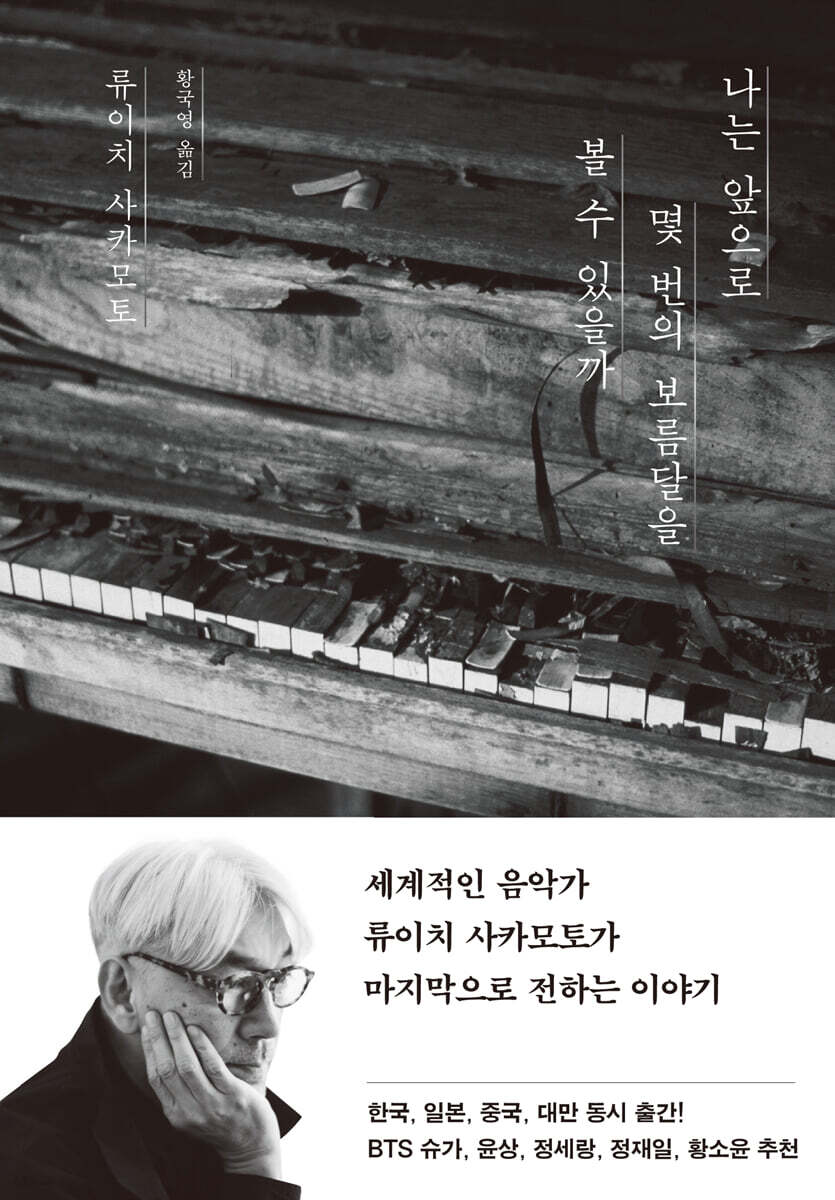
The cover photo for this book is of a piano in the garden of Ryuichi Sakamoto's New York home.
The piano was left in the yard as a test under the name of 'an experiment to return it to nature', and after being exposed to wind and rain several times over the years, the piano was gradually approaching its original wooden state with all the paint peeling off.
He said that the image is connected to how humans should age, and his last original album, "12," seems to be a continuation of that flow.
In early 2021, while recuperating in a temporary residence in Tokyo after major surgery, he said, “I just wanted to feel the sound to my heart’s content, without any intention of creating anything” (p.
353) I recorded it by playing the synthesizer and piano keys as if I was writing a diary, and among the accumulated sound sources, I selected twelve songs that I liked and released them under the title “12” on my birthday in 2023.
As Ryuichi Sakamoto said at the end of his writing, “Ars longa, vita brevis (Art is long, life is short),” he did not stop creating until the very end.
With the intention of capturing performance scenes worth leaving behind in the future, in September 2022, I rented a studio in Japan that I personally thought had the best sound resonance and recorded a piano solo performance over several days. Following this, I rented another studio and gathered other performers to record a song I had created while attending Tokyo University of the Arts as a proper sound source.
His last hospitalization was on March 19, 2023, about ten days before he passed away.
After being rushed to the hospital in the middle of the night due to pneumothorax, the condition of his lungs, which had previously suffered from pneumonia, worsened, and from the 25th, he entered palliative care according to his own wishes.
However, in the meantime, he watched the performance of the 'Tohoku Youth Orchestra' from his hospital room and provided necessary guidance remotely, and he is said to have held a remote meeting with his collaborator Shiro Takatani for an exhibition to be held in Chengdu, China at the end of July this year.
He says he carefully considered the songs to be played at his own funeral, and that funeral playlist ended up in the very last chapter of this book.
“I plan to make a little more music.”
Even after being diagnosed with laryngeal cancer in 2014, Ryuichi Sakamoto continued his active career, releasing the original album "async" (2017) and holding concerts and exhibitions related to the album around the world, all while focusing on treatment and recovery.
(The author's name is written as 'Ryuichi Sakamoto' in the main text of the book, but the widely known English spelling, Ryuichi Sakamoto, is used for the cover and promotional materials.) However, in June 2020, he was diagnosed with rectal cancer and learned that the cancer had recurred, so he began chemotherapy again at a cancer center in New York.
And in December of the same year, a test result in Japan revealed that the rectal cancer had metastasized to the lungs, liver, and lymph nodes, and that even with treatment, the five-year survival rate was only 50 percent.
Over the next two years, she would undergo six surgeries to remove the tumor, and immediately after the first surgery in January, she said, “I will live with cancer from now on.
I'm thinking of making a little more music.
“I would appreciate it if you could watch over me” (p.46), he said through his agency, conveying the situation.
From the fact that he chose the expression “living” rather than “fighting” cancer, and from his statement that he would “make a little more music,” we can read his heart and will about how he plans to spend the remaining time.
“How many full moons will I see in the future?”
The book begins with a line that is both the title and a line from the film "Last Love" (1990), the music of which was also composed by Ryuichi Sakamoto.
Ryuichi Sakamoto is said to have recited this sentence, which contains the finiteness of time and the preciousness of life, as if talking to himself after his first major surgery, which lasted 20 hours.
While informing his family of the recurrence of his cancer and preparing for the impending death that could strike at any time, he decided to take this opportunity to look back and organize his footsteps since the publication of "Freedom through Music" in 2009, and began a column series in the Japanese literary magazine "Shincho."
The book, “How Many Full Moons Will I See in the Future?” is a compilation of articles serialized from July 2022 to February of this year.
Ryuichi Sakamoto passed away on March 28, 2023, at the age of 71, leaving behind the manuscript for an epilogue to be added to the book. In the end, Masafumi Suzuki, the former editor-in-chief of GQ JAPAN, who was in charge of the interviews and manuscript editing at the time of the column serialization, calmly recorded and added a story about Sakamoto's last moments in place of the author's epilogue.
A portion of Sakamoto's diary provided by his bereaved family is also quoted verbatim, covering the period from January 31, 2021, when he was frequently experiencing delirium after a major surgery, to March 26, 2023, just before he passed away, representing his voice.
Free from the limitations of time
The world of Ryuichi Sakamoto's works
The book basically unfolds along Ryuichi Sakamoto's musical journey, including the release of the original album "Out of Noise" (2009), the European tour in the form of a solo piano concert (2009), the release of the collaborative album "UTAU" with Taeko Onuki (2010), the resumption of activities as YMO, including a concert in North America after 31 years (2011), his appointment as a jury member for the Venice International Film Festival (2013), and his experience as the music director for the film "The Revenant" (2015), which had a major influence on the latter part of his musical career.
However, rather than unfolding in a fragmentary chronological manner, the flow of the book often deviates from the frame of time and leads to deep and free thoughts and discourses that reveal his worldview and philosophy, much like the way Sakamoto perceives time, saying, “Time is, so to speak, an illusion created by the brain” (p. 27).
'Time' was a major theme in Sakamoto's later works, and he expressed his affection for the original album "async" to the point of saying, "I like it so much that I don't want to let anyone hear it." He also revealed that his "skepticism about time" that he developed after facing the finiteness of life influenced his work.
The album title is an abbreviation of 'asynchronization', and it contains the intention to turn one's back on the flow of the times where everything is synchronized and literally head towards 'asynchrony'.
When planning the album, it is said that the greatest inspiration was the work of artist Lee Ufan. In line with the ‘Mono-ha’ movement, which removes human thoughts and imagination and displays ‘mono’, that is, natural materials such as stones and trees, without processing them, he “wanted to deny the brain’s tendency to find meaning in all things” (p. 224).
Accordingly, unlike the usual composition method of meticulously building up the relationship between sounds, when producing this album, I used the opposite methodology, collecting and recording various 'sounds' such as picking up and hitting or rubbing stones on the streets of New York, and going to the forests of Kyoto to conduct field recording.
Because it was produced through this process, the true value of 《async》 can only be realized when you listen to it in a three-dimensional space, like listening to the sounds of nature. After the album was released, based on it, several performances were held, such as 〈Installation Music Exhibition〉, which had the characteristics of a concert, stage art, and installation work.
It is said that the “Installation Music Exhibition” became the seed for the planning of the exhibition “Ryuichi Sakamoto Exhibition: LIFE, LIFE” held at the gallery “piknic” in Seoul for five months from May 2018.
Shared with artists from all over the world
A place of deep friendship and artistic connection
As Ryuichi Sakamoto was an artist who was active in all directions on the world stage, if you follow the trajectory of his activities, such as his relationship with avant-garde artist Nam June Paik, the inspiration and communication shared with Monopa Lee Ufan, his exchange with installation artist Marina Abramović, the opening performance of the Yayoi Kusama exhibition held at the Glass House, and the filming of his piano solo MR (mixed reality) work, you can encounter many interesting aspects of modern art history and feel its vivid presence.
And his artistic exchanges with artists from all over the world, transcending boundaries of age and genre, from the previous generation's Nam June Paik, Lee Ufan, Bernardo Bertolucci, and Andrei Tarkovsky, to his contemporary artists Carsten Nicolai (Alva Noto), Shiro Takatani, and Iñárritu, to the new generation's musicians Flying Lotus, Thundercat, Sesoneon, and BTS's Suga, make us realize how Sakamoto has established himself as an outstanding creator to many people.
In particular, it appears that Sakamoto had a deep connection with Lee Ufan, whom he respected as a teacher and was inspired by, to the point that he hung the work Lee Ufan had drawn for the cover of his last original album, “12,” on the wall of his hospital room while he was receiving palliative care (p. 381).
“If I were really famous and had a name that I could sell,
Rather, we should use it more actively.”
Ryuichi Sakamoto, who began to actively voice his environmental movement in 2007 after establishing the non-profit organization "More Trees," which engages in forest management activities, continued his activities as an activist by actively participating in protests and activities against the Japanese government, while continuing various relief activities for the recovery of the affected areas following the Great East Japan Earthquake on March 11, 2011.
The opportunity to begin making social statements like this came at the end of the 20th century when he was invited to participate in the Jubilee 2000, a debt relief movement for the poorest countries in Africa led by Bono of U2. After that, he did not care about being ridiculed for “selling his name,” and instead said, “If you have a name that can be sold, you should use it more actively” (p.
330) is said to have decided to go that way.
In addition to 'More Trees', the 'Children's Music Regeneration Fund' was established in response to the March 11th earthquake, and activities were carried out to repair damaged instruments free of charge in approximately 2,000 schools in the earthquake-stricken areas, and in the case of instruments that could not be repaired, the fund was provided to replace them.
Going further, he recruited children's orchestra members from the earthquake-stricken areas and formed the "Tohoku Youth Orchestra," and then served as its music director, consistently supporting its activities.
It is said that the song "Now Time is Tilting", written for the regular concert of the Tohoku Youth Orchestra, incorporated 11 beats in memory of the March 11th earthquake.
Sakamoto's use of his musical talent to convey social messages isn't limited to issues related to his home country.
He recalls that in 2022, during the Russian invasion of Ukraine, he participated in a charity album to support Ukraine and completed a piece for the Ukrainian violinist Ilya.
“The moment you see the face of someone living somewhere in the world, the news starts to look completely different.” (p.
329)
“Art is long, life is short.”
The cover photo for this book is of a piano in the garden of Ryuichi Sakamoto's New York home.
The piano was left in the yard as a test under the name of 'an experiment to return it to nature', and after being exposed to wind and rain several times over the years, the piano was gradually approaching its original wooden state with all the paint peeling off.
He said that the image is connected to how humans should age, and his last original album, "12," seems to be a continuation of that flow.
In early 2021, while recuperating in a temporary residence in Tokyo after major surgery, he said, “I just wanted to feel the sound to my heart’s content, without any intention of creating anything” (p.
353) I recorded it by playing the synthesizer and piano keys as if I was writing a diary, and among the accumulated sound sources, I selected twelve songs that I liked and released them under the title “12” on my birthday in 2023.
As Ryuichi Sakamoto said at the end of his writing, “Ars longa, vita brevis (Art is long, life is short),” he did not stop creating until the very end.
With the intention of capturing performance scenes worth leaving behind in the future, in September 2022, I rented a studio in Japan that I personally thought had the best sound resonance and recorded a piano solo performance over several days. Following this, I rented another studio and gathered other performers to record a song I had created while attending Tokyo University of the Arts as a proper sound source.
His last hospitalization was on March 19, 2023, about ten days before he passed away.
After being rushed to the hospital in the middle of the night due to pneumothorax, the condition of his lungs, which had previously suffered from pneumonia, worsened, and from the 25th, he entered palliative care according to his own wishes.
However, in the meantime, he watched the performance of the 'Tohoku Youth Orchestra' from his hospital room and provided necessary guidance remotely, and he is said to have held a remote meeting with his collaborator Shiro Takatani for an exhibition to be held in Chengdu, China at the end of July this year.
He says he carefully considered the songs to be played at his own funeral, and that funeral playlist ended up in the very last chapter of this book.
GOODS SPECIFICS
- Date of issue: June 28, 2023
- Format: Hardcover book binding method guide
- Page count, weight, size: 396 pages | 614g | 128*188*30mm
- ISBN13: 9791168126541
- ISBN10: 1168126541
You may also like
카테고리
korean


korean

![GQ KOREA Mark (Monthly): December [2025]](http://librairie.coreenne.fr/cdn/shop/files/8ef265dbbfbf186523ed75ba7319009d.jpg?v=1765340328&width=3840)


