

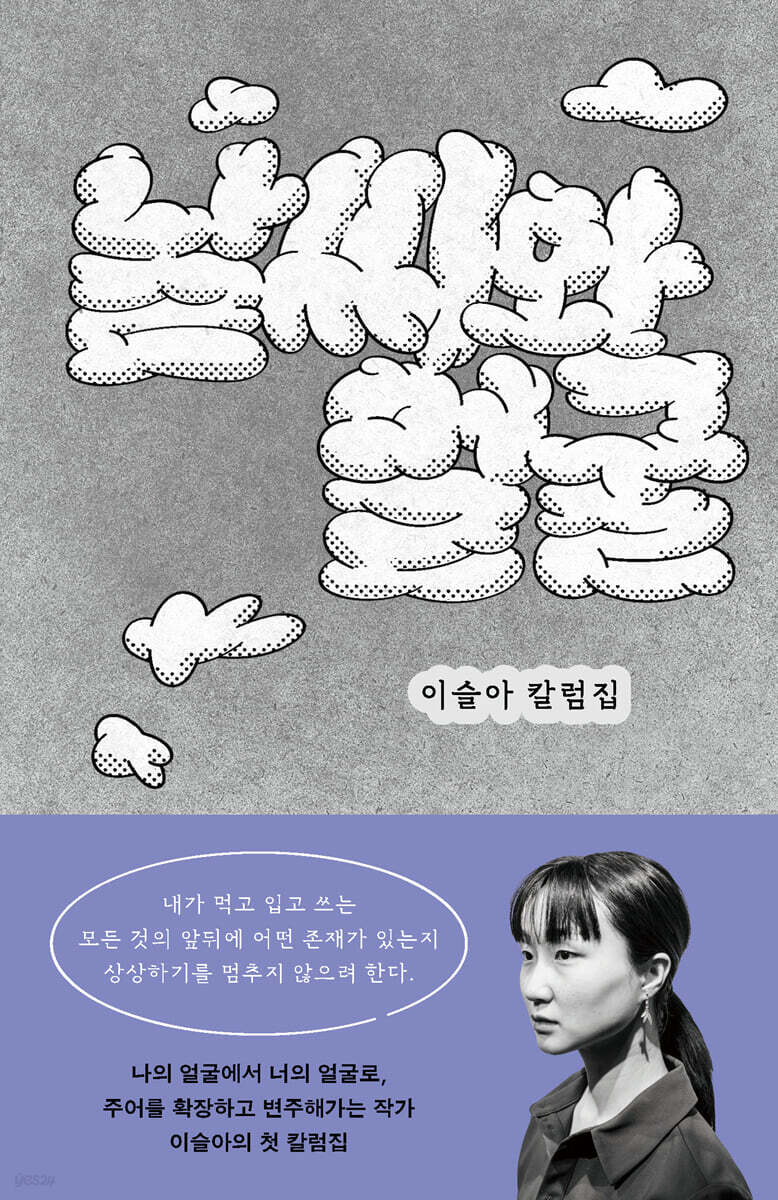
Weather and Face
 |
Description
Book Introduction
_From my face to your face, Isul-ah Lee's first column collection, which expands and varies the subject. "Weather and Face" is a book compiled by rewriting columns written by author Lee Seul-ah for the Kyunghyang Shinmun over the past two years and adding new writing. This book, which begins with the sentence, “We who have faces are all a community of destiny in the face of the accelerating climate crisis,” reminds us that behind the various aspects of the climate crisis, there are countless faces that humans have ignored, and brings to mind the happy and pitiful faces that this era has turned away from. Sometimes it is my face, but above all, it is the face of animals raised in factory farms, delivery workers, people with disabilities, and migrant women. The author, who “never stops imagining what kind of being exists before and after everything I eat, wear, and use,” clearly says that some faces are not sufficiently spoken of, and that to speak of them, we must explore a world where power tilts in a certain direction. This is also author Isul-ah's pledge. Addressing important stories with importance and accurately transcribing missing voices. I reflect on how that is a form of resistance I have learned as a writer. The author completed this book by asking more people, referencing more books, and diligently researching materials than ever before. |
- You can preview some of the book's contents.
Preview
index
Prologue: I looked closely at the face that bothered me.
Part 1: What We Forgot About Animals
We don't eat alone
If you want to talk about the future
Such a specific meat
The table is set again
How to count your lives
Imagine animal language being translated
What kind of declaration of the times
Don't be fooled by fake solutions
Part 2 Faces that are not mine
A midsummer delivery worker
I will not let our love be for nothing
An immigrant woman took the microphone.
Thinking of a bright-eyed reader
Interviewing mind
deep listener
Leaders who do not know sorrow
Everyone is bound to become a minority
The moment when different movements meet
Parents who are not taken for granted
Pain that is not flat
Words that cannot be hidden
Part 3: A List of Things I Don't Want to Repeat
In the hills and seas made of garbage
Looking at the forest fire
some extinction
Thoughts while washing my body
First liberation
Women who bring women home
To my friends who will never despair
Epilogue: Eyes that See More
Part 1: What We Forgot About Animals
We don't eat alone
If you want to talk about the future
Such a specific meat
The table is set again
How to count your lives
Imagine animal language being translated
What kind of declaration of the times
Don't be fooled by fake solutions
Part 2 Faces that are not mine
A midsummer delivery worker
I will not let our love be for nothing
An immigrant woman took the microphone.
Thinking of a bright-eyed reader
Interviewing mind
deep listener
Leaders who do not know sorrow
Everyone is bound to become a minority
The moment when different movements meet
Parents who are not taken for granted
Pain that is not flat
Words that cannot be hidden
Part 3: A List of Things I Don't Want to Repeat
In the hills and seas made of garbage
Looking at the forest fire
some extinction
Thoughts while washing my body
First liberation
Women who bring women home
To my friends who will never despair
Epilogue: Eyes that See More
Detailed image
.jpg)
Into the book
This book was written because of the faces that bothered me.
Clearly, some faces are not spoken of enough.
To talk about them, we must explore a world where forces are tilted in a certain direction.
That's how I learned to resist.
Treating important stories with importance.
Accurately transcribing missing voices.
--- p.7
In my writing classes, I often teach how we are all amazing individuals.
It instills in students the belief that the choices individuals make not to consume collectively drive business, politics, and science.
The belief that your choices can affect everyone else may sound narcissistic.
But what's worse than that is the self-deception that believes that one's choices don't affect anyone else.
In this age where the entire planet needs to be mobilized, I wonder what you would like to give up.
--- p.19
Animals are abstract figures in dishes on the table or products on the counter.
Any specific pain will be wiped away.
But we too are animals, and we can understand that pain.
This imagination even brings domesticated animals to life in beautiful milk cream cakes.
--- p.31
When I come across sentences like this, I miss someone who knows how to hurt my feelings so much.
The writers were changing the subject, knowing it would fail.
Perhaps it was because most things in the world were a battle between 'anyway' and 'at least'.
Words were flowing out that bridged the gap between those who said the world would never change and those who said they would at least not do this.
It was the will not to go extinct.
It was a wish that you and I could live together.
--- p.59
We encounter the truth of the world in a box with the large words 'Rocket Delivery' written on it.
Summer and winter will always come back.
Next summer can't be like this either.
Next winter can't be like this either.
It remains to be seen how Coupang treats its workers under the scrutiny of unfair weather conditions.
The balance of power does not change without someone watching.
Friendship doesn't even begin.
I imagine having as many friends as there are Coupang workers.
I hope that workers, Coupang, and we ourselves understand that we are not only consumers but also comrades of workers.
--- p.74
Let me list down some facts I've learned about you.
You often get asked rude questions.
How poor your family and country are.
How much of the money you earn you send to your family of origin.
Some people speak to you informally even though it's your first time meeting them.
When you are incorporated into a new family, you lose your original name.
You have to adapt to an unfamiliar climate and unfamiliar food.
It's relatively easy compared to adapting to the unfamiliar Korean language.
Your native language is excluded from the place where you unpack.
--- p.85
But this question arises.
What image comes to mind for those adults gathered at this moment? Aside from text and numbers, faces and scenes.
Is there someone in their hearts who breaks their hearts every time they discuss a policy, someone who trips over every word? If so, their words will resonate with greater vividness than ever before.
I watch the National Assembly broadcast because I miss the 'real questions' and 'real answers'.
--- p.109
“Isn’t there a moment when you truly come to know something you thought you knew?”
In the interview, he said:
His alarm that at least one of the 300 offices in the 21st National Assembly should be a climate crisis situation room led him to the climate inspection.
It was a parliamentary audit that directly questioned and monitored those in charge to see whether policies for reducing carbon emissions and supporting vulnerable groups were actually being implemented effectively.
--- pp.125~126
In a world where everyone throws away but no one cleans up, there are people who try to make things work.
There are those who don't say that there is no choice.
There are parents, children, children's children, workers, clothing store owners, divers, novelists, poets, and friends who see straight that trash is not temporary.
And then there's you.
We can't even count them.
How much life permeates one person's life.
--- p.148
As I grew older, I kept a list of things I didn't want to repeat.
When I was a teenager, I promised myself that when I grew up, I would live in an environment where I would avoid group living as much as possible.
I felt like life would be much more comfortable if I didn't have to live in a group.
But even after I started living independently, I often repeated things that made me feel uneasy both physically and mentally.
For example, slips of the tongue, rudeness, overspending, overeating, overwork, etc.
Even if I couldn't fix it all at once, I wanted to reduce it as much as possible.
--- p.164
I had older sisters who would tell me to come to their house when things got tough.
I was in my teens or twenties and homeless, or if I did have one it was so shabby that some nights I really didn't have anywhere to go.
When I visited my sisters' house, they cooked for me or ordered food for me.
She listened to my story and told me about her sisters.
He even made a bedding for me and told me to go to sleep.
Now that I think about it.
My sisters must have been really busy back then. How did they find the time?
My sisters were poor too, so why did they share what they had?
--- p.175
In the new year, I want to show more faces through writing.
Warm up your sentences so that they become manuscripts like the light of a lantern in the deep night.
I hope that continuing will bring hope not only to myself but also to the children.
It gives me the courage to see, hear, and write more with them.
Some readers ask why I keep writing political articles, but I always find this regrettable.
That my writing isn't political enough.
It's trying to be more specific and sharp in order to be more political.
It is a pledge to love life more deeply.
Clearly, some faces are not spoken of enough.
To talk about them, we must explore a world where forces are tilted in a certain direction.
That's how I learned to resist.
Treating important stories with importance.
Accurately transcribing missing voices.
--- p.7
In my writing classes, I often teach how we are all amazing individuals.
It instills in students the belief that the choices individuals make not to consume collectively drive business, politics, and science.
The belief that your choices can affect everyone else may sound narcissistic.
But what's worse than that is the self-deception that believes that one's choices don't affect anyone else.
In this age where the entire planet needs to be mobilized, I wonder what you would like to give up.
--- p.19
Animals are abstract figures in dishes on the table or products on the counter.
Any specific pain will be wiped away.
But we too are animals, and we can understand that pain.
This imagination even brings domesticated animals to life in beautiful milk cream cakes.
--- p.31
When I come across sentences like this, I miss someone who knows how to hurt my feelings so much.
The writers were changing the subject, knowing it would fail.
Perhaps it was because most things in the world were a battle between 'anyway' and 'at least'.
Words were flowing out that bridged the gap between those who said the world would never change and those who said they would at least not do this.
It was the will not to go extinct.
It was a wish that you and I could live together.
--- p.59
We encounter the truth of the world in a box with the large words 'Rocket Delivery' written on it.
Summer and winter will always come back.
Next summer can't be like this either.
Next winter can't be like this either.
It remains to be seen how Coupang treats its workers under the scrutiny of unfair weather conditions.
The balance of power does not change without someone watching.
Friendship doesn't even begin.
I imagine having as many friends as there are Coupang workers.
I hope that workers, Coupang, and we ourselves understand that we are not only consumers but also comrades of workers.
--- p.74
Let me list down some facts I've learned about you.
You often get asked rude questions.
How poor your family and country are.
How much of the money you earn you send to your family of origin.
Some people speak to you informally even though it's your first time meeting them.
When you are incorporated into a new family, you lose your original name.
You have to adapt to an unfamiliar climate and unfamiliar food.
It's relatively easy compared to adapting to the unfamiliar Korean language.
Your native language is excluded from the place where you unpack.
--- p.85
But this question arises.
What image comes to mind for those adults gathered at this moment? Aside from text and numbers, faces and scenes.
Is there someone in their hearts who breaks their hearts every time they discuss a policy, someone who trips over every word? If so, their words will resonate with greater vividness than ever before.
I watch the National Assembly broadcast because I miss the 'real questions' and 'real answers'.
--- p.109
“Isn’t there a moment when you truly come to know something you thought you knew?”
In the interview, he said:
His alarm that at least one of the 300 offices in the 21st National Assembly should be a climate crisis situation room led him to the climate inspection.
It was a parliamentary audit that directly questioned and monitored those in charge to see whether policies for reducing carbon emissions and supporting vulnerable groups were actually being implemented effectively.
--- pp.125~126
In a world where everyone throws away but no one cleans up, there are people who try to make things work.
There are those who don't say that there is no choice.
There are parents, children, children's children, workers, clothing store owners, divers, novelists, poets, and friends who see straight that trash is not temporary.
And then there's you.
We can't even count them.
How much life permeates one person's life.
--- p.148
As I grew older, I kept a list of things I didn't want to repeat.
When I was a teenager, I promised myself that when I grew up, I would live in an environment where I would avoid group living as much as possible.
I felt like life would be much more comfortable if I didn't have to live in a group.
But even after I started living independently, I often repeated things that made me feel uneasy both physically and mentally.
For example, slips of the tongue, rudeness, overspending, overeating, overwork, etc.
Even if I couldn't fix it all at once, I wanted to reduce it as much as possible.
--- p.164
I had older sisters who would tell me to come to their house when things got tough.
I was in my teens or twenties and homeless, or if I did have one it was so shabby that some nights I really didn't have anywhere to go.
When I visited my sisters' house, they cooked for me or ordered food for me.
She listened to my story and told me about her sisters.
He even made a bedding for me and told me to go to sleep.
Now that I think about it.
My sisters must have been really busy back then. How did they find the time?
My sisters were poor too, so why did they share what they had?
--- p.175
In the new year, I want to show more faces through writing.
Warm up your sentences so that they become manuscripts like the light of a lantern in the deep night.
I hope that continuing will bring hope not only to myself but also to the children.
It gives me the courage to see, hear, and write more with them.
Some readers ask why I keep writing political articles, but I always find this regrettable.
That my writing isn't political enough.
It's trying to be more specific and sharp in order to be more political.
It is a pledge to love life more deeply.
--- p.189
Publisher's Review
_“We are all a community with a shared destiny in the face of the accelerating climate crisis.”
And yet, how brave can we all be?
Through Isul-ah's language, issues that were once nothing more than distant murmurs, despite their importance and urgency, have become pressing issues that sit right next to me.
Objects that have become old and familiar and have lost their vitality gain new meaning.
Beautiful things become more beautiful and sad things become more sad.
Factory-farmed animals trapped in the livestock and dairy farming systems, reduced to nothing more than meat products on shelves; delivery workers who climb on and off trucks countless times in the middle of summer; disabled people on hunger strike demanding the enactment of anti-discrimination laws; geese who have diligently traveled the skies for a long time, faithful to their principles in life, but now destined to slowly face extinction in front of a blocked and cut-off road…
"Weather and Faces" takes a close look at the faces that sustain our lives but have been intentionally erased.
All along the way, we encounter people who are trying to make things work, who don't say they can't help it.
And we all realize what incredible individuals we are and how much braver we can be.
This is something the author always tries to teach in his writing classes.
He imagines with great excitement the immense emotion that would be created if we all decided to stop what we were doing.
The lives of human animals can flow without any harm, without exploiting non-human animals. This is the future that author Isul-ah dreams of.
Lee Ra-young, a researcher in the sociology of art, said, “In order to become an ethical ear in the face of the countless sufferings of society, artist Lee Seul-ah carefully constructs language,” and recommends, “Why not join in this language that emphasizes that we are connected beings by shining a light on faces that have gone unnoticed one by one?”
Author Isul-ah invites readers to dream the same dream.
That you will have wisdom that I do not have.
I'm sure we can learn from each other.
And yet, how brave can we all be?
Through Isul-ah's language, issues that were once nothing more than distant murmurs, despite their importance and urgency, have become pressing issues that sit right next to me.
Objects that have become old and familiar and have lost their vitality gain new meaning.
Beautiful things become more beautiful and sad things become more sad.
Factory-farmed animals trapped in the livestock and dairy farming systems, reduced to nothing more than meat products on shelves; delivery workers who climb on and off trucks countless times in the middle of summer; disabled people on hunger strike demanding the enactment of anti-discrimination laws; geese who have diligently traveled the skies for a long time, faithful to their principles in life, but now destined to slowly face extinction in front of a blocked and cut-off road…
"Weather and Faces" takes a close look at the faces that sustain our lives but have been intentionally erased.
All along the way, we encounter people who are trying to make things work, who don't say they can't help it.
And we all realize what incredible individuals we are and how much braver we can be.
This is something the author always tries to teach in his writing classes.
He imagines with great excitement the immense emotion that would be created if we all decided to stop what we were doing.
The lives of human animals can flow without any harm, without exploiting non-human animals. This is the future that author Isul-ah dreams of.
Lee Ra-young, a researcher in the sociology of art, said, “In order to become an ethical ear in the face of the countless sufferings of society, artist Lee Seul-ah carefully constructs language,” and recommends, “Why not join in this language that emphasizes that we are connected beings by shining a light on faces that have gone unnoticed one by one?”
Author Isul-ah invites readers to dream the same dream.
That you will have wisdom that I do not have.
I'm sure we can learn from each other.
GOODS SPECIFICS
- Date of issue: February 20, 2023
- Page count, weight, size: 190 pages | 240g | 120*185*20mm
- ISBN13: 9791186602935
- ISBN10: 1186602937
You may also like
카테고리
korean


korean

![GQ KOREA Mark (Monthly): December [2025]](http://librairie.coreenne.fr/cdn/shop/files/8ef265dbbfbf186523ed75ba7319009d.jpg?v=1765340328&width=3840)


