

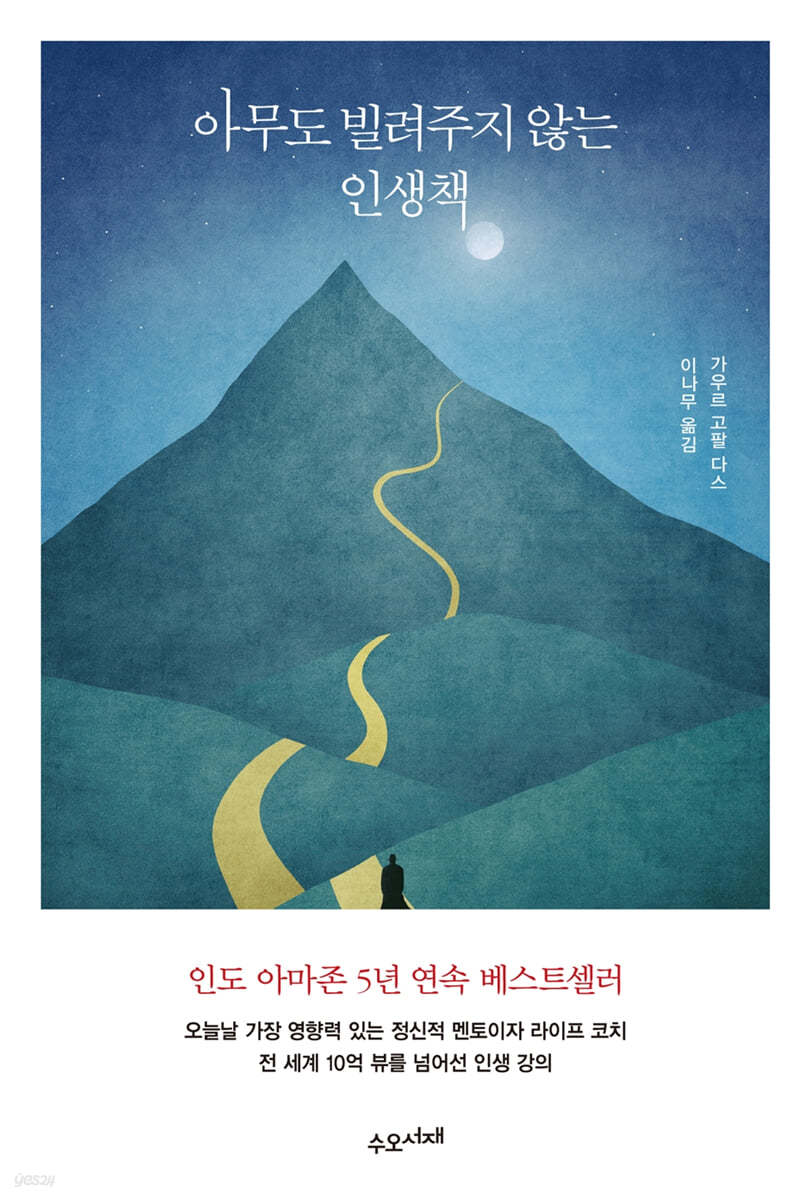
The book of life that no one lends
 |
Description
Book Introduction
This is a spiritual self-help book by a modern guru that has been a bestseller on Amazon India for the past five years.
The first book by Gaur Gopal Das, one of the most influential spiritual mentors, life coaches, and monks in India and the world today.
His presence became known worldwide as people around him posted his lectures online.
His lecture videos, with over a billion views, are so widely subscribed that they are called "Sutras for a Happy Life," transcending religion and sect.
His teachings on various aspects of life and the human condition are considered to have a perfect balance of humor and enlightenment.
Above all, the topic is ‘checking happiness.’
Because happiness will heal the world.
As he said in his conversation with the Dalai Lama, happiness is not something that is made to a set standard like a ready-made product, but is realized solely through one's own actions, and if one wants to be happy, one must develop a 'happiness habit'.
Reading each chapter, divided by topic, feels like listening to the narration of a spiritual master of our time.
Simple language holds profound meaning, as if guiding us through life without raising our voices.
If you want to make peace with life and wholeheartedly recover, especially if you are experiencing negative situations in your life and are struggling between what you 'want to do' and what you 'should do,' you will find the answers in this book.
The first book by Gaur Gopal Das, one of the most influential spiritual mentors, life coaches, and monks in India and the world today.
His presence became known worldwide as people around him posted his lectures online.
His lecture videos, with over a billion views, are so widely subscribed that they are called "Sutras for a Happy Life," transcending religion and sect.
His teachings on various aspects of life and the human condition are considered to have a perfect balance of humor and enlightenment.
Above all, the topic is ‘checking happiness.’
Because happiness will heal the world.
As he said in his conversation with the Dalai Lama, happiness is not something that is made to a set standard like a ready-made product, but is realized solely through one's own actions, and if one wants to be happy, one must develop a 'happiness habit'.
Reading each chapter, divided by topic, feels like listening to the narration of a spiritual master of our time.
Simple language holds profound meaning, as if guiding us through life without raising our voices.
If you want to make peace with life and wholeheartedly recover, especially if you are experiencing negative situations in your life and are struggling between what you 'want to do' and what you 'should do,' you will find the answers in this book.
- You can preview some of the book's contents.
Preview
index
1.
Don't lose the key to happiness
The world's best sambar
The man who lost the key to happiness
Knowing that you don't know
The Secret of Happiness
Facing the wounds within yourself
Tree of Life
freedom from problems
2.
Humans are beautifully imperfect beings
Traffic management in the mind
The car we have to drive
First Wheel - Gratitude
The fight against cumin seeds
We are beautifully imperfect beings
3.
Press the pause button on your mind
99 Club
Don't wait for life to stop you
Why worry
The mind that creates stories
The Rhodopsin Effect of Life
Running alone is running, but
4.
From a reactive life to an awakened life
The soul knows how to heal itself
Second Wheel - Relationship Building
How to treat laundry baskets and people
5.
Practice loving yourself and loving others
genes that attract negativity
Are you special or nothing?
What Happened in the Himalayas
Corrective technology
'I am right.
You just have to change.'
6.
The Aesthetics of Self-Care
Forgiveness is the aesthetic of self-care
The courage to forgive
Just because it's broken doesn't mean it's over
I create my relationships
A person who focuses on what he or she doesn't have
7.
If you do what you love, you don't have to work.
My hero is me 10 years from now
Don't fill your heart with other people's songs
FOMO - the feeling of being left behind
Third Wheel - Discovering Your Gift
If you do what you love, you don't have to work.
Reasons to wake up in the morning
The First Lesson of the Pencil
8.
The beauty of expanding existence
Freedom comes from being an individual human being.
The Saint and the Snake
The monk who bought a Ferrari
Camel and Two Jewels
Follow even one sentence of philosophy
The Second Lesson of the Pencil
9.
Better than perfect
The Fourth Wheel - Gifting Moments of Joy
The Porcupine Story
The Third Lesson of the Pencil
Did you love enough?
Better than perfect
10.
Reasons for living on this planet
The Gift of Community
What will you leave with?
Happiness will heal this planet
Feeling joy for others
The best sambar that life has to offer
Translator's Note
Don't lose the key to happiness
The world's best sambar
The man who lost the key to happiness
Knowing that you don't know
The Secret of Happiness
Facing the wounds within yourself
Tree of Life
freedom from problems
2.
Humans are beautifully imperfect beings
Traffic management in the mind
The car we have to drive
First Wheel - Gratitude
The fight against cumin seeds
We are beautifully imperfect beings
3.
Press the pause button on your mind
99 Club
Don't wait for life to stop you
Why worry
The mind that creates stories
The Rhodopsin Effect of Life
Running alone is running, but
4.
From a reactive life to an awakened life
The soul knows how to heal itself
Second Wheel - Relationship Building
How to treat laundry baskets and people
5.
Practice loving yourself and loving others
genes that attract negativity
Are you special or nothing?
What Happened in the Himalayas
Corrective technology
'I am right.
You just have to change.'
6.
The Aesthetics of Self-Care
Forgiveness is the aesthetic of self-care
The courage to forgive
Just because it's broken doesn't mean it's over
I create my relationships
A person who focuses on what he or she doesn't have
7.
If you do what you love, you don't have to work.
My hero is me 10 years from now
Don't fill your heart with other people's songs
FOMO - the feeling of being left behind
Third Wheel - Discovering Your Gift
If you do what you love, you don't have to work.
Reasons to wake up in the morning
The First Lesson of the Pencil
8.
The beauty of expanding existence
Freedom comes from being an individual human being.
The Saint and the Snake
The monk who bought a Ferrari
Camel and Two Jewels
Follow even one sentence of philosophy
The Second Lesson of the Pencil
9.
Better than perfect
The Fourth Wheel - Gifting Moments of Joy
The Porcupine Story
The Third Lesson of the Pencil
Did you love enough?
Better than perfect
10.
Reasons for living on this planet
The Gift of Community
What will you leave with?
Happiness will heal this planet
Feeling joy for others
The best sambar that life has to offer
Translator's Note
Into the book
Problems in life arise automatically.
But happiness depends on our own choices.
Anger arises automatically.
But peace is our own choice.
Hatred arises automatically.
Love is a matter of our own choice.
Negative things happen automatically.
A positive attitude is something we must choose for ourselves.
Complaining is automatic.
Gratitude is our own choice.
--- p.28
We tend to accept everyone for who they are.
I believe that what a person has on the outside is the same as what he feels on the inside.
But the paradox of our time is that those who have the most are often the least satisfied.
We've learned how to appear successful, but we haven't learned how to structure our lives so that we feel successful.
There is a beautiful parable that one of my spiritual teachers, Satchinandan Swami, told me.
It is a metaphor called the 'Tree of Life'.
When we look at a beautiful tree, one of the most essential parts of that tree is its roots.
A tree has three essential parts.
The first is the root, the second is the stump, and the third is the top of the tree.
A healthy tree has healthy roots.
The deeper and stronger the roots, the more resilient the tree will be in the face of strong winds such as storms and typhoons.
But the roots are invisible to our eyes.
Its roots can be likened to our spirituality.
Our achievements are visible to people.
The devices we have are visible to people.
Our wealth is visible to people, our followers are visible to people, and our charisma is visible to people.
Our success is visible to people.
But what people don't see is our roots, our spiritual growth.
If you don't work on what you don't see, it's very difficult to maintain what you see.
--- p.38
If you feel frustrated, that's normal.
If you feel depressed because of what's going on around you, that's normal.
If you're anxious about what your future holds and what the future holds, that's normal.
If you are disappointed with what is happening in your country and the world, that is normal.
If you feel lost and lonely even though you are among people, it is normal.
If you feel like people are pushing you into a corner, whether in your physical space, at home, or wherever you live, and you feel like you can't find your emotional space, that's normal.
It is normal to experience negative emotions.
This happens to each and every one of us without exception.
All of this is part of the life we experience.
There is no need to feel guilty about the negative emotions you are going through.
There is no reason to add negative thoughts and torment yourself with guilt.
There are already so many negatives that there is no need to add any more.
It is perfectly normal to experience such feelings.
Because I am a living human being.
We are not machines.
We are sentient human beings! We are not robots.
We are not silicon chips embedded in smartphones.
--- p.44
I exploded.
For 45 minutes, I went through my complaints about poor management and the many people who treated me unfairly.
He complained that if things continued this way, our community would collapse.
I felt like a self-proclaimed savior, pointing out the negative habits that had permeated our society.
“If we don’t do anything about all this, everything will go to pieces.”
I finally finished speaking.
Radhanath Swami sat there with a serious expression on his face the whole time.
While I was complaining, not a word came out of his mouth.
“Are you done?”
He asked in a solemn voice.
I said with a sigh.
"yes."
“There are so many positive things happening in our community.”
He started talking.
For the next 45 minutes, he didn't say a word about my complaint.
I felt good about focusing only on the positive aspects of the temple.
“I’m not saying that the problems you pointed out don’t exist.
But the real problem is that when negativity consumes our minds, we not only lose sight of the beauty around us, but we also lose the ability to solve the problems we face.
“We must train our minds to focus on the positive and gain the strength to deal with the negative.”
He then spent just as much time finding practical solutions to the problems I had raised, and then quickly instructed me to go to the dining hall to have lunch with the other monks.
He didn't ignore the fact that some of my complaints were genuine.
--- p.61
Statistically speaking, we have more things to be grateful for than things we are not grateful for.
Being ungrateful means forgetting the blessings of life and ignoring the kind things people do for us.
When we receive gratitude, we feel more than just positive emotions.
You will sleep better and have the ability to express more kindness.
Feeling more alive and even having a stronger immune system are all benefits of gratitude.
A poem by Johnson Oatman (American pastor and poet) that we sang in elementary school eloquently summarizes my message.
'When you are tossed by the waves of life, when you feel discouraged and think that all is lost, count the many blessings you have enjoyed and name them one by one.
Then you will be amazed at what God has done.'
--- p.68
Meditation is like an airplane.
It takes you high at first, then far, and then to distant places.
I see meditation as an airplane.
Because it gains altitude immediately upon takeoff.
We experience worry and anxiety in life.
Because we lose perspective and see things at face value.
Meditation allows us to look down on all our anxieties, problems, and worries from a higher perspective.
By doing so, it gives us peace and tranquility.
The deeper effect is that meditation takes us far.
Meditation can completely transform our personality, develop our best qualities, and enable us to experience self-realization.
Through meditation we become the best version of ourselves.
However, this takes time and is often difficult to detect.
For example, if you look out the window on an airplane, it doesn't seem like you're moving that fast.
But 10 hours later you land on the other side of the Earth.
Meditation becomes difficult because of our minds.
The mind is like a restless monkey, jumping from one thought to another.
But knowing this doesn't bring peace.
The mind needs to be controlled.
Therefore, meditation is a training that helps us to take care of our mind.
--- p.111
Although a moment of patience when angry can save a thousand moments of regret in the future, when we are in intense pain, we often have no choice but to let our minds run wild.
We must maintain composure in moments of testing for our own growth.
When someone hurts us, we need to look beyond the situation and think about it.
"How much pain must they be in? What must they be feeling, to say such things? Isn't there something even more turbulent in their lives that would make them say such things to me?"
This is not to endorse the hurtful words others have said.
Let's look at what they went through to make them say such things.
This is empathy, an essential element of forgiveness.
It is said, 'Sticks and stones may break my bones, but words will never hurt me,' but this is not true at all.
Just as physical violence can be inflicted with a weapon, emotional violence can be inflicted with words.
Words can leave invisible wounds that may take years, or even a lifetime, to heal.
--- p.170
Everyone comes in a package.
There are good and bad points.
We need to focus on the good and deal with the bad.
If something goes wrong, it needs to be addressed, communicated, and sorted out.
Whatever we have to do, we have to deal with it, but focusing on the good and dealing with the bad is how we approach it.
In one of my lectures, I took out a pencil and broke it in front of everyone.
That's what life does to us.
Relationships are like that sometimes, life situations are like that, and failures are like that too.
They break us, they break us.
Sometimes we punish ourselves too much for our own mistakes and end up broken inside.
Then I took out my pencil sharpener and started sharpening the remaining half of the broken pencil.
Just because it's broken doesn't mean it's over.
Isn't that right? Yes, we made a mistake.
Yes, we have had our moments of weakness.
Yes, it has slipped from our hearts and lives.
It doesn't matter.
What really matters is getting up, pulling yourself together, and starting over again.
--- p.184
It's not your standard of living that makes you happy.
What makes you happy is the quality of your life.
And very often we forget to pay attention to the things that can truly make us happy.
What I'm talking about has utility value.
But it is not the value of happiness.
Traveling business class or first class, there's nothing wrong with that.
Driving a Porsche? No problem.
But in doing so, don't compromise the principles that improve your quality of life.
So I always say.
Some people say they are too poor.
They are so poor, so poor, that all they have is money.
That's all they have.
I consider that life to be one of poverty.
If all you have is money, you are the poorest person in the world.
Because there is more to life than money, and there are more paths to life than money can buy.
--- p.233
I was driving in Mumbai and it was raining cats and dogs.
After the funeral, cremation took place.
The next day, in the makeup room, what I held in my hand was a small jar.
I was shocked when I held the urn containing my father's ashes in my hand.
For a while I couldn't think of anything.
Is this my father? Is this what's left of him? Everything I'd said, read, heard, and spoken about in so many places, including the British Parliament, suddenly came flooding back to me.
In the face of death, they all felt meaningless.
There are moments in life that are so mind-blowing.
Those moments ask you what priorities are truly important to you.
You have to evaluate what is important to you.
What will we hold onto? Resentment? Anger? When we depart, we must leave behind a legacy, and not just a legacy, but something we must take with us.
But happiness depends on our own choices.
Anger arises automatically.
But peace is our own choice.
Hatred arises automatically.
Love is a matter of our own choice.
Negative things happen automatically.
A positive attitude is something we must choose for ourselves.
Complaining is automatic.
Gratitude is our own choice.
--- p.28
We tend to accept everyone for who they are.
I believe that what a person has on the outside is the same as what he feels on the inside.
But the paradox of our time is that those who have the most are often the least satisfied.
We've learned how to appear successful, but we haven't learned how to structure our lives so that we feel successful.
There is a beautiful parable that one of my spiritual teachers, Satchinandan Swami, told me.
It is a metaphor called the 'Tree of Life'.
When we look at a beautiful tree, one of the most essential parts of that tree is its roots.
A tree has three essential parts.
The first is the root, the second is the stump, and the third is the top of the tree.
A healthy tree has healthy roots.
The deeper and stronger the roots, the more resilient the tree will be in the face of strong winds such as storms and typhoons.
But the roots are invisible to our eyes.
Its roots can be likened to our spirituality.
Our achievements are visible to people.
The devices we have are visible to people.
Our wealth is visible to people, our followers are visible to people, and our charisma is visible to people.
Our success is visible to people.
But what people don't see is our roots, our spiritual growth.
If you don't work on what you don't see, it's very difficult to maintain what you see.
--- p.38
If you feel frustrated, that's normal.
If you feel depressed because of what's going on around you, that's normal.
If you're anxious about what your future holds and what the future holds, that's normal.
If you are disappointed with what is happening in your country and the world, that is normal.
If you feel lost and lonely even though you are among people, it is normal.
If you feel like people are pushing you into a corner, whether in your physical space, at home, or wherever you live, and you feel like you can't find your emotional space, that's normal.
It is normal to experience negative emotions.
This happens to each and every one of us without exception.
All of this is part of the life we experience.
There is no need to feel guilty about the negative emotions you are going through.
There is no reason to add negative thoughts and torment yourself with guilt.
There are already so many negatives that there is no need to add any more.
It is perfectly normal to experience such feelings.
Because I am a living human being.
We are not machines.
We are sentient human beings! We are not robots.
We are not silicon chips embedded in smartphones.
--- p.44
I exploded.
For 45 minutes, I went through my complaints about poor management and the many people who treated me unfairly.
He complained that if things continued this way, our community would collapse.
I felt like a self-proclaimed savior, pointing out the negative habits that had permeated our society.
“If we don’t do anything about all this, everything will go to pieces.”
I finally finished speaking.
Radhanath Swami sat there with a serious expression on his face the whole time.
While I was complaining, not a word came out of his mouth.
“Are you done?”
He asked in a solemn voice.
I said with a sigh.
"yes."
“There are so many positive things happening in our community.”
He started talking.
For the next 45 minutes, he didn't say a word about my complaint.
I felt good about focusing only on the positive aspects of the temple.
“I’m not saying that the problems you pointed out don’t exist.
But the real problem is that when negativity consumes our minds, we not only lose sight of the beauty around us, but we also lose the ability to solve the problems we face.
“We must train our minds to focus on the positive and gain the strength to deal with the negative.”
He then spent just as much time finding practical solutions to the problems I had raised, and then quickly instructed me to go to the dining hall to have lunch with the other monks.
He didn't ignore the fact that some of my complaints were genuine.
--- p.61
Statistically speaking, we have more things to be grateful for than things we are not grateful for.
Being ungrateful means forgetting the blessings of life and ignoring the kind things people do for us.
When we receive gratitude, we feel more than just positive emotions.
You will sleep better and have the ability to express more kindness.
Feeling more alive and even having a stronger immune system are all benefits of gratitude.
A poem by Johnson Oatman (American pastor and poet) that we sang in elementary school eloquently summarizes my message.
'When you are tossed by the waves of life, when you feel discouraged and think that all is lost, count the many blessings you have enjoyed and name them one by one.
Then you will be amazed at what God has done.'
--- p.68
Meditation is like an airplane.
It takes you high at first, then far, and then to distant places.
I see meditation as an airplane.
Because it gains altitude immediately upon takeoff.
We experience worry and anxiety in life.
Because we lose perspective and see things at face value.
Meditation allows us to look down on all our anxieties, problems, and worries from a higher perspective.
By doing so, it gives us peace and tranquility.
The deeper effect is that meditation takes us far.
Meditation can completely transform our personality, develop our best qualities, and enable us to experience self-realization.
Through meditation we become the best version of ourselves.
However, this takes time and is often difficult to detect.
For example, if you look out the window on an airplane, it doesn't seem like you're moving that fast.
But 10 hours later you land on the other side of the Earth.
Meditation becomes difficult because of our minds.
The mind is like a restless monkey, jumping from one thought to another.
But knowing this doesn't bring peace.
The mind needs to be controlled.
Therefore, meditation is a training that helps us to take care of our mind.
--- p.111
Although a moment of patience when angry can save a thousand moments of regret in the future, when we are in intense pain, we often have no choice but to let our minds run wild.
We must maintain composure in moments of testing for our own growth.
When someone hurts us, we need to look beyond the situation and think about it.
"How much pain must they be in? What must they be feeling, to say such things? Isn't there something even more turbulent in their lives that would make them say such things to me?"
This is not to endorse the hurtful words others have said.
Let's look at what they went through to make them say such things.
This is empathy, an essential element of forgiveness.
It is said, 'Sticks and stones may break my bones, but words will never hurt me,' but this is not true at all.
Just as physical violence can be inflicted with a weapon, emotional violence can be inflicted with words.
Words can leave invisible wounds that may take years, or even a lifetime, to heal.
--- p.170
Everyone comes in a package.
There are good and bad points.
We need to focus on the good and deal with the bad.
If something goes wrong, it needs to be addressed, communicated, and sorted out.
Whatever we have to do, we have to deal with it, but focusing on the good and dealing with the bad is how we approach it.
In one of my lectures, I took out a pencil and broke it in front of everyone.
That's what life does to us.
Relationships are like that sometimes, life situations are like that, and failures are like that too.
They break us, they break us.
Sometimes we punish ourselves too much for our own mistakes and end up broken inside.
Then I took out my pencil sharpener and started sharpening the remaining half of the broken pencil.
Just because it's broken doesn't mean it's over.
Isn't that right? Yes, we made a mistake.
Yes, we have had our moments of weakness.
Yes, it has slipped from our hearts and lives.
It doesn't matter.
What really matters is getting up, pulling yourself together, and starting over again.
--- p.184
It's not your standard of living that makes you happy.
What makes you happy is the quality of your life.
And very often we forget to pay attention to the things that can truly make us happy.
What I'm talking about has utility value.
But it is not the value of happiness.
Traveling business class or first class, there's nothing wrong with that.
Driving a Porsche? No problem.
But in doing so, don't compromise the principles that improve your quality of life.
So I always say.
Some people say they are too poor.
They are so poor, so poor, that all they have is money.
That's all they have.
I consider that life to be one of poverty.
If all you have is money, you are the poorest person in the world.
Because there is more to life than money, and there are more paths to life than money can buy.
--- p.233
I was driving in Mumbai and it was raining cats and dogs.
After the funeral, cremation took place.
The next day, in the makeup room, what I held in my hand was a small jar.
I was shocked when I held the urn containing my father's ashes in my hand.
For a while I couldn't think of anything.
Is this my father? Is this what's left of him? Everything I'd said, read, heard, and spoken about in so many places, including the British Parliament, suddenly came flooding back to me.
In the face of death, they all felt meaningless.
There are moments in life that are so mind-blowing.
Those moments ask you what priorities are truly important to you.
You have to evaluate what is important to you.
What will we hold onto? Resentment? Anger? When we depart, we must leave behind a legacy, and not just a legacy, but something we must take with us.
--- p.311
Publisher's Review
Amazon India Bestseller
A Life Book for Awakening
This is a spiritual self-help book by a modern guru that has been a bestseller on Amazon India for the past five years.
The first book by Gaur Gopal Das, one of the most influential spiritual mentors, life coaches, and monks in India and the world today.
It talks about different aspects of life and the human condition.
The author, who became known through his lectures posted online by people around him as videos, has become a life coach to millions of people around the world, inspired by his lively conversational style based on practical content and logical reasoning, and his rich knowledge of ancient wisdom.
“We tend to take everyone for granted.
I believe that what a person has on the outside is the same as what he feels on the inside.
But the paradox of our time is that those who have the most are often the least satisfied.
We have learned how to appear successful, but we have not learned how to live our lives in a way that makes us feel successful.” - p. 38
His books and lectures, which are considered to have the perfect balance of humor and insight, are centered around the theme of 'checking happiness'.
Because happiness will heal the world.
As he said in his conversation with the Dalai Lama, happiness is not something that is made to a set standard like a ready-made product, but is realized solely through one's own actions, and if one wants to be happy, one must develop a 'happiness habit'.
It feels as if someone wise is listening to my problems, talking to me, and guiding my thoughts, like the Stoic philosophers Seneca and Epictetus, or the British monk Ajahn Brahma in The Taming of the Drunken Elephant.
Reading each chapter, divided by topic, feels like listening to the narration of a spiritual master of our time.
Simple language holds profound meaning, as if guiding us through life without raising our voices.
“We all need to understand that we are human beings, not machines.
It's normal to feel sad, depressed, lonely, and hurt by someone's insults.
That's completely normal.
And I always say that healing doesn't begin after the pain is over.
Healing begins when you experience pain.
Experiencing real pain is part of the healing process.
“Allowing yourself to go through the pain and letting it happen is also part of healing.” - p. 46
There are many little secrets in our lives, but we cannot see them.
Gaur Gopal Das talks about important things we tend to ignore.
Many people find strength and direction in his lectures when they face difficult times in their lives.
If you want to make peace with life and wholeheartedly recover, especially if you are experiencing negative situations in your life and are struggling between what you 'want to do' and what you 'should do,' you will find the answers in this book.
Even for those who may not have a philosophical or spiritual bent, this book can be a starting point for a new journey.
“Today I may face my biggest challenge.
That doesn't mean I should delay gratification.
Today I may be in the midst of a great change.
That doesn't mean I should delay gratification.
Happiness is a journey.
“It is not the destination.” - Page 87
Sometimes we feel like we don't know where life is taking us.
When you feel lost or in an existential crisis.
When life has no purpose or direction, it becomes tiring.
That's the chronic fatigue of life.
The books you need at that time are must-reads that will change your life.
When we are at a crossroads, confused, or have to make important choices, we can gain insight into solving problems arising from various situations we encounter in life.
“Just because it’s broken doesn’t mean it’s over.
Isn't that right? Yes, we made a mistake.
Yes, we have had our moments of weakness.
Yes, it has slipped from our hearts and lives.
It doesn't matter.
What really matters is getting up, pulling yourself together, and starting over again.” - Page 185
A Life Book for Awakening
This is a spiritual self-help book by a modern guru that has been a bestseller on Amazon India for the past five years.
The first book by Gaur Gopal Das, one of the most influential spiritual mentors, life coaches, and monks in India and the world today.
It talks about different aspects of life and the human condition.
The author, who became known through his lectures posted online by people around him as videos, has become a life coach to millions of people around the world, inspired by his lively conversational style based on practical content and logical reasoning, and his rich knowledge of ancient wisdom.
“We tend to take everyone for granted.
I believe that what a person has on the outside is the same as what he feels on the inside.
But the paradox of our time is that those who have the most are often the least satisfied.
We have learned how to appear successful, but we have not learned how to live our lives in a way that makes us feel successful.” - p. 38
His books and lectures, which are considered to have the perfect balance of humor and insight, are centered around the theme of 'checking happiness'.
Because happiness will heal the world.
As he said in his conversation with the Dalai Lama, happiness is not something that is made to a set standard like a ready-made product, but is realized solely through one's own actions, and if one wants to be happy, one must develop a 'happiness habit'.
It feels as if someone wise is listening to my problems, talking to me, and guiding my thoughts, like the Stoic philosophers Seneca and Epictetus, or the British monk Ajahn Brahma in The Taming of the Drunken Elephant.
Reading each chapter, divided by topic, feels like listening to the narration of a spiritual master of our time.
Simple language holds profound meaning, as if guiding us through life without raising our voices.
“We all need to understand that we are human beings, not machines.
It's normal to feel sad, depressed, lonely, and hurt by someone's insults.
That's completely normal.
And I always say that healing doesn't begin after the pain is over.
Healing begins when you experience pain.
Experiencing real pain is part of the healing process.
“Allowing yourself to go through the pain and letting it happen is also part of healing.” - p. 46
There are many little secrets in our lives, but we cannot see them.
Gaur Gopal Das talks about important things we tend to ignore.
Many people find strength and direction in his lectures when they face difficult times in their lives.
If you want to make peace with life and wholeheartedly recover, especially if you are experiencing negative situations in your life and are struggling between what you 'want to do' and what you 'should do,' you will find the answers in this book.
Even for those who may not have a philosophical or spiritual bent, this book can be a starting point for a new journey.
“Today I may face my biggest challenge.
That doesn't mean I should delay gratification.
Today I may be in the midst of a great change.
That doesn't mean I should delay gratification.
Happiness is a journey.
“It is not the destination.” - Page 87
Sometimes we feel like we don't know where life is taking us.
When you feel lost or in an existential crisis.
When life has no purpose or direction, it becomes tiring.
That's the chronic fatigue of life.
The books you need at that time are must-reads that will change your life.
When we are at a crossroads, confused, or have to make important choices, we can gain insight into solving problems arising from various situations we encounter in life.
“Just because it’s broken doesn’t mean it’s over.
Isn't that right? Yes, we made a mistake.
Yes, we have had our moments of weakness.
Yes, it has slipped from our hearts and lives.
It doesn't matter.
What really matters is getting up, pulling yourself together, and starting over again.” - Page 185
GOODS SPECIFICS
- Date of issue: January 30, 2023
- Page count, weight, size: 332 pages | 480g | 135*200*30mm
- ISBN13: 9791190382946
- ISBN10: 1190382946
You may also like
카테고리
korean


korean

![GQ KOREA Mark (Monthly): December [2025]](http://librairie.coreenne.fr/cdn/shop/files/8ef265dbbfbf186523ed75ba7319009d.jpg?v=1765340328&width=3840)


