

Reading method for organizing thoughts
 |
Description
Book Introduction
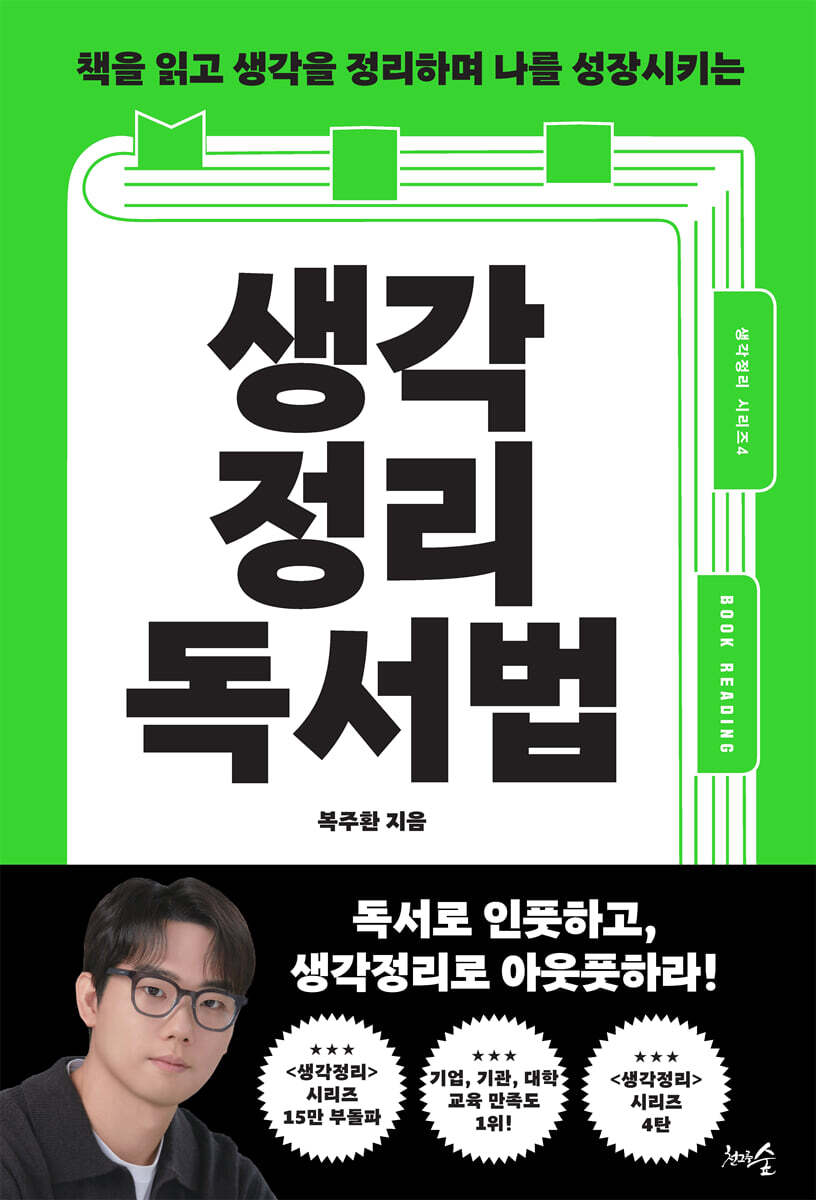
*** The fourth installment of the "Thought Organization" series, "Thought Organization Reading Method," has been published, surpassing 130 cumulative editions. ***
"From reading just for reading, to reading that becomes mine!"
If you change the way you read, your life will change.
'Why can't the contents of a book stay in my head?'
'What's the point of reading a book if you don't remember it?'
This is a concern that everyone feels while reading a book.
But you don't need to memorize every book.
Rather than trying to memorize everything in the book, it's more important to focus on what I feel and realize as I read.
What is needed at this time is a balanced 'thought-organizing reading method'.
In order to read something that will stay in your heart and be remembered for a long time, you need to do both of these reading comprehension skills: 'organizing the book' and 'organizing your thoughts.'
In order to properly understand and remember the content of a book, you must start by understanding how the author structured the content before reading the book.
You should summarize the main points of the book and use visual tools such as mind maps or mandalas to clearly understand the message the author is trying to convey.
To organize my thoughts, I need to write notes or questions in the margins of the book, organize my own ideas and insights that come to me while reading, and develop them into actionable plans.
It involves not simply accepting the author's thoughts, but adding your own thoughts to them and creating changes in your life.
Reading books should go beyond simply acquiring information; it should become a tool for creating change in one's life.
"The Thought-Organizing Reading Method" makes reading more meaningful and memorable through a balanced approach that organizes the content of the book and your own thoughts.
"From reading just for reading, to reading that becomes mine!"
If you change the way you read, your life will change.
'Why can't the contents of a book stay in my head?'
'What's the point of reading a book if you don't remember it?'
This is a concern that everyone feels while reading a book.
But you don't need to memorize every book.
Rather than trying to memorize everything in the book, it's more important to focus on what I feel and realize as I read.
What is needed at this time is a balanced 'thought-organizing reading method'.
In order to read something that will stay in your heart and be remembered for a long time, you need to do both of these reading comprehension skills: 'organizing the book' and 'organizing your thoughts.'
In order to properly understand and remember the content of a book, you must start by understanding how the author structured the content before reading the book.
You should summarize the main points of the book and use visual tools such as mind maps or mandalas to clearly understand the message the author is trying to convey.
To organize my thoughts, I need to write notes or questions in the margins of the book, organize my own ideas and insights that come to me while reading, and develop them into actionable plans.
It involves not simply accepting the author's thoughts, but adding your own thoughts to them and creating changes in your life.
Reading books should go beyond simply acquiring information; it should become a tool for creating change in one's life.
"The Thought-Organizing Reading Method" makes reading more meaningful and memorable through a balanced approach that organizes the content of the book and your own thoughts.
- You can preview some of the book's contents.
Preview
index
Intro _ Why are there margins in books?
Part 1: Beginning Reading
Chapter 1: Why should we read books?
1 The Secret of Reading That Changed My Life
2 Is it really necessary to read books in the AI era?
How to do well in 3 days? The answer lies in reading!
Reading books improves the quality of your language.
5 If you want to change your life, start by changing the books you read!
Chapter 2: How to Develop a Reading Habit
1 How do I develop a reading habit?
2 Things you gain by keeping a reading list
3. Create a Reading List Using Notion
4. Creating Reading Notes Using Notion
5 How to Connect with the World and Grow Through Reviews
Chapter 3: How to Improve Your Reading Skills
1. Create your own reading hideout
2. Create your own study
3 Find a space related to books
4 Attend the author's lecture
Part 2 How to Find a Good Book for Me
Chapter 1: What kind of book should I read and how?
1. Meet the intellectual's study
2. In fact, humanities classics are interesting.
3 Why the same book looks different every time
4 Books to filter, books to borrow, books to keep
5 Books, Do I Have to Read Them All the Way Through?
6 All roads lead to books.
Chapter 2: How to Choose a Good Book
1. If your purpose is clear, you will see the books you need.
2. A 5-Step Reading Method to Grasp the Core of a Book
3 Reasons Why You Need a Core Reading Method
4. Once you grasp the core, speaking becomes easier.
Part 3: How to Organize Book Contents
[Thought-Organizing Reading Method Roadmap]
Chapter 1: The process of creating a book
1 How is a book made?
2 How is the content created?
3 How is logic created?
4 How is the flow of content created?
Chapter 2: Key Reading Methods for Becoming a Reading Expert
1. The art of summarizing the essence of a book
2 Four Ways to Summarize a Book
3 Re-creation begins in the summary
How to quickly grasp the main point of a sentence
Chapter 3: A Picture-Organizing Reading Method That Leaves a Long-lasting Memory
1. Why it's good to organize it in a picture
2 Organize into simple shapes
3 Organize with a mind map
4 Organize with Mandala
5 Organize with graphic recording
Part 4 How to Organize My Thoughts
1 Margin Reading Method
2 Comments Reading Method
3-Sentence Collection Reading Method
4 Diary Writing Reading Method
5 Letter Writing Reading Methods
6 Discussion Reading Method
7 Question Search Reading Method
8 Problem-Solving Reading Methods
9 Business Planning Reading Methods
Part 5 Reading that Helps Me Grow
1 I am made as I read
2 A book that changed my life
3 Reading Creates a Growth Mindset
4. Open the book and you will see a new path.
Epilogue: Read for a Year Once in Your Life
List of books introduced in "Thought-Organizing Reading Method"
Part 1: Beginning Reading
Chapter 1: Why should we read books?
1 The Secret of Reading That Changed My Life
2 Is it really necessary to read books in the AI era?
How to do well in 3 days? The answer lies in reading!
Reading books improves the quality of your language.
5 If you want to change your life, start by changing the books you read!
Chapter 2: How to Develop a Reading Habit
1 How do I develop a reading habit?
2 Things you gain by keeping a reading list
3. Create a Reading List Using Notion
4. Creating Reading Notes Using Notion
5 How to Connect with the World and Grow Through Reviews
Chapter 3: How to Improve Your Reading Skills
1. Create your own reading hideout
2. Create your own study
3 Find a space related to books
4 Attend the author's lecture
Part 2 How to Find a Good Book for Me
Chapter 1: What kind of book should I read and how?
1. Meet the intellectual's study
2. In fact, humanities classics are interesting.
3 Why the same book looks different every time
4 Books to filter, books to borrow, books to keep
5 Books, Do I Have to Read Them All the Way Through?
6 All roads lead to books.
Chapter 2: How to Choose a Good Book
1. If your purpose is clear, you will see the books you need.
2. A 5-Step Reading Method to Grasp the Core of a Book
3 Reasons Why You Need a Core Reading Method
4. Once you grasp the core, speaking becomes easier.
Part 3: How to Organize Book Contents
[Thought-Organizing Reading Method Roadmap]
Chapter 1: The process of creating a book
1 How is a book made?
2 How is the content created?
3 How is logic created?
4 How is the flow of content created?
Chapter 2: Key Reading Methods for Becoming a Reading Expert
1. The art of summarizing the essence of a book
2 Four Ways to Summarize a Book
3 Re-creation begins in the summary
How to quickly grasp the main point of a sentence
Chapter 3: A Picture-Organizing Reading Method That Leaves a Long-lasting Memory
1. Why it's good to organize it in a picture
2 Organize into simple shapes
3 Organize with a mind map
4 Organize with Mandala
5 Organize with graphic recording
Part 4 How to Organize My Thoughts
1 Margin Reading Method
2 Comments Reading Method
3-Sentence Collection Reading Method
4 Diary Writing Reading Method
5 Letter Writing Reading Methods
6 Discussion Reading Method
7 Question Search Reading Method
8 Problem-Solving Reading Methods
9 Business Planning Reading Methods
Part 5 Reading that Helps Me Grow
1 I am made as I read
2 A book that changed my life
3 Reading Creates a Growth Mindset
4. Open the book and you will see a new path.
Epilogue: Read for a Year Once in Your Life
List of books introduced in "Thought-Organizing Reading Method"
Detailed image

Into the book
The secret to reading I've discovered is to think of the book as a person, and to think of it as a conversation with the author.
By changing your mindset this way, you will be able to become familiar with books and grow further through reading.
You too, please write down your feelings and thoughts about this article in the margins.
Then, a living reading experience completely different from now on will begin.
--- p.31
'To speak well, you must first think well.'
And you need to organize those thoughts well so that you can express them effectively to the other person.
Reading has a positive effect on all of these processes.
Reading allows us to generate good thoughts, organize them logically, and express them more richly.
--- pp.39-40
To make reading a habit, you must not think of reading as something special.
Sometimes, we think of reading as some grand ritual, like, "I absolutely have to read for an hour today," but this kind of thinking actually makes reading feel burdensome.
--- p.53
If you've gathered your thoughts through a reading list and reading notes, try writing a book review based on those thoughts.
Writing a review not only allows you to naturally organize the book's content and thoughts, but it also provides an opportunity to connect with the author.
--- p.70
To become closer to books, it is better to experience the various spaces where books are located, rather than simply reading them.
You will become more familiar with books in that space.
--- p.90
Humanities classics are not simply relics of the past; they are books that still contain meaningful stories for the modern world.
And those stories are deeply connected to the world we live in today.
Reading classics is not simply exploring old stories, but a process of deepening our understanding and broadening our current lives and thoughts.
--- p.104
When you have a problem, where do you look for solutions? The first thing I do is open a relevant book.
Books contain a wealth of wisdom and information that can help you see problems from a new perspective and sometimes even provide clues to solutions.
Every time I have an experience like this, I think, 'All roads lead to books.'
--- p.118
A book is a collection of thoughts on a particular topic.
Every book has a core theme and is comprised of supporting material.
Just as a building is completed by combining various materials based on a blueprint, a book is also composed by combining various materials and contents.
--- p.155
If you know how to summarize properly, you can condense a book into ten chapters, a chapter into one sentence, a chapter into one sentence, and ultimately, into one keyword.
--- p.179
Our brains can understand and remember the contents of a book faster when they are organized into pictures or diagrams rather than simply reading the text.
Even if you organize complex theories into images, you can quickly recall the core content of the book later just by looking at the images.
--- p.206
I felt that the margins were not just blank spaces, but spaces where I could organize my thoughts.
As I read the book, various thoughts come to mind, and I thought that perhaps these margins were there to help me organize those thoughts.
The margins are divided into four quadrants, and this is what I thought.
'The left side acts as the left brain, and the right side acts as the right brain.
The upper part acts as the head, and the lower part acts as the feet.'
--- p.234
I think the quickest way to become familiar with a book is through the 'comment reading method.'
Because you can communicate and engage in conversation with the author by leaving a comment.
--- p.242
Are you reading a book you'd like to give to someone? Think of that person and write a letter somewhere in the margins of the book.
A book will be the link that connects our hearts.
--- p.252
Want to become more immersed in a book? The fastest way to do so is by using "questions."
Look at the title of the book or chapter and write questions in the margins of the book.
--- p.258
Before reading the book, I thought, 'I can't do this.
I often thought, 'I can't do it.'
But after reading various books and learning the methods, my mindset gradually changed to encouraging myself, saying, "I can do it! Why can't I? Let's give it a try!"
This experience led me to believe that books can play a crucial role in changing a fixed mindset into a growth mindset.
By changing your mindset this way, you will be able to become familiar with books and grow further through reading.
You too, please write down your feelings and thoughts about this article in the margins.
Then, a living reading experience completely different from now on will begin.
--- p.31
'To speak well, you must first think well.'
And you need to organize those thoughts well so that you can express them effectively to the other person.
Reading has a positive effect on all of these processes.
Reading allows us to generate good thoughts, organize them logically, and express them more richly.
--- pp.39-40
To make reading a habit, you must not think of reading as something special.
Sometimes, we think of reading as some grand ritual, like, "I absolutely have to read for an hour today," but this kind of thinking actually makes reading feel burdensome.
--- p.53
If you've gathered your thoughts through a reading list and reading notes, try writing a book review based on those thoughts.
Writing a review not only allows you to naturally organize the book's content and thoughts, but it also provides an opportunity to connect with the author.
--- p.70
To become closer to books, it is better to experience the various spaces where books are located, rather than simply reading them.
You will become more familiar with books in that space.
--- p.90
Humanities classics are not simply relics of the past; they are books that still contain meaningful stories for the modern world.
And those stories are deeply connected to the world we live in today.
Reading classics is not simply exploring old stories, but a process of deepening our understanding and broadening our current lives and thoughts.
--- p.104
When you have a problem, where do you look for solutions? The first thing I do is open a relevant book.
Books contain a wealth of wisdom and information that can help you see problems from a new perspective and sometimes even provide clues to solutions.
Every time I have an experience like this, I think, 'All roads lead to books.'
--- p.118
A book is a collection of thoughts on a particular topic.
Every book has a core theme and is comprised of supporting material.
Just as a building is completed by combining various materials based on a blueprint, a book is also composed by combining various materials and contents.
--- p.155
If you know how to summarize properly, you can condense a book into ten chapters, a chapter into one sentence, a chapter into one sentence, and ultimately, into one keyword.
--- p.179
Our brains can understand and remember the contents of a book faster when they are organized into pictures or diagrams rather than simply reading the text.
Even if you organize complex theories into images, you can quickly recall the core content of the book later just by looking at the images.
--- p.206
I felt that the margins were not just blank spaces, but spaces where I could organize my thoughts.
As I read the book, various thoughts come to mind, and I thought that perhaps these margins were there to help me organize those thoughts.
The margins are divided into four quadrants, and this is what I thought.
'The left side acts as the left brain, and the right side acts as the right brain.
The upper part acts as the head, and the lower part acts as the feet.'
--- p.234
I think the quickest way to become familiar with a book is through the 'comment reading method.'
Because you can communicate and engage in conversation with the author by leaving a comment.
--- p.242
Are you reading a book you'd like to give to someone? Think of that person and write a letter somewhere in the margins of the book.
A book will be the link that connects our hearts.
--- p.252
Want to become more immersed in a book? The fastest way to do so is by using "questions."
Look at the title of the book or chapter and write questions in the margins of the book.
--- p.258
Before reading the book, I thought, 'I can't do this.
I often thought, 'I can't do it.'
But after reading various books and learning the methods, my mindset gradually changed to encouraging myself, saying, "I can do it! Why can't I? Let's give it a try!"
This experience led me to believe that books can play a crucial role in changing a fixed mindset into a growth mindset.
--- p.279
Publisher's Review
Why are there margins in books?
Doesn't that mean to organize your thoughts in that space?
Perhaps it's meant to encourage me to freely jot down and organize my thoughts, good ideas, key keywords, and impressions that come to me while reading? There are four margins on a book: top, bottom, left, and right. What should I do with these blank spaces? Think of the left side as the "left brain," the right as the "right brain," the top as the "head," and the bottom as the "feet."
The left side is the 'left brain', so write down the 'key keywords' of the book rationally.
The right side is the 'right brain', so let's look at the book and write down 'what I felt and what I thought'!
The top is the 'head', so write down the 'ideas' that come to mind while reading the book.
Since the bottom is the 'foot', it would be good to write down an 'action plan' after reading the book.
Organize your thoughts by writing a diary entry in the margins of a book, or write a letter in a book and send it to a friend.
Let's leave comments on the author's writing, leave a sympathetic comment for opinions we agree with, critically discuss opposing opinions, and actively write down questions if we have any.
Write down your thoughts or ideas in the margins of the book.
Then I will feel like the book really belongs to me.
Don't just see a book as a bunch of words; think of it as a person having a conversation with you.
The ideas I gain from talking to books like this can be of practical help to my life.
Because it can give you ideas or hints on how to solve a problem.
As you read the book, write down your thoughts, good ideas, key words, and impressions that come to mind in the margins of the book.
A living reading experience that is completely different from the one we have now will begin.
Doesn't that mean to organize your thoughts in that space?
Perhaps it's meant to encourage me to freely jot down and organize my thoughts, good ideas, key keywords, and impressions that come to me while reading? There are four margins on a book: top, bottom, left, and right. What should I do with these blank spaces? Think of the left side as the "left brain," the right as the "right brain," the top as the "head," and the bottom as the "feet."
The left side is the 'left brain', so write down the 'key keywords' of the book rationally.
The right side is the 'right brain', so let's look at the book and write down 'what I felt and what I thought'!
The top is the 'head', so write down the 'ideas' that come to mind while reading the book.
Since the bottom is the 'foot', it would be good to write down an 'action plan' after reading the book.
Organize your thoughts by writing a diary entry in the margins of a book, or write a letter in a book and send it to a friend.
Let's leave comments on the author's writing, leave a sympathetic comment for opinions we agree with, critically discuss opposing opinions, and actively write down questions if we have any.
Write down your thoughts or ideas in the margins of the book.
Then I will feel like the book really belongs to me.
Don't just see a book as a bunch of words; think of it as a person having a conversation with you.
The ideas I gain from talking to books like this can be of practical help to my life.
Because it can give you ideas or hints on how to solve a problem.
As you read the book, write down your thoughts, good ideas, key words, and impressions that come to mind in the margins of the book.
A living reading experience that is completely different from the one we have now will begin.
GOODS SPECIFICS
- Date of issue: January 20, 2025
- Page count, weight, size: 296 pages | 464g | 152*225*19mm
- ISBN13: 9791193000663
You may also like
카테고리
korean


korean

![ELLE 엘르 스페셜 에디션 A형 : 12월 [2025]](http://librairie.coreenne.fr/cdn/shop/files/b8e27a3de6c9538896439686c6b0e8fb.jpg?v=1766436872&width=3840)


