

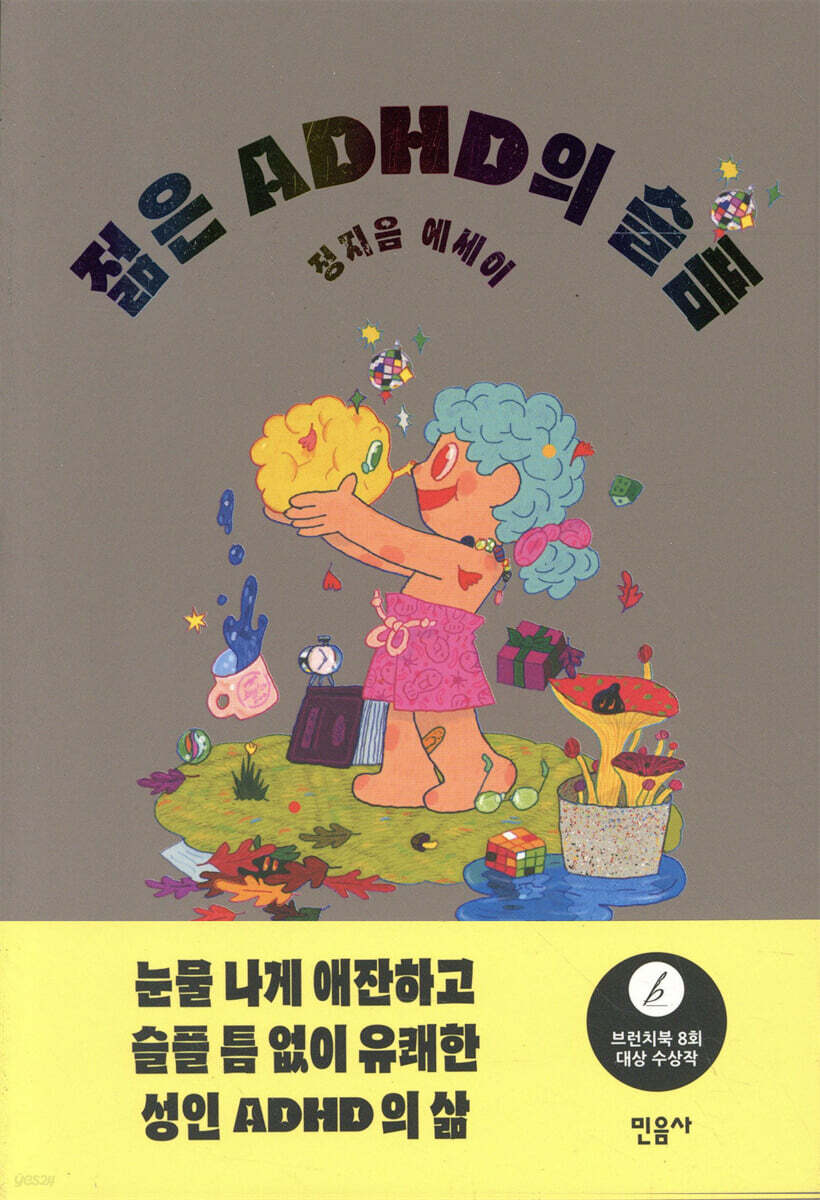
The Grief of Young ADHD
 |
Description
Book Introduction
Living through pure white nights and dark days A warm greeting to them A mess full of mistakes, I hated it A record of reconciliation from the past The 8th Brunch Book Award winner, author Ji-eum Jeong's "The Sorrow of Young ADHD" has been published. "The Sadness of Young ADHD" begins with a day when the author was 25 years old and diagnosed with adult ADHD. Accustomed to a life full of mistakes, forgetting things and losing things, he is overcome with complex emotions after the diagnosis. The futility and pain of realizing that the traits I thought were my personality traits were just symptoms of a disease, and the regret and longing that if I had received ADHD treatment as a child, I would have had a normal school life like everyone else. Seeking solace, the author sought out stories of ADHD patients struggling with similar concerns, but was only confronted with the cold 'facts' of medical textbooks. So, he decided to hold onto his 'fleeting concentration' and write his own story. "The Sorrow of Young ADHD" is a record of reconciliation that warmly embraces one's messy past and present. It is also a hand of comfort to all those who are lonely and suffering because of their own shortcomings. |
- You can preview some of the book's contents.
Preview
index
Prologue 9
Chapter 1: Being Diagnosed with ADHD
I get sick of things I hate 15
ADHD Self-Diagnosis and 20 Excuses
Psychiatry Was Not a Magic Shop 29
ADHD, borderline intellectual disability, depression 34
About ADHD 39
Chapter 2: Living with Adult ADHD
So what if I have ADHD? ㅑ용 42
50 students spinning around in a daze
Reflecting on my 1999th binge drinking, 55
I chose active insomnia 61
Reflections on the "She'll be late for her own wedding" assessment (Part 66)
Imperfect and Sustainable Cleanup Operation 70
ADHD's Money Sense 78
Too Noisy Solitude 84
How to Use Self-Abuse 90
95 Frequently Asked Questions for 6-Year-Old ADHD Patients
Chapter 3: Going to the Hospital
104 for those considering ADHD treatment
ADHD Medication: Effectiveness and Side Effects 109
About ADHD and Depression 118
Psychiatric Episodes 124
Chapter 4: The World I Met
I wish you were a rich kid 134
I like being the second of three sisters 138
The World of Parents, the Wall of School 144
The Immature Love Theory of "Goldsmith" 151
A Breakup Story That Sounds Like a Love Story 157
When will our daughter get married? 161
The Perfect Cat 166
We are the bundle of troublemakers from hell 173
Residents of Warur Mansion 180
DEAR ADHD 185
Chapter 5: Me, Writing, and Others
190 days until ADHD writes
Purpose of Reading 196
I regret driving you crazy 205
Should I Call It ADHD? 211
I believe in writing more than antidepressants. 216
Perfect Kindness 221
Secret Genius and Genius Hunter 225
Living with ADHD: Designing Happiness 230
Epilogue 240
Recommendation 244
Chapter 1: Being Diagnosed with ADHD
I get sick of things I hate 15
ADHD Self-Diagnosis and 20 Excuses
Psychiatry Was Not a Magic Shop 29
ADHD, borderline intellectual disability, depression 34
About ADHD 39
Chapter 2: Living with Adult ADHD
So what if I have ADHD? ㅑ용 42
50 students spinning around in a daze
Reflecting on my 1999th binge drinking, 55
I chose active insomnia 61
Reflections on the "She'll be late for her own wedding" assessment (Part 66)
Imperfect and Sustainable Cleanup Operation 70
ADHD's Money Sense 78
Too Noisy Solitude 84
How to Use Self-Abuse 90
95 Frequently Asked Questions for 6-Year-Old ADHD Patients
Chapter 3: Going to the Hospital
104 for those considering ADHD treatment
ADHD Medication: Effectiveness and Side Effects 109
About ADHD and Depression 118
Psychiatric Episodes 124
Chapter 4: The World I Met
I wish you were a rich kid 134
I like being the second of three sisters 138
The World of Parents, the Wall of School 144
The Immature Love Theory of "Goldsmith" 151
A Breakup Story That Sounds Like a Love Story 157
When will our daughter get married? 161
The Perfect Cat 166
We are the bundle of troublemakers from hell 173
Residents of Warur Mansion 180
DEAR ADHD 185
Chapter 5: Me, Writing, and Others
190 days until ADHD writes
Purpose of Reading 196
I regret driving you crazy 205
Should I Call It ADHD? 211
I believe in writing more than antidepressants. 216
Perfect Kindness 221
Secret Genius and Genius Hunter 225
Living with ADHD: Designing Happiness 230
Epilogue 240
Recommendation 244
Into the book
Every time I asked myself the question of defining myself, the answer I always got was, "an imperfect monster."
The existence of a country seemed so destructively incompetent that it could only become perfect by destroying itself.
I thought I would continue to fail as written in the book, living a life of impulse and depression, playing with air.
Even Steve Jobs and Edison had ADHD, but that wasn't much of a consolation.
Unless I invent something comparable to the iPhone or the lightbulb, I'll never be able to feel happy about being on par with them.
Whenever my hopes faded, I wanted to read the writings of people who couldn't love themselves.
It would be even better if the author were a single Korean woman with ADHD who was taking her first steps toward narcissism.
But it wasn't there yet.
There was a popular optimism in the world that said, "Whatever you are, you are precious and beautiful," but it wasn't the right reassurance for me.
It seems that people who cry alone for a long time become wary of the easy way to laugh.
Actually, I wasn't okay, I had been on the run for years, just hanging on to life.
I wondered if other ADHD patients had white nights and dark days like me.
To be friendly and polite, I wrote my story first.
If I could send out my insufficient writings as an invitation, my old sense of defeat would become the host of a fun party.
--- p.10~11
The world is a more interesting place when viewed from both sides.
I used to hate myself for always forgetting things, and for forgetting things that were either really happy or really sad as if they never happened.
But now I think that forgetting is a gift from God, and I think I have received a little more of it than others.
'A life light without holding anything' became 'a life lightened by forgetting' when we changed our perspective.
I will continue to feel privately hopeless, but I will eventually be happy because they don't last.
--- p.19
At that time, my hidden future hope was simply to be a 'person'.
Not the "crazy, bewildered, and spinning-around-the-world" life of Shin-chan, but the refined state of adulthood, where you have the power to decide whether to live a good or bad life. A major reason I felt such a sense of defeat after being diagnosed with ADHD was the belated realization that this crazy mental illness had completely stolen my teenage years.
Although the regret of 'I lived badly' was minimal, the regret of 'I could have lived better' was serious.
It was past and present, real, yet an illusion.
For a long time, I couldn't accept or deny my illness because I felt that countless mistakes that had made my life unsatisfactory were due to my ADHD.
When I meet people who have a child or teen with ADHD, I often ask them to help them understand the condition.
Once they realize themselves, they can use themselves as a turning point in their lives.
Just as I, who grew up with a childlike mind and body, eventually overcame the chaos and moved on with life.
--- p.53~54
One of my acquaintances became even more depressed because he had no idea that he could be depressed.
Some people wonder why they are so careless and continue to be careless.
I couldn't be sure with my level of knowledge whether they had depression or ADHD, but it was rare for someone to hold it in for a long time and then have an emergency.
My only regret about my treatment process now is that I was too late.
I also had a deeply ingrained misconception that only severely pathological people should go to a psychiatrist.
But, after all, a hospital is a place you go to not to become a patient, but to not be a patient.
This is a place where I go to accept that I am a patient now so that I can have a better future someday.
--- p.122~123
And surprisingly, I… …loved picking gum off the stains in the hallway.
Removing gum was a task I had to perform after I finished writing my reflection paper in the hallway of the teacher's office.
All my friends and seniors who were being disciplined together hated it.
The good teacher gave us rubber gloves, but otherwise we had to handle the sponges, gum knives, and pom-poms with our bare hands.
It was dirty work.
But when I saw the hallway, which had been so clean that it was holy by my touch, I felt as happy as a farmer who had succeeded in growing three crops.
Why would I, a lazy and weak-skinned person, like that?
Sadly, I guess… … chewing gum was the only task I could do in school that gave me a sense of accomplishment.
While other kids were scraping together possibilities for their future careers, I was finding solace in collecting chewed gum.
The disadvantages I've experienced are largely my fault, but when I think about this point, I can't help but feel sad.
Sometimes, whenever I hear people say that ADHD doesn't exist and that medication and treatment are just psychiatric tricks, I think back to that moment when I squatted down and chewed gum.
I regretted that if I, who couldn't live in a group without offending others and who used self-loathing as a shield in my teens, had taken prescriptions instead of gum, my life might have been a little different.
If the pill I'm swallowing now had been given to me then, I might have run inside instead of out.
--- p.148
My desire to be perfect from the beginning eventually banished me from countless perfections.
I'm learning that when you tolerate sloppiness, you gain the ability to execute, and that you need a start to make progress.
If you're reading this and struggling with ADHD or another issue, I suggest you consider changing your goals rather than your abilities or work process.
It's much easier to be perfect in your shortcomings than to just be perfect.
Mojaram is a pretty good friend.
It may not make me a master, but it will make me an amateur who may or may not become a master.
The existence of a country seemed so destructively incompetent that it could only become perfect by destroying itself.
I thought I would continue to fail as written in the book, living a life of impulse and depression, playing with air.
Even Steve Jobs and Edison had ADHD, but that wasn't much of a consolation.
Unless I invent something comparable to the iPhone or the lightbulb, I'll never be able to feel happy about being on par with them.
Whenever my hopes faded, I wanted to read the writings of people who couldn't love themselves.
It would be even better if the author were a single Korean woman with ADHD who was taking her first steps toward narcissism.
But it wasn't there yet.
There was a popular optimism in the world that said, "Whatever you are, you are precious and beautiful," but it wasn't the right reassurance for me.
It seems that people who cry alone for a long time become wary of the easy way to laugh.
Actually, I wasn't okay, I had been on the run for years, just hanging on to life.
I wondered if other ADHD patients had white nights and dark days like me.
To be friendly and polite, I wrote my story first.
If I could send out my insufficient writings as an invitation, my old sense of defeat would become the host of a fun party.
--- p.10~11
The world is a more interesting place when viewed from both sides.
I used to hate myself for always forgetting things, and for forgetting things that were either really happy or really sad as if they never happened.
But now I think that forgetting is a gift from God, and I think I have received a little more of it than others.
'A life light without holding anything' became 'a life lightened by forgetting' when we changed our perspective.
I will continue to feel privately hopeless, but I will eventually be happy because they don't last.
--- p.19
At that time, my hidden future hope was simply to be a 'person'.
Not the "crazy, bewildered, and spinning-around-the-world" life of Shin-chan, but the refined state of adulthood, where you have the power to decide whether to live a good or bad life. A major reason I felt such a sense of defeat after being diagnosed with ADHD was the belated realization that this crazy mental illness had completely stolen my teenage years.
Although the regret of 'I lived badly' was minimal, the regret of 'I could have lived better' was serious.
It was past and present, real, yet an illusion.
For a long time, I couldn't accept or deny my illness because I felt that countless mistakes that had made my life unsatisfactory were due to my ADHD.
When I meet people who have a child or teen with ADHD, I often ask them to help them understand the condition.
Once they realize themselves, they can use themselves as a turning point in their lives.
Just as I, who grew up with a childlike mind and body, eventually overcame the chaos and moved on with life.
--- p.53~54
One of my acquaintances became even more depressed because he had no idea that he could be depressed.
Some people wonder why they are so careless and continue to be careless.
I couldn't be sure with my level of knowledge whether they had depression or ADHD, but it was rare for someone to hold it in for a long time and then have an emergency.
My only regret about my treatment process now is that I was too late.
I also had a deeply ingrained misconception that only severely pathological people should go to a psychiatrist.
But, after all, a hospital is a place you go to not to become a patient, but to not be a patient.
This is a place where I go to accept that I am a patient now so that I can have a better future someday.
--- p.122~123
And surprisingly, I… …loved picking gum off the stains in the hallway.
Removing gum was a task I had to perform after I finished writing my reflection paper in the hallway of the teacher's office.
All my friends and seniors who were being disciplined together hated it.
The good teacher gave us rubber gloves, but otherwise we had to handle the sponges, gum knives, and pom-poms with our bare hands.
It was dirty work.
But when I saw the hallway, which had been so clean that it was holy by my touch, I felt as happy as a farmer who had succeeded in growing three crops.
Why would I, a lazy and weak-skinned person, like that?
Sadly, I guess… … chewing gum was the only task I could do in school that gave me a sense of accomplishment.
While other kids were scraping together possibilities for their future careers, I was finding solace in collecting chewed gum.
The disadvantages I've experienced are largely my fault, but when I think about this point, I can't help but feel sad.
Sometimes, whenever I hear people say that ADHD doesn't exist and that medication and treatment are just psychiatric tricks, I think back to that moment when I squatted down and chewed gum.
I regretted that if I, who couldn't live in a group without offending others and who used self-loathing as a shield in my teens, had taken prescriptions instead of gum, my life might have been a little different.
If the pill I'm swallowing now had been given to me then, I might have run inside instead of out.
--- p.148
My desire to be perfect from the beginning eventually banished me from countless perfections.
I'm learning that when you tolerate sloppiness, you gain the ability to execute, and that you need a start to make progress.
If you're reading this and struggling with ADHD or another issue, I suggest you consider changing your goals rather than your abilities or work process.
It's much easier to be perfect in your shortcomings than to just be perfect.
Mojaram is a pretty good friend.
It may not make me a master, but it will make me an amateur who may or may not become a master.
--- p.195
Publisher's Review
*8th Brunch Book Award Winner
I believe in Jeong Ji-eum's words, "A person lacking is a pretty good friend."
─Moon Bo-young (poet and writer)
Rather than giving up in despair over the disease,
It's like they're trying to pickle cabbage by extracting the saltiness from their tears.
Lee Joo-hyun (author of "Pippi Crossed the Desert of Manic Depression")
Spending dark days and pure white nights
To my ADHD colleagues
Not much is still known about adult ADHD.
The first image that comes to mind when you hear the word 'ADHD' is probably a boy running around the classroom during class time.
The image of an adult with ADHD daydreaming during meeting time, forgetting important meetings, and constantly succumbing to the urge to smoke or drink is not well-drawn.
The symptoms of adult ADHD not only appear differently from those of childhood ADHD, but are also easily understood as individual characteristics, so even the person with the disorder is often unaware of it.
The prevalence of adult ADHD is approximately 4%, and it is estimated that 820,000 people in Korea are suffering from the disease, but the actual treatment rate is only 1%.
"The Sorrows of Youthful ADHD" is a candid report on the daily struggles faced by adults with ADHD, and a practical guide for those with ADHD, detailing the process from diagnosis to treatment. The book's descriptions of ADHD symptoms, testing, and treatment were reviewed by the author's attending physician, an ADHD specialist.
What tests will I need if I go to the hospital? What are the effects and side effects of ADHD medication? What should I do if I suspect I have ADHD but hesitate to go to the hospital? Jeong Ji-eum shares her experiences with clarity for those who spend their nights pondering these questions.
Furthermore, it presents honest and pleasant solutions to the big and small problems of everyday life.
How to get yourself to clean when you can't even start because you're too caught up in other thoughts, how to protect your wallet from the urge to spend money, etc.
For ADHD patients who are prone to criticism from those around them, such as, "Why on earth are you doing that?" or "Are you doing that on purpose?", we also share tips on minimizing problems and maintaining self-esteem.
A record of reconciliation with the self I hated,
Affirmation of inherent shortcomings
On the one hand, there is the half-joking, half-serious self-mockery of, "Could I have ADHD too?"
Modern people, who cannot concentrate on a single book, a single movie, or even a short video clip, complain of frequent mistakes and impossibilities in the workplace and in daily life, and the resulting sense of deprivation.
The thought of secretly taking an ADHD self-diagnosis test may be mixed with anxiety and frustration about not being able to do anything properly.
This is why we cannot help but sympathize with the author's story, which is far from perfect.
"The Sadness of Young ADHD" is a story for everyone who feels resentful of their imperfections.
Jeong Ji-eum, who honestly confesses her own 'lack' and mocks herself sharply, is the most cheerful representative of lack.
The life of an adult with ADHD he portrays is tearfully sad, yet cheerful without any room for sadness.
Longing for the past self who was called a 'problem child' and could not dream of any future, regret and gratitude toward family and friends who must have suffered due to mistakes that even he could not understand, and positivity and anticipation for the new possibilities that come with being lacking.
Jeong Ji-eum melts all these emotions into her own humor.
"The Sadness of Youthful ADHD" is a courageous step forward in discovering uniqueness in flaws and seeking new possibilities.
I believe in Jeong Ji-eum's words, "A person lacking is a pretty good friend."
─Moon Bo-young (poet and writer)
Rather than giving up in despair over the disease,
It's like they're trying to pickle cabbage by extracting the saltiness from their tears.
Lee Joo-hyun (author of "Pippi Crossed the Desert of Manic Depression")
Spending dark days and pure white nights
To my ADHD colleagues
Not much is still known about adult ADHD.
The first image that comes to mind when you hear the word 'ADHD' is probably a boy running around the classroom during class time.
The image of an adult with ADHD daydreaming during meeting time, forgetting important meetings, and constantly succumbing to the urge to smoke or drink is not well-drawn.
The symptoms of adult ADHD not only appear differently from those of childhood ADHD, but are also easily understood as individual characteristics, so even the person with the disorder is often unaware of it.
The prevalence of adult ADHD is approximately 4%, and it is estimated that 820,000 people in Korea are suffering from the disease, but the actual treatment rate is only 1%.
"The Sorrows of Youthful ADHD" is a candid report on the daily struggles faced by adults with ADHD, and a practical guide for those with ADHD, detailing the process from diagnosis to treatment. The book's descriptions of ADHD symptoms, testing, and treatment were reviewed by the author's attending physician, an ADHD specialist.
What tests will I need if I go to the hospital? What are the effects and side effects of ADHD medication? What should I do if I suspect I have ADHD but hesitate to go to the hospital? Jeong Ji-eum shares her experiences with clarity for those who spend their nights pondering these questions.
Furthermore, it presents honest and pleasant solutions to the big and small problems of everyday life.
How to get yourself to clean when you can't even start because you're too caught up in other thoughts, how to protect your wallet from the urge to spend money, etc.
For ADHD patients who are prone to criticism from those around them, such as, "Why on earth are you doing that?" or "Are you doing that on purpose?", we also share tips on minimizing problems and maintaining self-esteem.
A record of reconciliation with the self I hated,
Affirmation of inherent shortcomings
On the one hand, there is the half-joking, half-serious self-mockery of, "Could I have ADHD too?"
Modern people, who cannot concentrate on a single book, a single movie, or even a short video clip, complain of frequent mistakes and impossibilities in the workplace and in daily life, and the resulting sense of deprivation.
The thought of secretly taking an ADHD self-diagnosis test may be mixed with anxiety and frustration about not being able to do anything properly.
This is why we cannot help but sympathize with the author's story, which is far from perfect.
"The Sadness of Young ADHD" is a story for everyone who feels resentful of their imperfections.
Jeong Ji-eum, who honestly confesses her own 'lack' and mocks herself sharply, is the most cheerful representative of lack.
The life of an adult with ADHD he portrays is tearfully sad, yet cheerful without any room for sadness.
Longing for the past self who was called a 'problem child' and could not dream of any future, regret and gratitude toward family and friends who must have suffered due to mistakes that even he could not understand, and positivity and anticipation for the new possibilities that come with being lacking.
Jeong Ji-eum melts all these emotions into her own humor.
"The Sadness of Youthful ADHD" is a courageous step forward in discovering uniqueness in flaws and seeking new possibilities.
GOODS SPECIFICS
- Publication date: June 25, 2021
- Page count, weight, size: 248 pages | 386g | 128*188*17mm
- ISBN13: 9788937472114
- ISBN10: 8937472112
You may also like
카테고리
korean


korean

![GQ KOREA Mark (Monthly): December [2025]](http://librairie.coreenne.fr/cdn/shop/files/8ef265dbbfbf186523ed75ba7319009d.jpg?v=1765340328&width=3840)


