

When life speaks to me
 |
Description
Book Introduction
Is this really my path?
- A message of life to all who ask for directions -
"When Life Talks to Me" is a book by Parker J., who is praised as a "teacher of teachers."
Among Palmer's many works, this is arguably his best essay, combining both spirituality and emotion.
Since its first publication in the United States in 2000, it has been widely loved by people of all generations, not just young people contemplating their future careers.
Since its publication in Korea in 2001, it has been consistently loved by readers.
This revised edition, published this time, was designed and proofread to repay that love.
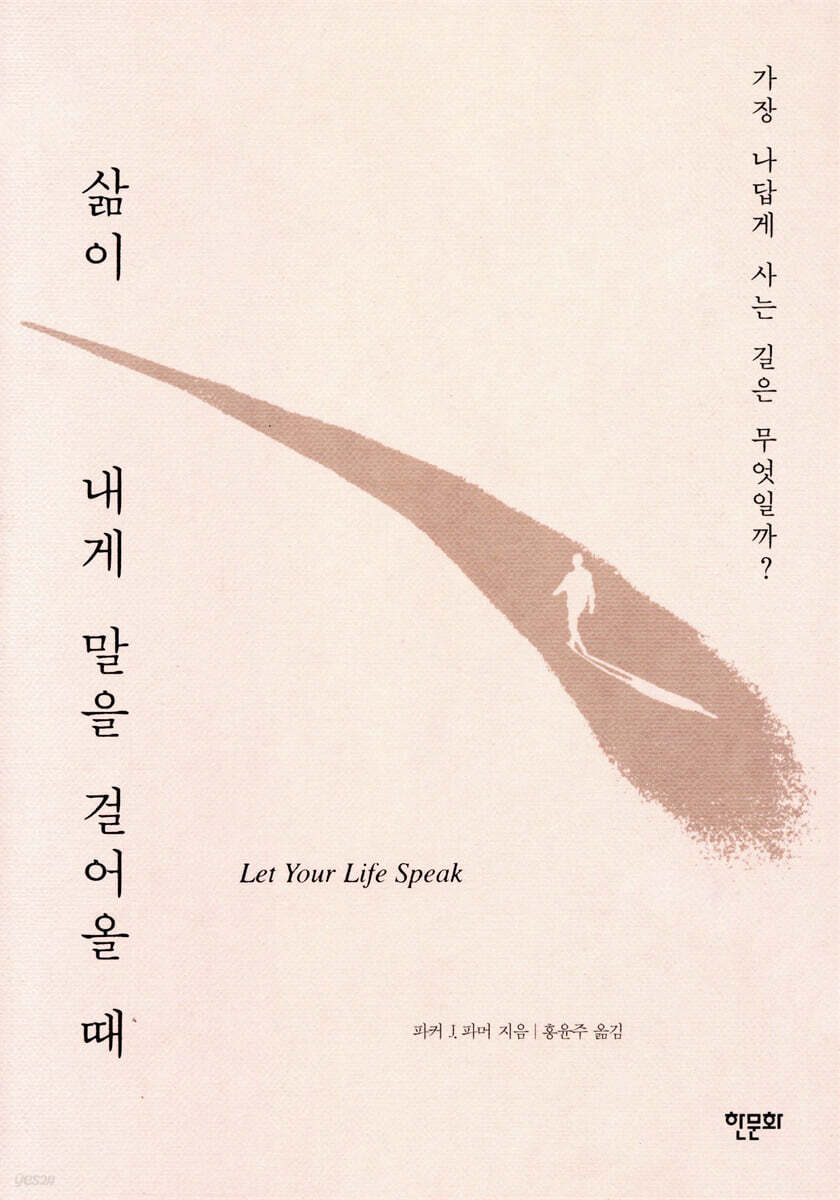
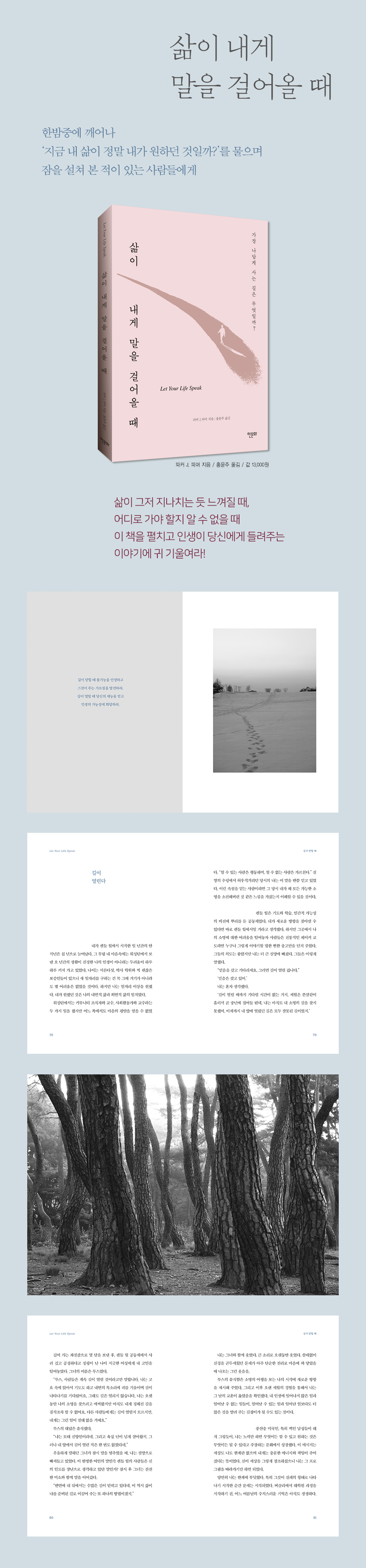
The cover has been changed to match the text containing the self-reflective message, and photos have been added to the text to help readers converse with their inner selves.
Additionally, valuable reviews from readers who read and cherished this book have been added.
- A message of life to all who ask for directions -
"When Life Talks to Me" is a book by Parker J., who is praised as a "teacher of teachers."
Among Palmer's many works, this is arguably his best essay, combining both spirituality and emotion.
Since its first publication in the United States in 2000, it has been widely loved by people of all generations, not just young people contemplating their future careers.
Since its publication in Korea in 2001, it has been consistently loved by readers.
This revised edition, published this time, was designed and proofread to repay that love.
The cover has been changed to match the text containing the self-reflective message, and photos have been added to the text to help readers converse with their inner selves.
Additionally, valuable reviews from readers who read and cherished this book have been added.
- You can preview some of the book's contents.
Preview
index
1.
Listen to the story of life
2.
Now I become myself
Discovering your innate talent
Journey into Darkness
Where inner joy and the demands of the world meet
3.
When the road closes
The road opens
When the road closes, the rest of the world opens.
Acts that go against nature
Right here, right now
Turn the world upside down
4.
All roads lead down
Wounded Healer
What Depression Taught Me
Approaching the pain of the soul
Down, down
Light and Darkness
5.
Back to the world again
Journey inward
Shadow and Spirituality
Five Shades Leaders Are Easily Able to Have
Inner activity in the community
6.
The four seasons of life: fall, winter, spring, and summer
endless cycle
autumn
winter
spring
summer
Listen to the story of life
2.
Now I become myself
Discovering your innate talent
Journey into Darkness
Where inner joy and the demands of the world meet
3.
When the road closes
The road opens
When the road closes, the rest of the world opens.
Acts that go against nature
Right here, right now
Turn the world upside down
4.
All roads lead down
Wounded Healer
What Depression Taught Me
Approaching the pain of the soul
Down, down
Light and Darkness
5.
Back to the world again
Journey inward
Shadow and Spirituality
Five Shades Leaders Are Easily Able to Have
Inner activity in the community
6.
The four seasons of life: fall, winter, spring, and summer
endless cycle
autumn
winter
spring
summer
Detailed image
Publisher's Review
What is the best way to live like myself?
Everyone has thought about their life's path and calling at least once, but it is not easy to come to a conclusion.
A significant portion of the concerns of people in their 20s and 30s is the question, “What kind of work should I do to live?”
And even in their 40s and 50s, there is still a emptiness in a corner of their hearts, and they begin to doubt the path they are taking.
“Is this really my path?”
They say everyone has their own path, but finding that path is never easy.
What should I live for? How should I live? In search of these answers, we open our eyes and ears only to the outside world.
But this book says that the answer lies within the life you have lived.
What should we do when nothing we do seems to work out, we're fired from our job, we lose our will to live, and we're in deep frustration and disappointment? This book tells us to "listen to the voice of your life."
This book is written by Parker J., a respected American educational leader, social activist, and author.
It is Palmer's collection of prose.
What is striking about this book is that it interprets finding one's calling not only from an individual's perspective, but also from a socio-ecological perspective.
The author's life experience is used to gently and movingly describe the close relationship between his personal interest, "My True Path," and the collective, "Community," making it very appealing.
The author achieved a brilliant social career and honor at a young age, and was a model student from elementary school until he graduated from the highest level of college.
The author, who has lived a life that everyone envies and respects, confesses in this book the process of finding one's calling, and it has the power to move and captivate the hearts of all ordinary people.
The greatest virtue of this book is that the author describes with surprising honesty the mistakes, trials, and errors, as well as the inner weaknesses and darkness, that he experienced during his journey to find his calling.
Moreover, such content is never portrayed as serious or heavy, but rather is unfolded with the author's characteristically gentle humor and warmth.
This comes from the warm and rich power of the author's soul.
The author's profound insights pour forth from every page, leaving a profound resonance in the readers' souls.
This book talks about the mistakes we commonly make as we search for our calling in life.
Why do so many people stray far from their true calling and end up on the wrong path? Everyone is said to have their own unique calling, but why do so many people fail to recognize it and spend so much time wandering? … When countless trials and errors reveal that the path we are on is not our true path, how can we find our true path? Why do unbearable trials and suffering come into our lives? How should we embrace them? Palmer addresses all these questions in a calm voice, sharing his own experiences.
How do I discover my calling in life?
- Some clues to help you figure out your calling -
Listen to the voice of life
The reason we stray from our original path is because of a misunderstanding of our calling.
Often we mistake calling for some lofty value or ideal that we must follow in our lives, whether we like it or not.
But calling is not something that is created through one's own will.
It is also not a goal that must be achieved through effort.
Calling is a gift given to us from birth.
Before I talk about what I want to accomplish in life, I can discover my calling by listening to the 'voice of my life' that tells me who I am.
As the original title 'Let Your Life Speak' implies, 'let your life speak'.
The author himself did not initially fully understand the true meaning of this saying, which has been a long-standing adage in the Quaker community.
Palmer believed that calling was a life lived by listing the highest ideals one could find and striving to achieve them.
I tried to live a noble life like Martin Luther King Jr. or Mahatma Gandhi, but the results were disastrous.
Such a life was nothing more than a 'noble path' that distorted one's true self and imitated the lives of heroes.
Palmer says that pursuing a calling you don't have is an act of self-harm.
When you listen to your true inner voice, you will hear the voice of your calling.
Even if that true self is quite different from the life my ego wants, I must follow the voice of my true self.
When our true self is violated, it will resist us and disrupt our lives, sometimes at great cost, until we acknowledge the truth.
Find clues to your calling in your childhood
From the very beginning, our lives begin with some clues about our true self and calling.
Deciphering that clue is difficult, but solving it is of great significance.
This is especially true when you are in your 20s, 30s, or 40s and still wandering around, not knowing where to go, or being dragged around here and there, completely forgetting about your natural talents.
We are each born with a gift of talent.
And then they either throw away that talent or are deceived by other people's words and appearances, wearing someone else's face and fitting themselves into that mold and living their lives.
And then, if you happen to realize that fact too late, you dedicate the rest of your life to trying to get back the gift you originally had.
When we stray from the path of our true self, how can we reclaim its traces? One way is to find clues in childhood memories, when we lived closer to our innate talents.
What was it about your childhood that you were so absorbed in with such pure passion that you lost track of time? What did you show extraordinary interest and talent in? The most vivid clues can be found there.
Sometimes life's mistakes, weaknesses, and darkness provide clues.
A calling is not found solely through talent or ability.
The author also did not accept ‘teaching’ and ‘writing’ as his calling from the beginning.
There were countless trials and errors until then.
At first, I wanted to enter a theological seminary and become a pastor, but I also decided to become a sociology research professor.
Every time that happened, I would become disillusioned with my 'so-so grades' or get fired from my research assistant position, and through miserable failures and mistakes, I would realize that this was not the path for me.
Palmer, who was wandering in search of his true path, suffered from severe depression twice in his 40s.
And in the process of overcoming that depression, you come to realize the following truth:
“When shouting, patting on the shoulder, throwing stones, and swinging sticks didn’t work, life dropped a nuclear bomb on me called depression.
It was not an attempt to kill me, but a last-ditch effort to turn me around and ask, 'What do you want?'" Failure, frustration, and pain are signals from our friend, our 'True Self,' who has been watching over us since childhood, trying to guide us along the path we should take.
As our ego ignores the voice of our true self and strays from the path it should take, it constantly sends signals in ways that try to get our attention.
Palmer tells us that through these paradoxes of life, we can only find our "whole selves" when we honestly acknowledge and accept both the light and the dark, the strength and the weakness, the abilities and the inabilities within ourselves.
What it means when the path of life is closed
While the author was wandering and struggling, not knowing what his true path was, he met an older woman in the Quaker community who was known for being thoughtful and fair, and confided his concerns to her.
“People keep telling me to just wait, because the road will open.
I prayed, listened to my inner voice, and waited for the path to appear.
Still, the road is not open.
“I’ve been trying to find my calling for a long time, but time keeps passing by and I still can’t even begin to fathom the path.” Her answer was honest.
“I am a born-again Christian.
And I've lived for over 60 years.
But the road never opened before me.” When she paused for a moment in her melancholy speech, Palmer fell into despair.
But after a while, she continued speaking with a gentle smile.
“On the other hand, behind me, countless roads are closing.
“This is another way life is leading me down the path it has prepared for me.” At that moment, Palmer laughed out loud and long with her.
That kind of laughter that comes when a problem that had been unnecessarily troubling you comes to your mind as a very simple truth.
And Palmer realizes in that moment that the things that didn't happen in life, the things that couldn't happen, can be more telling than the things that could happen, the things that did.
Palmer advises us not to stand too long before the closing doors of life.
Because the closing of the door also means that the possibilities of the rest of the world are wide open before our souls.
Where inner joy and the world's desperate needs meet
- My calling is to find my true role within the ecosystem of society. -
Answer the question of 'self' as honestly as possible.
All things in the world have their own nature.
Everyone has abilities, but also limitations.
If you seek your calling without understanding the resources you have, not only will your life be ugly, but you may also endanger your own life and the lives of those around you.
For example, making pottery is not simply about telling the clay what to do.
If the potter does not listen to the clay, the result is broken shards or an unsightly object.
If architects don't respect the nature of materials like iron, wood, and stone, the problem isn't just an eyesore; it can lead to bridges and buildings collapsing and even endangering human lives.
If you want to find your calling, you must ask yourself the question, "Who am I?"
And no matter what the outcome, you must answer as honestly as possible.
Only then can we find our true place in the ecosystem of life and discover our true community.
Then, we will be able to live in this world, interacting with all beings in the web of relationships, and experiencing the joy and fulfillment of life.
My calling is my natural place in the ecosystem of life.
Our deepest calling is to grow toward our true selves, whether or not they fit some image of ourselves.
In doing so, we not only discover the joy that all humans seek, but also discover our true path in the world.
A calling begins with the self and moves toward the needs of the world.
Managing your unique talent, the talent you have on this earth to bestow upon others, is not selfish at all, but a responsibility to others.
If you stray from your calling now and are not true to yourself, you are doing a terrible disservice to the world.
Calling and Leadership
When we discover our true calling, we can fulfill our role within the community.
If you live on this earth and do everything you have to do, that is exercising leadership.
Leadership is everyone's calling.
To stray from that path and reject it may be an escape.
Palmer says that everyone should lead others from their original position and also be led by others.
Palmer concludes that the ecosystem of this world can exist healthily in a harmony in which people guide each other.
· A book that corrects the wrong answers in life by making you ask the questions you need to ask.
I should have met Parker a long time ago and listened to what he had to say.
- Dreaming student
· Living according to one's calling means not looking at the world and searching for oneself, but looking at oneself and listening to the quiet voice within oneself.
- Mr. Mongmong Dino
A book that encouraged me to naturally embrace my fears and confidently walk into them. A book that gave me hope that even if I feel exhausted and give up everything, new doors will open! - EY
· Of all the books I've read recently, this one has been the most helpful in helping me reflect on and embrace myself.
- hsmyung
· This book was like a gift to me, who was frustrated because I couldn't find the starting point that would become the foundation of life.
- Red Bean
· A book I read while having a conversation with my inner self.
That time became a time for me to become more like myself.
- Simmi-an
· I believe everyone will find this book at some point in their lives! - jhokug
· This book comes to mind when you feel discouraged and lose your sense of direction in life, wondering where to run towards. It gives you a different feeling every time you read it.
- Winged One
· I'm not sure what kind of way I was born into this world with, but I think I can finally look at myself fully.
-Will Together
A book that shows you how to live a life following the voice within you - Geumgeumnim
· I learned that calling is not a goal to be achieved, but a gift already given.
- Watami
· A book that taught me that rather than dwelling on why one door is closed, we should discover another that is open - ykdman
· Recommended for those who find that what they ‘want to do’ and what they ‘have to do’ do not match.
- Mr. Blue Haruki
· A book to read the moment you hear the question, "Do you feel like you're living a good life now?"
I was able to look back on my life so far and slowly think about it.
- Lily86
Everyone has thought about their life's path and calling at least once, but it is not easy to come to a conclusion.
A significant portion of the concerns of people in their 20s and 30s is the question, “What kind of work should I do to live?”
And even in their 40s and 50s, there is still a emptiness in a corner of their hearts, and they begin to doubt the path they are taking.
“Is this really my path?”
They say everyone has their own path, but finding that path is never easy.
What should I live for? How should I live? In search of these answers, we open our eyes and ears only to the outside world.
But this book says that the answer lies within the life you have lived.
What should we do when nothing we do seems to work out, we're fired from our job, we lose our will to live, and we're in deep frustration and disappointment? This book tells us to "listen to the voice of your life."
This book is written by Parker J., a respected American educational leader, social activist, and author.
It is Palmer's collection of prose.
What is striking about this book is that it interprets finding one's calling not only from an individual's perspective, but also from a socio-ecological perspective.
The author's life experience is used to gently and movingly describe the close relationship between his personal interest, "My True Path," and the collective, "Community," making it very appealing.
The author achieved a brilliant social career and honor at a young age, and was a model student from elementary school until he graduated from the highest level of college.
The author, who has lived a life that everyone envies and respects, confesses in this book the process of finding one's calling, and it has the power to move and captivate the hearts of all ordinary people.
The greatest virtue of this book is that the author describes with surprising honesty the mistakes, trials, and errors, as well as the inner weaknesses and darkness, that he experienced during his journey to find his calling.
Moreover, such content is never portrayed as serious or heavy, but rather is unfolded with the author's characteristically gentle humor and warmth.
This comes from the warm and rich power of the author's soul.
The author's profound insights pour forth from every page, leaving a profound resonance in the readers' souls.
This book talks about the mistakes we commonly make as we search for our calling in life.
Why do so many people stray far from their true calling and end up on the wrong path? Everyone is said to have their own unique calling, but why do so many people fail to recognize it and spend so much time wandering? … When countless trials and errors reveal that the path we are on is not our true path, how can we find our true path? Why do unbearable trials and suffering come into our lives? How should we embrace them? Palmer addresses all these questions in a calm voice, sharing his own experiences.
How do I discover my calling in life?
- Some clues to help you figure out your calling -
Listen to the voice of life
The reason we stray from our original path is because of a misunderstanding of our calling.
Often we mistake calling for some lofty value or ideal that we must follow in our lives, whether we like it or not.
But calling is not something that is created through one's own will.
It is also not a goal that must be achieved through effort.
Calling is a gift given to us from birth.
Before I talk about what I want to accomplish in life, I can discover my calling by listening to the 'voice of my life' that tells me who I am.
As the original title 'Let Your Life Speak' implies, 'let your life speak'.
The author himself did not initially fully understand the true meaning of this saying, which has been a long-standing adage in the Quaker community.
Palmer believed that calling was a life lived by listing the highest ideals one could find and striving to achieve them.
I tried to live a noble life like Martin Luther King Jr. or Mahatma Gandhi, but the results were disastrous.
Such a life was nothing more than a 'noble path' that distorted one's true self and imitated the lives of heroes.
Palmer says that pursuing a calling you don't have is an act of self-harm.
When you listen to your true inner voice, you will hear the voice of your calling.
Even if that true self is quite different from the life my ego wants, I must follow the voice of my true self.
When our true self is violated, it will resist us and disrupt our lives, sometimes at great cost, until we acknowledge the truth.
Find clues to your calling in your childhood
From the very beginning, our lives begin with some clues about our true self and calling.
Deciphering that clue is difficult, but solving it is of great significance.
This is especially true when you are in your 20s, 30s, or 40s and still wandering around, not knowing where to go, or being dragged around here and there, completely forgetting about your natural talents.
We are each born with a gift of talent.
And then they either throw away that talent or are deceived by other people's words and appearances, wearing someone else's face and fitting themselves into that mold and living their lives.
And then, if you happen to realize that fact too late, you dedicate the rest of your life to trying to get back the gift you originally had.
When we stray from the path of our true self, how can we reclaim its traces? One way is to find clues in childhood memories, when we lived closer to our innate talents.
What was it about your childhood that you were so absorbed in with such pure passion that you lost track of time? What did you show extraordinary interest and talent in? The most vivid clues can be found there.
Sometimes life's mistakes, weaknesses, and darkness provide clues.
A calling is not found solely through talent or ability.
The author also did not accept ‘teaching’ and ‘writing’ as his calling from the beginning.
There were countless trials and errors until then.
At first, I wanted to enter a theological seminary and become a pastor, but I also decided to become a sociology research professor.
Every time that happened, I would become disillusioned with my 'so-so grades' or get fired from my research assistant position, and through miserable failures and mistakes, I would realize that this was not the path for me.
Palmer, who was wandering in search of his true path, suffered from severe depression twice in his 40s.
And in the process of overcoming that depression, you come to realize the following truth:
“When shouting, patting on the shoulder, throwing stones, and swinging sticks didn’t work, life dropped a nuclear bomb on me called depression.
It was not an attempt to kill me, but a last-ditch effort to turn me around and ask, 'What do you want?'" Failure, frustration, and pain are signals from our friend, our 'True Self,' who has been watching over us since childhood, trying to guide us along the path we should take.
As our ego ignores the voice of our true self and strays from the path it should take, it constantly sends signals in ways that try to get our attention.
Palmer tells us that through these paradoxes of life, we can only find our "whole selves" when we honestly acknowledge and accept both the light and the dark, the strength and the weakness, the abilities and the inabilities within ourselves.
What it means when the path of life is closed
While the author was wandering and struggling, not knowing what his true path was, he met an older woman in the Quaker community who was known for being thoughtful and fair, and confided his concerns to her.
“People keep telling me to just wait, because the road will open.
I prayed, listened to my inner voice, and waited for the path to appear.
Still, the road is not open.
“I’ve been trying to find my calling for a long time, but time keeps passing by and I still can’t even begin to fathom the path.” Her answer was honest.
“I am a born-again Christian.
And I've lived for over 60 years.
But the road never opened before me.” When she paused for a moment in her melancholy speech, Palmer fell into despair.
But after a while, she continued speaking with a gentle smile.
“On the other hand, behind me, countless roads are closing.
“This is another way life is leading me down the path it has prepared for me.” At that moment, Palmer laughed out loud and long with her.
That kind of laughter that comes when a problem that had been unnecessarily troubling you comes to your mind as a very simple truth.
And Palmer realizes in that moment that the things that didn't happen in life, the things that couldn't happen, can be more telling than the things that could happen, the things that did.
Palmer advises us not to stand too long before the closing doors of life.
Because the closing of the door also means that the possibilities of the rest of the world are wide open before our souls.
Where inner joy and the world's desperate needs meet
- My calling is to find my true role within the ecosystem of society. -
Answer the question of 'self' as honestly as possible.
All things in the world have their own nature.
Everyone has abilities, but also limitations.
If you seek your calling without understanding the resources you have, not only will your life be ugly, but you may also endanger your own life and the lives of those around you.
For example, making pottery is not simply about telling the clay what to do.
If the potter does not listen to the clay, the result is broken shards or an unsightly object.
If architects don't respect the nature of materials like iron, wood, and stone, the problem isn't just an eyesore; it can lead to bridges and buildings collapsing and even endangering human lives.
If you want to find your calling, you must ask yourself the question, "Who am I?"
And no matter what the outcome, you must answer as honestly as possible.
Only then can we find our true place in the ecosystem of life and discover our true community.
Then, we will be able to live in this world, interacting with all beings in the web of relationships, and experiencing the joy and fulfillment of life.
My calling is my natural place in the ecosystem of life.
Our deepest calling is to grow toward our true selves, whether or not they fit some image of ourselves.
In doing so, we not only discover the joy that all humans seek, but also discover our true path in the world.
A calling begins with the self and moves toward the needs of the world.
Managing your unique talent, the talent you have on this earth to bestow upon others, is not selfish at all, but a responsibility to others.
If you stray from your calling now and are not true to yourself, you are doing a terrible disservice to the world.
Calling and Leadership
When we discover our true calling, we can fulfill our role within the community.
If you live on this earth and do everything you have to do, that is exercising leadership.
Leadership is everyone's calling.
To stray from that path and reject it may be an escape.
Palmer says that everyone should lead others from their original position and also be led by others.
Palmer concludes that the ecosystem of this world can exist healthily in a harmony in which people guide each other.
· A book that corrects the wrong answers in life by making you ask the questions you need to ask.
I should have met Parker a long time ago and listened to what he had to say.
- Dreaming student
· Living according to one's calling means not looking at the world and searching for oneself, but looking at oneself and listening to the quiet voice within oneself.
- Mr. Mongmong Dino
A book that encouraged me to naturally embrace my fears and confidently walk into them. A book that gave me hope that even if I feel exhausted and give up everything, new doors will open! - EY
· Of all the books I've read recently, this one has been the most helpful in helping me reflect on and embrace myself.
- hsmyung
· This book was like a gift to me, who was frustrated because I couldn't find the starting point that would become the foundation of life.
- Red Bean
· A book I read while having a conversation with my inner self.
That time became a time for me to become more like myself.
- Simmi-an
· I believe everyone will find this book at some point in their lives! - jhokug
· This book comes to mind when you feel discouraged and lose your sense of direction in life, wondering where to run towards. It gives you a different feeling every time you read it.
- Winged One
· I'm not sure what kind of way I was born into this world with, but I think I can finally look at myself fully.
-Will Together
A book that shows you how to live a life following the voice within you - Geumgeumnim
· I learned that calling is not a goal to be achieved, but a gift already given.
- Watami
· A book that taught me that rather than dwelling on why one door is closed, we should discover another that is open - ykdman
· Recommended for those who find that what they ‘want to do’ and what they ‘have to do’ do not match.
- Mr. Blue Haruki
· A book to read the moment you hear the question, "Do you feel like you're living a good life now?"
I was able to look back on my life so far and slowly think about it.
- Lily86
GOODS SPECIFICS
- Date of publication: February 18, 2019
- Page count, weight, size: 208 pages | 346g | 148*210*20mm
- ISBN13: 9788956993478
- ISBN10: 8956993475
You may also like
카테고리
korean


korean

![GQ KOREA Mark (Monthly): December [2025]](http://librairie.coreenne.fr/cdn/shop/files/8ef265dbbfbf186523ed75ba7319009d.jpg?v=1765340328&width=3840)


