

Mourning Diary
 |
Description
Book Introduction
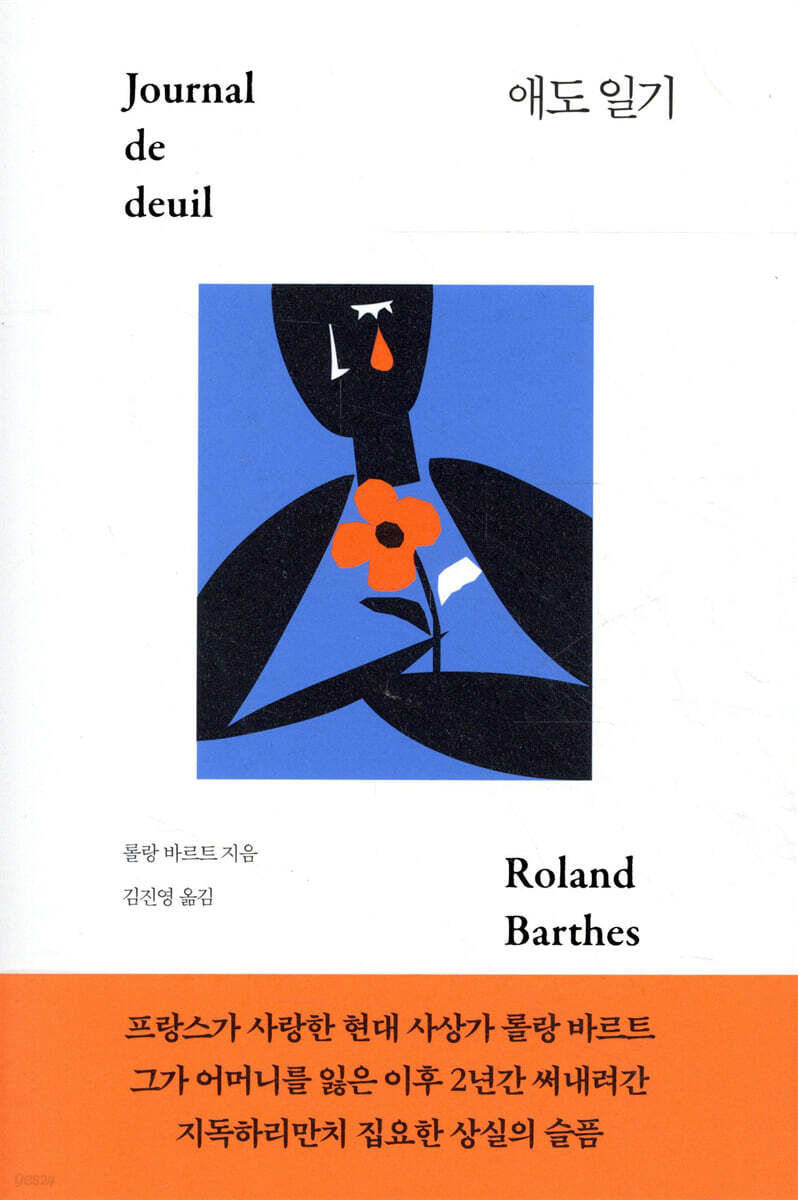
Roland Barthes' essay "Diary of Mourning," which records the grief of losing a loved one to death, has been published in a newly designed cover edition.
The book is presented with a format that reinterprets the text and a cover that encapsulates the beautiful and desperate emotions of sorrow, enhancing the collection value of this famous work.
This book is a diary written by Roland Barthes, one of the most outstanding French intellectuals of the late 20th century, while mourning the death of his mother.
This is one of Roland Barthes' best-selling works, consistently read and interpreted by readers of humanities and literature. Unlike Barthes's other works, which have a high barrier to entry, it is known as a masterpiece that encompasses the widest range of readers.
The book is presented with a format that reinterprets the text and a cover that encapsulates the beautiful and desperate emotions of sorrow, enhancing the collection value of this famous work.
This book is a diary written by Roland Barthes, one of the most outstanding French intellectuals of the late 20th century, while mourning the death of his mother.
This is one of Roland Barthes' best-selling works, consistently read and interpreted by readers of humanities and literature. Unlike Barthes's other works, which have a high barrier to entry, it is known as a masterpiece that encompasses the widest range of readers.
- You can preview some of the book's contents.
Preview
index
Foreword / Nathalie Leger
Mourning Diary: October 26, 1977–June 21, 1978
Follow-up Diary: June 24, 1978 - October 25, 1978
Diary written later: November 4, 1978 - September 15, 1979
The remaining chapters without dates
A few notes about Maman
Commentary / Kim Jin-young
Mourning Diary: October 26, 1977–June 21, 1978
Follow-up Diary: June 24, 1978 - October 25, 1978
Diary written later: November 4, 1978 - September 15, 1979
The remaining chapters without dates
A few notes about Maman
Commentary / Kim Jin-young
Detailed image
Into the book
October 27, 1977
People around me probably think deeply (or at least they do), about how deep my sadness is.
But it is impossible to measure the magnitude of the impact of grief on a single person (a ridiculous and absurd attempt).
November 6, 1977
A Sunday morning as foggy as cotton.
I'm alone.
I have a feeling that week after week will go by like this.
So now I stand before a long line of days that will pass without her.
November 9, 1977
This pure sadness, a sadness that has nothing to do with loneliness or wanting to rebuild one's life.
A deep furrow is formed when a love relationship is broken.
November 28, 1977
To whom can one ask such questions (and hope to get an answer)?
If we lose someone we loved so much and we can live without them, does that mean we didn't love them as much as we believed?
November 28, 1977
cold.
It's night.
It's winter.
I am warm inside the house, but I am alone.
And on nights like these I realize again: I must now get used to taking these lonely nights for granted, to acting and working in this solitude, to clinging to that 'presence of absence' and living with it constantly.
November 30, 1977
Let's not talk about mourning.
That's too psychoanalytical.
I am not in sorrow.
I am sad.
July 18, 1978
Everyone has their own rhythm of pain that only they know.
August 21, 1978
If those I loved and still love so dearly, those who have outlived me, will simply vanish from this world without a trace after I die and those who have outlived them, then why should I continue to be remembered after death, why should I leave a trace of my life in the world? If the memory of Mamang cannot survive in this world after I and those who knew her, then what good is it for me to be remembered after I die, to live on somewhere in this cold and hypocritical history? I don't want to be the only "monument" I have.
People around me probably think deeply (or at least they do), about how deep my sadness is.
But it is impossible to measure the magnitude of the impact of grief on a single person (a ridiculous and absurd attempt).
November 6, 1977
A Sunday morning as foggy as cotton.
I'm alone.
I have a feeling that week after week will go by like this.
So now I stand before a long line of days that will pass without her.
November 9, 1977
This pure sadness, a sadness that has nothing to do with loneliness or wanting to rebuild one's life.
A deep furrow is formed when a love relationship is broken.
November 28, 1977
To whom can one ask such questions (and hope to get an answer)?
If we lose someone we loved so much and we can live without them, does that mean we didn't love them as much as we believed?
November 28, 1977
cold.
It's night.
It's winter.
I am warm inside the house, but I am alone.
And on nights like these I realize again: I must now get used to taking these lonely nights for granted, to acting and working in this solitude, to clinging to that 'presence of absence' and living with it constantly.
November 30, 1977
Let's not talk about mourning.
That's too psychoanalytical.
I am not in sorrow.
I am sad.
July 18, 1978
Everyone has their own rhythm of pain that only they know.
August 21, 1978
If those I loved and still love so dearly, those who have outlived me, will simply vanish from this world without a trace after I die and those who have outlived them, then why should I continue to be remembered after death, why should I leave a trace of my life in the world? If the memory of Mamang cannot survive in this world after I and those who knew her, then what good is it for me to be remembered after I die, to live on somewhere in this cold and hypocritical history? I don't want to be the only "monument" I have.
--- From the text
Publisher's Review
The 2018 Recover Edition of "Diary of Mourning" was published.
Written by Roland Barthes over the two years following the loss of his mother
The agonizingly persistent grief of loss
The Diary of a Mourner may not be the greatest achievement of critic Roland Barthes.
But it is Barthes's most passionate and accessible work - The New York Times
Roland Barthes, a critic, thinker, and outstanding essayist who had the most powerful influence on modern criticism.
Among Barthes' books, "The Diary of Mourning" is considered to be an essay in which one can read his most passionate emotions.
This is Roland Barthes's poignant and tenacious record of the sorrow of losing a loved one, and it has become a steady seller, constantly being recalled by those who love Roland Barthes.
Since its publication, 『Mourning Diary』 has become a reference that novelists, critics, and countless readers never fail to mention when discussing 'mourning'. It has become a text that poses the topic of 'mourning' to a culture that is reluctant to talk about 'death' and raises questions about the ethics of mourning.
An important discovery that provides a glimpse into Roland Barthes's later style.
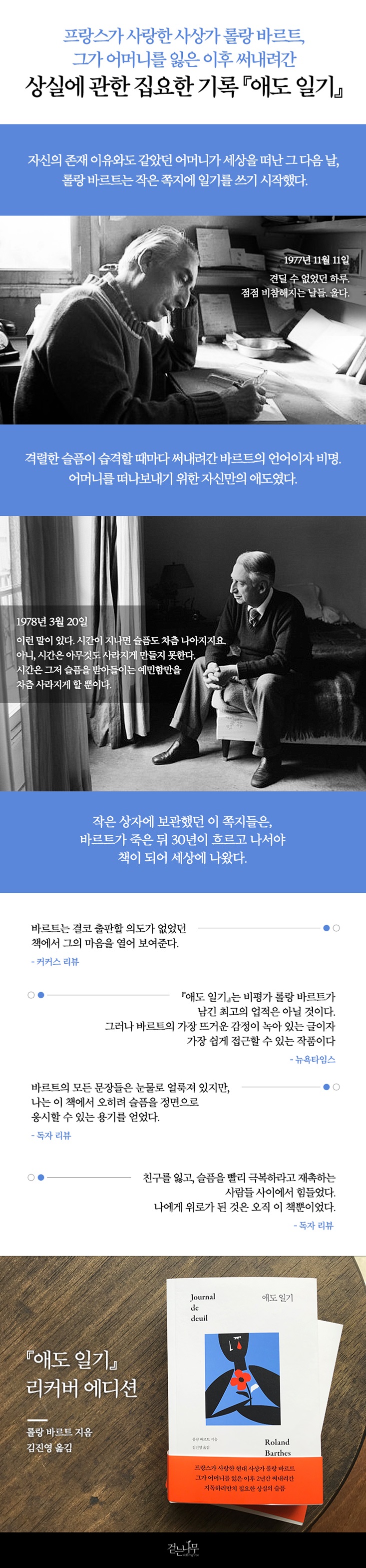
On October 25, 1977, Barthes' mother, Henriette Benger, died.
From the next day, Bart began to keep a diary.
Usually written in ink, sometimes in pencil, on a note made by dividing a notebook into four parts.
Instead of releasing these notes to the world, he kept them in a small box on his desk.
On February 25, 1980, Bart was struck by a laundry truck while crossing the street.
He was taken to the hospital but refused treatment and died a month later on March 26.
His death was officially declared an accident, but some say it was suicide.
The note was first published in 2009, 30 years later.
The manuscript, which was stored in the International Museum of Modern Art (IMEC), was edited to resemble the separated pages when it was made into a book, without any omissions, and published by Soyyu Publishing.
Barth's attachment to his mother was special.
Having lost his father at an early age, he lived with his mother his entire life.
The special bond he had with his mother is also famous for the anecdote in which, when Barthes was appointed professor at the Collège de France, he invited his mother and had her sit in the front row while giving his inaugural lecture.
So, Bart's life is divided into before and after his mother's death.
As his life changed, his intellectual trajectory also took a completely different direction.
He, who used to sing about the joys of life, now talks about 'death' after his mother's death.
The Diary of a Mourner is an important text that provides a glimpse into Barthes's later style, which accepted his mother's death as an important symbol.
The language and screams written whenever intense sadness attacks
A Philosopher's Essay for Those Who Live with Loss as Their Fate
Roland Barthes once said in his book, "The Bright Room," published in the same year as "The Journal of Mourning," that he wanted to "write a little memoir about my mother just for myself."
But what stands out most in 『Diary of Mourning』 is neither Roland Barthes nor his mother, Henriette Benger.
The main character of this book is the 'sadness' he is in.
A feeling of pure sadness, irreplaceable and unresolvable until the very end, permeates every sentence.
The boy who grew up with a single mother became a world-renowned scholar, but he was unable to escape the pain of separation from his mother.
A gloomy afternoon.
Go to the market for a bit.
I buy one of these financiers at the bakery (without thinking about it).
A little waitress helps a customer and says: Voila.
The words I always said when I was taking care of Mamang and bringing her what she needed.
This word, carelessly blurted out by the female clerk, ultimately made me unable to hold back my tears.
I cry alone for a long time (back home where I can't hear anything).
-47p
On almost every page, Barthes's sentences about longing for 'Mamang (mother)' are stained with tears, but they are not vulgar or melodramatic.
Reading the raw sentences poured out as if spewing out one's feelings gives me the courage to face my sadness head on.
People urge us to stop grieving and get back to our daily lives quickly, and they allow us to grieve fully in a society that does not acknowledge grief.
Barth says, 'Do not try to suppress the sadness of mourning.'
There is no sign that can indicate one's own unique sadness.
This sadness is the completion of absolute innerity.
But all wise societies have predetermined and codified how grief should be expressed.
The evil of our society is that it does not acknowledge sorrow.
- 165p
We always live by letting someone go.
We are people who have already lost someone, are in the process of losing someone, or are about to lose someone.
For humans who have no choice but to live with loss as their fate, 'mourning' is a topic that must be constantly discussed.
We indirectly experience the profound sorrow of others through Barthes's short passages woven with sorrow.
And we watch as sadness and pain 'slowly take hold' within us.
Although Barthes worried that his notes would eventually "become literature," the "Mourning Diary" has come to us as a sad and beautiful piece of literature.
I don't want to talk about these things.
Because I'm afraid that it will end up becoming literature.
Or maybe because I'm not confident that my words won't become literature.
Yet, despite the fact that literature is none other than what is rooted and born from these truths.
- 33p
Written by Roland Barthes over the two years following the loss of his mother
The agonizingly persistent grief of loss
The Diary of a Mourner may not be the greatest achievement of critic Roland Barthes.
But it is Barthes's most passionate and accessible work - The New York Times
Roland Barthes, a critic, thinker, and outstanding essayist who had the most powerful influence on modern criticism.
Among Barthes' books, "The Diary of Mourning" is considered to be an essay in which one can read his most passionate emotions.
This is Roland Barthes's poignant and tenacious record of the sorrow of losing a loved one, and it has become a steady seller, constantly being recalled by those who love Roland Barthes.
Since its publication, 『Mourning Diary』 has become a reference that novelists, critics, and countless readers never fail to mention when discussing 'mourning'. It has become a text that poses the topic of 'mourning' to a culture that is reluctant to talk about 'death' and raises questions about the ethics of mourning.
An important discovery that provides a glimpse into Roland Barthes's later style.
On October 25, 1977, Barthes' mother, Henriette Benger, died.
From the next day, Bart began to keep a diary.
Usually written in ink, sometimes in pencil, on a note made by dividing a notebook into four parts.
Instead of releasing these notes to the world, he kept them in a small box on his desk.
On February 25, 1980, Bart was struck by a laundry truck while crossing the street.
He was taken to the hospital but refused treatment and died a month later on March 26.
His death was officially declared an accident, but some say it was suicide.
The note was first published in 2009, 30 years later.
The manuscript, which was stored in the International Museum of Modern Art (IMEC), was edited to resemble the separated pages when it was made into a book, without any omissions, and published by Soyyu Publishing.
Barth's attachment to his mother was special.
Having lost his father at an early age, he lived with his mother his entire life.
The special bond he had with his mother is also famous for the anecdote in which, when Barthes was appointed professor at the Collège de France, he invited his mother and had her sit in the front row while giving his inaugural lecture.
So, Bart's life is divided into before and after his mother's death.
As his life changed, his intellectual trajectory also took a completely different direction.
He, who used to sing about the joys of life, now talks about 'death' after his mother's death.
The Diary of a Mourner is an important text that provides a glimpse into Barthes's later style, which accepted his mother's death as an important symbol.
The language and screams written whenever intense sadness attacks
A Philosopher's Essay for Those Who Live with Loss as Their Fate
Roland Barthes once said in his book, "The Bright Room," published in the same year as "The Journal of Mourning," that he wanted to "write a little memoir about my mother just for myself."
But what stands out most in 『Diary of Mourning』 is neither Roland Barthes nor his mother, Henriette Benger.
The main character of this book is the 'sadness' he is in.
A feeling of pure sadness, irreplaceable and unresolvable until the very end, permeates every sentence.
The boy who grew up with a single mother became a world-renowned scholar, but he was unable to escape the pain of separation from his mother.
A gloomy afternoon.
Go to the market for a bit.
I buy one of these financiers at the bakery (without thinking about it).
A little waitress helps a customer and says: Voila.
The words I always said when I was taking care of Mamang and bringing her what she needed.
This word, carelessly blurted out by the female clerk, ultimately made me unable to hold back my tears.
I cry alone for a long time (back home where I can't hear anything).
-47p
On almost every page, Barthes's sentences about longing for 'Mamang (mother)' are stained with tears, but they are not vulgar or melodramatic.
Reading the raw sentences poured out as if spewing out one's feelings gives me the courage to face my sadness head on.
People urge us to stop grieving and get back to our daily lives quickly, and they allow us to grieve fully in a society that does not acknowledge grief.
Barth says, 'Do not try to suppress the sadness of mourning.'
There is no sign that can indicate one's own unique sadness.
This sadness is the completion of absolute innerity.
But all wise societies have predetermined and codified how grief should be expressed.
The evil of our society is that it does not acknowledge sorrow.
- 165p
We always live by letting someone go.
We are people who have already lost someone, are in the process of losing someone, or are about to lose someone.
For humans who have no choice but to live with loss as their fate, 'mourning' is a topic that must be constantly discussed.
We indirectly experience the profound sorrow of others through Barthes's short passages woven with sorrow.
And we watch as sadness and pain 'slowly take hold' within us.
Although Barthes worried that his notes would eventually "become literature," the "Mourning Diary" has come to us as a sad and beautiful piece of literature.
I don't want to talk about these things.
Because I'm afraid that it will end up becoming literature.
Or maybe because I'm not confident that my words won't become literature.
Yet, despite the fact that literature is none other than what is rooted and born from these truths.
- 33p
GOODS SPECIFICS
- Publication date: November 20, 2018
- Page count, weight, size: 288 pages | 374g | 125*188*20mm
- ISBN13: 9788901228068
- ISBN10: 8901228068
You may also like
카테고리
korean


korean

![GQ KOREA Mark (Monthly): December [2025]](http://librairie.coreenne.fr/cdn/shop/files/8ef265dbbfbf186523ed75ba7319009d.jpg?v=1765340328&width=3840)


