

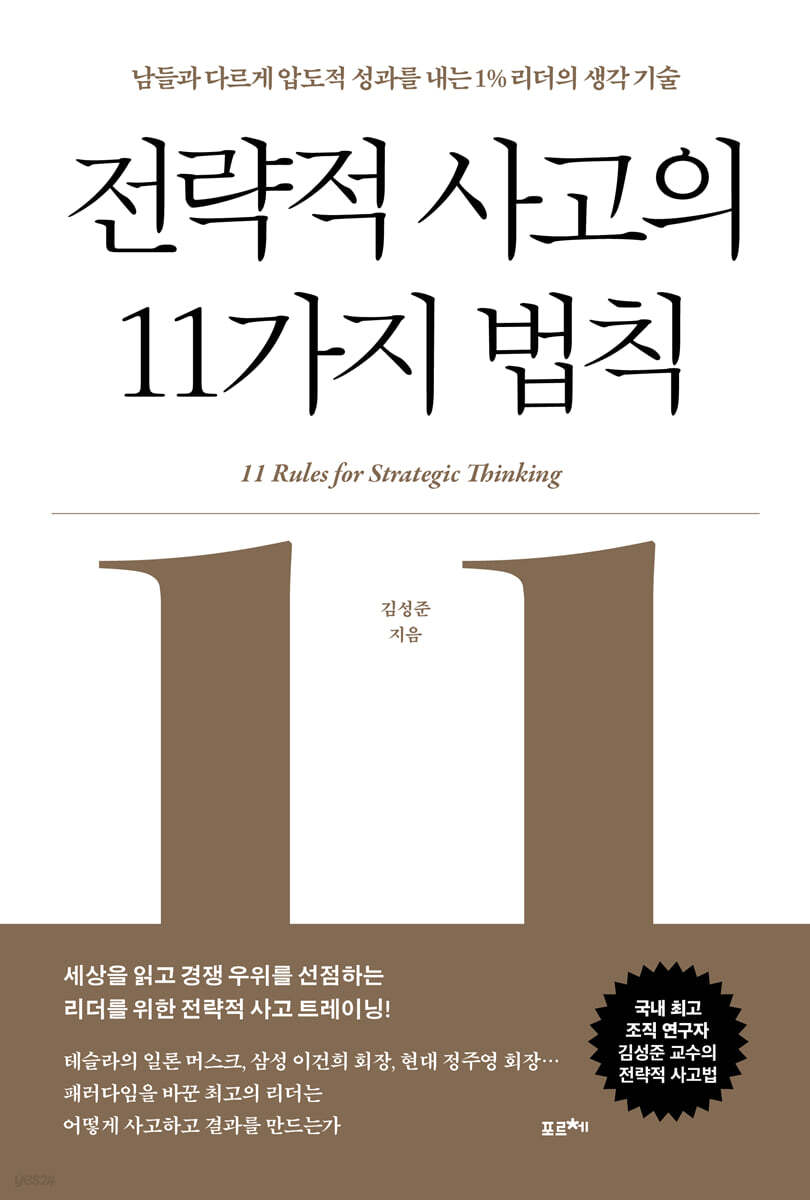
11 Laws of Strategic Thinking
 |
Description
Book Introduction
Coaching Insights from Korea's Top Companies, Including Lotte, SK, LG, and Hyundai Motors
***Current CEOs and Executives Seek Organizational Culture/Leadership Advisory Professor***
Strategic thinking is needed for South Korea's leaders today!
The secret of the 1% leader who reads the world and creates new competitiveness.
Navigate the competitive world of business with strategic thinking.
Tesla, Samsung, Apple… How do the best leaders who have changed paradigms think and achieve results? This book is for leaders who strive to read industry trends and achieve overwhelming results for their organizations, their team members, and themselves.
In an age where technology advances at a rapid pace, where does the power to find new competitive advantages that will enable our organizations to survive lie? The secret lies in "strategic thinking."
"The 11 Laws of Strategic Thinking" defines strategic thinking as "the power to break out of deadlocks," "a perspective that approaches problems in a different way than before," and "the ability to foresee the future and create new competitive advantages."
The author, who has coached numerous corporate executives and studied leadership and organizational culture for many years, reveals, based on his experience, that there are 11 laws of strategic thinking.
Strategic thinking is not something you are born with.
By constantly training your thinking through acquired efforts, you can seize opportunities that others cannot see and gain a competitive advantage faster than anyone else.
This book will help you develop the strategic thinking skills to find a breakthrough in any situation.
***Current CEOs and Executives Seek Organizational Culture/Leadership Advisory Professor***
Strategic thinking is needed for South Korea's leaders today!
The secret of the 1% leader who reads the world and creates new competitiveness.
Navigate the competitive world of business with strategic thinking.
Tesla, Samsung, Apple… How do the best leaders who have changed paradigms think and achieve results? This book is for leaders who strive to read industry trends and achieve overwhelming results for their organizations, their team members, and themselves.
In an age where technology advances at a rapid pace, where does the power to find new competitive advantages that will enable our organizations to survive lie? The secret lies in "strategic thinking."
"The 11 Laws of Strategic Thinking" defines strategic thinking as "the power to break out of deadlocks," "a perspective that approaches problems in a different way than before," and "the ability to foresee the future and create new competitive advantages."
The author, who has coached numerous corporate executives and studied leadership and organizational culture for many years, reveals, based on his experience, that there are 11 laws of strategic thinking.
Strategic thinking is not something you are born with.
By constantly training your thinking through acquired efforts, you can seize opportunities that others cannot see and gain a competitive advantage faster than anyone else.
This book will help you develop the strategic thinking skills to find a breakthrough in any situation.
- You can preview some of the book's contents.
Preview
index
Introduction: The 4 Most Important Competencies a Leader Must Have
Rule 0: Leaders who change the world have strategic thinking.
Tesla 22 Redefines the Car
How Tesla Led the Auto Industry 32
The mindset of Chairman Lee Kun-hee, who developed Samsung, 37
Rule 1: Invest Time in Strategic Thinking
How long will we be stuck in the practical world? 52
A leader's time management determines the success or failure of an organization. 61
Strategic Thinking Training: Evaluating Your Time/Effort 69
Rule 2: Know Your Thinking Style
Intuitive and Analytical Thinking 74
Which Thinking Styles Facilitate Strategic Thinking? 88
I need to figure out my thinking style 96
Develop your own unique style 112
Strategic Thinking Training: Understanding Your Thinking Style 116
Rule 3: Clearly define the essence of the word.
A leader's thinking must be clear 118
6 Ways to Clarify Concepts 125
Add Depth with the Universal-Context-Practice Framework 140
Strategic Thinking Training: Clearly Defining Words and Concepts 145
Rule 4: Break out of the binary framework
The path to success isn't all or nothing. 148
3 Ways to Avoid Dichotomous Thinking 165
Strategic Thinking Training: Breaking Free from Dichotomous Thinking 179
Rule 5: Escape the Thinking Trap with Meta-Questions
The Core of Strategic Thinking: Meta-Questions 182
3 Easy-to-Fall-Into-Thinking Traps 186
Penetrate the Essence with Meta-Questions 199
The Secret of Executives Who Never Fail at Performance 203
What is your meta question? 208
Strategic Thinking Training: Organizing My Meta-Questions 215
Rule 6: Start with the Customer
A customer-focused strategy succeeds. 220
Define Your Customers 229
Defining Your Customers: Strategic Thinking Training 238
Rule 7: Know the Rules of the Game and Lead
The Rules of the Game in an Ever-Changing Industry 244
Industry-leading strategies sometimes lie beyond the customer. 254
Broaden your horizons and perceive the paradigm 259
Strategic Thinking Training: Understanding the Rules of Industry Competition 275
Rule 8: Look at your organization and industry from multiple perspectives.
A leader's job is to observe. 278
Henry Mintzberg's Seven Thinking Methods 284
Strategic Thinking Training: Looking at the Seven Directions 305
Rule 9: Capitalize on Your Experiences
What experiences do strategists develop through? 310
The Power of Experience 317
Unreflected experience is useless 327
Develop Insight by Reconstructing Experiences 335
Capitalizing on Strategic Thinking Training Experiences 360
Rule 10: Avoid the Trap of a Glorious Past
Past Glory 364: A Jaw-Catching Ankle
Two Secrets of Leaders Who Avoided the Experience Trap 374
Avoiding the Traps of Strategic Thinking Training Experiences 387
Rule 11: Think with the Organization
Leaders Who Work Alone Fail 390
Why Leaders Work with Organizations 394
Strategic thinking is a state of mind 403
Week 408
Rule 0: Leaders who change the world have strategic thinking.
Tesla 22 Redefines the Car
How Tesla Led the Auto Industry 32
The mindset of Chairman Lee Kun-hee, who developed Samsung, 37
Rule 1: Invest Time in Strategic Thinking
How long will we be stuck in the practical world? 52
A leader's time management determines the success or failure of an organization. 61
Strategic Thinking Training: Evaluating Your Time/Effort 69
Rule 2: Know Your Thinking Style
Intuitive and Analytical Thinking 74
Which Thinking Styles Facilitate Strategic Thinking? 88
I need to figure out my thinking style 96
Develop your own unique style 112
Strategic Thinking Training: Understanding Your Thinking Style 116
Rule 3: Clearly define the essence of the word.
A leader's thinking must be clear 118
6 Ways to Clarify Concepts 125
Add Depth with the Universal-Context-Practice Framework 140
Strategic Thinking Training: Clearly Defining Words and Concepts 145
Rule 4: Break out of the binary framework
The path to success isn't all or nothing. 148
3 Ways to Avoid Dichotomous Thinking 165
Strategic Thinking Training: Breaking Free from Dichotomous Thinking 179
Rule 5: Escape the Thinking Trap with Meta-Questions
The Core of Strategic Thinking: Meta-Questions 182
3 Easy-to-Fall-Into-Thinking Traps 186
Penetrate the Essence with Meta-Questions 199
The Secret of Executives Who Never Fail at Performance 203
What is your meta question? 208
Strategic Thinking Training: Organizing My Meta-Questions 215
Rule 6: Start with the Customer
A customer-focused strategy succeeds. 220
Define Your Customers 229
Defining Your Customers: Strategic Thinking Training 238
Rule 7: Know the Rules of the Game and Lead
The Rules of the Game in an Ever-Changing Industry 244
Industry-leading strategies sometimes lie beyond the customer. 254
Broaden your horizons and perceive the paradigm 259
Strategic Thinking Training: Understanding the Rules of Industry Competition 275
Rule 8: Look at your organization and industry from multiple perspectives.
A leader's job is to observe. 278
Henry Mintzberg's Seven Thinking Methods 284
Strategic Thinking Training: Looking at the Seven Directions 305
Rule 9: Capitalize on Your Experiences
What experiences do strategists develop through? 310
The Power of Experience 317
Unreflected experience is useless 327
Develop Insight by Reconstructing Experiences 335
Capitalizing on Strategic Thinking Training Experiences 360
Rule 10: Avoid the Trap of a Glorious Past
Past Glory 364: A Jaw-Catching Ankle
Two Secrets of Leaders Who Avoided the Experience Trap 374
Avoiding the Traps of Strategic Thinking Training Experiences 387
Rule 11: Think with the Organization
Leaders Who Work Alone Fail 390
Why Leaders Work with Organizations 394
Strategic thinking is a state of mind 403
Week 408
Detailed image

Into the book
Observing leaders struggling in the field has shown me that strategic thinking is not a tool or technique, but rather a state of mind and a habitual way of thinking.
Strategic thinking is the attitude, mindset, and thought process that strives to create greater utility to satisfy customers, maintain and develop identity despite fierce competition, and constantly consider and seek ways for the organization to survive and grow.
--- p.13
Second, strategic thinking is the process of exploring possibilities and figuring out how to develop them.
Eberhard and Tarpenning wanted to find an alternative to petroleum energy.
They explored various alternatives, and as a result, they turned to electric batteries.
Even when we first started, most people responded with, "Is that possible? It's impossible." or, "Even if it's possible, it's still a long way off."
However, as Tesla's founders explored the battery industry, they discovered the potential and advancements in battery technology.
Through strategic thinking, they realized that electric vehicles had a good chance of success, so they began to think about how to implement them, and Tesla ultimately changed the landscape of the automobile industry.
--- p.34
To develop strategic thinking, there are some things you must do first.
It's about securing time to plan and focus on strategic tasks.
To do so, you need to check where you are investing your time and effort among your many work tasks.
I should be able to choose for myself what kind of work content I fill my head with every day.
If you're caught up in the minutiae of trivial matters, and thus have no time to contemplate the future and direction of your organization, how can you develop your critical thinking? What kind of intellectual stimulation will you receive?
--- p.52
As we have seen, intuitive thinkers rely on touch and feeling rather than evidence and logic.
They are quick to change their thoughts, make quick judgments and decisions, and often take action right away.
But there is also a sad downside to this type of thinking.
It can be difficult to convince people around you because you lack sound logic and evidence.
Additionally, since many ideas come to mind at the same time, you may often end up talking without being able to organize your thoughts.
I also hear from those I work with, with some regret, that decisions are often reversed.
So, this type of person needs to be aware of the shortcomings of the thinking they like to do and be mindful of them.
--- pp.103-104
The process of understanding in what context people use specific words provides useful information to managers.
This is because I can look at the concepts that I have implicitly defined so far from the perspective of others and feel the gap between the meaning I use and the meaning that is conventionally understood.
Going through this process will help you choose and use clearer words when you want to convey your thoughts to your team members.
When you listen to your team members' thoughts and opinions, you can go beyond the dictionary definition and capture the subtle meaning they intended when a leader or team member used a particular word in a specific context.
--- p.133
To do this, you need to create your own meta-questions in advance.
It's also important to keep a list of meta-questions on your phone or computer, or keep them in your work notebook or on your desk so you can easily refer to them at any time.
So that you can refer to that list immediately.
When you hit a wall of doubt, you can spark your thinking by examining meta-questions like, "What are my assumptions about this problem?"
The list of meta questions is not fixed and immutable.
It can be updated continuously.
This may lead to new concerns or more meta-questions that are appropriate for the situation.
Isn't the increase in meta-questions evidence that our thinking models are expanding?
--- p.214
Game changers offer products and services that are completely different from existing ones.
Many of these are not understood until they are shown to the customer directly.
Customers may not know what they want from a completely new or unfamiliar product.
So, in addition to asking customers, we need to find out the rules of the game in other ways.
--- p.258
Next, Mintzberg recommends “Seeing Beyond.”
You might wonder how the advice to look 'beyond' is any different from the advice to look 'forward'.
He explains:
"A strategist needs to look not only to the side but also beyond.
That is, you must be able to see the world that will unfold in the future.
It may look similar to looking ahead, but it is actually different.
Looking ahead is the process of looking ahead and seeing what is expected by creating a framework based on past events.
On the other hand, looking beyond is creating a world that would never have existed."
--- pp.301-302
As a result, 36 common experiences that leaders can experience during their growth process were identified.
These unit experiences could then be categorized into ten broad categories: strategic change experience, difficult problem-solving experience and resource allocation experience, market- and customer-oriented experience, business process and system establishment experience, broad management experience, organizational structure and member change experience, internal/external relationship management experience, global diversity management experience, and experience working at headquarters and affiliates.
--- p.336
Developing strategic thinking with your organization in this way offers several benefits.
A broader range of information can be gained through the joint efforts of multiple members, rather than when the leader struggles and worries alone.
You can gain insights from various perspectives that go beyond the cognitive limitations of individual leaders.
It can also help raise the intellectual level and capabilities of the organization's members.
In the next chapter, we'll explore how you can grow with and benefit from your organization's support in developing strategic thinking.
Strategic thinking is the attitude, mindset, and thought process that strives to create greater utility to satisfy customers, maintain and develop identity despite fierce competition, and constantly consider and seek ways for the organization to survive and grow.
--- p.13
Second, strategic thinking is the process of exploring possibilities and figuring out how to develop them.
Eberhard and Tarpenning wanted to find an alternative to petroleum energy.
They explored various alternatives, and as a result, they turned to electric batteries.
Even when we first started, most people responded with, "Is that possible? It's impossible." or, "Even if it's possible, it's still a long way off."
However, as Tesla's founders explored the battery industry, they discovered the potential and advancements in battery technology.
Through strategic thinking, they realized that electric vehicles had a good chance of success, so they began to think about how to implement them, and Tesla ultimately changed the landscape of the automobile industry.
--- p.34
To develop strategic thinking, there are some things you must do first.
It's about securing time to plan and focus on strategic tasks.
To do so, you need to check where you are investing your time and effort among your many work tasks.
I should be able to choose for myself what kind of work content I fill my head with every day.
If you're caught up in the minutiae of trivial matters, and thus have no time to contemplate the future and direction of your organization, how can you develop your critical thinking? What kind of intellectual stimulation will you receive?
--- p.52
As we have seen, intuitive thinkers rely on touch and feeling rather than evidence and logic.
They are quick to change their thoughts, make quick judgments and decisions, and often take action right away.
But there is also a sad downside to this type of thinking.
It can be difficult to convince people around you because you lack sound logic and evidence.
Additionally, since many ideas come to mind at the same time, you may often end up talking without being able to organize your thoughts.
I also hear from those I work with, with some regret, that decisions are often reversed.
So, this type of person needs to be aware of the shortcomings of the thinking they like to do and be mindful of them.
--- pp.103-104
The process of understanding in what context people use specific words provides useful information to managers.
This is because I can look at the concepts that I have implicitly defined so far from the perspective of others and feel the gap between the meaning I use and the meaning that is conventionally understood.
Going through this process will help you choose and use clearer words when you want to convey your thoughts to your team members.
When you listen to your team members' thoughts and opinions, you can go beyond the dictionary definition and capture the subtle meaning they intended when a leader or team member used a particular word in a specific context.
--- p.133
To do this, you need to create your own meta-questions in advance.
It's also important to keep a list of meta-questions on your phone or computer, or keep them in your work notebook or on your desk so you can easily refer to them at any time.
So that you can refer to that list immediately.
When you hit a wall of doubt, you can spark your thinking by examining meta-questions like, "What are my assumptions about this problem?"
The list of meta questions is not fixed and immutable.
It can be updated continuously.
This may lead to new concerns or more meta-questions that are appropriate for the situation.
Isn't the increase in meta-questions evidence that our thinking models are expanding?
--- p.214
Game changers offer products and services that are completely different from existing ones.
Many of these are not understood until they are shown to the customer directly.
Customers may not know what they want from a completely new or unfamiliar product.
So, in addition to asking customers, we need to find out the rules of the game in other ways.
--- p.258
Next, Mintzberg recommends “Seeing Beyond.”
You might wonder how the advice to look 'beyond' is any different from the advice to look 'forward'.
He explains:
"A strategist needs to look not only to the side but also beyond.
That is, you must be able to see the world that will unfold in the future.
It may look similar to looking ahead, but it is actually different.
Looking ahead is the process of looking ahead and seeing what is expected by creating a framework based on past events.
On the other hand, looking beyond is creating a world that would never have existed."
--- pp.301-302
As a result, 36 common experiences that leaders can experience during their growth process were identified.
These unit experiences could then be categorized into ten broad categories: strategic change experience, difficult problem-solving experience and resource allocation experience, market- and customer-oriented experience, business process and system establishment experience, broad management experience, organizational structure and member change experience, internal/external relationship management experience, global diversity management experience, and experience working at headquarters and affiliates.
--- p.336
Developing strategic thinking with your organization in this way offers several benefits.
A broader range of information can be gained through the joint efforts of multiple members, rather than when the leader struggles and worries alone.
You can gain insights from various perspectives that go beyond the cognitive limitations of individual leaders.
It can also help raise the intellectual level and capabilities of the organization's members.
In the next chapter, we'll explore how you can grow with and benefit from your organization's support in developing strategic thinking.
--- p.393
Publisher's Review
“Will you be swayed or will you lead?”
Investing leaders' time, asking meta-questions, and capitalizing on their experiences…
Become a leader who leads your industry with these 11 laws of strategic thinking!
What tasks are you investing your time in right now? Are you entangled in a mountain of practical tasks? Our country's leaders are short on time.
But the leader's job is to observe.
We need to delegate practical tasks to trustworthy individuals and secure time to broadly view the industry and grasp its trends.
The author presents "A Leader's Time Investment" as the first law of strategic thinking, helping leaders understand what tasks they invest their time in and what tasks they should secure time for.
Have you ever encountered a difficult problem that just doesn't seem to have a solution? In those situations, there are seven ways to think strategically.
"11 Laws of Strategic Thinking" contains 11 laws of strategic thinking that can be put into practice immediately, such as a list of meta-questions to ask when you become stuck in a narrow field of vision due to being obsessed with a single task, and how to turn your own experience into an asset, which will be of great help to leaders working in the field.
Vivid data collected from the field and
Practical strategic thinking training centered on case studies from the world's best companies!
Includes [Strategic Thinking Training] questions you can put into practice right now.
There are many books that analyze the thinking styles of the world's best leaders and summarize their characteristics.
However, few books offer immediate, actionable methods based on data gathered from meeting leaders and coaching executives in the field.
The author of this book was in charge of executive development at Lotte Group and executive diagnosis and evaluation at SK Group. He currently works as an adjunct professor at Kookmin University's Graduate School of Business, where he works with leading domestic companies such as LG Group, SK Group, and Hyundai-Kia Automotive Group, contemplating and researching strategic thinking, leadership, and organizational culture.
"11 Laws of Strategic Thinking" was written based on the characteristics of Korean companies and leaders that the author observed over many years.
It is rich in case studies from leaders of the world's best companies, including Tesla, Apple, Samsung, Hyundai, and Toyota, as well as [Strategic Thinking Training] questions that can be applied to your own situation.
This book is written by an author who understands the situations of leaders better than anyone else through field experience, providing practical help that anyone can easily apply in real-world situations.
If you train your strategic thinking through this book, you will be able to stand tall as a top leader recognized by your organization.
Investing leaders' time, asking meta-questions, and capitalizing on their experiences…
Become a leader who leads your industry with these 11 laws of strategic thinking!
What tasks are you investing your time in right now? Are you entangled in a mountain of practical tasks? Our country's leaders are short on time.
But the leader's job is to observe.
We need to delegate practical tasks to trustworthy individuals and secure time to broadly view the industry and grasp its trends.
The author presents "A Leader's Time Investment" as the first law of strategic thinking, helping leaders understand what tasks they invest their time in and what tasks they should secure time for.
Have you ever encountered a difficult problem that just doesn't seem to have a solution? In those situations, there are seven ways to think strategically.
"11 Laws of Strategic Thinking" contains 11 laws of strategic thinking that can be put into practice immediately, such as a list of meta-questions to ask when you become stuck in a narrow field of vision due to being obsessed with a single task, and how to turn your own experience into an asset, which will be of great help to leaders working in the field.
Vivid data collected from the field and
Practical strategic thinking training centered on case studies from the world's best companies!
Includes [Strategic Thinking Training] questions you can put into practice right now.
There are many books that analyze the thinking styles of the world's best leaders and summarize their characteristics.
However, few books offer immediate, actionable methods based on data gathered from meeting leaders and coaching executives in the field.
The author of this book was in charge of executive development at Lotte Group and executive diagnosis and evaluation at SK Group. He currently works as an adjunct professor at Kookmin University's Graduate School of Business, where he works with leading domestic companies such as LG Group, SK Group, and Hyundai-Kia Automotive Group, contemplating and researching strategic thinking, leadership, and organizational culture.
"11 Laws of Strategic Thinking" was written based on the characteristics of Korean companies and leaders that the author observed over many years.
It is rich in case studies from leaders of the world's best companies, including Tesla, Apple, Samsung, Hyundai, and Toyota, as well as [Strategic Thinking Training] questions that can be applied to your own situation.
This book is written by an author who understands the situations of leaders better than anyone else through field experience, providing practical help that anyone can easily apply in real-world situations.
If you train your strategic thinking through this book, you will be able to stand tall as a top leader recognized by your organization.
GOODS SPECIFICS
- Date of issue: May 22, 2024
- Page count, weight, size: 428 pages | 766g | 145*215*26mm
- ISBN13: 9791193584408
- ISBN10: 119358440X
You may also like
카테고리
korean


korean

![GQ KOREA Mark (Monthly): December [2025]](http://librairie.coreenne.fr/cdn/shop/files/8ef265dbbfbf186523ed75ba7319009d.jpg?v=1765340328&width=3840)


