

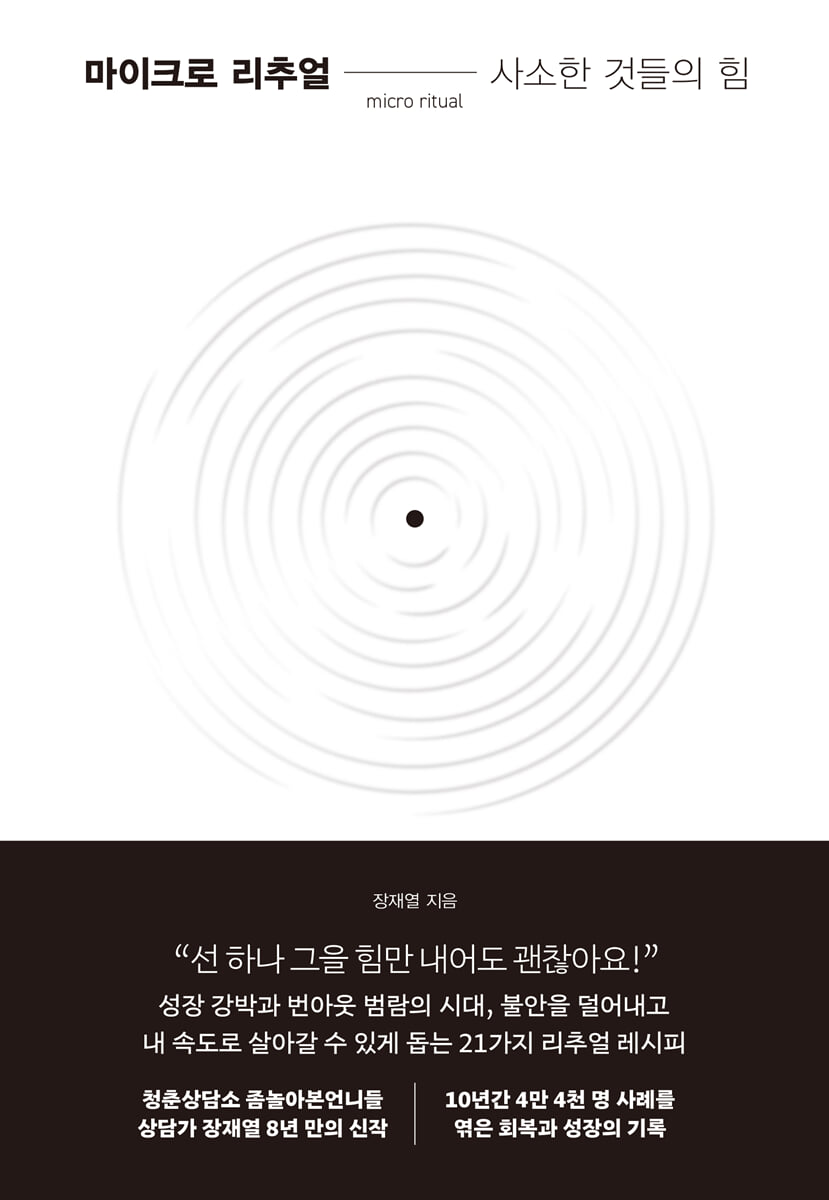
Micro Rituals: The Power of Little Things
 |
Description
Book Introduction
- A word from MD
-
The power of small things that change meIt's a time when you feel like you'll fall behind if you stop, and even if you work hard, you'll stay in the same place.
For those who experience anxiety and burnout on a daily basis, this book contains 21 ways to recover through small habits.
I hope you can feel yourself changing little by little with simple habits such as micro-walking for 2-3 minutes per 100 meters, copying one page a day, or reading.
April 26, 2024. Self-Development PD Kim Sang-geun
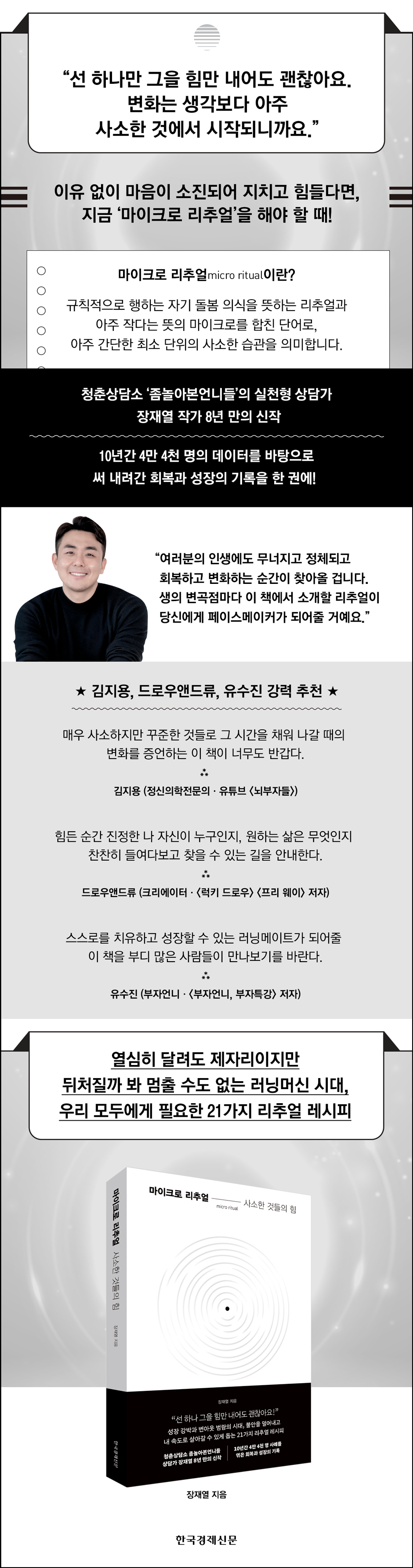
In an era of growth obsession and burnout,
Helps me reduce anxiety and live at my own pace
A book that will become your daily pacemaker
* A record of recovery and growth, compiled from 44,000 stories over 10 years.
* Recommended by psychiatrists Kim Ji-yong, Draw Andrew, and Yoo Su-jin
* 21 Ritual Guides Perfect for You
In this era of motivational obsession—where we believe we must succeed, work harder, and show more—and where the keywords "growth" and "burnout" are simultaneously on the rise, are you maintaining your center? Are you living at your own pace? Jang Jae-yeol, a Seoul National University and corporate graduate, is the head counselor of the non-profit youth counseling center "Some Fun Sisters," a youth mentor who delves into the inner struggles of the MZ generation, a columnist, bestselling author, and broadcaster.
As he wraps up his career over the past 10 years, he looks back on the burnout experiences he personally endured at different times and the many psychological issues that people around him have overcome and overcome through counseling. He has compiled the healing processes and published a book that tells the story of 'How to recover and live today.'
Based on actual raw data accumulated over 10 years by meeting 44,000 people, this book encourages you to create very simple, minimal habits through small but reliable 'self-rituals' that can help you take care of your inner self, so that you can always look at them when you feel physically and mentally exhausted or when your mind is anxious and wavering.
Helps me reduce anxiety and live at my own pace
A book that will become your daily pacemaker
* A record of recovery and growth, compiled from 44,000 stories over 10 years.
* Recommended by psychiatrists Kim Ji-yong, Draw Andrew, and Yoo Su-jin
* 21 Ritual Guides Perfect for You
In this era of motivational obsession—where we believe we must succeed, work harder, and show more—and where the keywords "growth" and "burnout" are simultaneously on the rise, are you maintaining your center? Are you living at your own pace? Jang Jae-yeol, a Seoul National University and corporate graduate, is the head counselor of the non-profit youth counseling center "Some Fun Sisters," a youth mentor who delves into the inner struggles of the MZ generation, a columnist, bestselling author, and broadcaster.
As he wraps up his career over the past 10 years, he looks back on the burnout experiences he personally endured at different times and the many psychological issues that people around him have overcome and overcome through counseling. He has compiled the healing processes and published a book that tells the story of 'How to recover and live today.'
Based on actual raw data accumulated over 10 years by meeting 44,000 people, this book encourages you to create very simple, minimal habits through small but reliable 'self-rituals' that can help you take care of your inner self, so that you can always look at them when you feel physically and mentally exhausted or when your mind is anxious and wavering.
- You can preview some of the book's contents.
Preview
index
Prologue_To you who live in the era of the treadmill
Chapter 1.
Micro-Rituals: Recovery Begins with the Smallest Things
1.
In an age where even psychologists feel left behind, do you know about the ethics of rest?
2.
I just lived hard for fear of falling behind
3.
Where does the strength to rise again come from?
Ritual Recipe 1: Writing a Q&A
Ritual Recipe 2 Micro Walk
4.
Living alone means I have to welcome myself.
Ritual Recipe 3: What I Can Do in the Morning for My Evening Self
5.
The heart breaks and rises again over the smallest things.
Ritual Recipe 4: The Power to Break Free from Lethargy: Micro-Rituals
6.
A look at the professions with the highest incidence of burnout reveals the algorithm for burnout.
7.
The mind needs a bath too
Ritual Recipe 5: One Sheet a Day, Copying My Heart
Ritual Recipe 6, One Page a Day, Random Reading
8.
Recovery, a two-person triad between doctor and patient
Ritual Recipes 7 Daily Checklist, Mental Weather
9.
1 hour vs 167 hours
Ritual Recipe 8: Bringing Good People Back to Me: 'Saengjeokka'
Chapter 2.
Mind Balancing: Finding a Centered Mind Free from Anxiety
1.
Anxiety leads to burnout again
2.
Just as flowers bloom at different times,
3.
Not a temporary recovery, but a permanent recovery
Ritual Recipe 9: Is My Recovery Mode Conditional or Constant?
4.
Avoidance, immersion, confrontation
Ritual Recipe 10: Self-Awareness Check
Ritual Recipe 11: The Self-Esteem Chalkboard That Saves Me
5.
Team Leader Phobia: People who are anxious about becoming a team leader
6.
Not everyone wants a life of growth.
Ritual Recipe 12 Instructions for Use, Introduction to Existence
7.
Meditation should be something you can do even in the bathroom.
Ritual Recipe 13: Laughter, Smile Meditation to Start Your Day
8.
Working moms, to those who can't even spare 10 minutes a day
Ritual Recipe 14: Meditation and Body Scan: The More Sleepy You Are, the More Successful You'll Be
9.
Is there any way to stop anxiety?
Ritual Recipe 15: Practice Being Present, Mindfulness Bell
Chapter 3.
A small habit just for me_From recovery to growth
1.
The story of 39-year-old Jang Jae-yeol, who cried out loud at a samgyetang restaurant on the first day of the hottest days of summer.
2.
Can I climb further by hitting my already tired thighs?
3.
The Usefulness of the Most Useless
Ritual Recipe 16: Discovering Unproductive Desires
4.
What matters is how consistent you are with your day.
5.
Hello? Morning Friends
Ritual Recipe 17 Today's Emotional Word
Ritual Recipe 18: Setting the Morning Imprint Effect: Your First Words
6.
The illusion of dominoes of misfortune
Ritual Recipe 19: Positive Interpretation Practice Writing
7.
Beyond recovery to growth
Ritual Recipe 20: Prayer for Others
8.
Ritual Cheat Day: The Right to Choose Not to Do It
9.
A life that is more than satisfactory
10.
To get out of the swamp of emotions
Ritual Recipe 21: Migosa, the Self-Care
11.
I like it because it's a noisy country
Epilogue_Like a small umbrella tucked under your arm
Appendix_Designing Your Own Ritual: 4W Plan Worksheet
Chapter 1.
Micro-Rituals: Recovery Begins with the Smallest Things
1.
In an age where even psychologists feel left behind, do you know about the ethics of rest?
2.
I just lived hard for fear of falling behind
3.
Where does the strength to rise again come from?
Ritual Recipe 1: Writing a Q&A
Ritual Recipe 2 Micro Walk
4.
Living alone means I have to welcome myself.
Ritual Recipe 3: What I Can Do in the Morning for My Evening Self
5.
The heart breaks and rises again over the smallest things.
Ritual Recipe 4: The Power to Break Free from Lethargy: Micro-Rituals
6.
A look at the professions with the highest incidence of burnout reveals the algorithm for burnout.
7.
The mind needs a bath too
Ritual Recipe 5: One Sheet a Day, Copying My Heart
Ritual Recipe 6, One Page a Day, Random Reading
8.
Recovery, a two-person triad between doctor and patient
Ritual Recipes 7 Daily Checklist, Mental Weather
9.
1 hour vs 167 hours
Ritual Recipe 8: Bringing Good People Back to Me: 'Saengjeokka'
Chapter 2.
Mind Balancing: Finding a Centered Mind Free from Anxiety
1.
Anxiety leads to burnout again
2.
Just as flowers bloom at different times,
3.
Not a temporary recovery, but a permanent recovery
Ritual Recipe 9: Is My Recovery Mode Conditional or Constant?
4.
Avoidance, immersion, confrontation
Ritual Recipe 10: Self-Awareness Check
Ritual Recipe 11: The Self-Esteem Chalkboard That Saves Me
5.
Team Leader Phobia: People who are anxious about becoming a team leader
6.
Not everyone wants a life of growth.
Ritual Recipe 12 Instructions for Use, Introduction to Existence
7.
Meditation should be something you can do even in the bathroom.
Ritual Recipe 13: Laughter, Smile Meditation to Start Your Day
8.
Working moms, to those who can't even spare 10 minutes a day
Ritual Recipe 14: Meditation and Body Scan: The More Sleepy You Are, the More Successful You'll Be
9.
Is there any way to stop anxiety?
Ritual Recipe 15: Practice Being Present, Mindfulness Bell
Chapter 3.
A small habit just for me_From recovery to growth
1.
The story of 39-year-old Jang Jae-yeol, who cried out loud at a samgyetang restaurant on the first day of the hottest days of summer.
2.
Can I climb further by hitting my already tired thighs?
3.
The Usefulness of the Most Useless
Ritual Recipe 16: Discovering Unproductive Desires
4.
What matters is how consistent you are with your day.
5.
Hello? Morning Friends
Ritual Recipe 17 Today's Emotional Word
Ritual Recipe 18: Setting the Morning Imprint Effect: Your First Words
6.
The illusion of dominoes of misfortune
Ritual Recipe 19: Positive Interpretation Practice Writing
7.
Beyond recovery to growth
Ritual Recipe 20: Prayer for Others
8.
Ritual Cheat Day: The Right to Choose Not to Do It
9.
A life that is more than satisfactory
10.
To get out of the swamp of emotions
Ritual Recipe 21: Migosa, the Self-Care
11.
I like it because it's a noisy country
Epilogue_Like a small umbrella tucked under your arm
Appendix_Designing Your Own Ritual: 4W Plan Worksheet
Detailed image
Into the book
A ritual is a simple act of caring for your body and mind that you set aside every day and repeat.
Making the bed, walking barefoot, meditating, anything is fine.
It looks similar to a routine, but it's a little different.
Unlike routines that have various purposes, such as skin care routines, health routines, and self-improvement routines, rituals clearly focus on 'centering my mind.'
A ritual is a habit of taking care of your mind for 5 to 10 minutes a day, tailored to your specific goals.
It mainly consists of very small actions that we commonly do in our daily lives.
But the process of finding your own ritual is not trivial.
Rather, it is special, like having a custom-made suit made.
This is because it is a very active journey of self-exploration, where among the countless daily actions, you find out what 'calms your mind', verify for yourself whether it actually works for you, and design a time to do it.
--- p.20~21
“Do you know what occupation ranks first in our society when it comes to burnout?”
"well….
“Service industry?”
“No, I’m a housewife.
Do you know why?”
“Really? I don’t know.
“I understand that mothers have a hard time, but why is it ranked the highest…?”
The correct answer is that housewives are the group that receives the least compensation for the amount of work they do.
In other words, burnout is not a concept determined simply by how 'hard' one lives.
Just as an imbalance in the body can cause knee damage without overexertion, an imbalance in the mind can lead to burnout without overexertion.
That balance is the balance between the amount of work and the compensation.
In other words, if the situation of not receiving compensation commensurate with the amount of work you do continues for a long time, you will gradually become tired of just daily life, and when you pass the critical point, burnout will set in.
--- p.69~70
Unlike the body, when the mind is not feeling well, it is not easy to think of places where you can receive light care, such as a pharmacy or a bathhouse.
Are there any places that come to mind besides psychiatry or psychological counseling centers? Not many, I'm sure.
Compared to physical health, mental health does not yet have a diverse treatment system.
But one day, three gentlemen who pushed the time in my heart appeared.
This is a project called ‘Mind Bathhouse’ created by three young people in Mokpo, Jeollanam-do.
The people who plan and carry out this are called 'three judges'.
Instead of the character ‘身’ in the three gods that removes dirt from the body, the character ‘心’ was added to give it the meaning of removing dirt from the mind.
Isn't it fun?
--- p.74
Have you ever experienced something like this? It's so exhausting that you take a long vacation, only to return to work feeling like you've been through a lot.
Or maybe you felt something different and changed during a long trip after quitting your job, but then you started a new job and those realizations and changes gradually faded and you started feeling exhausted again.
Every time that happens, we think.
'Oh, I want to go again.' Traveling is such a great way to recover.
However, it is not suitable as the only means of recovery.
Because travel is a 'conditional recovery'.
Once we become accustomed to these conditional recoveries, we may feel lost about how to de-stress and re-energize when the conditions are no longer met.
The opposing view is 'permanent recovery'.
It's a recovery that you can do, whether you have money or not, or whether you have a lot of time or a little.
Once we become familiar with this, we can pull it out and use it in any stressful situation we find ourselves in.
--- p.118~119
I realized that if I wanted to truly help my friend, I needed to teach him how to "cut the pulse" on his brain, which was constantly producing anxiety, rather than just listening to his anxieties and making them worse.
So I asked one question.
“You don’t know about cognitive behavioral therapy?”
In cognitive behavioral therapy, there is a concept called 'thought stopping'.
It literally makes you stop thinking.
A representative example is the rubber band technique.
When you wear a rubber band on your wrist and feel obsessed or anxious, you pull and release the rubber band, causing pain.
It's an attempt to stop thinking through an 'external stimulus' called pain.
When you are consumed by anxiety and find yourself thinking endlessly, it breaks your pulse!
--- p.168~169
"The purpose of a ritual is ultimately to make me feel at ease, so on days when I don't want to do something, isn't the act of 'not doing it' itself a ritual in itself?" Doesn't that resonate with you? Ultimately, the specific emotions each person desires will vary, but ultimately, rituals are about having a 'positive influence' on yourself.
So, on days when you don't want to do it or don't think you can do it, skip a day or so.
And not feeling guilty about it is also a form of self-care, a 'ritual'.
Since that day, I have made three tickets.
Even in rituals, cheat days are created.
If you feel like you can't do it today, instead of thinking, "Today is a failure," think, "Today is a cheat day."
It gives you the right to choose not to do something.
Okay, how many do you need?
Making the bed, walking barefoot, meditating, anything is fine.
It looks similar to a routine, but it's a little different.
Unlike routines that have various purposes, such as skin care routines, health routines, and self-improvement routines, rituals clearly focus on 'centering my mind.'
A ritual is a habit of taking care of your mind for 5 to 10 minutes a day, tailored to your specific goals.
It mainly consists of very small actions that we commonly do in our daily lives.
But the process of finding your own ritual is not trivial.
Rather, it is special, like having a custom-made suit made.
This is because it is a very active journey of self-exploration, where among the countless daily actions, you find out what 'calms your mind', verify for yourself whether it actually works for you, and design a time to do it.
--- p.20~21
“Do you know what occupation ranks first in our society when it comes to burnout?”
"well….
“Service industry?”
“No, I’m a housewife.
Do you know why?”
“Really? I don’t know.
“I understand that mothers have a hard time, but why is it ranked the highest…?”
The correct answer is that housewives are the group that receives the least compensation for the amount of work they do.
In other words, burnout is not a concept determined simply by how 'hard' one lives.
Just as an imbalance in the body can cause knee damage without overexertion, an imbalance in the mind can lead to burnout without overexertion.
That balance is the balance between the amount of work and the compensation.
In other words, if the situation of not receiving compensation commensurate with the amount of work you do continues for a long time, you will gradually become tired of just daily life, and when you pass the critical point, burnout will set in.
--- p.69~70
Unlike the body, when the mind is not feeling well, it is not easy to think of places where you can receive light care, such as a pharmacy or a bathhouse.
Are there any places that come to mind besides psychiatry or psychological counseling centers? Not many, I'm sure.
Compared to physical health, mental health does not yet have a diverse treatment system.
But one day, three gentlemen who pushed the time in my heart appeared.
This is a project called ‘Mind Bathhouse’ created by three young people in Mokpo, Jeollanam-do.
The people who plan and carry out this are called 'three judges'.
Instead of the character ‘身’ in the three gods that removes dirt from the body, the character ‘心’ was added to give it the meaning of removing dirt from the mind.
Isn't it fun?
--- p.74
Have you ever experienced something like this? It's so exhausting that you take a long vacation, only to return to work feeling like you've been through a lot.
Or maybe you felt something different and changed during a long trip after quitting your job, but then you started a new job and those realizations and changes gradually faded and you started feeling exhausted again.
Every time that happens, we think.
'Oh, I want to go again.' Traveling is such a great way to recover.
However, it is not suitable as the only means of recovery.
Because travel is a 'conditional recovery'.
Once we become accustomed to these conditional recoveries, we may feel lost about how to de-stress and re-energize when the conditions are no longer met.
The opposing view is 'permanent recovery'.
It's a recovery that you can do, whether you have money or not, or whether you have a lot of time or a little.
Once we become familiar with this, we can pull it out and use it in any stressful situation we find ourselves in.
--- p.118~119
I realized that if I wanted to truly help my friend, I needed to teach him how to "cut the pulse" on his brain, which was constantly producing anxiety, rather than just listening to his anxieties and making them worse.
So I asked one question.
“You don’t know about cognitive behavioral therapy?”
In cognitive behavioral therapy, there is a concept called 'thought stopping'.
It literally makes you stop thinking.
A representative example is the rubber band technique.
When you wear a rubber band on your wrist and feel obsessed or anxious, you pull and release the rubber band, causing pain.
It's an attempt to stop thinking through an 'external stimulus' called pain.
When you are consumed by anxiety and find yourself thinking endlessly, it breaks your pulse!
--- p.168~169
"The purpose of a ritual is ultimately to make me feel at ease, so on days when I don't want to do something, isn't the act of 'not doing it' itself a ritual in itself?" Doesn't that resonate with you? Ultimately, the specific emotions each person desires will vary, but ultimately, rituals are about having a 'positive influence' on yourself.
So, on days when you don't want to do it or don't think you can do it, skip a day or so.
And not feeling guilty about it is also a form of self-care, a 'ritual'.
Since that day, I have made three tickets.
Even in rituals, cheat days are created.
If you feel like you can't do it today, instead of thinking, "Today is a failure," think, "Today is a cheat day."
It gives you the right to choose not to do something.
Okay, how many do you need?
--- p.231~232
Publisher's Review
“It’s okay if you just have the strength to draw a line!”
In the treadmill era, the key is to cultivate a tireless mindset.
We recommend 'micro-rituals', the smallest unit of practice that can change your life!
“I was an ordinary office worker at a large fashion company, but I opened a writing therapy blog to help me overcome my burnout and depression.
A year later, 30,000 people subscribed and started sending letters.
In the process, I came to think that there are many people who are in a similar state of mind as me.
People who are anxious about falling behind if they stop, people who are completely exhausted but have no one to tell, people who are running with all their might but ultimately lose their direction...
As I continued to respond to letters from those who resembled me, I soon found myself as the head of a mental health NGO called “Youth Counseling Center for Some Fun Sisters,” and became a counselor for my friends living in the same era.”
A person who, despite possessing world-renowned credentials like "Seoul National University and Samsung," took a break from his unhappy life and accepted the "off" signal. A person who started a self-questioning blog to solve his own worries, and the blog has become a seed that has now become a counselor for young people in their 20s and 30s.
The author, who has been a counselor for 10 years since starting the NGO 'Some Playful Sisters' youth counseling center in 2013, has been doing many activities, big and small, to become a practical counselor who goes beyond comforting and empathizing with the MZ generation who are struggling and in pain and helps them in their lives.
This book is also the result of such activities.
The author says that, looking back on his activities over the past ten years, he discovered that our society resembles the 'treadmill era'.
It's an ironic era where we run so hard that we can't stop for fear of falling behind if we rest, but even if we run, we can barely make it to the same place. So we focus even more on growth and self-development, but the more we do, the more our burnout and anxiety grow.
He asks, if we cannot easily change the flow and current of the times, shouldn't we now take the time to center our minds?
In these times, isn't it more important to learn how to 'not get tired' and 'recover properly' on the treadmill than to learn how to succeed?
“5 minutes a day, the time when you become the most yourself in your daily life!”
A very small and simple mind recovery method that helps me help myself every day.
21 Ritual Recipes to Live Today, Recover, and Move Forward
“A ritual is a conscious habit that may seem trivial, but if practiced consistently, it can bring about big changes in life.
It is not a task that you have to check every day like a routine, but rather a 'very small action' that you can unconsciously get into your body.
The reason I started focusing on the little things was because of one thing I discovered while counseling countless people about their concerns.
'Surprisingly, life falls apart because of very small things, but it also changes because of very small things.'
“I wanted to show the power of the small but big waves that naturally permeate our daily lives, even if they are not noticeable.”
The author shares his honest and unvarnished account of three burnouts he personally experienced, and suggests small rituals, micro-rituals, that he has personally practiced with many people in his daily life.
This is a portmanteau of “micro,” meaning very small, and “ritual,” meaning a regular self-care ritual. It refers to very small things that you can do for yourself on a regular basis every day, such that you can say, “This is nothing!”
For example, starting small with things like drawing a single line on a piece of paper or a notepad on your phone, opening any book and reading only the line that catches your eye, or giving yourself a 'thumbs up' after showering, it goes on to detail ritual methods that are enough to arouse curiosity just with keywords such as self-questioning writing, micro-walks, introducing one's existence, smiling meditation, body scans, mental weather, and self-esteem chalkboards.
What's interesting is that all of these methods are based on the author's own experiences in real life or while counseling clients.
It reminds me that even something as simple as making my bed in the morning for my evening self, or a short meditation that I can do in the bathroom, can be enough to create a catalyst for change in my daily life.
The 21 ritual recipes, applicable to different situations and emotions, are presented in a specific and practical self-workbook format that encourages the will to practice, making them even more useful.
From essays to psychological counseling and self-workbooks
From caring for and caring for myself to praying for others.
A journey to reclaim the power of self-reliance within me
“I truly feel that life is not what I want it to be.
There will be days when it thunders and lightning again.
There will be days when it rains heavily.
I think that as we go into new territory, we will probably face much stronger storms.
But I'm not as worried as I used to be.
Now, as I walk through life, I carry in my backpack a small umbrella called 'Ritual'.
I wanted to give this umbrella to each of you who are walking your own path in life.
I hope this book will be a companion that you can keep by your side, and that you can take out at every turning point in your life.”
This is precisely why the author has so honestly told his story.
In particular, burnout is not something that only special people who have worked hard experience, but can be experienced by anyone. Therefore, I hope that it can be an immediate therapy that can help people deal with unstable psychological issues that anyone can experience at least once with just a little change in behavior.
This book paradoxically states that in an age where things like how to succeed and how to become rich are in the spotlight, the path to growth is to live steadily and tirelessly, even if it is slow and steady, at one's own pace.
Instead of blaming myself for not working hard enough, I look at myself fully, even though I may have a glass body and glass mentality.
Rather than following the standards set by society or the standards of success that others look up to, hold on to a small cornerstone in your heart, center yourself, and steadily move forward at your own pace.
Isn't that perhaps the most essential virtue in our lives, living in an age of unstoppable treadmills?
In a very kind and approachable tone, the author helps our bodies and minds to heal and grow together.
A self-care and self-development book that will help you find the answers that are right for you as you listen carefully to the psychological counseling episodes that will make you say, "That's right, that's exactly my story."
Through this book, I encourage you to design habits of self-reflection for 5 to 10 minutes a day, tailored to your situation and purpose, and to develop the self-reliance to overcome the difficult yesterday and live today.
Like a small umbrella tucked away at your side to avoid the rain at any time, it will serve as a reliable guide to prepare for the unpredictable weather of life where you cannot predict even an inch ahead.
In the treadmill era, the key is to cultivate a tireless mindset.
We recommend 'micro-rituals', the smallest unit of practice that can change your life!
“I was an ordinary office worker at a large fashion company, but I opened a writing therapy blog to help me overcome my burnout and depression.
A year later, 30,000 people subscribed and started sending letters.
In the process, I came to think that there are many people who are in a similar state of mind as me.
People who are anxious about falling behind if they stop, people who are completely exhausted but have no one to tell, people who are running with all their might but ultimately lose their direction...
As I continued to respond to letters from those who resembled me, I soon found myself as the head of a mental health NGO called “Youth Counseling Center for Some Fun Sisters,” and became a counselor for my friends living in the same era.”
A person who, despite possessing world-renowned credentials like "Seoul National University and Samsung," took a break from his unhappy life and accepted the "off" signal. A person who started a self-questioning blog to solve his own worries, and the blog has become a seed that has now become a counselor for young people in their 20s and 30s.
The author, who has been a counselor for 10 years since starting the NGO 'Some Playful Sisters' youth counseling center in 2013, has been doing many activities, big and small, to become a practical counselor who goes beyond comforting and empathizing with the MZ generation who are struggling and in pain and helps them in their lives.
This book is also the result of such activities.
The author says that, looking back on his activities over the past ten years, he discovered that our society resembles the 'treadmill era'.
It's an ironic era where we run so hard that we can't stop for fear of falling behind if we rest, but even if we run, we can barely make it to the same place. So we focus even more on growth and self-development, but the more we do, the more our burnout and anxiety grow.
He asks, if we cannot easily change the flow and current of the times, shouldn't we now take the time to center our minds?
In these times, isn't it more important to learn how to 'not get tired' and 'recover properly' on the treadmill than to learn how to succeed?
“5 minutes a day, the time when you become the most yourself in your daily life!”
A very small and simple mind recovery method that helps me help myself every day.
21 Ritual Recipes to Live Today, Recover, and Move Forward
“A ritual is a conscious habit that may seem trivial, but if practiced consistently, it can bring about big changes in life.
It is not a task that you have to check every day like a routine, but rather a 'very small action' that you can unconsciously get into your body.
The reason I started focusing on the little things was because of one thing I discovered while counseling countless people about their concerns.
'Surprisingly, life falls apart because of very small things, but it also changes because of very small things.'
“I wanted to show the power of the small but big waves that naturally permeate our daily lives, even if they are not noticeable.”
The author shares his honest and unvarnished account of three burnouts he personally experienced, and suggests small rituals, micro-rituals, that he has personally practiced with many people in his daily life.
This is a portmanteau of “micro,” meaning very small, and “ritual,” meaning a regular self-care ritual. It refers to very small things that you can do for yourself on a regular basis every day, such that you can say, “This is nothing!”
For example, starting small with things like drawing a single line on a piece of paper or a notepad on your phone, opening any book and reading only the line that catches your eye, or giving yourself a 'thumbs up' after showering, it goes on to detail ritual methods that are enough to arouse curiosity just with keywords such as self-questioning writing, micro-walks, introducing one's existence, smiling meditation, body scans, mental weather, and self-esteem chalkboards.
What's interesting is that all of these methods are based on the author's own experiences in real life or while counseling clients.
It reminds me that even something as simple as making my bed in the morning for my evening self, or a short meditation that I can do in the bathroom, can be enough to create a catalyst for change in my daily life.
The 21 ritual recipes, applicable to different situations and emotions, are presented in a specific and practical self-workbook format that encourages the will to practice, making them even more useful.
From essays to psychological counseling and self-workbooks
From caring for and caring for myself to praying for others.
A journey to reclaim the power of self-reliance within me
“I truly feel that life is not what I want it to be.
There will be days when it thunders and lightning again.
There will be days when it rains heavily.
I think that as we go into new territory, we will probably face much stronger storms.
But I'm not as worried as I used to be.
Now, as I walk through life, I carry in my backpack a small umbrella called 'Ritual'.
I wanted to give this umbrella to each of you who are walking your own path in life.
I hope this book will be a companion that you can keep by your side, and that you can take out at every turning point in your life.”
This is precisely why the author has so honestly told his story.
In particular, burnout is not something that only special people who have worked hard experience, but can be experienced by anyone. Therefore, I hope that it can be an immediate therapy that can help people deal with unstable psychological issues that anyone can experience at least once with just a little change in behavior.
This book paradoxically states that in an age where things like how to succeed and how to become rich are in the spotlight, the path to growth is to live steadily and tirelessly, even if it is slow and steady, at one's own pace.
Instead of blaming myself for not working hard enough, I look at myself fully, even though I may have a glass body and glass mentality.
Rather than following the standards set by society or the standards of success that others look up to, hold on to a small cornerstone in your heart, center yourself, and steadily move forward at your own pace.
Isn't that perhaps the most essential virtue in our lives, living in an age of unstoppable treadmills?
In a very kind and approachable tone, the author helps our bodies and minds to heal and grow together.
A self-care and self-development book that will help you find the answers that are right for you as you listen carefully to the psychological counseling episodes that will make you say, "That's right, that's exactly my story."
Through this book, I encourage you to design habits of self-reflection for 5 to 10 minutes a day, tailored to your situation and purpose, and to develop the self-reliance to overcome the difficult yesterday and live today.
Like a small umbrella tucked away at your side to avoid the rain at any time, it will serve as a reliable guide to prepare for the unpredictable weather of life where you cannot predict even an inch ahead.
GOODS SPECIFICS
- Date of issue: April 25, 2024
- Page count, weight, size: 272 pages | 458g | 145*210*16mm
- ISBN13: 9788947549509
- ISBN10: 8947549509
You may also like
카테고리
korean


korean

![ELLE 엘르 스페셜 에디션 A형 : 12월 [2025]](http://librairie.coreenne.fr/cdn/shop/files/b8e27a3de6c9538896439686c6b0e8fb.jpg?v=1766436872&width=3840)


