

The Essential Han River
 |
Description
Book Introduction
The Essential Han River
Discover author Han Kang's novels, short stories, poetry, and prose in one volume!
A special edition of 'The Essential', curated and compiled into one volume the author's core works.
The Essential Korean Writers, published by Munhakdongne, selects writers who have created a sensation in Korean literature, offering readers an intense reading experience under the keyword "sensation."
We hope that you will enjoy 'The Essential Korean Writers', which has been selected based on a comprehensive overview of the author's works and has a new cover and editing, as a first book to introduce you to Korean literature or as an opportunity to rediscover Korean writers.
The first author is Han Kang.
Since her literary debut in 1993, author Han Kang has written works across a variety of genres for the past 30 years that confront the fundamental questions literature poses about life: how do people trust and love one another? Why is the world so beautiful and yet so cruel? What can humans do in the face of loss and pain?
In addition to novels and poetry, he has consistently published fairy tales for adults, prose collections that include songs and writings he created and sang himself, and collections of works that combine poetry and novels.
In addition, he continued to work on visual performances through media art, expanding his space beyond text.
He is the first Korean to win the International Booker Prize and the first Asian writer to be selected to participate in Norway's "Library of the Future" project. He has become a sensation and symbol of Korean literature beyond national borders, and we present him as the first writer in "The Essential Korean Writer Edition."
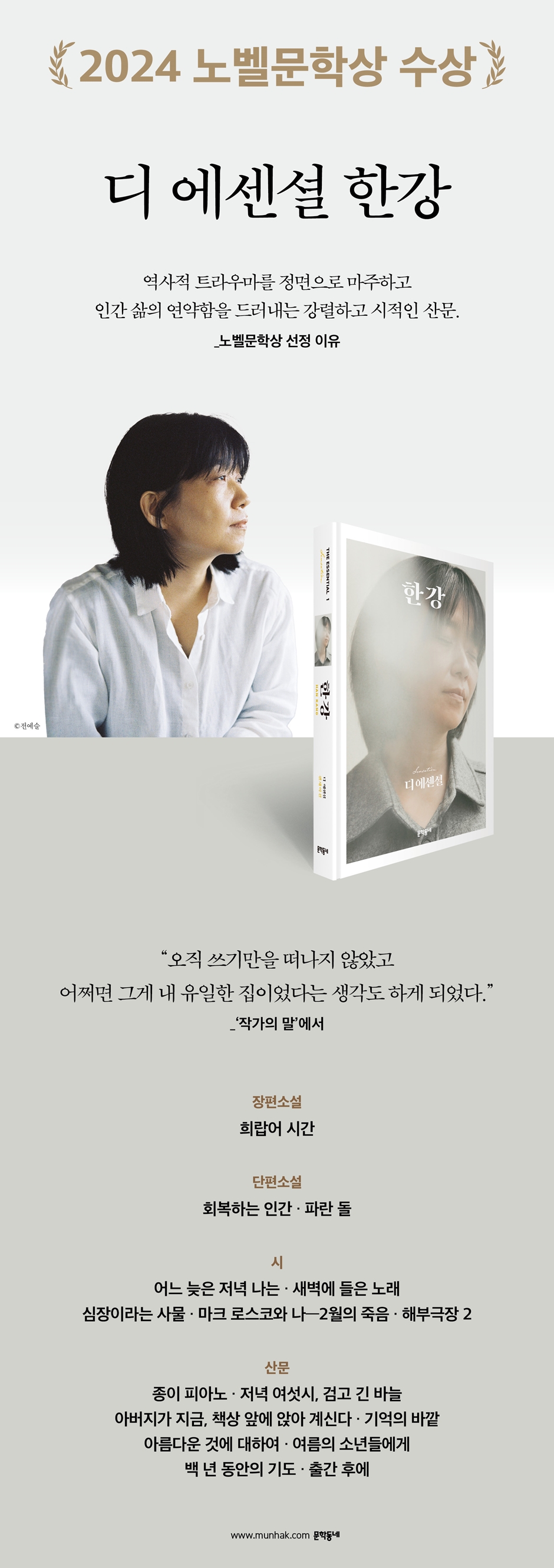
『The Essential Han River』 contains the novel 『Greek Time』, two short stories 『Recovering Human』 and 『Blue Stone』, five poems, and eight prose pieces.
These works condense the aesthetics of Han Kang's novels, which are "a ray of light encountered by those who live with the pain of loss."
I hope that through the diverse genres of works presented in one volume, we will be able to better understand the literary map that the author is creating.
The old me is more like someone I resemble than someone who is the same as me.
While reading the proofs, I felt like I was silently with that person(s).
Perhaps because of the presence of the horse in my fortune, I moved around a lot, but I never left my writing, and I even thought that maybe that was my only home.
Discover author Han Kang's novels, short stories, poetry, and prose in one volume!
A special edition of 'The Essential', curated and compiled into one volume the author's core works.
The Essential Korean Writers, published by Munhakdongne, selects writers who have created a sensation in Korean literature, offering readers an intense reading experience under the keyword "sensation."
We hope that you will enjoy 'The Essential Korean Writers', which has been selected based on a comprehensive overview of the author's works and has a new cover and editing, as a first book to introduce you to Korean literature or as an opportunity to rediscover Korean writers.
The first author is Han Kang.
Since her literary debut in 1993, author Han Kang has written works across a variety of genres for the past 30 years that confront the fundamental questions literature poses about life: how do people trust and love one another? Why is the world so beautiful and yet so cruel? What can humans do in the face of loss and pain?
In addition to novels and poetry, he has consistently published fairy tales for adults, prose collections that include songs and writings he created and sang himself, and collections of works that combine poetry and novels.
In addition, he continued to work on visual performances through media art, expanding his space beyond text.
He is the first Korean to win the International Booker Prize and the first Asian writer to be selected to participate in Norway's "Library of the Future" project. He has become a sensation and symbol of Korean literature beyond national borders, and we present him as the first writer in "The Essential Korean Writer Edition."
『The Essential Han River』 contains the novel 『Greek Time』, two short stories 『Recovering Human』 and 『Blue Stone』, five poems, and eight prose pieces.
These works condense the aesthetics of Han Kang's novels, which are "a ray of light encountered by those who live with the pain of loss."
I hope that through the diverse genres of works presented in one volume, we will be able to better understand the literary map that the author is creating.
The old me is more like someone I resemble than someone who is the same as me.
While reading the proofs, I felt like I was silently with that person(s).
Perhaps because of the presence of the horse in my fortune, I moved around a lot, but I never left my writing, and I even thought that maybe that was my only home.
- You can preview some of the book's contents.
Preview
index
novel
Greek time
Short stories
recovering human
blue stone
city
One late evening I
A song I heard at dawn
The thing called heart
Mark Rothko and I - Death in February
Anatomy Theater 2
prose
paper piano
Six o'clock in the evening, long black needle
My father is sitting at his desk right now.
Outside of Memory
About Beautiful Things - In memory of Professor Choi In-ho
To the boys of summer
A Hundred Years of Prayer - Participating in the Future Library Project
After publication
Greek time
Short stories
recovering human
blue stone
city
One late evening I
A song I heard at dawn
The thing called heart
Mark Rothko and I - Death in February
Anatomy Theater 2
prose
paper piano
Six o'clock in the evening, long black needle
My father is sitting at his desk right now.
Outside of Memory
About Beautiful Things - In memory of Professor Choi In-ho
To the boys of summer
A Hundred Years of Prayer - Participating in the Future Library Project
After publication
Detailed image
Into the book
Back then, she had words, so her feelings would have been clearer and stronger.
But now there is no word in her body.
Words and sentences follow her like spirits, just close enough to be seen and heard.
Because of that distance, emotions that aren't strong enough quickly fall away like weak pieces of tape.
She just looks.
As you look, you don't translate anything you look at into words.
Images of other objects continued to form in her eyes, moving and disappearing as she walked.
As it is erased, it is never translated into any words.
---From "Greek Time"
I don't understand.
Now that you're dead, I feel like everything has fallen away from me.
Just because you died,
I feel like every memory I have is bleeding, rapidly becoming stained, rusting, crumbling.
---From "Greek Time"
When we return our life, the weakest, most fragile, and most lonely thing we have, to the material world, there will be no price paid for it.
When that moment comes, I don't think I'll ever be able to remember all the experiences I've had as being beautiful.
It is in such a shabby context that I believe I understand Plato.
He also knew that there was nothing beautiful.
The fact that nothing is perfect forever.
At least in this world.
---From "Greek Time"
Before that year passed, you asked her in her room late at night.
I really don't understand how people can live in a world of convention, how they can endure such a life.
Her face darkened slightly in the mirror as she removed her makeup with her back turned to you.
She looked into your eyes through the mirror and replied.
I think so, but I wonder if there are people who think it's fortunate that they can do that, that they can hide behind common sense.
---From "The Recovering Human"
I remember you saying, "The tree resembles you."
“Everything you draw is actually your self-portrait,” you added.
I spent the entire afternoon looking through your bookshelf, looking at your tree drawings.
I vaguely understood what you meant when I discovered the young, fragile trees Schiele had painted.
If all paintings are self-portraits, then I had a fleeting thought that a painting of a tree might be the most serene self-portrait a human being can draw.
---From "Blue Stone"
At some point, a moment comes when the child suddenly understands everything about his father.
That is the child's destiny.
Without questioning whether life really has to be that difficult.
Without complaint or pity.
Without any words or logic.
Without any tears welling up.
In just one moment.
---From "Father is sitting at the desk now"
But now, thirty years later, on the last page of this book, I reread it again, and I realized something as startling as if I had burned my palm in flames.
The meaning of the questions I asked myself at twelve, leaning against the wall of a darkening room, holding this book, not even knowing clearly what was burning my eyes and throat.
The fact that those questions still live vividly inside me, shaking me to my core.
How can they love so much? Why is the world around them so beautiful and yet so violent?
To my twelve-year-old self, I think I can finally speak, though only with some hesitation.
It is precisely because we love that we despair.
It is because we believe in dignity that we feel pain.
So, our suffering is the key and the strong seed.
But now there is no word in her body.
Words and sentences follow her like spirits, just close enough to be seen and heard.
Because of that distance, emotions that aren't strong enough quickly fall away like weak pieces of tape.
She just looks.
As you look, you don't translate anything you look at into words.
Images of other objects continued to form in her eyes, moving and disappearing as she walked.
As it is erased, it is never translated into any words.
---From "Greek Time"
I don't understand.
Now that you're dead, I feel like everything has fallen away from me.
Just because you died,
I feel like every memory I have is bleeding, rapidly becoming stained, rusting, crumbling.
---From "Greek Time"
When we return our life, the weakest, most fragile, and most lonely thing we have, to the material world, there will be no price paid for it.
When that moment comes, I don't think I'll ever be able to remember all the experiences I've had as being beautiful.
It is in such a shabby context that I believe I understand Plato.
He also knew that there was nothing beautiful.
The fact that nothing is perfect forever.
At least in this world.
---From "Greek Time"
Before that year passed, you asked her in her room late at night.
I really don't understand how people can live in a world of convention, how they can endure such a life.
Her face darkened slightly in the mirror as she removed her makeup with her back turned to you.
She looked into your eyes through the mirror and replied.
I think so, but I wonder if there are people who think it's fortunate that they can do that, that they can hide behind common sense.
---From "The Recovering Human"
I remember you saying, "The tree resembles you."
“Everything you draw is actually your self-portrait,” you added.
I spent the entire afternoon looking through your bookshelf, looking at your tree drawings.
I vaguely understood what you meant when I discovered the young, fragile trees Schiele had painted.
If all paintings are self-portraits, then I had a fleeting thought that a painting of a tree might be the most serene self-portrait a human being can draw.
---From "Blue Stone"
At some point, a moment comes when the child suddenly understands everything about his father.
That is the child's destiny.
Without questioning whether life really has to be that difficult.
Without complaint or pity.
Without any words or logic.
Without any tears welling up.
In just one moment.
---From "Father is sitting at the desk now"
But now, thirty years later, on the last page of this book, I reread it again, and I realized something as startling as if I had burned my palm in flames.
The meaning of the questions I asked myself at twelve, leaning against the wall of a darkening room, holding this book, not even knowing clearly what was burning my eyes and throat.
The fact that those questions still live vividly inside me, shaking me to my core.
How can they love so much? Why is the world around them so beautiful and yet so violent?
To my twelve-year-old self, I think I can finally speak, though only with some hesitation.
It is precisely because we love that we despair.
It is because we believe in dignity that we feel pain.
So, our suffering is the key and the strong seed.
---From "To the Boys of Summer"
Publisher's Review
The novel "Greek Lessons"
There is silence and darkness between the man and woman who met as students and instructors of the Greek language class.
A story of a moment where the silence of a woman losing her voice and the light of a man losing his eyes meet.
It is also a story of people who face each other for just a moment in their fading lives.
Like Greek, the oldest and most solid language on Earth, this novel uses carefully chosen, restrained words to see, feel, and express the world. Through this novel, we witness a scene where things that existed long ago, moments that seem eternal, meet in one place.
Here, you can encounter the essence of Han Kang's world of work, which persistently contemplates the essence of hope that can save humanity, as well as the essence of language and art.
Now I know, because foolishness destroyed that time and destroyed itself.
If we had really lived together, I wouldn't have needed your voice after I went blind.
As the visible world slowly recedes like an ebb tide, our silence will also gradually become complete.
_『Greek Hours』, p. 53
Short stories "The Recovering Man" and "The Blue Stone"
Two short stories that reflect the author's reflections on the question, "How can humans recover?"
Through the process of physical and mental wounds and their recovery, we meet characters who move from death to life, from darkness to light.
Just as new flesh grows on a wound, “time heals everything.”
They console each other by saying, “Everyone gets better,” and, drawing a picture of another time outside of time, they slowly, wholeheartedly move towards life.
You don't know.
I don't know that I will wake up in the cold dawn with a dry throat, my eyes drenched from a dream I can't remember, and look into the mirror above the sink.
You don't know that your hand will keep shaking as you pour cold water on your face.
They don't know that words they've never spoken will sting their throats like hot skewers.
I can't see ahead either.
I always couldn't see ahead.
I just held on.
I just tried to hold on because I felt anxious if I didn't try even for a moment.
_「Recovering Humans」, p. 241
At that time, the thought that perhaps time does not flow also came to me.
So, if we go back to that time, you and I are listening to the sound of rain.
You didn't go anywhere.
It didn't disappear or leave.
That's why, from some point on, whenever I met a man of the same age as you, I started to vaguely picture your face, which must have changed over time.
_「Blue Stone」, p. 271
Poem "One Late Evening I" and 4 others
Author Han Kang began her full-fledged creative career in 1993 when her poem was published in the winter issue of the quarterly magazine Literature and Society and her short story was selected for publication in the Seoul Shinmun the following year. She also wrote and published poetry in between writing novels.
In 2013, he published his first poetry collection, “I Put Dinner in a Drawer,” and five poems from it were selected and included in this issue of “The Essential Hangang.”
“Late Evening Me,” “A Song I Heard at Dawn,” “The Thing Called the Heart,” “Mark Rothko and I—Death in February,” and “The Anatomy Theater 2” are just some of the titles, and you can feel the sentiment of the poem just by looking at them.
From loneliness and sorrow, life and death, the time of deepening dusk, and even the moments of joy that emerge in between, the fierce battle of the soul that rages within the author shines gently through refined language.
Prose "Paper Piano" and seven other works
From childhood memories to recollections of loved ones and the meaning of writing, the eight prose pieces are imbued with the soft voice of author Han Kang.
You can hear the author's intimate voice in "To the Boys of Summer," which contains memories of Gwangju in 1980 and anecdotes from the time he was writing "The Boy Comes," "A Hundred Years of Prayer," which describes his feelings about participating in the Norwegian "Future Library" project, and "After Publication," which contains his thoughts after the publication of his latest work, "I Don't Say Goodbye."
When you're writing, you can't do anything else.
I can't move.
I can't walk or eat.
In the most passive position, put everything other than writing in parentheses and write it out word by word.
There is no other way.
There are times when I feel fortunate.
It's fortunate that there is no other way.
It's a good thing I can't move.
I am fortunate to be able to put everything in my life that I call mine in parentheses.
_「Outside Memory」, p. 315
Cover Story
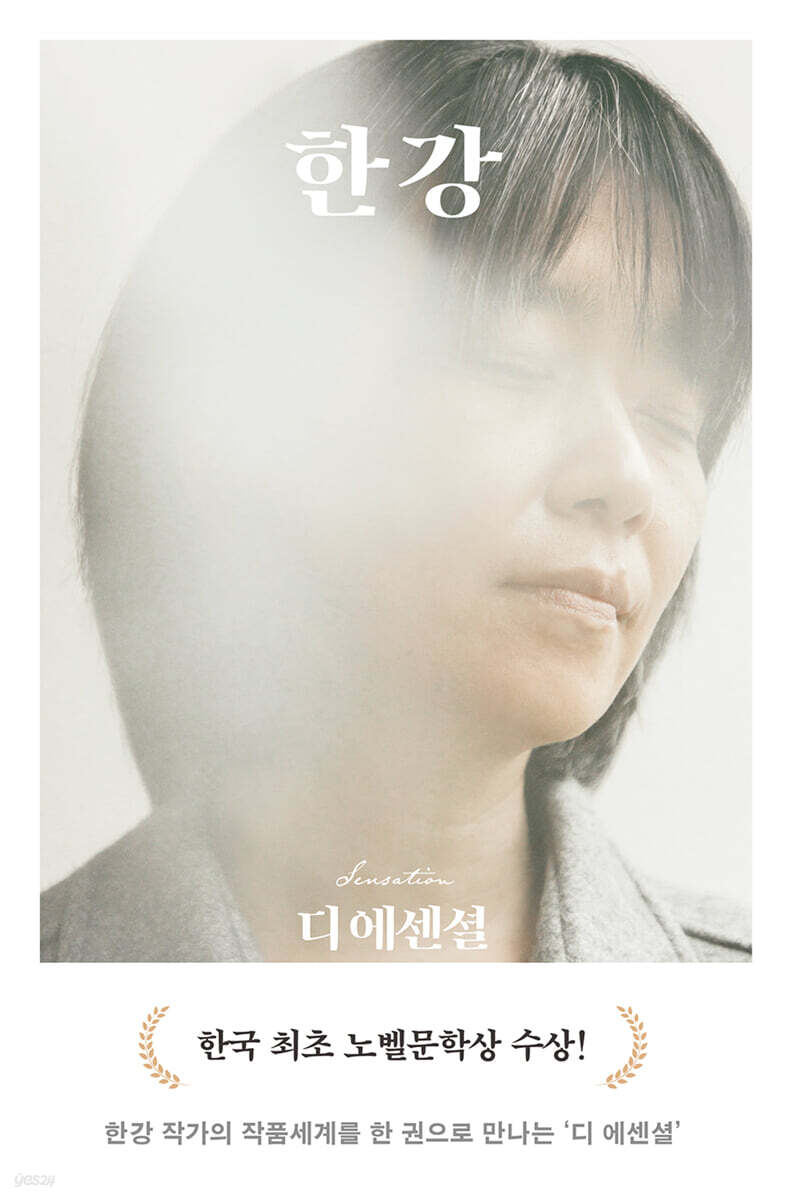
The cover photo is the work of Jeong Mel-Mel, one of the most notable photographers of recent times.
Among the numerous photos produced through collaboration with a photographer who captures subjects with a warm and calm gaze, the photographer selected a cut in which the photographer's eyes were closed.
I thought this photo was a good representation of author Han Kang, as I could feel mystery and newness in her tightly closed eyes, and affection and warmth in her faint smile.
The back cover includes a photo of the author's hand writing.
The 'writer's hand' feels like a metaphor for literature in itself.
In addition, the list of included works was simply included on the back cover.
As the series title 'Essential' suggests, we wanted to capture the artist and his work in its entirety without any promotional phrases that would describe them.
*The above book is a popular edition of Kyobo Bookstore's exclusive limited edition product, "The Essential Hangang." The content is the same, but the specifications have been changed from hardcover to paperback.
There is silence and darkness between the man and woman who met as students and instructors of the Greek language class.
A story of a moment where the silence of a woman losing her voice and the light of a man losing his eyes meet.
It is also a story of people who face each other for just a moment in their fading lives.
Like Greek, the oldest and most solid language on Earth, this novel uses carefully chosen, restrained words to see, feel, and express the world. Through this novel, we witness a scene where things that existed long ago, moments that seem eternal, meet in one place.
Here, you can encounter the essence of Han Kang's world of work, which persistently contemplates the essence of hope that can save humanity, as well as the essence of language and art.
Now I know, because foolishness destroyed that time and destroyed itself.
If we had really lived together, I wouldn't have needed your voice after I went blind.
As the visible world slowly recedes like an ebb tide, our silence will also gradually become complete.
_『Greek Hours』, p. 53
Short stories "The Recovering Man" and "The Blue Stone"
Two short stories that reflect the author's reflections on the question, "How can humans recover?"
Through the process of physical and mental wounds and their recovery, we meet characters who move from death to life, from darkness to light.
Just as new flesh grows on a wound, “time heals everything.”
They console each other by saying, “Everyone gets better,” and, drawing a picture of another time outside of time, they slowly, wholeheartedly move towards life.
You don't know.
I don't know that I will wake up in the cold dawn with a dry throat, my eyes drenched from a dream I can't remember, and look into the mirror above the sink.
You don't know that your hand will keep shaking as you pour cold water on your face.
They don't know that words they've never spoken will sting their throats like hot skewers.
I can't see ahead either.
I always couldn't see ahead.
I just held on.
I just tried to hold on because I felt anxious if I didn't try even for a moment.
_「Recovering Humans」, p. 241
At that time, the thought that perhaps time does not flow also came to me.
So, if we go back to that time, you and I are listening to the sound of rain.
You didn't go anywhere.
It didn't disappear or leave.
That's why, from some point on, whenever I met a man of the same age as you, I started to vaguely picture your face, which must have changed over time.
_「Blue Stone」, p. 271
Poem "One Late Evening I" and 4 others
Author Han Kang began her full-fledged creative career in 1993 when her poem was published in the winter issue of the quarterly magazine Literature and Society and her short story was selected for publication in the Seoul Shinmun the following year. She also wrote and published poetry in between writing novels.
In 2013, he published his first poetry collection, “I Put Dinner in a Drawer,” and five poems from it were selected and included in this issue of “The Essential Hangang.”
“Late Evening Me,” “A Song I Heard at Dawn,” “The Thing Called the Heart,” “Mark Rothko and I—Death in February,” and “The Anatomy Theater 2” are just some of the titles, and you can feel the sentiment of the poem just by looking at them.
From loneliness and sorrow, life and death, the time of deepening dusk, and even the moments of joy that emerge in between, the fierce battle of the soul that rages within the author shines gently through refined language.
Prose "Paper Piano" and seven other works
From childhood memories to recollections of loved ones and the meaning of writing, the eight prose pieces are imbued with the soft voice of author Han Kang.
You can hear the author's intimate voice in "To the Boys of Summer," which contains memories of Gwangju in 1980 and anecdotes from the time he was writing "The Boy Comes," "A Hundred Years of Prayer," which describes his feelings about participating in the Norwegian "Future Library" project, and "After Publication," which contains his thoughts after the publication of his latest work, "I Don't Say Goodbye."
When you're writing, you can't do anything else.
I can't move.
I can't walk or eat.
In the most passive position, put everything other than writing in parentheses and write it out word by word.
There is no other way.
There are times when I feel fortunate.
It's fortunate that there is no other way.
It's a good thing I can't move.
I am fortunate to be able to put everything in my life that I call mine in parentheses.
_「Outside Memory」, p. 315
Cover Story
The cover photo is the work of Jeong Mel-Mel, one of the most notable photographers of recent times.
Among the numerous photos produced through collaboration with a photographer who captures subjects with a warm and calm gaze, the photographer selected a cut in which the photographer's eyes were closed.
I thought this photo was a good representation of author Han Kang, as I could feel mystery and newness in her tightly closed eyes, and affection and warmth in her faint smile.
The back cover includes a photo of the author's hand writing.
The 'writer's hand' feels like a metaphor for literature in itself.
In addition, the list of included works was simply included on the back cover.
As the series title 'Essential' suggests, we wanted to capture the artist and his work in its entirety without any promotional phrases that would describe them.
*The above book is a popular edition of Kyobo Bookstore's exclusive limited edition product, "The Essential Hangang." The content is the same, but the specifications have been changed from hardcover to paperback.
GOODS SPECIFICS
- Date of issue: June 1, 2023
- Page count, weight, size: 364 pages | 424g | 133*200*30mm
- ISBN13: 9788954693462
- ISBN10: 8954693466
You may also like
카테고리
korean


korean

![GQ KOREA Mark (Monthly): December [2025]](http://librairie.coreenne.fr/cdn/shop/files/8ef265dbbfbf186523ed75ba7319009d.jpg?v=1765340328&width=3840)


