

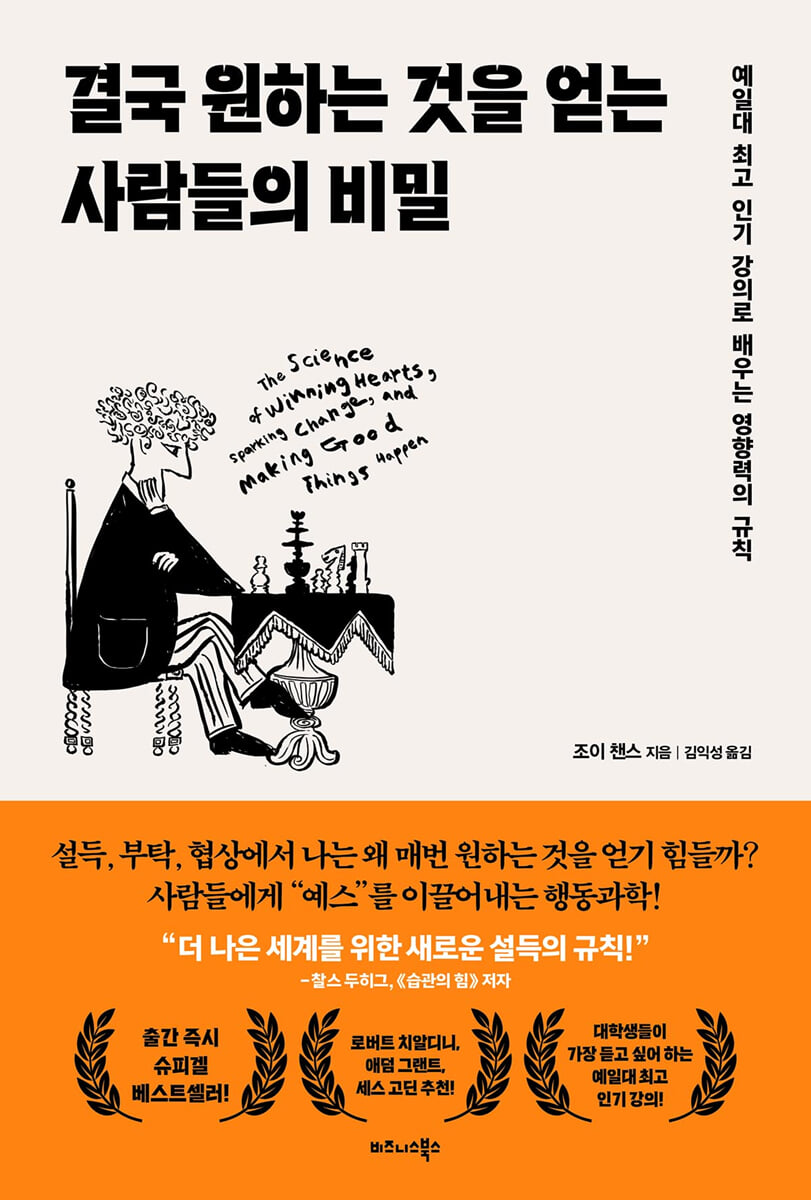
The Secret of People Who Finally Get What They Want
 |
Description
Book Introduction
The most influential lecture people want to hear in their lives! The laws of behavioral science that help you get what you want in persuasion, requests, and negotiations! If you ask people if they want to be more persuasive, more charismatic, more focused on what they say, and ultimately get what they want—a "person of influence"—they'll all say yes. Because influence is power. Influence is also the path to happiness and success. Some influence experts recommend using "weapons of influence" to defeat your opponents. Marketing experts call customers targets. However, these methods of using influence in sales or marketing to make deals are generally ineffective in everyday life. This is especially true in relationships with superiors, colleagues, subordinates, friends, and family. We need to get a positive 'yes' from people in a different way. There are great rewards to be had for being someone people want to say "yes." Top salespeople earn more money than their own company presidents. As your influence grows, you gain other forms of benefits besides money. We can be better friends, more trustworthy advisors, more committed spouses, or better parents. All of this is the power of influence. The author studied how people make decisions and what actually influences their behavior at MIT and Harvard University. After becoming a professor at Yale School of Management, I began teaching a course called "The Mastery of Influence and Persuasion," which brought together everything I knew about the science and practice of influence. This course was packed with students standing and listening from the first day, and it was selected as the most popular course in the business school, attracting students from all over the school. Afterwards, I published this book by collecting newly discovered scientific facts and experiences through lectures and discussions, and it became a bestseller and a hot topic immediately after its publication. Discover the magic of influence, where even small changes can have a big impact on people. |
- You can preview some of the book's contents.
Preview
index
Chapter 1: Becoming the Person People Want to Say "Yes" To
Chapter 1 and 1/2 In Search of 'Temu'
Chapter 2: Influence Doesn't Work the Way We Think
Why We Do That | The Root of All Misunderstanding | Crocodile Mode's Fragmentary Judgment | Why We Can't Eat Dog Poop-Shaped Chocolate | Selective Attention | Biased Reasoning
Chapter 2 and a half: Path of least resistance
Chapter 3: The One Word That Saved the World: "No"
The 'No' Challenge | Boundaries | From Rejection to Resilience
Chapter 3 and a half, Just ask
Chapter 4: The Unusual Characteristics of Charisma
The Twin Paradox of Charisma | Trying to be charismatic backfires | Give others attention and they'll pay attention to you | Shifting the focus to someone else | Relaxing your voice as a sign of confidence | Charisma on stage | The problem of time distortion on stage | To connect with many, connect with one.
Chapter 4 and a half: Moments of Truth
Chapter 5: The Magic of a Simple Frame That Changes Your Life
Bigger and Better Game | Monumental Frames | Affordable Frames | Monumental or Affordable? | Mysterious Frames | Combining Frames | Framing in Real Life
Chapter 5 and a half What do you do?
Chapter 6: The Two-Year-Old Within Me
Dealing with opposition like an Aikido master | Observe and analyze their resistance | Acknowledge their freedom of choice | Moove resistance with gentle requests | Be a gentle herbivore | What would it sound like to talk about opposition? | Observe and analyze their resistance | Affirm their freedom of choice | Moove resistance with gentle requests | Become a gentle herbivore
Lesson 6.5: Listening
Empathy Challenge
Chapter 7 Creative Negotiation
Gathering Ingredients for a Bigger Pie | Baking a Bigger Pie Together | Questions That Create Value | Other Ways to Encourage Collaboration | How to Deal with Difficult People | Pressure Tools | Saving Face, Part 2
Chapter 7.5: Negotiating as a Woman
Chapter 8: Defense Against the Dark Arts
Red Flags That You're Being Manipulated | Red Flag #1 "Excited" | Red Flag #2 Desperation | Red Flag #3 Exclusivity | Red Flag #4 Too Good to Believe | Red Flag #5 Half-Truths | Red Flag #6 Magical Thinking About Money | Red Flag #7 Ignoring Your Firm Rejections | Red Flag #8 Going Between Hot and Cold | Red Flag #9 Feeling Weird
Chapter 8 and a half: Angels and Demons
Chapter 9: Dream Bigger and Better
Let Tunisia make history once again.
Chapter 9 and a half You, Me, Us
Let's be friends
Discussion Assignment
Acknowledgements
annotation
Chapter 1 and 1/2 In Search of 'Temu'
Chapter 2: Influence Doesn't Work the Way We Think
Why We Do That | The Root of All Misunderstanding | Crocodile Mode's Fragmentary Judgment | Why We Can't Eat Dog Poop-Shaped Chocolate | Selective Attention | Biased Reasoning
Chapter 2 and a half: Path of least resistance
Chapter 3: The One Word That Saved the World: "No"
The 'No' Challenge | Boundaries | From Rejection to Resilience
Chapter 3 and a half, Just ask
Chapter 4: The Unusual Characteristics of Charisma
The Twin Paradox of Charisma | Trying to be charismatic backfires | Give others attention and they'll pay attention to you | Shifting the focus to someone else | Relaxing your voice as a sign of confidence | Charisma on stage | The problem of time distortion on stage | To connect with many, connect with one.
Chapter 4 and a half: Moments of Truth
Chapter 5: The Magic of a Simple Frame That Changes Your Life
Bigger and Better Game | Monumental Frames | Affordable Frames | Monumental or Affordable? | Mysterious Frames | Combining Frames | Framing in Real Life
Chapter 5 and a half What do you do?
Chapter 6: The Two-Year-Old Within Me
Dealing with opposition like an Aikido master | Observe and analyze their resistance | Acknowledge their freedom of choice | Moove resistance with gentle requests | Be a gentle herbivore | What would it sound like to talk about opposition? | Observe and analyze their resistance | Affirm their freedom of choice | Moove resistance with gentle requests | Become a gentle herbivore
Lesson 6.5: Listening
Empathy Challenge
Chapter 7 Creative Negotiation
Gathering Ingredients for a Bigger Pie | Baking a Bigger Pie Together | Questions That Create Value | Other Ways to Encourage Collaboration | How to Deal with Difficult People | Pressure Tools | Saving Face, Part 2
Chapter 7.5: Negotiating as a Woman
Chapter 8: Defense Against the Dark Arts
Red Flags That You're Being Manipulated | Red Flag #1 "Excited" | Red Flag #2 Desperation | Red Flag #3 Exclusivity | Red Flag #4 Too Good to Believe | Red Flag #5 Half-Truths | Red Flag #6 Magical Thinking About Money | Red Flag #7 Ignoring Your Firm Rejections | Red Flag #8 Going Between Hot and Cold | Red Flag #9 Feeling Weird
Chapter 8 and a half: Angels and Demons
Chapter 9: Dream Bigger and Better
Let Tunisia make history once again.
Chapter 9 and a half You, Me, Us
Let's be friends
Discussion Assignment
Acknowledgements
annotation
Detailed image
.jpg)
Into the book
Since joining the faculty at Yale School of Management, I've taught MBA programs and brought together everything I know about the science and practice of influence.
It covers behavioral economics, charisma, negotiation, dealing with resistance, and handling rejection.
People were so eager to increase their influence that the lecture was packed with people standing from the first day.
Mastering Influence and Persuasion has become the most popular course in the business school, attracting students from across the school.
During the ten years that the course was being taught, I tested new ideas and discovered new scientific facts.
--- From "Chapter 1: Becoming a Person People Want to Say 'Yes' to"
If you are tried at the beginning of the first of three hearings scheduled that day, you have a 65 percent chance of being granted parole and released.
On the other hand, if you are tried at the end of the first trial period, your chances of being released plummet to almost zero.
After the judge takes a short break, the release rate soars again to 65 percent.
The judge had no involvement in the trial order, which was determined by the order in which the inmates' lawyers arrived.
No matter how serious the crime, how long the inmate served, or whether he had previously served time, nothing explained this pattern.
The same was true for the nationality and gender of the prisoners.
Researchers concluded that when judges are tired, they are biased toward easier, pre-determined options.
--- From Chapter 2, "Influence Doesn't Work the Way We Think"
Your decision may not balance the world, but saying 'no' can save you.
If you are reluctant to say 'no', you will never be able to break free from the state of being overly concerned with the task.
If you find it difficult to hear the word "no," you're stuck in a state of being overly cautious and afraid to ask questions, a state of being completely exhausted over small things.
Most of us don't even realize that what we're facing is a problem until we start making the effort to say "no."
So 'no' is our starting point.
--- From "Chapter 3: The One Word That Saved the World, 'No'"
I've admired Prince since elementary school and was about to see him perform live in concert.
As the drums began to thump, the legendary singer slowly walked across the stage in a long silk jacket and high heels.
He looked me straight in the eye (I was sure he did) as I paused, holding the microphone with both hands.
He hummed the first line of his performance's first song, "Satisfied," in a satisfied voice.
“It’s not even starting yet, are we the only two here?”
I grabbed the arm of the friend I went with.
“I think I’m going to faint.”
(...) Prince's charisma was greater than some people could handle.
But it wasn't always like that.
Prince actually almost ended his singing career before he even got started because he lacked charisma.
--- From "Chapter 4: The Unusual Characteristics of Charisma"
Steve Jobs co-founded Apple in a garage.
Only a few years later, Jobs was tempted to persuade John Sculley to become the company's new CEO.
It was not a small request.
Sculley was the CEO of PepsiCo, a dinosaur in the snack and beverage market with a market capitalization of $2 billion.
In other words, Jobs was asking one of the world's most successful entrepreneurs to accept a massive demotion.
As expected, Sculley rejected Jobs' offer.
But the two became friends, and Jobs would sometimes make the same offer over and over again.
One day, the two were sitting on a balcony overlooking Central Park.
Suddenly, Jobs turned to his friend and asked:
"Will you spend the rest of your life selling sugar water? Or will you join me and change the world?"
--- From "Chapter 5: The Magic of a Simple Frame That Changes Your Life"
Journalist and author Jessica Winter has a great way of explaining how even the most reserved herbivorous dinosaur manages to snag a seat on a fully booked flight.
When the check-in agent tells people that there is no chance of a seat opening, people usually back off and say something along the lines of "there must be a way to solve this."
Winter writes:
“Stand quietly, leaning slightly forward and holding your hands loosely as if in prayer.
And stay within sight of the check-in staff.
Close enough that the employee doesn't miss your presence, but not so close that you fill their field of vision.
Your eyes should remain calm and focused on the employee's face.
Put on a look on your face that shows you understand the employee's situation, even that you are very happy about it.
Don't speak until you're asked a question.
Whenever the check-in agent speaks to you or to another passenger who is about to board, you should nod sympathetically.
If you continue like this, the check-in staff will eventually give you a seat number.
The polite herbivores always get seat numbers.
"
--- From "Chapter 6: The Two-Year-Old Inside Me"
Steinem asked the question first.
“What do we need to do to prevent that from happening again?”
The townspeople told Steinem it was an electric fence.
“Electric fence?”
Village women said that when the corn grows to a certain height, elephants come and eat it and trample the fields, leaving the families starving and ultimately vulnerable to sexual exploitation.
"all right.
“If I save up money, can I do all the work of clearing the field and putting up a fence?” Steinem asked.
The village women answered yes.
Steinem raised thousands of dollars, and the women cleared rocks and stumps by hand.
The next time Steinem visited the village, he saw a bumper corn crop, thanks to the elephants not destroying the fields.
Since the fence went up, none of the young women in the village have been trafficked.
“What do you need?”
I call this question the 'magic question'.
--- From Chapter 7, Creative Negotiation
We are terribly bad at detecting liars.
(...) If you're a parent, you're probably pretty sure you know when your child is lying, but you're wrong.
The cues we rely on, the signals that make us uncomfortable, can be misleading.
Most people who tell the truth are uncomfortable, but most people who lie are completely calm.
Especially those who have practiced a lot.
You should pay the most attention to these people.
This is why we need to look at other signals.
It covers behavioral economics, charisma, negotiation, dealing with resistance, and handling rejection.
People were so eager to increase their influence that the lecture was packed with people standing from the first day.
Mastering Influence and Persuasion has become the most popular course in the business school, attracting students from across the school.
During the ten years that the course was being taught, I tested new ideas and discovered new scientific facts.
--- From "Chapter 1: Becoming a Person People Want to Say 'Yes' to"
If you are tried at the beginning of the first of three hearings scheduled that day, you have a 65 percent chance of being granted parole and released.
On the other hand, if you are tried at the end of the first trial period, your chances of being released plummet to almost zero.
After the judge takes a short break, the release rate soars again to 65 percent.
The judge had no involvement in the trial order, which was determined by the order in which the inmates' lawyers arrived.
No matter how serious the crime, how long the inmate served, or whether he had previously served time, nothing explained this pattern.
The same was true for the nationality and gender of the prisoners.
Researchers concluded that when judges are tired, they are biased toward easier, pre-determined options.
--- From Chapter 2, "Influence Doesn't Work the Way We Think"
Your decision may not balance the world, but saying 'no' can save you.
If you are reluctant to say 'no', you will never be able to break free from the state of being overly concerned with the task.
If you find it difficult to hear the word "no," you're stuck in a state of being overly cautious and afraid to ask questions, a state of being completely exhausted over small things.
Most of us don't even realize that what we're facing is a problem until we start making the effort to say "no."
So 'no' is our starting point.
--- From "Chapter 3: The One Word That Saved the World, 'No'"
I've admired Prince since elementary school and was about to see him perform live in concert.
As the drums began to thump, the legendary singer slowly walked across the stage in a long silk jacket and high heels.
He looked me straight in the eye (I was sure he did) as I paused, holding the microphone with both hands.
He hummed the first line of his performance's first song, "Satisfied," in a satisfied voice.
“It’s not even starting yet, are we the only two here?”
I grabbed the arm of the friend I went with.
“I think I’m going to faint.”
(...) Prince's charisma was greater than some people could handle.
But it wasn't always like that.
Prince actually almost ended his singing career before he even got started because he lacked charisma.
--- From "Chapter 4: The Unusual Characteristics of Charisma"
Steve Jobs co-founded Apple in a garage.
Only a few years later, Jobs was tempted to persuade John Sculley to become the company's new CEO.
It was not a small request.
Sculley was the CEO of PepsiCo, a dinosaur in the snack and beverage market with a market capitalization of $2 billion.
In other words, Jobs was asking one of the world's most successful entrepreneurs to accept a massive demotion.
As expected, Sculley rejected Jobs' offer.
But the two became friends, and Jobs would sometimes make the same offer over and over again.
One day, the two were sitting on a balcony overlooking Central Park.
Suddenly, Jobs turned to his friend and asked:
"Will you spend the rest of your life selling sugar water? Or will you join me and change the world?"
--- From "Chapter 5: The Magic of a Simple Frame That Changes Your Life"
Journalist and author Jessica Winter has a great way of explaining how even the most reserved herbivorous dinosaur manages to snag a seat on a fully booked flight.
When the check-in agent tells people that there is no chance of a seat opening, people usually back off and say something along the lines of "there must be a way to solve this."
Winter writes:
“Stand quietly, leaning slightly forward and holding your hands loosely as if in prayer.
And stay within sight of the check-in staff.
Close enough that the employee doesn't miss your presence, but not so close that you fill their field of vision.
Your eyes should remain calm and focused on the employee's face.
Put on a look on your face that shows you understand the employee's situation, even that you are very happy about it.
Don't speak until you're asked a question.
Whenever the check-in agent speaks to you or to another passenger who is about to board, you should nod sympathetically.
If you continue like this, the check-in staff will eventually give you a seat number.
The polite herbivores always get seat numbers.
"
--- From "Chapter 6: The Two-Year-Old Inside Me"
Steinem asked the question first.
“What do we need to do to prevent that from happening again?”
The townspeople told Steinem it was an electric fence.
“Electric fence?”
Village women said that when the corn grows to a certain height, elephants come and eat it and trample the fields, leaving the families starving and ultimately vulnerable to sexual exploitation.
"all right.
“If I save up money, can I do all the work of clearing the field and putting up a fence?” Steinem asked.
The village women answered yes.
Steinem raised thousands of dollars, and the women cleared rocks and stumps by hand.
The next time Steinem visited the village, he saw a bumper corn crop, thanks to the elephants not destroying the fields.
Since the fence went up, none of the young women in the village have been trafficked.
“What do you need?”
I call this question the 'magic question'.
--- From Chapter 7, Creative Negotiation
We are terribly bad at detecting liars.
(...) If you're a parent, you're probably pretty sure you know when your child is lying, but you're wrong.
The cues we rely on, the signals that make us uncomfortable, can be misleading.
Most people who tell the truth are uncomfortable, but most people who lie are completely calm.
Especially those who have practiced a lot.
You should pay the most attention to these people.
This is why we need to look at other signals.
--- From "Chapter 8 Defense Against Dark Magic"
Publisher's Review
Do you want to earn more?
Do you have to ask people for difficult requests?
Get small but powerful tools!
First, this book shows that influence doesn't work the way we think.
The brain makes decisions through two cognitive processes.
The 'crocodile brain' is where we make decisions unconsciously and automatically, including emotions, snap judgments, and any behavior that becomes easier or becomes habitual with practice.
On the other hand, the 'judge brain' makes decisions consciously and rationally.
It involves planning, calculating, strategizing, interpreting, and doing things you are not yet good at.
The author says that when people make decisions, their crocodile brain takes precedence.
This fact makes us realize the illusion that we are always making rational decisions, and shows that to exert influence, we must first and foremost speak to our crocodile brain.
It also covers the 'No' challenge, which the author first experienced and experimented with on his students.
Being able to say 'no' to someone's request makes it easier to accept rejection when it happens.
And saying 'no' makes it easier to hear 'yes' from the other person.
This is a way to clearly identify your limits and gain confidence.
When you want to be more influential, the easiest thing you can do, besides saying "no," is to just ask.
Ask more often, ask more directly, and ask for more.
People who ask for what they want get better grades, bigger raises and promotions, greater job opportunities, and even greater sexual pleasure.
How to gain charisma, how to change your frame of mind,
How to negotiate as a woman, how to overcome resistance, etc.
An influence textbook that anyone can use, anytime!
The author explores the many forms of influence we can have on people, offering tools for creating positive impacts through small actions.
One of the influence skills people want to have is charisma.
The author talks about the paradox of charisma and says that if you want to attract other people's attention, you have to pay attention to other people, not yourself.
It also teaches you how to relax your posture and voice to appear more charismatic.
It also teaches you a very easy way to capture the audience's attention on stage.
Framing someone's experience is also a great way to exert influence.
Just a few years after co-founding Apple, Steve Jobs wanted to appoint John Sculley as its new CEO.
Sculley was the CEO of PepsiCo, a dinosaur company with a market capitalization of $2 billion at the time.
Jobs asked Sculley:
“Will you spend the rest of your life selling sugar water? Or will you come with me and change the world?” Just as the word “snow” prevents the mind from conjuring other white objects, the phrase “selling sugar water” made it difficult for Scully to think of her work at Pepsi in any other way.
Once Jobs created the frame, it stuck in Sculley's mind.
Sculley eventually joined Apple, and the rest, as they say, is history.
This book details three frames that can influence people.
The author also shares how he helped tens of thousands of Google employees around the world make healthier choices at mealtimes by changing their mindsets.
The author also changes the way we think about negotiation.
First, you have to realize that anything is negotiable and get over the mindset that if one side wins, the other side loses.
In other words, negotiation is not a matter of winning or losing, but rather an opportunity for both sides to add value.
We will also learn about the 'magic question' that creates greater value.
In addition, it covers how to become someone who gets what you want in various situations, such as how to negotiate as a woman, how to overcome resistance with gentle requests, and how to get what you want passively. It also summarizes nine warning signs that indicate people, such as scammers, are trying to influence you with bad intentions.
As you progress along the path to becoming more and more influential, bigger and better ideas will come to you.
This book will serve as your go-to influencer when you're ready to pursue your dreams.
Do you have to ask people for difficult requests?
Get small but powerful tools!
First, this book shows that influence doesn't work the way we think.
The brain makes decisions through two cognitive processes.
The 'crocodile brain' is where we make decisions unconsciously and automatically, including emotions, snap judgments, and any behavior that becomes easier or becomes habitual with practice.
On the other hand, the 'judge brain' makes decisions consciously and rationally.
It involves planning, calculating, strategizing, interpreting, and doing things you are not yet good at.
The author says that when people make decisions, their crocodile brain takes precedence.
This fact makes us realize the illusion that we are always making rational decisions, and shows that to exert influence, we must first and foremost speak to our crocodile brain.
It also covers the 'No' challenge, which the author first experienced and experimented with on his students.
Being able to say 'no' to someone's request makes it easier to accept rejection when it happens.
And saying 'no' makes it easier to hear 'yes' from the other person.
This is a way to clearly identify your limits and gain confidence.
When you want to be more influential, the easiest thing you can do, besides saying "no," is to just ask.
Ask more often, ask more directly, and ask for more.
People who ask for what they want get better grades, bigger raises and promotions, greater job opportunities, and even greater sexual pleasure.
How to gain charisma, how to change your frame of mind,
How to negotiate as a woman, how to overcome resistance, etc.
An influence textbook that anyone can use, anytime!
The author explores the many forms of influence we can have on people, offering tools for creating positive impacts through small actions.
One of the influence skills people want to have is charisma.
The author talks about the paradox of charisma and says that if you want to attract other people's attention, you have to pay attention to other people, not yourself.
It also teaches you how to relax your posture and voice to appear more charismatic.
It also teaches you a very easy way to capture the audience's attention on stage.
Framing someone's experience is also a great way to exert influence.
Just a few years after co-founding Apple, Steve Jobs wanted to appoint John Sculley as its new CEO.
Sculley was the CEO of PepsiCo, a dinosaur company with a market capitalization of $2 billion at the time.
Jobs asked Sculley:
“Will you spend the rest of your life selling sugar water? Or will you come with me and change the world?” Just as the word “snow” prevents the mind from conjuring other white objects, the phrase “selling sugar water” made it difficult for Scully to think of her work at Pepsi in any other way.
Once Jobs created the frame, it stuck in Sculley's mind.
Sculley eventually joined Apple, and the rest, as they say, is history.
This book details three frames that can influence people.
The author also shares how he helped tens of thousands of Google employees around the world make healthier choices at mealtimes by changing their mindsets.
The author also changes the way we think about negotiation.
First, you have to realize that anything is negotiable and get over the mindset that if one side wins, the other side loses.
In other words, negotiation is not a matter of winning or losing, but rather an opportunity for both sides to add value.
We will also learn about the 'magic question' that creates greater value.
In addition, it covers how to become someone who gets what you want in various situations, such as how to negotiate as a woman, how to overcome resistance with gentle requests, and how to get what you want passively. It also summarizes nine warning signs that indicate people, such as scammers, are trying to influence you with bad intentions.
As you progress along the path to becoming more and more influential, bigger and better ideas will come to you.
This book will serve as your go-to influencer when you're ready to pursue your dreams.
GOODS SPECIFICS
- Date of issue: December 19, 2023
- Page count, weight, size: 352 pages | 152*225*30mm
- ISBN13: 9791162543542
- ISBN10: 116254354X
You may also like
카테고리
korean


korean

![GQ KOREA Mark (Monthly): December [2025]](http://librairie.coreenne.fr/cdn/shop/files/8ef265dbbfbf186523ed75ba7319009d.jpg?v=1765340328&width=3840)


