

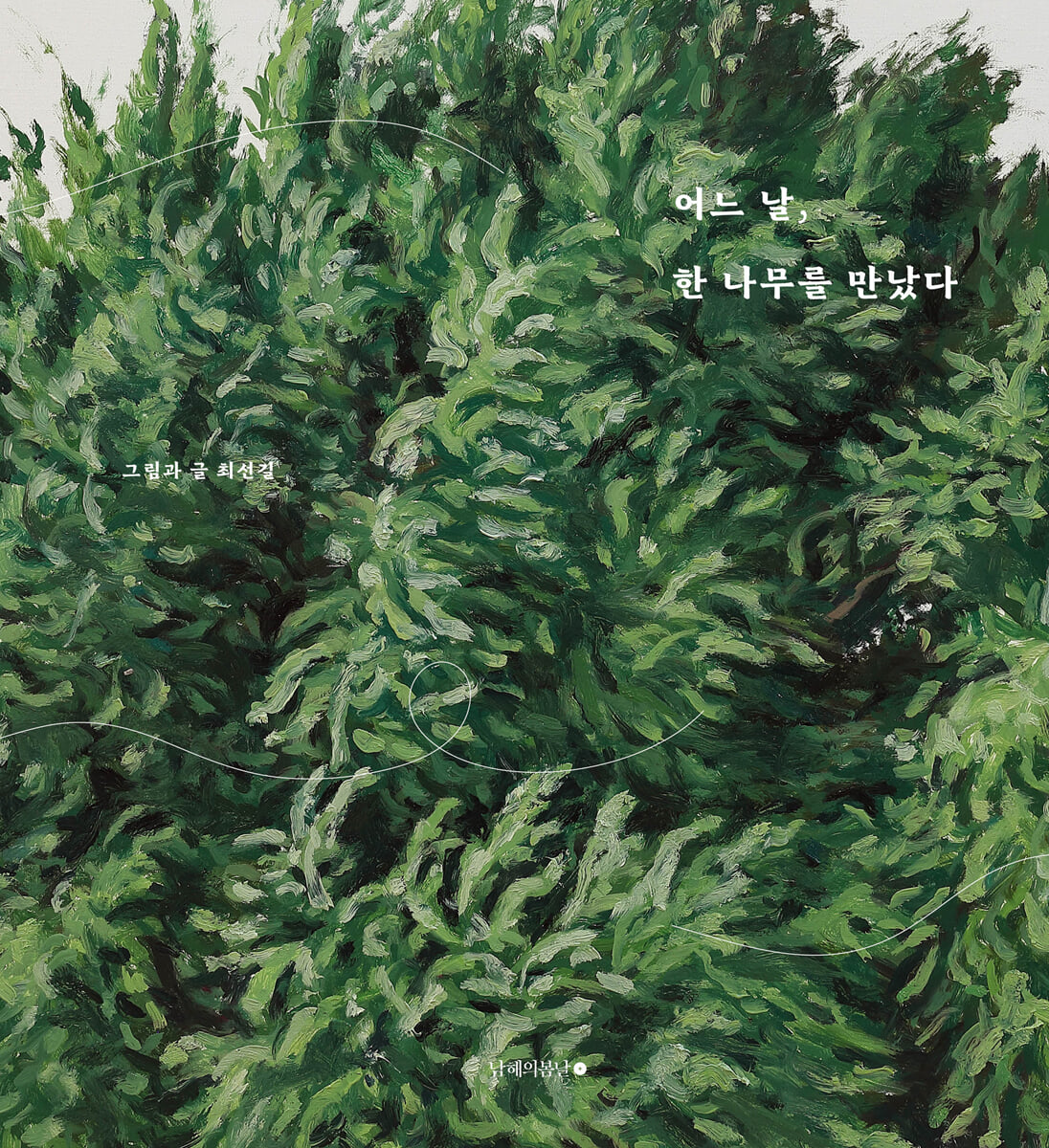
One day, I met a tree
 |
Description
Book Introduction
In the same spot every day for five years
A painting of a giant tree that has lived for over a thousand years
The life and nature stories of painter Choi Seon-gil
There is a painter who is obsessed with ginkgo trees.
Choi Seon-gil, a painter who has been capturing Korea's mountains and trees on canvas for a long time.
Having graduated from Seoul National University's Department of Painting, he has been reflecting on human life in the midst of natural landscapes for nearly 40 years.
Then I came across a tree.
This is a ginkgo tree in Bangye-ri, Wonju that is 1318 years old.
“That tree seemed to be the culmination of all the tree drawings I had made over the past 30 years.”
The artist, who was captivated by the vitality of this giant tree, began a project to capture the four seasons of the ginkgo tree on canvas in one spot every day.
The project was named 'Song of a Thousand Years'.
More than five years have passed like that.
The ginkgo tree, captured in this masterpiece of 1000 pieces, perfectly captures the morning light, the wind blowing through the branches, and even the colors of the evening sunset.
Those who have seen his paintings confess that they felt the wind blowing in them.
"Looking at this picture healed my sadness."
"It seems like I can smell the scent and hear the sound from the painting."
"The wisdom of a tree, acquired over a thousand years, is expressed through the wind and air that lingers in each crevice of the tree."
The light and wind of the season, vibrant nature
A time of immersion and meditation presented by paintings
“One Day, I Met a Tree” is the first book to encompass the world of artist Choi Seon-gil’s works spanning over 40 years.
I included all the short work notes I left while working and the thoughts I had at each exhibition.
For the writer, the forest is a mirror of life, and trees are a medium that allows him to reflect on human life.
Human time is so short and fleeting that it seems pitiful compared to the time of a tree that has lived for over a thousand years.
The tree that stands in the same place despite the relentless wind and typhoons is a miracle in itself.
The same goes for our lives.
This is also the reason why the author chose to go out to the field every day and draw sketches.
It is not easy to paint a still life indoors, but rather a picture of the setting sun and trees constantly moving in the wind in an open field.
This work was completed by enduring the summer heat and winter cold together with the tree.
Do I really have to go through all this trouble to draw it?
However, the author says that life is the work of fully experiencing life and capturing the ever-changing essence of the subject.
His work, which captures the continuity of time and space flowing from 'here and now (hic et nunc)', is therefore philosophical and, in some ways, borders on meditation.
That is why the author says at some point that he did not draw the tree, but that 'the tree drew me.'
It is the state of selflessness that the tree taught us.
"
A painting of a giant tree that has lived for over a thousand years
The life and nature stories of painter Choi Seon-gil
There is a painter who is obsessed with ginkgo trees.
Choi Seon-gil, a painter who has been capturing Korea's mountains and trees on canvas for a long time.
Having graduated from Seoul National University's Department of Painting, he has been reflecting on human life in the midst of natural landscapes for nearly 40 years.
Then I came across a tree.
This is a ginkgo tree in Bangye-ri, Wonju that is 1318 years old.
“That tree seemed to be the culmination of all the tree drawings I had made over the past 30 years.”
The artist, who was captivated by the vitality of this giant tree, began a project to capture the four seasons of the ginkgo tree on canvas in one spot every day.
The project was named 'Song of a Thousand Years'.
More than five years have passed like that.
The ginkgo tree, captured in this masterpiece of 1000 pieces, perfectly captures the morning light, the wind blowing through the branches, and even the colors of the evening sunset.
Those who have seen his paintings confess that they felt the wind blowing in them.
"Looking at this picture healed my sadness."
"It seems like I can smell the scent and hear the sound from the painting."
"The wisdom of a tree, acquired over a thousand years, is expressed through the wind and air that lingers in each crevice of the tree."
The light and wind of the season, vibrant nature
A time of immersion and meditation presented by paintings
“One Day, I Met a Tree” is the first book to encompass the world of artist Choi Seon-gil’s works spanning over 40 years.
I included all the short work notes I left while working and the thoughts I had at each exhibition.
For the writer, the forest is a mirror of life, and trees are a medium that allows him to reflect on human life.
Human time is so short and fleeting that it seems pitiful compared to the time of a tree that has lived for over a thousand years.
The tree that stands in the same place despite the relentless wind and typhoons is a miracle in itself.
The same goes for our lives.
This is also the reason why the author chose to go out to the field every day and draw sketches.
It is not easy to paint a still life indoors, but rather a picture of the setting sun and trees constantly moving in the wind in an open field.
This work was completed by enduring the summer heat and winter cold together with the tree.
Do I really have to go through all this trouble to draw it?
However, the author says that life is the work of fully experiencing life and capturing the ever-changing essence of the subject.
His work, which captures the continuity of time and space flowing from 'here and now (hic et nunc)', is therefore philosophical and, in some ways, borders on meditation.
That is why the author says at some point that he did not draw the tree, but that 'the tree drew me.'
It is the state of selflessness that the tree taught us.
"
- You can preview some of the book's contents.
Preview
index
Mountains, Seasons of Life
One day, I met a tree
Song of a Thousand Years, Dancing with the Wind
epilogue
One day, I met a tree
Song of a Thousand Years, Dancing with the Wind
epilogue
Detailed image

Into the book
It was a late spring day.
A day when the sun was warm and the wind made my heart flutter.
While driving, I saw the trees along the road swaying in the wind as they bathed in the spring sun.
The leaves, shining brightly under the warm sunlight, rustle and tremble in the breeze,
The sight of them swaying freely seemed to me like 'life' itself.
--- p.32
The tree seemed to be the culmination of all the tree drawings I had made over the past 30 years.
It was a ginkgo tree in Bangye-ri that was over 1,300 years old.
As I looked at the beautiful sight of that tree that had survived for so many years, I felt grateful, my heart was filled with emotion, and I felt a strange surge of strength.
At that moment, I decided that I had to draw the four seasons of that tree right there on site.
And I recorded those feelings like a diary.
--- p.46
When you sit down and draw with a living subject in the field, unexpected problems always arise.
The first is the dazzling changes in light caused by the unpredictable weather.
You quickly realize how foolish and futile it is to try to draw by following the changing light.
How to draw light that never stays in one place for even a moment!
It is impossible to draw properly with the concept of light and shade when drawing indoors.
What about the color of an object that is swaying countless times in the wind?
The field is full of problems that are difficult to solve like this.
If you rush into solving it, the picture will become abstract.
In such a case, can truth be contained in a painting?
If you let go of the desire to solve the problem and just dance with the wind, following your feelings from moment to moment, the problem will soon disappear and the vibrant brushstrokes and feast of colors will be fully conveyed on the canvas.
--- p.82
I spent the first day of the new year with an old tree covered in lingering snow.
Occasionally, a faint ray of sunlight melts the remaining snow.
Shakespeare said, "When the snow melts, where does the white light go?"
The colors of the trees drying their huge, snow-covered bodies in the winter sun look quite colorful.
White light becomes light.
The ginkgo tree's branches spread out in all directions.
Looking at that branch, the word 'freedom' comes to mind again.
How can branches from one body bloom so freely?
--- p.104
While I'm sketching, the brushstrokes progress without me even realizing it, and when I get absorbed in it for a moment and step back to look at it, I realize that it wasn't me who drew it, but the tree that drew me.
Is this what it means to empty myself?
Me drawn by a tree.
The work on the ginkgo tree so far has been an attempt to change myself.
If my previous work was about expressing myself by changing the subject, the five-year project with the ginkgo tree in Bangye-ri was not about changing the subject, but about observing myself with the same subject and changing myself as a result.
(…)
This book is a compilation of traces of my life as an artist with these thoughts and wills.
I am embarrassed, but I have included my own records without any exaggeration.
A day when the sun was warm and the wind made my heart flutter.
While driving, I saw the trees along the road swaying in the wind as they bathed in the spring sun.
The leaves, shining brightly under the warm sunlight, rustle and tremble in the breeze,
The sight of them swaying freely seemed to me like 'life' itself.
--- p.32
The tree seemed to be the culmination of all the tree drawings I had made over the past 30 years.
It was a ginkgo tree in Bangye-ri that was over 1,300 years old.
As I looked at the beautiful sight of that tree that had survived for so many years, I felt grateful, my heart was filled with emotion, and I felt a strange surge of strength.
At that moment, I decided that I had to draw the four seasons of that tree right there on site.
And I recorded those feelings like a diary.
--- p.46
When you sit down and draw with a living subject in the field, unexpected problems always arise.
The first is the dazzling changes in light caused by the unpredictable weather.
You quickly realize how foolish and futile it is to try to draw by following the changing light.
How to draw light that never stays in one place for even a moment!
It is impossible to draw properly with the concept of light and shade when drawing indoors.
What about the color of an object that is swaying countless times in the wind?
The field is full of problems that are difficult to solve like this.
If you rush into solving it, the picture will become abstract.
In such a case, can truth be contained in a painting?
If you let go of the desire to solve the problem and just dance with the wind, following your feelings from moment to moment, the problem will soon disappear and the vibrant brushstrokes and feast of colors will be fully conveyed on the canvas.
--- p.82
I spent the first day of the new year with an old tree covered in lingering snow.
Occasionally, a faint ray of sunlight melts the remaining snow.
Shakespeare said, "When the snow melts, where does the white light go?"
The colors of the trees drying their huge, snow-covered bodies in the winter sun look quite colorful.
White light becomes light.
The ginkgo tree's branches spread out in all directions.
Looking at that branch, the word 'freedom' comes to mind again.
How can branches from one body bloom so freely?
--- p.104
While I'm sketching, the brushstrokes progress without me even realizing it, and when I get absorbed in it for a moment and step back to look at it, I realize that it wasn't me who drew it, but the tree that drew me.
Is this what it means to empty myself?
Me drawn by a tree.
The work on the ginkgo tree so far has been an attempt to change myself.
If my previous work was about expressing myself by changing the subject, the five-year project with the ginkgo tree in Bangye-ri was not about changing the subject, but about observing myself with the same subject and changing myself as a result.
(…)
This book is a compilation of traces of my life as an artist with these thoughts and wills.
I am embarrassed, but I have included my own records without any exaggeration.
--- p.114, from 「epilogue」
Publisher's Review
Immersive pictorial meditations
"A time to rethink the four seasons of life."
Mark Rothko Chapel in Texas, Monet's Water Lilies series at the Orangerie Museum in Paris, and the Room of Thought and Moon Jar at the National Museum of Korea.
There is something in common here.
The point is that many people go out of their way to visit the artwork, spend the whole day standing in front of it, and come back in tears.
The same goes for the ginkgo tree on the best path.
People who see the picture of a giant tree that has survived for over a thousand years are overcome with emotion and thrill.
It feels like a wind is blowing from somewhere, and the branches seem like they might sway at any moment.
Standing in front of this tree for a long time, people reflect not on the life of the tree that has lived for over a thousand years, but on their own lives.
The leaves fluttering in the wind bring about new emotions every time I see them.
This is because the viewer's mind is projected.
Deep reflection and philosophy on nature and humanity
Writing and illustrations by artist Choi Seon-gil
It is said that the life of a craftsman devoted to one thing ultimately leads to enlightenment.
The same goes for the life of an artist.
What the artist has been obsessed with while painting for over 40 years is reflection on existence.
The object is nature, it is humanity, it is the world we live in, and at the same time, all of it ultimately comes down to one universe called ‘me.’
Choi Seon-gil's paintings are beautiful and comfortable, but at the same time have a sense of honesty and weight.
This is because of the solid center and depth of the author's philosophy.
His first book, One Day, I Saw a Tree, not only contains his most recent work, but also shows the entire process by which the author reached the pinnacle of the Ban-gye-ri ginkgo tree.
As we follow the artist's gaze, moving from the mountain to the forest, and from the forest to the trees, getting closer and closer, we come to understand why he had to visit the ginkgo tree every day for five years and paint on the spot.
The 'Painter's Book' series presented by Namhae Spring Day
From painter Im-Kyung Lee, who has long depicted cozy hole-in-the-wall shops, to Maud Lewis, who is called Canada's national painter, to painter Jae-Shin Kim, who impressed us with his works depicting the deep and colorful sea of Tongyeong, to the first book by painter Seon-Gil Choi, who has depicted thousand-year-old trees, Namhae Spring Day has consistently presented 'painters' books' that are noteworthy both domestically and internationally.
What makes this series special is that it does not simply copy the artist's works, but also weaves them together with the artist's own writings, allowing us to view the artist's life, thoughts, and entire world of works.
Additionally, it is a large format book suitable for appreciating the work and is bound in a hardcover suitable for long-term collection, receiving constant interest and love from readers who love art.
"A time to rethink the four seasons of life."
Mark Rothko Chapel in Texas, Monet's Water Lilies series at the Orangerie Museum in Paris, and the Room of Thought and Moon Jar at the National Museum of Korea.
There is something in common here.
The point is that many people go out of their way to visit the artwork, spend the whole day standing in front of it, and come back in tears.
The same goes for the ginkgo tree on the best path.
People who see the picture of a giant tree that has survived for over a thousand years are overcome with emotion and thrill.
It feels like a wind is blowing from somewhere, and the branches seem like they might sway at any moment.
Standing in front of this tree for a long time, people reflect not on the life of the tree that has lived for over a thousand years, but on their own lives.
The leaves fluttering in the wind bring about new emotions every time I see them.
This is because the viewer's mind is projected.
Deep reflection and philosophy on nature and humanity
Writing and illustrations by artist Choi Seon-gil
It is said that the life of a craftsman devoted to one thing ultimately leads to enlightenment.
The same goes for the life of an artist.
What the artist has been obsessed with while painting for over 40 years is reflection on existence.
The object is nature, it is humanity, it is the world we live in, and at the same time, all of it ultimately comes down to one universe called ‘me.’
Choi Seon-gil's paintings are beautiful and comfortable, but at the same time have a sense of honesty and weight.
This is because of the solid center and depth of the author's philosophy.
His first book, One Day, I Saw a Tree, not only contains his most recent work, but also shows the entire process by which the author reached the pinnacle of the Ban-gye-ri ginkgo tree.
As we follow the artist's gaze, moving from the mountain to the forest, and from the forest to the trees, getting closer and closer, we come to understand why he had to visit the ginkgo tree every day for five years and paint on the spot.
The 'Painter's Book' series presented by Namhae Spring Day
From painter Im-Kyung Lee, who has long depicted cozy hole-in-the-wall shops, to Maud Lewis, who is called Canada's national painter, to painter Jae-Shin Kim, who impressed us with his works depicting the deep and colorful sea of Tongyeong, to the first book by painter Seon-Gil Choi, who has depicted thousand-year-old trees, Namhae Spring Day has consistently presented 'painters' books' that are noteworthy both domestically and internationally.
What makes this series special is that it does not simply copy the artist's works, but also weaves them together with the artist's own writings, allowing us to view the artist's life, thoughts, and entire world of works.
Additionally, it is a large format book suitable for appreciating the work and is bound in a hardcover suitable for long-term collection, receiving constant interest and love from readers who love art.
GOODS SPECIFICS
- Date of issue: November 6, 2025
- Format: Hardcover book binding method guide
- Page count, weight, size: 120 pages | 572g | 195*215*15mm
- ISBN13: 9791193027561
- ISBN10: 119302756X
You may also like
카테고리
korean


korean

![GQ KOREA Mark (Monthly): December [2025]](http://librairie.coreenne.fr/cdn/shop/files/8ef265dbbfbf186523ed75ba7319009d.jpg?v=1765340328&width=3840)


