

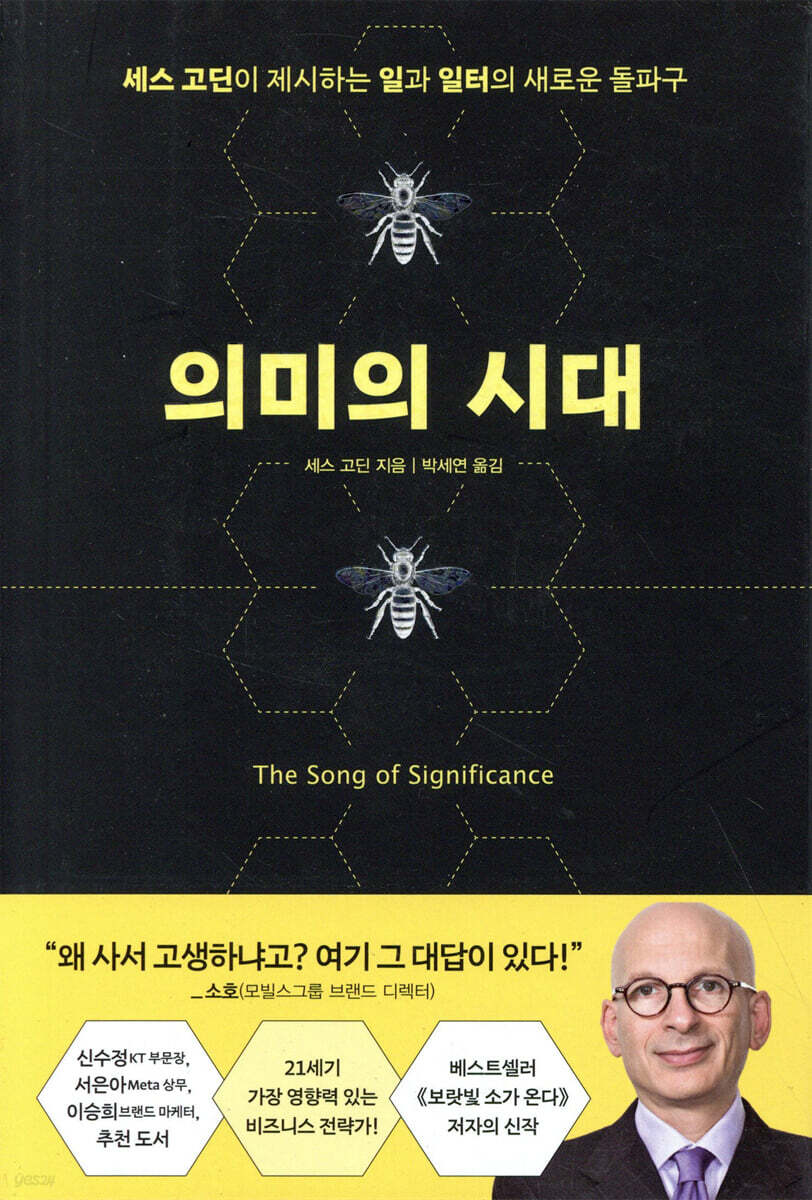
The Age of Meaning
 |
Description
Book Introduction
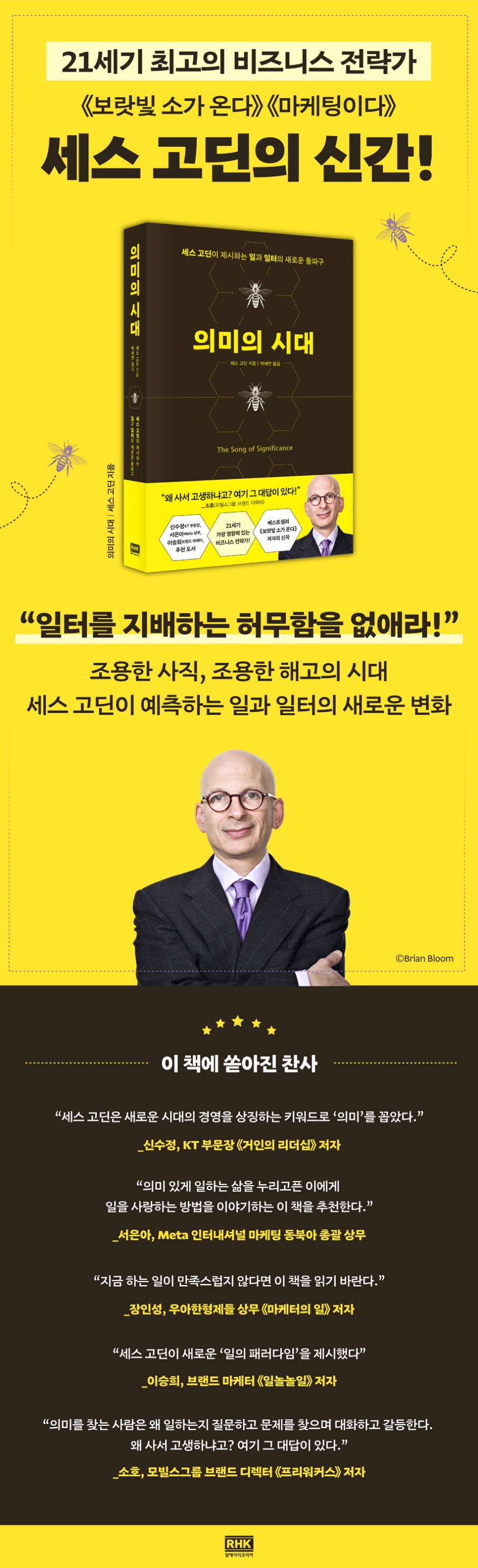
"Why bother buying it? Here's the answer!"
*[Forbes] Recommended Books*
*Recommended by Adam Grant, "Originals" and "Think Again"*
*Books recommended by 'work' experts*
Shin Soo-jung (KT Division Head), Seo Eun-ah (Meta Managing Director), and Lee Seung-hee (Brand Marketer)
Jang In-seong (Managing Director, Woowa Brothers) and Soho (Brand Director, Mobils Group)
An ideal workplace is the dream of every worker.
An organization where you don't feel job insecurity, are respected for challenging the status quo, and are fully recognized for your achievements without having to wait for an opportunity to appeal.
Could such a place really exist? In an era where "hard work pays off" is the motto for office workers, and people often claim to practice "quiet resignation."
Even if the company doesn't take responsibility for us, we can't just abandon the work we've been given.
No matter where you belong or what responsibilities you bear, work is an inseparable part of the process of creating your values, your life, and who you are.
Seth Godin is a world-renowned marketer and entrepreneur who has been in the industry for over 30 years and has sensed change with unparalleled insight.
In "The Age of Meaning," we quickly capture the signs of change that have swept through the workplace since the endemic and present them in 144 case studies.
He found the solution to navigating this era, marked by defeat and discouragement, in ‘meaning.’
Comparing the bee's journey to the human journey, he proclaims that profit is not the purpose of work.
Just as the purpose of a beehive is to house bees and honey is a byproduct of a healthy beehive, the purpose of work is to find meaning and when this is achieved, results and profits will naturally follow.
To find meaning, members of an organization must change from being workers who just quickly complete given tasks to players who find and accomplish meaningful work. Creating an environment where members of an organization can become players is a virtue that a true leader must possess.
If you went to work today wondering why you should work and how you should work in the future, this book will give you the answers.
*[Forbes] Recommended Books*
*Recommended by Adam Grant, "Originals" and "Think Again"*
*Books recommended by 'work' experts*
Shin Soo-jung (KT Division Head), Seo Eun-ah (Meta Managing Director), and Lee Seung-hee (Brand Marketer)
Jang In-seong (Managing Director, Woowa Brothers) and Soho (Brand Director, Mobils Group)
An ideal workplace is the dream of every worker.
An organization where you don't feel job insecurity, are respected for challenging the status quo, and are fully recognized for your achievements without having to wait for an opportunity to appeal.
Could such a place really exist? In an era where "hard work pays off" is the motto for office workers, and people often claim to practice "quiet resignation."
Even if the company doesn't take responsibility for us, we can't just abandon the work we've been given.
No matter where you belong or what responsibilities you bear, work is an inseparable part of the process of creating your values, your life, and who you are.
Seth Godin is a world-renowned marketer and entrepreneur who has been in the industry for over 30 years and has sensed change with unparalleled insight.
In "The Age of Meaning," we quickly capture the signs of change that have swept through the workplace since the endemic and present them in 144 case studies.
He found the solution to navigating this era, marked by defeat and discouragement, in ‘meaning.’
Comparing the bee's journey to the human journey, he proclaims that profit is not the purpose of work.
Just as the purpose of a beehive is to house bees and honey is a byproduct of a healthy beehive, the purpose of work is to find meaning and when this is achieved, results and profits will naturally follow.
To find meaning, members of an organization must change from being workers who just quickly complete given tasks to players who find and accomplish meaningful work. Creating an environment where members of an organization can become players is a virtue that a true leader must possess.
If you went to work today wondering why you should work and how you should work in the future, this book will give you the answers.
- You can preview some of the book's contents.
Preview
index
Praise poured in for this book
Chapter 1 Three Songs
Chapter 2 Towards Meaning
Chapter 3 What Happened to Management?
Chapter 4 This time, with meaning
Chapter 5 Promise
Chapter 6: Let's face reality
Chapter 7 What Do We Make and How Do We Explain It?
Chapter 8: Finding Your Way
Chapter 9: The Meeting is a Sign
Chapter 10: Creating Meaningful Organizations
Chapter 11: The Broom
Acknowledgements
supplement
Chapter 1 Three Songs
Chapter 2 Towards Meaning
Chapter 3 What Happened to Management?
Chapter 4 This time, with meaning
Chapter 5 Promise
Chapter 6: Let's face reality
Chapter 7 What Do We Make and How Do We Explain It?
Chapter 8: Finding Your Way
Chapter 9: The Meeting is a Sign
Chapter 10: Creating Meaningful Organizations
Chapter 11: The Broom
Acknowledgements
supplement
Detailed image
Into the book
We've been doing the same thing for so long that it's easy to think we're stuck, but we can always move on to something better.
--- p.12
Now, in 2023, machines have expanded to include robots working in hotels, algorithms trading stocks, and machine learning systems that draw illustrations and read X-rays.
Now, what companies demand has changed.
Suddenly.
Companies are looking for two extremely rare resources, not cheap labor to perform semi-automated tasks that machines (yet) cannot do.
It is ‘creativity’ and ‘humanity’.
--- p.29
We have to decide what we should work for.
We must decide whether to spend our time dwelling on scarcity and loss, or to dedicate ourselves to the reproductive work of building the best jobs every worker has ever known and the best organizations every consumer has ever known.
--- p.37
But the end of the industrial age and the advent of computers completely changed the equation.
Tools increase efficiency.
But value comes from change, from a very rare form of relationship that comes with meaning from humanity.
--- p.41
Questions like, “What do you think about that customer?” or “Why do you want to handle it this way?” are good starting points.
Relationships begin by understanding each other through these conversations.
Then the real question must follow.
Rather than rhetorical arguments like, “Let’s figure out how to understand it my way,” we need to have impartial discussions that lead to discovery.
--- p.54
What all revolutions have in common is that they are 'inconvenient'.
It was quite uncomfortable for entrepreneurs to embrace the Internet in 1998, for nonprofits to change their approach to sustainability, and for successful businesses to embrace what it meant.
This trend rarely happens quickly or easily.
That is why change is revolutionary.
Revolutions start on the periphery, but eventually change everything they interact with.
--- p.66
Product production can be easily measured and scaled.
However, the standards and methods of product production do not contribute to human interaction, insight, or innovation.
--- p.72
Managers emphasize compliance.
To achieve industrial progress, increase productivity, and generate profits, we must do yesterday's work faster and cheaper.
Leaders, on the other hand, create the conditions for people to drive change.
Leaders do not demand authority, but rather foster trust, interest, and relationships among those involved in the journey of important work.
--- p.104
Let's find out the tech geeks, the special interests, and the outcasts and see what they want.
These efforts allow companies to identify needs that typical customers have but don't voice out loud.
--- p.123~124
To do anything meaningful, you have to make promises and keep them.
We need to make a change.
Additionally, boundaries must be identified during the process of change.
This is by no means an easy task.
Above all, if you can't hear the song of safety, it's very difficult to move forward.
--- p.127
Courage is not the absence of fear.
Courage is the willingness to take on important and worthwhile challenges even when (or especially when) you feel fear.
And the power to say what you see and believe, even when you feel fear.
Courage is the opposite of weakness.
--- p.131
When we realize that leaders aren't just managers with fancy titles, our decisions become easier.
Leaders, whether working in their own organizations or in other organizations, sow the seeds for future generations who will exert influence.
What happens in the conference room today may or may not change the people present.
It depends on who called the meeting.
--- p.133
Bees do not spontaneously form colonies.
However, in an organic way, each bee recognizes its role through the actions of other bees and the journey of the hive.
They have a culture of mutual recognition, not a vertical culture.
The same goes for flexible and decentralized human organizations.
--- p.164
We pay attention to standards when we work outside the supervision of our superiors.
If our behavior changes under the watchful eye of our superiors, the reason is simple.
Because they were forced to obey.
Obedience is about the will and power of the manager, while standards are about the values of the organization.
--- p.194
Every great story has a moment of transition.
Every respected company is doing something they didn't plan to do when they started their business.
They are not excuse makers, they are path finders.
--- p.258
We can improve by critiquing our performance with useful and experienced feedback.
Conversely, when we approach work emotionally and perceive outcomes as objective assessments of the individual, we hinder our potential for growth.
--- p.297
We embrace industrialism because of the gifts it gives us.
However, I cannot agree with the claim that the gift is the purpose of our lives.
When we leverage the resources industrialism provides us to create a foundation for growth, relationships, and humanity, magic happens.
The magic called humanity.
--- p.12
Now, in 2023, machines have expanded to include robots working in hotels, algorithms trading stocks, and machine learning systems that draw illustrations and read X-rays.
Now, what companies demand has changed.
Suddenly.
Companies are looking for two extremely rare resources, not cheap labor to perform semi-automated tasks that machines (yet) cannot do.
It is ‘creativity’ and ‘humanity’.
--- p.29
We have to decide what we should work for.
We must decide whether to spend our time dwelling on scarcity and loss, or to dedicate ourselves to the reproductive work of building the best jobs every worker has ever known and the best organizations every consumer has ever known.
--- p.37
But the end of the industrial age and the advent of computers completely changed the equation.
Tools increase efficiency.
But value comes from change, from a very rare form of relationship that comes with meaning from humanity.
--- p.41
Questions like, “What do you think about that customer?” or “Why do you want to handle it this way?” are good starting points.
Relationships begin by understanding each other through these conversations.
Then the real question must follow.
Rather than rhetorical arguments like, “Let’s figure out how to understand it my way,” we need to have impartial discussions that lead to discovery.
--- p.54
What all revolutions have in common is that they are 'inconvenient'.
It was quite uncomfortable for entrepreneurs to embrace the Internet in 1998, for nonprofits to change their approach to sustainability, and for successful businesses to embrace what it meant.
This trend rarely happens quickly or easily.
That is why change is revolutionary.
Revolutions start on the periphery, but eventually change everything they interact with.
--- p.66
Product production can be easily measured and scaled.
However, the standards and methods of product production do not contribute to human interaction, insight, or innovation.
--- p.72
Managers emphasize compliance.
To achieve industrial progress, increase productivity, and generate profits, we must do yesterday's work faster and cheaper.
Leaders, on the other hand, create the conditions for people to drive change.
Leaders do not demand authority, but rather foster trust, interest, and relationships among those involved in the journey of important work.
--- p.104
Let's find out the tech geeks, the special interests, and the outcasts and see what they want.
These efforts allow companies to identify needs that typical customers have but don't voice out loud.
--- p.123~124
To do anything meaningful, you have to make promises and keep them.
We need to make a change.
Additionally, boundaries must be identified during the process of change.
This is by no means an easy task.
Above all, if you can't hear the song of safety, it's very difficult to move forward.
--- p.127
Courage is not the absence of fear.
Courage is the willingness to take on important and worthwhile challenges even when (or especially when) you feel fear.
And the power to say what you see and believe, even when you feel fear.
Courage is the opposite of weakness.
--- p.131
When we realize that leaders aren't just managers with fancy titles, our decisions become easier.
Leaders, whether working in their own organizations or in other organizations, sow the seeds for future generations who will exert influence.
What happens in the conference room today may or may not change the people present.
It depends on who called the meeting.
--- p.133
Bees do not spontaneously form colonies.
However, in an organic way, each bee recognizes its role through the actions of other bees and the journey of the hive.
They have a culture of mutual recognition, not a vertical culture.
The same goes for flexible and decentralized human organizations.
--- p.164
We pay attention to standards when we work outside the supervision of our superiors.
If our behavior changes under the watchful eye of our superiors, the reason is simple.
Because they were forced to obey.
Obedience is about the will and power of the manager, while standards are about the values of the organization.
--- p.194
Every great story has a moment of transition.
Every respected company is doing something they didn't plan to do when they started their business.
They are not excuse makers, they are path finders.
--- p.258
We can improve by critiquing our performance with useful and experienced feedback.
Conversely, when we approach work emotionally and perceive outcomes as objective assessments of the individual, we hinder our potential for growth.
--- p.297
We embrace industrialism because of the gifts it gives us.
However, I cannot agree with the claim that the gift is the purpose of our lives.
When we leverage the resources industrialism provides us to create a foundation for growth, relationships, and humanity, magic happens.
The magic called humanity.
--- p.320
Publisher's Review
Salary, benefits, performance bonus, fancy office… .
Why do you spend half your day working?
Are you going to continue living like this in the future?
Let's stop a passing office worker and ask him the following:
“Why do you work?” Most people will give one of two answers.
“Because I need to make money.” or “What will happen to my living expenses if I quit right now?” The joy of office workers is their salary.
I just count down the days until payday to get through the month.
Then, you get a salary as compensation, but the happy feeling doesn't last even two days.
Transportation, rent, insurance, utility bills, and other expenses that are automatically deducted on payday are all used to steal a month's worth of labor.
I spend about half of my day at work, enduring boredom in search of the next reward, filled with nothing but emptiness.
Would a higher salary really motivate me to work harder? Would improved performance-based pay and benefits make me more satisfied with my job?
Seth Godin, considered one of the most influential business strategists of the 21st century, surveyed 10,000 people in 90 countries about the "best job conditions they've ever experienced" to find the answer to this question.
As a result, high salaries and good benefits were not at the top.
The four most common responses were "experiences of accomplishment," "an environment where I can work independently," "a team that creates important things," and "an atmosphere of respect."
He says the following about the problem of how we eat and live:
“How will we make a living? It’s not just a question of money.” (p. 15) That’s right.
If we continue to live solely for our paychecks, we will never be able to escape the boredom and emptiness that dominate the workplace.
So how do we escape this emptiness?
New insights from a world-leading guru
In an era of quiet resignation, the key word for the answer is "meaning."
Eliminate the futility that dominates the workplace!
Companies are now looking for two extremely rare resources: creativity and humanity, rather than cheap labor that can get things done quickly.
These two things are related to dealing with people, developing strategies, and discovering insights in a rapidly changing world. (p. 29) Seth Godin, who always demonstrates innovative insights that are ahead of their time, says that the purpose of such corporate actions is to "find meaning."
While most people spend their days passively handling assigned tasks and looking forward to the end of work, some people constantly worry, clash, and struggle.
These are people who seek a reason to work and a meaning to work.
As Soho, the brand director of Mobils Group and author of “Free Workers,” said, “People who seek meaning ask why they work, find problems, and repeat the process of conversation and conflict,” and Seo Eun-ah, executive director of Meta, said, “As a leader, I always put more effort into telling the people I work with why they should do something before asking what they should do,” the journey to find meaning has already begun in many places.
Interface, a leading company in the US carpet market, has gone beyond sustainability and is now selling carbon-negative carpet tiles.
Rising Tide Car, a car wash company staffed by people with autism, washes 150,000 cars a year.
Anecdotes from real global organizations demonstrate that an organization's influence will grow exponentially only when it can accommodate the demands of even extremists and listen to and improve even the smallest opinions of customers who haven't purchased from it.
Meaning naturally brings about change.
Now it's each of our turn to find meaning in our work.
The meeting is just a place to 'reveal the hierarchy'!
Sharp advice from a business strategist on how to transform organizational culture.
Godin emphasizes that, above all, an environment in which meaning can be found is paramount.
As a starting point, we must distinguish between managers and leaders.
While managers emphasize compliance and focus on generating revenue by increasing productivity, leaders create the conditions for people to drive change.
Leaders don't demand authority; they foster trust, interest, and relationships among those involved in the journey of important work. (p. 104) Forcing employees to do what their superiors want based on discipline is no longer as effective as it once was.
We need to change our old culture to create an environment where we can find meaning.
Godin says that meaningless meetings are simply lectures disguised as conversations, where the hierarchy is clearly defined by who sits where, who asks questions and who remains silent.
A meaningful meeting is a space for dialogue where everyone listens and everyone speaks, only those who need to be present are present, and energy is created, not destroyed.
He also points out that an atmosphere that values 'really important technologies' must be created.
Rather than focusing on job-related skills that can be expressed in certificates or numbers, he says, we should focus on the core competencies we need to find meaning: engaging passionately, dancing with fear, speaking confidently, working as a team, telling the truth, and inspiring others.
Additionally, the book is full of examples of corporate organizational cultures that can be applied in the workplace.
Jang In-seong, Managing Director of Wooah Brothers, said, “If you are a leader leading an organization, this book is even more important.
This is the reason why he evaluated this book, saying, “It can influence the culture of all members of an organization.”
Work takes up a huge amount of time in our daily lives.
If our work hours are unsatisfactory and meaningless, can we really say our lives are truly fulfilling? Seth Godin's story will serve as a guide for those who aspire to find meaning in their work.
Why do you spend half your day working?
Are you going to continue living like this in the future?
Let's stop a passing office worker and ask him the following:
“Why do you work?” Most people will give one of two answers.
“Because I need to make money.” or “What will happen to my living expenses if I quit right now?” The joy of office workers is their salary.
I just count down the days until payday to get through the month.
Then, you get a salary as compensation, but the happy feeling doesn't last even two days.
Transportation, rent, insurance, utility bills, and other expenses that are automatically deducted on payday are all used to steal a month's worth of labor.
I spend about half of my day at work, enduring boredom in search of the next reward, filled with nothing but emptiness.
Would a higher salary really motivate me to work harder? Would improved performance-based pay and benefits make me more satisfied with my job?
Seth Godin, considered one of the most influential business strategists of the 21st century, surveyed 10,000 people in 90 countries about the "best job conditions they've ever experienced" to find the answer to this question.
As a result, high salaries and good benefits were not at the top.
The four most common responses were "experiences of accomplishment," "an environment where I can work independently," "a team that creates important things," and "an atmosphere of respect."
He says the following about the problem of how we eat and live:
“How will we make a living? It’s not just a question of money.” (p. 15) That’s right.
If we continue to live solely for our paychecks, we will never be able to escape the boredom and emptiness that dominate the workplace.
So how do we escape this emptiness?
New insights from a world-leading guru
In an era of quiet resignation, the key word for the answer is "meaning."
Eliminate the futility that dominates the workplace!
Companies are now looking for two extremely rare resources: creativity and humanity, rather than cheap labor that can get things done quickly.
These two things are related to dealing with people, developing strategies, and discovering insights in a rapidly changing world. (p. 29) Seth Godin, who always demonstrates innovative insights that are ahead of their time, says that the purpose of such corporate actions is to "find meaning."
While most people spend their days passively handling assigned tasks and looking forward to the end of work, some people constantly worry, clash, and struggle.
These are people who seek a reason to work and a meaning to work.
As Soho, the brand director of Mobils Group and author of “Free Workers,” said, “People who seek meaning ask why they work, find problems, and repeat the process of conversation and conflict,” and Seo Eun-ah, executive director of Meta, said, “As a leader, I always put more effort into telling the people I work with why they should do something before asking what they should do,” the journey to find meaning has already begun in many places.
Interface, a leading company in the US carpet market, has gone beyond sustainability and is now selling carbon-negative carpet tiles.
Rising Tide Car, a car wash company staffed by people with autism, washes 150,000 cars a year.
Anecdotes from real global organizations demonstrate that an organization's influence will grow exponentially only when it can accommodate the demands of even extremists and listen to and improve even the smallest opinions of customers who haven't purchased from it.
Meaning naturally brings about change.
Now it's each of our turn to find meaning in our work.
The meeting is just a place to 'reveal the hierarchy'!
Sharp advice from a business strategist on how to transform organizational culture.
Godin emphasizes that, above all, an environment in which meaning can be found is paramount.
As a starting point, we must distinguish between managers and leaders.
While managers emphasize compliance and focus on generating revenue by increasing productivity, leaders create the conditions for people to drive change.
Leaders don't demand authority; they foster trust, interest, and relationships among those involved in the journey of important work. (p. 104) Forcing employees to do what their superiors want based on discipline is no longer as effective as it once was.
We need to change our old culture to create an environment where we can find meaning.
Godin says that meaningless meetings are simply lectures disguised as conversations, where the hierarchy is clearly defined by who sits where, who asks questions and who remains silent.
A meaningful meeting is a space for dialogue where everyone listens and everyone speaks, only those who need to be present are present, and energy is created, not destroyed.
He also points out that an atmosphere that values 'really important technologies' must be created.
Rather than focusing on job-related skills that can be expressed in certificates or numbers, he says, we should focus on the core competencies we need to find meaning: engaging passionately, dancing with fear, speaking confidently, working as a team, telling the truth, and inspiring others.
Additionally, the book is full of examples of corporate organizational cultures that can be applied in the workplace.
Jang In-seong, Managing Director of Wooah Brothers, said, “If you are a leader leading an organization, this book is even more important.
This is the reason why he evaluated this book, saying, “It can influence the culture of all members of an organization.”
Work takes up a huge amount of time in our daily lives.
If our work hours are unsatisfactory and meaningless, can we really say our lives are truly fulfilling? Seth Godin's story will serve as a guide for those who aspire to find meaning in their work.
GOODS SPECIFICS
- Date of issue: November 7, 2023
- Page count, weight, size: 336 pages | 370g | 128*188*20mm
- ISBN13: 9788925575889
- ISBN10: 8925575884
You may also like
카테고리
korean


korean

![GQ KOREA Mark (Monthly): December [2025]](http://librairie.coreenne.fr/cdn/shop/files/8ef265dbbfbf186523ed75ba7319009d.jpg?v=1765340328&width=3840)


