

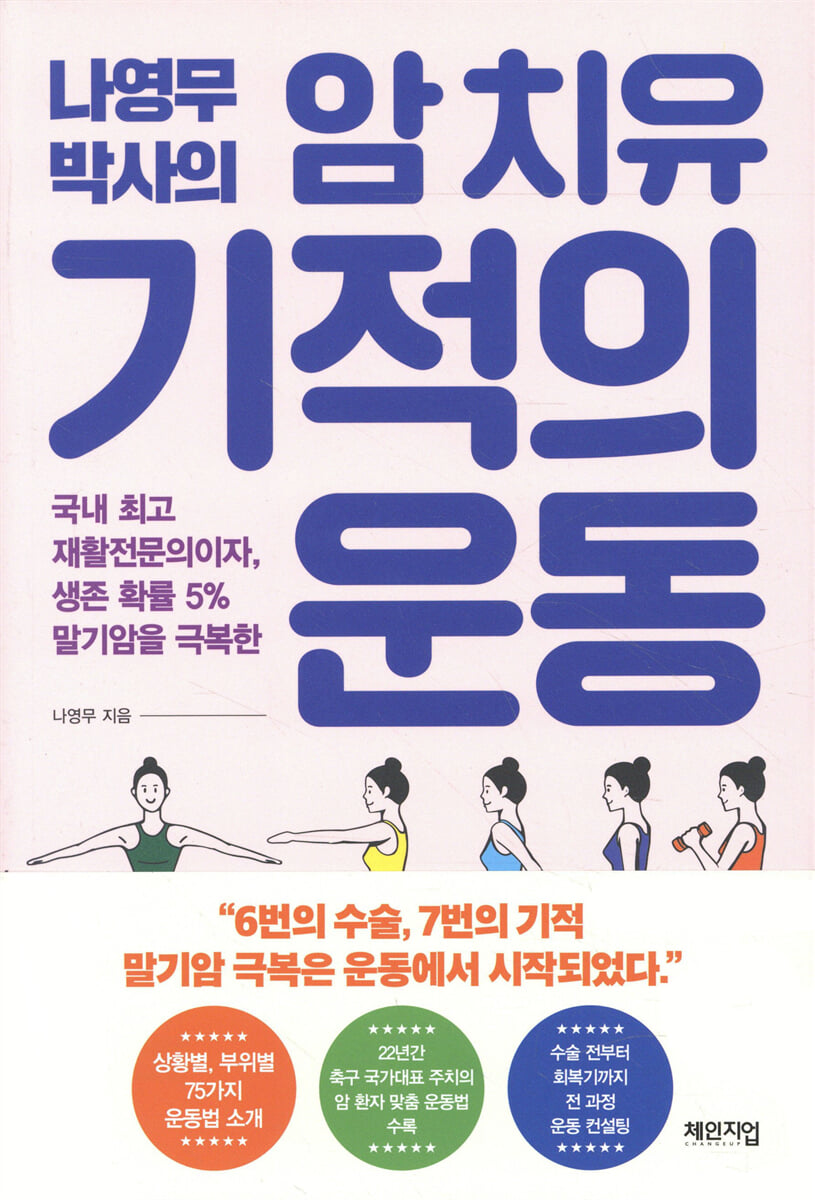
Dr. Na Young-moo's Miracle Exercise for Cancer Healing
 |
Description
Book Introduction
Overcoming cancer starts with 5 minutes of exercise every now and then. “Cells that died from cancer and chemotherapy are revived by exercise.” This is the secret of Dr. Na Young-moo, Korea's top rehabilitation medicine specialist, who escaped the dark tunnel of terminal cancer. Dr. Na Young-moo was diagnosed with stage 4 rectal cancer in 2018. The cancer cells had metastasized to his liver and lungs, and he had to undergo six surgeries and 36 rounds of chemotherapy over three years to fight the cancer fiercely. Based on the various pains and enlightenment he experienced over the past four years, as well as his own experiences, he compiled a book containing rehabilitation exercises necessary for cancer patients. Dr. Na is now facing the fear of relapse and metastasis and is walking step by step towards a 'complete cure', and the thing that has helped me the most is definitely 'exercise'. Dr. Na Young-moo's "Miracle Exercise for Cancer Healing" gently captures the human struggles of facing terminal cancer, the warmth of family love, and the journey to overcoming cancer, along with the wisdom of the battle itself. The book presents the benefits of exercise, tailored to cancer patients. It provides practical advice on overcoming cancer that cancer patients know, such as 'There is an order to rehabilitation exercise for cancer patients', 'Sarcopenia, the silent assassin', and 'Eat like a hippopotamus, manage like a swan', as well as 'Exercises you can do before surgery', 'Exercises you can do in bed', 'Traffic light exercise', and 'Exercises you can do for the 8 major types of cancer', and presents 75 different exercise methods for different situations and body parts. Above all, it can be said to be a 'must-read book on overcoming cancer' that cancer patients and their families must read, as it presents methods to alleviate the side effects of surgery and chemotherapy that they have experienced in the short term and overcome them in the long term. The cancer incidence rate in Korea is steadily increasing, reaching 475.3 cases per 100,000 people (2019 cancer incidence statistics, announced in December 2021). Due to the advancement of medical equipment and the extension of life expectancy, the incidence of cancer is expected to continue to increase in the future. Nonetheless, being first diagnosed with cancer can be a confusing experience for anyone. Cancer patients say that they blame themselves and feel resentful, thinking, "I've lived a good life, so why did I get this disease?" or "What did I do wrong?" After that, many cancer patients become increasingly socially isolated and live a listless life while undergoing surgery and chemotherapy. However, the author says that this lethargy is also a side effect of cancer treatment. So, the patient must become aware of it and exercise on his own. He himself was diagnosed with stage 4 colon cancer, a disease that everyone associates with death. However, he devoted himself to exercising with the firm belief that “my life must continue brilliantly.” He is currently leading an ordinary life, treating patients at his hospital. Dr. Na said, “Cancer patients’ wish is to return to their pre-cancer life. “It is a painful and lonely journey, but the most reliable companion is exercise,” he said. “I hope that you can live a happy life by gradually accumulating the satisfaction that exercise gives you.” |
- You can preview some of the book's contents.
Preview
index
Prologue_We Need Realistic Exercise Advice, Not False Hopes
PART 1.
An uninvited guest in my body
One day, I got cancer.
A 'deadly disease' mistaken for hemorrhoids
Six surgeries and 36 rounds of chemotherapy, and I'm still alive.
'Relapse and metastasis' are still scary and terrifying.
The sorrow of a cancer patient
A sleepless night of crying alone in secret
The name I miss, Captain Yoo Sang-cheol!
My self-esteem is crumbling
My family, who protected me when I was lonely and struggling.
I took off my doctor's gown and put on a patient gown.
Tip 1.
6 Daily Habits Cancer Patients Should Avoid
PART 2.
Chemotherapy: A Game of Hide and Seek with Tenacious Cancer Cells
Surgery is better
Chemotherapy: Feeling like I'm being dragged to the slaughterhouse
Hide and seek with cunning cancer cells
Why Cancer Patients Wear Big Shoes
38 Traces Chemotherapy Drugs Left on My Body
Cancer Treatment Aftereffects: My Smart Way to Cope
You have to eat to avoid starving to death.
It's painful and hard, but there is an end.
The problem was more about the mind than the body.
Tip 2.
How to Make Wise Choices to Beat Cancer
PART 3.
7 Rules for Overcoming Cancer: A Rehabilitation Medicine Specialist
Rule 1: I have cancer, but I have to study to beat it.
Rule 2: Keep sighs short and train your heart muscles hard.
Rule 3: Soldiers need guns, cancer patients need essentials.
Rule 4: Eat like a hippopotamus, manage like a swan.
Law 5: Fight together, not alone.
Rule 6: Get out of the house at all costs.
Rule 7: Exercise every now and then, even if it's just for five minutes.
Tip 3.
Dealing with vague fears wisely with your own routine
PART 4.
5-minute exercise routine for any situation
Beware of Sarcopenia, the Silent Killer of Cancer Patients
There is a certain order to follow when it comes to rehabilitation exercises for cancer patients.
Exercises you can do before surgery
Exercises you can do while lying in bed
Exercises you can do while sitting on a chair
Exercises you can do when you can walk
Tip 4.
Cancer Patients: Debunking Misconceptions About Exercise
PART 5.
Exercises to Help with Cancer and Surgery Aftereffects
Traffic light exercise
When gas doesn't come out
When you have constipation
When there is numbness in the hands and feet (peripheral neuropathy)
When you have no sense of balance
When you feel tired
Tip 5.
Osteoporosis, another enemy of cancer patients
PART 6.
Exercises that Help Fight the 8 Major Cancers
breast cancer
thyroid cancer
lung cancer
uterine cancer and prostate cancer
colon cancer and liver cancer
stomach cancer
Tip 6.
Why Walking Is Good for Cancer Patients
PART 7.
Exercise to Improve Quality of Life After Cancer Treatment
Aerobic exercise and strength training are good to do in parallel.
How to build stamina without overdoing it
Tip 7.
Ten Exercise Commandments for Cancer Patients
PART 1.
An uninvited guest in my body
One day, I got cancer.
A 'deadly disease' mistaken for hemorrhoids
Six surgeries and 36 rounds of chemotherapy, and I'm still alive.
'Relapse and metastasis' are still scary and terrifying.
The sorrow of a cancer patient
A sleepless night of crying alone in secret
The name I miss, Captain Yoo Sang-cheol!
My self-esteem is crumbling
My family, who protected me when I was lonely and struggling.
I took off my doctor's gown and put on a patient gown.
Tip 1.
6 Daily Habits Cancer Patients Should Avoid
PART 2.
Chemotherapy: A Game of Hide and Seek with Tenacious Cancer Cells
Surgery is better
Chemotherapy: Feeling like I'm being dragged to the slaughterhouse
Hide and seek with cunning cancer cells
Why Cancer Patients Wear Big Shoes
38 Traces Chemotherapy Drugs Left on My Body
Cancer Treatment Aftereffects: My Smart Way to Cope
You have to eat to avoid starving to death.
It's painful and hard, but there is an end.
The problem was more about the mind than the body.
Tip 2.
How to Make Wise Choices to Beat Cancer
PART 3.
7 Rules for Overcoming Cancer: A Rehabilitation Medicine Specialist
Rule 1: I have cancer, but I have to study to beat it.
Rule 2: Keep sighs short and train your heart muscles hard.
Rule 3: Soldiers need guns, cancer patients need essentials.
Rule 4: Eat like a hippopotamus, manage like a swan.
Law 5: Fight together, not alone.
Rule 6: Get out of the house at all costs.
Rule 7: Exercise every now and then, even if it's just for five minutes.
Tip 3.
Dealing with vague fears wisely with your own routine
PART 4.
5-minute exercise routine for any situation
Beware of Sarcopenia, the Silent Killer of Cancer Patients
There is a certain order to follow when it comes to rehabilitation exercises for cancer patients.
Exercises you can do before surgery
Exercises you can do while lying in bed
Exercises you can do while sitting on a chair
Exercises you can do when you can walk
Tip 4.
Cancer Patients: Debunking Misconceptions About Exercise
PART 5.
Exercises to Help with Cancer and Surgery Aftereffects
Traffic light exercise
When gas doesn't come out
When you have constipation
When there is numbness in the hands and feet (peripheral neuropathy)
When you have no sense of balance
When you feel tired
Tip 5.
Osteoporosis, another enemy of cancer patients
PART 6.
Exercises that Help Fight the 8 Major Cancers
breast cancer
thyroid cancer
lung cancer
uterine cancer and prostate cancer
colon cancer and liver cancer
stomach cancer
Tip 6.
Why Walking Is Good for Cancer Patients
PART 7.
Exercise to Improve Quality of Life After Cancer Treatment
Aerobic exercise and strength training are good to do in parallel.
How to build stamina without overdoing it
Tip 7.
Ten Exercise Commandments for Cancer Patients
Into the book
I decided to write a book after thinking about how I could provide small comfort and practical help to people suffering from cancer who don't know what to do and their families who watch over them with a sad heart.
I thought it would be helpful to explain the various situations cancer patients face, from cancer diagnosis to chemotherapy and surgery, and customized rehabilitation exercise methods, and to suggest solutions accordingly.
I also thought that if I could compile the stories that I couldn't tell in the column and create a comprehensive guide for a cheerful life fighting cancer, it would help cancer patients who have an uncertain future feel less afraid.
Knowing how painful and difficult a time it can be to be diagnosed with cancer, I sincerely hope that this book will provide cancer patients and their families with some courage and help them fight and overcome cancer.
We send them a message of encouragement: “Even if you’ve been diagnosed with cancer, our lives must go on.”
--- From the "Prologue"
The change in my life began with cancer cells, an 'uninvited tenant' that suddenly appeared one day.
My ordinary daily life was filled with pain from harsh chemotherapy and the side effects that took over my entire body.
At the crossroads of life and death, I always had to face the fear that 'my life could end like this.'
Also, in the loneliness caused by social isolation, the question, 'Will I ever be cured?' constantly followed me.
It was a reality that getting cancer felt like a rite of passage.
But I couldn't continue living like that.
Because life with 'death' always in mind was truly hell.
After that, I decided to change my mind.
I decided to accept cancer cells as a part of my body and actively receive treatment to overcome them.
--- p.16, from “One Day, I Got Cancer”
There are as many as 38 types, including 'peripheral neuropathy, hand-foot syndrome, nausea (dizzy feeling), vomiting, diarrhea, constipation, stomatitis, dry mouth, loss of appetite, dizziness, lethargy, hair loss, indigestion, skin rash, discoloration of fingernails and toenails, depression, insomnia, sensitivity, anxiety, fatigue, joint pain, muscle pain, abdominal pain, chest pain, urinary difficulty, itching, sarcopenia, decreased concentration, chills, weight loss, lack of energy, dysphagia (difficulty swallowing food), flushing, gum disease, short-term memory loss, pain at the surgical site, joint stiffness, and body deformation'.
These side effects would occur simultaneously or in a relay fashion, tormenting my body.
It was especially worse when I was not feeling well or had not eaten well.
As the mouth ulcer subsided a little, I suddenly felt a pain in my throat, my lower abdomen started to hurt, and I also had a headache.
It's as if, after a period of nausea and vomiting, muscle pain and hand-foot syndrome take their place.
--- p.66, from “38 Traces Left on My Body by Anticancer Drugs”
Preoperative exercise should focus on building physical strength.
Since chemotherapy is required following surgery, securing the physical strength to endure it is a top priority.
In particular, since anesthesia is administered during surgery, respiratory function may decline.
It is helpful to develop the habit of exercising your breathing muscles to increase your lung capacity.
Additionally, after surgery, muscle imbalance is disrupted along with pain, which leads to poor posture.
This is why you need spinal erector spinae exercises to straighten your spine.
In particular, you need to strengthen your core muscles to walk well after surgery.
--- p.134, from “Exercises You Can Do Before Surgery”
After surgery for uterine or prostate cancer, pelvic pain and urinary incontinence are common.
It is due to damage to the pelvic muscles and nerves, so it hurts when you get up from lying down and after walking.
You may also feel pain as your pelvic muscles become stiff and tense.
Weakness of the thigh muscles due to nerve damage can make walking difficult and cause pain.
When the pelvis is misaligned, the weight shifts to one side of the pelvis, causing stress to build up and eventually causing muscle damage and knots.
Tight muscles can compress the sciatic nerve that runs through them, causing pain.
Kegel exercises, pelvic and thigh muscle strengthening exercises, and pelvic muscle stretching can help.
I thought it would be helpful to explain the various situations cancer patients face, from cancer diagnosis to chemotherapy and surgery, and customized rehabilitation exercise methods, and to suggest solutions accordingly.
I also thought that if I could compile the stories that I couldn't tell in the column and create a comprehensive guide for a cheerful life fighting cancer, it would help cancer patients who have an uncertain future feel less afraid.
Knowing how painful and difficult a time it can be to be diagnosed with cancer, I sincerely hope that this book will provide cancer patients and their families with some courage and help them fight and overcome cancer.
We send them a message of encouragement: “Even if you’ve been diagnosed with cancer, our lives must go on.”
--- From the "Prologue"
The change in my life began with cancer cells, an 'uninvited tenant' that suddenly appeared one day.
My ordinary daily life was filled with pain from harsh chemotherapy and the side effects that took over my entire body.
At the crossroads of life and death, I always had to face the fear that 'my life could end like this.'
Also, in the loneliness caused by social isolation, the question, 'Will I ever be cured?' constantly followed me.
It was a reality that getting cancer felt like a rite of passage.
But I couldn't continue living like that.
Because life with 'death' always in mind was truly hell.
After that, I decided to change my mind.
I decided to accept cancer cells as a part of my body and actively receive treatment to overcome them.
--- p.16, from “One Day, I Got Cancer”
There are as many as 38 types, including 'peripheral neuropathy, hand-foot syndrome, nausea (dizzy feeling), vomiting, diarrhea, constipation, stomatitis, dry mouth, loss of appetite, dizziness, lethargy, hair loss, indigestion, skin rash, discoloration of fingernails and toenails, depression, insomnia, sensitivity, anxiety, fatigue, joint pain, muscle pain, abdominal pain, chest pain, urinary difficulty, itching, sarcopenia, decreased concentration, chills, weight loss, lack of energy, dysphagia (difficulty swallowing food), flushing, gum disease, short-term memory loss, pain at the surgical site, joint stiffness, and body deformation'.
These side effects would occur simultaneously or in a relay fashion, tormenting my body.
It was especially worse when I was not feeling well or had not eaten well.
As the mouth ulcer subsided a little, I suddenly felt a pain in my throat, my lower abdomen started to hurt, and I also had a headache.
It's as if, after a period of nausea and vomiting, muscle pain and hand-foot syndrome take their place.
--- p.66, from “38 Traces Left on My Body by Anticancer Drugs”
Preoperative exercise should focus on building physical strength.
Since chemotherapy is required following surgery, securing the physical strength to endure it is a top priority.
In particular, since anesthesia is administered during surgery, respiratory function may decline.
It is helpful to develop the habit of exercising your breathing muscles to increase your lung capacity.
Additionally, after surgery, muscle imbalance is disrupted along with pain, which leads to poor posture.
This is why you need spinal erector spinae exercises to straighten your spine.
In particular, you need to strengthen your core muscles to walk well after surgery.
--- p.134, from “Exercises You Can Do Before Surgery”
After surgery for uterine or prostate cancer, pelvic pain and urinary incontinence are common.
It is due to damage to the pelvic muscles and nerves, so it hurts when you get up from lying down and after walking.
You may also feel pain as your pelvic muscles become stiff and tense.
Weakness of the thigh muscles due to nerve damage can make walking difficult and cause pain.
When the pelvis is misaligned, the weight shifts to one side of the pelvis, causing stress to build up and eventually causing muscle damage and knots.
Tight muscles can compress the sciatic nerve that runs through them, causing pain.
Kegel exercises, pelvic and thigh muscle strengthening exercises, and pelvic muscle stretching can help.
--- p.230, from “Uterine Cancer and Prostate Cancer”
Publisher's Review
“The most effective prescription to cure your cancer!”
Alternative medicine: Exercise cures cancer better than diet!
So, what foods should cancer patients eat? What kind of exercise should they engage in? What efforts should they make to prevent recurrence? The author, who was first diagnosed with Stage 4 rectal cancer in 2018 and returned to a healthy life after undergoing surgery for the last time in 2020, explains that even if cancer cells grow in the same area, each case is different, and the prognosis for surgery and chemotherapy varies.
So, it is difficult to say what kind of food a person should eat or how they should live for certain cancers.
Because each cancer cell has different characteristics, it is important to study each patient to determine what type of cancer they have and how they differ from other cancer patients.
However, there are some common symptoms.
Cancer treatment damages not only cancer cells but also normal cells.
This causes various side effects.
That's why Dr. Na Young-moo says we need to exercise.
The idea is to prevent sarcopenia, the "silent killer of cancer patients," and boost immunity through exercise.
As part of this, what Dr. Na Young-moo suggested to cancer patients is 'occasional exercise.'
So, starting before surgery and continuing until you can move after surgery, we introduce various exercises to maintain muscle strength, even while holding a cell phone.
Cancer patients who have difficulty standing on their own due to a loss of balance caused by the side effects of surgery and chemotherapy are able to enjoy normal daily life by raising their arms, opening their chests to increase lung capacity, and strengthening their thigh and calf muscles to walk. This course presents exercises that are essential for cancer patients, using his professional knowledge and experience, step by step.
The thing to be careful of at this time is that you should not exercise as hard as you did when you were healthy, saying, 'I used to be like that.'
The author particularly emphasizes that exercise should be done slowly, step by step, and for short periods of time, and then gradually adjusted to suit one's physical strength.
Dr. Na Young-moo says that he is also anxiously waiting for a full recovery, but he always exercises, controls his diet, and lives positively.
And he asserts that any cancer patient can overcome cancer by slowly and gradually engaging in the exercise they like.
As the author says, "To see the light in the long, dark, and depressing tunnel that is cancer, you must believe that there is light ahead," this book was published with the earnest hope that other cancer patients and their families will overcome it and become healthy.
So, if you don't have a favorite exercise, try the 75 exercises suggested in this book.
No matter how difficult it may be, no matter what the situation, let's start practicing it today whenever we have time.
It may also be possible to overcome the persistent battle against 'cancer cells'.
Cancer, you have to know it properly to be cured!
A book that should be read not only by cancer patients but also by their families!
When you get cancer, not only the person but also the entire family has to live like a cancer patient.
So, when a loved one gets cancer, it is common for both the patient and the family to go through a painful and difficult time.
However, because they cannot feel pain directly, their families cannot know what cancer patients need, what process they go through, and what kind of pain they feel.
Cancer patients are well aware that their families are suffering because of them, so most of them do not share their suffering, thinking that they should suffer alone.
Since he doesn't talk in detail about his feelings or physical condition, his family can only guess.
So it is difficult for both the patient and his family.
This book helped cancer patients and their families learn about cancer and the various physical and mental pain they experience.
By doing so, cancer patients can receive warm support from their families and gain mental stability, just like with surgery or chemotherapy that needs to be done in a timely manner.
The author says that for cancer patients, not only physical but also mental stability and mental muscle are important.
In order to win the battle against persistent cancer cells, the patient's own will to overcome is essential.
Dr. Na Young-moo, who served as the national soccer team's personal physician for 22 years and is Korea's top rehabilitation medicine specialist, has written about the various pains and realizations he experienced after being diagnosed with stage 4 rectal cancer, as well as cancer rehabilitation exercises that can help cancer patients.
By writing down the daily lives and pains of cancer patients who become pessimistic about their situation → feel depressed → become socially isolated, we have provided a window for patients to empathize, comfort, and hope, and for their families to understand the patients a little better.
It helps cancer patients and their families to live healthy lives again by working hard to receive cancer treatment and rehabilitation with positivity and hope.
Alternative medicine: Exercise cures cancer better than diet!
So, what foods should cancer patients eat? What kind of exercise should they engage in? What efforts should they make to prevent recurrence? The author, who was first diagnosed with Stage 4 rectal cancer in 2018 and returned to a healthy life after undergoing surgery for the last time in 2020, explains that even if cancer cells grow in the same area, each case is different, and the prognosis for surgery and chemotherapy varies.
So, it is difficult to say what kind of food a person should eat or how they should live for certain cancers.
Because each cancer cell has different characteristics, it is important to study each patient to determine what type of cancer they have and how they differ from other cancer patients.
However, there are some common symptoms.
Cancer treatment damages not only cancer cells but also normal cells.
This causes various side effects.
That's why Dr. Na Young-moo says we need to exercise.
The idea is to prevent sarcopenia, the "silent killer of cancer patients," and boost immunity through exercise.
As part of this, what Dr. Na Young-moo suggested to cancer patients is 'occasional exercise.'
So, starting before surgery and continuing until you can move after surgery, we introduce various exercises to maintain muscle strength, even while holding a cell phone.
Cancer patients who have difficulty standing on their own due to a loss of balance caused by the side effects of surgery and chemotherapy are able to enjoy normal daily life by raising their arms, opening their chests to increase lung capacity, and strengthening their thigh and calf muscles to walk. This course presents exercises that are essential for cancer patients, using his professional knowledge and experience, step by step.
The thing to be careful of at this time is that you should not exercise as hard as you did when you were healthy, saying, 'I used to be like that.'
The author particularly emphasizes that exercise should be done slowly, step by step, and for short periods of time, and then gradually adjusted to suit one's physical strength.
Dr. Na Young-moo says that he is also anxiously waiting for a full recovery, but he always exercises, controls his diet, and lives positively.
And he asserts that any cancer patient can overcome cancer by slowly and gradually engaging in the exercise they like.
As the author says, "To see the light in the long, dark, and depressing tunnel that is cancer, you must believe that there is light ahead," this book was published with the earnest hope that other cancer patients and their families will overcome it and become healthy.
So, if you don't have a favorite exercise, try the 75 exercises suggested in this book.
No matter how difficult it may be, no matter what the situation, let's start practicing it today whenever we have time.
It may also be possible to overcome the persistent battle against 'cancer cells'.
Cancer, you have to know it properly to be cured!
A book that should be read not only by cancer patients but also by their families!
When you get cancer, not only the person but also the entire family has to live like a cancer patient.
So, when a loved one gets cancer, it is common for both the patient and the family to go through a painful and difficult time.
However, because they cannot feel pain directly, their families cannot know what cancer patients need, what process they go through, and what kind of pain they feel.
Cancer patients are well aware that their families are suffering because of them, so most of them do not share their suffering, thinking that they should suffer alone.
Since he doesn't talk in detail about his feelings or physical condition, his family can only guess.
So it is difficult for both the patient and his family.
This book helped cancer patients and their families learn about cancer and the various physical and mental pain they experience.
By doing so, cancer patients can receive warm support from their families and gain mental stability, just like with surgery or chemotherapy that needs to be done in a timely manner.
The author says that for cancer patients, not only physical but also mental stability and mental muscle are important.
In order to win the battle against persistent cancer cells, the patient's own will to overcome is essential.
Dr. Na Young-moo, who served as the national soccer team's personal physician for 22 years and is Korea's top rehabilitation medicine specialist, has written about the various pains and realizations he experienced after being diagnosed with stage 4 rectal cancer, as well as cancer rehabilitation exercises that can help cancer patients.
By writing down the daily lives and pains of cancer patients who become pessimistic about their situation → feel depressed → become socially isolated, we have provided a window for patients to empathize, comfort, and hope, and for their families to understand the patients a little better.
It helps cancer patients and their families to live healthy lives again by working hard to receive cancer treatment and rehabilitation with positivity and hope.
GOODS SPECIFICS
- Publication date: September 13, 2022
- Page count, weight, size: 288 pages | 502g | 152*223*17mm
- ISBN13: 9791191378238
- ISBN10: 1191378233
You may also like
카테고리
korean


korean

![GQ KOREA Mark (Monthly): December [2025]](http://librairie.coreenne.fr/cdn/shop/files/8ef265dbbfbf186523ed75ba7319009d.jpg?v=1765340328&width=3840)


