

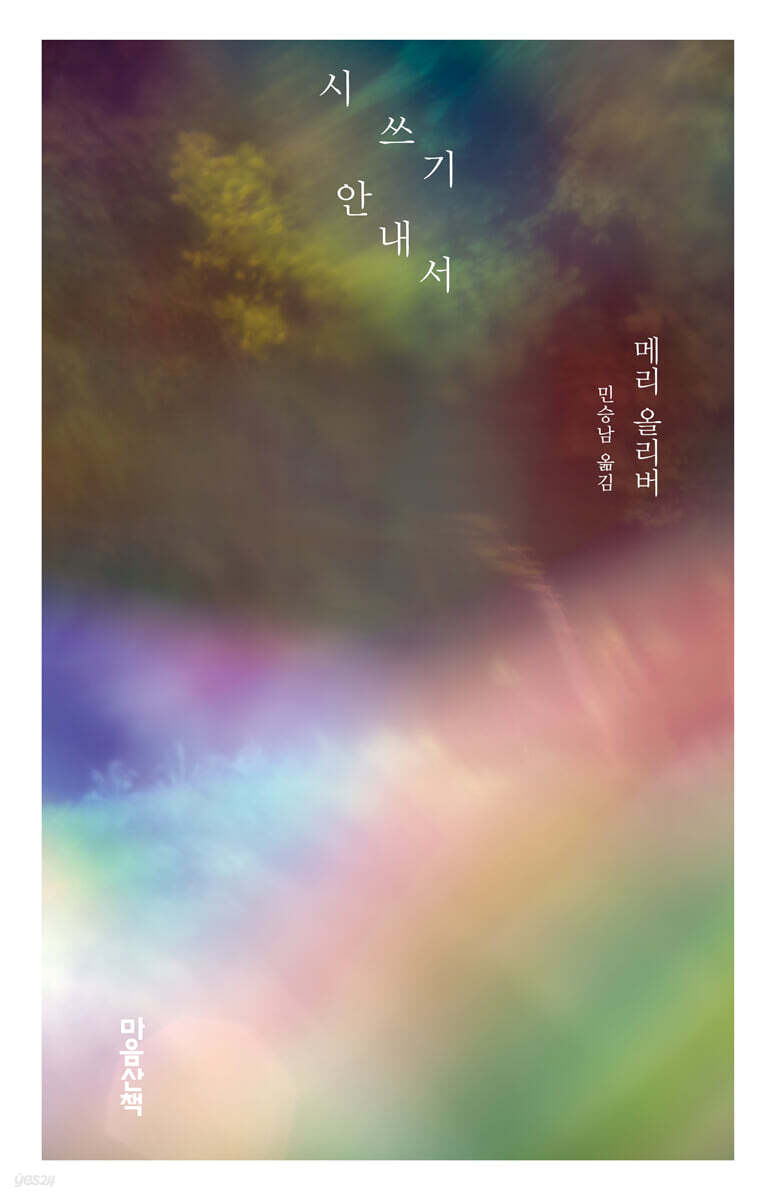
A Guide to Writing Poetry
 |
Description
Book Introduction
Poetry is the power to cherish life.
“Ultimately, poetry is not a collection of words, but a fire for those who shiver in the cold,
It is a rope for the lost, and bread in the pockets of the hungry.
Because it is absolutely necessary.
“That’s really true.”
Mary Oliver, the poet of "Wild Geese," who has comforted countless readers across borders and generations, the Pulitzer Prize-winning author, and a beloved reader of countless writers including Han Kang, Kim Yeon-su, Kim So-yeon, and Lee Je-ni, has published "A Guide to Writing Poetry" by Maumsanchaek.
Although he has been loved for his poetry collections such as “A Thousand Mornings” and “The Way of Accepting the World,” as well as his prose works such as “Long Breath” and “Perfect Days,” this is the first time a full-fledged guide to writing poetry has been introduced.
This book contains the creative secrets of Mary Oliver, who admires the beauty of nature with her infinite poetic language, and offers advice that will help you savor poetry more deeply.
More than 30 years have passed since the publication of his first poetry collection, and the poet, who has reached a mature level, generously shares the insights he has gained from his poetic career.
“Ultimately, poetry is not a collection of words, but a fire for those who shiver in the cold,
It is a rope for the lost, and bread in the pockets of the hungry.
Because it is absolutely necessary.
“That’s really true.”
Mary Oliver, the poet of "Wild Geese," who has comforted countless readers across borders and generations, the Pulitzer Prize-winning author, and a beloved reader of countless writers including Han Kang, Kim Yeon-su, Kim So-yeon, and Lee Je-ni, has published "A Guide to Writing Poetry" by Maumsanchaek.
Although he has been loved for his poetry collections such as “A Thousand Mornings” and “The Way of Accepting the World,” as well as his prose works such as “Long Breath” and “Perfect Days,” this is the first time a full-fledged guide to writing poetry has been introduced.
This book contains the creative secrets of Mary Oliver, who admires the beauty of nature with her infinite poetic language, and offers advice that will help you savor poetry more deeply.
More than 30 years have passed since the publication of his first poetry collection, and the poet, who has reached a mature level, generously shares the insights he has gained from his poetic career.
- You can preview some of the book's contents.
Preview
index
Opening remarks
preparation
Reading poetry
imitation
sound
Other devices of sound
line
Some given formats
free poetry
Grammar, tone, voice
image
rewrite
Creative Classroom and Solitude
Conclusion
Translator's Note
Author's chronology
Tributes to Mary Oliver
preparation
Reading poetry
imitation
sound
Other devices of sound
line
Some given formats
free poetry
Grammar, tone, voice
image
rewrite
Creative Classroom and Solitude
Conclusion
Translator's Note
Author's chronology
Tributes to Mary Oliver
Into the book
Everyone knows that poets are born, not trained in school.
It's the same for painters, sculptors, and musicians.
Essential things cannot be taught; they are either given or acquired.
It is formed in a mysterious way that cannot be disassembled and reassembled for the next person.
Nevertheless, painters, sculptors, and musicians must actively engage with not only the modern theories and techniques of their fields, but also the history of the past.
The same goes for poets.
Even if there are things that cannot be taught, there are many things that can and must be learned.
This book contains such things that you can learn.
--- p.9
Poetry is a river, and countless voices flow along it.
Each poem moves with the exhilarating swell of the waves.
No attempt is eternal.
All poetry arrives within a historical context, and eventually almost all of it disappears.
But the desire to write poetry, and the world that willingly accepts poetry – no, needs poetry – these two things never disappear.
If it is not only one's own work but 'all' poetry that allows one to soar high in this green, finite world - to lift the doorknob and glimpse the great heaven - then one can be said to have poetic sensibility.
Poetic sensibility refers to gratitude that has nothing to do with authorship, and passion and longing that transcend the boundaries of the ego.
--- pp.19-20
Poetry is a moment.
A moment in the world when you look at something and pay attention.
--- p.104
A poet must not simply write poetry, but must also carefully observe the world he has chosen as the subject of his poetry.
If some poems feel shallow and weak, it is not because the poet lacks vocabulary, but because he does not linger long among the flowers and thus fails to see them in a new, interesting, and effective way.
--- p.141
Literature is not simply a collection of words, nor is it a collection of ideas.
It is a formal composition that reflects life as a whole, reports on it, and questions it.
And the power of poetry comes from spiritual exploration and figurative language - it is the mud and leaves of the world.
Without mud and leaves, without fish and roses and bees, poetry would be as dry as muttering.
--- p.155
I like to say that I write poetry for some stranger who will be born in a distant land hundreds of years from now.
This idea is especially useful when rewriting poetry.
Because it's a powerful reminder that everything you need in a poem must be on the page.
I must write complete poetry - poetry about swimming in rivers, poetry about climbing mountains.
If a poem is well written, it is no longer my poem, but a self-sufficient poem that breathes deeply and lives.
Poetry, like a traveler in a land of constant uncertainty, must carry with it everything it needs to sustain itself.
--- p.159
Athletes take good care of their bodies.
Writers, too, must take good care of their sensibilities, which contain the potential of poetry.
It is nourished by books, other arts, history, philosophy, and the sacred and the joyful.
There is also honest labor done by hand (I am not advocating only the academic life).
And there is a green world - in people, in animals, and even in trees (if you truly care about trees).
A lively and inquisitive mind, a mind filled with compassion, curiosity, anger, music, and emotion, are also full of possibilities for poetry.
Poetry is the power to cherish life.
And poetry demands a vision, or, to use an old-fashioned expression, faith.
That's true.
Because, in the end, poetry is not just a collection of words, but something essential, like a fire for those shivering in the cold, a rope for the lost, and bread in the pockets of the hungry.
That's true.
It's the same for painters, sculptors, and musicians.
Essential things cannot be taught; they are either given or acquired.
It is formed in a mysterious way that cannot be disassembled and reassembled for the next person.
Nevertheless, painters, sculptors, and musicians must actively engage with not only the modern theories and techniques of their fields, but also the history of the past.
The same goes for poets.
Even if there are things that cannot be taught, there are many things that can and must be learned.
This book contains such things that you can learn.
--- p.9
Poetry is a river, and countless voices flow along it.
Each poem moves with the exhilarating swell of the waves.
No attempt is eternal.
All poetry arrives within a historical context, and eventually almost all of it disappears.
But the desire to write poetry, and the world that willingly accepts poetry – no, needs poetry – these two things never disappear.
If it is not only one's own work but 'all' poetry that allows one to soar high in this green, finite world - to lift the doorknob and glimpse the great heaven - then one can be said to have poetic sensibility.
Poetic sensibility refers to gratitude that has nothing to do with authorship, and passion and longing that transcend the boundaries of the ego.
--- pp.19-20
Poetry is a moment.
A moment in the world when you look at something and pay attention.
--- p.104
A poet must not simply write poetry, but must also carefully observe the world he has chosen as the subject of his poetry.
If some poems feel shallow and weak, it is not because the poet lacks vocabulary, but because he does not linger long among the flowers and thus fails to see them in a new, interesting, and effective way.
--- p.141
Literature is not simply a collection of words, nor is it a collection of ideas.
It is a formal composition that reflects life as a whole, reports on it, and questions it.
And the power of poetry comes from spiritual exploration and figurative language - it is the mud and leaves of the world.
Without mud and leaves, without fish and roses and bees, poetry would be as dry as muttering.
--- p.155
I like to say that I write poetry for some stranger who will be born in a distant land hundreds of years from now.
This idea is especially useful when rewriting poetry.
Because it's a powerful reminder that everything you need in a poem must be on the page.
I must write complete poetry - poetry about swimming in rivers, poetry about climbing mountains.
If a poem is well written, it is no longer my poem, but a self-sufficient poem that breathes deeply and lives.
Poetry, like a traveler in a land of constant uncertainty, must carry with it everything it needs to sustain itself.
--- p.159
Athletes take good care of their bodies.
Writers, too, must take good care of their sensibilities, which contain the potential of poetry.
It is nourished by books, other arts, history, philosophy, and the sacred and the joyful.
There is also honest labor done by hand (I am not advocating only the academic life).
And there is a green world - in people, in animals, and even in trees (if you truly care about trees).
A lively and inquisitive mind, a mind filled with compassion, curiosity, anger, music, and emotion, are also full of possibilities for poetry.
Poetry is the power to cherish life.
And poetry demands a vision, or, to use an old-fashioned expression, faith.
That's true.
Because, in the end, poetry is not just a collection of words, but something essential, like a fire for those shivering in the cold, a rope for the lost, and bread in the pockets of the hungry.
That's true.
--- pp.172-173
Publisher's Review
“There are many things that can and must be learned, even if they cannot be taught.
This book contains such things that can be learned.”
As its honest title suggests, 『A Guide to Writing Poetry』 provides detailed yet rigorous instruction on the entire process of creating poetry, from the rhythm and sound of poetic language, the effect of line division, poetic form, tone and imagery, and even rewriting.
Mary Oliver demonstrates her exceptional talents not only as a poet but also as a teacher in this book.
It specifically introduces the poetry of British and American poets who inspired him, including Robert Frost, Walt Whitman, and Emily Dickinson, and encompasses not only professional knowledge about writing poetry but also a broader perspective on literature and art in general.
“Writing poetry is a process that takes place between the learned skills of the heart and the conscious mind.
It's a kind of love story."
In this book, Mary Oliver refreshingly renews a series of old beliefs surrounding creation.
Art is often misunderstood as relying on inspiration or innate talent, but in "A Guide to Writing Poetry," he urges us not to neglect the effort to train our literary skills.
Poetry is said to be achieved when “two beings, the mind and the skill, make a promise and keep that promise.”
His words, “You have to practice before you can become a poet, and imitation is a very good way to explore real poetry,” lightly break the stereotype that only pursues originality and taboos imitation, and give a sense of liberation to new poets.
Who hasn't seen a young artist in an art gallery, diligently copying a Vermeer or a van Gogh, believing he's learning something valuable?
Freedom of emotion, authenticity and originality of the work - these come at the end, not at the beginning.
Only those who are patient, diligent, and inspired can reach that level.
_In the text
He then emphasizes the importance of 'rewriting'.
While rewriting is certainly arduous and sometimes tedious work, Mary Oliver emphasizes that in the early stages of writing, we can learn a lot from rewriting, and asks us to “remember that beauty is born in the process of writing and rewriting.”
Even those who seem to write poetry as smoothly as water flowing at first glance confess that they have to revise it at least forty or fifty times to complete a single poem, which gives courage to struggling creators.
On the other hand, Mary Oliver, who has already left behind countless beautiful poems, is not content with the poems she has written so far, but rather strives to write even better poems in the future. This encourages those who are following in her footsteps and walking the long journey to renew their resolve to write.
“Poetry is an attitude and a prayer.
“Poetry sings on paper, and the song resonates beyond the paper.”
This book was written to help those who dream of writing poetry take their first steps toward creation, while also warmly welcoming those who read poetry.
By understanding the process of poetry's creation and the time and effort a poet puts into completing a poem, readers can finally take a step closer to the wondrous world of poetry.
Just as there is no one right way to pray, Mary Oliver reminds us that there is no single right way to read poetry, but rather that “a bond can be formed between the poem and the individual by each reading with their own individual intonation.”
As readers listen to Mary Oliver's voice here, they experience a precious time meeting their beloved poet as a literary teacher and friend.
This book is like Mary Oliver's invitation to all who love poetry.
The sweet moment when a beautiful and wonderful poem is finally born from a place where there was only struggle and tangled words, and the joy of the creative writing classroom is that everyone can participate in that moment.
Everyone shares a little bit of that miracle.
The miracle is not just a product of luck, inspiration, and chance; it is also the fruition of technical knowledge and diligent effort—somewhat less exciting, but essential elements.
These elements are the very foundation that supports the moving light called 'poetry', its indescribable existence.
_In the text
This book contains such things that can be learned.”
As its honest title suggests, 『A Guide to Writing Poetry』 provides detailed yet rigorous instruction on the entire process of creating poetry, from the rhythm and sound of poetic language, the effect of line division, poetic form, tone and imagery, and even rewriting.
Mary Oliver demonstrates her exceptional talents not only as a poet but also as a teacher in this book.
It specifically introduces the poetry of British and American poets who inspired him, including Robert Frost, Walt Whitman, and Emily Dickinson, and encompasses not only professional knowledge about writing poetry but also a broader perspective on literature and art in general.
“Writing poetry is a process that takes place between the learned skills of the heart and the conscious mind.
It's a kind of love story."
In this book, Mary Oliver refreshingly renews a series of old beliefs surrounding creation.
Art is often misunderstood as relying on inspiration or innate talent, but in "A Guide to Writing Poetry," he urges us not to neglect the effort to train our literary skills.
Poetry is said to be achieved when “two beings, the mind and the skill, make a promise and keep that promise.”
His words, “You have to practice before you can become a poet, and imitation is a very good way to explore real poetry,” lightly break the stereotype that only pursues originality and taboos imitation, and give a sense of liberation to new poets.
Who hasn't seen a young artist in an art gallery, diligently copying a Vermeer or a van Gogh, believing he's learning something valuable?
Freedom of emotion, authenticity and originality of the work - these come at the end, not at the beginning.
Only those who are patient, diligent, and inspired can reach that level.
_In the text
He then emphasizes the importance of 'rewriting'.
While rewriting is certainly arduous and sometimes tedious work, Mary Oliver emphasizes that in the early stages of writing, we can learn a lot from rewriting, and asks us to “remember that beauty is born in the process of writing and rewriting.”
Even those who seem to write poetry as smoothly as water flowing at first glance confess that they have to revise it at least forty or fifty times to complete a single poem, which gives courage to struggling creators.
On the other hand, Mary Oliver, who has already left behind countless beautiful poems, is not content with the poems she has written so far, but rather strives to write even better poems in the future. This encourages those who are following in her footsteps and walking the long journey to renew their resolve to write.
“Poetry is an attitude and a prayer.
“Poetry sings on paper, and the song resonates beyond the paper.”
This book was written to help those who dream of writing poetry take their first steps toward creation, while also warmly welcoming those who read poetry.
By understanding the process of poetry's creation and the time and effort a poet puts into completing a poem, readers can finally take a step closer to the wondrous world of poetry.
Just as there is no one right way to pray, Mary Oliver reminds us that there is no single right way to read poetry, but rather that “a bond can be formed between the poem and the individual by each reading with their own individual intonation.”
As readers listen to Mary Oliver's voice here, they experience a precious time meeting their beloved poet as a literary teacher and friend.
This book is like Mary Oliver's invitation to all who love poetry.
The sweet moment when a beautiful and wonderful poem is finally born from a place where there was only struggle and tangled words, and the joy of the creative writing classroom is that everyone can participate in that moment.
Everyone shares a little bit of that miracle.
The miracle is not just a product of luck, inspiration, and chance; it is also the fruition of technical knowledge and diligent effort—somewhat less exciting, but essential elements.
These elements are the very foundation that supports the moving light called 'poetry', its indescribable existence.
_In the text
GOODS SPECIFICS
- Date of issue: August 15, 2025
- Page count, weight, size: 188 pages | 135*210*20mm
- ISBN13: 9788960909434
- ISBN10: 8960909432
You may also like
카테고리
korean


korean

![GQ KOREA Mark (Monthly): December [2025]](http://librairie.coreenne.fr/cdn/shop/files/8ef265dbbfbf186523ed75ba7319009d.jpg?v=1765340328&width=3840)


