

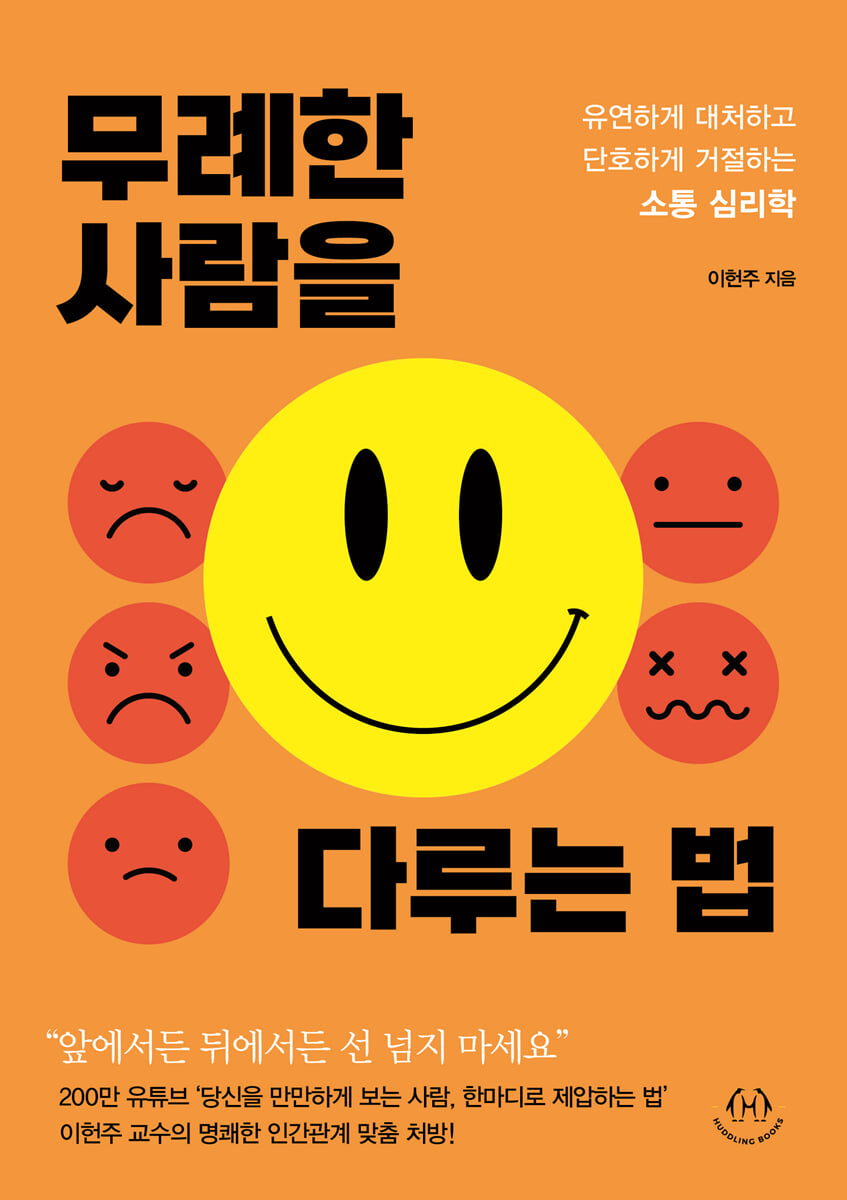
How to deal with rude people
 |
Description
Book Introduction
Professor Lee Heon-ju of Yonsei University, who created the popular YouTube video "How to Subdue People Who Underestimate You in One Word," has published his first popular book, "How to Deal with Rude People."
The author, a counseling scholar and counseling psychologist, hopes that everyone can protect themselves in interpersonal relationships. In this book, he has included essential interpersonal skills that were previously shared only in classrooms and counseling rooms. "How to Deal with Rude People" is a systematic and friendly book that follows the process of psychological counseling with a professional. It consists of three steps: first, sharing your concerns about interpersonal relationships, then receiving professional advice and a customized prescription. In particular, this book provides very useful coping methods that can help you protect yourself flexibly and decisively in various places and situations, such as work, school, and home. These are actually methods that the author has practiced and applied in his daily life with many clients who have visited his counseling office and have found effective. Readers will find the best method for themselves and apply it to those who cross the line in their relationships, such as bosses, seniors and juniors, friends, family, and club members, to live a happier life with better interpersonal relationships. |
- You can preview some of the book's contents.
Preview
index
Recommendation
Instructions for use of this book │ For those who find interpersonal relationships more difficult than anything else
Prologue │ Why does this kind and affectionate girl always get rude people?
The Story of the Shepherd and the Fence
Chapter 1: Understanding Yourself: Understanding Your Inner Self, Which Was Only Good
I feel like I've become a trash can of emotions
All About the 'Good Kid Complex'
Reason for wearing the good boy mask ① Pressure
The reason why I wore the good boy mask ② Criticism
Reason for wearing the good boy mask ③ Relationships
Chapter 2: Understanding Others: Examining Those Who Made Me Struggle
Feeling uncomfortable is a sign that social distancing is necessary.
Type 1: The Ice Type: Cold and has low desire for relationships
Hurtful Type ② Narcissistic Narcissist
Type 3: The obsessive type with no boundaries
The type that causes harm ④ Sociopaths with zero empathy
Chapter 3: Dealing with Uncomfortable and Rude People: Be Flexible and Firm in Your Defense
I was kind, but you thought I was a fool…
What the words that hurt me the most tell me
Be flexible with people who are uncomfortable
How to Deal with Uncomfortable People ① People who don't know the other person's needs well
How to Deal with Uncomfortable People ② People who approach you in a burdensome way, saying they want to become friends
How to Deal with Uncomfortable People ③ People who are sensitive and prickly
How to Deal with Uncomfortable People ④ Dependent People Who Are Good at Asking for Favors
How to Deal with Uncomfortable People ⑤ People Who Keep Demanding Things
Dealing firmly with rude people
How to Deal with Rude People ① People who are as cunning as wolves
How to Deal with Rude People ② People Who Are as Hard to Beat as a Lion
Epilogue │ A tender encounter in resoluteness
Instructions for use of this book │ For those who find interpersonal relationships more difficult than anything else
Prologue │ Why does this kind and affectionate girl always get rude people?
The Story of the Shepherd and the Fence
Chapter 1: Understanding Yourself: Understanding Your Inner Self, Which Was Only Good
I feel like I've become a trash can of emotions
All About the 'Good Kid Complex'
Reason for wearing the good boy mask ① Pressure
The reason why I wore the good boy mask ② Criticism
Reason for wearing the good boy mask ③ Relationships
Chapter 2: Understanding Others: Examining Those Who Made Me Struggle
Feeling uncomfortable is a sign that social distancing is necessary.
Type 1: The Ice Type: Cold and has low desire for relationships
Hurtful Type ② Narcissistic Narcissist
Type 3: The obsessive type with no boundaries
The type that causes harm ④ Sociopaths with zero empathy
Chapter 3: Dealing with Uncomfortable and Rude People: Be Flexible and Firm in Your Defense
I was kind, but you thought I was a fool…
What the words that hurt me the most tell me
Be flexible with people who are uncomfortable
How to Deal with Uncomfortable People ① People who don't know the other person's needs well
How to Deal with Uncomfortable People ② People who approach you in a burdensome way, saying they want to become friends
How to Deal with Uncomfortable People ③ People who are sensitive and prickly
How to Deal with Uncomfortable People ④ Dependent People Who Are Good at Asking for Favors
How to Deal with Uncomfortable People ⑤ People Who Keep Demanding Things
Dealing firmly with rude people
How to Deal with Rude People ① People who are as cunning as wolves
How to Deal with Rude People ② People Who Are as Hard to Beat as a Lion
Epilogue │ A tender encounter in resoluteness
Detailed image

Into the book
Life and the human relationships we encounter in life are so vast that it is all the more important to examine their deeper dynamics.
It is also important to develop the ability to see yourself and others.
To make the content of this book easily accessible to everyone, I have tried to explain psychological processes while avoiding academic terminology as much as possible, and have also included a wealth of vivid examples.
These are real-life stories of difficulties in interpersonal relationships at home, school, work, and social gatherings.
In addition, it also introduced various types of human relationships that appear in literature and movies that are familiar to everyone.
These numerous examples will help you understand yourself and others by examining the dynamics of human relationships both up close and from a distance.
--- p.15 From the “User’s Manual for This Book”
In any human relationship, protecting yourself comes first.
But why can't even those who know this well do so? The most common reason is a lack of clear understanding of the personality structure of both partners and the dynamics of the relationship.
If you are particularly indecisive in your relationships, if you live as a good person even though you are constantly being hurt, then you need to first understand yourself.
You also need to know exactly the patterns and dynamics of the person who is making things difficult for you.
Then build a fence.
--- p.38 From the "Prologue"
When you feel pressured, try to tell yourself a little bit about your true desires.
It doesn't have to be big.
When someone asks for your opinion, you should practice speaking up, starting with small things.
If you haven't been able to use your voice for a long time, it may take a lot of practice.
It's also good for things like deciding on a menu or deciding where to stop during your trip.
If you've been saying, "I'm fine with everything.
If you said, “I guess it’s okay,” put your hand on your heart and look back to see if that was really true.
If you keep trying little by little like that, you will soon become better at saying what you truly want and desire.
--- p.71 From “The reason I wore the good kid mask ① Pressure”
George RR
Martin's novel, A Song of Ice and Fire, became a huge hit in North America and was even made into a drama, making it a fairly well-known work in Korea as well.
Let's pay attention to the title of this novel.
Ice and fire are polar opposites, yet they sing together! It's a sublime phrase, a perfect blend of contradiction and harmony.
There are many things that at first glance don't seem to go together, but strangely enough, they do.
(…) But what about in reality? When exploring many people's close friends or romantic partners, I often find that their level of relationship needs varies greatly.
And because of that, we often see huge conflicts between people.
There is a gap between the fictional world and the real world.
Can ice and fire sing together?
--- p.95 From “Type that causes hurt ① Ice type that is cold and has low desire for relationships”
What if the obsessive person is already close to you? What if they're someone you absolutely can't refuse? In these cases, you need to clearly communicate your limits to them.
You should gradually reduce contact and say, “I need to see other people besides you,” and actually do so.
It must be said that something that is too difficult to solve is difficult.
This way, you show the other person that you have not left them completely, but you cannot stay with them forever.
Then, the obsessive person will gradually relax his obsessive attitude of wanting to share everything with you, and instead use his obsessive energy on other people or in other ways.
This is the first step to setting boundaries in life.
--- p.170 From “Type that causes hurt ③ Boundary-less obsession”
Let's go back to the conversation between the older and younger cousins.
It would be a good idea for a younger brother to say the following to his older brother, who has had a harder time than he has.
“Brother, you must have felt lost back then too.
“I’m really anxious right now because I can’t find a job.” If I told him exactly what I was going through, he wouldn’t keep bringing up latte.
I will understand my younger sibling's feelings and offer words of comfort that are appropriate for him.
Some people might point out that it is not necessary to say it out loud.
That's right, there are people who really need to be told.
Some people only listen if you tell them very clearly what you want.
Tell that person exactly what you want.
This is the secret to building good human relationships.
--- p.165 From “Uncomfortable Relationship Type ① People Who Don’t Know the Other Person’s Needs”
In the animated film Finding Nemo, Nemo's father, Marlin, appears.
Nemo is Marlin's only family since his wife and eggs were all eaten by predators.
However, Marlin is overprotective of Nemo as he continues to grow, interfering with his autonomy.
On the first day of school, he tries to persuade Nemo to stay for another year or two before going to school.
But Nemo does not comply with his father's request.
And he leaves his father and goes on a long journey.
The story ends happily, with Nemo growing his sense of self through various crises and forming a healthy relationship with his father.
Are there really children like Nemo in real life? In fact, there are countless children who aren't like that.
If parents raise their children to be dependent, their children will naturally become dependent.
--- p.191 From “Uncomfortable Relationship Type ④ Dependent People Who Are Good at Asking for Favors”
Chief Kang left work on time.
Would he, after returning home, be concerned about his subordinates working overtime, saying, "You must be working hard even though it's not work hours?" Surprisingly, that's unlikely.
After finishing his dinner, Chief Kang lay down on the sofa and watched a soccer game on TV.
As soon as the soccer game was over, I went to bed, watched some YouTube videos, and then fell asleep.
Chief Kang is always like this.
He doesn't have a bad personality, but compared to other headquarters managers, he distributes a lot of work and is difficult.
So the teams in his headquarters are so busy with work that they work overtime repeatedly, eventually becoming exhausted and losing their private lives.
If you are an employee and suspect that you are in a similar situation to Team Leader Lee or Manager Kwon, ask yourself this question.
“Are these things I’m doing for my own good, or am I just taking on someone else’s work?”
--- p.201 From “Uncomfortable Relationship Type ⑤ People Who Keep Demanding Something”
There are many people in our society who can help you discover your true potential and possibilities.
They are the ones you need to invite into your fold.
Let's share delicious food, chat until late, and plan the future together.
Deep relationships are the greatest healing.
No matter how difficult the situation or how painful it may be, let's not lose hope in people.
When you are having a hard time because of interpersonal problems, don't try to solve them on your own; instead, take a step back.
I hope you broaden your horizons and look at the loving people around you.
If you have been hurt by bad relationships, I hope you will find comfort and healing in good relationships.
It is also important to develop the ability to see yourself and others.
To make the content of this book easily accessible to everyone, I have tried to explain psychological processes while avoiding academic terminology as much as possible, and have also included a wealth of vivid examples.
These are real-life stories of difficulties in interpersonal relationships at home, school, work, and social gatherings.
In addition, it also introduced various types of human relationships that appear in literature and movies that are familiar to everyone.
These numerous examples will help you understand yourself and others by examining the dynamics of human relationships both up close and from a distance.
--- p.15 From the “User’s Manual for This Book”
In any human relationship, protecting yourself comes first.
But why can't even those who know this well do so? The most common reason is a lack of clear understanding of the personality structure of both partners and the dynamics of the relationship.
If you are particularly indecisive in your relationships, if you live as a good person even though you are constantly being hurt, then you need to first understand yourself.
You also need to know exactly the patterns and dynamics of the person who is making things difficult for you.
Then build a fence.
--- p.38 From the "Prologue"
When you feel pressured, try to tell yourself a little bit about your true desires.
It doesn't have to be big.
When someone asks for your opinion, you should practice speaking up, starting with small things.
If you haven't been able to use your voice for a long time, it may take a lot of practice.
It's also good for things like deciding on a menu or deciding where to stop during your trip.
If you've been saying, "I'm fine with everything.
If you said, “I guess it’s okay,” put your hand on your heart and look back to see if that was really true.
If you keep trying little by little like that, you will soon become better at saying what you truly want and desire.
--- p.71 From “The reason I wore the good kid mask ① Pressure”
George RR
Martin's novel, A Song of Ice and Fire, became a huge hit in North America and was even made into a drama, making it a fairly well-known work in Korea as well.
Let's pay attention to the title of this novel.
Ice and fire are polar opposites, yet they sing together! It's a sublime phrase, a perfect blend of contradiction and harmony.
There are many things that at first glance don't seem to go together, but strangely enough, they do.
(…) But what about in reality? When exploring many people's close friends or romantic partners, I often find that their level of relationship needs varies greatly.
And because of that, we often see huge conflicts between people.
There is a gap between the fictional world and the real world.
Can ice and fire sing together?
--- p.95 From “Type that causes hurt ① Ice type that is cold and has low desire for relationships”
What if the obsessive person is already close to you? What if they're someone you absolutely can't refuse? In these cases, you need to clearly communicate your limits to them.
You should gradually reduce contact and say, “I need to see other people besides you,” and actually do so.
It must be said that something that is too difficult to solve is difficult.
This way, you show the other person that you have not left them completely, but you cannot stay with them forever.
Then, the obsessive person will gradually relax his obsessive attitude of wanting to share everything with you, and instead use his obsessive energy on other people or in other ways.
This is the first step to setting boundaries in life.
--- p.170 From “Type that causes hurt ③ Boundary-less obsession”
Let's go back to the conversation between the older and younger cousins.
It would be a good idea for a younger brother to say the following to his older brother, who has had a harder time than he has.
“Brother, you must have felt lost back then too.
“I’m really anxious right now because I can’t find a job.” If I told him exactly what I was going through, he wouldn’t keep bringing up latte.
I will understand my younger sibling's feelings and offer words of comfort that are appropriate for him.
Some people might point out that it is not necessary to say it out loud.
That's right, there are people who really need to be told.
Some people only listen if you tell them very clearly what you want.
Tell that person exactly what you want.
This is the secret to building good human relationships.
--- p.165 From “Uncomfortable Relationship Type ① People Who Don’t Know the Other Person’s Needs”
In the animated film Finding Nemo, Nemo's father, Marlin, appears.
Nemo is Marlin's only family since his wife and eggs were all eaten by predators.
However, Marlin is overprotective of Nemo as he continues to grow, interfering with his autonomy.
On the first day of school, he tries to persuade Nemo to stay for another year or two before going to school.
But Nemo does not comply with his father's request.
And he leaves his father and goes on a long journey.
The story ends happily, with Nemo growing his sense of self through various crises and forming a healthy relationship with his father.
Are there really children like Nemo in real life? In fact, there are countless children who aren't like that.
If parents raise their children to be dependent, their children will naturally become dependent.
--- p.191 From “Uncomfortable Relationship Type ④ Dependent People Who Are Good at Asking for Favors”
Chief Kang left work on time.
Would he, after returning home, be concerned about his subordinates working overtime, saying, "You must be working hard even though it's not work hours?" Surprisingly, that's unlikely.
After finishing his dinner, Chief Kang lay down on the sofa and watched a soccer game on TV.
As soon as the soccer game was over, I went to bed, watched some YouTube videos, and then fell asleep.
Chief Kang is always like this.
He doesn't have a bad personality, but compared to other headquarters managers, he distributes a lot of work and is difficult.
So the teams in his headquarters are so busy with work that they work overtime repeatedly, eventually becoming exhausted and losing their private lives.
If you are an employee and suspect that you are in a similar situation to Team Leader Lee or Manager Kwon, ask yourself this question.
“Are these things I’m doing for my own good, or am I just taking on someone else’s work?”
--- p.201 From “Uncomfortable Relationship Type ⑤ People Who Keep Demanding Something”
There are many people in our society who can help you discover your true potential and possibilities.
They are the ones you need to invite into your fold.
Let's share delicious food, chat until late, and plan the future together.
Deep relationships are the greatest healing.
No matter how difficult the situation or how painful it may be, let's not lose hope in people.
When you are having a hard time because of interpersonal problems, don't try to solve them on your own; instead, take a step back.
I hope you broaden your horizons and look at the loving people around you.
If you have been hurt by bad relationships, I hope you will find comfort and healing in good relationships.
--- p.249 From "Epilogue"
Publisher's Review
“Workplace boss, seniors and juniors, friends, family, club members…
“How should I deal with people who cross the line in interpersonal relationships?”
A 180-degree change in relationships with uncomfortable and rude people, which are found everywhere in the world.
Counseling psychology professor Lee Heon-ju of Yonsei University shares his secrets to human relationships!
As we live, we meet people who cross the line everywhere.
These are the uncomfortable and rude people who cause us harm and hurt us.
A boss who imposes unreasonable workload and schedules and steals your work performance, a lover who uses love as an excuse to treat you like an emotional trash can, a parent who interferes with and obsesses over their child every single day, saying, “For your sake,” a coworker who treats kind people who kindly pay for meals and coffee like fools, a friend who is too dependent on you, sharing everything from trivial issues to major life events via KakaoTalk day and night and asking for your opinions on every little thing…
How about this? Aren't these familiar people you've met in your daily life?
Inconvenient and rude people like this exist everywhere in the world, whether at home, at school, at work, or in clubs.
German psychologist Monika Wittblum even proposed an interesting concept called the "Law of Conservation of Weird People," stating that any organization or group will have a certain percentage of weird people.
The problem is that we have to live with these 'rude people', but we don't really know how to protect ourselves and get along with them.
This is why you need to learn how to properly deal with rude people from human relations experts.
One of the most viewed videos on the popular psychology YouTube channel, "Learn Psychology While Playing," is "How to Subdue People Who Underestimate You in One Word."
This video is full of appreciative comments, confirming that there are a lot of people who need smart interpersonal skills to deal with rude people.
The main character of this video is Professor Lee Heon-ju of Yonsei University.
As a counselor and counseling psychologist, he published his first popular book, How to Deal with Rude People, hoping that more people would be able to maintain their strengths in interpersonal relationships and live happy lives.
This book contains a compilation of the essential human relationship techniques that were previously shared only in his classroom and counseling room.
From the 'good kid complex' to the 'type of person who hurts others' as described in psychology...
By following the guidance of this book, I can get to know myself deeply and understand others properly.
If you learn the skills to deal with uncomfortable and rude people,
The answer to unraveling the tangled web of human relationships appears!
The most notable feature of "How to Deal with Rude People" is its systematic and friendly structure, which is based on a psychological counseling process with an expert.
It consists of three chapters, or three steps, from sharing your personal concerns about interpersonal relationships to receiving professional advice and receiving a customized prescription.
The main contents of this book are as follows:
* Chapter 1) This is the 'Self-understanding' section. In interpersonal relationships, we try to understand the inner side of people who are often hurt and abused by others.
* Chapter 2) ‘Understanding Others’
Let's take a look at the types of human relationships that are generally difficult, uncomfortable, and rude to deal with.
* Chapter 3) 'Practice' section. Learn how to deal with uncomfortable and rude people flexibly yet firmly.
Chapter 1 explores the inner workings of a person who, despite being hurt and harmed in relationships, seeks the cause of his problems within himself in order to consider the relationship.
In this process, readers can see themselves as they are, gain a more balanced perspective, and ultimately experience freedom as they realize that they are not at fault in their relationships.
In particular, it broadens the scope of understanding of the human mind by covering in detail the 'good kid complex' that is commonly experienced by those who are more tolerant than others in interpersonal relationships.
Chapter 2 examines the most common types of difficult human relationships.
It examines the specific characteristics and relationship dynamics of each of the four types: 'cold and low-relationship ice type', 'narcissistic narcissist', 'obsessive type with no boundaries', and 'sociopath with zero empathy'.
This allows readers to reflect on their everyday relationships and build a more wise network of human relationships.
Above all, this chapter teaches you about social distancing and setting boundaries (fences).
In Chapter 3, you will learn how to protect yourself flexibly and decisively in various situations.
This is actually a culmination of methods that the author has practiced and applied in his own life with many clients who have visited his counseling office and found effective.
If readers find techniques that fit their individual situations and apply them to those who cross the line in their relationships, such as superiors, seniors and juniors, friends, family, and club members, they will certainly achieve good results.
“No one knows human relationships well from the beginning.
Human relationships are something that you learn.
And this book provides that learning.”
Vivid real-life cases brought up in the counseling room of a psychological expert,
Upgrade your interpersonal skills by learning about interpersonal relationships in literature and film!
Now you are someone who responds flexibly and refuses firmly.
"How to Deal with Rude People" ultimately leads readers to reflect on human relationships.
This book is rich in vivid real-life cases gleaned from the counseling offices of psychologists, as well as human relationships depicted in classic literature and films.
As readers encounter the process of those who have suffered losses and hurt in interpersonal relationships gradually finding their voices, they acquire practical interpersonal skills and have valuable time to reflect on their relationships and themselves.
Professor Kwon Soo-young of Yonsei University's Department of Psychology, who read the book first and wrote a recommendation, said this.
“No one knows human relationships well from the beginning.
Human relationships are something that you learn.
And this book provides just that learning.” He also praised Professor Lee Heon-ju, saying, “Professor Lee Heon-ju is the best expert in the field of mental health who can teach us how to build healthy relationships.”
Are you struggling with interpersonal relationships right now? If so, take a step back and open the book "How to Deal with Rude People."
In this book, you will gain powerful weapons to protect yourself in your relationships.
And let us find good relationships nearby and receive comfort and healing from them.
Darkness passes and bright light comes.
Surely you can use this book as a stepping stone to grow further.
Be a person who is strong enough to smile and deal with rude people!
“How should I deal with people who cross the line in interpersonal relationships?”
A 180-degree change in relationships with uncomfortable and rude people, which are found everywhere in the world.
Counseling psychology professor Lee Heon-ju of Yonsei University shares his secrets to human relationships!
As we live, we meet people who cross the line everywhere.
These are the uncomfortable and rude people who cause us harm and hurt us.
A boss who imposes unreasonable workload and schedules and steals your work performance, a lover who uses love as an excuse to treat you like an emotional trash can, a parent who interferes with and obsesses over their child every single day, saying, “For your sake,” a coworker who treats kind people who kindly pay for meals and coffee like fools, a friend who is too dependent on you, sharing everything from trivial issues to major life events via KakaoTalk day and night and asking for your opinions on every little thing…
How about this? Aren't these familiar people you've met in your daily life?
Inconvenient and rude people like this exist everywhere in the world, whether at home, at school, at work, or in clubs.
German psychologist Monika Wittblum even proposed an interesting concept called the "Law of Conservation of Weird People," stating that any organization or group will have a certain percentage of weird people.
The problem is that we have to live with these 'rude people', but we don't really know how to protect ourselves and get along with them.
This is why you need to learn how to properly deal with rude people from human relations experts.
One of the most viewed videos on the popular psychology YouTube channel, "Learn Psychology While Playing," is "How to Subdue People Who Underestimate You in One Word."
This video is full of appreciative comments, confirming that there are a lot of people who need smart interpersonal skills to deal with rude people.
The main character of this video is Professor Lee Heon-ju of Yonsei University.
As a counselor and counseling psychologist, he published his first popular book, How to Deal with Rude People, hoping that more people would be able to maintain their strengths in interpersonal relationships and live happy lives.
This book contains a compilation of the essential human relationship techniques that were previously shared only in his classroom and counseling room.
From the 'good kid complex' to the 'type of person who hurts others' as described in psychology...
By following the guidance of this book, I can get to know myself deeply and understand others properly.
If you learn the skills to deal with uncomfortable and rude people,
The answer to unraveling the tangled web of human relationships appears!
The most notable feature of "How to Deal with Rude People" is its systematic and friendly structure, which is based on a psychological counseling process with an expert.
It consists of three chapters, or three steps, from sharing your personal concerns about interpersonal relationships to receiving professional advice and receiving a customized prescription.
The main contents of this book are as follows:
* Chapter 1) This is the 'Self-understanding' section. In interpersonal relationships, we try to understand the inner side of people who are often hurt and abused by others.
* Chapter 2) ‘Understanding Others’
Let's take a look at the types of human relationships that are generally difficult, uncomfortable, and rude to deal with.
* Chapter 3) 'Practice' section. Learn how to deal with uncomfortable and rude people flexibly yet firmly.
Chapter 1 explores the inner workings of a person who, despite being hurt and harmed in relationships, seeks the cause of his problems within himself in order to consider the relationship.
In this process, readers can see themselves as they are, gain a more balanced perspective, and ultimately experience freedom as they realize that they are not at fault in their relationships.
In particular, it broadens the scope of understanding of the human mind by covering in detail the 'good kid complex' that is commonly experienced by those who are more tolerant than others in interpersonal relationships.
Chapter 2 examines the most common types of difficult human relationships.
It examines the specific characteristics and relationship dynamics of each of the four types: 'cold and low-relationship ice type', 'narcissistic narcissist', 'obsessive type with no boundaries', and 'sociopath with zero empathy'.
This allows readers to reflect on their everyday relationships and build a more wise network of human relationships.
Above all, this chapter teaches you about social distancing and setting boundaries (fences).
In Chapter 3, you will learn how to protect yourself flexibly and decisively in various situations.
This is actually a culmination of methods that the author has practiced and applied in his own life with many clients who have visited his counseling office and found effective.
If readers find techniques that fit their individual situations and apply them to those who cross the line in their relationships, such as superiors, seniors and juniors, friends, family, and club members, they will certainly achieve good results.
“No one knows human relationships well from the beginning.
Human relationships are something that you learn.
And this book provides that learning.”
Vivid real-life cases brought up in the counseling room of a psychological expert,
Upgrade your interpersonal skills by learning about interpersonal relationships in literature and film!
Now you are someone who responds flexibly and refuses firmly.
"How to Deal with Rude People" ultimately leads readers to reflect on human relationships.
This book is rich in vivid real-life cases gleaned from the counseling offices of psychologists, as well as human relationships depicted in classic literature and films.
As readers encounter the process of those who have suffered losses and hurt in interpersonal relationships gradually finding their voices, they acquire practical interpersonal skills and have valuable time to reflect on their relationships and themselves.
Professor Kwon Soo-young of Yonsei University's Department of Psychology, who read the book first and wrote a recommendation, said this.
“No one knows human relationships well from the beginning.
Human relationships are something that you learn.
And this book provides just that learning.” He also praised Professor Lee Heon-ju, saying, “Professor Lee Heon-ju is the best expert in the field of mental health who can teach us how to build healthy relationships.”
Are you struggling with interpersonal relationships right now? If so, take a step back and open the book "How to Deal with Rude People."
In this book, you will gain powerful weapons to protect yourself in your relationships.
And let us find good relationships nearby and receive comfort and healing from them.
Darkness passes and bright light comes.
Surely you can use this book as a stepping stone to grow further.
Be a person who is strong enough to smile and deal with rude people!
GOODS SPECIFICS
- Date of issue: June 20, 2023
- Page count, weight, size: 252 pages | 364g | 148*210*15mm
- ISBN13: 9791191505313
- ISBN10: 1191505316
You may also like
카테고리
korean


korean

![GQ KOREA Mark (Monthly): December [2025]](http://librairie.coreenne.fr/cdn/shop/files/8ef265dbbfbf186523ed75ba7319009d.jpg?v=1765340328&width=3840)


